

How many films employ an Intimacy Coordinator?
Intimacy Coordinators went from almost nowhere to mainstream in a few years. I crunch the numbers of the number of films which hire them, the genres, and the arguments for and against the role.

The film industry is pretty slow to change and usually opts to do whatever it was doing last year rather than embrace change. This is never more true than in the area of employment and on-set roles.
However, two types of roles which have popped into being almost overnight are the intrepid staff of "The Covid Department" and Intimacy Coordinators. While the former are a dying breed, the latter are here to stay.
Last year, Gwyneth Paltrow said she asked the intimacy coordinator on Marty Supreme to “step a little bit back”, describing the process as something that felt “stifling” to her.
Gwyneth is not alone in going on the record to push back against the rise of Intimacy Coordinators. So today I thought I’d take a look at three things:
How many films hire an Intimacy Coordinator?
What types of films most commonly hire an Intimacy Coordinator?
The arguments for and against the Intimacy Coordinators.
As a quick primer, an Intimacy Coordinator is a professional advocate who choreographs and oversees scenes of intimacy in film and theatre, ensuring the well-being, safety, and consent of the actors involve.
How many films hire an Intimacy Coordinator?
Prior to 2020, almost no Intimacy Coordinators were credited on movies. The closest we got were roles which were nominally focused on the appearance or creation of intimate moments on-screen but from a very different paradigm. These included:
Michael C. Quadland as human sexuality consultant on Chance of a Lifetime (1985)
Martin Turner as sex & cruelty consultant on Straight to Hell (1987). (This sounds like it might possibly be the complete opposite of what the modern Intimacy coordinator is striving for).
Andy Prevezer as sex aide on Staggered (1994). (One has to take this credit at face value in order to include it in this article).
Lonnie Barbach as sexuality consultant on The Hottest Bid (1995) and The Voyeur (1997)
Eva Norvind as psychosexual consultant on Distress (2003).
As a minor aside, I strongly recommend reading more about the last person on that list - Eva Norvind. Daughter of a Russian prince and Finnish sculptor, she was a film director, Playboy bunny, academic, photographer, dominatrix, actress and forensic psychologist. She was thrown out of Mexico with only 24 hours' notice, spoke eight languages, worked under three aliases, and coached Renne Russo on how to dial up her sexuality in The Thomas Crown Affair (1999).
Beyond learning about a fascinating person, Eva’s case highlights one limitation of studying credits. Her credit on The Thomas Crown Affair was a rather bland "technical consultant". Spot-checking trivia on other films, I found another case of what we might call a proto-Intimacy Coordinator being credited as a "technical advisor", namely Susie Bright on Bound (1996). We can't know how many other people have performed the role, because their contributions are hidden from us due to opaque crediting.
The first movie credit I could find for someone acknowledged for focusing on the actors’ perspectives in intimate scenes was Amanda Gabriel, who was credited as "acting coach / intimacy choreographer" (as well as casting) on Amigos de Risco (2007).
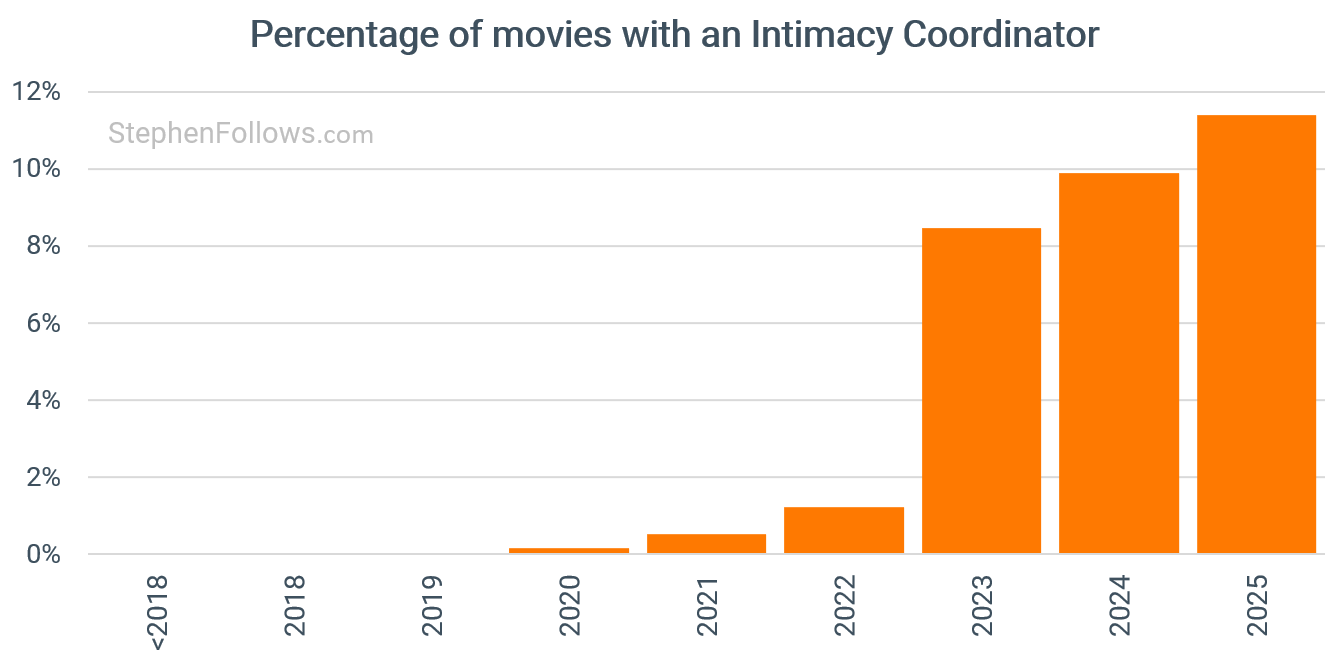
It took the #MeToo movement to cause change within the industry. There was an initial increase in the role between 2020 and 2022 (from 0.1% to 1.2% of movies hiring one), but 2023 was a major year, with representation in crews skyrocketing to 8.5% of movies. 11.4% of movies released in 2025 credit at least one Intimacy Coordinator.
The most I have seen credited on one movie is three, on A Cinderella Story: Starstruck, which has the following credits:
Amanda Cutting - lead intimacy coordinator
Megan Gilron - intimacy coordinator
Anastasia St. Amand - assistant intimacy coordinator
What’s especially interesting about this is that it’s in a genre which rarely employs Intimacy Coordinators - family films.
Which brings me to my next question…
What types of films most commonly hire an Intimacy Coordinator?
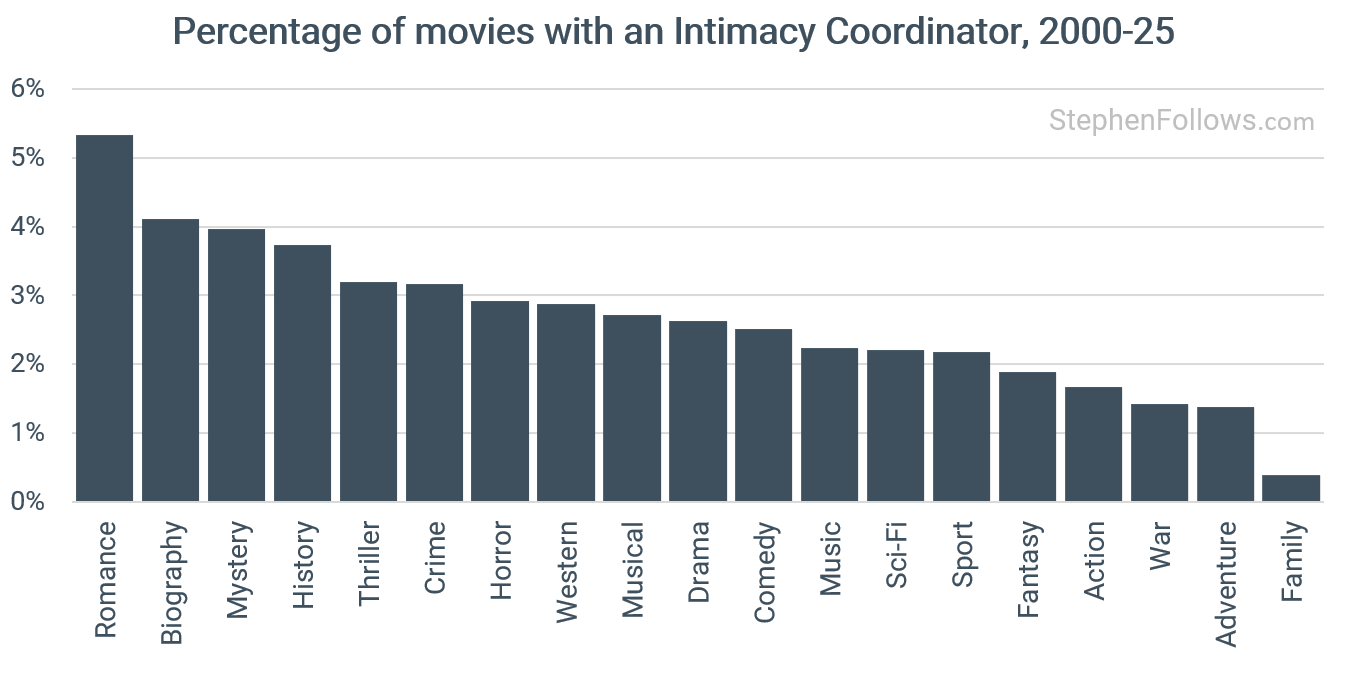
Perhaps unsurprisingly, over the past six years the most common genre to feature Intimacy Coordinators are romantic movies, where 5.3% of such productions included a credit. They were the least credited among War, Adventure and Family movies.
How are Intimacy Coordinators credited?
Given what we've seen about the vague and varied pre-MeToo crediting, it's surprising that there is such conformity among the current crop of Intimacy Coordinators.
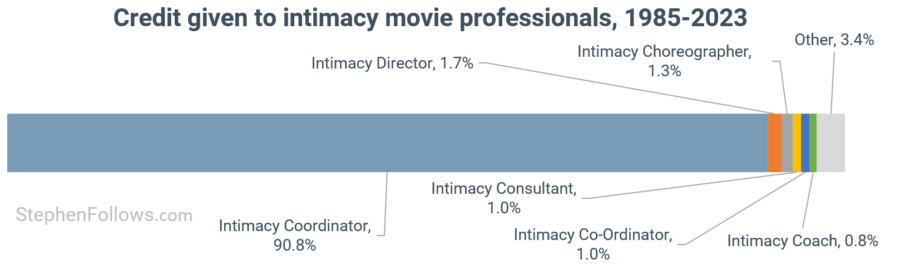
Nine out of ten credits are for “Intimacy Coordinator”, with a few productions swapping the second half for Director, Choreographer, Consultant, or Coach.
The argument for and against using Intimacy Coordinators
The case for Intimacy Coordinators is relatively easy to articulate, and is the one most often made publicly by studios, guilds and training bodies.
At their best, Intimacy Coordinators introduce structure to situations that were historically handled ad hoc. They formalise conversations about consent, boundaries and expectations, ideally before a camera is rolling and tempers or schedules are tight. For actors, particularly those early in their careers or without much leverage, this can remove much of the ambiguity. Saying “no” or “not like that” becomes part of a process rather than a personal confrontation.
They also serve as a buffer between actors and directors. Instead of an actor having to negotiate intimate physicality directly with someone who also controls their employment, the conversation can be mediated by a third party whose job is explicitly to advocate for the performer. From a production perspective, this can reduce risk, minimise misunderstandings, and create a paper trail showing that due care was taken.
There is also a choreography argument. Just as fight scenes moved from improvised scuffles to carefully planned action beats, intimacy can be mapped, repeated, adjusted and shot efficiently. For some productions, this makes intimate scenes faster to film, not slower.
The arguments against the role are more diffuse, but increasingly voiced by high-profile performers.
One concern is creative interference. Some actors and directors argue that intimacy is a fundamental part of performance, and that inserting another authority into the process can flatten spontaneity or emotional truth. For experienced actors who are comfortable with their scene partners, the presence of an Intimacy Coordinator can feel redundant, or worse, inhibiting.
There is also a question of trust. Film sets already operate with a dense hierarchy of roles and permissions. Adding another gatekeeper can make intimacy feel over-managed, especially when the actors involved already know each other well or have worked together before.
Finally, there is a quiet but persistent argument about universality. Not all productions are the same, and not all intimate scenes carry the same risks. Some filmmakers bristle at the idea that a role born out of very real abuses has become a default expectation, even in contexts where the actors involved feel it is unnecessary.
Famous voices have gone on the record to share their hesitation with the role include:
Gwyneth Paltrow. “We said: ‘I think we’re good. You can step a little bit back.’ … if someone is like, ‘OK, and then he’s going to put his hand here,’ I would feel, as an artist, very stifled by that.”
Kim Basinger. “I can’t imagine having somebody come up to me and say, ‘Do you mind if they put their hand here?’ … That’s just another person in the room. Either we work it out or we don’t. I don’t see all of this need for supervised visits.”
Michael Douglas. “It feels like executives taking control away from filmmakers.”
Jennifer Lawrence. “We did not have [an intimacy coordinator], or maybe we did but we didn’t really … I felt really safe with Rob.”
Jennifer Aniston. “They said, ‘Where someone asks you if you’re OK,’ and I’m like, ‘Please, this is awkward enough!’ We’re seasoned, we can figure this one out.”
Sean Bean. “It would spoil the spontaneity. It would inhibit me more because it’s drawing attention to things.”
(As a casual observation, the average age of the actors listed above is 60.5 years old, and the youngest is on her way to 40. I suspect that if we were to poll younger actors, we might get a different collection of views, more open to change and managing consent. This is not to draw aspersions, but just to reflect that we all like things to stay as they were when we were on the way up - change is horrible!)
In practice, most productions now land somewhere in the middle. Intimacy Coordinators are increasingly present, but their level of involvement varies widely, from hands-on choreography to a more advisory role that fades into the background once trust is established.
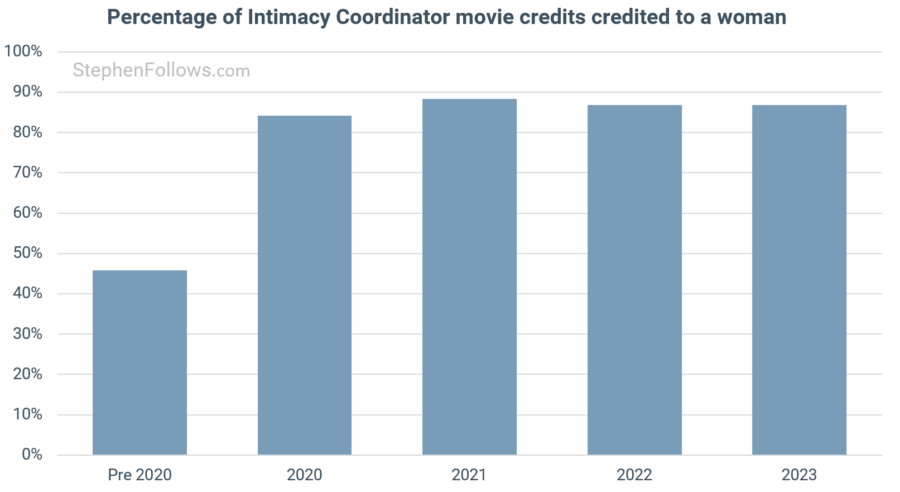
The gender of Intimacy Coordinators
Before we finish, I want to highlight an interesting trend. I was not able to track down biographical data for all the Intimacy Coordinators for today’s research, but when I last looked at the topic a few years ago, I found that the vast majority of people who take on the role self-identify as women.
Of the credits awarded on movies released between 2020 and 2023, 87% went to women, 12% to men and 1% to people who identify in other ways.
Notes
The data for today's work came from IMDb, OMDb, The Numbers, Wikipedia and my own research.
Epilogue
If you're wondering if you need to hire an Intimacy Coordinator for your next production, then you probably do. There are plenty of formal ways to hire people (such as reaching out to Intimacy Directors and Coordinators) as well as semi-formal ways (such as the Facebook group I Need An Intimacy Professional/Coordinator/Director/Consultant).
And if you're thinking of becoming an intimacy professional, there are an increasing number of courses and industry accreditations you can look into.
Love to have numbers to back the arguments now. I equate the acceptance of the IC job along the lines of stunt coordinator in its early days. If you read any of the quotes against an intimacy coordinator as if talking against using a stunt coordinator, you’ll quickly see how fallacious the arguments are. Building respect and trust are key to any scene done well. Those should be the goals. And using ICs even with those who think they don’t need them, sets a precedent for the occasions when the parties really do in other film situations. It’s the new and welcomed norm.
Fascinating! I’ve been curious about this role for some time. Appreciate the thoughtful research. Also love the note on the average age of the quoted actors; vets are not typically the most vulnerable!