


If you’re an avid reader of culture journalists, then it seems as though there is always some country or other “taking over Hollywood”. In the 2000s it was the Australians. In the 2010s it was the Brits (when Spider-Man, Superman and Batman were all Englishmen), and the latest “invasion” is coming from the Irish.
But just because journalists can sell a piece about it doesn’t make it true. I dug into the numbers to see just how “Un-American” American movies are when it comes to casting.

I crunched the numbers on roughly 16,000 American-made feature films released in US cinemas, pulled out every actor flagged as a lead, and matched them to their recorded birthplaces. That gave me 5,408 leading actors and 17,867 lead performances between 1990 and 2024.
How American are the leads of American films?
At the risk of sounding like I should be wearing a red baseball cap, movies are a lot less American than they used to be.
The American-born share of leads has fallen from 82% in the 1990s to 64% in the 2020s. This nearly twenty-point fall has occurred consistently over three decades.
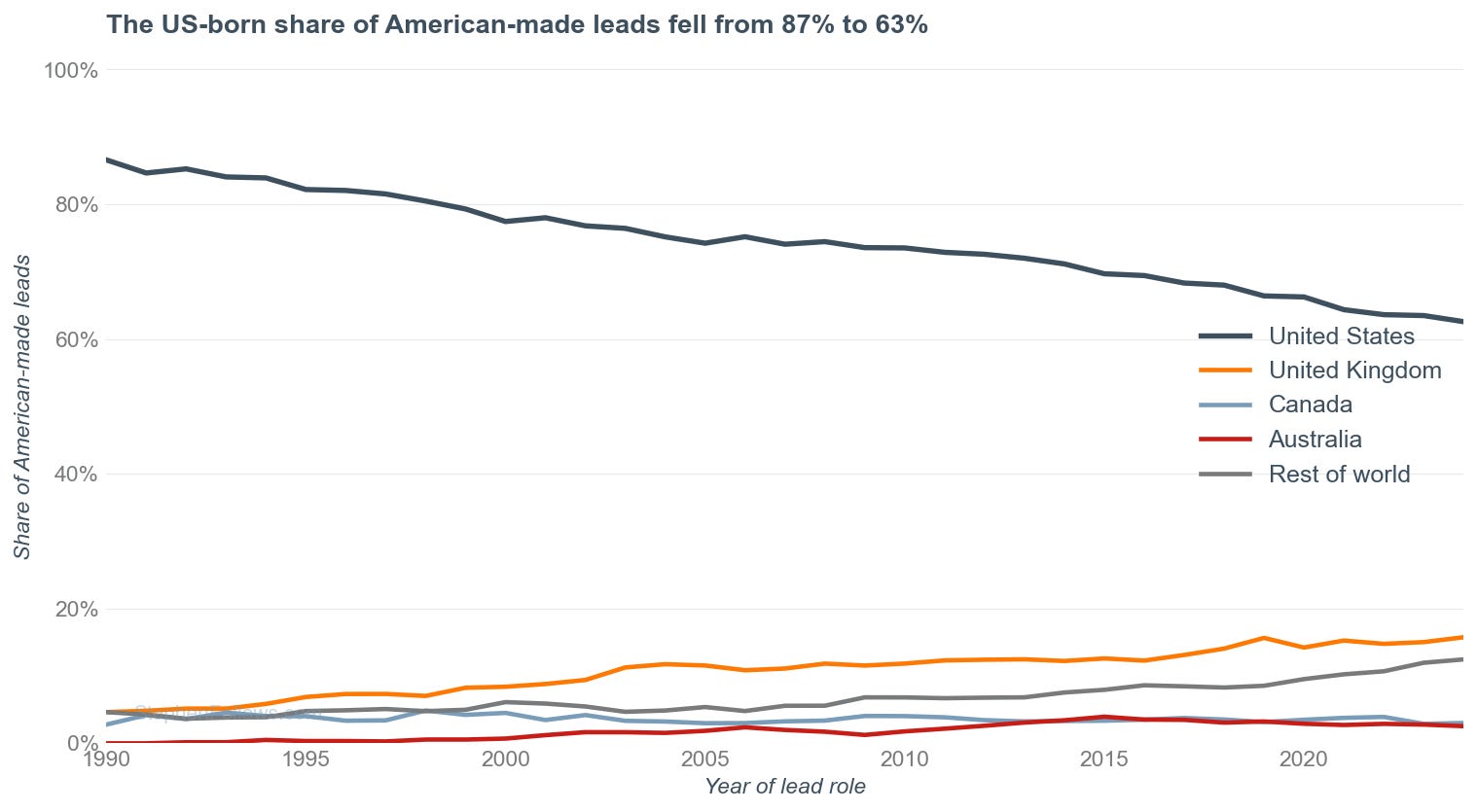
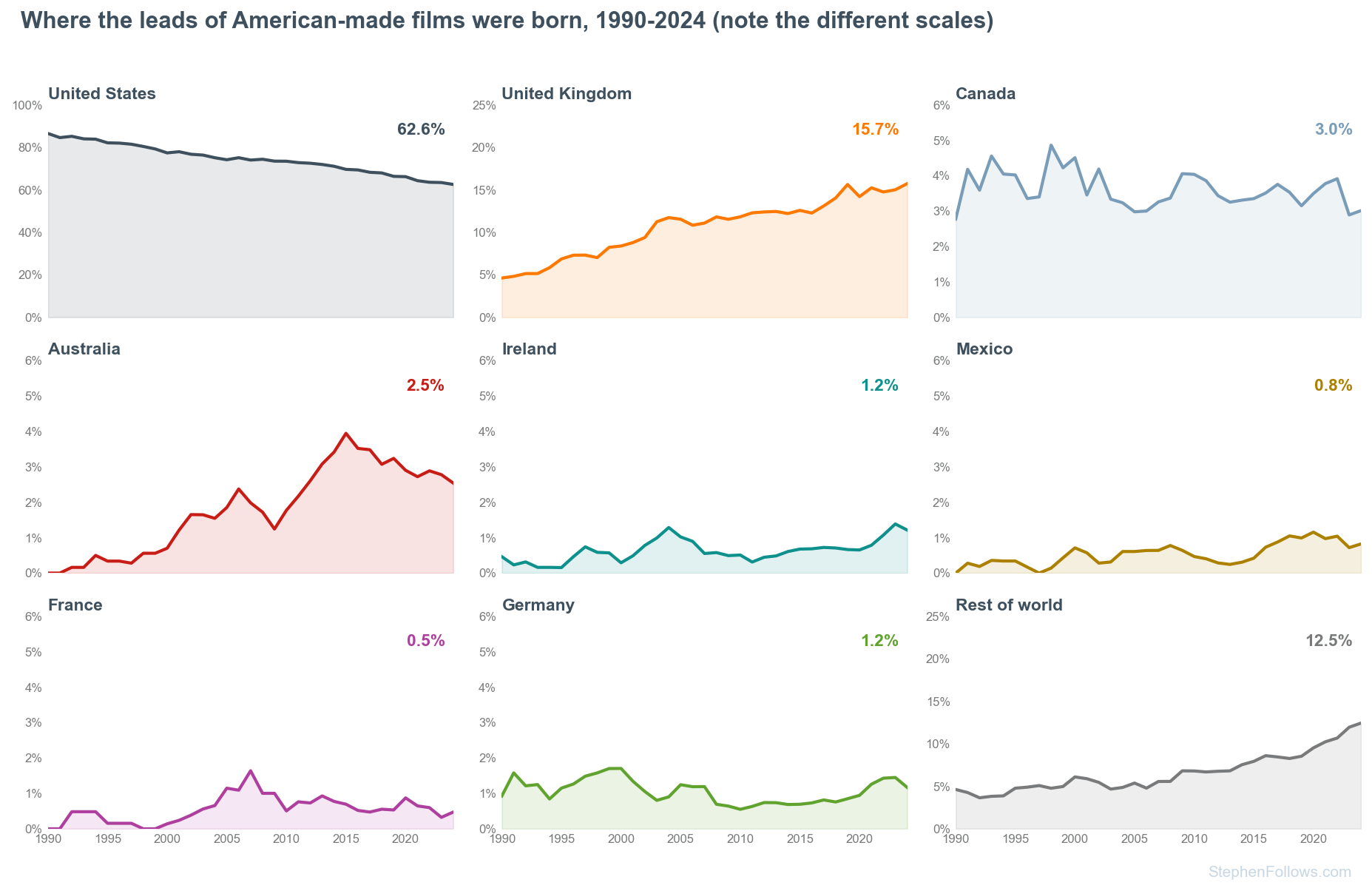
The single biggest beneficiary is the UK, whose share of American-made leads has climbed from about 6% in the mid-1990s to 15% in 2024, and unlike the others, it is still rising.

Canada holds steady at 3 to 4% across the whole period, which will surprise nobody who has noticed that a large chunk of Hollywood comedy is secretly Canadian.
Australia, Ireland, Mexico, Germany and France split most of the remainder, each holding somewhere between 0.5% and 3%.
So what about the “invasions”?
The Australian invasion was real. Australian-born actors went from under 1% of American-made leads in the mid-1990s to a peak of 3.6% around 2017, the high-water mark of the Hemsworth and Robbie era, and have eased back a little since.
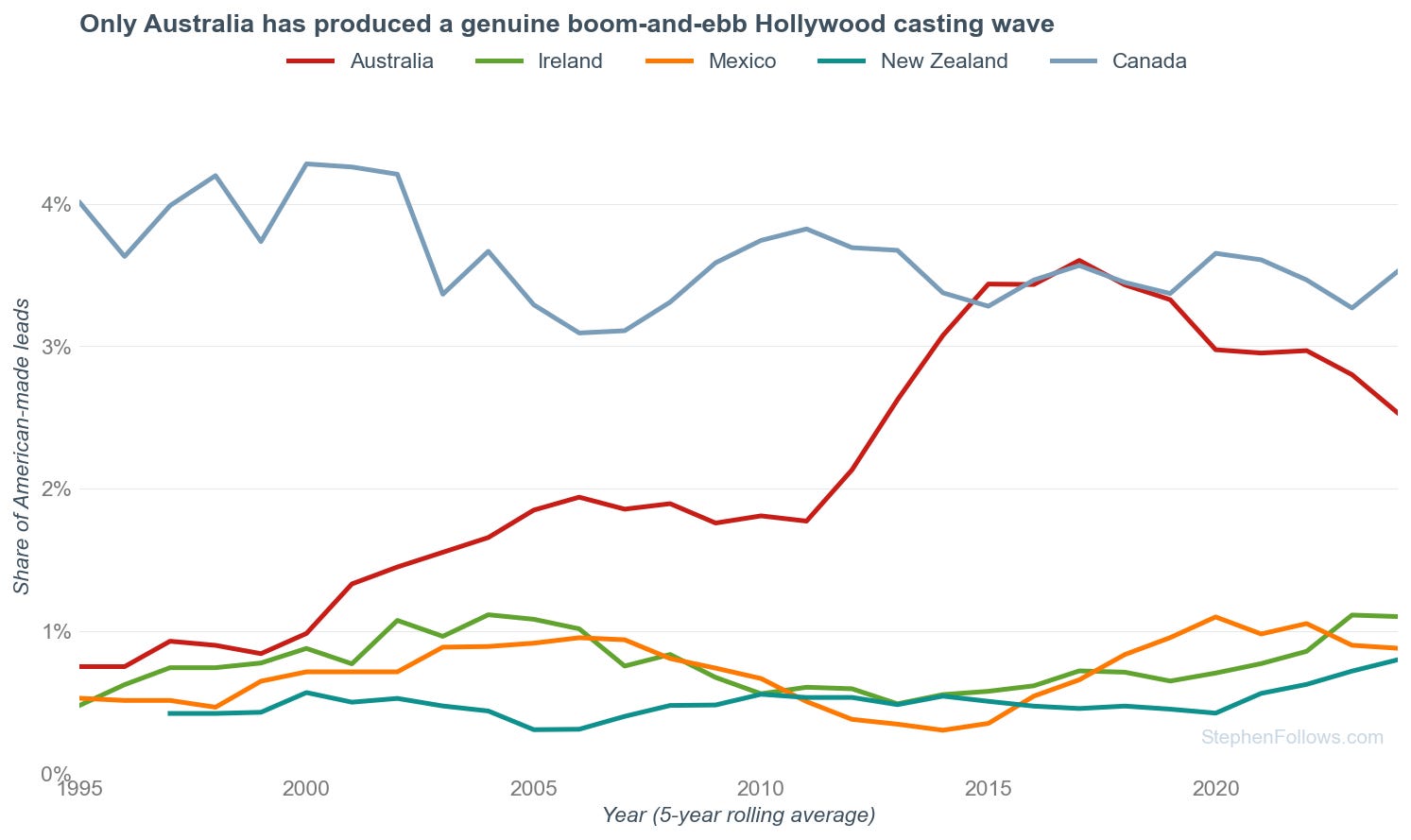
The Irish wave is a different story. Measured against American-made films, Ireland’s share today is about 1.1%, which is no higher than it was in 2004, when Colin Farrell was single-handedly carrying the flag. The current generation of Irish talent is real and very visible, but much of its work is Irish and British productions rather than Hollywood ones.
Mexico and New Zealand both show slow builds to around 1%, and Canada barely moves. For all the talk of waves, the only country that has produced a genuine boom-and-ebb pattern in Hollywood casting is Australia.
But where did they learn the job?
The data thus far has focused on birth country, but that’s not the only way to measure today’s topic. Nicole Kidman was born in Honolulu, which makes her American by birth, yet her career is about as Australian as it can be.

So I built a second measure, the home industry. This is the national film industry that developed an actor before Hollywood came calling. To track this, for each lead, I took the first three feature films in which they had a substantial role (defined as billed in the top ten of the cast) as an adult, outside of animated movies. If at least two of those three films were made in the same country with no US involvement, that country’s industry gets the credit for developing them.
This revealed that the foreign-developed share of new American-made leads has more than doubled, from 9% of debuts in the 1990s to 23% in the 2020s. Hollywood is importing more ready-made actors than it used to.
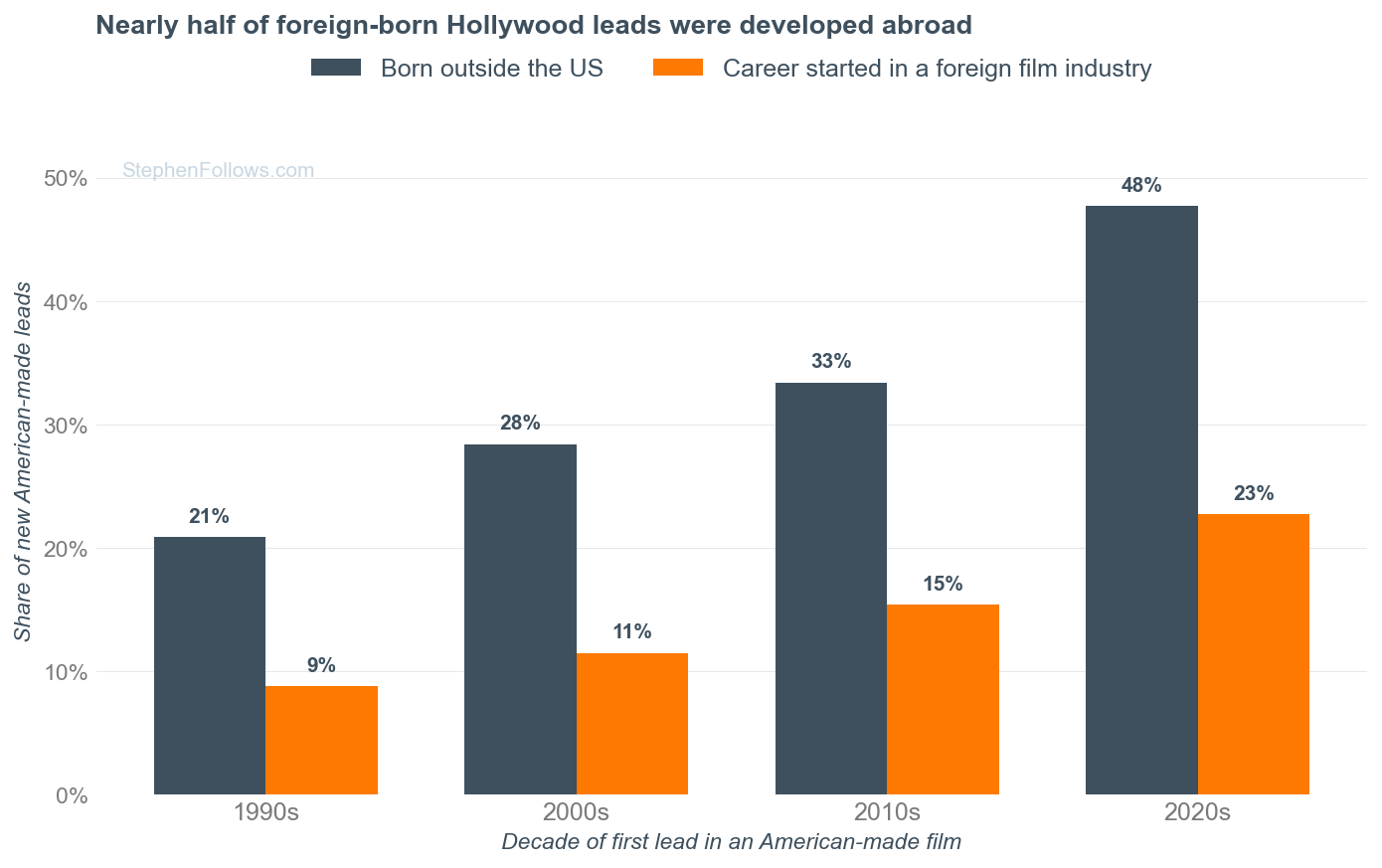
Also interesting is the gap between the bars. In every decade, somewhere between two-fifths and a half of the foreign-born leads were developed by a foreign film industry. The rest went straight into American productions from the start.
This means that the “foreign invasion” is actually two different migrations. The first is actors poached after another country’s industry trained them, and the second is actors born elsewhere who built their careers in Hollywood from day one.
When we split it this way, we see differences between countries. Among French-born leads, 72% made French films before they made American ones, and among Swedish-born leads, the figure is the same. France and Sweden develop, then export.
But only 29% of Canadian-born leads and 38% of British-born leads started in their own national industry. The Anglosphere mostly exports people rather than films. (The British figure is probably an undercount, since so much British production has American money attached, and any US involvement disqualifies a film from the count.)
Money buys foreigners
Two last tidbits before I go.
The first is that budget size is heavily correlated with the chances that the film will be led by a non-American.
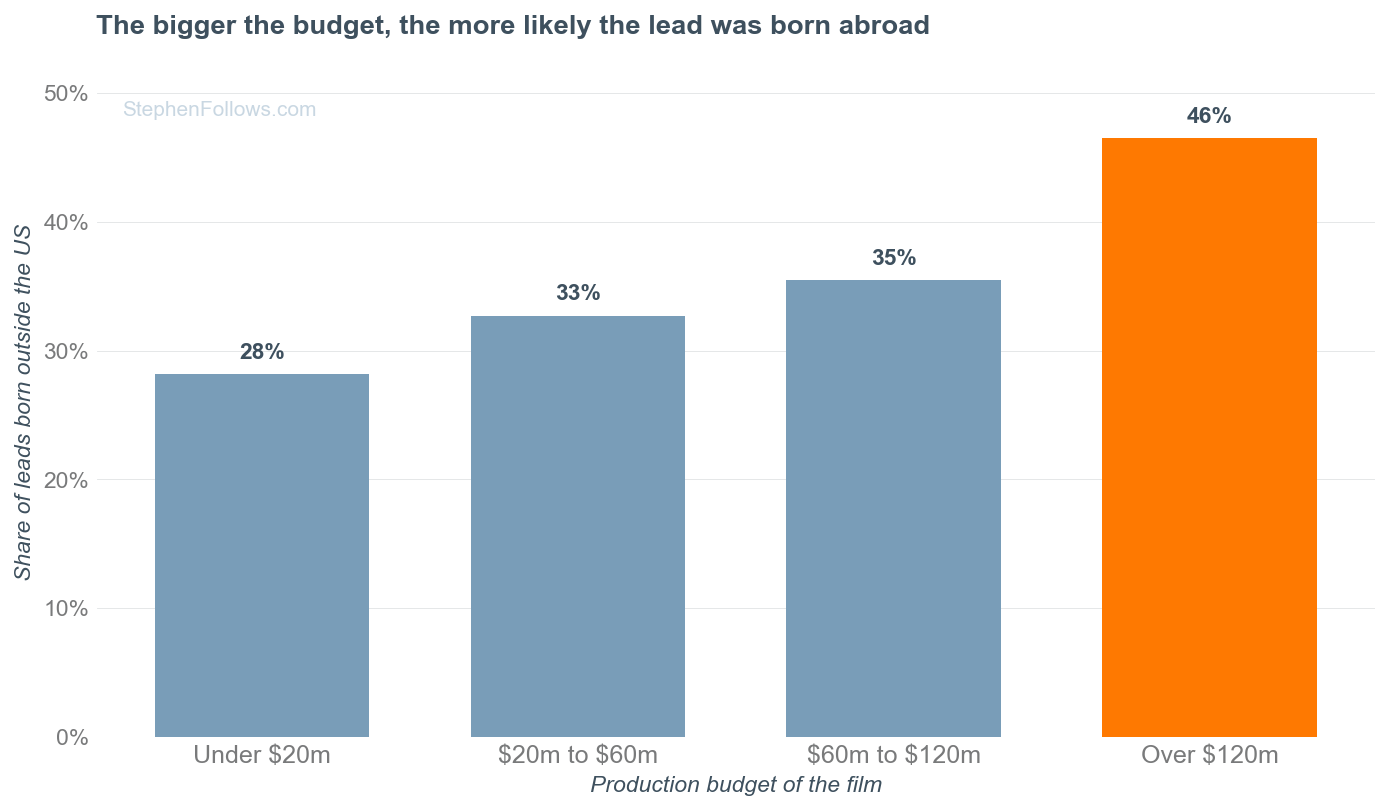
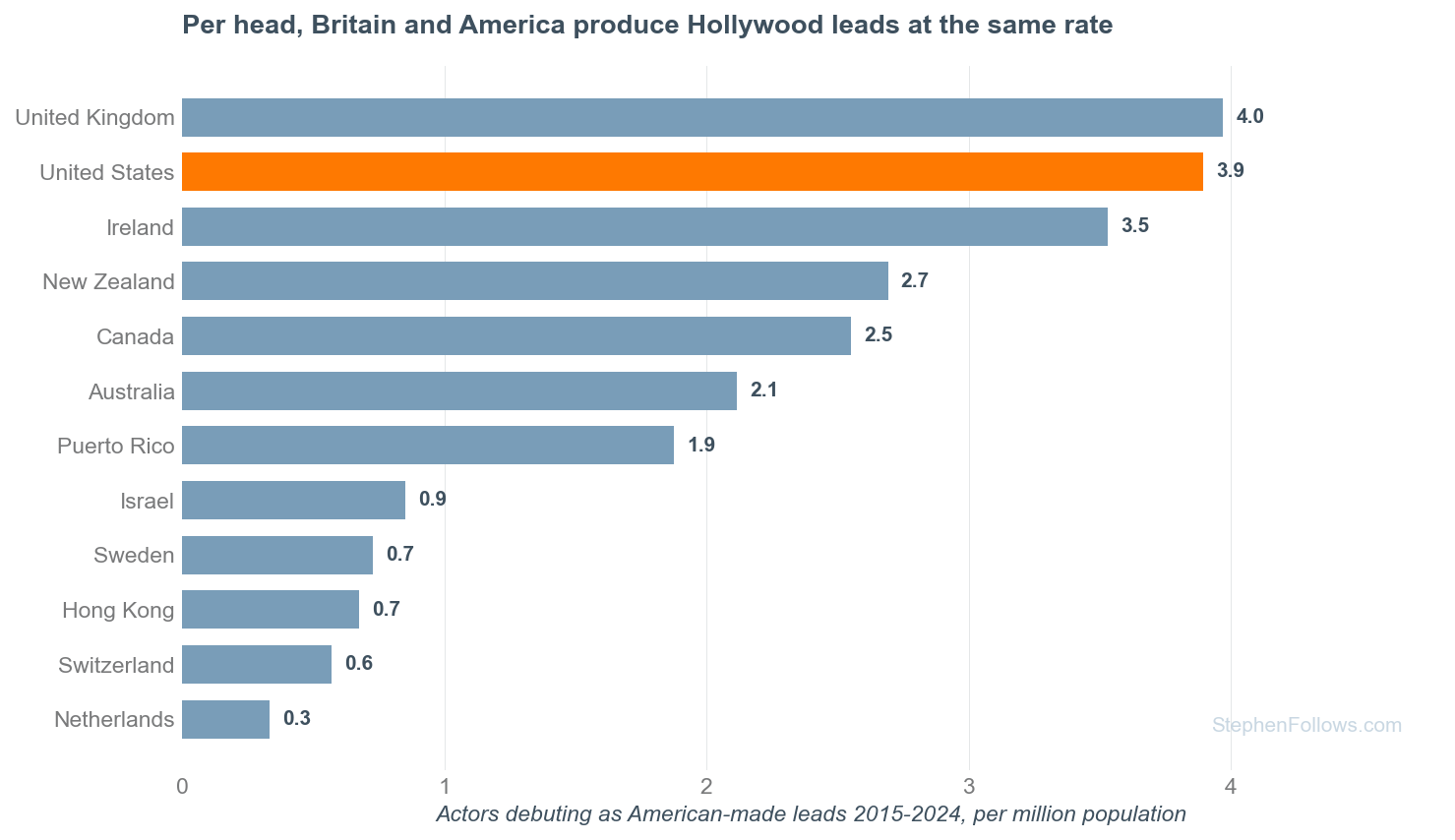
The other is that, when you account for each country's size, the UK (very slightly) outproduces America in creating Hollywood leads, producing four Hollywood leads per million people.
What have we learned?
I took four things away after conducting this research:
There has been a generational shift. The American-born share of leads in American-made films has fallen from 87% to around 64% over three decades. That is slow enough to be invisible year on year, but large enough to have changed the face of American movies.
The invasion is top-heavy. Foreign-born actors are over-represented in the films with the biggest budgets, the biggest box office and the biggest cultural footprint.
Almost all of it comes from three countries. The UK, Canada and Australia supply the overwhelming majority of foreign-born Hollywood leads, and the British share is still climbing while the others have levelled off.
The real effect is actually two migrations. Nearly half of the foreign-born leads were developed by another country’s film industry before Hollywood hired them. The rest were born elsewhere but made in America.
Notes
This research examined 17,867 lead performances by 5,408 distinct actors with a known birth country in American-made feature films from 1990 to 2024, drawn from OpusData’s tracking of US cinema releases.
‘American-made’ means the United States appears among the film’s production countries, so international co-productions count, while films that played in US cinemas but were made without any US involvement are outside the study.
At the heart of this research is a seemingly easy question (where an actor is “from”), but one for which there is often no single definitive answer. It’s not uncommon for actors to hold multiple passports, either through family or because they have worked in America long enough that it makes sense to apply for American citizenship. Therefore, we cannot rely purely on “passports held”. Tracking country of birth is nicely singular and seemingly definitive, but fails in isolated cases (Emma Watson was born in Paris and Saoirse Ronan in the Bronx). I used birth country as the headline measure because it is the most consistently recorded fact across 5,408 people, and because these edge cases are rare enough not to move the big numbers.
Production-country data exists for 93% of the database overall, but only about three-quarters of films from the 1990s and 2000s, and films without it are excluded.
‘Lead’ uses the database’s Leading and Lead Ensemble Member flags, which means large ensemble films credit several leads each. Coverage skews towards better-known actors.
Birth country data came from Wikipedia, Wikidata, IMDb and other public sources. I applied standard normalisations such as UK home nations to the United Kingdom, USSR to Russia, the divided Germanies to Germany, and so on.
Budgets are known for 53% of the 2010-24 American-made lead performances, skewed towards bigger films, so the budget chart describes the half of the slate where budgets are public.
Distinct actors whose first American-made lead came between 2015 and 2024, divided by current population, countries with at least five such debuts. Population figures are 2024.
Home industry was classified from each actor’s first three substantial feature roles: billed in the cast’s top ten (films with no billing data are allowed through), aged 16 or over, animated films excluded. A country counts as the home industry when at least two of those three films were made there with no US involvement. Actors whose early films involve the US stay unclassified, since debuting in American films says nothing about origin. Restricted to actors with at least five features. Production countries are known for 93% of these early credits. I tested if loosening the billing rule shifts the decade shares, and it does, but only by about a percentage point, so the trend does not depend on the threshold.
We should remember that television careers were not studied, so an actor developed by Australian TV who went straight into American films stays unclassified. In addition, production country follows the financing, so an American-shot film with British money counts as British, which occasionally files a Los Angeles character actor under the UK.
I bet if you took a deeper dive into the timeline, before the 90’s, perhaps a similar trend will emerge? Hollywood has been the place to be for creatives/ performers worldwide for a bit
Interesting. 90% of these actors are Anglo-Saxon and speak English as their first language, and those of color are not diverse in their attitudes. If you close your eyes, you wouldn't know the difference.