


Last week, I investigated whether there was a link between the number of people thanked in a movie’s credits and the movie’s quality. That prompted a number of people to ask how the number of producers relates to quality.
I have in the past shown that movies are increasingly less likely to generate a profit as the number of producers increases. But what of quality?
Does having more people on hand to share the producing duties result in better movies? Or do too many producers spoil the set?
To answer this, I studied 75,903 producing credits across 8,415 movies (details of the exact criteria in the notes at the end of the article).
How many producers do you need?
Let’s start by looking at how many producers are credited on the average movie.
Across all the films I studied, and all flavours of producing credit, the average movie had nine producers.
That may instinctively feel like a lot, and that’s because, well, it is! It would be hard to have nine people working in unison, each taking on a ninth of the producing duties.
In reality, there are a number of different types of producing credit, each with varying levels of control and areas of focus.
The primary producing credit is that of “Producer”, with the average film having 2.7 such Producers. When we split this out by year, we discover that the number of Producers on a movie has been increasing over the past two decades. In 2000, the figure sat at 2.1, but this had increased to 3.3 by 2021.
However, this increase is dwarfed by the epic rise in the number of people receiving an Executive Producer credit. In 2000, the average movie had 1.9 Execs, whereas by 2021, that had more than doubled to 5.1.
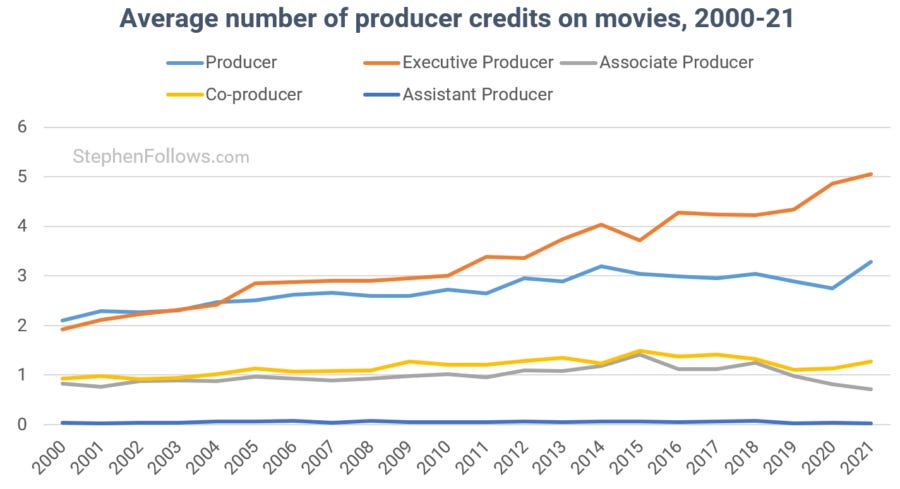
It’s impossible to say if this reflects an inflation of credits (i.e. people who would have received an Associate Producer credit in 2000, today demand an Exec credit instead) or if it’s just a case of more people being regarded as worthy of an Executive producing credit.
In the past, I’ve written much more about what each type of credit means, and studied the data on producing credits going back to 1949. You can read that work here.
But let’s focus on the core question in today’s piece – does an increased number of producers indicate a movie is to be avoided?
Does the number of producers indicate the quality of the movie?
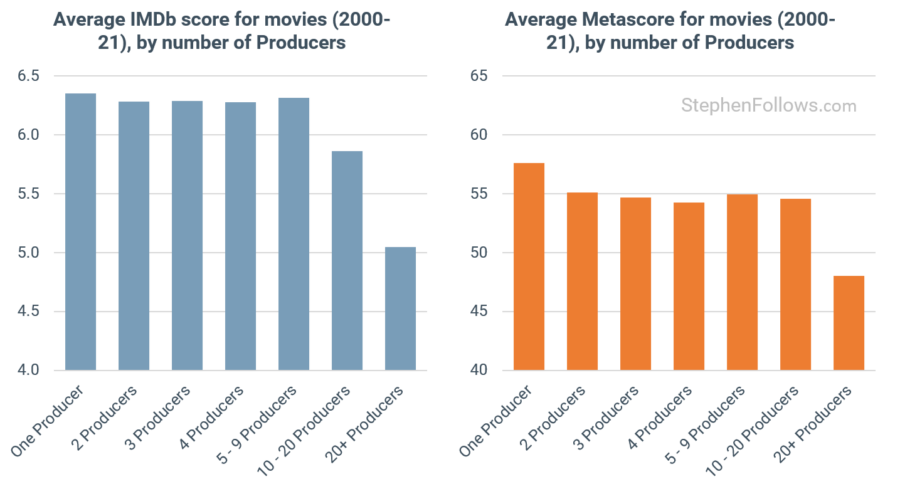
We’re going to use IMDb scores (out of 10) to stand in for audience views, and the Metascore (out of 100) to represent professional film critics’ views.
As the charts below show, there is a clear link between the number of Producers and quality measures.
As the number of Producers increases, the quality of movies decreases.
Is there a link between Executive Producers and the quality of a movie?
On the topic of Executive Producers, the effect is absent among the views of film audiences. However, film critics display the same dislike of multi-Exec’d movies as they did for multi-Producer’d movies.
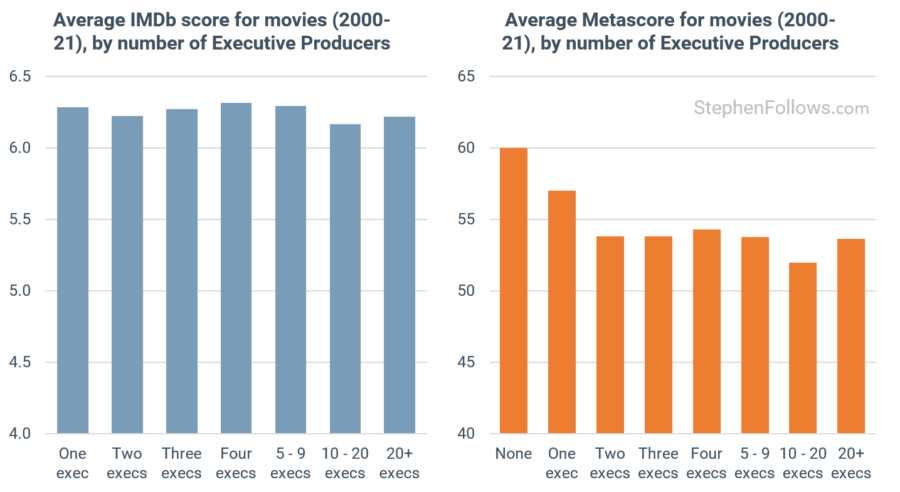
So it seems that a lower number of producers is an indication that a movie is more likely to make money and be worth watching than those with many producers.
That said, there are always exceptions to trends like this, so I’m not sure how useful it is in practice as a filter for bad movies. Plus, film professionals and film fans receive much more information about a new movie than just the number of credited producers, and I would argue that other information (i.e., plot, cast, pitch, presentation, etc.) would be relevant indicators of quality.
Notes
Today’s research examines live-action movies released in Domestic cinemas between 2000 and 2019, as well as those released by one of the major studios on any platform in 2020 and 2021. The raw data came from IMDb, The Numbers and Wikipedia. This is slightly older data as I want to keep the same dataset used in the previous research project that sparked this one.
In the charts, when referring to “Producer” I am tracking people who received a producing credit in the form of “Producer”, rather than having any qualification, limitation or area of focus, such as Executive Producer, Associate Producer, Co-producer, Line Producer, Post-Production Producer, etc.
Intersting article, but it depends. I am working on the new Paul Greengrass movie in Nurmberg, it has 5 Production companies attached to complete the 70 million finance completion on it. So 5 producers, 5 countries, 5 production deals. Each country has a couple of producers or prodcers and assistants on it. Co-porductions mean distribution deals and tax incentives. There is no major studio behind this so he can call it the most expensive Indie film ever produced.
Excellent analysis! I would be interested to see how other confounding factors correlate. For example, I would imagine that budget and number of producers also correlate, and I would also imagine that critical darlings often have lower budgets. Part 2 when?