


Today’s research is a mix of two things - researching a reader’s questions, and also accepting a methodology challenge.
First, the topic. A reader forwarded me a recent article by Ben Child in The Guardian entitled “There are no new superhero movies for the next six months – is Hollywood up to something?“ The article claims for the first time in over a decade, audiences face a six-month stretch without a single caped hero or comic book universe taking over the multiplex. The reader asked me if this was true.
Secondly, I have been speaking to a company called Talarian who have a plugin called GPT for Work. Their tool allows you to access all manner of AI model direct from Excel and Word. In return for free research credits I agreed to conduct a piece of research only using their tool and Excel, without any existing datasets. I'll publish a tutorial video showing how I did it in the next few days.
Are superhero movies dying?
I started by building up a dataset of the top 50 highest-grossing films for each year going back half a century. I also gathered a list of every film scheduled for theatrical release over the remainder of 2025. These were the only inputs with all the rest of the work being conducted in Excel.
I tracked how many fit the definition of a superhero film. In the 1970s and 1980s, superhero titles turned up only occasionally, with spikes linked to releases like Superman or Batman. Even into the late 1990s, the percentage rarely climbed above 15 or 16 percent.
Things began to shift in the early 2000s, with titles like Spider-Man and X-Men leading the charge. By the late 2000s, this share rose again, driven by the launch of the Marvel Cinematic Universe. The real boom arrived in the 2010s, with superhero movies sometimes taking up 40% of the market’s top earners.
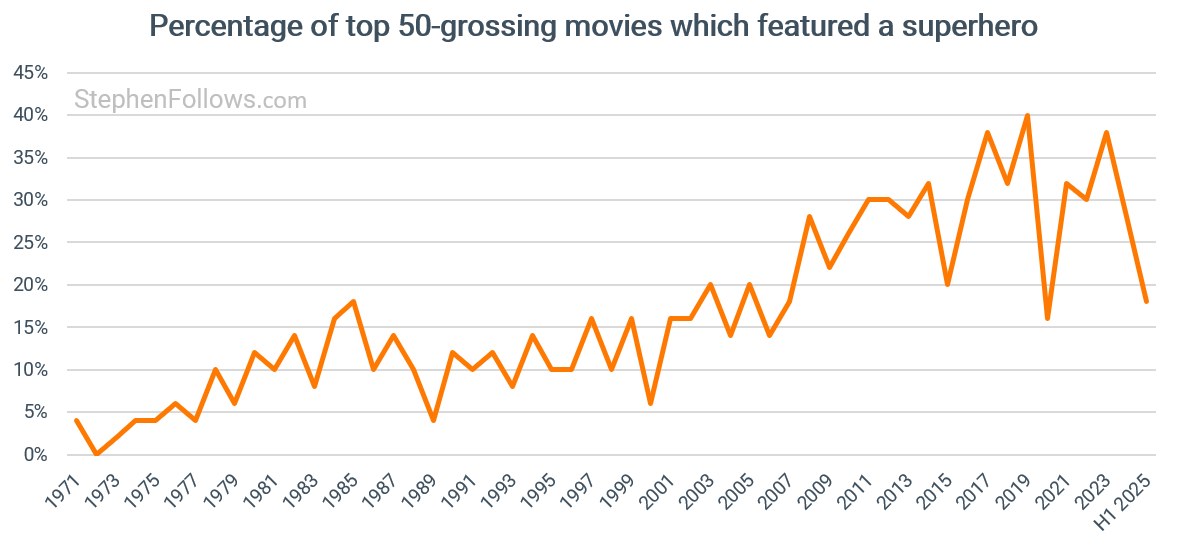
We can also see that for the first seven months of 2025, there has been a below average superhero prevalence (second worst year since 2007).
Am I a superhero?
While charting this rise, I ran into an immediate question: what actually counts as a superhero movie?
Genre boundaries are more flexible than they appear on the surface. A good test case for me was Kill Bill, where Uma Thurman’s The Bride character has extraordinary abilities and a signature look, but she doesn't quite fit the classic “costumed hero” mould.
To help focus the research, I set three criteria:
A superhero must have either superhuman powers or access to clearly science-fiction-level technology (so peak human skill alone is not enough).
The character needs a coded or costumed identity linked to heroism or vigilante justice, not just a nickname or job description.
Lastly, the story should clearly take place in a heightened world with other powered beings, secret organisations, or threats that push beyond everyday reality.
Applying this set of rules ruled out some famous edge cases but caught others that don’t usually get grouped under the superhero label.
So are we facing a superhero drought?
Turning to the 172 movies expected to be theatrically released between August and December 2025, we can see that the last majority are not superhero movies. But a few stick out.
There are a number of movies that really test the above criteria:
Avatar: Fire and Ash. Jake and Neytiri lead their grieving family into conflict with a hostile Na’vi tribe, with superhuman abilities and advanced tech on display, but no clear superhero identity. So I’m going to say no.
Mortal Kombat II pits Earth’s fighters against Shao Kahn in an interdimensional martial arts tournament. Several characters have powers and distinct personas, though it blurs action and superhero codes. This one I think is superhero-adjacent but if I had to pick, I’d say they couldn’t Finish it.
Predator: Badlands tells the heart-warming tale of a young Predator outcast who teams up with an android to battle across an alien wasteland. The Predator is not a hero in the sense of fighting for justice or public good, and there’s also a lack of the coded alter ego central to superhero storytelling. This is more sci-fi quest and action adventure than superhero cinema.
Wicked: For Good is the second half of the movie adaptation of the Broadway musical, Wicked. Both Elphaba and Glinda have magical powers, coded identities and operate in a heightened, conflict-filled setting. The story centres on choices, reputation, and standing up to corrupt authority. In short, this is firmly in the territory of many superhero narratives. The only thing keeping Wicked from being called a superhero film is tradition. It happens to be a musical, focuses on friendship, and stars women in the key roles. There is no story logic barring musicals from the genre, or women from leading. If we are strict about powers, persona, and a world of consequence, Wicked fits just as well as any comic book property. Whether it gets the superhero label says more about our cultural habits than the content itself (and maybe a dash of sexism?).
The Toxic Avenger has a janitor transformed by toxic waste becomes a grotesque vigilante, fighting villains as a costumed antihero. It was first screened at Fantastic Fest in 2023 but it’s official US release is late August 2025. While a little less polished or conventional as the standard Marvel superhero movie, this is solidly a superhero movie.
Sooo… at the most conservative accounting we have one superhero movie for the second half of 2025, but personally I would include Wicked and Mortal Kombat.
Ben Child’s article got it right. For the first time in years, the big screen will spend six months without a single Marvel or DC superhero release. Only a handful of borderline cases prevent this from being true in the strictest sense, and none are the tentpole events audiences have come to expect.
His wider point stands, in that the superhero assembly line has slowed, studios are scaling back, and a long-overdue reset is underway. For now, the capes really are out of sight.
Why have all the heroes left us?
Production halts from the 2023 writers’ and actors’ strikes pushed many Marvel and DC titles out of the year. Blade was pulled from the schedule, Thunderbolts barely started filming before the stoppage, and The Batman Part II was bumped to 2027.
Studios are making fewer superhero films on purpose. Marvel is moving from three or four movies a year to a leaner two or three, with leadership focused on quality over volume after several costly misfires.
DC is in full reboot mode, launching a new universe under new management. Only Superman was ready for 2025, with the rest still in early development.
Sony has paused its Spider-Man spin-offs following weak box office and negative reviews, and their next big projects are not yet ready.
Audiences are now pickier, and middling superhero releases are no longer automatic hits. Studios want to space out films, not overload the audience after a decade of near-constant capes on screens.
The titles that do remain are being saved for later years. Studios are choosing to leave the back half of 2025 almost empty while preparing bigger launches in 2026 and beyond. That includes
Notes
Today’s raw data came from IMDb, and First Showing.
I gathered the list of movies from the websites but then did everything else in Excel. This was a fun challenge which the makers of GPT For Work set me. I am going to record a video tutorial to show the whole process shortly. They gave me research credits but didn’t affect the content of the piece.
GPT For Work is a set of AI add-ins for Microsoft Excel, Word, Google Sheets, and Docs.
It integrates models like ChatGPT, Claude, Perplexity/Sonar, and Gemini to automate data research, content creation, translation, summarisation, sentiment analysis, and more directly within spreadsheets and documents.
It enables bulk web searches inside a sheet, batch processing of queries, and automated generation or rephrasing of text, making tasks like market research or cleaning large datasets significantly faster and more efficient.
Even with the criteria I detailed above, we’re still left with a few edge cases on superhero identification. It created three rough groups:
Definitely superhero – Characters like Iron Man, Robocop, Hellboy, and Deadpool all pass with ease. They have powers or advanced tech, a costumed identity, and operate in worlds full of larger-than-life threats.
Not superhero – Others clearly fall short. The Bride from Kill Bill, John Wick, and Sherlock Holmes in most versions don’t have powers or a superhero persona, even if they’re distinctive, skilled, or fighting evil.
Questionable – Then there are the edge cases. Elsa from Frozen has powers but no costumed identity or vigilante arc. V from V for Vendetta and Catwoman in some versions come close, depending on how you interpret their world and intent. Neo from The Matrix has powers and the right kind of world but no alternate persona. Also, it could be argued that Neo wasn’t a superhero in the first Matrix movie but become one in the later sequels.
The vast majority fell into groups 1 and 2.
And just for completeness, here are few movie contenders from 2025 which I considered but rejected:
Chainsaw Man – The Movie: Reze Arc is an animated feature due for release this September in Japan, featuring a devil-human hybrid hero known as Chainsaw Man. It passes all the tests (i.e. Superhuman powers, a costumed alter ego, and a narrative built around larger-than-life powered conflict), but although it might come out in the US in 2025 but is very unlikely to set the box office alight.
Ne Zha 2 is a Chinese animation about a reborn boy-hero joins dragons and gods in mythic battles; transformation, powers, and coded identity place this firmly in international superhero territory but I have the same scepticism of its US box office potential.
I don’t think re-releases should count, thereby relieving us of having to work out if ParaNorman (2012) or Teenage Mutant Ninja Turtles (1990) feature superheroes.
I think including Wicked is a stretch, not because it's a musical (there's been several superhero musicals), or because the characters are female (many obvious examples), but because I don't think either character really has a superhero identity, as opposed to nicknames.
I hope superhero movies are really slowing down, and it's not just a six-month lull. I'm not anti-superhero, but it's felt a little overloaded the last decade.
This data is very informative. Great work!