


Marketing is a key part of any film’s success, but training and case studies are much more likely to focus on the filmmaking than on film promotion.
So I went looking for real-world examples of indie movies where the people behind them had published how much they spent on marketing, and why.
I ended up with 57 case files, built from interviews, Substack post-mortems, podcast transcripts and the small number of organisations that publish full release ledgers.
The four big lessons
Across the 57 cases I looked at for this piece, four key lessons kept occurring to me.
You need to seriously budget for marketing. The filmmakers who fared best (Hundreds of Beavers, Columbus, Thunder Road) had already raised money before they needed it. The ones who suffered most ran out mid-release, such as the team behind the Oscar-shortlisted documentary UNION (2024), who published their campaign sums ($800,000 planned for an 18-month campaign, $400,000 actually raised against a $1.2m production budget), wrote that their theatrical “could have kept going to even more success, but ran out of money to fund our modest social media ad budget”.
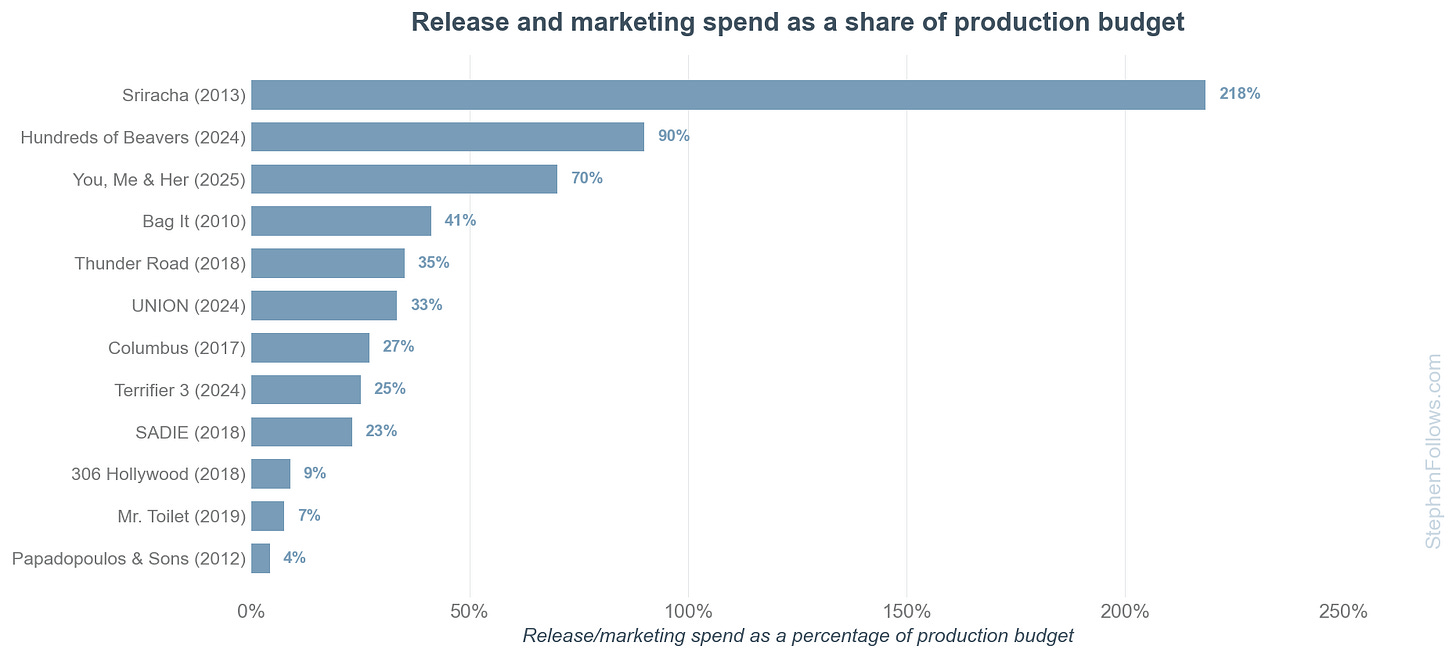
Theatrical almost never recoups directly. “The theatrical release did not come close to recouping” (You, Me & Her). “Was not profitable. P&A is truly costly” is how Lisa Hurwitz put it in her account of self-distributing the documentary The Automat (2022) into 100+ cinemas, where her cut of the $255,000 box office “nearly covered” the $100,000 P&A. The 306 Hollywood team knew from the outset it was “nearly impossible to make a lot of money from our theatrical”. “Expect to lose money” (Bomb It). What theatrical bought, in many cases, was legitimacy that led to later deals and revenue.
The biggest line item is not in the budget. The Beavers team valued their unpaid social labour at $150,000–$250,000. The UNION team “primarily worked for free throughout 2024”. Hammond counted 18 months as “a part-time marketer and DVD shipper” against his Sriracha profits. Warshawski toured Big Sonia for two years and reported the damage to her health. When you read about a film doing miraculously well on a low- or no-budget, look for the unpaid labour that made it happen.
The numbers are shaky, hidden, and rarely complete. Very few filmmakers are kind enough to share their costs, and there are no effective tools to make a reasonable guess from the outside. Even when there are publicly agreed numbers, they often don’t tell the full story. For example, the trades said Eno grossed $300k, but its actual US revenue was $730k when the filmmaker-led one-off events are included. Burn grossed more than $1 million with no distributor at all, almost none of it through channels the trades track. The documentary Age of Champions (2011) built more than $1.5 million from screening kits, speaking fees and sponsorships, almost entirely outside every reporting system in the industry.
My fifth lesson is to follow Jon Reiss and Distribution Advocates. Both have excellent Substacks that kept coming up time and again when looking for real numbers and case studies. Good examples are hard to find, so any filmmaker planning to release a film themselves should devour both of these sites.
Let’s start with a few excellent full case studies and after that go into the individual line items.
“Hundreds of Beavers”
The most recent and most complete case study is Hundreds of Beavers (2024). The film cost $150,000 to make, but when producer Kurt Ravenwood was offered an MG (minimum guarantee) of just $30k, he declined and opted for self-distribution.

The total release cost was “approximately $135,000”, meaning they spent almost as much releasing the film as making it. Kurt opened his books to Jon Reiss over a 90-minute video I highly suggest watching.
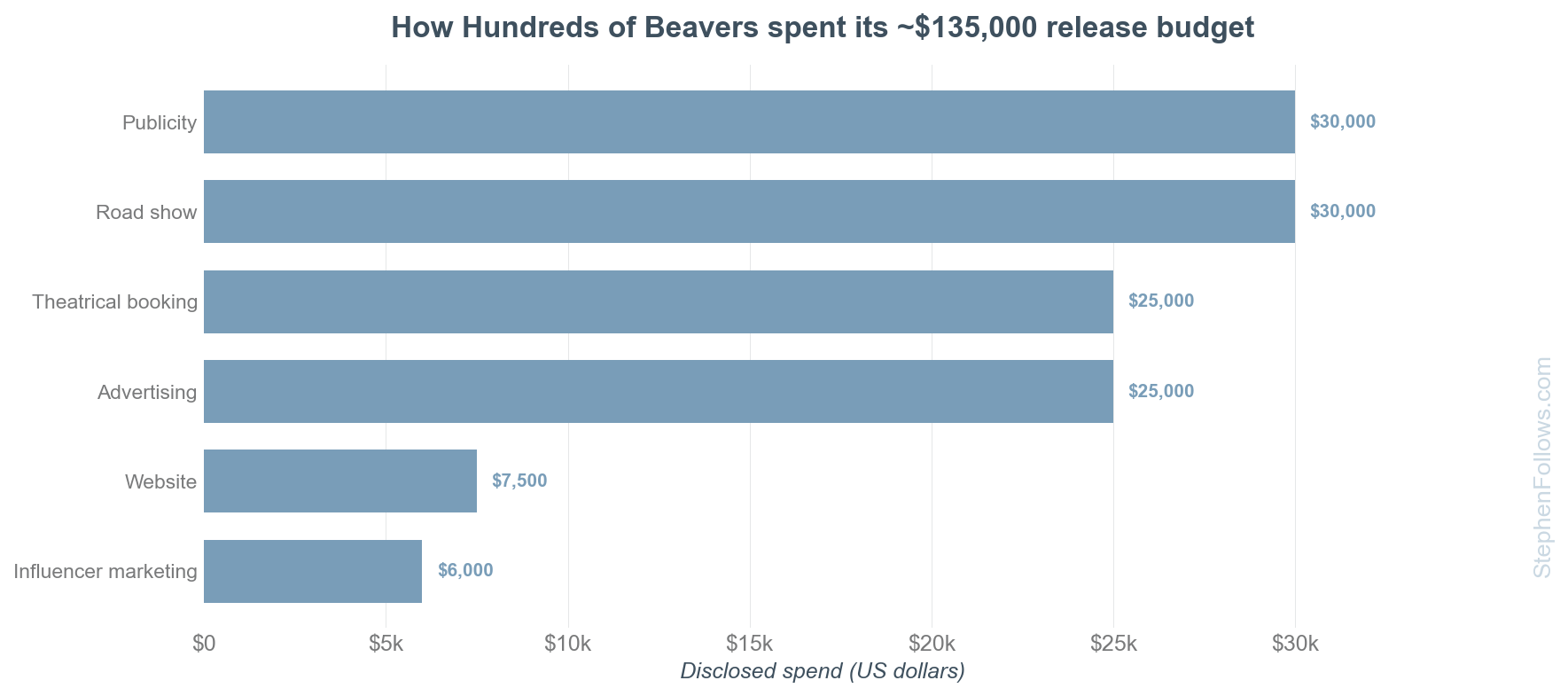
In the end, the movie grossed just over $1.5m in cinemas worldwide, plus roughly $500,000 on digital platforms and $250,000 in merchandise sales (according to Wikipedia).
This is also a good example of the value of unpaid labour. The team ran their own social media for two years at no cash cost.
Large scale social media engagement was done by producers and SRH at no cost - this would have normally cost between $150K-$250K if they were paid for it.
The unpaid labour was worth more than the entire cash release budget.
“You, Me & Her”
You, Me & Her (2025) is the same shape at a higher price point, as seen in Distribution Advocates’ case study. Selina Ringel and Dan Levy Dagerman made their rom-com for $500,000, and then raised an additional $350,000 for theatrical marketing and distribution.
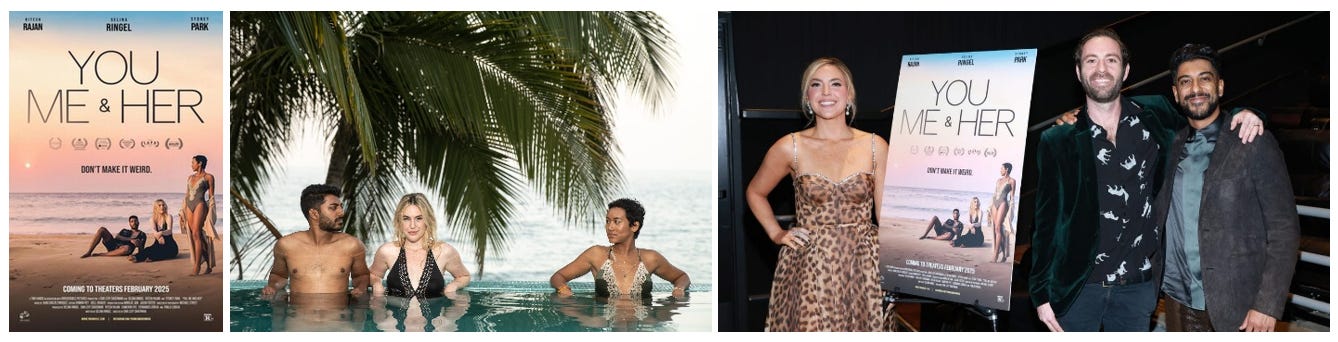
That paid for a national release across more than 250 cinemas, a $100,000 marketing co-op with exhibitors, 250 influencer boxes, and digital billboards in Times Square and on Sunset Boulevard (a bargain at $3,000, “affordable due to timing and inventory”).
The theatrical release did not come close to recouping the cost to market and distribute the film. But the visibility we generated would ultimately help to secure a STARZ SVOD deal and in-flight licensing agreements with American Airlines, Qantas, and Jetstar through Encore Inflight.
Theatrical has traditionally been seen as a loss leader for many movies. The splashy, big release increases awareness and cements the movie's status as a ‘proper movie’ in the public eye. The filmmakers can then (hopefully) reap the rewards of their all-important “third window” (such as VHS, DVD, or TV), where costs were much lower.
“Sriracha”
The most complete micro-budget P&L belongs to Griffin Hammond’s Sriracha (2013), a documentary made for $12,728 that then spent $27,807 on marketing and distribution, more than twice its production cost.
Hammond published everything at 18 months and again at 36 months, revealing $136,813 of revenue, $78,186 of profit, 42 festival submissions at an average of $42 each, and the sobering discovery that ad-supported YouTube paid him $341 for 127,485 views.
The pre-pandemic Sundance case studies
The Sundance Creative Distribution case studies remain the most granular release breakdowns, and although they describe a 2017–18 world, their category splits are still the best benchmark we have at scale.
Columbus (2017) turned down a $150,000 all-rights offer against a $700,000 budget and self-released with a final P&A budget of $189,032. PR took $51,328 (close to 30% of the P&A budget), theatrical costs $50,673, and social media ads $24,000, split $8,000 theatrical, $12,000 iTunes, $4,000 boosting posts. The film grossed $1,014,533 in domestic cinemas, and per the case study:
More than twice as much money came back to the filmmakers in the self-release model as compared with a hypothetical traditional distribution arrangement.
Thunder Road (2018) did it smaller, with a distribution and marketing budget “just under $70,000” on a $200,000 film, after rejecting a $125,000 minimum guarantee. By January 2019 it had netted about $510,000 across all platforms. The single biggest revenue line was, unusually, airlines, at $166,396, at over ten times the theatrical take ($12,345).
And at the micro end, distributor Matt Grady of Factory 25 published a complete ledger for Christmas, Again (2014) on Sundance’s blog: PR $10,000, marketing $2,500, digital deliverables $3,400, an LA four-wall $5,000, and so on. $23,550 costs against combined digital and theatrical income of $20,004. They noted that they expect a Netflix deal later, see it as “the tipping point financially”.
Assorted other case studies
A few others worth a read:
SADIE (2018): $650,000 budget; declined a 25%-of-budget MG; set aside $50,000 for marketing plus a $100,000 non-recoupable Amazon Festival Stars bonus; did not recoup. Producer Lacey Leavitt’s honest write-up is at Dear Producer.
First Girl I Loved (2016): P&A “approached six figures”, including roughly $35,000 of social ads; approached three times its best Sundance offer. Producer Ross Putman wrote it up for Sundance.
The Discoverers (2014): raised $100,000 on Kickstarter purely for distribution; split 31% exhibition, 37% publicity/marketing/creative, 32% advertising. The filmmakers’ account is at IndieWire.
Red State (2011): Kevin Smith toured his $4m thriller as 15 one-night events with “less than $500 in paid advertising”, grossing $851,832 on tour (IndieWire, IGN). His stated alternative: “minimum $10 million on P&A” for a traditional release.
Marcus Markou’s Papadopoulos & Sons (2012). Markou self-financed the £825,222 film and self-released it in the UK on a P&A budget of £35,525, itemised down to £1,000 for the BBFC certificate and £8,000 of Facebook ads targeted at people with ‘Greek interests’ living near Greek churches. It took the second-highest screen average of its opening weekend. The full costs and income are in my original article from 2015.
Christmas, Again’s small but successful holiday release costing $24,000.

Publicists and PR
If there is one cost every self-releasing filmmaker eventually confronts, it is the cost of a publicist. The disclosed fees run from $2,000 to $54,000, and the verdicts run from “well worth it” to a lawsuit.
Part of the reason I saw such a wide range of costs across the examples is that “Publicity” isn't a single thing. It’s a collection of the full cost of activities, ranging in scope, scale, and complexity.
In the chart below, the Columbus and Unrest figures are total PR spend across the entire campaign (consultants, print ads, travel, press screenings), whereas the 1946 figure is a publicity firm’s fee within a $75,000 theatrical release. The small ones are single engagements.
