


Next month’s Cannes Film Festival will see a very strong showing from the South Korean contingent. Park Chan-wook is presiding over the jury, and the country has two films In Competition:
Hope (호프) is Na Hong-jin’s big-budget sci-fi thriller that marks his English-language debut and his first film in a decade. It stars a mixed Korean and Hollywood cast, including Alicia Vikander, Michael Fassbender and Hoyeon.
Colony (군체) is Yeon Sang-ho’s zombie thriller about survivors trapped in a building during a viral outbreak, notable largely for the return of Jun Ji-hyun to cinema screens after an eleven-year absence.
Six years after Parasite (기생충) became the first non-English-language film to win the Academy Award for Best Picture, Korean cinema’s place at the top table feels established.

This got me thinking about what the ‘Parasite Effect’ was. When a film wins an Oscar, does it have a lasting effect on the perception of that nation’s cinema? Or is it more of an isolated incident with no lasting impact?
So I crunched the numbers on ten years of international winners and their effects.
Is there a halo effect for national cinema?
I took the Best International Feature Oscar winner from 2015 to 2025 and pulled their country’s entire film back catalogue i.e. every film from that nation with a Wikipedia page, minus the winner itself.
I then compared the monthly Wikipedia pageviews in the 12 months following the Oscar ceremony with those in the 12 months preceding it.
To control for global trends (including a rather large pandemic), I divided each country’s change by the average of all other tracked countries in the same window.
This reveals that South Korea is the only winning country that generated a meaningful lift for its national cinema. On Wikipedia, the South Korean back catalogue beat the global average by +24%.
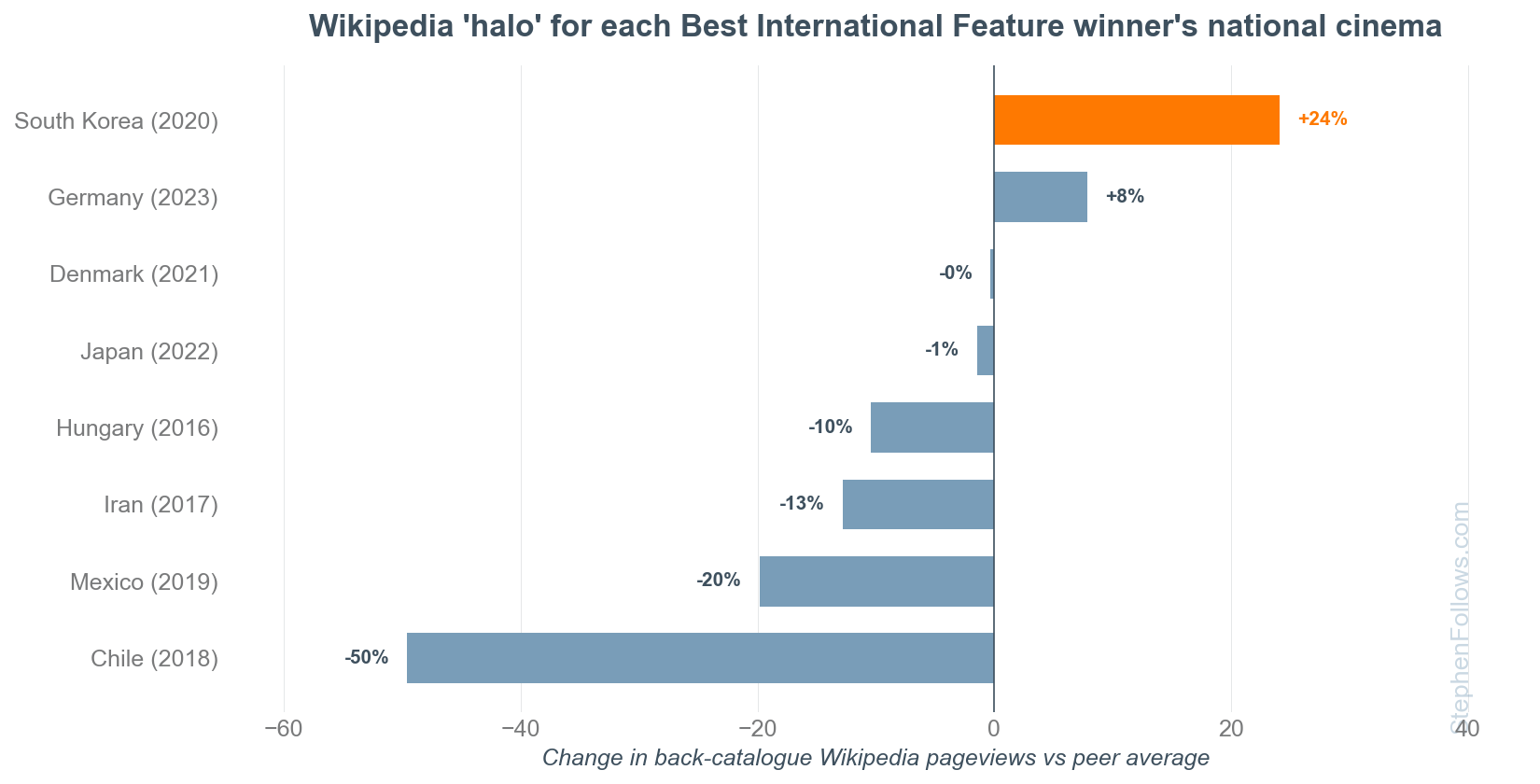
Everyone else came in at or below the peer average.
Mexico’s back catalogue fell roughly 20% after Roma.
Chile’s halved after A Fantastic Woman.
Germany managed a modest +8% after All Quiet on the Western Front (albeit Netflix released that film globally a month into the measurement window, so streaming distribution is doing some of the work the Oscar cannot claim credit for on its own).
It seems that in most cases, an Oscar win does not help a national cinema’s output, but that Parasite was an outlier.

What did the South Korean lift look like?
To show this Parasite Effect in practice, let’s look at the Wikipedia data in more detail.
On the chart below, the orange line is per-film monthly Wikipedia views for 1,301 Korean films (Parasite excluded). The blue line is the comparison group, covering films from France, Japan, Germany, Spain and Italy (10,966 films in total). Both are indexed to 100 at January 2019, so what matters is the shape.
Through 2018 and 2019, Korea tracks its peers almost exactly. From February 2020, they split. Korea rises more sharply and remains 45 to 60% above its pre-Parasite baseline by mid-2020. The peer group gets a bump too (the COVID effect of people locked indoors looking things up on Wikipedis more) but drifts back down.
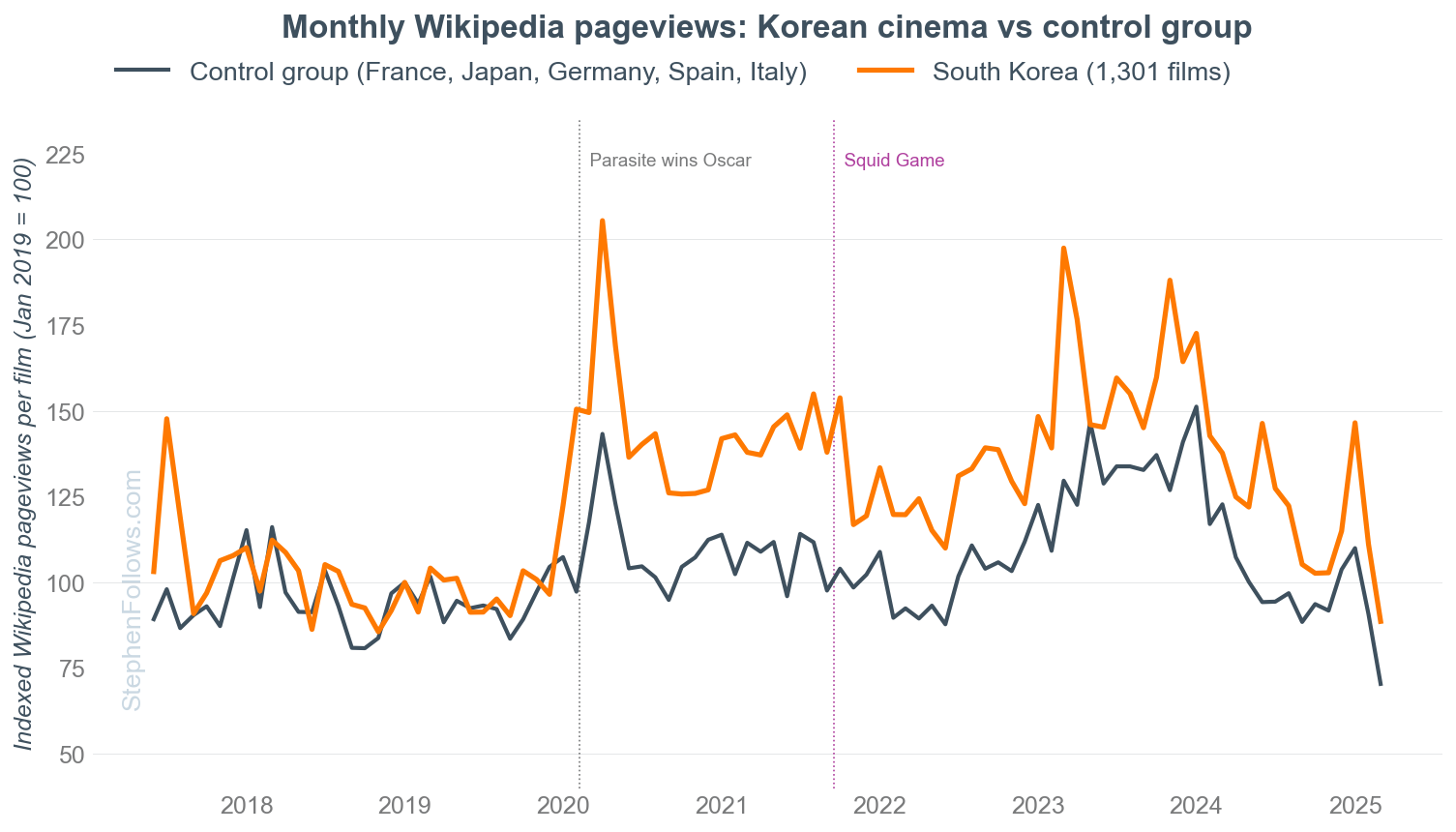
I have marked Squid Game’s September 2021 release to illustrate that the South Korean lift began a full 18 months earlier. So Squid Game wasn’t the trigger, even if it later reinforced the effect.

Did more people watch South Korean movies after Parasite won the Oscar?
This Wikipedia data is useful for tracking whether people were curious about South Korean cinema, but I also wanted to look at who was watching the movies. So I ran another analysis, this time using almost 10 million audience reviews with submission dates.
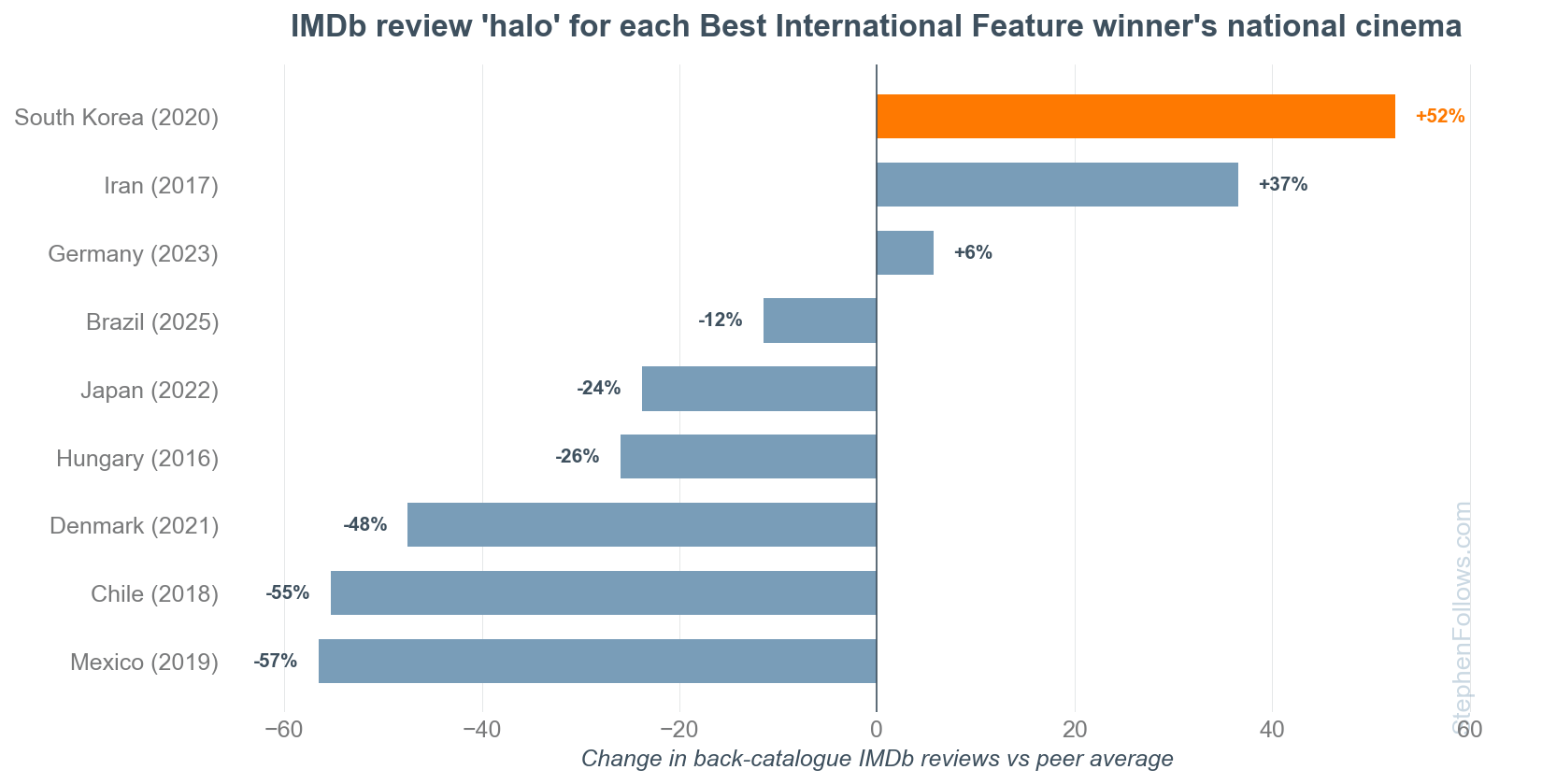
The pattern across countries is even more striking in the review data. South Korea is again alone at +52%. Iran shows a positive number too, but that is based on just too few reviews in the pre-win window to be a reliable signal.
Every other country with a robust sample came in flat or negative. Mexico and Chile both fell by roughly half. Denmark, Japan and Hungary all ended up well below their peers.
Was it South Korea or was it Bong?
When Parasite won, was global curiosity pulled toward Korean cinema as a whole, or specifically toward Bong Joon-ho? Hulu bundled Mother, The Host and Barking Dogs Never Bite alongside Parasite in April 2020, which gave an obvious reason for a director-specific spike.
The data says national, not personal. Bong’s five pre-Parasite films moved +43% on Wikipedia in the 12 months after the Oscar. The broader South Korean catalogue moved +46%. On user reviews, Bong’s back catalogue barely shifted (+8%) while the wider South Korean catalogue almost doubled (+86%).
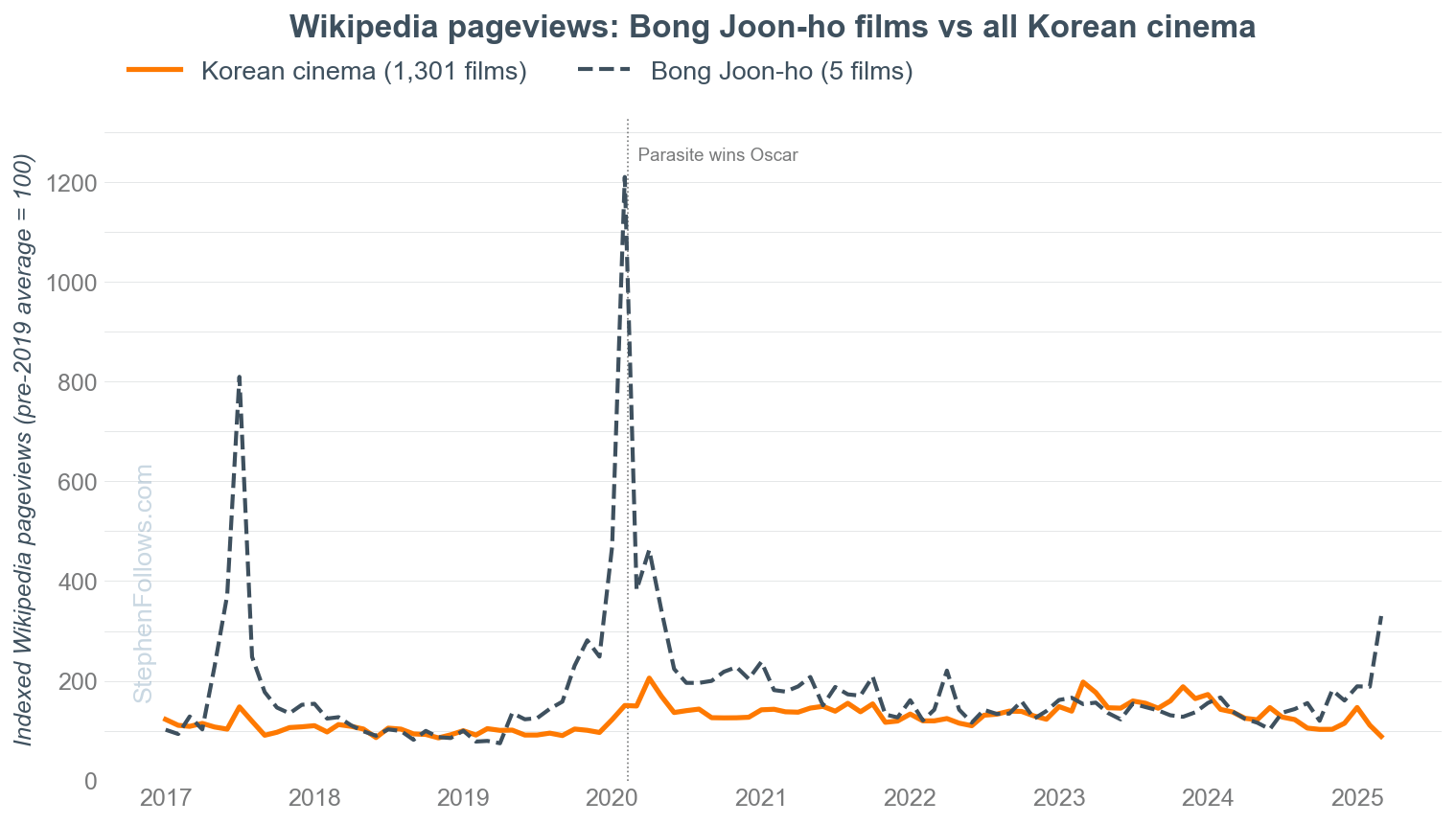
So it’s fair to say that this film’s Oscar win contributed in a big way to reshaping how audiences thought about an entire national cinema.

So why South Korea and not the others?
This kind of data can reveal the pattern but not the reasons behind it. Here are my first thoughts as to why this moment played out as it did:
The movie is outstanding. No, really. It’s a cut above most films, even at the Oscars that year, and watching art that good can be exhilarating in a way that makes you want to chase that high. The film was infused with a number of South Korean elements, characters, and tropes, which made viewers keen to learn more.
The speech. When Bong picked up his Golden Globes, he said something widely reported: “Once you overcome the one-inch tall barrier of subtitles, you will be introduced to so many more amazing films”. It made the whole thing feel more like a moment in history than just a single film winning a vote.
Streaming was ready. Neon’s deal with Hulu put three Bong films on a major US platform in April 2020, exactly when lockdowns sent viewers looking for something new. By February 2021, Netflix had committed $500 million to Korean content in a single year, on top of $700 million already spent between 2015 and 2020. That commitment later grew to $2.5 billion through 2027.
Korea had a deeper bench. Iran, Chile, Denmark and Hungary do not have Memories of Murder, Train to Busan, Oldboy and The Handmaiden queued up and ready to reward a curious viewer. When Parasite opened the door, there was somewhere for the audience to go.
The timing was extraordinary. Parasite won on 9 February 2020, which was roughly five weeks before the world went into a global lockdown. People confined at home with streaming subscriptions and an appetite for novelty are the ideal environment for a back catalogue to catch fire.
Epilogue
For most filmmakers, reaching the heights of winning the Best International Feature at the Oscars is a personal honour. But once in a while, it is also a moment when you get to help your peers and increase a lasting interest in your nation’s cinematic output.
Parasite was a rare case where not only was the film exceptional, but the collision of a compelling argument, a ready infrastructure, a deep catalogue worth discovering, and a world that was about to be locked indoors with nothing to do but watch.
Notes
I tested every Best International Feature winner from 2016 to 2023 (eight films, eight countries). For each, I pulled the winning country’s entire film back catalogue from metadata databases, excluded the winner itself, and compared Wikipedia pageviews and written review volumes from several major review sites in the 12 months after the Oscar ceremony with the 12 months before.
To strip out global trends (such as the odd pandemic) I measured each country’s change relative to the average of all other tracked countries in the same window. The comparison group for South Korea is France, Japan, Germany, Spain and Italy, which I chose for coverage density. The 2015 winner (Ida, Poland) was excluded for insufficient pre-win data, and the 2025 winner (I’m Still Here, Brazil) has not yet completed its post-win window.
Both Wikipedia and the review data skew toward English-speaking audiences, so this measures global cinephile curiosity as expressed in English, not South Korean domestic viewership.
Co-productions can appear in more than one country’s catalogue, which inflates the numbers slightly for Germany and France but is a minor issue for South Korea.
It’s interesting how Parasite became more than just a film moment it actually shifted global attention toward Korean cinema as a whole. This idea of a ‘halo effect’ on an entire national industry is something we don’t often see in other film industries at the same scale.
Strange that Old boy trilogy, and other movies of Park Chan-wook didn't have the public boostrap of Parasite. Someone were probably more niche, but in any case, could have more attention focused on the director, and his next movies.