


This month, we’ve seen the stellar performance of Obsession (currently $147 million at the worldwide box office - almost 80 times its budget), which has led readers to get in touch to ask if this proves that ‘stars don’t matter’
It might be the oldest argument in the film business, and the two sides go like this:
One camp says a famous face is the closest thing to insurance a producer can buy. Audiences seem to see them as consistent brands in which every film is a prototype and genre labels are fuzzy at best.
The other camp points out that the famous names are only there to protect the risk-averse gatekeepers within the production and distribution supply chain. Once movies hit audiences, they just want it to deliver and be entertaining.
While Obsession may have provided a powerful visual, the plural of anecdotes is not data. I went back to the data, studying the box office performance of 3,052 films this century, in relation to the fame of their lead cast (more details in the Notes section at the end of the article).
Does having a star help your film succeed?
Given that we can’t know how much an actor is paid upfront (or how much of the income they also get), we can’t talk about true value for money. For every star, there will be a price at which their involvement is a net positive to the bottom line, and after which they cost more than they help.
But we can measure the difference in performance between films with famous, semi-famous and non-famous names. For this, I am using the worldwide box-office multiplier relative to the budget. Let’s not worry too much about the exact numbers; instead, focus on the difference between the cohorts.
Films led by an actor in the top 10% of fame for their era grossed a median of 2.54 times their budget worldwide. Films led by someone in the 50th to 75th percentile, the group I am calling ‘Low Fame’, grossed 1.91 times.
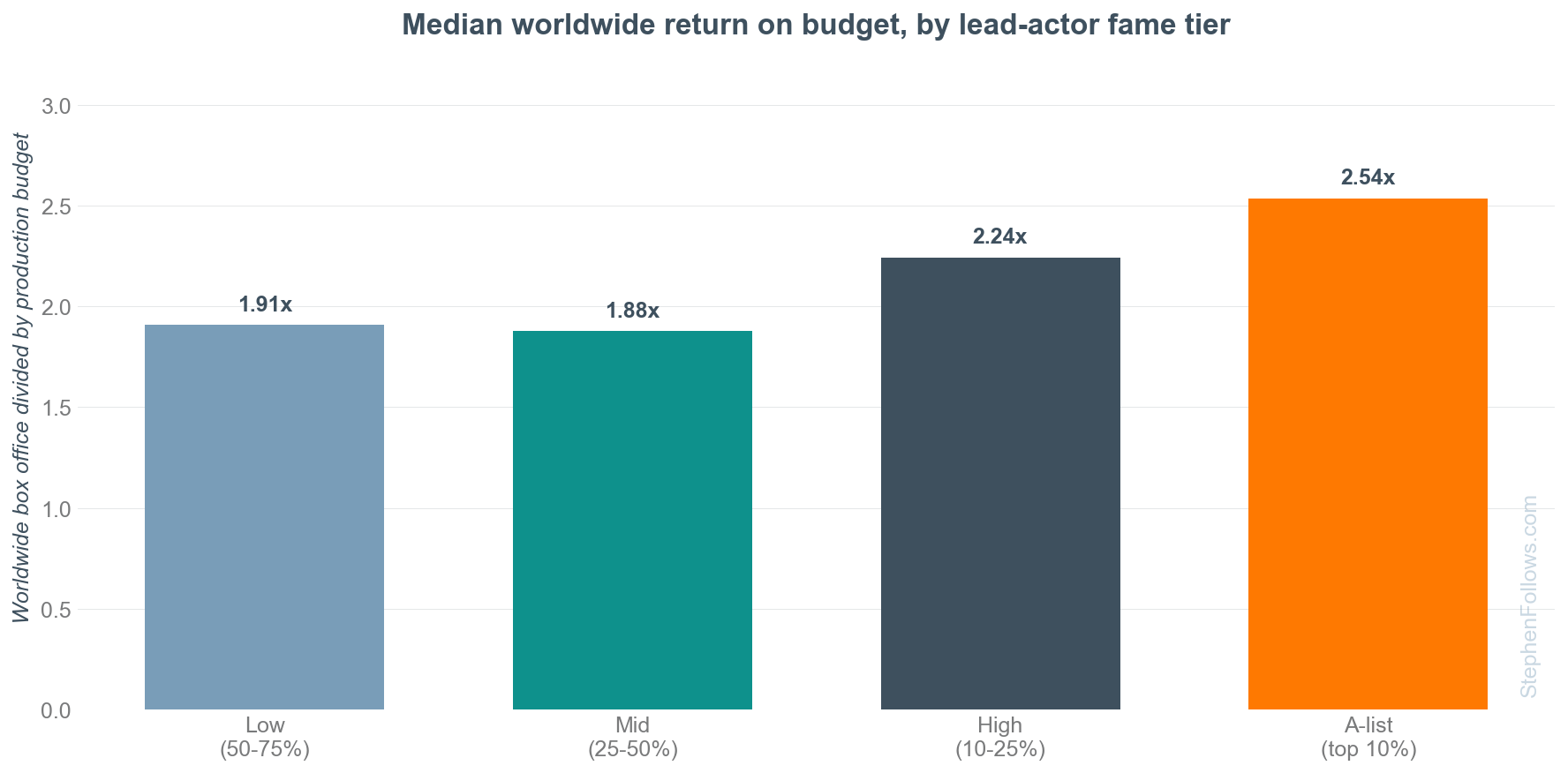
So we can see that fame does have an effect.
The difference between ‘not famous’ and ‘kinda famous, I guess’ is nothing. It’s only as we start to talk about actors in the top quarter that we see an uplift, with the largest impact on the biggest name.
Given that those are also the highest-paid actors, it’s fair to assume that some of that uplift doesn’t go to the producers, studio, or investors, instead ending up in the pockets of the actors (and their agents, managers, stylists, doctors, and spiritual gurus).
Are there other ways having a famous name helps?
So many of the decisions in the film industry are made in response to perceived risk. Some can be seen as professionals making smart, informed decisions, but in a large number of cases, it’s people acting instinctively, reactions rooted in fear. So it makes sense that having a famous name can feel reassuring.
So while the previous graph SHOULD be the most important one, I suspect the one below is more interesting to film professionals. It shows that having a famous name helps reduce the risk of an embarrassing box-office failure.
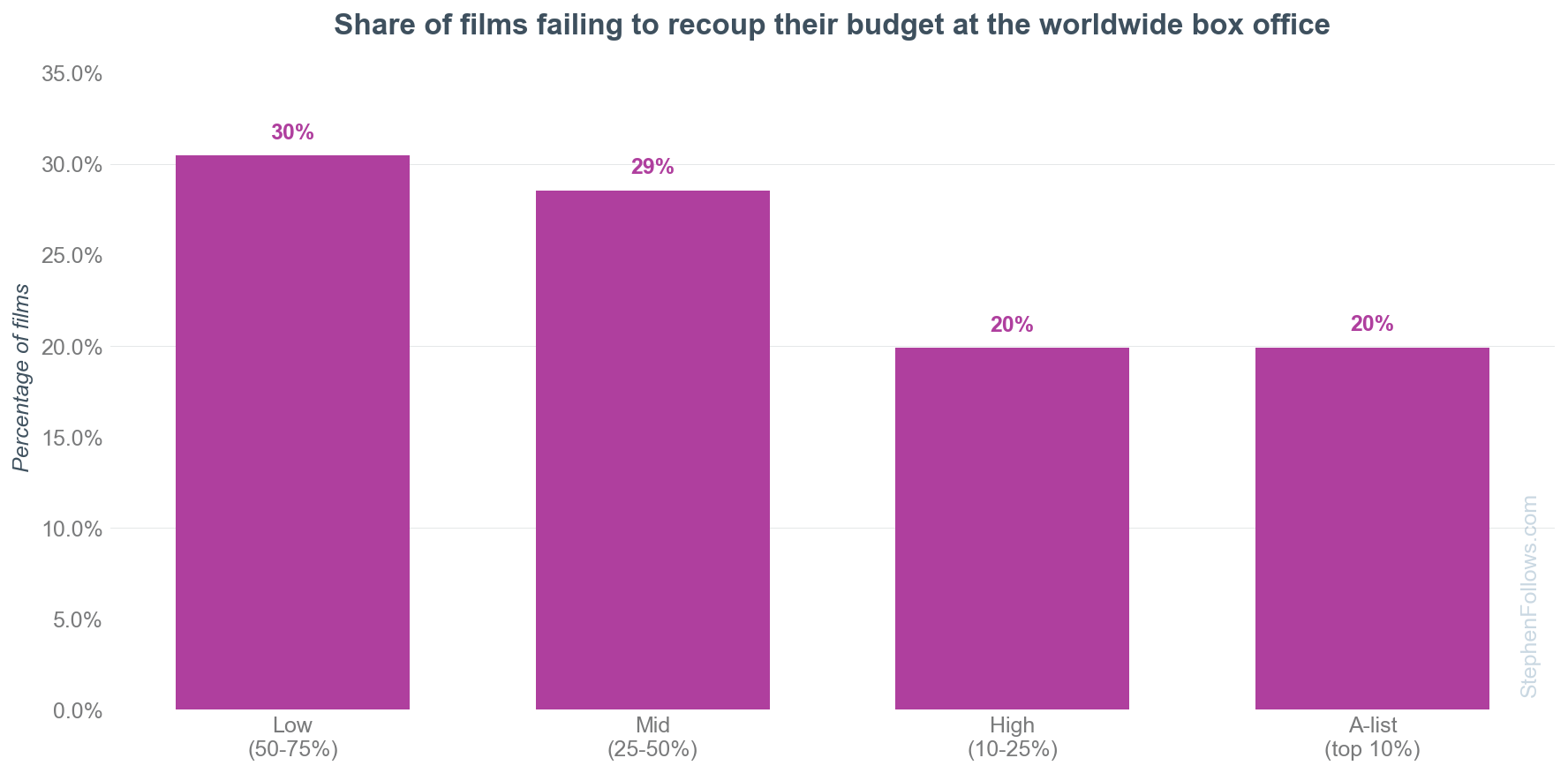
A star does not guarantee a hit, but the floor under the downside is noticeably higher.
Where fame pays, and where it barely matters
But these effects are not spread evenly across genres. Obsession appeals to a younger, horror-friendly crowd.
When we split our data by genre, we find that while an A-lister is associated with higher returns across every major genre, the size of the effect varies widely.
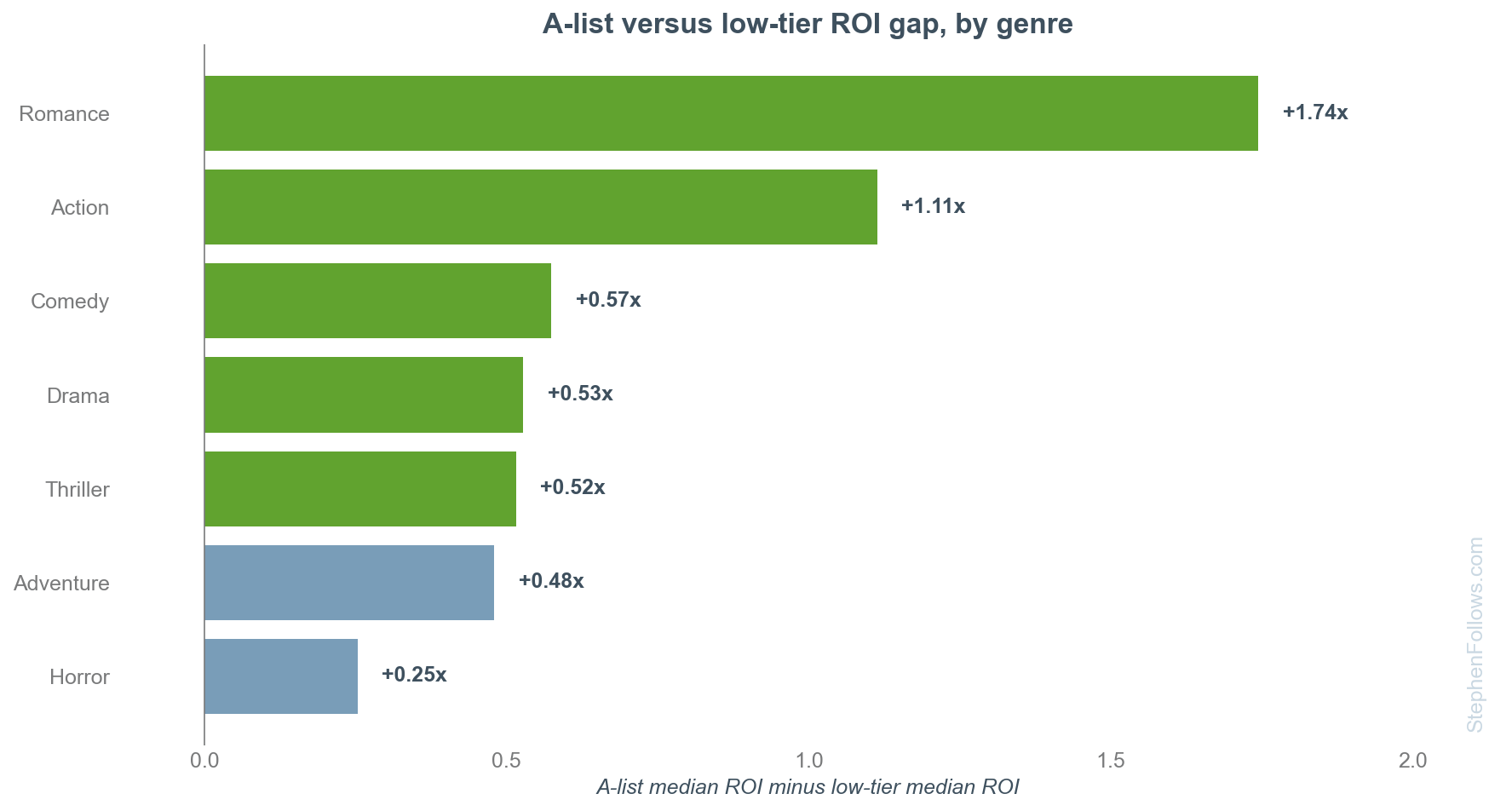
The biggest payoff is in romance, where top-tier-led films return a multiplier of 3.82 versus 2.08 for lower-tier leads. A romantic film is largely a question of whether audiences want to spend two hours in a particular person’s company, and a recognisable, well-liked lead is close to the whole product.
Comedy, drama, thriller and adventure sit in a tighter band of roughly half a multiplier.
The genre where fame does least is horror, where the gap is only about 0.25x. This is the same pattern that Bruce Nash and I found when we looked at 877 independent films and the odds of a theatrical release a decade ago. Horror was the genre least dependent on a name and most dependent on concept.
The franchise does most of the lifting
Eagle-eyed readers may have noticed I didn’t comment on the effect of action in the section above. Action had the second largest effect of a star, after romance. However, it is worth asking which famous leads those are actually appearing in. Increasingly, the answer is a franchise.
The share of top-tier-led action films that belong to an established franchise has climbed from around 40% early in the period to about 79% in recent years.
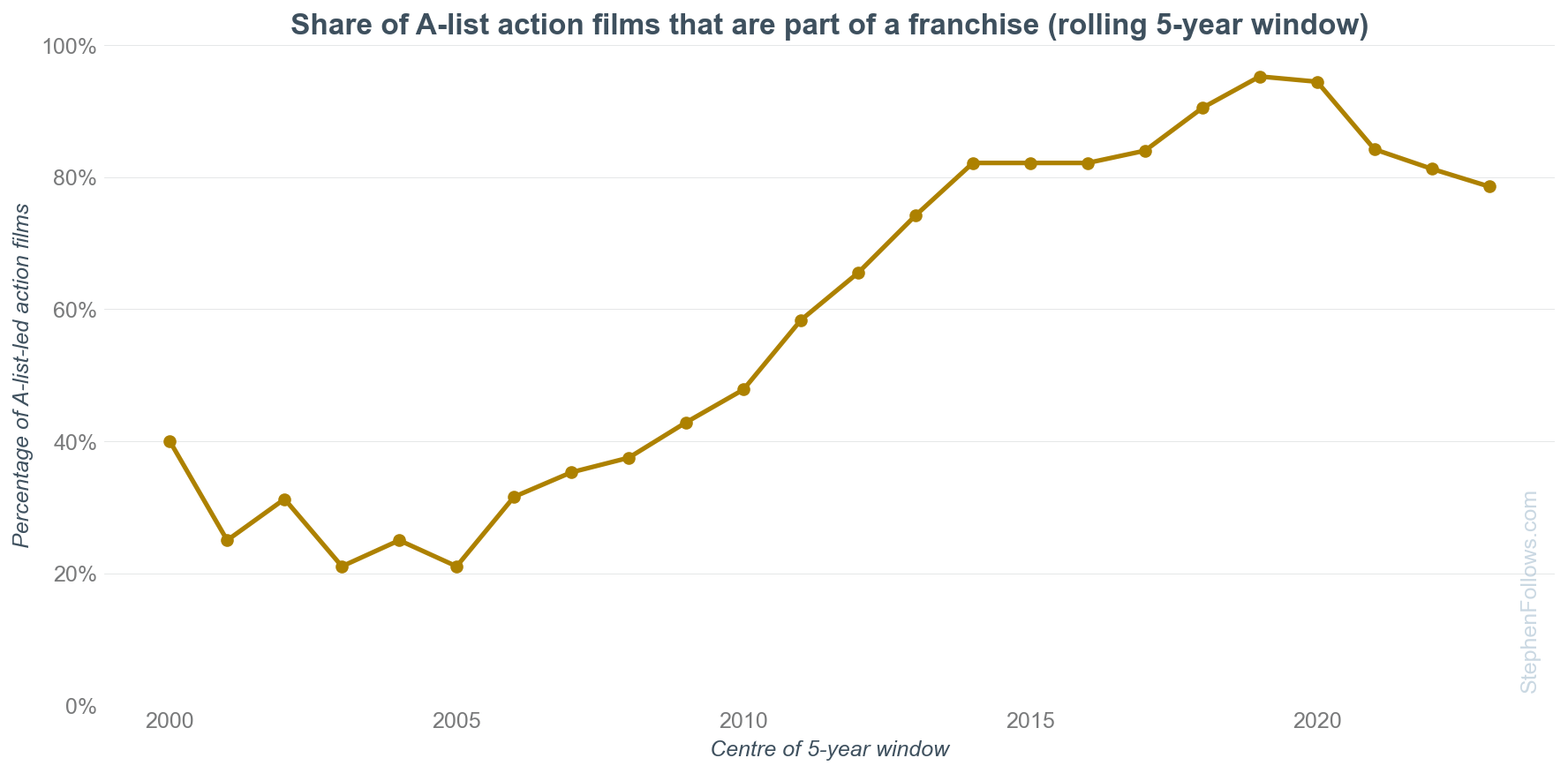
In top-tier action, films in a franchise return a median ratio of 3.47, while those that are not return 1.99. The famous winners are nearly all franchise instalments, from Spider-Man: No Way Home and Jurassic World to The Hunger Games and Aquaman. The famous flops are the films that asked a star to carry a brand-new idea on their name alone: Jonah Hex (less than a quarter of its budget back), Argylle and Mortdecai. The famous name and the franchise usually travel together now, and when you can separate them, the franchise is doing most of the lifting.
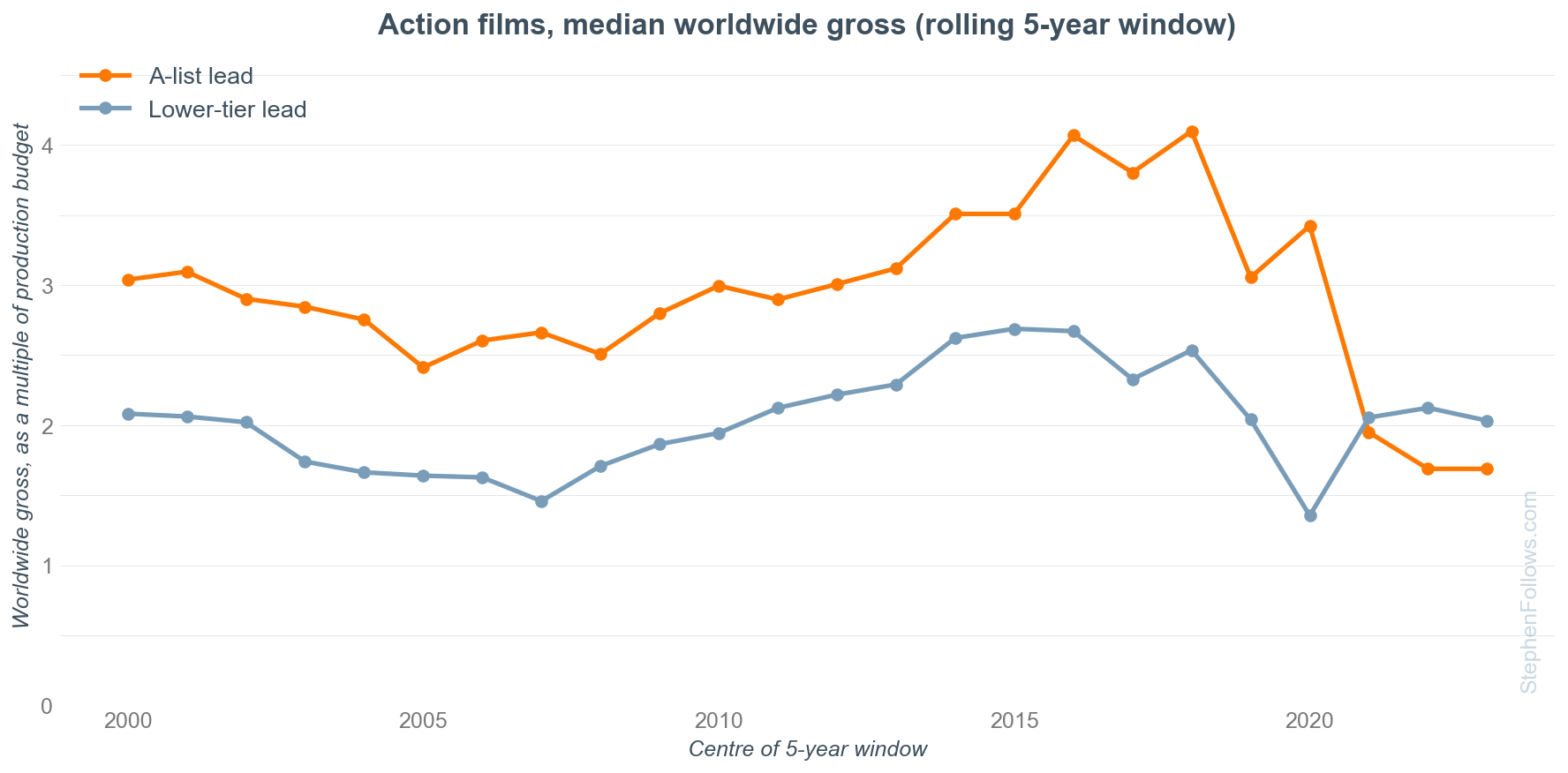
A study from 15 years ago concluded that the revenue gap between star and non-star films was driven almost entirely by those films having bigger budgets and wider releases, not by audiences turning up for the face. It is also why some people contend that intellectual property is killing the movie star, and why studios and actors openly disagree about who is actually generating the money, the person or the logo.
Two bonus findings
Before we go, I want to share two minor findings I came across along the way that I found interesting.
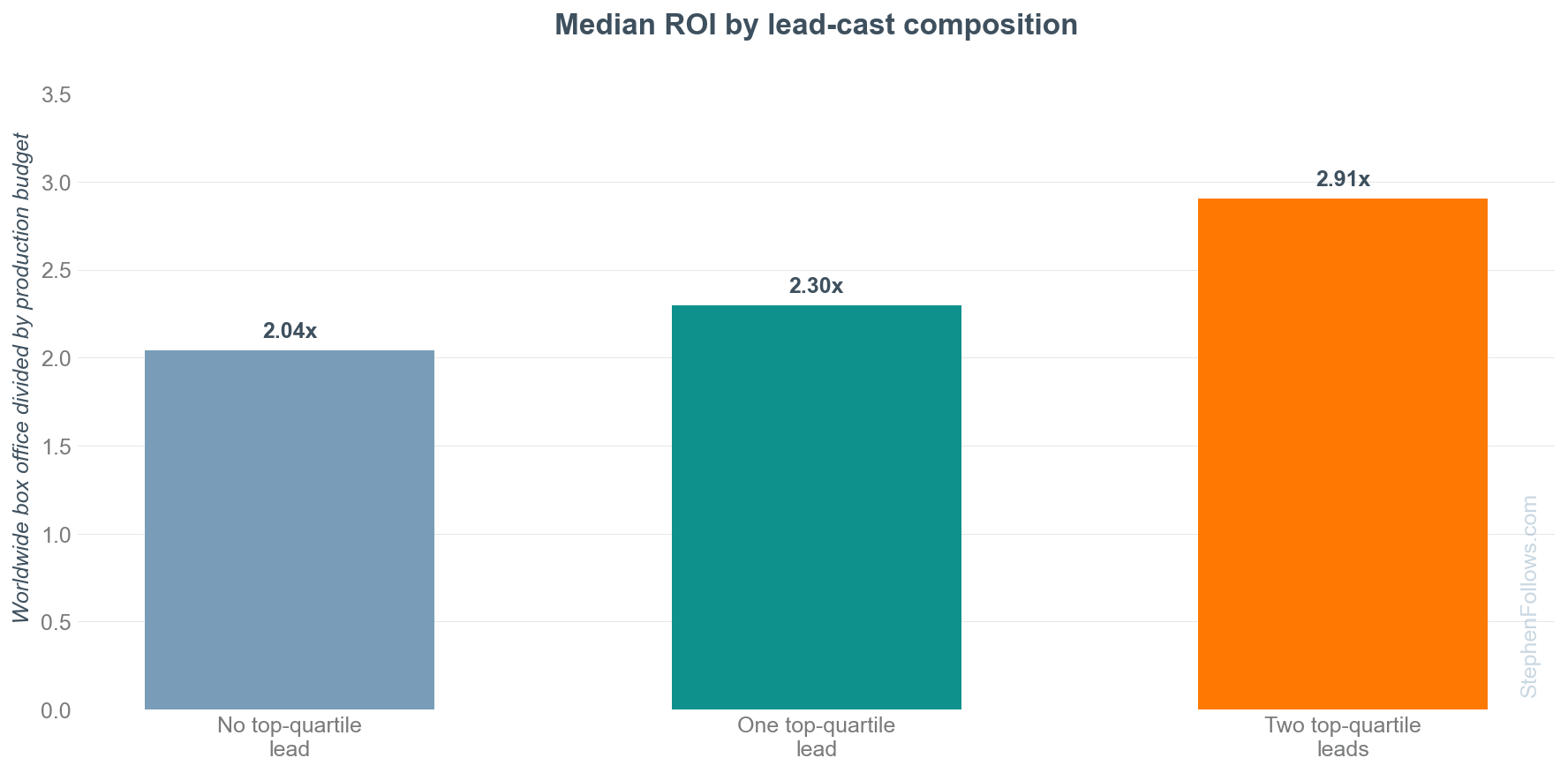
The first is that the value of a famous name is stackable:
Films with no top-quartile fame grossed a median of 2.04 times their budget.
Add one famous lead, and that rises to 2.30.
Put two genuinely famous names at the top of the call sheet, and it reaches 2.91.
I hear a few people in Cannes this year complained that while they already had a famous name in their proposed film, sales agents and distributors were not interested until they added a second famous name. While I appreciate how frustrating that must be for the filmmakers, the data seem to support what these sales professionals have been saying.
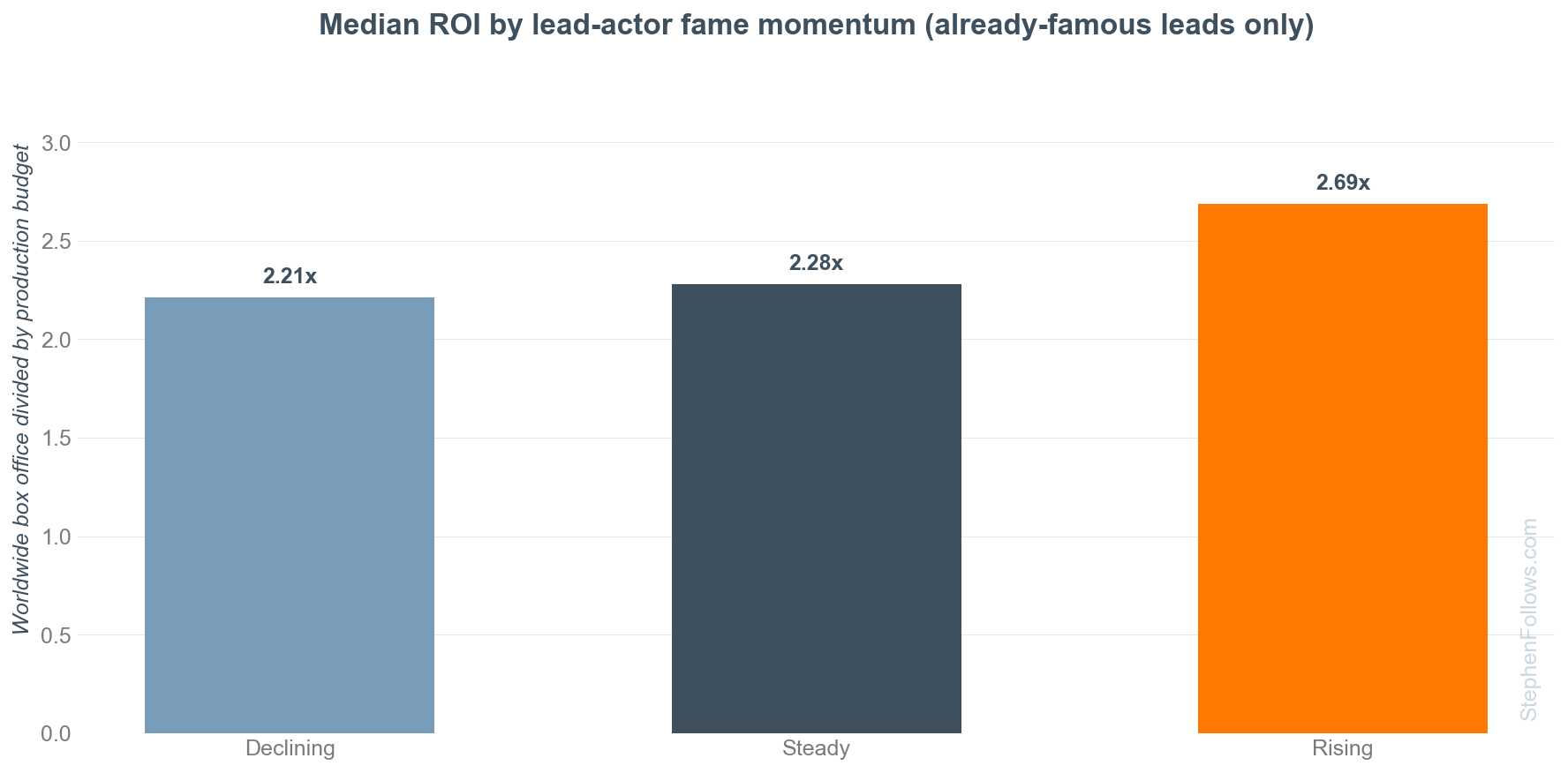
Secondly, it’s not just how famous the actors are in the moment; it’s also about the wider story of their fame.
Among leads who were already famous, I split them by whether their public attention was rising, steady or falling in the year before release.
Rising stars outperform. At the same level of established fame, films whose lead was climbing returned a median 2.69, against 2.28 for steady names and 2.21 for those whose moment was fading.
Catching an actor on the way up, when audiences are actively getting more interested in them, beats booking an equally famous name on the way down.
Notes
Today’s research examines 3,052 films released between 2000 and 2025, each with a recorded production budget, a positive worldwide box office, and a lead actor whose fame could be measured before release.
Budgets and box office come from The Numbers. The sample leans towards English-language theatrical releases, because those are the films whose budgets are publicly reported. There is a growing (and worrying) trend of reduced budget availability, which I’ve written about before.
In addition, today’s research tracks the worldwide theatrical box office. This is a useful signal, but it doesn’t capture all of a film’s income, and over the period I studied, the industry's economics have shifted.
That said, given that my numbers are comparative rather than trying to be comprehensive, I don’t feel that either effect is skewing the overall findings.
For each film, I built a relative fame score for its lead actor from a blend of publicly visible popularity signals gathered across several sources, averaged over the year ending one month before release, so the film’s own launch could not inflate it. Each film took the score of its most famous lead, and films were ranked against others from the same five-year window, so ‘top 10%’ means famous for its time rather than famous today. Leads were also classified by whether that attention was rising, steady or falling over the same window.
The median ratio is used throughout because the average is skewed by the occasional billion-dollar hit. Some genre and tier cells are small, in particular top-tier horror (10 films) and romance (22 films), so those specific figures are best read as indicative. Stars are also cast into better-financed films in the first place, so part of any apparent star effect is really a selection effect, which is exactly why the franchise comparison matters.
I find “Backrooms” an odd film to consider as evidence, given that its lead is an Oscar-nominated actor.
How do you balance the marketing spend that films with famous actors get vs films without them. Like Mamdani’s team figures out how to use all the great social creators and their shows to turn him from a city councilman into an international superstar. Smaller movies could do this with the right size budgets.