


Filmmaker Matthew Leigh reached out last week to ask me an interesting question….
Do non-sequel films with numbers in their titles underperform?
He pointed to films like Mickey 17, The Ninth Gate and 1408 and asked if the presence of a number was a bad sign for the film’s backers.
There are certainly examples of successful non-sequel numbered films. 1917 and 8 Mile did just fine, and 2001: A Space Odyssey is an all-time classic. But is this the exception rather than the rule?
I set about finding out by studying the titles of 420,384 feature films.
Which numbers count?
Determining if a film has a number in its title is harder than it first seems.
Some are obvious, like 1917, 2046, or Room 237 or the flurry of nine-based films released in 2009 - 9, 9, Nine, Nine Dead, Nine Miles Down, Nine Young Women Talk About Sex, One Nine Nine Four, The Back Nine and District 9.
But then you come up against One Flew Over the Cuckoo’s Nest and have to decide whether it’s numerically relevant or just a meditation on existential singularity. Is it about one in the sense of a lonely protagonist, a collective ideal, or just a particularly independent-minded bird?!
And don’t get me started on Tell No One.
I didn’t count titles with Roman numerals (Rocky II, The Godfather Part III, et al) , so I never had to draw the line at American History X , though, as far as I’m aware, there’s no American History IX (other than in the news, of course).
I included titles with strange numbers, such as Alien³ (which technically uses a superscript '3' to mean cubed), but excluded those which alluded to numbers such as Darren Aronofsky’s Pi.
So with all that semantic taxonomic numeronymic discernment out of the way, let’s get onto the pretty graphs…
How common are numbers in movie titles?
The first thing that surprised me was just how many movies do have numbers in their titles. Across all movies, around one in twenty have a number of some kind in their title.
Films have been sneaking numbers into their titles for over a century, sometimes as simple markers of time and place, sometimes as cryptic puzzles for audiences to decode.
Some directors seem to love a number-focused title. Michael Winterbottom has directed Eleven Days In May, 9 Songs, Code 46, 24 Hour Party People, and the double-digited 60 Seconds of Solitude in Year Zero (I did not count Welcome To Sarajevo).
To see how often numbers appear in movie titles, I split them into two categories:
Written numbers (One Hour Photo, The Sixth Sense)
(Oh, and a biiiiig thank you to David Fincher for ruining my lovely system with Se7en).
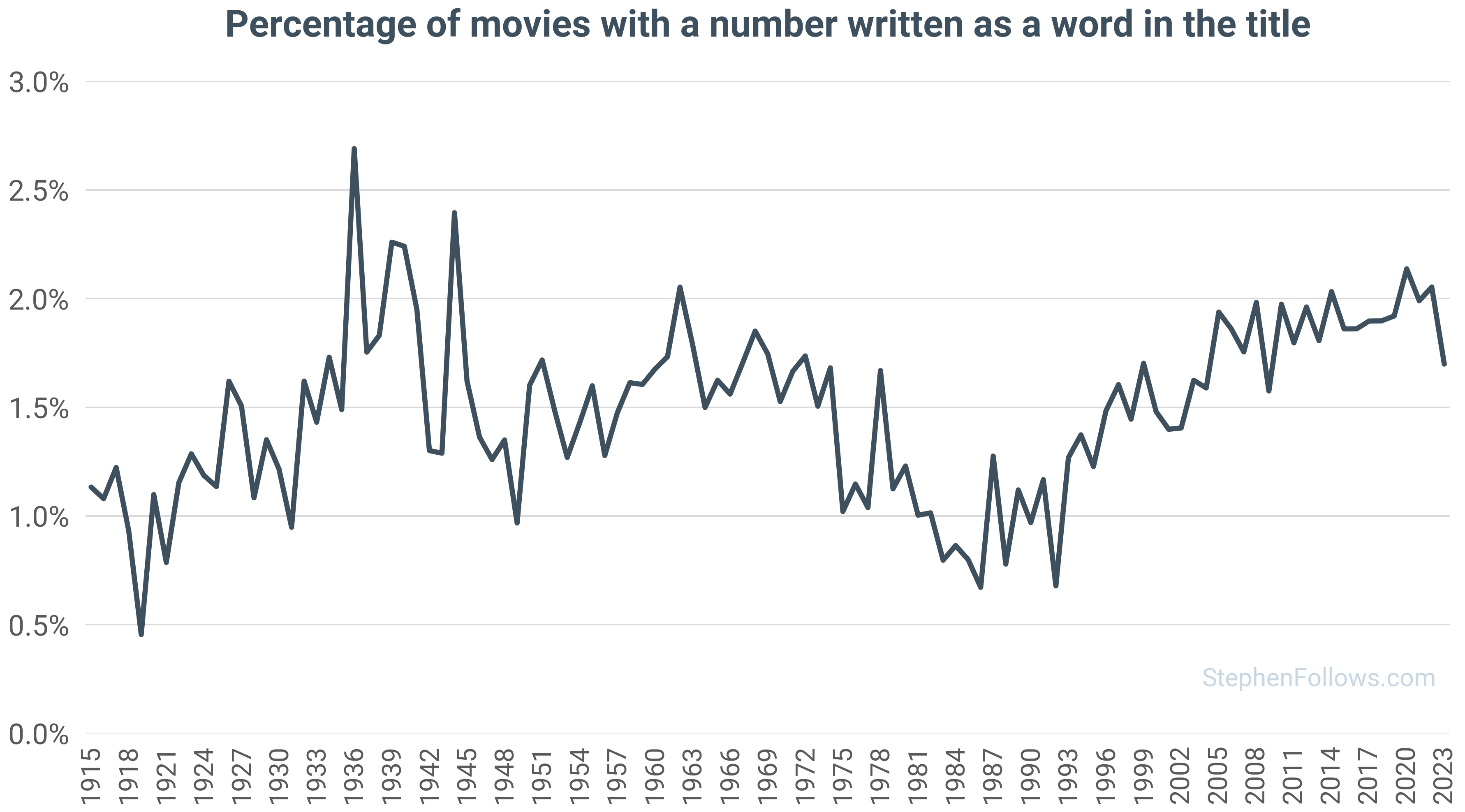
The presence of written numbers (i.e. ‘one’, ‘two’, ‘three hundred and seventy-seven’) has remained relatively stable, hovering around 1.5 to 2% of all films.
The 1980s represented a low point for the literary numerals, with fewer titles opting for words over digits. In recent decades, however, they have rebounded.
I can see the appeal - there’s more charm in One Fine Day than 1 Fine Day, and more weight in The Seventh Seal than The 7th Seal.
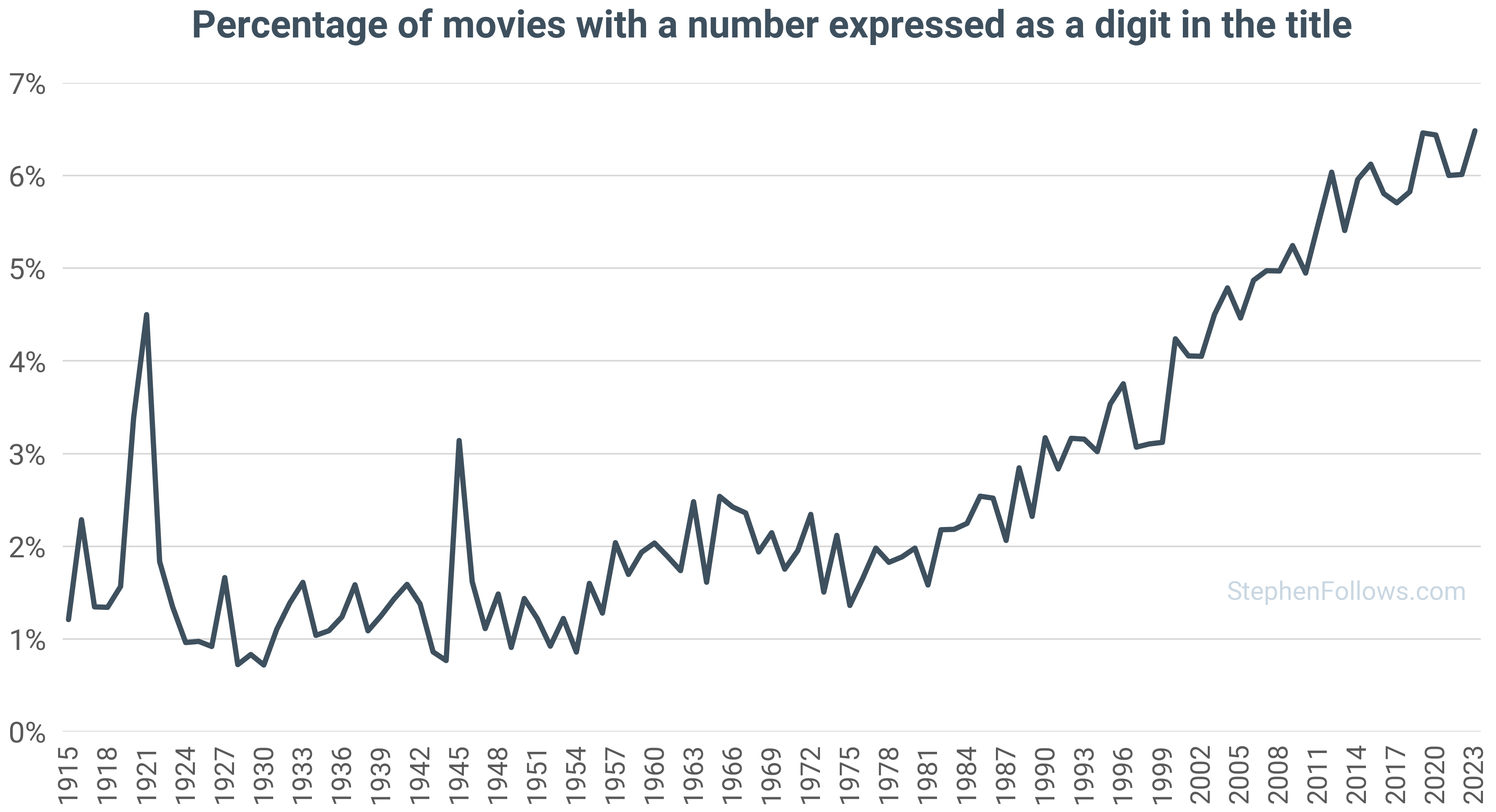
But the real increase has been within movies that feature a numerical digit, rising from around 2% in the mid-20th century to over 6% today.
Which numbers are most common?
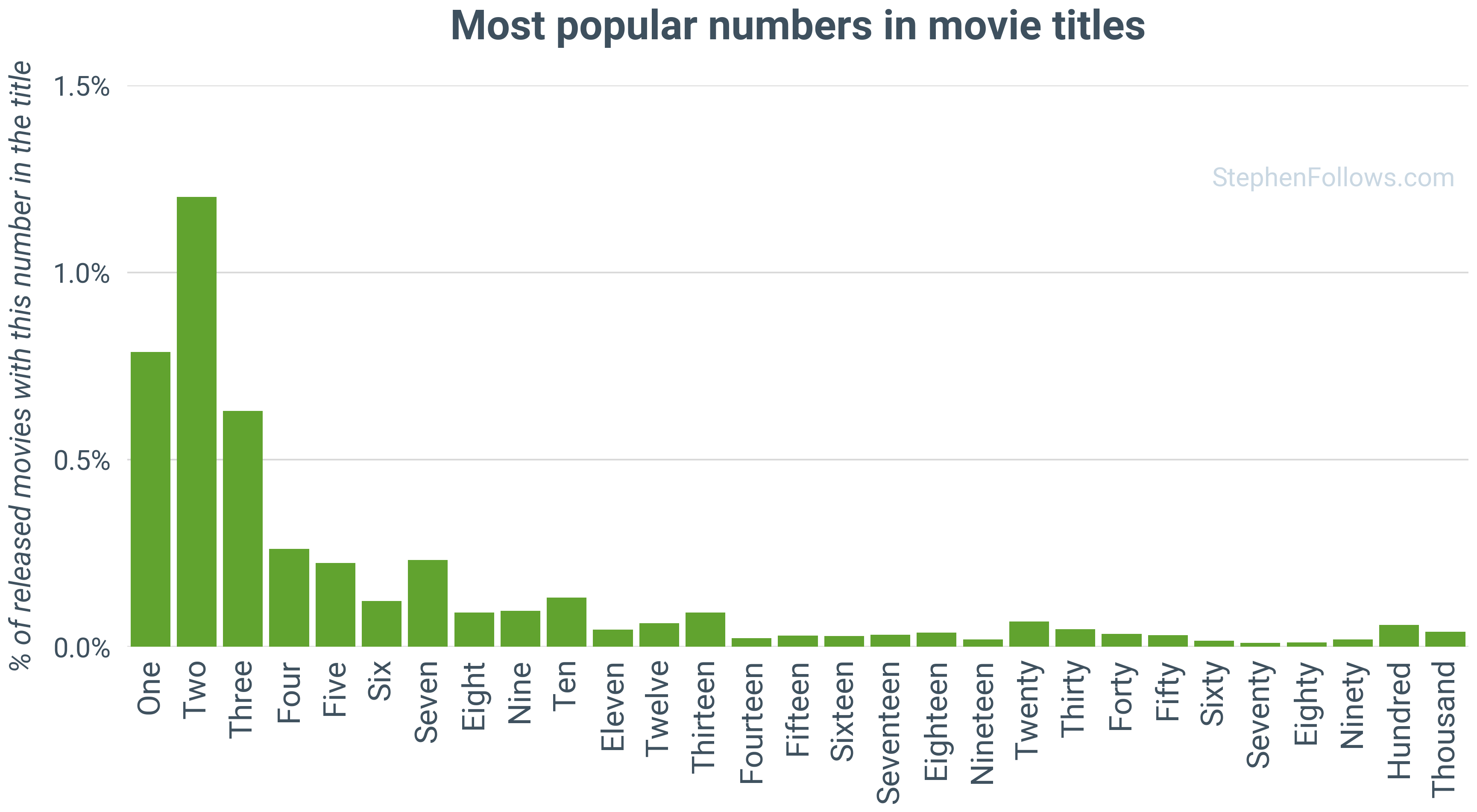
Some numbers are far more popular than others.
‘One’ and ‘Two’ are the most frequently used, likely because they fit well into phrases and character dynamics. Higher numbers appear less often but some, like 300 or 2012, have broken through.
Do numbers in titles affect box office success?
Matthew’s original question was asking if films with numbers performed worse than those without.
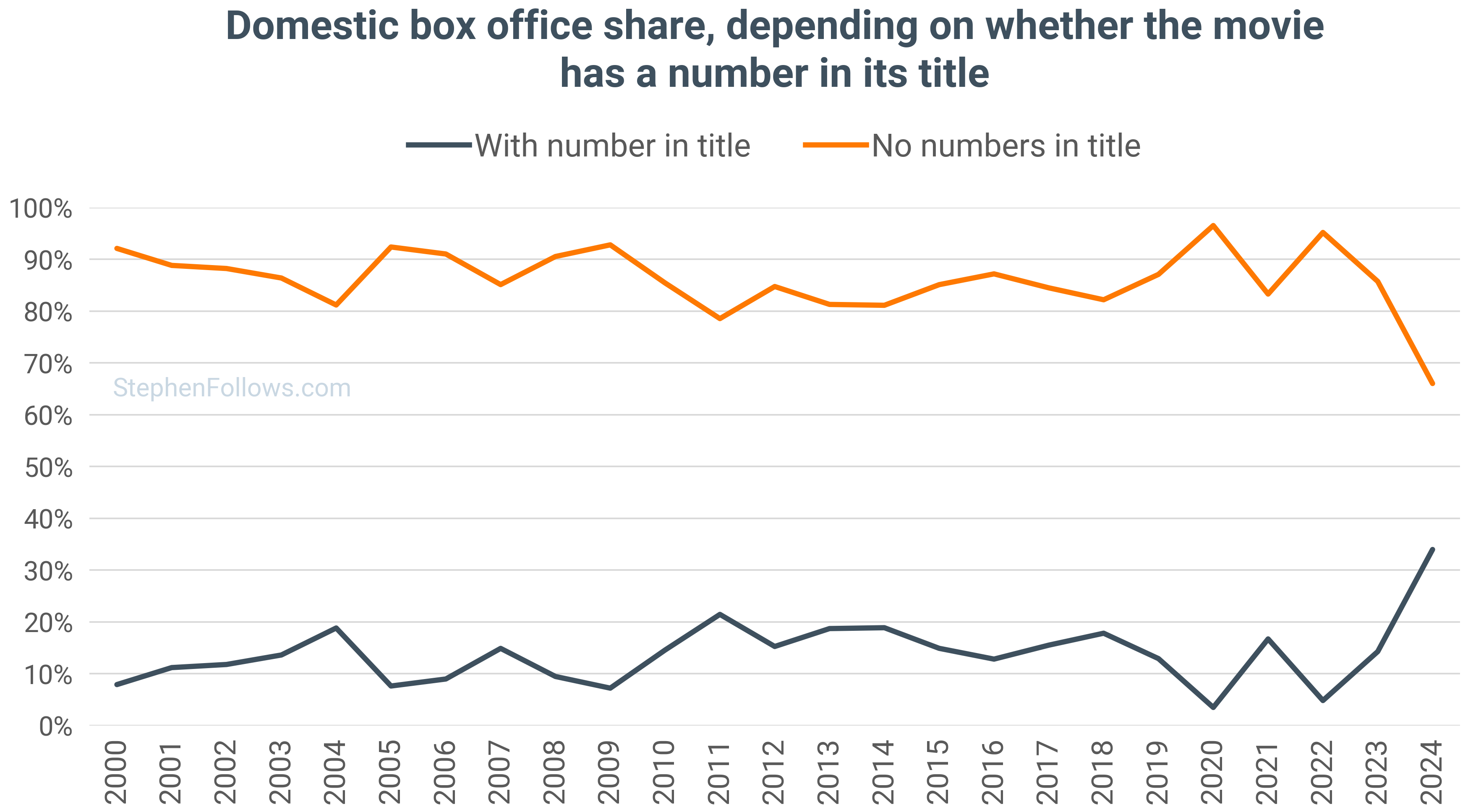
Films without numbers in their titles have historically dominated the box office. However, in recent years, that has changed dramatically. This is a mix of the increased production of numerically-aided movies we saw earlier and the fact that they are more likely to be well-funded sequels.
To try to account for scale, let’s take a look at the Domestic ‘Box Office to Budget’ ratio.
Here we can see that, for the most part, films with numbers tend to come out on top.
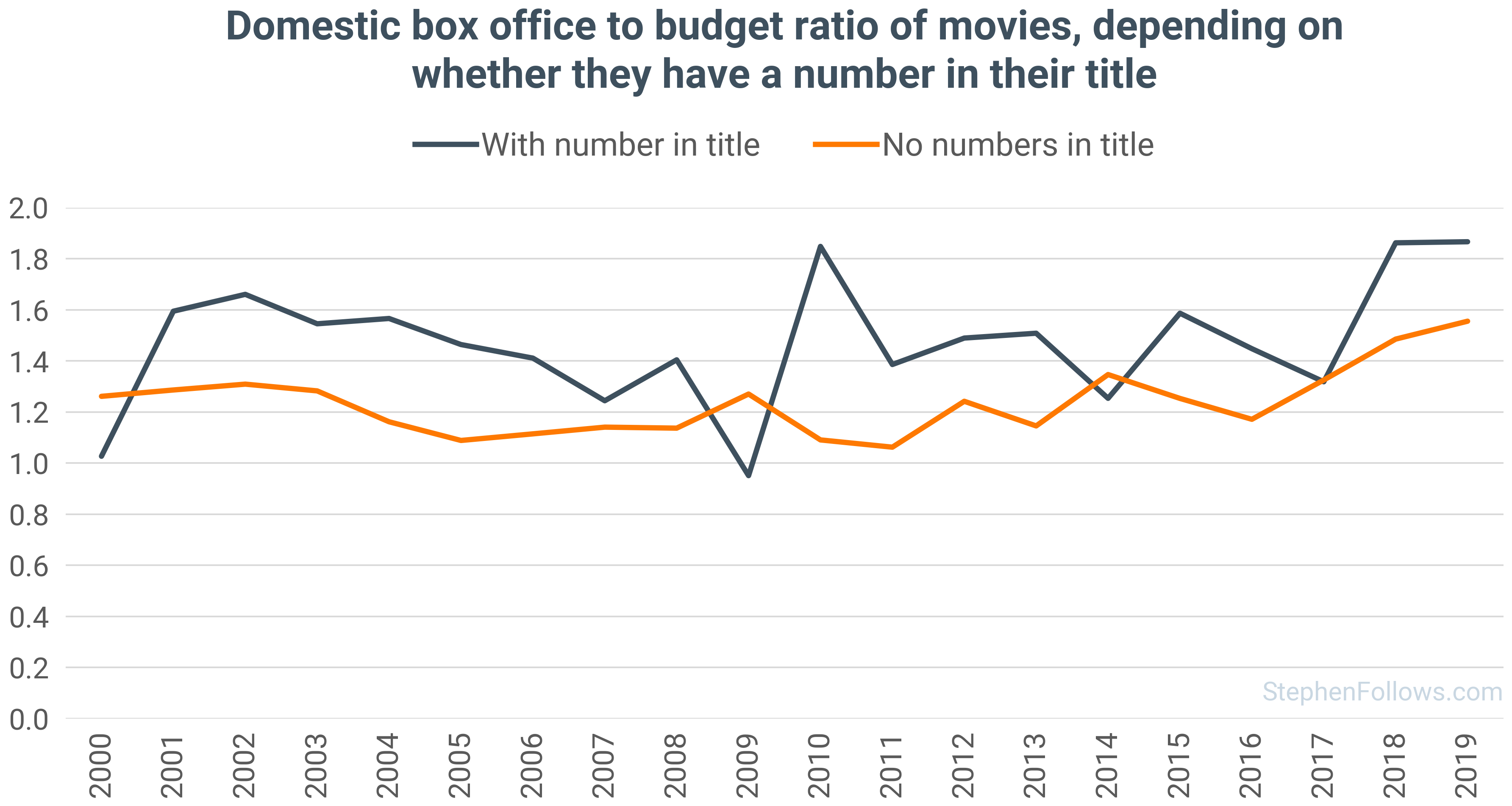
So for those who want to know the final score, it’s - No-numbers zero, numbers won.
Before we go, let’s quickly have a look at how the films differ in quality.
Are films with numbers worse than those without?
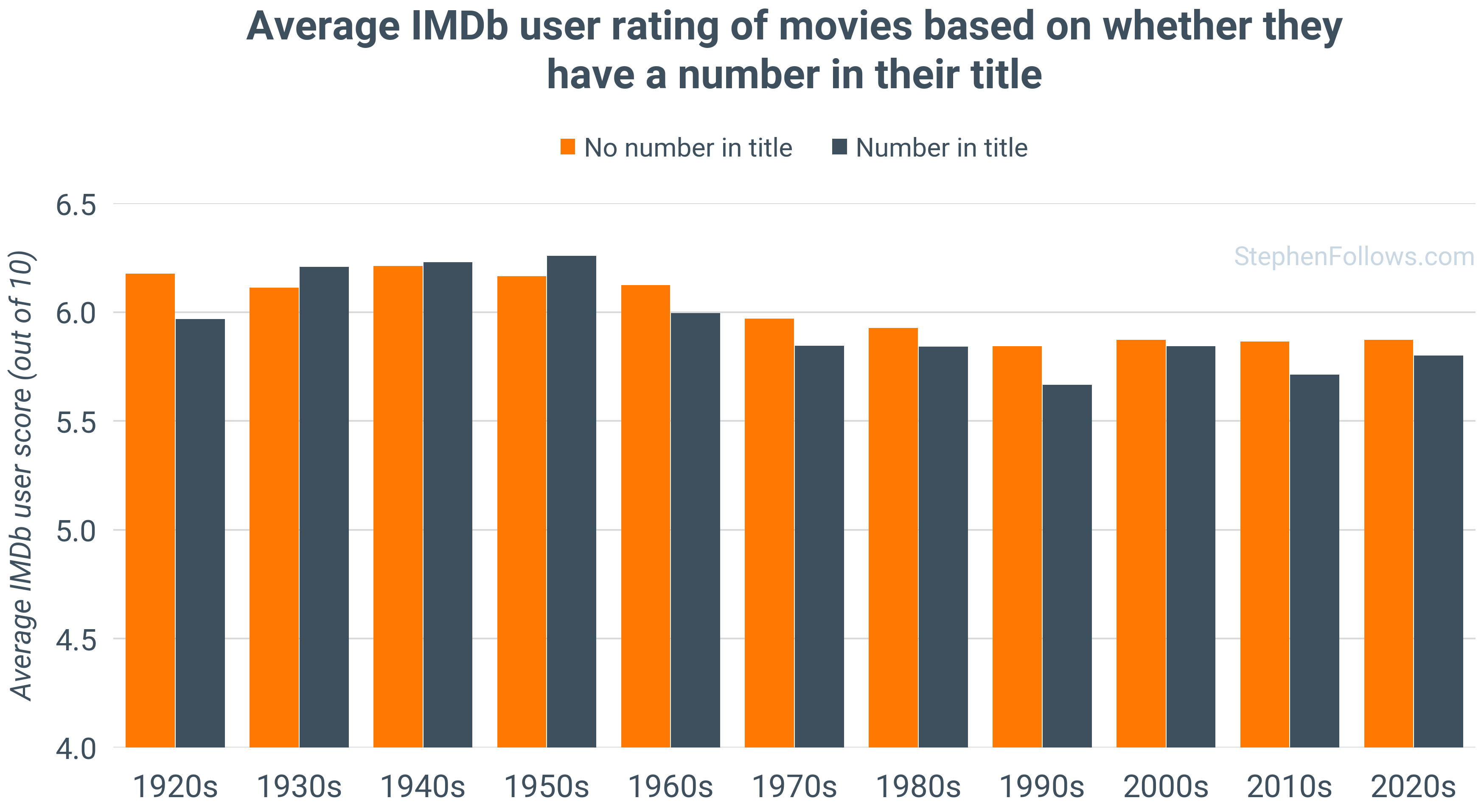
A little. Film audiences score films with numbers lower in 8 of the 11 decades, though never by more than a quarter of a point out of 10.
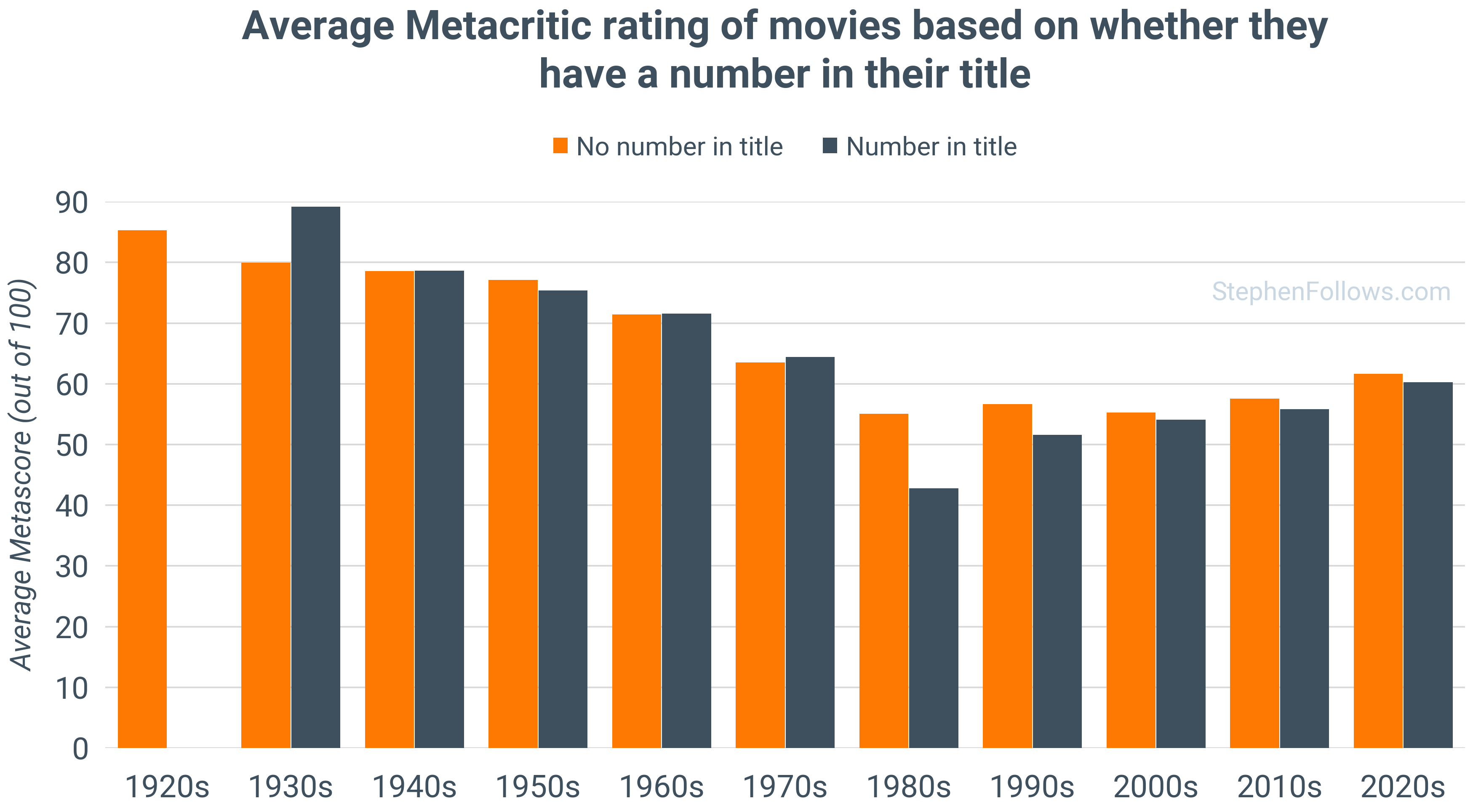
And film critics agree, scoring films with numbers lower in every decade from the 1980s on.
Are numbered movies more likely to be sequels?
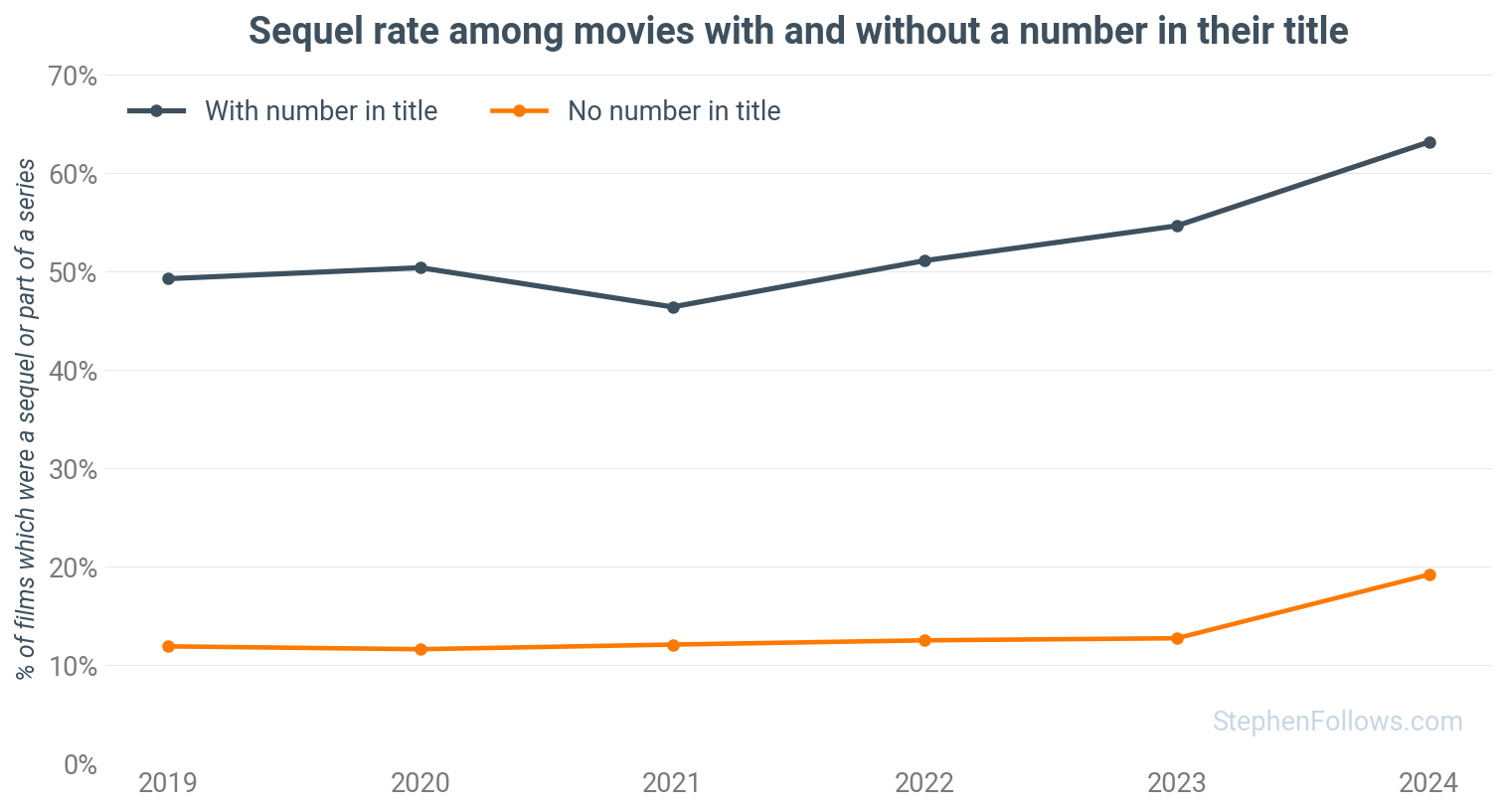
If you’ve been glancing at the chart above and thinking, ‘Wait, isn’t this just a fancy way of saying sequels love numbers?’ you are not wrong. But the data confirms that it is not just your gut feeling. There is a strong numerical bias in favour of franchises.
Since 2019, the proportion of films with numbers in their titles that were also sequels has hovered around the 50% mark. More recently, this number has shot up, reaching over 63% in 2024.
This suggests that if a film has a number in its title, it is increasingly likely to be part of a franchise rather than a standalone story.
So what does this mean for Matthew’s actual question: do non-sequel films with numbers in their titles underperform?
If numbers are now mostly associated with sequels, then a non-sequel film with a number in its title is an outlier. This could lead to audience confusion. A film called District 10 would be expected to follow District 9. If it did not, there could be marketing challenges.
It seems that if you are making an original film and want to include a number in the title, you won’t face an uphill battle at the box office. From 2000 to 2019, original films with numbers made $1.14 at the domestic box office for every $1 of budget, against $1.15 for those without. So it all comes down to how much you love that number.
Notes
I looked at the English language titles of all feature films over 60 minutes long.
I included broad numerical interpretations, so the data for the number 10 include uses of ‘10’, ‘ten’, and ‘tenth’, but 423 would not trigger ‘400’, ‘20’, or ‘3’.
I was focussing on films with numbers in their title, not ‘numbers’ in their title, meaning that Murder by Numbers and Drowning by Numbers did not make the cut despite their best efforts.
An honourable mention goes to the latter of those two, which apparently features all the numbers from one to one hundred throughout the film.
Does the popularity of numbers in a title reflect Zipf's law?
great read - as if we'd ever get a District 10 though!