


Last weekend I was at the Zurich Film Festival and attended a panel with some of the biggest names in film festivals. The topic of standing ovations came up.
Cameron Bailey, head of the Toronto International Film Festival, said that he felt that the trade press’ coverage of standing ovations was “ridiculous but useful”. He noted that at this year’s TIFF Palestine 36 received the longest ovation but barely any reviews the next day.
Tricia Tuttle, the director of the Berlinale, wasn’t sure of how useful they were as indicators of how the film may go on to perform, and asked me to look into it.
So I have.
I gathered every reported instance of a standing ovation at five major festivals (i.e. Cannes, Venice, Berlin, Toronto, and Sundance) from online sources and the film trade press.
How often are standing ovations reported?
Standing ovations at film festivals are a surprisingly recent invention. In the 20th century, Cannes and Venice audiences were far more likely to make headlines by booing than by applauding at length. Antonioni’s L’Avventura (1960) and even Palme d’Or winners like Taxi Driver (1976) and Pulp Fiction (1994) all provoked jeers.
The only notable exception came in 1984, when Sergio Leone’s Once Upon a Time in America received a 15-minute ovation at Cannes, widely seen as both a tribute to the director’s final work and a protest against the butchering of his cut for the U.S. release
It wasn’t until the early 2000s, with Bowling for Columbine (2002) and Fahrenheit 9/11 (2004), that marathon ovations became regular, timed, and reported.
Across these five festivals I studied (Cannes, Venice, Berlin, Toronto, and Sundance) since 2000, I found 529 screenings where an ovation length was reported.

From speaking to insiders, the consensus was that the recent surge owes more to the growing fashion for timing and reporting ovations than to a genuine surge in spontaneous applause. That said, it’s likely a symbiotic relationship, with increased coverage making ovations more common, and more ovations generating further coverage.
How long do these ovations last?
At Cannes and Venice, ten-minute ovations are commonplace, with Venice having an average reported ovation time of 8.7 minutes. By contrast, other festivals have shorter averages - Berlin (6.5 minutes), Sundance (6.4) and Toronto (6.3).

Looking more closely at Cannes, the festival most associated with marathon applause, the average length of a standing ovation in recent years has been around nine minutes. That’s down from peaks in the mid-2000s when films like The Artist (2011) and Mud (2012) drew ovations of around 20 minutes.
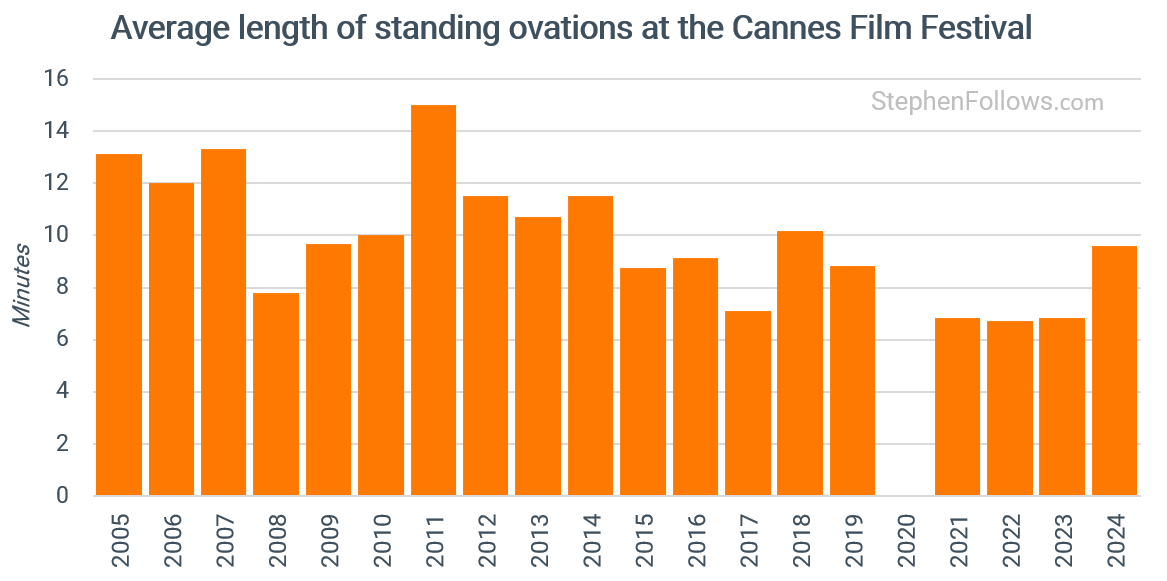
The longest recorded in my dataset is Fahrenheit 9/11 at 25 minutes, though others are not far behind. Joyeux Noël (2005) and Pan’s Labyrinth (2006) each at 20 minutes, and more recently The Room Next Door (2024) at 18 minutes.
By contrast, films such as Killers of the Flower Moon (2023) and Parasite (2019) were met with around nine minutes, which is relatively modest by Cannes standards, yet both went on to be critical and awards-season standouts.
Does it matter?
Tricia Tuttle’s request was to look at the correlation between applause length and the performance of the film.
Put another way, is the length of a standing ovation at a major film festival a useful indicator of the film’s future?
In a word - no.
There is no meaningful correlation between ovation length and the films’ awards performance, box office, or popularity with the public. There is a very slight correlation with Metascore and IMDb rating, but it’s not strong enough to be useful in any sense.
How accurate is the reporting?
Before we end, I did want to mention that this is a bit of a slippery topic to study objectively for a few reasons.
Firstly, what counts as a standing ovation is not as clear cut as it may first seem. When The Hollywood Reporter covered the Cannes premiere of Lee Daniels’ The Paperboy in 2012 they declared the ovation to be 15 minutes long, and that it moved the director and some cast to tears. However, a year later upon the film’s UK’s release, Robbie Collin wrote in The Daily Telegraph:
Readers of the film’s Wikipedia page may spot the claim that it received ‘the longest sustained standing ovation of the festival at 16 minutes’. As someone who was present at that screening, and the cacophonous quarter-hour of jeering, squawking and mooing that followed, I think Wikipedia may want to clarify its definition of ‘standing ovation’.
The film’s Rotten Tomatoes ratings (45% with critics and 33% with audiences), and poor box office performance ($3.8m worldwide on a $12.5m budget), chime more with the latter perspective.
Secondly, there is no universal criterion for timing the ovations. Despite the fact that the average Cannes ovation will be witnessed by almost 2,500 people (many of whom are professional journalists) there are a number of cases where the length of the ovations differs in reports the next day.
After a bit of data work and chatting to some insiders, this seems to be more about competing methodologies than conspiracy. Deadline appears to start the stopwatch at the beginning of the credits, whereas The Hollywood Reporter and Variety do so from the end
The chart below shows the average Cannes ovation length, based only on films where all three publications reported a duration. Deadline came in at the longest at 8.7 minutes, whereas The Hollywood Reporter and Variety largely agree at 7.4 and 7.0 minutes respectively.

Epilogue
I ran this article past Tricia to see if it answered her question. She confirmed it did, and in our conversation added:
I have always been circumspect about measuring world premiere ovations. As a Fest director, I know the premiere of any film has a high proportion of filmmakers, collaborators, friends and family. But I also love anything that ups the hype on cinema – we can use the buzz.
And that’s a perfect framing for this topic. Festivals are, after all, major part of an industry of storytellers telling stories about how they tell stories. The fact that there are stories about the screenings themselves should come as no surprise.
Standing ovations may not be science and they don’t correlate with what comes next, but they do add to the overall salience of a premiere.
So long as nobody mistakes them for hard data (and so long as they aren’t used to make business decisions or to disparage the people who made the films) they seem fairly harmless.