


Last week, I got pulled into a conversation with some friends about Donnie Darko. The debate quickly turned to whether the film’s hard-to-follow narrative held it back or whether that was part of its appeal.
I can’t answer it on a per-film basis, but I can look across the financial performance of many thousands of movies to tackle the question: Does it matter if the audience fully understands a film?
This builds on research I recently conducted on the profitability of over 10,000 films, cross-referenced against over four million audience signals. The work was for my new Greenlight Signals report, which breaks down which factors correlate most with profitability across genres and budget ranges. More details at GreenlightSignals.com

Today, I am focusing on how audiences perceived the movie’s narrative coherence. I.e. did it make sense to them?
Mid-movie mystery vs concluding coherence
Let’s start by defining terms. I’m not talking about whether audiences always knew what was going on while they watched the movie. Most movies involve some form of information withholding, and some genres positively rely on it (e.g., thrillers, horror).
Mystery is when a film withholds information on purpose, leaving the audience unsure until the right moment. Films such as Knives Out, Parasite or Arrival are full of uncertainty while they unfold, but the pieces fit together by the time the story resolves and the audience leaves the cinema.
By contrast, coherence is the extent to which the film makes sense once it’s over. Did the story hold together? Did events follow clear rules? Could audiences explain what they’d just seen to someone else?
To explore this properly, I used millions of audience feedback points to score each film’s coherence for viewers. I then correlated these scores with each film’s financial performance.
This gives us a single number showing how strongly narrative clarity is linked to a film’s commercial outcome, which I’m calling the Coherence–Profit Correlation. The higher the number, the stronger the link between an audience thinking a movie made sense and rewarding it with their cold, hard cash.
Overall, does coherence matter?
In a word, yes. Quite a bit for some types of movies.
Across the fifty groups in the dataset, forty-nine show a positive link between coherence and profitability. The strongest link was to be found among thrillers, comedies and dramas. The data suggests that for movies like these, it’s a bad idea to leave audiences confused about key plot elements.
At the other end of the spectrum, we have genres where the link is much weaker. Music films, romances and sports-based movies don’t seem to punish incoherence nearly as much.
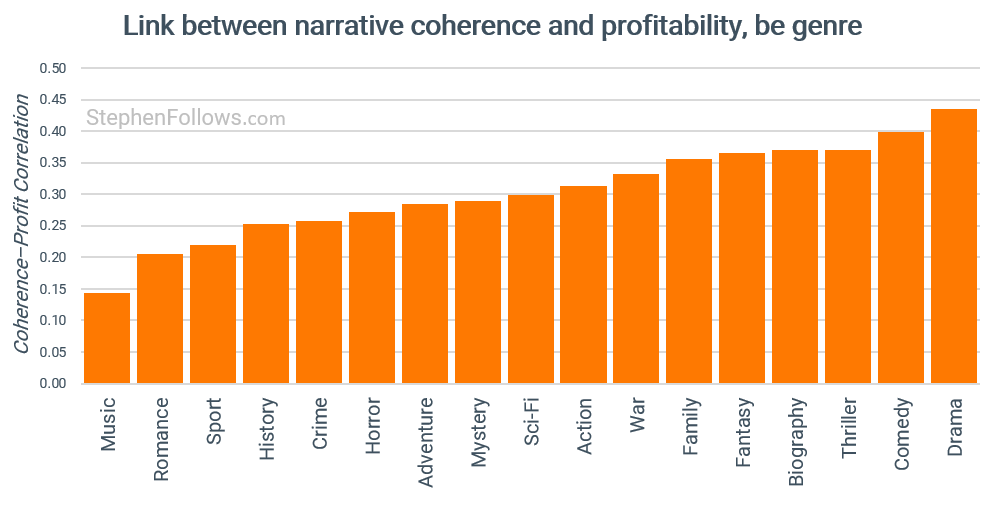
One could argue that the clustering of genres at each end represents the extent to which movie genres are cognitive vs emotional. You may want to really think about thrillers and dramas, whereas you want to feel music and romance movies.
For example, music films such as Mamma Mia! and Bohemian Rhapsody, as well as romances like The Notebook or La La Land, place more weight on emotional delivery than on plot logic.
Differences by budget range
The scale of the movie affects how strong this link is.
The weakest links are at the lowest end of movie budgets. In one case (low-budget horror), there is even a slight negative correlation. This includes movies such as Paranormal Activity and Terrifier, where atmosphere, novelty, or shock value mattered more than tidy story logic. (The connection here is weak, so we shouldn’t over-read this result).
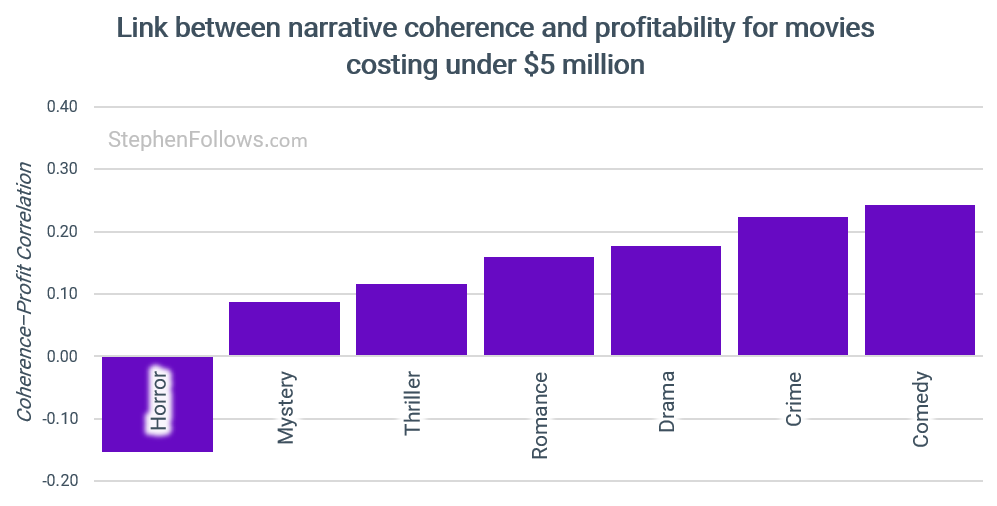
As we move up the budget range, we start to see stronger correlations, with horror moving into the stronger cohort of correlated genres.
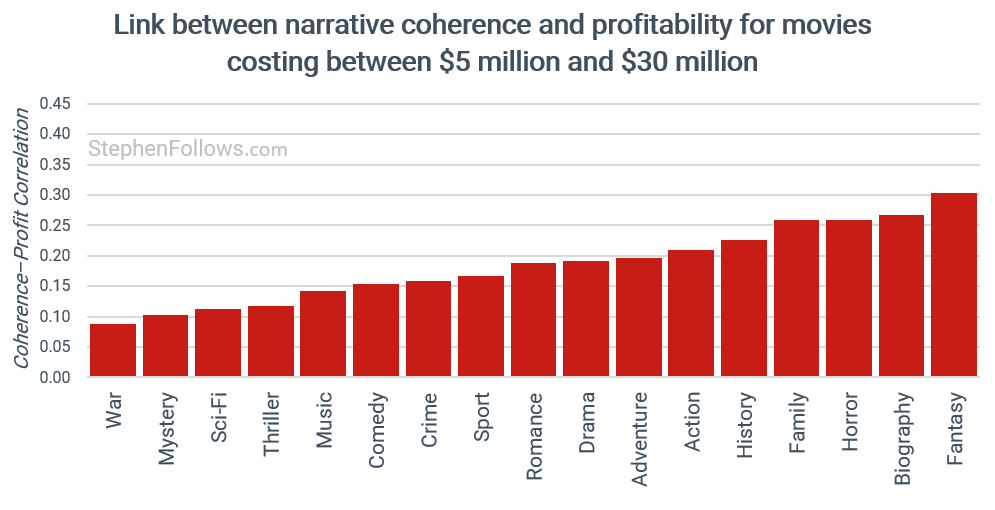
Once we’re firmly in studio-filmmaking territory, we see even stronger links. While war films under $30 million saw next to no meaningful connection, those over $30 million now seem much more linked.
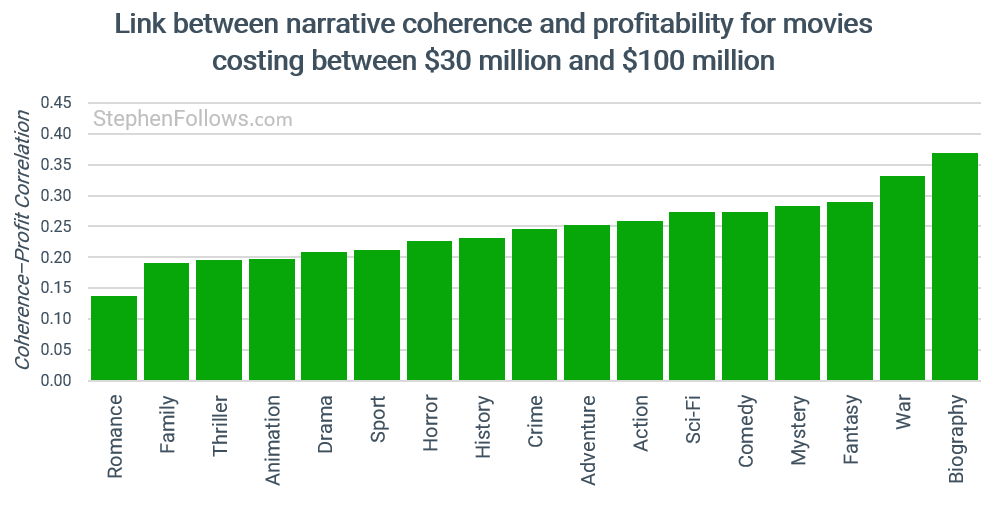
Finally, at the highest budget end, we had the most correlated genres: big-budget dramas, comedies, and thrillers. These are the types of films that rely on broad audiences and extensive marketing campaigns, meaning any loss of coherence can have a noticeable commercial cost.
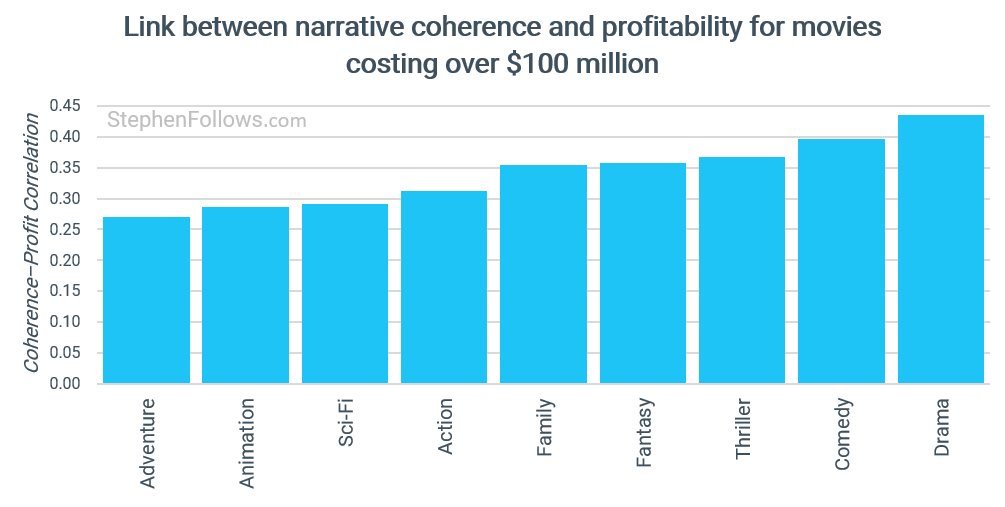
All in all, the data shows that Hollywood studios simply cannot risk leaving people confused or narratively unfulfilled, whereas indie films (which need to stand out) may be able to take bigger risks.
Notes
The analysis covered 10,524 fiction feature films with estimated profitability outcomes and over four million pieces of audience commentary.
Text data were processed using semantic models that capture meaning rather than surface language, allowing consistent comparison across a wide range of expressions and concepts.
Each film was represented numerically across hundreds of creative and audience-related dimensions, such as story strength, character focus, tone and perceived craft quality.
To control for scale and context, results were examined separately by genre and budget level, with only sufficiently large groups included.
Correlations between audience language patterns and financial outcomes were then calculated, and only the strongest signals were retained. The resulting patterns highlight where audience response most reliably aligns with commercial performance.
Epilogue
It bears repeating that none of this replaces taste, timing or invention. It simply gives film professionals a clearer view of where audiences tend to reward craft, and common mistakes to avoid.
At the end of the day, a kick-ass movie will beat any generalised model, and a bad movie will fail no matter how much it overlaps with past successes.
And as for Donnie Darko… I feel it sits in the small group of films where confusion didn’t hurt, and may even have helped. But that’s just my personal view.