


Since 2005, Franklin Leonard has run an annual survey of film industry insiders, asking for their favourite screenplays of the year that have not yet been made. The result, the Black List, has become one of the most watched documents in Hollywood. Get on it and, the story goes, your career changes.
There are really two claims tangled up in that reputation.
The first is that the list finds talent, i.e. it is very good at picking out the scripts and writers who matter.
The second is that it makes careers, as in, simply being on the Black List actively lifts a writer who would otherwise have stalled.
Those two things are not the same, so let’s test each in turn.
First, just how well do these scripts do?
Start with the scripts themselves. Of the 1,901 screenplays listed between 2005 and 2025, 576 have been made into films, and together they have grossed over $31bn worldwide at the box office.
That includes 103 films that grossed more than $100m each. Four Black Listed scripts have won Best Picture (Slumdog Millionaire, The King’s Speech, Argo and Spotlight), and a total of 74 have received Oscar nominations.
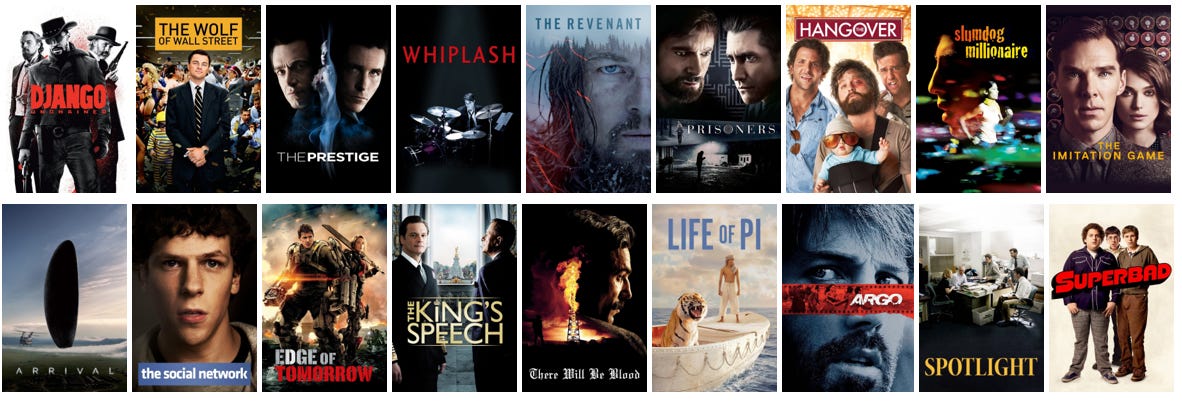
But raw totals can flatter. The fairer test is how these films compare to everything else released in the same era. So I plotted every Black List film against the wider field of films from 2005 to 2025, on two axes that matter: what audiences thought of them, and what they made.
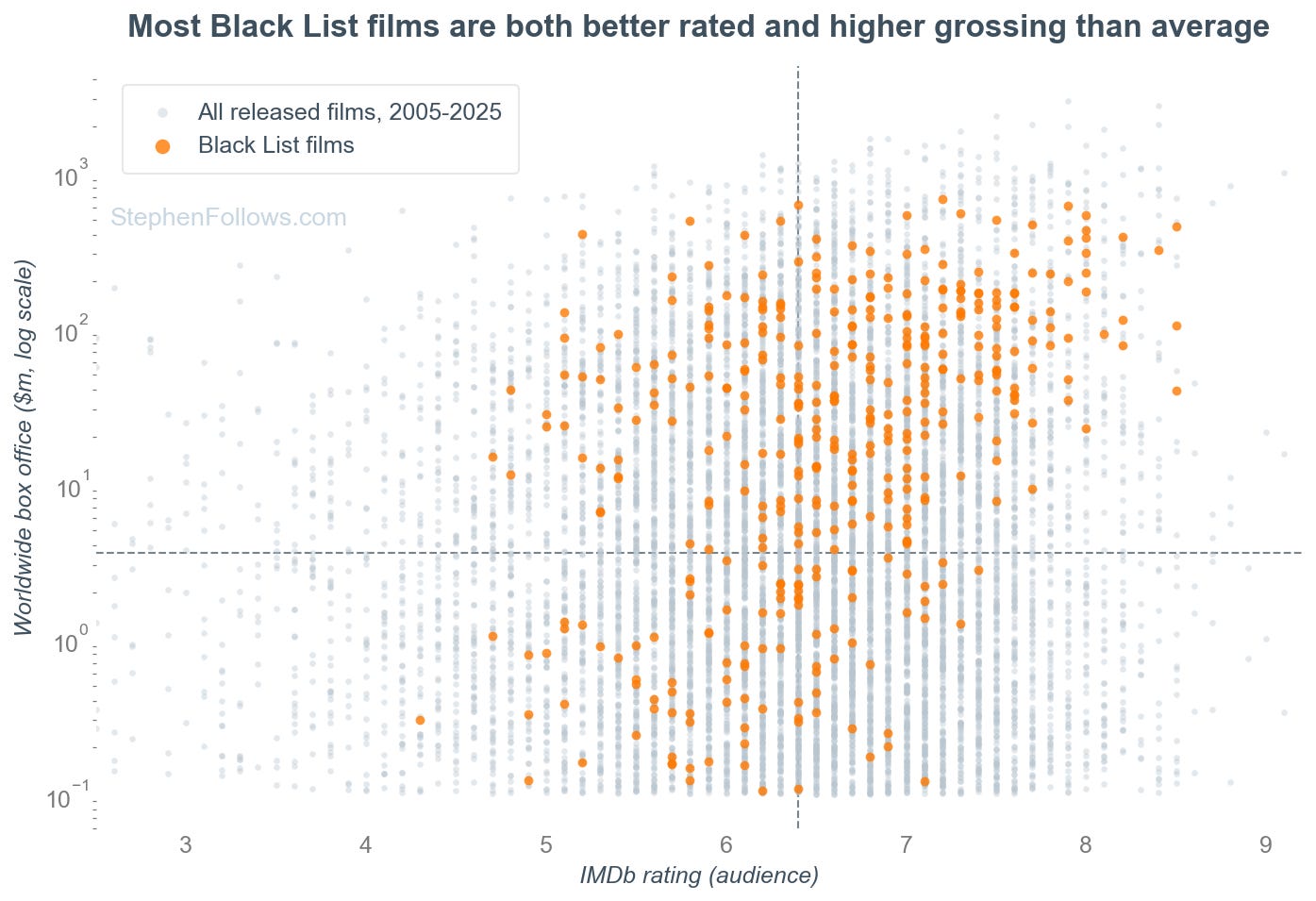
The Black Listed projects are represented by the orange dots, and they are not randomly scattered. I have added dotted lines at the median film, meaning that 25% of any random group of films will fall in the top-right quadrant of films that are both well-liked and commercially successful.
For Black List films, 55% land there, more than double that base rate.
Three-quarters out-gross the average film and nearly two-thirds out-rate it. The typical Black List film earns around $23m worldwide and scores 6.5 on IMDb, against 6.3 for the field. These are, on the whole, good films that make money. As a piece of talent-spotting, that is a very strong hit rate.
I am not the first to find this. In 2019, researchers at Harvard Business School ran their own numbers on the annual Black List and reached strikingly similar conclusions. They found that listed scripts were about twice as likely to be produced, and the resulting films earned roughly 90% more at the box office than comparable titles made on the same budget.
Does the Black List spot talent?
Let’s move from the produced movies to the writers behind them. If the list really has an eye for identifying talent, then the writers it picks should be on the rise.
To check, I used my own measure of fame (based on a mix of public sources) to track our writers’ visibility around the year they first appeared on the list.
Before the list, these writers are in a much lower position, and that position is static. Once they get listed, the line climbs and keeps climbing, roughly doubling within five years.
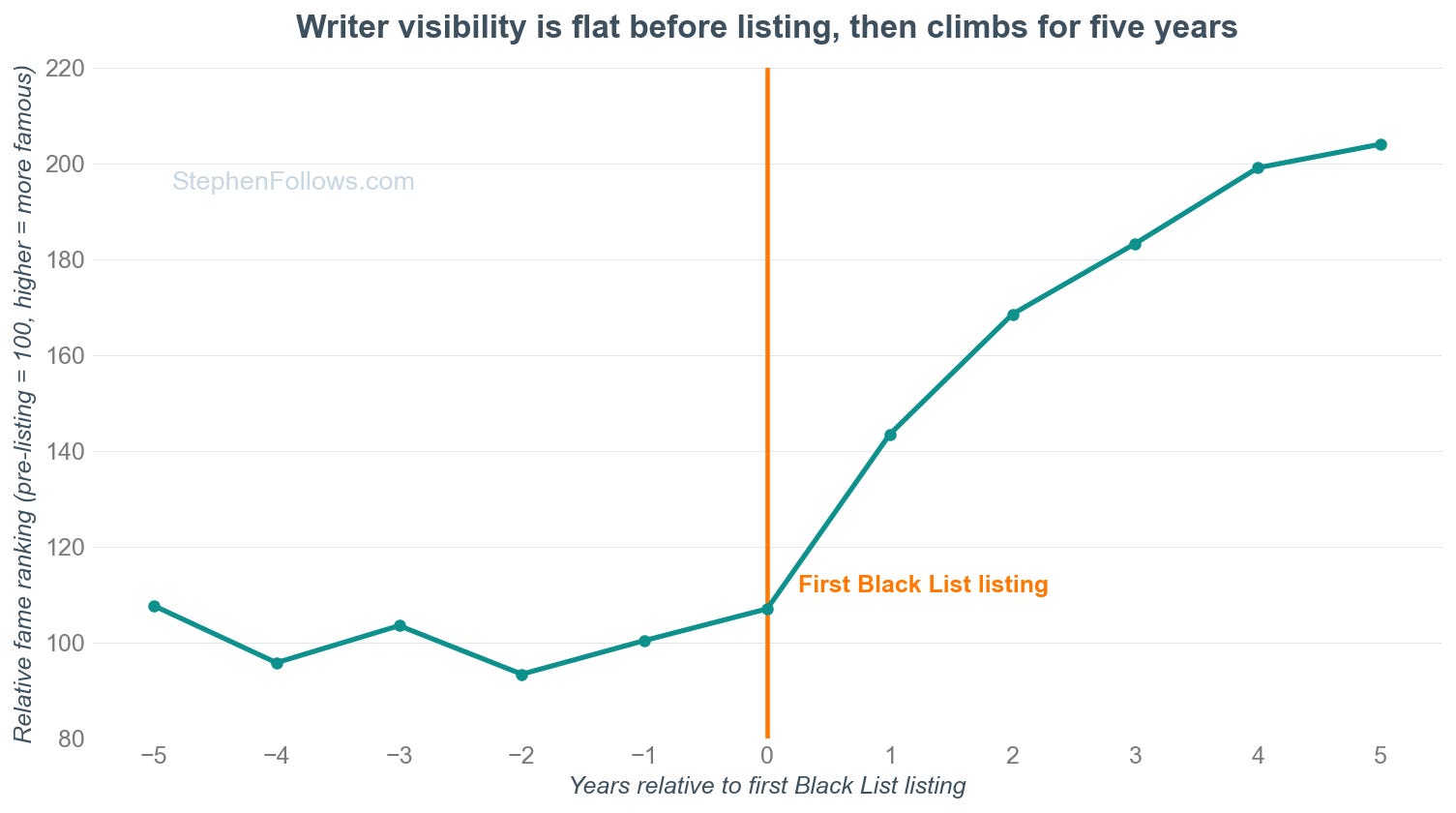
So the answer to the first question is clear. The Black List spots talent extremely well. Its scripts succeed, and its writers go on to careers that visibly take off.
Does the Black List make careers?
The climbing visibility line we’ve just seen certainly does look like a career launch.
But we need to consider causation here. The reason the writers have ended up on the Black List is that they’ve written something that has got some serious Hollywood folks talking about it. They just wrote something brilliant, meaning that the listing lands, almost by definition, at a moment when their career was already heating up.
How much of the rise is the list, and how much would have happened anyway?
One way to answer that is to compare these writers to others who were in exactly the same position but did not make the list.
So I built that comparison. For each Black List writer, I found a matched control: a writer with a released film in the same year and a similar number of prior credits who had never appeared on the list. Then I ran the identical before-and-after analysis on both groups.
Black List writers roughly doubled their output in the five years after listing, a factor of 2.15. And the comparable writers who never made the list managed a factor of 1.96 over the same stretch.
It’s fair to say that some of the “Black List bump” is what happens to any writer you catch at a hot moment, but not all of it. Black Listed writers sit consistently above their matched twins, outproducing them by roughly 18%.
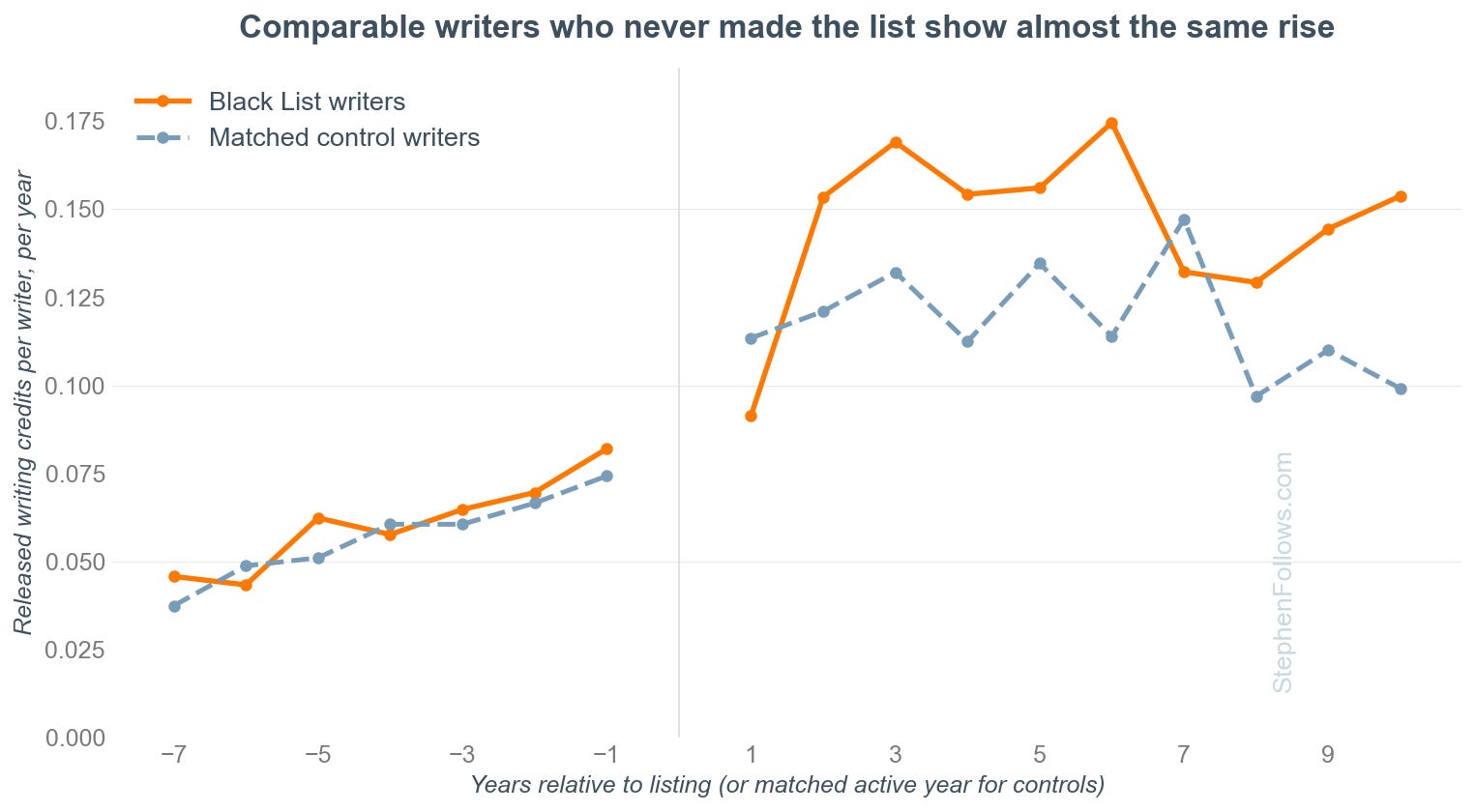
So being on The Black List provides a modest bump to an already on-the-up career.
It is not just writers it launches
Before we finish, here are two interesting tidbits I found along the way. While the Black List bills itself purely as a writers’ showcase, it is also providing fuel to directors’ careers.
More than a quarter of Black List writers have directed a feature film, and on a like-for-like measure they do so at over twice the rate of writers in general (35% vs 15%).
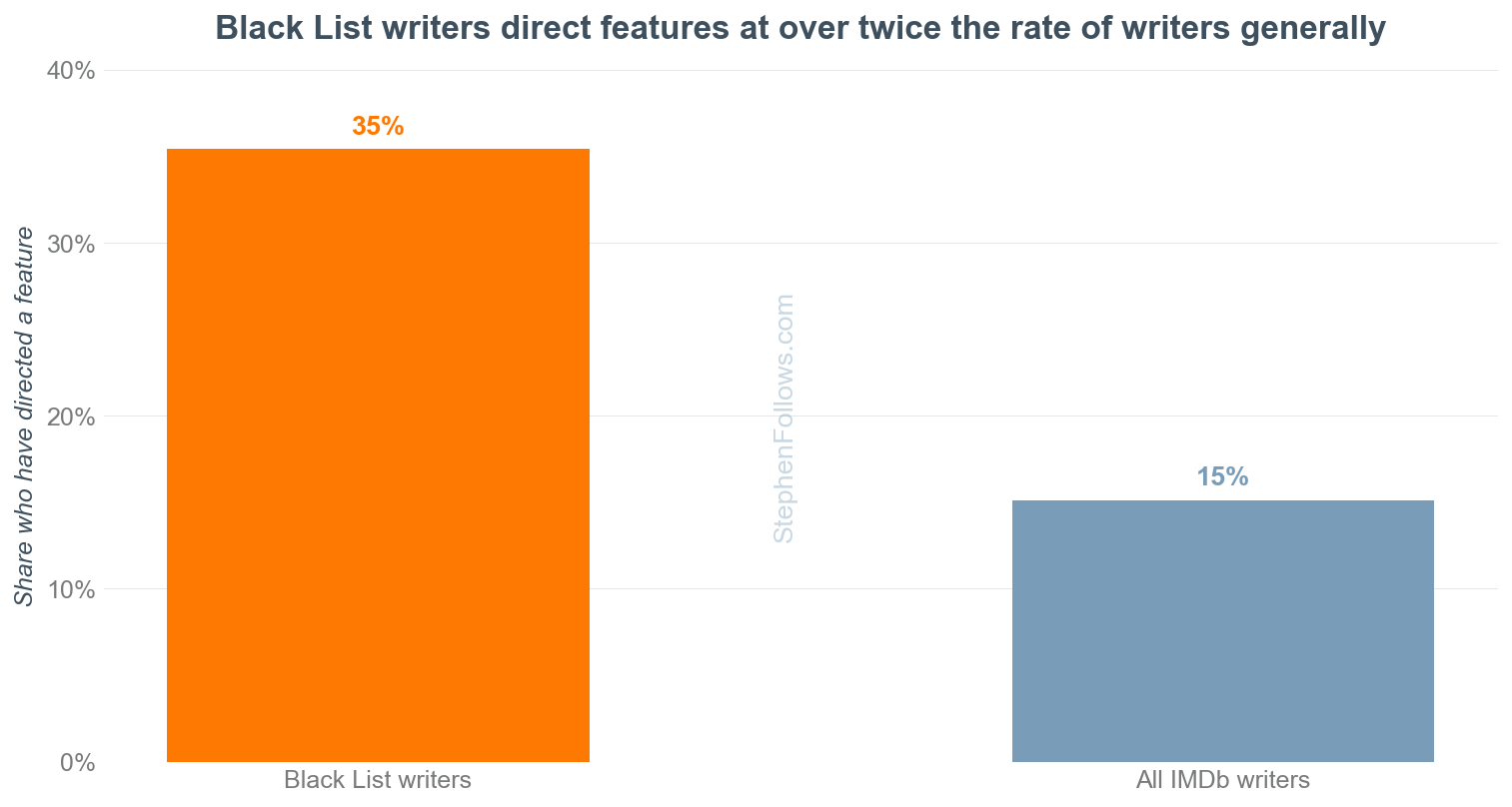
A full quarter of the Black List films that got made were directed by one of the script’s own writers, a group that includes Paul Thomas Anderson, Damien Chazelle, Emerald Fennell and Taika Waititi.

How quickly does it launch people?
The second data point I found concerns the delay between the script’s appearance on the Black List and its reaching cinema screens.
For the scripts that get made, the median time from listing to release is three years, and more than three-quarters arrive within five. The chances of a sale peak in years two and three and then fade away, so a script’s best window is early.
(That's looking at the share of films that are eventually made. Only about one script in three has ever been made, and most of those arrived within five years of listing).
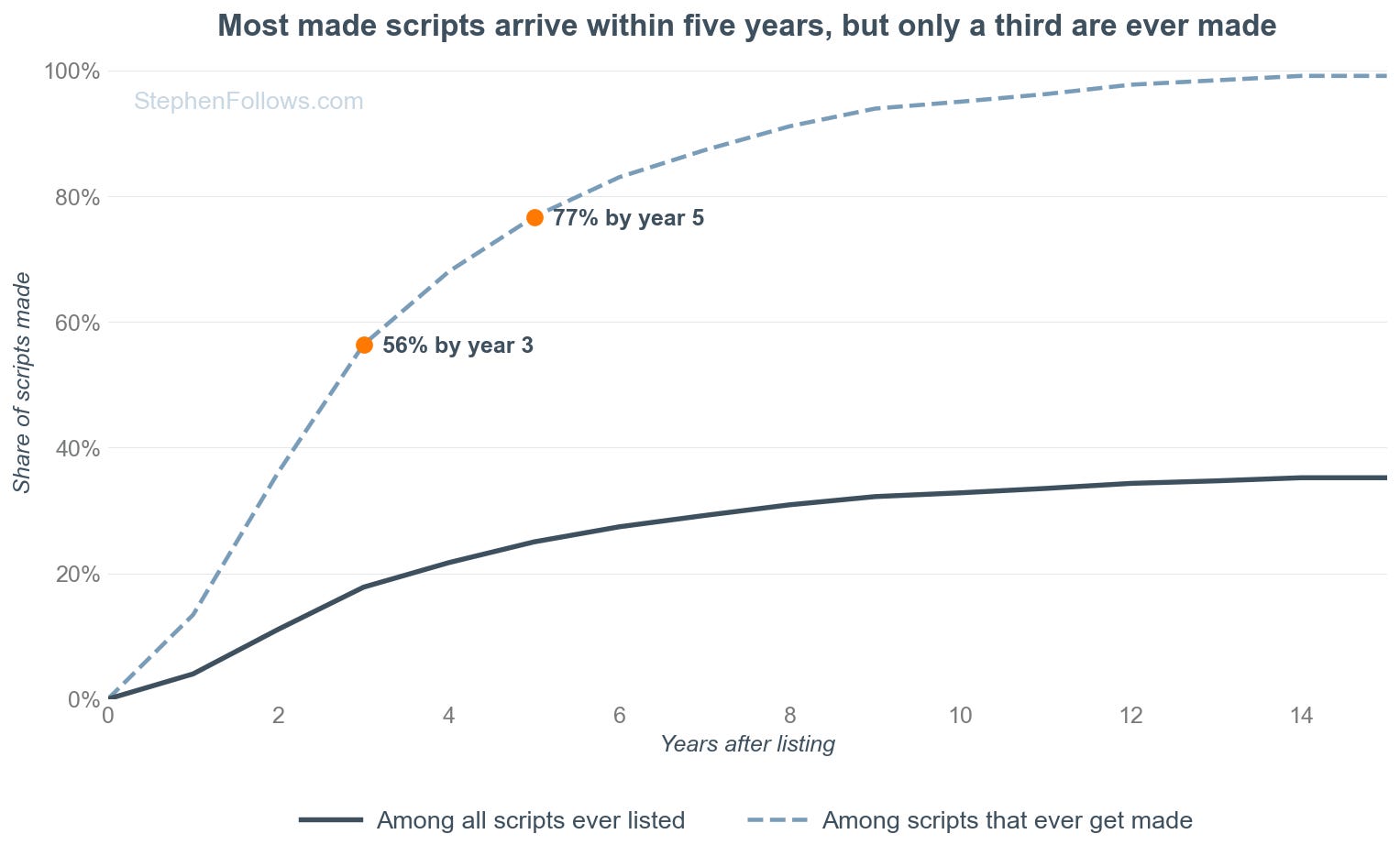
So the launch, where it happens, is reasonably quick. It just does not happen for most scripts.
The Black List is a superb spotter of talent, a modest maker of careers, and, for the majority of the screenplays it celebrates, a beautiful credential that never becomes a film.
Reaction from Franklin Leonard
Before publishing a study, I like to reach out to one or two people to see if I’ve missed anything obvious and to provide context. For today’s article, I chatted with the man behind the Black List himself, Franklin Leonard.
He’s a math whizz, so rather than being affronted that I turned his life's work into a few charts, he really engaged with the findings. He was also careful not to overclaim on what The Black List is and is not:
I try to be very careful about what we claim, because the truth is already strong enough, as your analysis shows. I’ve never believed that the Black List makes careers. A writer’s career takes off because they wrote something great, something good enough that the right people couldn’t ignore it.
What the Black List does is put a very bright spotlight on that script so that the people who should read it actually do. And once they’ve read it, they get involved with that script or come back to the writer for the next thing, and the next thing, and so on and so forth.
Ultimately, we’re a catalyst, and a catalyst isn’t a small thing, especially in a system so broken that an almost laughably rudimentary data study can consistently beat the market.
And it’s still an incomplete solution to the deeper discovery problem. The annual list can only do what it does for scripts already in circulation, the ones that are already in the right rooms.
That’s actually why we built the website: To be the same catalyst for writers who might not be in the room yet at all. But the principle’s the same either way: If the work is good enough, it should have opportunities commensurate with its merits, regardless of who wrote it, where they live, or who they happen to know.
I’m very grateful to Franklin for his good nature and time.
Notes
I looked at every annual Black List from 2005 to 2025. That’s 1,901 scripts, 2,222 writing credits, 1,682 writers matched to a verified IMDb profile.
On the scatter plot, each point is a commercially tracked film released from 2005 to 2025 with a worldwide box office figure, an IMDb rating, and more than 1,000 votes (to exclude obscure titles). Box office is on a log scale. Black List films are those whose listed script reached the screen.
When creating the career control groups, each Black List writer was matched to one non-Black List writer with a released feature in the same year and a similar number of prior credits, drawn from the full IMDb writer population. Both groups are measured using the same before-and-after method, which ensures a fair comparison.
This research shows correlation, not proof of cause. The matched comparison strongly suggests that most of the career rise is due to selection and momentum rather than the list itself, with a smaller genuine lift on top. My measure of fame measures attention, not quality, and reacts to events such as releases, awards, deaths, and scandals.
The Harvard Business School study referenced above is by Hong Luo and colleagues. The accessible write-up is at HBS Working Knowledge, with the academic record here.
I’ve grown highly skeptical of the Black List due to what I view as a track record of misleading public statements from Franklin Leonard regarding his operations. Letting the owner essentially plug his unrelated, controversial business right in the article wasn't exactly reassuring.
Doing my best to put that aside, I have some reservations regarding your analysis of the 18% credit differential. While I recognize that you explicitly constructed a control group by matching writers in similar positions to isolate the list's impact, the comparison itself remains fundamentally skewed. Matching writers on observable baseline metrics fails to capture the critical, unobservable variable that actually lands a script on the annual Black List: latent industry momentum.
The annual Black List does select these scripts themselves, it simply polls the industry on scripts executives are already buzzing about. To get onto the list in the first place, a script already needs an immense amount of existing advocacy, representation, and internal momentum. Therefore, your control group doesn't represent identical writers where one randomly received a "Black List bump." Instead, the comparison is inadvertently drawn between writers who already possessed critical mass in development circles and those who, despite looking similar on paper, simply lacked that specific pre-existing institutional heat. The 18% credit delta is almost certainly measuring that initial variance in insider reputation rather than an independent lift generated by the list itself.
This quote's interesting:
"What the Black List does is put a very bright spotlight on that script so that the people who should read it actually do."
What you could argue from the numbers is that the black list puts a very bright spotlight on those who decide what goes on the black list. All the data can work to legitimize that spotlight.