


Every year, tens of thousands of screenwriters pay to enter contests. A major selling point for them is that winning (or placing highly) will mean that the right people will finally read your script.
Some competitions directly provide top scripts to influential industry people during or just after the competition runs. Beyond that, the implication is that having placed well in their competition will be a mark of quality you can use to get people to notice you.
Final Draft’s Big Break says:
Enter the contest that has been launching screenwriting careers for over 20 years.
Winners and finalists have signed with agents and managers, sold and optioned scripts, and been staffed in TV writers’ rooms.
Is this the year for YOUR Big Break?
The PAGE International Screenwriting Awards say:
many dozens of our past winners have secured representation, landed paid writing assignments, signed option agreements on their work, and many now have movies and television shows in production, on the air, and in theaters.
The BlueCat Screenplay Competition puts it like this:
we’ve consistently introduced our winners and finalists to the industry, launching numerous successful careers in film and television.
BlueCat has a long and distinguished history of discovering unknown screenwriters, introducing them to the industry and launching their careers.

I wanted to test the utility of winning or placing highly in these competitions, so I reached out to a number of top Hollywood agents, assistants, and junior execs who handle the first read. In the end, 38 shared their thoughts.
I’m going to split the results over two articles, as there were a lot of great nuggets that came out of it.
So what actually gets a script read?
I asked each person how a given thing mentioned in a cold query would affect their likelihood of actually reading the script. I have converted those answers into a score ranging from -2 to +2, where 0 indicates no difference.
In the chart below, the dark blue bars represent what I think of as industry pre-validation, and the orange bars represent competitions open to all.
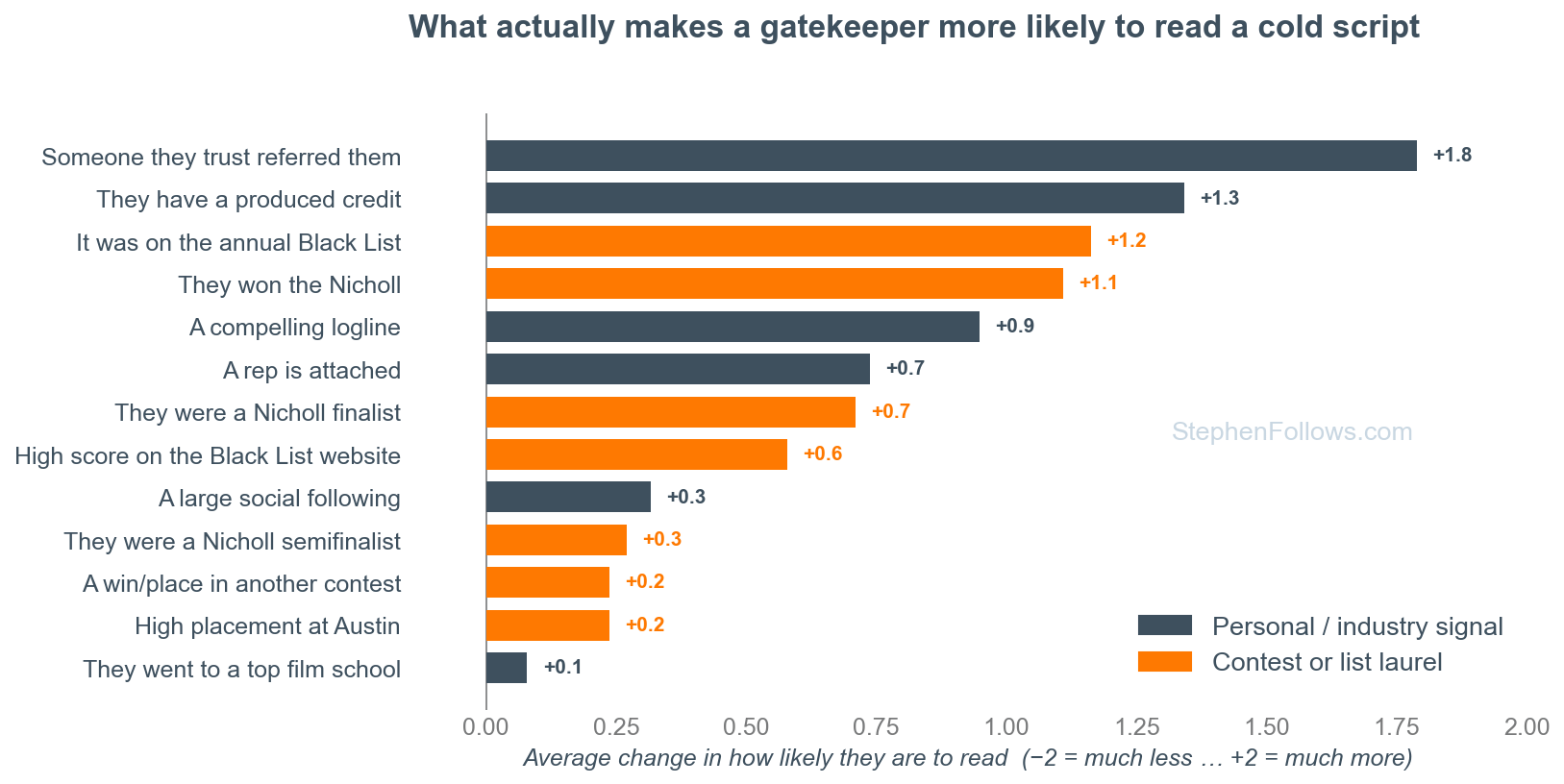
Nothing beats a referral from a trusted contact. And the second most important signal was also an indicator that the industry has pre-validated you - namely, that you had already had a script produced.
Real work, and a warm introduction, beat every competition by a long way.
To help get a sense of this perspective, it’s worth listening to UTA literary agent Peter Dodd in a 2016 interview on the Scriptnotes podcast. He described himself as ‘a recommendation-based engine’ and when asked whether a single client had ever come to him through a query letter, he replied:
Never happens.
The annual Black List was the highest-ranked “competition,” although it’s not quite the same as the others. To get on it, your script needs to have already been read by well-placed people in the industry, so while it’s technically open to all, it also fits the model of industry pre-validation.
By far and away the most useful competition to win if you’re a true industry outsider is the Nicholl Fellowship. This is from The Academy of Motion Picture Arts and Sciences (the folks handing out Oscars), and it awards up to five winners $35,000 each to spend a year writing.
(Minor note, but it is arguable if the Nicholl Fellowship really is “open to all” any more. Last year they changed their rules to only accept submissions through partner universities, labs, and the Black List website or the Writers Guild Foundation).
Even a high placement at Austin, a win in another contest, or being a Nicholl semifinalist barely have any effect. A handful of the experts said it actually makes them less likely to read:
I want to know WHY I should look at something. Compel me. I don’t care which competition (that usually no longer exists) gave the script a high score.
The Nicholl cliff
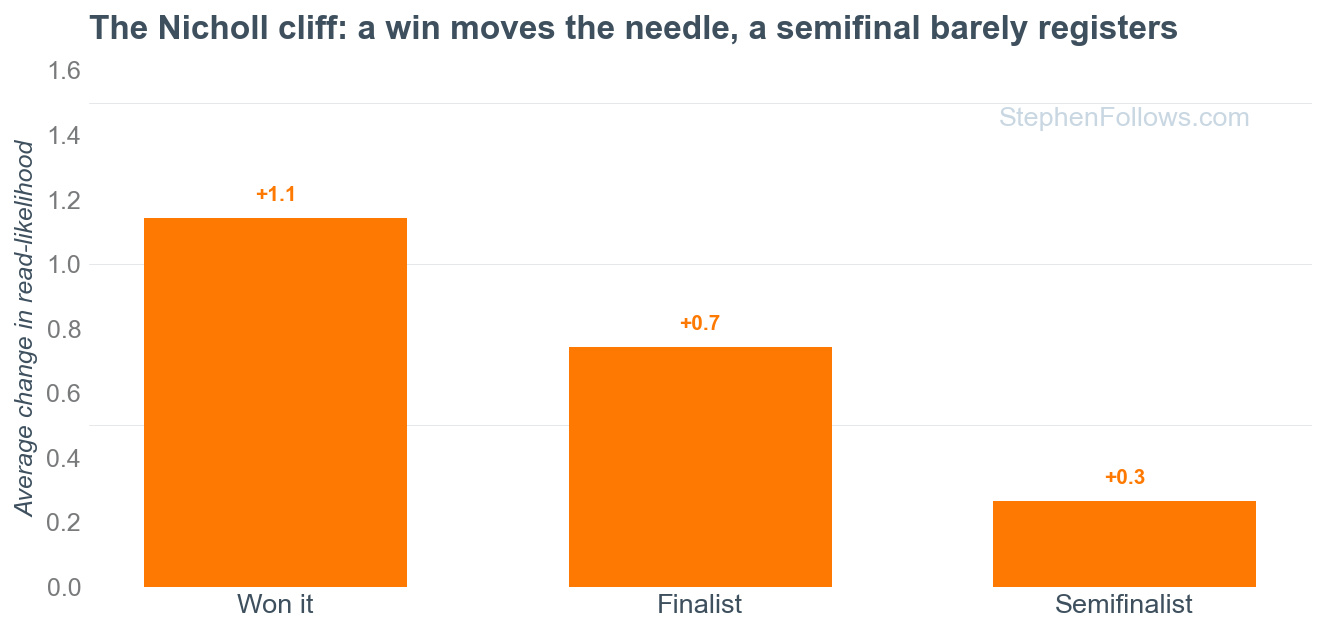
While winning the Nicholl Fellowship is a clear advantage, the drop-off to later placements is steep.
Winning was worth +1.1 (on my five-point scale from -2 to +2), but being a finalist drops to +0.7, which was the same as having a rep attached. A semifinal place falls to +0.3, which is almost nothing.
Which screenwriting contest does the industry respect?
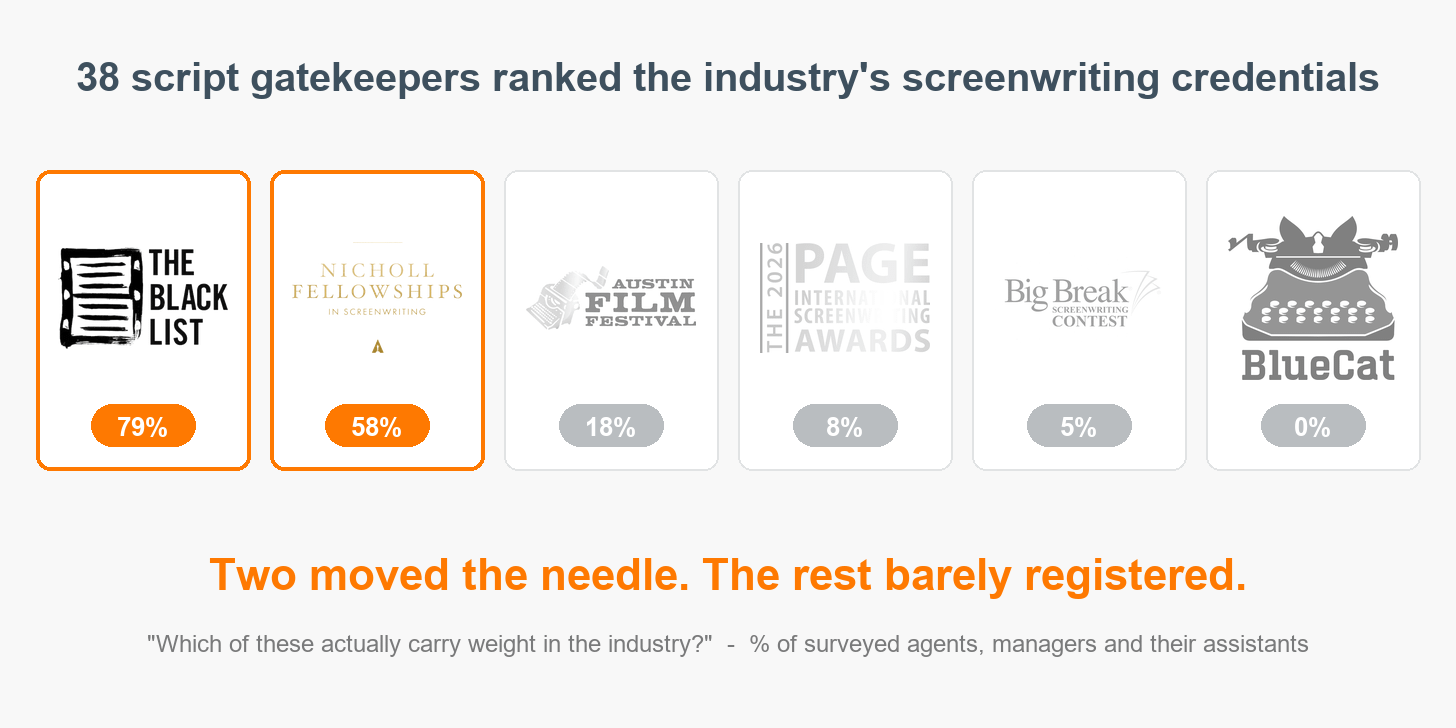
As a follow-up, I also asked everyone, “Which of these actually carry weight in the industry?” and listed some of the biggest screenwriting competitions.
This is obviously a highly subjective question, so all we’re measuring is everyone’s opinion.
Here again we see the annual Black List top the poll, in an exact tie with Sundance’s programmes (i.e., its Labs: Screenwriters, Episodic and the rest) and with the Nicholl Fellowship a distant third.
Outside of those top three, it’s slim pickings. This is a rather stark answer as they could pick as many as they wanted. So it’s not a case of the top ones crowding out the others; rather, they really don’t think the others matter.
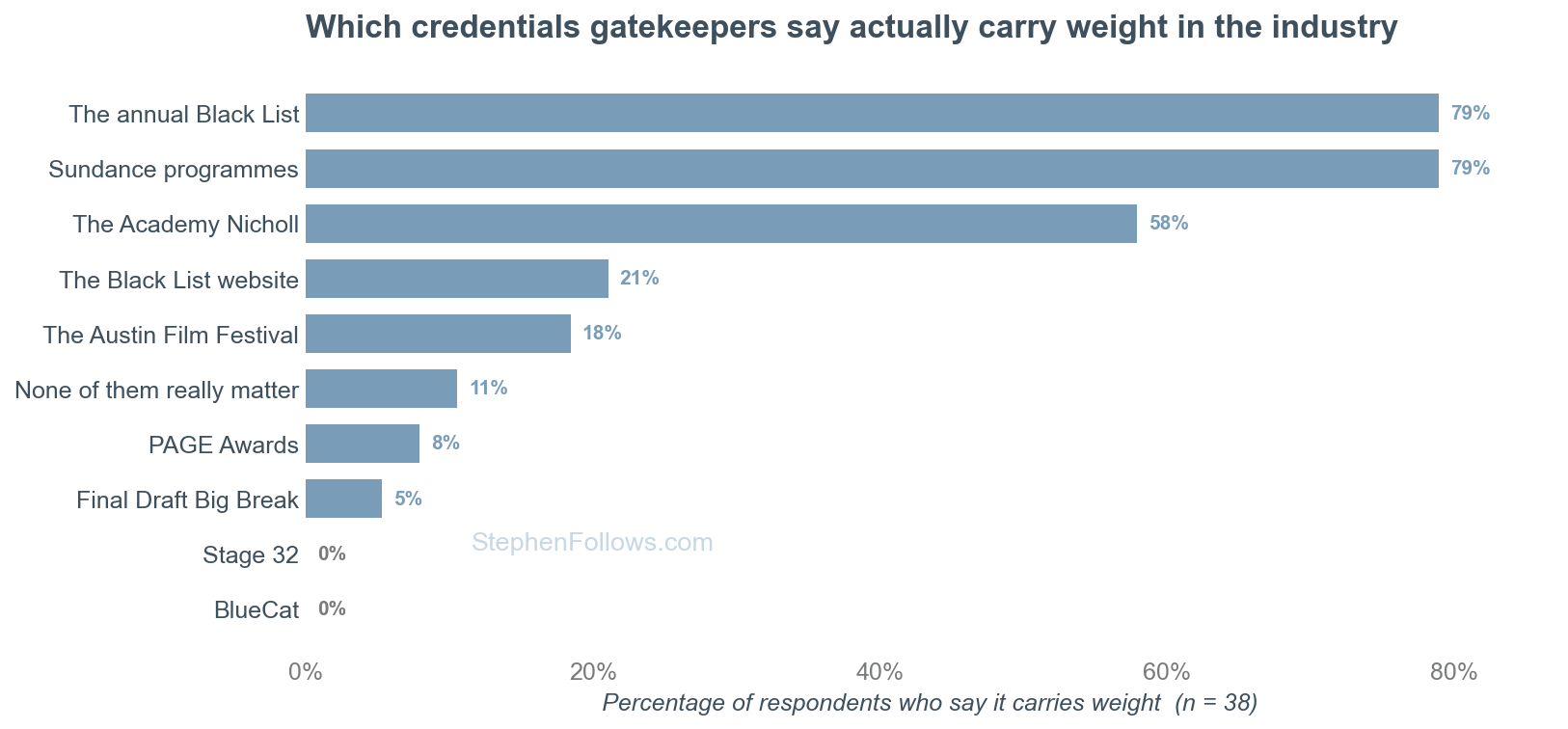
Underneath those three, everything drops off a cliff. The Austin Film Festival, the biggest name in the next tier, gets just 18% of the votes. The paid contests that market themselves hardest to writers sit at the very bottom. BlueCat and Stage 32 were picked by nobody at all.
One agent, asked what gets them to read a cold query, said:
There are a handful of writing competitions like the Black List, Nicholl Fellowship, Channel 4 Screenwriting, BBC Writersroom competitions that if you win or are a finalist, they pique some interest, but I would say the absolute BEST way of getting your work read is through reputable recommendation... Sadly the old tale of “it’s not what you know, but who you know” plays a big role in getting your material read.
The Black List and its website are not the same
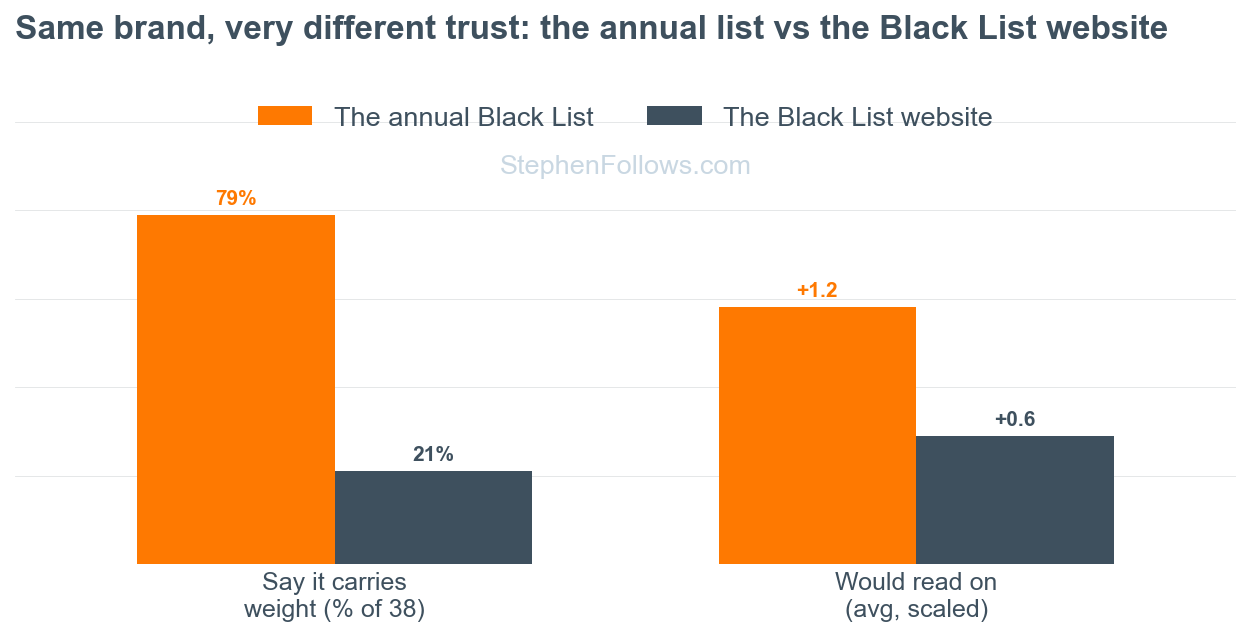
The annual Black List (the year-end list of the most-liked unproduced scripts) and the Black List website (the paid script-hosting and evaluation site) are treated very differently by the people I canvassed.
The annual list is named as carrying weight by four out of five, and scores +1.2 on read-likelihood. The website is named by just 21%, and scores +0.6, with three people saying a high website score makes them less likely to read.
How much of a script do they read?
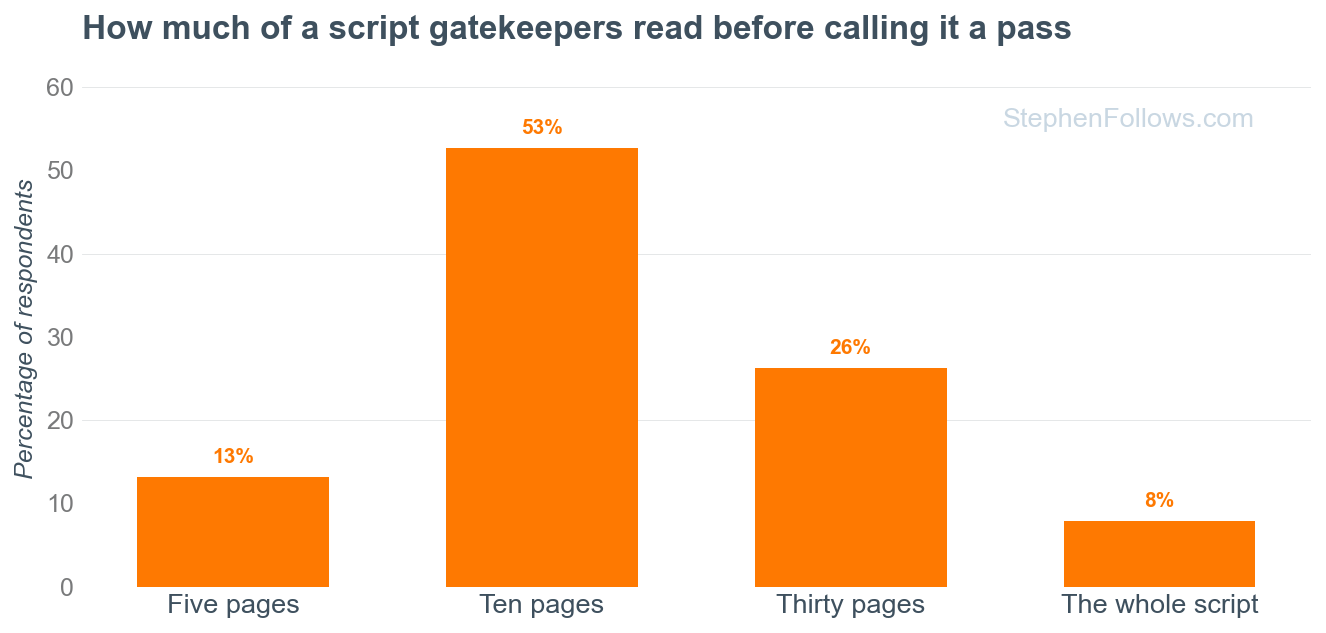
I also asked how much of a script they read before they know it is a pass.
The most common answer, from more than half of respondents (53%), was ten pages. A further 13% said they only need five. Put those together and roughly two in three gatekeepers have decided your script’s fate before the end of page ten.
The more patient 26% hold out until page thirty, which is roughly the end of the first act. And just 8% said they read the whole script before passing.
So, do contests get your script read?
For two of them, sometimes, yes. Being on the annual Black List or winning the Nicholl puts a writer just below a produced credit, and both clearly help.
For almost everything else with an entry fee, the honest answer from the people reading the scripts is - not really, and occasionally the reverse.
But the thing that beats every contest, every time, is a person the reader already trusts saying ‘read this’.
However, I don’t wish to imply that that is the only proposed benefit of entering a competition. Entering a script competition provides something every writer wants (i.e., a deadline), and many also provide what writers need (i.e., feedback).
In addition, the moment a script wins, it is likely to catch the eye of many industry watchers. Many competitions have distinguished industry names on the judging panel, and some even offer mentorship and connections as the core prize.
Break the rules
To end on a more hopeful note, I wanted to point out that this is what people told me, not what they always do. There are instances where a cold email with a less-than-top-tier placing in a competition can lead to glory.
In August 2020, unknown writer Sophie Dawson sent literary manager John Zaozirny a cold query that led with a Nicholl quarterfinal placement. The whole email, as later published, read:
Hi John! My dark comedy just made the quarterfinals of the 2020 Academy Nicholl Fellowships competition! Would you be interested in taking a look?
Four months later her script Headhunter was the number one script on the 2020 Black List.
As Zaozirny tells it:
Sophie was someone I found off of a query letter in August and four months later she was the number one writer on The Black List.
So don’t let anyone tell you to stop trying - least of all me.
Thank you for exposing some truths; no doubt you will earn no friends with this one. To be fair, Nichol and Blacklist are in bed together now. Most screenwriters wouldn't qualify for Nichol anymore; it's shall we say, 'exclusive'. For someone like me, with 37 years of experience in filmmaking (which has zero bearing according to both groups; imagine if they included IMDB filmmaking credits...but that would be a free earned pass, wouldn't it). So for someone like me, our only 'in' is to pay BL for a good review. Pay to play; este es no bueno. Most if not all recognized screenplays on the BL are signed writers; at the end of each year, they throw a token unsigned writer into the best of list. And even that token writer seems suspect, honestly. So perhaps let's put an *asterisk next to BL and Nichol moving forward please; it falls under the "Who Do You Know" category. Next question would be about our darling query superstar Sophie, her screenplay was never produced, she has one IMDB credit for said film. Google her and the road starts and ends at 2020 with 'Headhunter', further research reveals she doesn't work as a screenwriter or in filmmaking... Not a good hero for our story, there is no second or third act. So we are back to square one. Which is zip code, friends group and family? Luck for sure. But overall if we read between the lines of your wonderful study it's more dismal than the ray of hope exposes. Yet it still points to make your own quality film, somehow, someway.
These are truths many of us in the industry know inherently!
Thanks for putting them into words and clarifying.