


Today is the first day of the 2026 Cannes Film Festival. 22 films are competing to win the coveted top prize in cinema - the Palme d’Or.
Winning a Palme will certainly give you a moment of fame, the adulation of filmmakers, and a chance to boost your next project. But will it help your movie’s chance at the box office?
All films which are ‘In Competition’ at Cannes have not yet been released to the public anywhere in the world. Some may have a release lined up, but most will deliberately leave negotiations open, just in case they can use the Cannes buzz to get a better deal.
But does winning help?
We can’t definitively prove cause and effect, but we can certainly look for patterns in the data. I built a dataset of every main competition film at Cannes, Berlin and Venice between 1990 and 2024. That gave me 2,159 competition slots across 35 years.
Do Cannes-winning films perform well at the box office?
Let’s start with the headline figure - yes, films which win the Palme d’Or do significantly outgross their fellow nominated films in commercial cinemas.
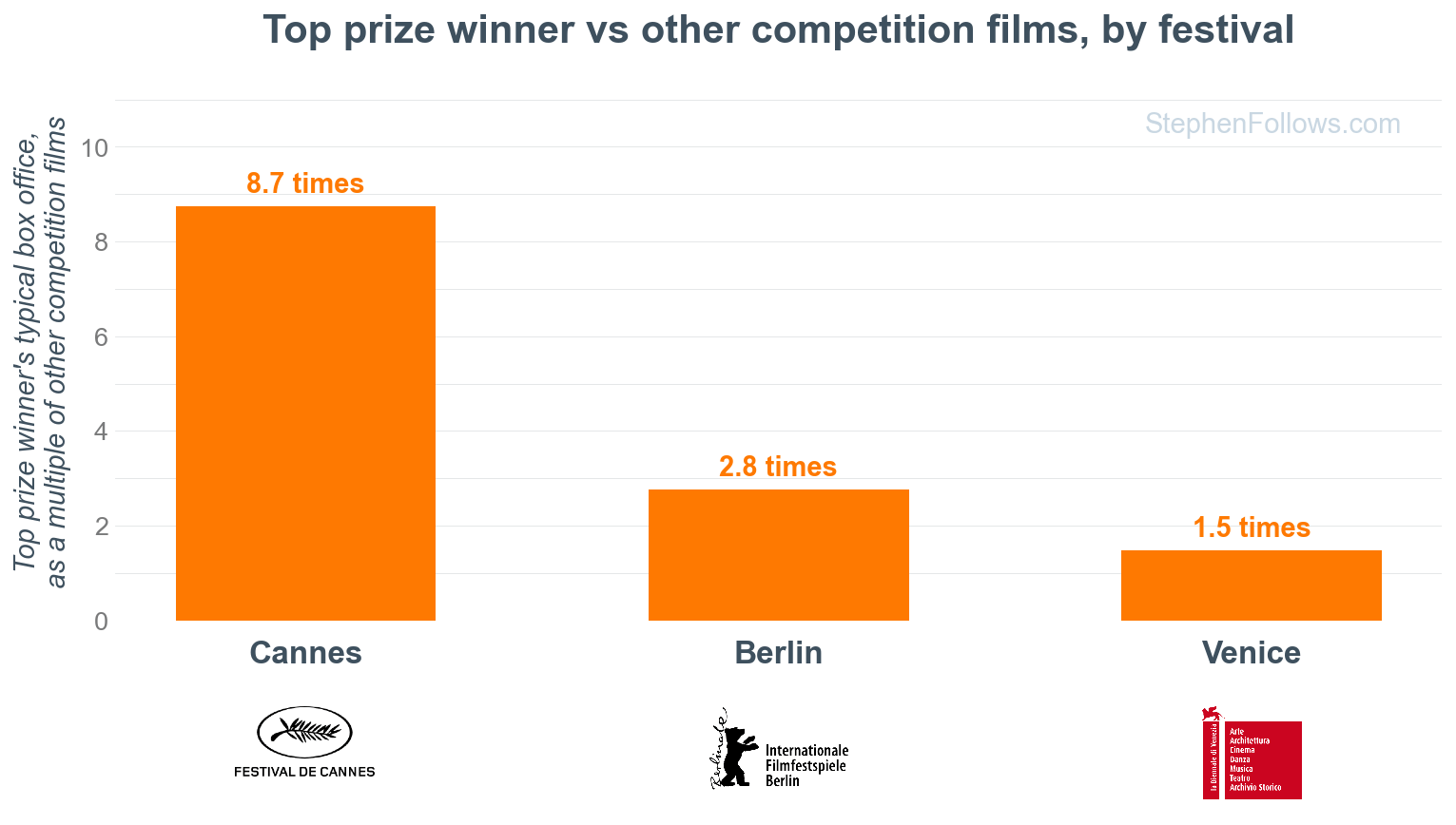
Cannes top-prize winners typically take roughly nine times the worldwide gross of the other films competing alongside them.
Berlin and Venice top winners do better than the rest of their slate, too, but the gaps are far smaller and not stable enough to build a business plan on.
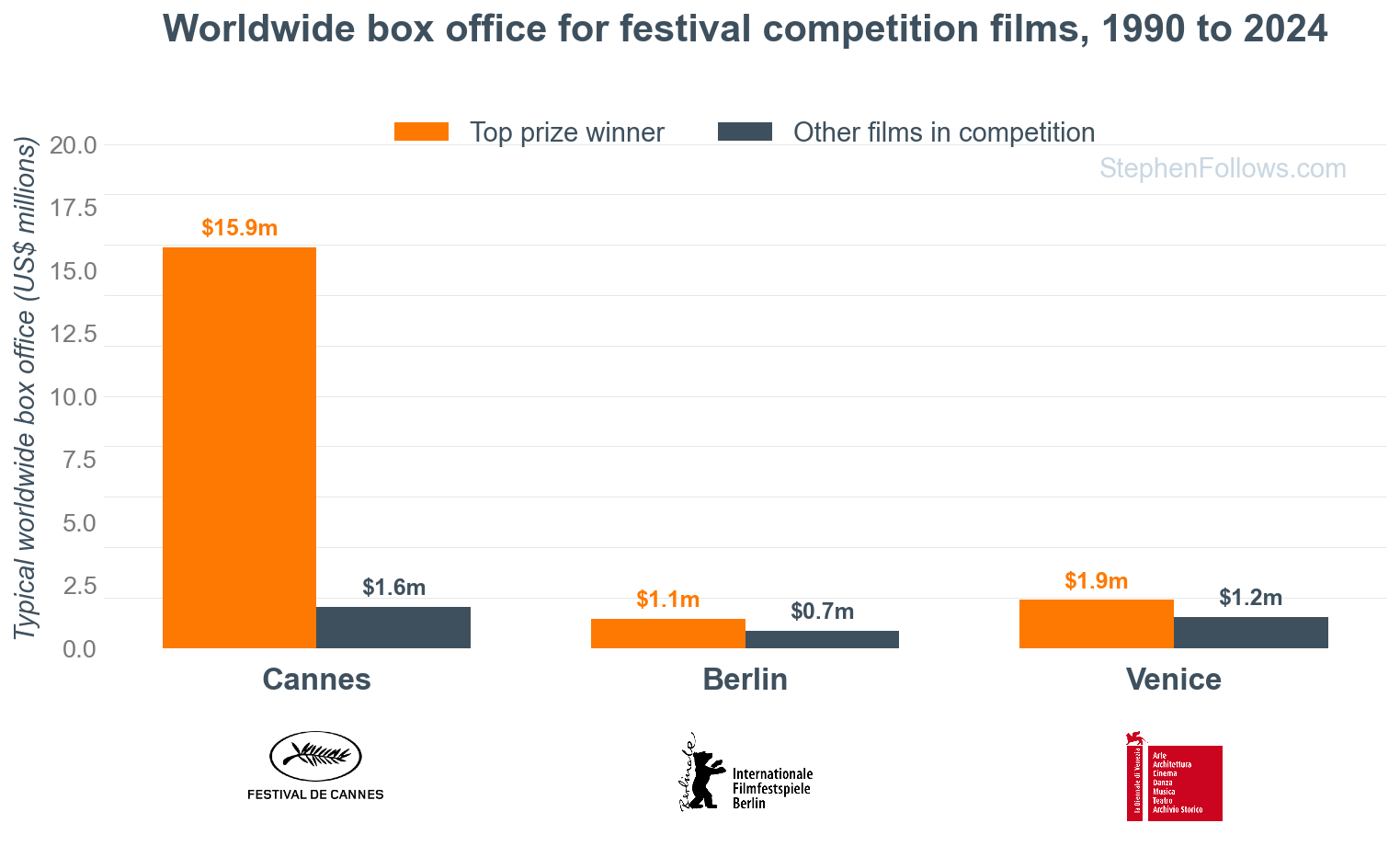
Cannes has some standout winners:
Pulp Fiction took $213m worldwide on the back of its 1994 Palme.
Parasite took $254m in 2019.
Fahrenheit 9/11 took $221m in 2004.
The Pianist took $112m in 2002.
Anora took $58m last year .
Anatomy of a Fall $49m the year before.
Berlin’s top of the pile contains:
Spirited Away ($396m)
Sense and Sensibility ($135m)
A Separation ($24m)
Venice has had three blockbuster top winners in the last seven years alone with:
Joker ($1.1bn)
The Shape of Water ($196m)
Poor Things ($112m)
So the difference with Cannes winners is almost nine times and still a respectable 2.8 times at Berlin, and around 1.5 times at Venice. These three festivals are not the same!
But is it really the Palme doing the work?
There are two things we should take into account when considering this finding: quality and language.
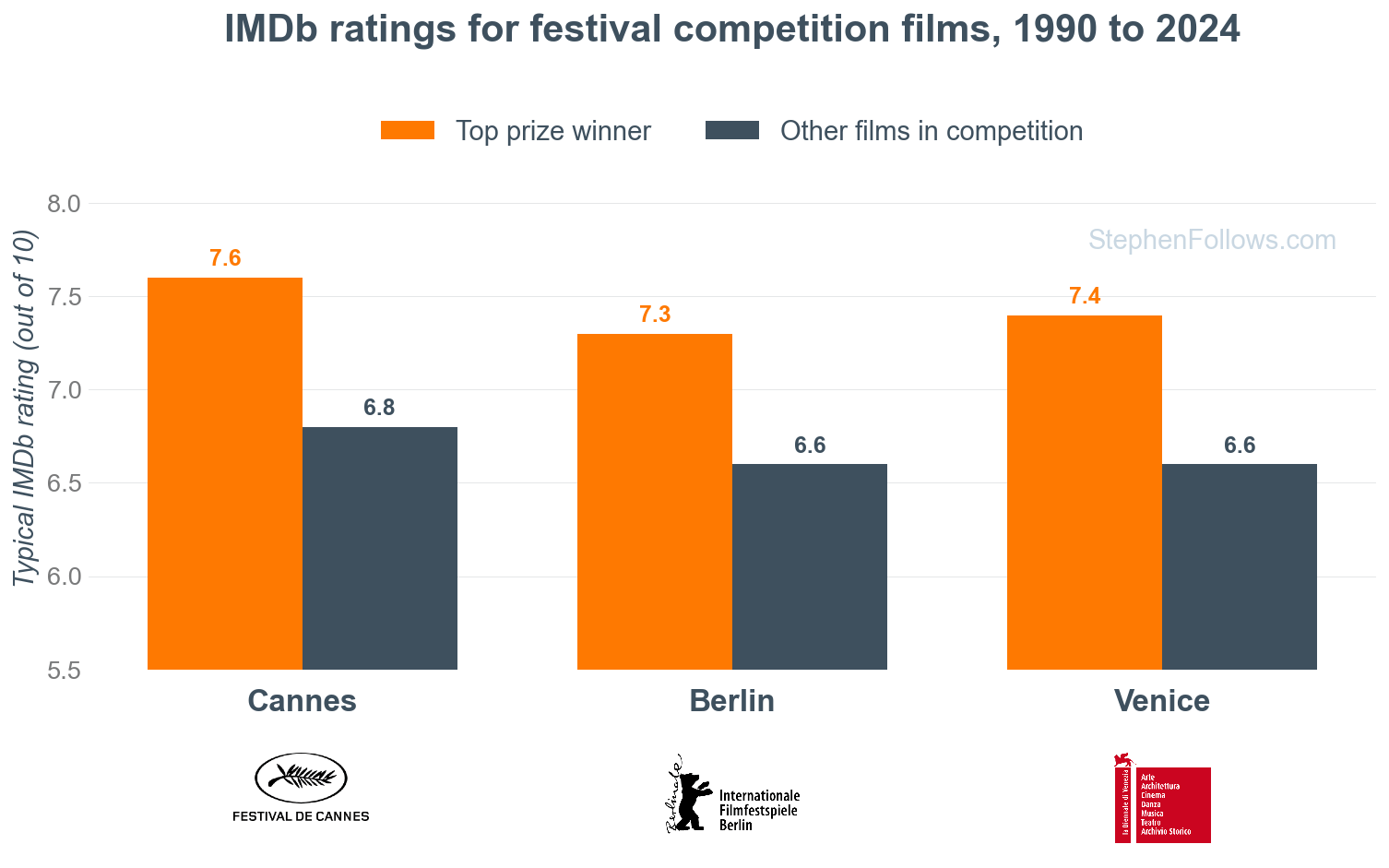
Firstly, a film that wins the Palme is probably a better film, on average, than one that doesn’t. When we crunch the numbers, it turns out that, yes, festival juries at all three festivals select films that critics and audiences rate above average.
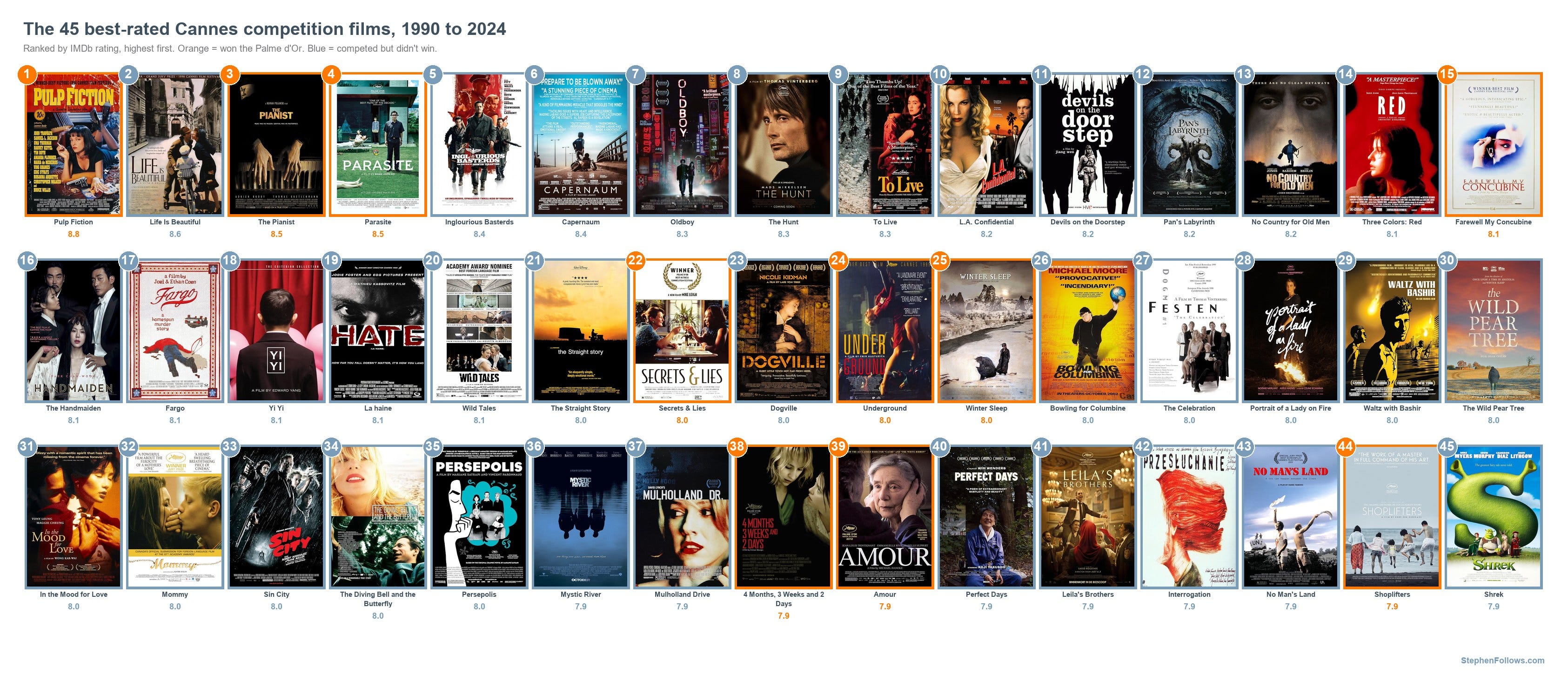
The second factor we need to consider is language. It’s worth noting that the Palme has tilted noticeably toward films with English-language distribution partners in recent years. Anora, Parasite and Triangle of Sadness all had US distributors locked in early.
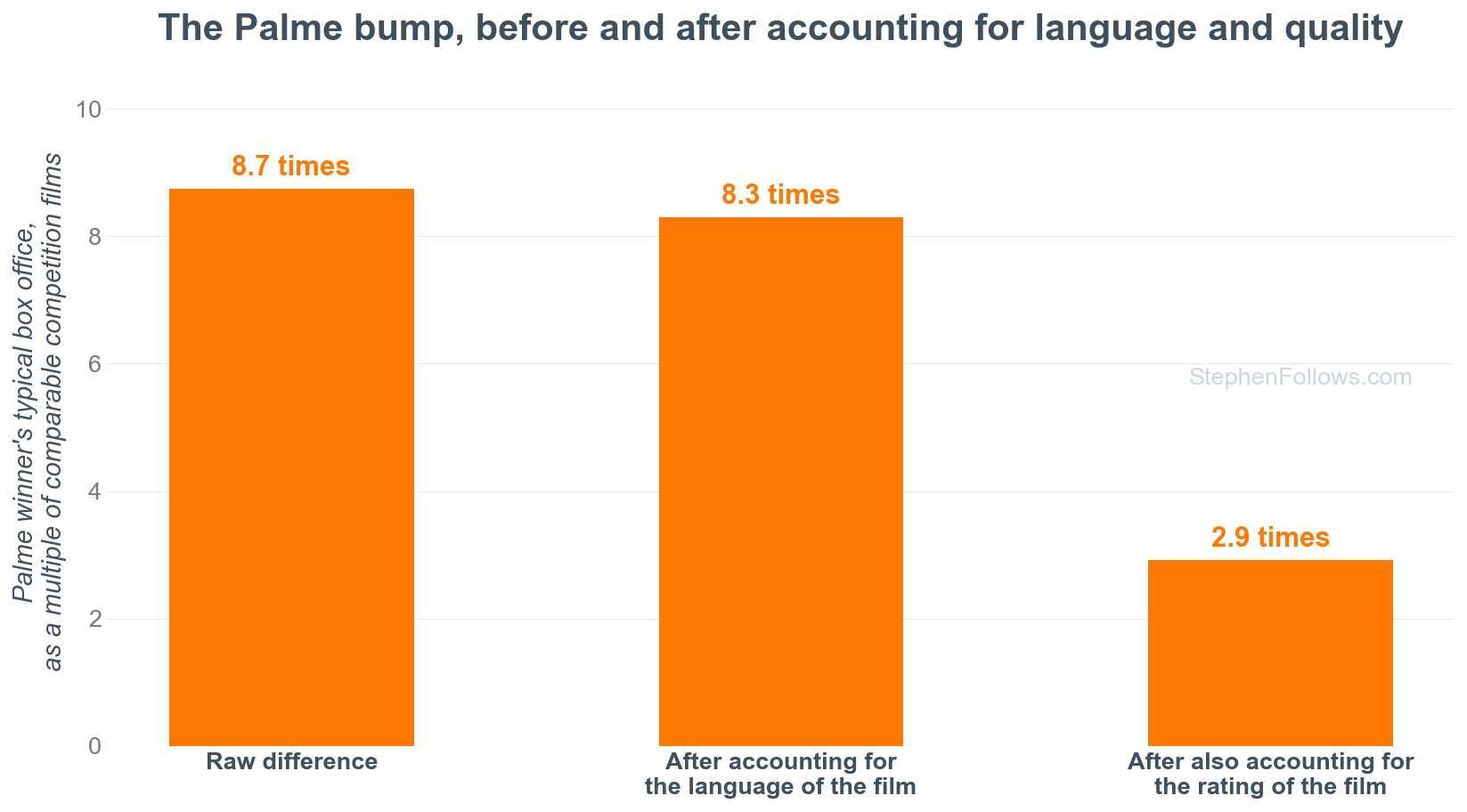
To check whether the prize itself is doing the work, I compared like with like. I held the film's language constant first (English-language films earn much more, regardless of any prize), then held the IMDb rating constant on top of that (better films earn more, regardless of any prize).
So what we’re left with is data on how big the Palme bump is at each stage of stripping out those two factors. By the time you’re comparing Palme winners against other Cannes competition films with the same language and a similar rating, the bump is down to a bit under three times the typical gross.
That residual is the part the prize itself can plausibly take credit for; the rest of the headline gap is the prize tracking films that were already commercially advantaged.
When I did the same maths with the winners at Berlin and Venice, I found nothing survived. Once you compare like with like, neither festival’s top prize lifts a film above the rest of its competition in any way that the data can detect.
None of this means the prizes are worth nothing. Career legitimacy, future financing, critical standing, distributor curiosity, the right to put a laurel on a poster for the rest of your life.
But the specific claim, that winning a top festival prize equals a commercial bump, turns out to be a Cannes-specific claim, and less than it initially seems.
Bonus - Is the Cannes winner usually the best or biggest film of its year?
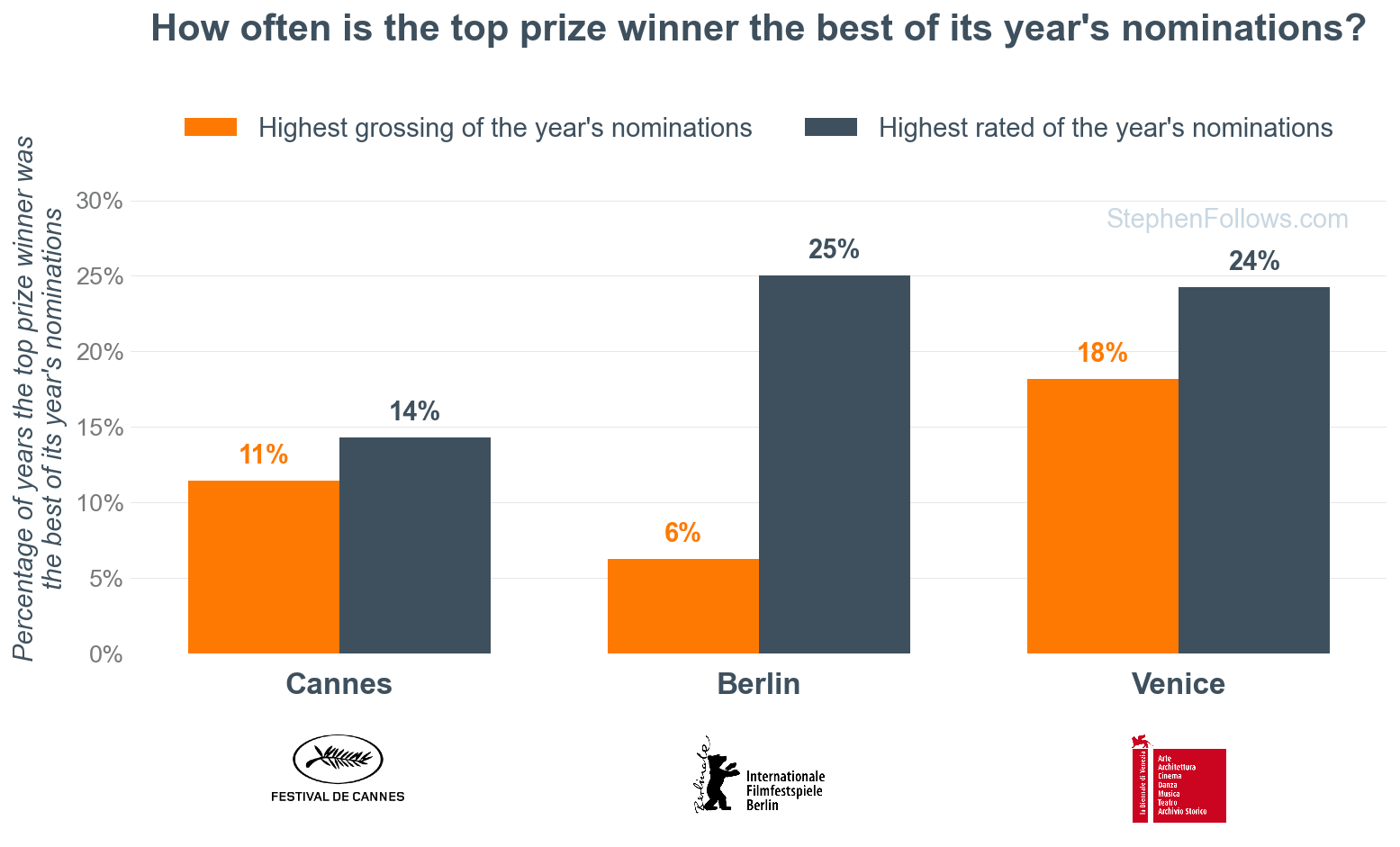
As a side note to finish on, I also looked into whether, when a jury awards a Palme, Lion or Bear, they are handing it to the highest-grossing or best-rated film in their year’s nominations.
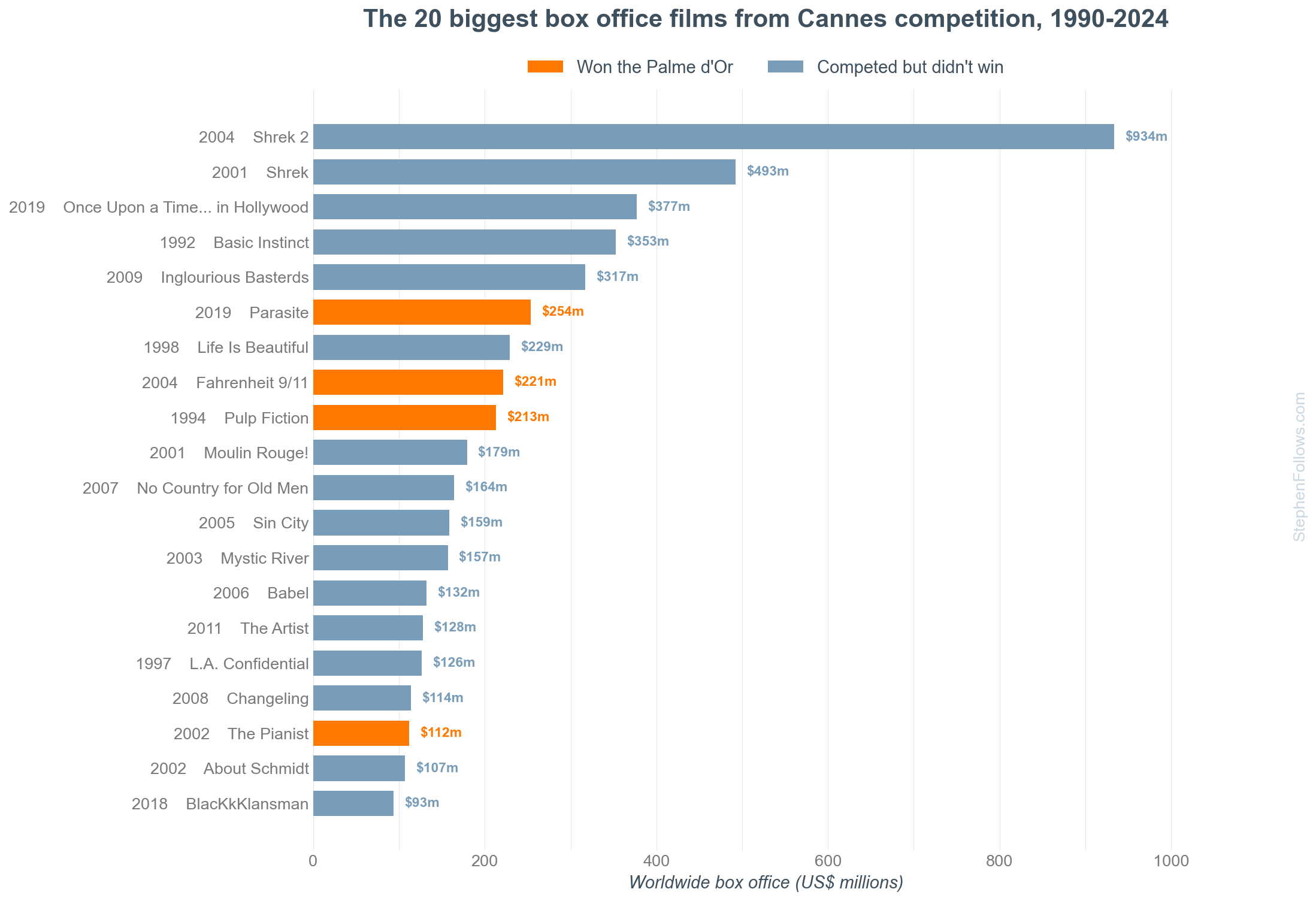
For example, Parasite won the Palme d’Or and became the highest-rated film on IMDb in the entire 2019 Cannes competition. But it was not the highest-earning hit of the cohort, being beaten at the worldwide box office by Once Upon a Time in Hollywood ($377m versus Parasite's $254m).
It turns out that Berlin and Venice juries find the top-rated films about a quarter of the time (not bad for a lineup of 20 to pick from), but Cannes lags behind at just 14%.
The top-prize winners are rarely the highest-grossing films in the cohort.
If you want to guess if a Cannes-nominated film will do well in cinemas with the public, just look for famous names. Or Shrek. Mostly Shrek.

Notes
Today’s analysis covers every main competition film at Cannes, Berlin and Venice between 1990 and 2024. Sidebar sections such as Un Certain Regard, Forum, Orizzonti and the Director’s Fortnight are not included.
I used 1990 as the cutoff because earlier years have patchier box office records and many older films’ totals are inflated by re-releases that no modern release would benefit from, which distorts comparisons.
I'm disheartened to live in a world where shrek is only on that list twice.
Interesting discoveries. Cannes seems to be more about spectacle than substance, but still affects a film’s critical versus commercial success.