


Last Friday I ran another event with Jason Blum and the Blumhouse team, this time in New York. We were looking at how the horror is changing, and how we have to evolve the way we think about horror.
In preparing for the event, I spent time digging into what’s happening in the genre - how it’s evolving, what’s working, and where things might go next.
Horror has always changed shape to match the times, but right now the pace of that change feels faster than usual.
The Horror Movie Report. Get under the skin of over 27,000 horror movies with the most detailed data-led insights ever compiled for both horror fans and industry professionals alike. Grab a copy at HorrorMovieReport.com

It’s an exciting time to be having these conversations. Horror films have already cleared $1 billion at the US box office this year and is currently sitting at a 17% marketshare, making it the third most popular genre on the big screen.
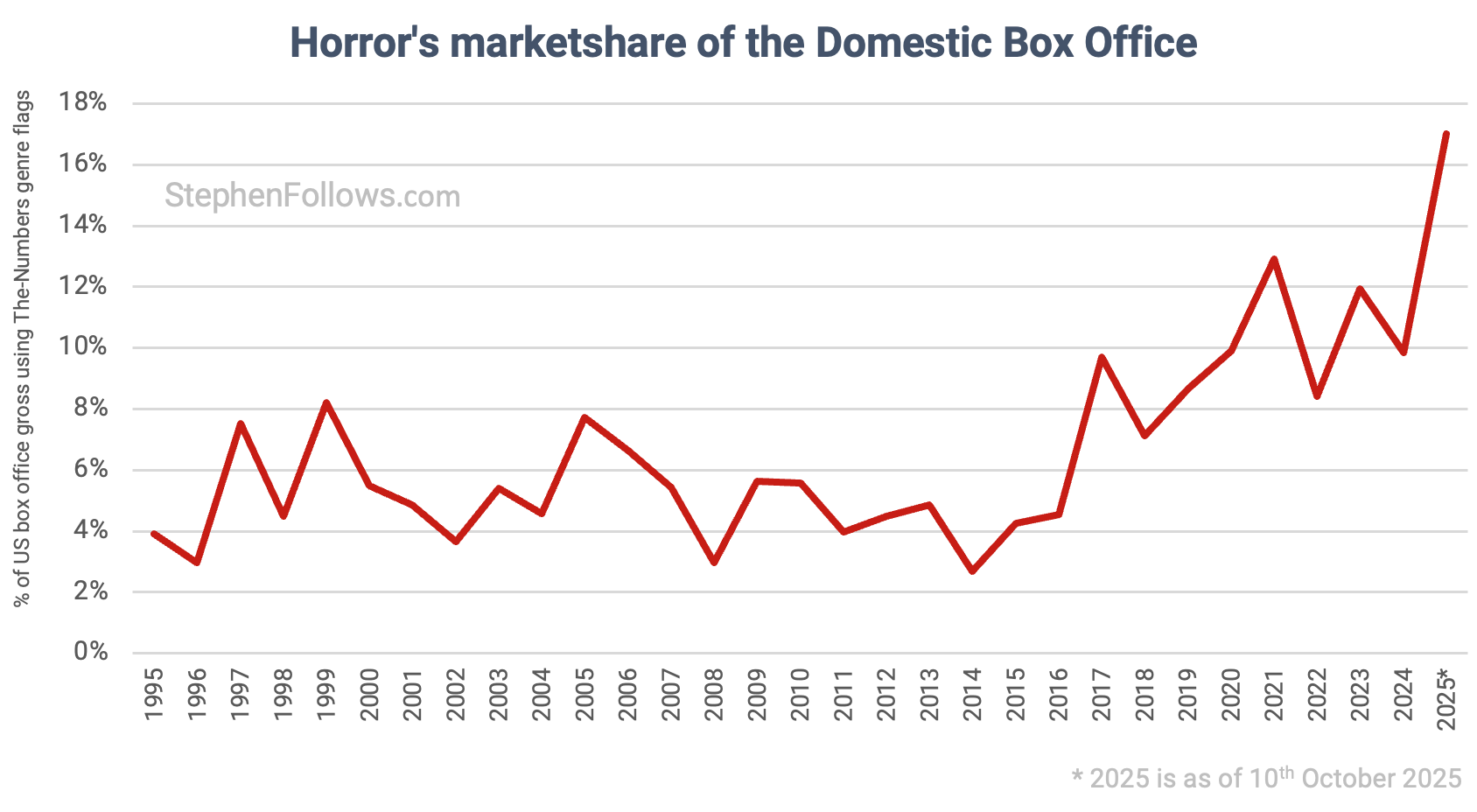
Below are seven trends and three questions that came out of my preparation for the event.
1. Studios have their franchises…
At the top, studios are building out interconnected universes and sequels that behave more like long-running TV shows than individual films. The Conjuring: Last Rites, Final Destination: Bloodlines and 28 Years Later each drew huge audiences this year, helped by familiar names and clear promises of what they deliver.
These films look like the kind of stable assets studio covet, being as they are (relatively) low risk, high return, and very marketable.

2. …and directors have their followers
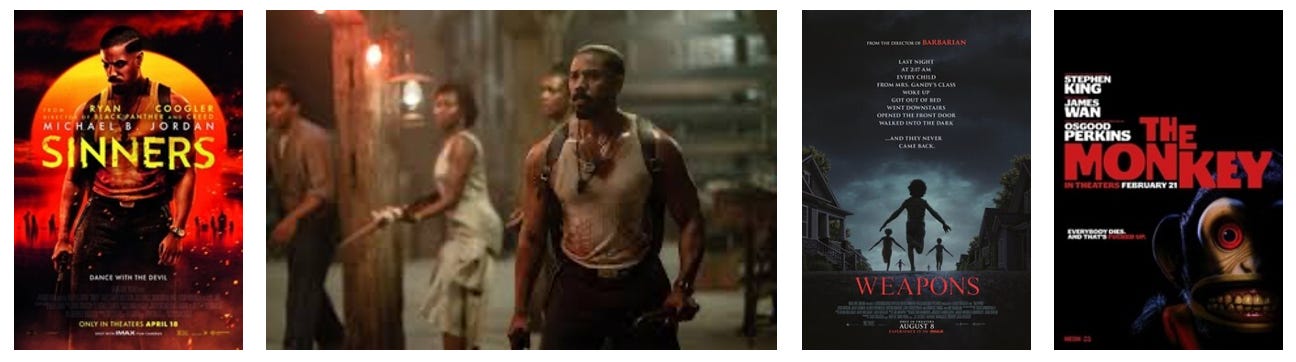
At the same time, the biggest energy in horror is coming from directors rather than brands. Sinners didn’t need an existing franchise to pass $360 million worldwide. It sold itself on Ryan Coogler’s name and the promise of seeing what the director of Black Panther would do with vampires. The same applies to Zach Cregger’s Weapons and Osgood Perkins’s The Monkey. In horror right now, the filmmaker is often the franchise.
I love how both sides feed each other. The confidence that studios have in sequels gives directors room to take bigger creative swings elsewhere. And when those swings connect, they create new IP that studios can build on later. That loop between commercial reliability and creative originality is proving a real boon for the horror genre.
3. Horror is getting the respect it deserves
For a long time, horror was treated as a guilty (or even shameful) pleasure, something audiences loved but critics dismissed. But that perception is changing fast.
Many of the highest-grossing horror films of the past year also earned strong reviews and awards attention. Sinners was a mega box office hit with 97% score on Rotten Tomatoes, Longlegs was one of the most-discussed releases of last year, and A Quiet Place: Day One was praised for its emotional weight.
Horror has always fed on the zeitgeist of fears, but what’s new is that the critical classes seem to be appreciating it. A number of recent films have received positive critical coverage for reflecting modern fears of loneliness, identity, surveillance, and control. The Woman in the Yard told a tale of grief and suicidal thoughts through a supernatural lens, while Bring Her Back used haunting as a metaphor for guilt and exploitation.
What’s most interesting to me is that this new respect hasn’t come at the cost of the genre’s edginess. The films remain unsettling and confrontational, just with sharper ideas behind the scares. Right now, horror is leading the way in showing how a genre can balance art and commerce without compromising either.

4. Body horror has returned (and it’s transformed)
Body horror has been pretty much dormant since the 1980s but now it’s back with a vengeance, and in an evolved form. The first big wave of such movies from Cronenberg, Carpenter, and their copycats were about transgression, whereas the modern crop are taking the nature of control (or the lack thereof).
The Substance and Together took the old language of mutation and use it to talk about how people are shaped by pressure, expectation, and power. The fear isn’t really about what happens to the body, but instead who owns it. And while modern SFX and VFX allow for even more extreme imagery, the movie’s true focus has shifted inward, seeking to turn shock into empathy

5. Bold ideas still cut though
Despite the commercialisation and critical acclaim horror is still a genre which rewards big, bold ideas on over budget.
Good Boy builds an entire film from a dog’s perspective. In a Violent Nature shows the a slasher’s quiet routine, Late Night with the Devil confines itself to a single 1970s talk-show broadcast that unravels live on air, while Vincent Must Die starts with one unexplained rule (i.e. everyone suddenly wants to kill one man) and sticks to it without explanation.
These films fully commit to their concept and so in a landscape full of sequels and shared universes, these pared-down ideas stand out precisely because they’re self-contained, disciplined, and memorable.

6. Horror’s biggest scares are happening everywhere
Horror is spreading beyond its traditional silos, both in timing (with releases throughout the year) and invading the very biggest screens. Sinners opened in IMAX and The Conjuring: Last Rites played in 4DX.
The way horror reaches audiences is changing just as fast as the stories themselves. Studio marketing has borrowed tactics from online fandom, using cryptic trailers, hotline numbers, and scavenger-hunt clues to build mystery. Longlegs proved how far that can go, with its campaign generating weeks of conversation before anyone even saw the film. Once the films open, short theatrical windows push them quickly to home release, keeping momentum alive for streaming platforms and digital sales.
This all adds up to making horror feel omnipresent. It’s in cinemas, on TikTok, and in game adaptations that blur the line between movie and experience.

7. Horror’s mixing with everything
We’re increasing seeing horror used as a tool inside other genres.
Sinners is part gothic drama, part action movie, and part musical. The Gorge adds combat choreography to its creature feature, while Death of a Unicorn turns absurdist comedy into unease.
This blending works both ways, with Get Out being political, Barbarian being funny, and A Quiet Place being about family. Horror is a flexible language that can express almost anything (fear, grief, anger, absurdity, etyc) and still find an audience.

Three questions for the genre
To end, here are three questions I’m keen to see answered over time.
Q1. Will audiences ever care about AI horror?
Horror movies centered on stories feature Artificial Intelligence arrived quickly, but audiences seem unsure what they want from it. M3GAN 2.0 and AFRAID both underperformed, suggesting the novelty has worn off.
That doesn’t mean the idea is finished, it’s just that it’s waiting for a defining film, the kind that reshapes expectations the way The Blair Witch Project did for found footage or 28 Days Later did for pandemic stories.
Q2. Will horror be a permanent feature on IMAX?
As horror expands into premium formats and massive screens, will it stay there? Films like Sinners and The Conjuring: Last Rites proved that horror can fill IMAX theatres, but it’s unclear if that’s the new normal or just a temporary peak.
Horror works best when it feels close and personal, and that intimacy can be lost on a sixty-foot screen.
Q3. Will horror festivals become the new Cannes or Sundance?
Horror festivals have been growing in number and influence, with places like Fantastic Fest and FrightFest shaping early buzz for new voices. As horror becomes more central to cinema, these festivals could become its equivalent of Cannes or Sundance.
If horror continues to evolve as it has this year, it may stop being treated as a subset of film altogether and instead as one of the pillars that define what modern cinema looks like.

The Horror Movie Report
If you want to dig deeper into the horror genres, then grab a copy of my Horror Movie Report
It’s a massive collection of research, statistics, and spreadsheets. It’s packed with insights on everything from horror’s financials to its evolving subgenres.
Read more at HorrorMovieReport.com
Are you planning to update the horror report? I'm planning to purchase a copy. Thanks!