


A few days ago, a new UK film distributor, True Brit Entertainment, went into administration. It had been launched under three years ago, intending to co-finance $150m of British films. In the end, it released just seven films, two of which did reasonably well, and also had six more on its slate, some already finished, with no one to distribute them in the UK.

Launching any new business is a challenge, especially in film, and even more so given the current state of the market. It was a bold play that didn't pan out. The company’s founder, Zygi Kamasa, blamed ‘extremely challenging market conditions’.
This got me thinking - if you start a new film distribution company, how long should you expect it to last?
And are conditions harder than they were previously?
Finally, what happens to the films they had deals with, now that the company is no more?
How I measured it
To answer these questions, I built a database of all the distributors I could find and logged their date of birth (i.e., the year they released their first film) and their date of death (i.e., three years without having released a film). I appreciate that the real world is slightly more complex than this, but it gives us a good baseline for what’s going on. Each company will have more nuanced incorporation and closing dates, but this method lets us see the big picture.
Using this method, I examined the lives (and afterlives) of 4,593 distributors who released at least three feature films, with their first release between 1980 and 2020. The Notes at the end cover the definitions, the checks and what happens when you change the rules.
What is the typical lifespan?
The chart below is a survival curve. It starts with every distributor launched in a given decade and shows what share of them were still releasing films one year, two years, five years and so on after their first release. (The 2010s line stops early because those companies have not had time to get any older).
Across all distributors, 83% were still releasing three years after their first film, 69% at five years, 49% at ten and 31% at twenty.
The median lifespan (i.e. the point at which half have stopped) is 10 years.
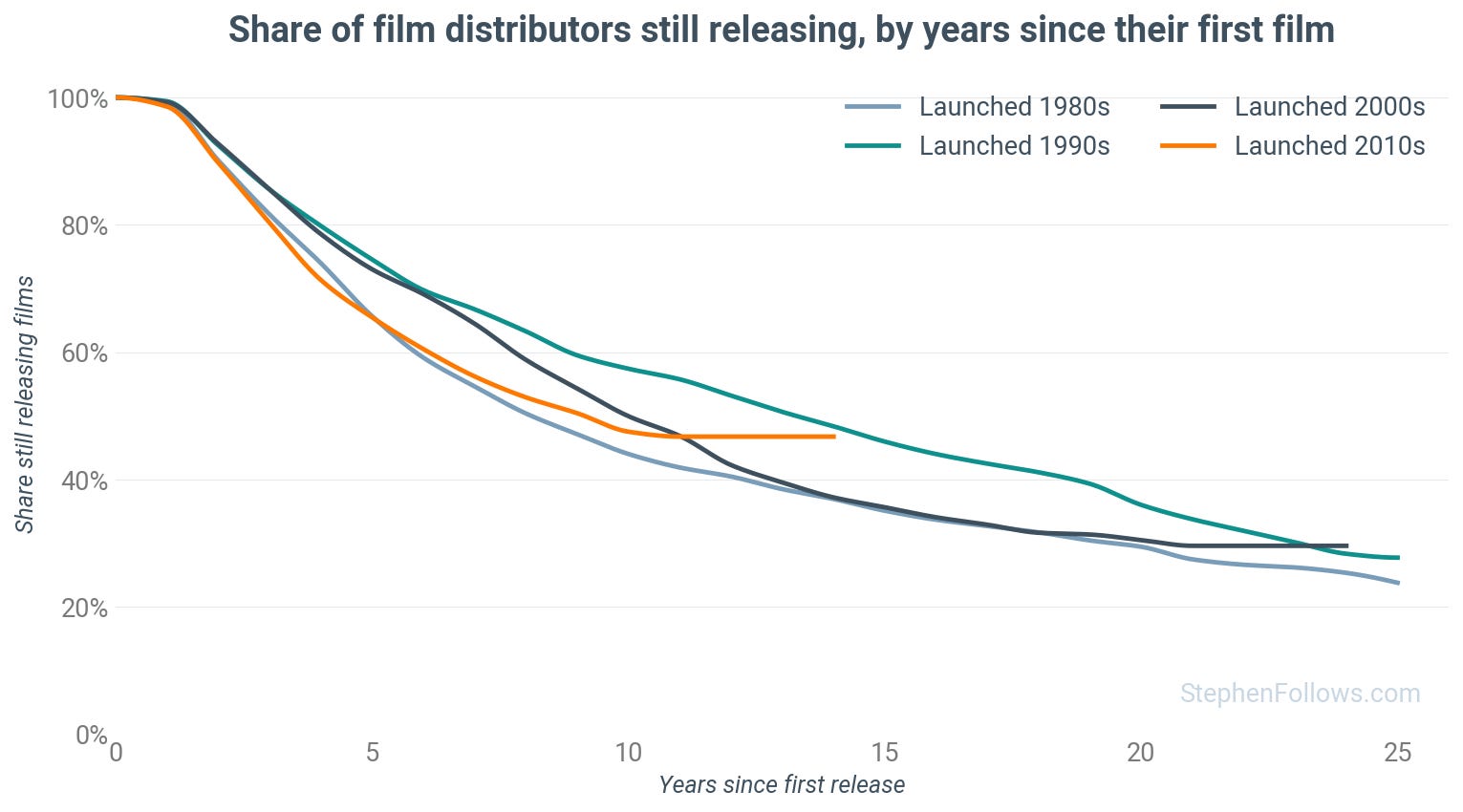
Of the 664 distributors launched in the 1990s, 75% made it to five years and 57% to ten.
For the 1,803 launched in the 2010s the figures are 65% and 47%.
The 2000s sit in between at 73% and 50%.
The 1980s cohort looks almost as fragile as the 2010s, at 66% at five years, for a different reason that I come back to in the Notes.
So the 1990s were the good years to start a distribution company. The good old days of VHS and DVD income on top of the cinema, a growing number of screens, and no streaming services buying up the middle of the market. If you bring this up to any film sales professional, they will get misty-eyed (followed by telling you some mad story about what they did with all that money).
When do distributors die?
A survival curve shows how many are left, but it doesn't tell you when the danger is greatest. To do that, we need to calculate the hazard, which is the chance that a company still trading at the start of a given year of its life has stopped by the end of it.
The chart below shows that chance for each of the first 20 years.
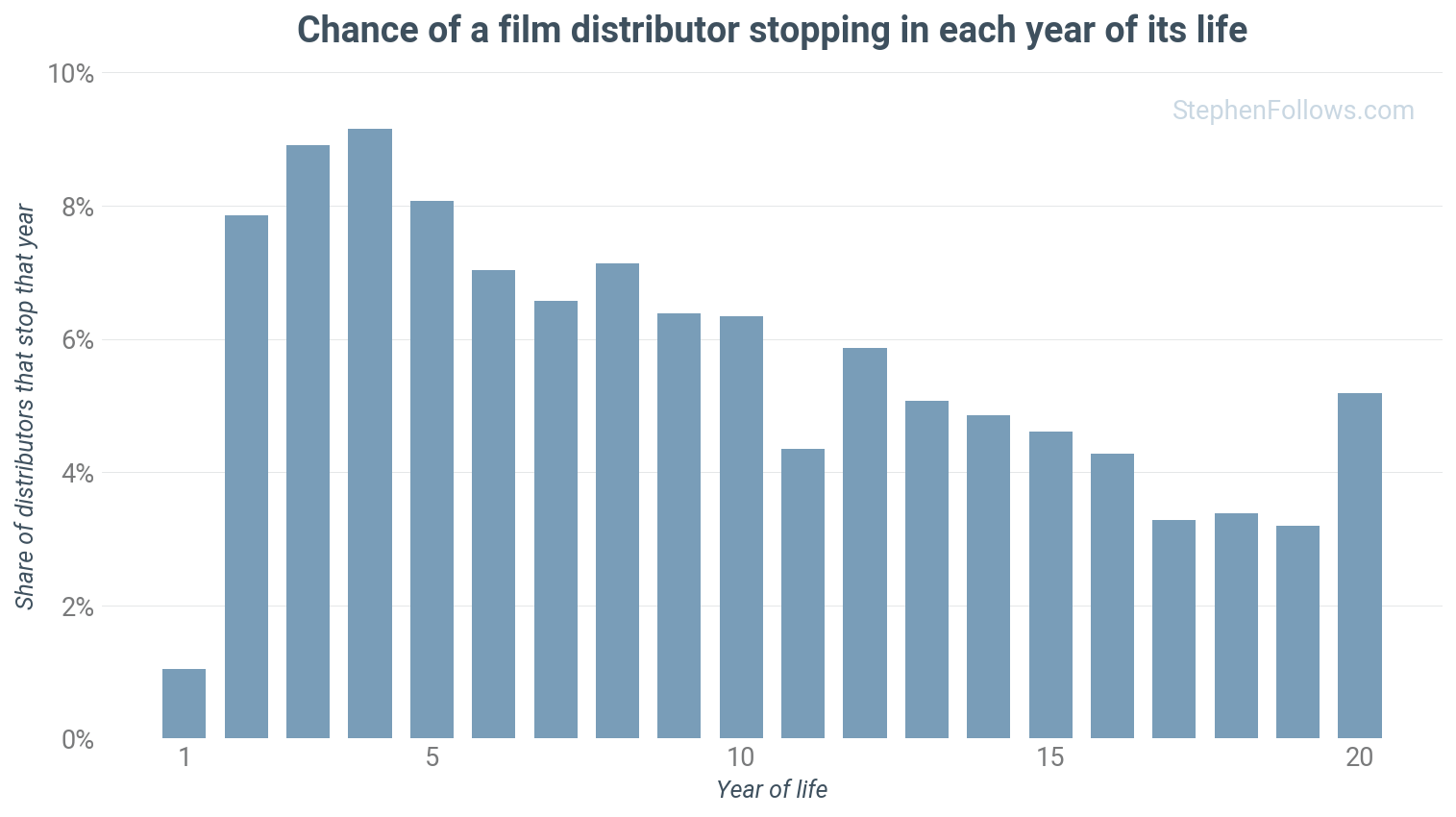
Year one is almost nothing at 1%, which is basically a quirk of the method (you cannot fail before you have released anything). Then the danger jumps.
In the second year, 7.9% of surviving distributors stop. In the third, it is 8.9%; in the fourth, 9.1%; and in the fifth, 8.1%. Those four years between them account for 47% of every distributor death I tracked.
After year 10, the chance drops to an average of 4.2% a year, and a company that has reached its fifteenth birthday is about as safe as this business gets.
The shape makes sense once you think about how a distributor is financed. The first slate is paid for with the money that launched the company. The second has to be paid for by the first, and the first slate’s results arrive in years two, three and four. That is when the investors find out whether the plan worked. True Brit’s collapse in its third year is fairly typical.
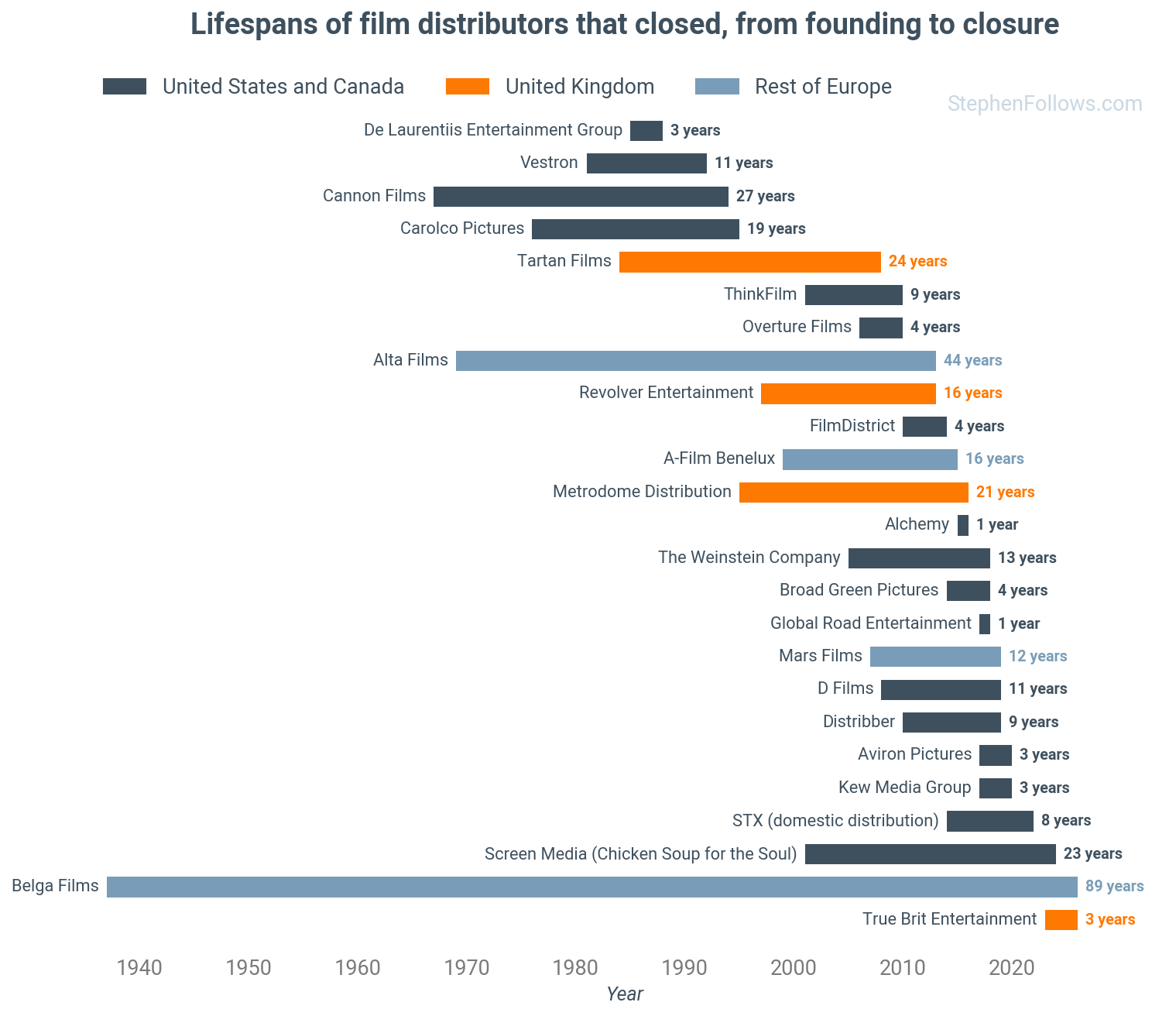
While surviving the danger years lowers the risk, it does not remove it. Below are some notable distributor closures from the past four decades (with exact dates, not rounded to the year as I did for the wide dataset).
Are more distributors dying than before?
Kamasa blamed True Brit's failure on market conditions, and I suspect you would struggle to find someone attending a film market in 2026 who doesn’t agree that things are tough right now.
So I looked at when each distributor has crossed the rite of passage of releasing their first film and their last film. (This can only go up to 2020 because a company needs a couple of years of history before I can be sure it has started, and three empty years before I can be sure it has stopped).
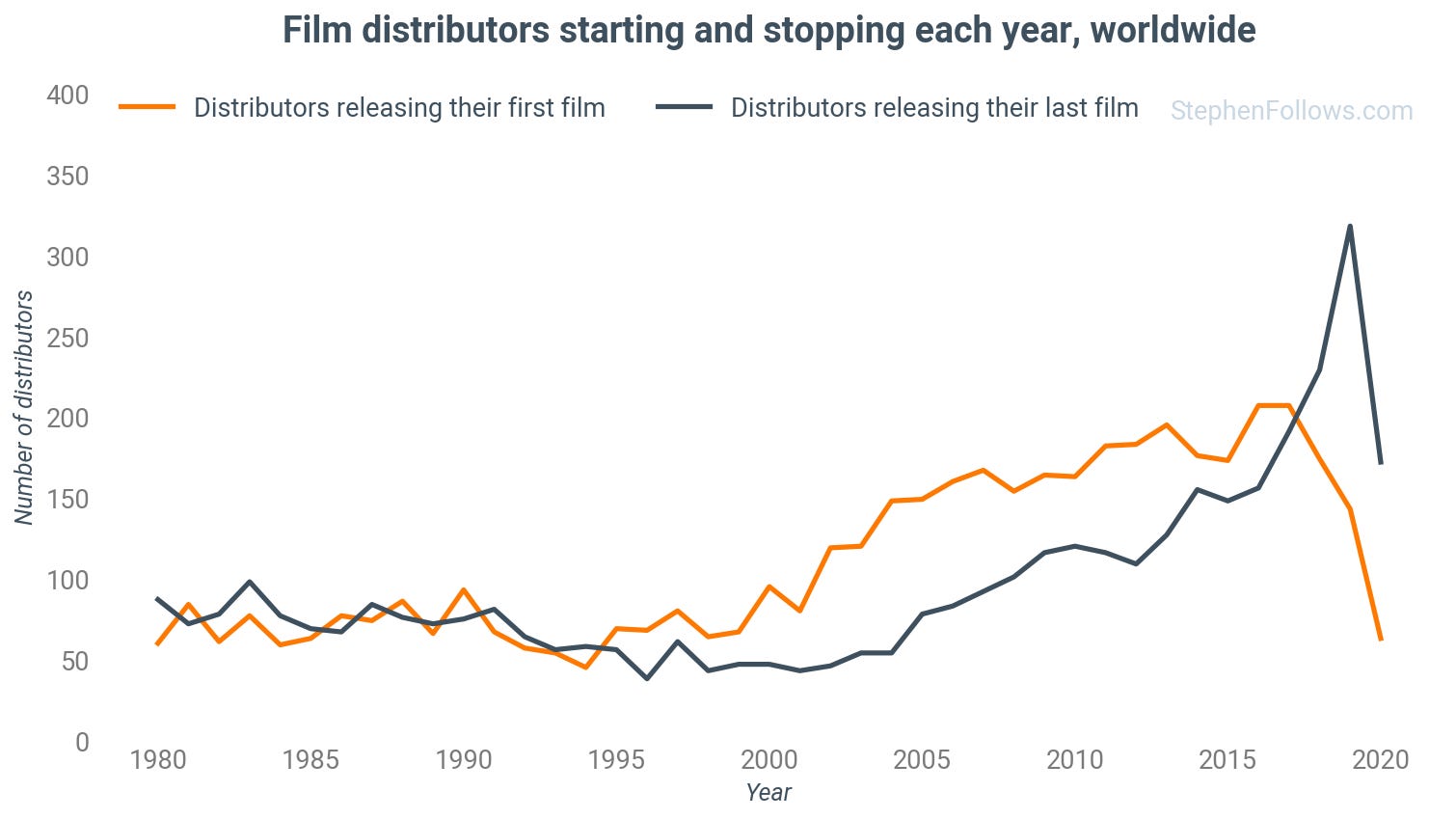
This chart says two things to me;
The number of new distributors has more than doubled. An average of 71 companies a year released their first film in the 1980s, compared with 180 a year in the 2010s, with a peak of 207 in 2016.
The number of distributors releasing their last film has also risen sharply, from under 60 a year in the mid-1990s to a spike of 318 in 2019.
Initially, I was suspicious of that spike, but three independent sources confirm this pattern (i.e. IMDb, Lumiere, and The Numbers). Their numbers differ slightly because of differences in methodology and criteria, but the effect is real. It is the companies that went into the pandemic and never came out.
However, it’s not only the pandemic. The failure rate had already been rising steadily since about 2005, so the pandemic only accelerated something already underway. Of the 967 distributors launched between 2015 and 2020, 328 have already stopped releasing. And the list of closures since the pandemic is long including:
EuropaCorp’s distribution department in France in 2018
Mars Films in 2019
Kew Media in receivership in February 2020
STX’s domestic distribution in 2022 in the US,
Chicken Soup for the Soul Entertainment and its Screen Media label in 2024,
Belga Films in February 2026,
True Brit a few days ago.
Where is it hardest to survive?
True Brit also operated in the UK market, which had the lowest five-year survival of the 14 markets I could measure from official release records covering Europe and North America.
