


There’s a lot of advice out there about ideal running times for festivals, and most of it boils down to one thing: keep it short.
A while back I interviewed over 500 film festival directors. When I asked them to give advice to filmmakers, about half mentioned the running time of films submitted to their festival. And the data looked like this:
0% = "Please can you make longer films"
100% = "Please, please, please make shorter films"
Below are just a few of the quotes on the topic from film festival directors:
If you’re intending to make a short film, timing is of the essence! Short films that are over 25mins are incredibly difficult to programme into an event, and longer ‘short’ films have to be very VERY strong in order to make it through.
Filmmakers are long winded about their subject matter and shoot themselves in the foot, so to speak. Knowing how to tackle and get to the heart of the subject matter is the key to brilliant filmmaking.
Filmmakers often think that 10 minutes isn’t long enough for their film. Audiences often know that 10 minutes is too long for a first film.
Make your film shorter – 5 minutes or under and it will increase its likelihood of being selected.
That’s sage advice but it’s time we brought some numbers to the party.
The Academy of Motion Picture Arts and Sciences, which sets the rules for the Oscars, draws the ‘short film’ line at 40 minutes. Anything longer qualifies as a feature.
BAFTA leans in the other direction. It suggests films under 70 minutes may not qualify, reflecting a preference for longer work. SAG-AFTRA uses 60 minutes, but that's mostly for labour contracts, not artistic intent.
France takes a more technical route. The CNC defines a feature using the physical length of 35mm film: anything longer than 1,600 metres. That translates to exactly 58 minutes and 29 seconds.
Complicated length rules seem to be popular in France. Clermont-Ferrand, one of the most important short film festival in the world, allows international shorts up to 40 minutes. But if you're French, the domestic category gives you a full 59 minutes to work with.
I decided to take the largest view possible, by studying the rules of just over 13,000 film festivals.
More shorts are made than features, so we’ll start there, before turning to feature films.
Short films
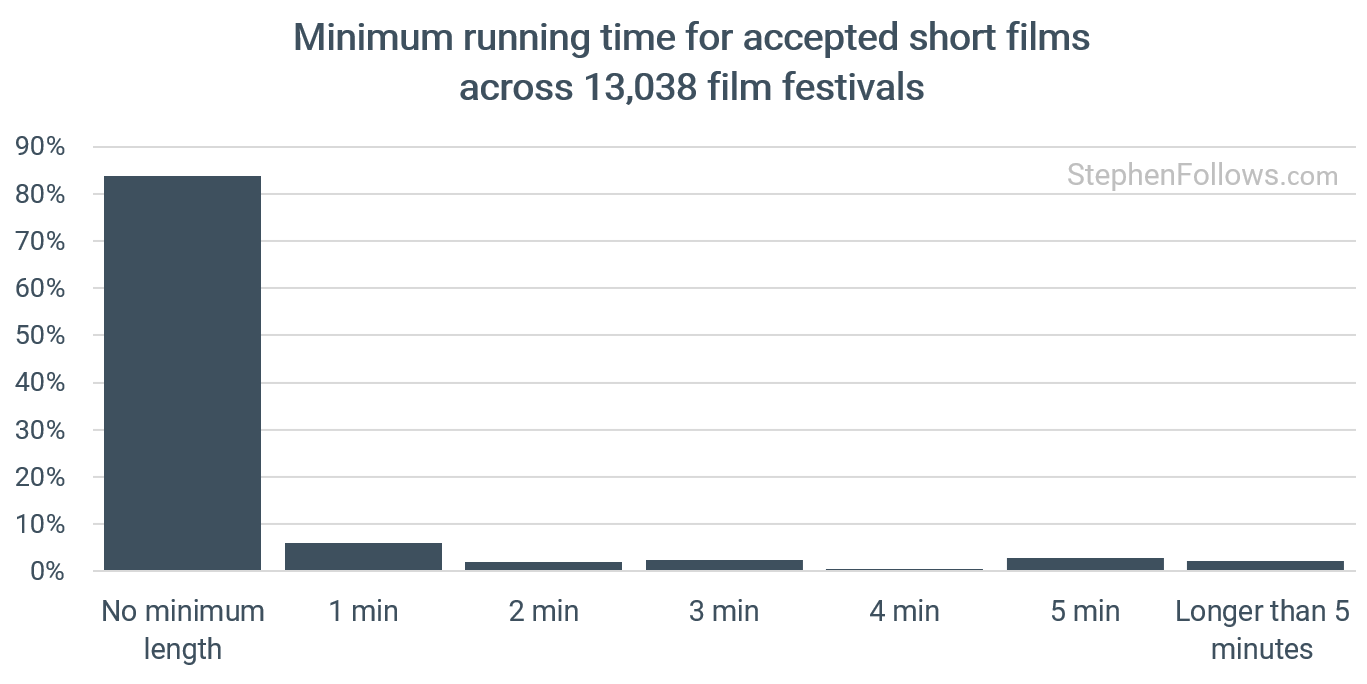
The vast majority (83.8%) of film festivals do not state a minimum running time for a short film to be eligible. Even those that do, keep it fairly short. Fewer than 2.2% of festivals require their short films to be at least five minutes long.
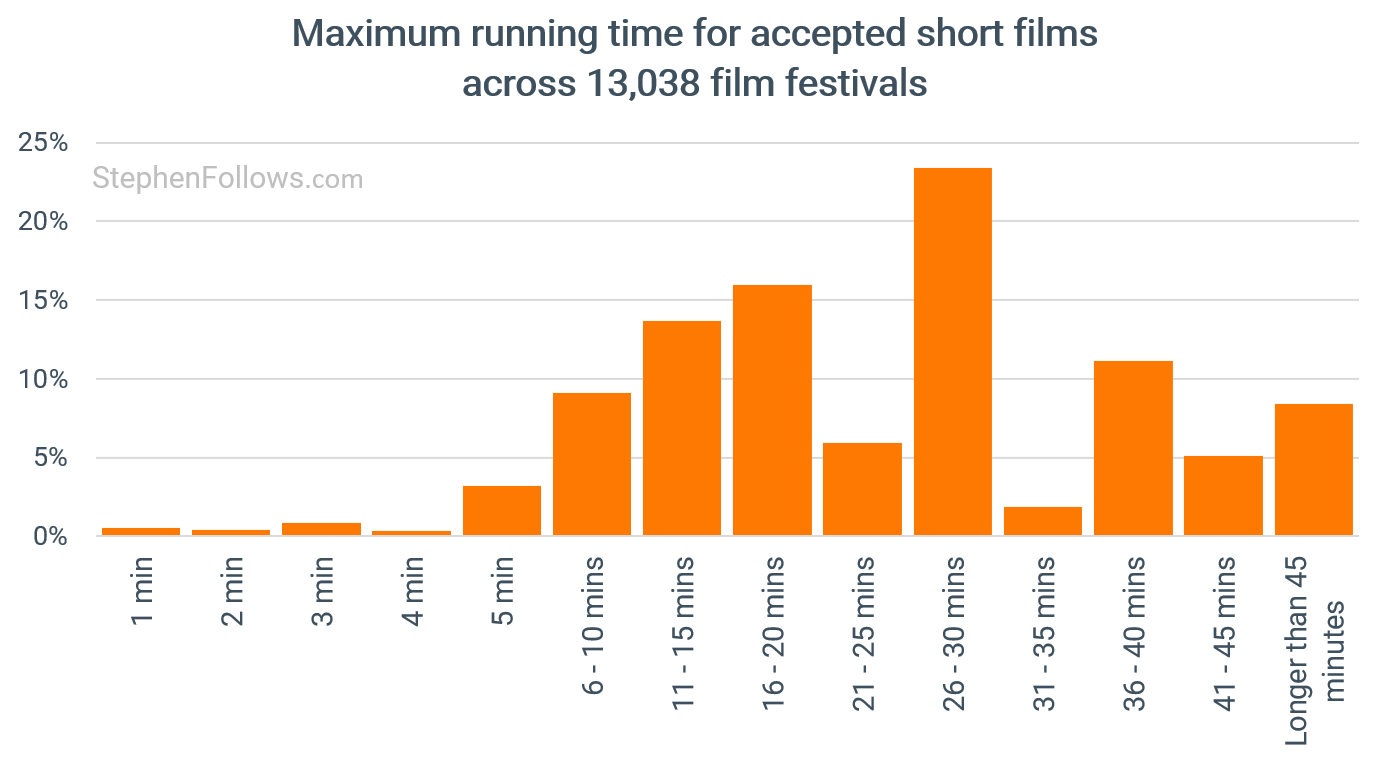
It’s not usually the minimum length requirement that trips filmmakers up, but the maximum. And this rule shows a much wider range of figures in the data.
The most common cut off was 30 minutes.
We can combine these two sets of data points to see how the running time of your short film affects your overall eligibly on the film festival circuit.
Eligibility stays above 85% until about 15 minutes. After that, it drops sharply. By the 30-minute mark, only around half of festivals are still in play. If your film runs over half an hour, you've already lost access to more than a quarter of festivals. Past 45 minutes, that becomes over 90%.
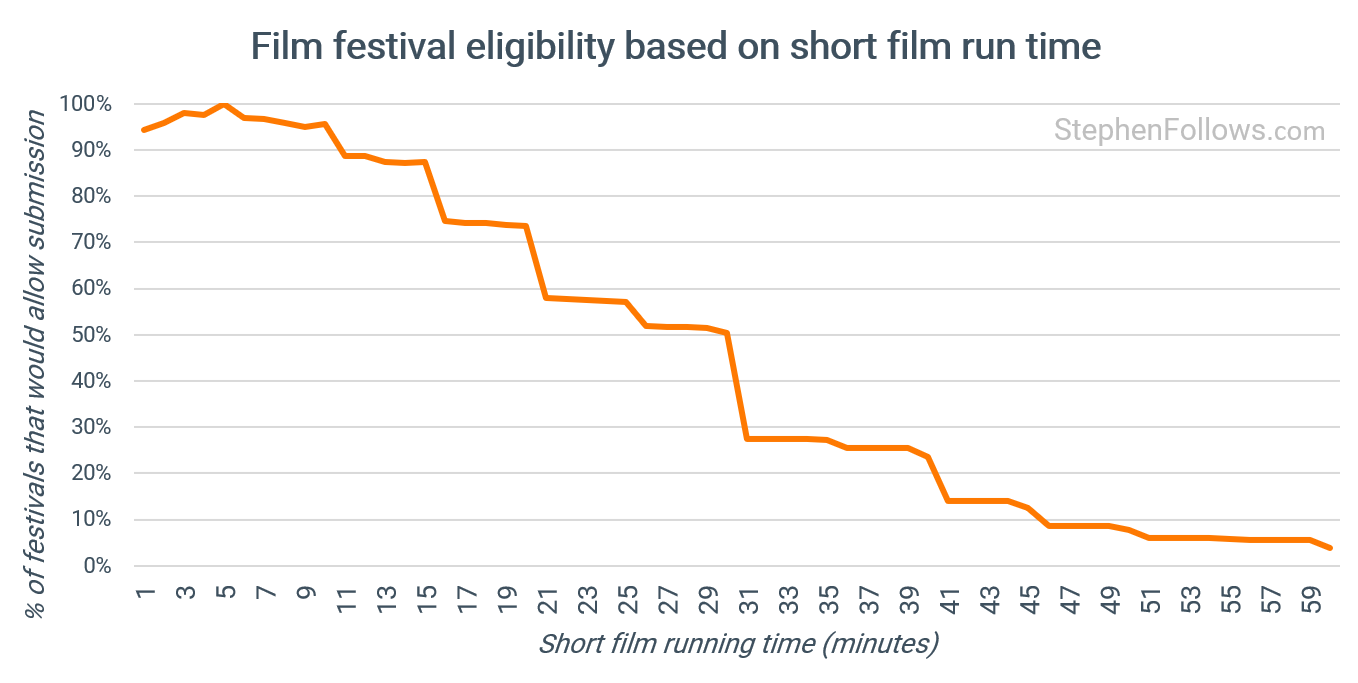
This means, if you make a 90-second short film then it is eligible for nine out of ten film festivals. (It’s worth noting that the combined submission cost of doing so would be around $312,951 - more on that in the Notes section).
Next up features.
Feature films
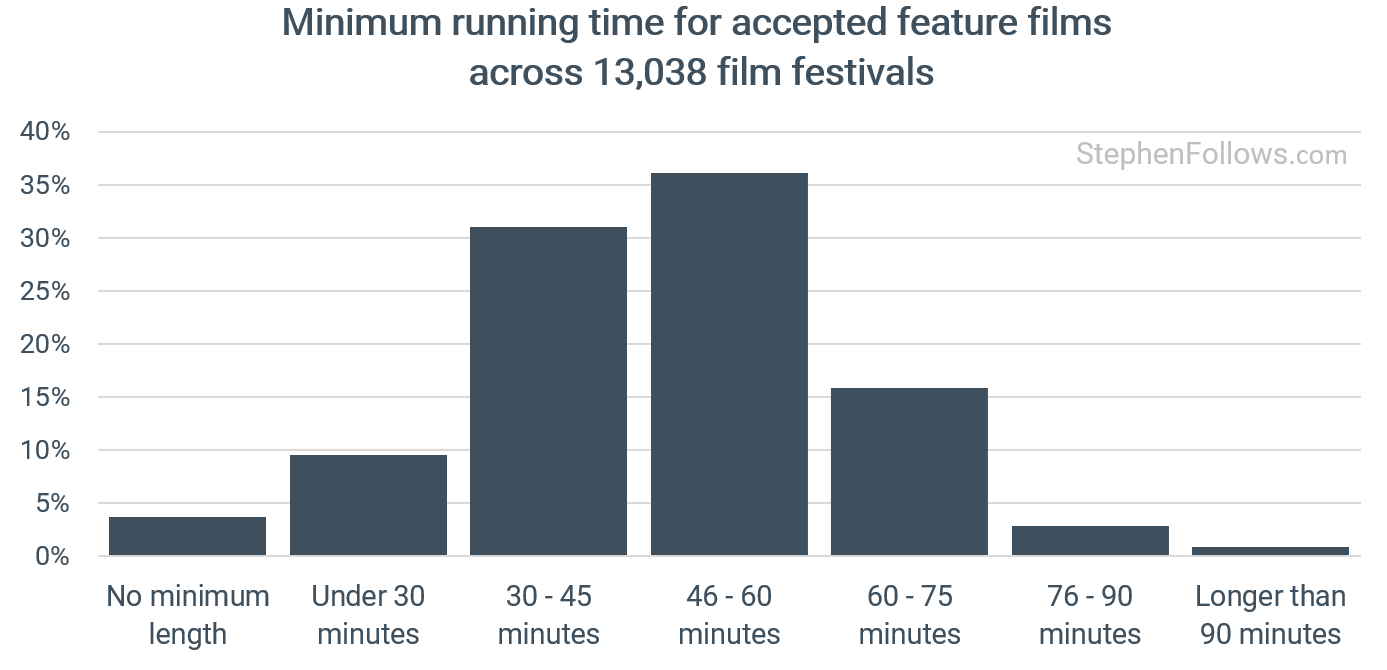
Feature films are where the term “minimum” gets fuzzier. Technically, 3.7% have no lower limit at all and nearly 10% said they allow "features" under 30 minutes.
My suspicion (and from what I’ve seen this in festival language) is that “feature” doesn’t always mean “feature film” in the commercial sense. Some festivals use it to mean “main event” or “primary slot.” That’s fine on the festival circuit, but if you’re trying to sell your 39-minute feature to a distributor, you’ll have problems.
The most common festival threshold is 46 minutes (36.1% of festivals), followed by 30–45 minutes (31%).
At the other end of the spectrum, almost three-quarters of film festivals don’t have public rules about the maximum runtime for feature films.
When they do, fewer than 10% draw the line at 2 hours or less and only 0.7% have a stated cap below three hours.
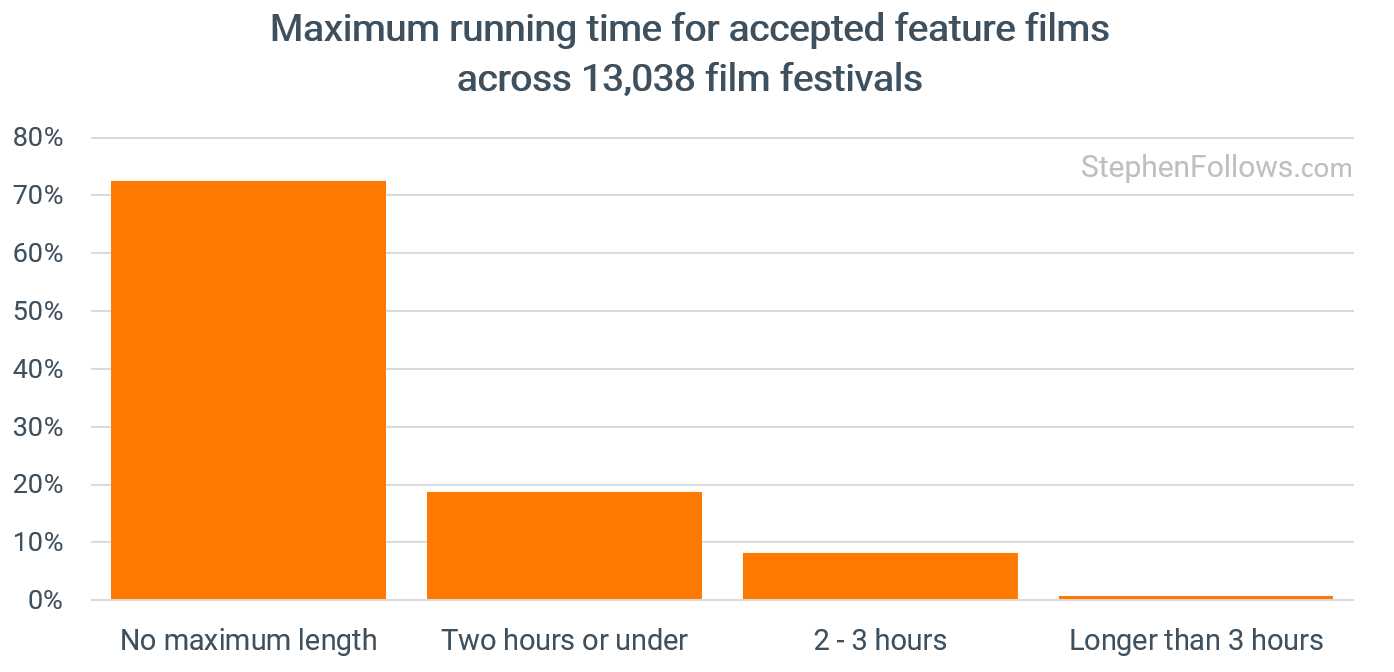
So in theory, your 4-hour documentary is eligible at most festivals but in the real world, it’s a tough sell. Festivals might even want to accept it but struggle to find space in the schedule. I discussed this dynamic more in Why do cinemas hate long movies?.
This is where filmmakers need to think wider than just festivals. While 30 to 45 minute “features” are accepted on paper by a third of festivals, they fall into a dead zone for many distributors, broadcasters and cinemas.
You’re too long to play as a short, you’re too short to fill a standard slot, and for buyers, you’re too much work to package into a schedule.
So yes, festivals will accept you. But what happens after the laurels?
In past research entitled Are movies getting longer? I found that the average theatrically released film runs about 106 minutes, and the average top-grossing title runs 114 minutes.
A practical cut-off guide
To summarise the official eligibility rules of the festivals I looked at :
Short Films
Under 10 mins: Eligible at 90%+ of festivals
10 to 20 mins: Eligible at around 56%
21 to 30 mins: Eligible at about 26%
Over 45 mins: Eligible at just 8.4%
Feature Films
30 to 45 mins: Accepted by ~30%, but may be classified inconsistently
46 to 60 mins: Safely “feature” for most festivals
60 to 90 mins: Accepted everywhere
Over 3 hours: Technically allowed by 70%+, but hard to schedule
So how long is too long? It depends what you’re calling it.
If you’re making a short, anything over 20 minutes is going to shrink your festival options dramatically - and probably your audience too.
If you’re calling it a feature, make sure it crosses 45 minutes at the very least, though ideally you’ll aim for 80+ to make it saleable.
In the end, the shorter version is almost always better. But knowing the cut-off points lets you weigh that choice properly.
Notes
The data on festival running times comes from the official rules of 13,038 festivals staged over the past decade, with the majority occurring in the last three years.
I focused on fiction shorts and feature films wherever possible, though some festivals blur those lines by including music videos, documentaries or “special feature” slots in their rules.
The calculation of average submission costs uses an internal dataset built from thousands of published entry fees across a wide range of festivals. Sources include official festival websites, listing sites and public aggregators. The figures shown here are only used to illustrate potential cost ranges. If readers are interested, I can publish a separate breakdown of average festival entry fees and how they vary by size, geography and type of event.
Thanks for this. I was shocked by how high the totaled fees would be, and would very much like to read the breakdown of average festival entry fees and how they vary by size, geography and type of event.