


Despite the massive changes in production, exhibition, and home entertainment over the past twenty years, it’s always surprising to me how similar the sales side of the film business has remained.
The standard route to market has barely changed. A film's producer signs with a single sales agent, who gains the exclusive right to represent the film at film markets (such as Cannes, Berlin or AFM). They sell the exploitation rights to distributors, aiming to secure a distributor in every territory and format (from cinema screens through to long-term TV deals).

While it’s true that perhaps 20 years ago there were fewer films and more pre-sales (i.e. deals done before the film has been shot), the core mechanics are the same. A single sales agent, a physical attendance at one of a handful of film markets, in return for a slice off the top of all earned revenue.
Signing with a sales agent has historically been seen as a vital step for any professional independent production, in part because agents only take on films they believe they can sell. The deal is the first sign the industry sees commercial value in the production.
Although no money changes hands at the point of the deal, the sales agent needs to invest significant time, resources, and money up front to fly to Cannes et al and show off their posters and iPad trailers. If the film makes money, they will be reimbursed, but if it doesn’t, they won’t (well, not from that film😉). So sales agents are understandably cautious about signing new projects.

Given the barrier they face in securing a sales agent, not all films achieve this rite of passage.
IMDb lists 14,345 fiction feature films as made in 2024. In the same year, by my count, 356 professional sales companies took on at least one of them. That means there are roughly forty times as many film productions as sales agencies. While we know that sales agents take on multiple projects each year (and I calculate the average later in the article), it still seems unlikely that many films secure a sales agent.
So I dug into the data and, in a research project that got way out of hand, worked out the numbers behind feature film sales agents.
How far films get
I started with every fiction feature film that IMDb says was made between 2000 and 2024, excluding documentaries, adult titles, and anything IMDb itself marks as still in development or post-production. That is 224,914 films. I then looked for evidence that anyone ever tried to sell or release it, across a number of public and industry sources (details at the end of the article).
The chart below gives you the headline findings. Read it from top to bottom, showing how the pool of films narrows as we add ever firmer criteria.
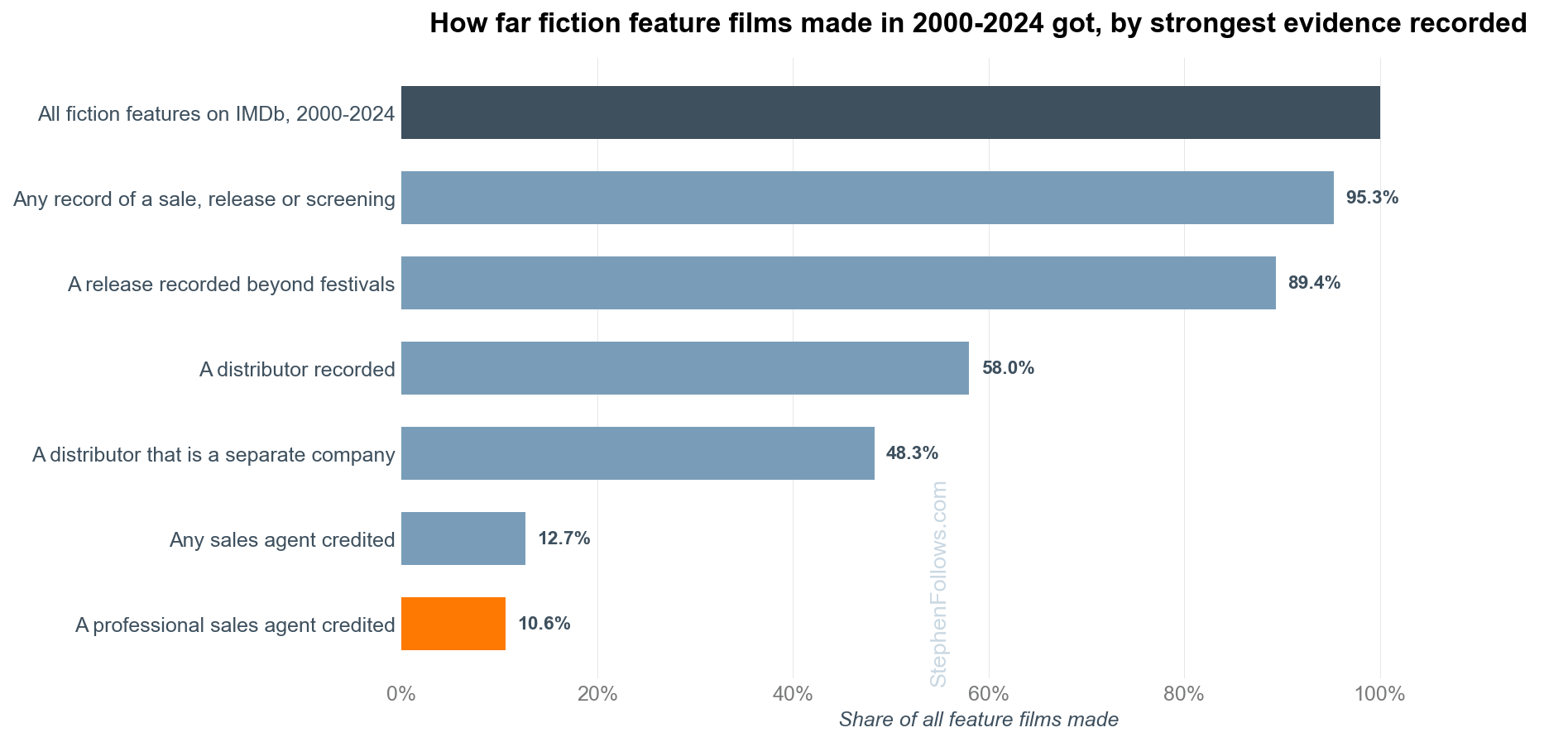
95.3% of films have some kind of sale, release or screening recorded, although that drops to 89.4% for a release beyond just a festival screening. 58.0% have a distributor of some kind named somewhere in the world, even if that is a single television sale in a single territory.
48.3% have a distributor (i.e. an established company separate from the production company).
And at the next step, we have our headline finding: 12.7% of fiction feature films made 2000-24 carry a sales agent credit.
We can go one step narrower if we only accept sales agents that are genuinely in the business of selling films (more on that shortly). That brings the number to 23,943 films, or 10.6%.
So about one fiction feature in ten made this century had a professional company selling it. Half found a distributor that was a real, separate company. Nineteen in twenty reached some kind of audience. And one in twenty was made and then never released in any form that anyone, anywhere, recorded.
Has it always been one in ten?
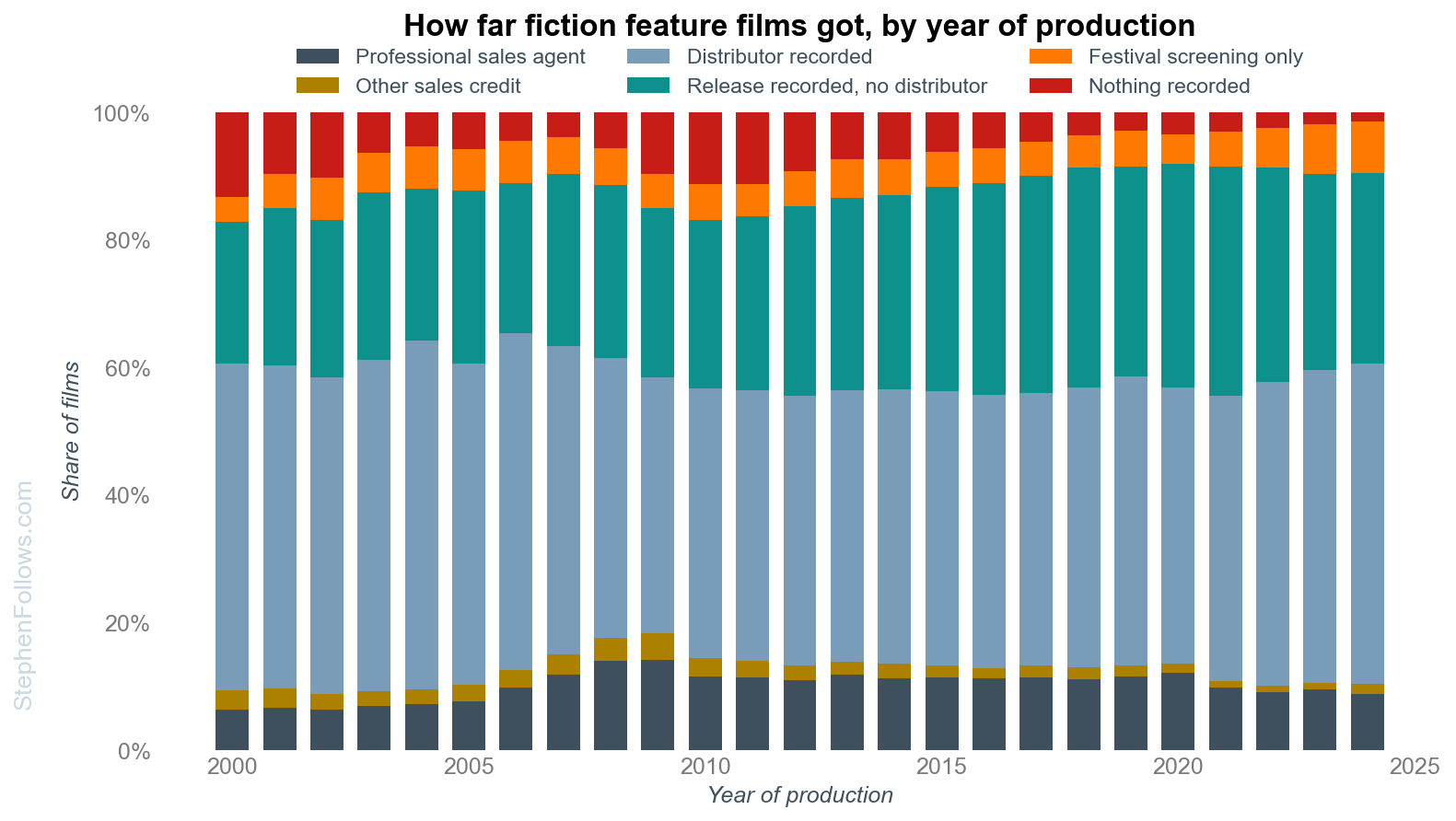
No. Over the past quarter century, the rate of sales agency representation shows a clear rise and fall.
For films produced in 2000, just 6.4% secured a professional sales agent. The share climbs steadily through the decade to a peak of 14.2% for films from 2009. Then it slides: 11.7% for 2015 films, 9.9% for 2021, and 8.9% for 2024 (a figure that will still tick up a little, since the newest films are still signing).
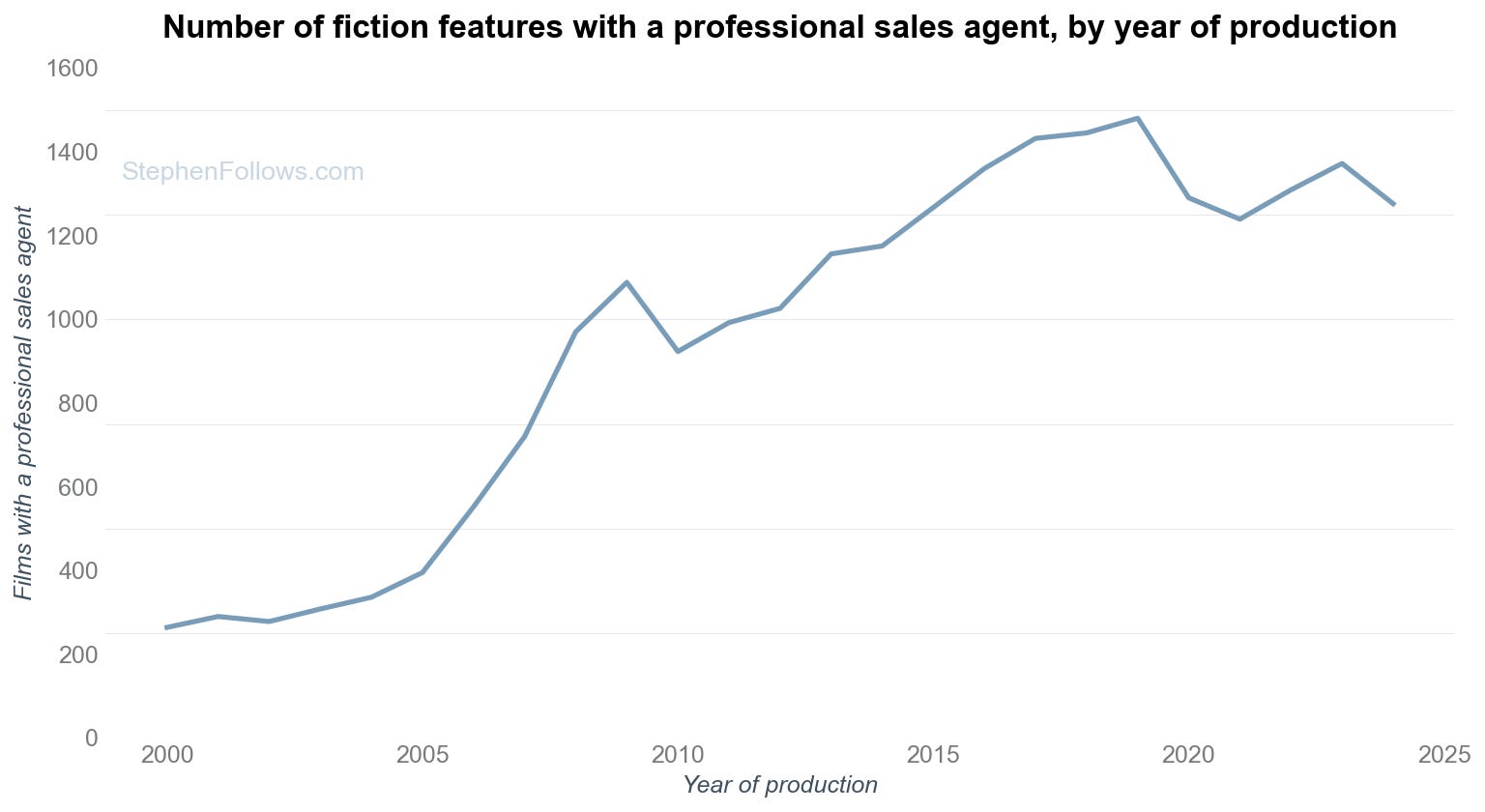
Over this period, the cost and complexity of making a feature film fell dramatically, leading to a boom in feature film production. So if we focus on the number of represented films, we see a steep rise from 264 films in 2000 to 1,088 in 2009, and a peak of 1,480 in 2019.
It has since levelled off, at around 1,250 to 1,400 films a year.
The peak years of sales agency representation are no mystery to anyone who worked through them. The late 2000s were the high-water mark of the international rights business. DVD money was everywhere, television buyers were still hungry, and pre-sales could still finance a mid-budget picture. Agents could afford to take on more films because they could sell more films.
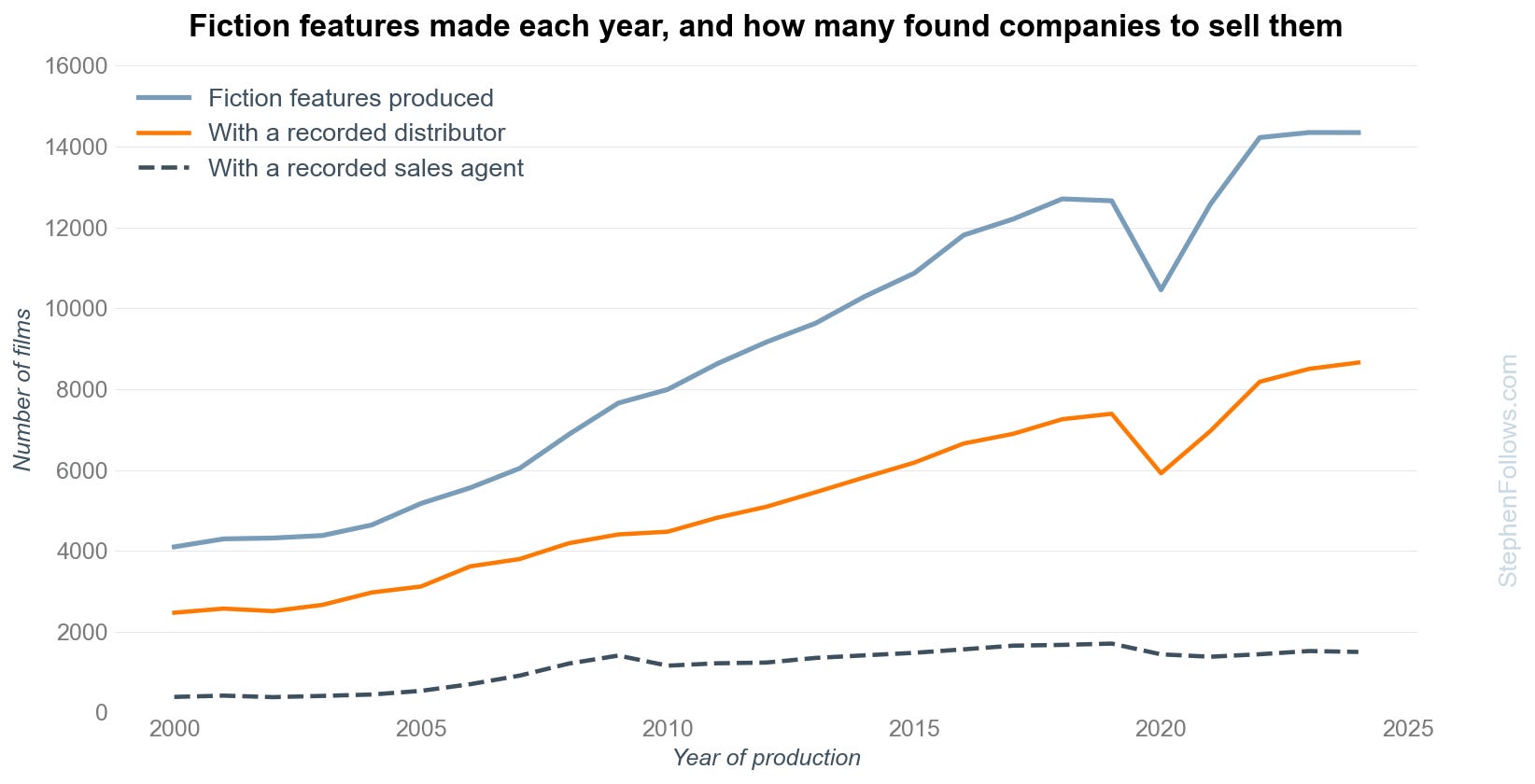
Around the pandemic, the market hit saturation, but production has continued to climb. There were 4,097 fiction features produced in 2000, compared with 14,345 in 2024. This means that a smaller percentage of films secure a sales agent in recent years.
Who are these sales agents?
If 28,519 films this century carry a sales credit, who are the sales agents who are representing them?
This is where “sales agent” becomes a complicated label. IMDb lets anyone submit a company credit, and “sales representative” is a box that gets ticked for all sorts of reasons. I opted not to rely on IMDb data, as spot-checking it showed it varies in integrity (such as listing Jaguar Land Rover as the sole sales agent for Fast & Furious: Hobbs & Shaw).
I investigated all 3,891 companies that hold sales credits on these films across other industry sources, such as Cinando, Cineuropa, and others.
I quickly figured out that a key test of whether it was a “real” sales agent was how many films they represented that they did not produce. It’s not unusual for a sales agent to put in some money and/or get a producer credit, but across their entire slate we would not expect most dedicated sales agents to also be one of the core producing entities.
77 of the 3,891 turned out to be plain data errors, credited as sellers by mistake, and I excluded them.
After researching the companies, I split the remaining 3,814 into four groups:
Professional sales agents are companies listed in the market directories or confirmed by research as independent sales operations. I identified 1,693 of them.
Producer sales agents are companies that only ever sell their own productions, plus the small sellers with one or two credits and no traceable web presence, which in practice are the same thing. There are 1,394 of them.
Studios and distributors are companies whose main business is releasing films, credited as sellers of their own slates. There are 429 different such companies operating since 2000.
Other covers national film bodies that act as agents for their country's cinema, rights catalogues that hold old libraries, talent and management firms that appear in no market directory, and a handful of companies that sell other people's films but appear in no directory. There are 298.
The 1,693 companies I classed as “Professional Sales Agents” only account for 44.4% of the companies but hold 81.6% of the credits.
