


Earlier this week, the national board of SAG-AFTRA (the actors’ union) voted to keep Duncan Crabtree-Ireland in charge until June 2032 and to add ‘CEO’ to his title. The announcement didn’t mention what his new contract pays, but coincidentally I have been approached to run the numbers on what film and TV union leaders are paid.
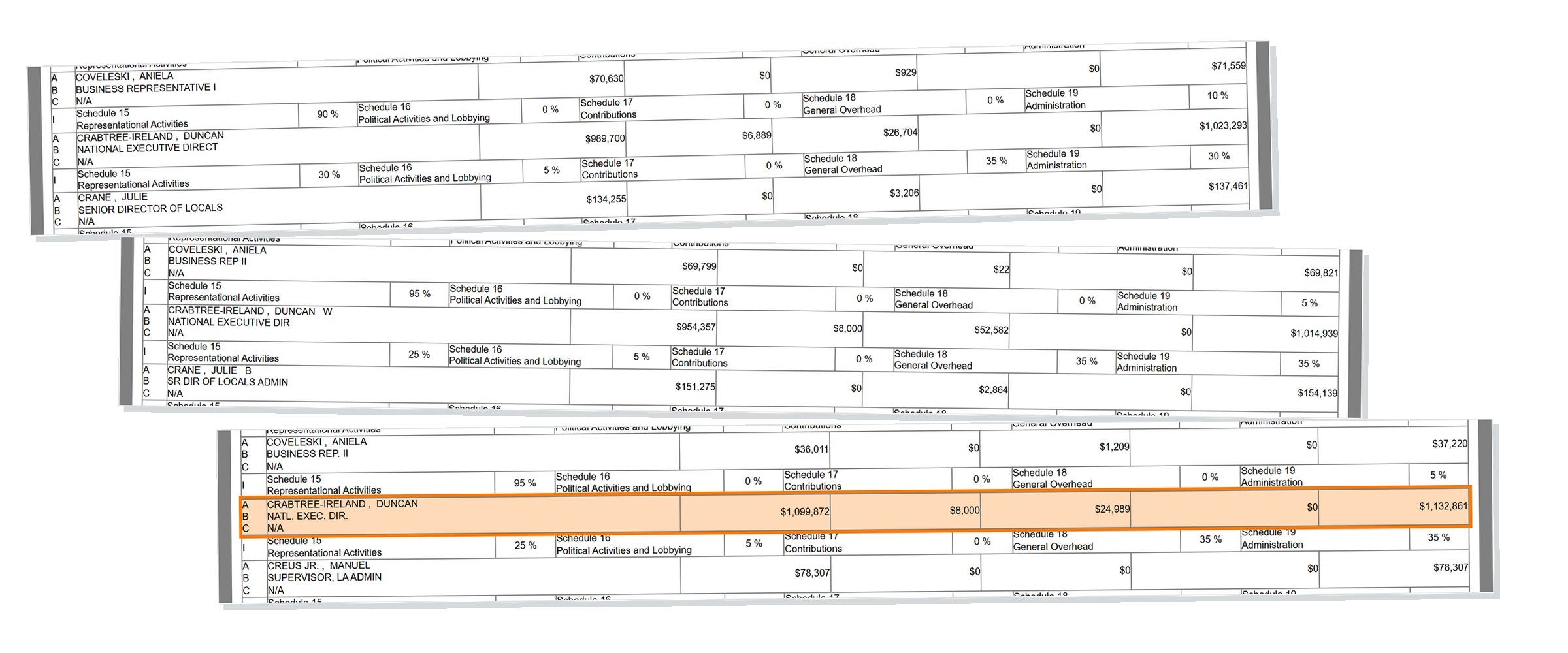
According to the union’s latest public filing, which covers the year to April 2026, he was paid a salary of $1.1 million. That is about 40 times what the average SAG-AFTRA member earned from union work that year.
(His total package is actually higher than just salary. Their tax return for 2024 includes his bonus, pension contributions, and benefits, which takes the total to $1,366,117, but for this article I’m going to stick to the base salary).
His new contract has arrived at an inconvenient time for this kind of conversation. Actors, including Drake Bell, have been going public about losing their union health coverage, which, from 2027, requires $28,933 in earnings under union contracts in a year. Bell had $17,480.53 over the year to June 2026.
I obviously can’t speak to the most recent deal, as I have no inside knowledge, but I compare the most recent public figures across the unions and look at how they've evolved over time.
Every sizeable American union has to file an LM-2 annual financial report with the Department of Labor. It lists every officer and senior employee, what each was paid, membership, dues income, and the rates the union charges.
I took the complete files for 2000 to 2026 and focused on 877 returns from 35 entertainment unions. They range from SAG-AFTRA and the Directors Guild of America down to the Hollywood crew locals of IATSE, the drivers and casting directors of Teamsters Local 399, and the musicians’ locals in Los Angeles and New York. Between them, they hold more than 72,000 individual pay records. The full method is in the Notes at the end.
How much are union bosses paid?
Crabtree-Ireland was promoted from chief operating officer to national executive director in 2021, on a starting salary of $770,000. By his second year in the job, he was paid $954,357 (an increase of about 24%), and his pay has gone up every year since (6.5% in the year to April 2024, 5.2% to 2025 and 2.9% to 2026).
Over five years in the job, his salary has risen about 43%, and most of that came in his second year. (His filing for the year to April 2022 shows $989,700, but that included a payout of holiday he had built up in his earlier jobs at the union).
He’s not the only union leader with a hefty pay packet. The DGA’s Russell Hollander received $824,327, and Ellen Stutzman of the Writers Guild of America West is on $810,286.
After these two, the next-highest paid is quite a step down, with IATSE’s elected international president, Matthew Loeb, receiving $577,762. The 16 IATSE locals in my sample pay their leaders between $131,015 and $381,260. Lowest of all is the president of the Los Angeles musicians’ local, on $126,921.
For the guilds, a hired chief executive runs the place. For most crew locals, it’s the elected business agent who runs the office day to day. In the chart below, orange bars are hired executives and slate bars are elected officers, each from their union’s latest filing.
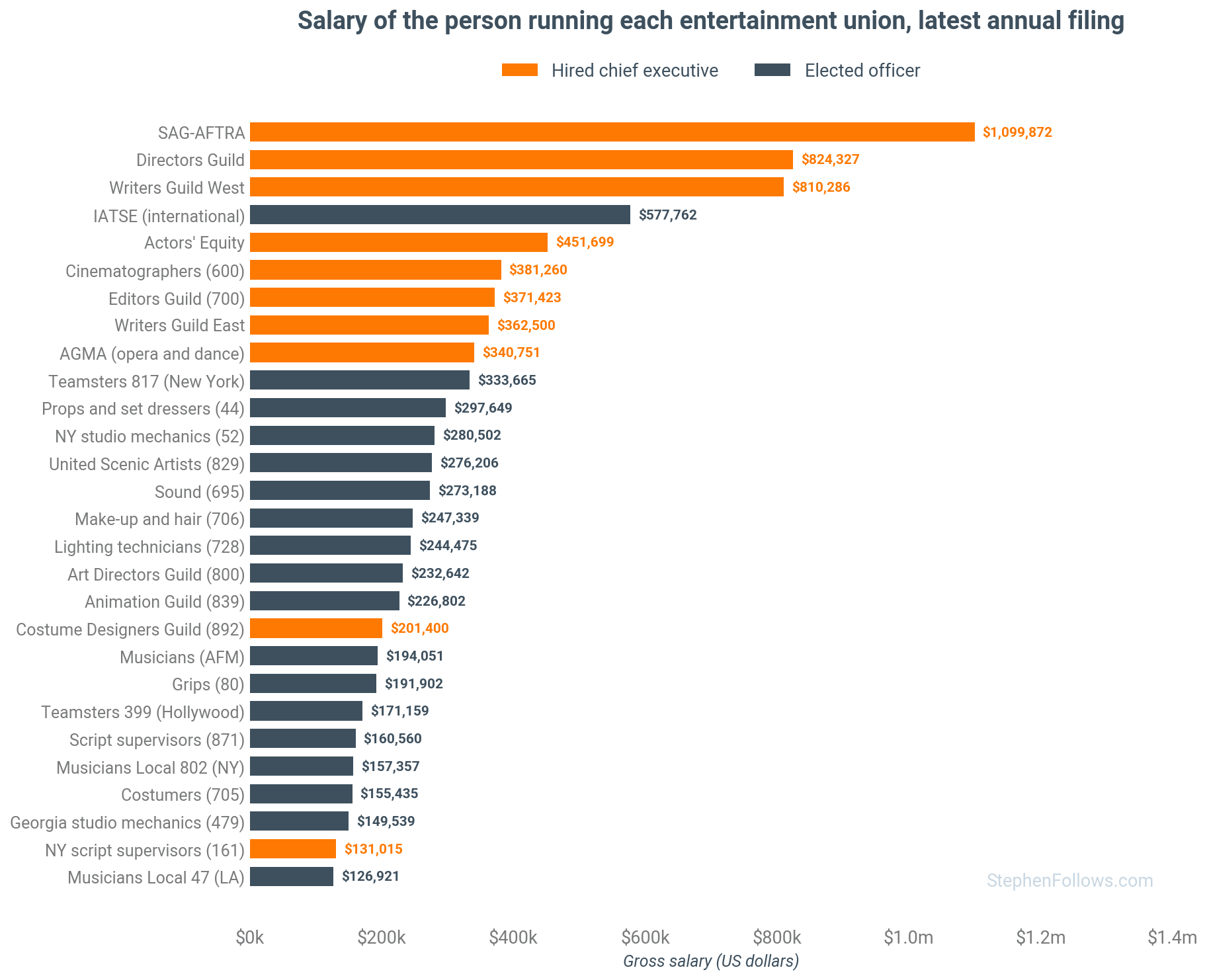
If you’re wondering why there aren’t any famous names on the chart, it's because the elected presidents of the actors’, writers’, and directors’ unions work for free.
Christopher Nolan serves as president of the DGA without a salary.
Sean Astin at SAG-AFTRA and Brooke Shields at Actors’ Equity receive only expenses ($2,210 and $4,833, respectively).
The pattern across the board is that members elect well-known faces to lead the organisation, and then the board hires a professional to run things. The former don’t need the cash, while the latter get the cash.
What does the average member earn?
I wanted to put these figures in context, so I tried to figure out how much the average member of each union earns. It’s harder than it sounds, as none of the unions seems to publish what their typical member takes home.
This is where maths takes the fore!
The actors’, writers’ and directors’ guilds charge dues as a percentage of what members earn on union contracts (aka “covered earnings”), and this data is reported in the publicly filed LM-2 forms. So if we know the tax rate and how much it raised, we can work out the income level it was charged on.
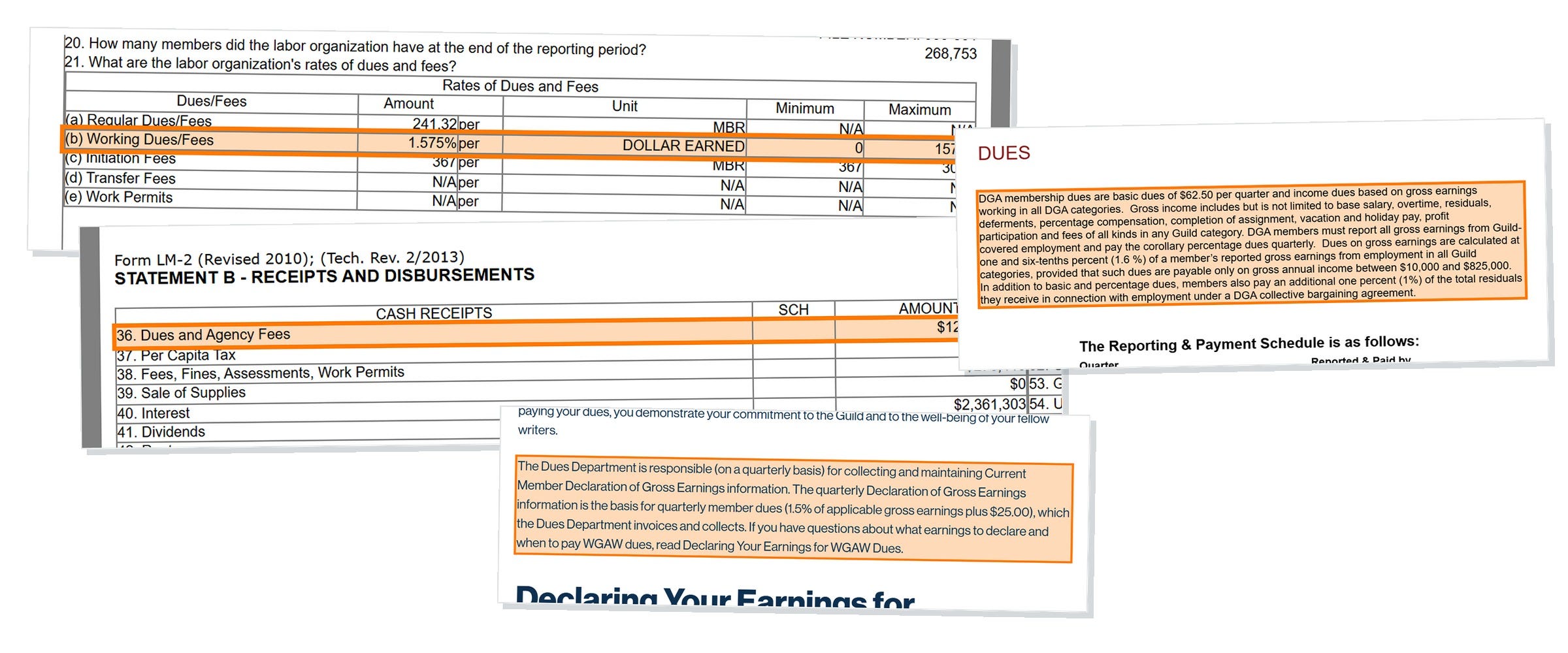
For example, let’s start with SAG-AFTRA. In the year to April 2026, members paid $241.32 in base dues plus 1.575% of their covered earnings (capped at $1 million a year). The union collected $121,315,552 in dues, so if we subtract the base dues for its 180,042 active members, and divide what’s left by 1.575%, and we get roughly $4.94 billion in covered earnings, or $27,460 per active member. Maths FTW!
I did the same for the other guilds. This method shouldn’t be used to draw any wider conclusions as it’s not perfect. The figures include residuals, which also attract dues. WGA West’s annual report puts members’ 2025 earnings, before residuals, at $1.66 billion, and my dues-based estimate, including residuals, is $2.32 billion. But it is a useful figure for comparing leadership salaries and calculating rough multiples.
This shows us that Crabtree-Ireland’s salary in the year ending April 2026 was 40 times the average union earnings of its active members. The figure is lower for Actors’ Equity (32 times) and much lower for the DGA (9 times), WGA East (4.4) and WGA West (3.6).
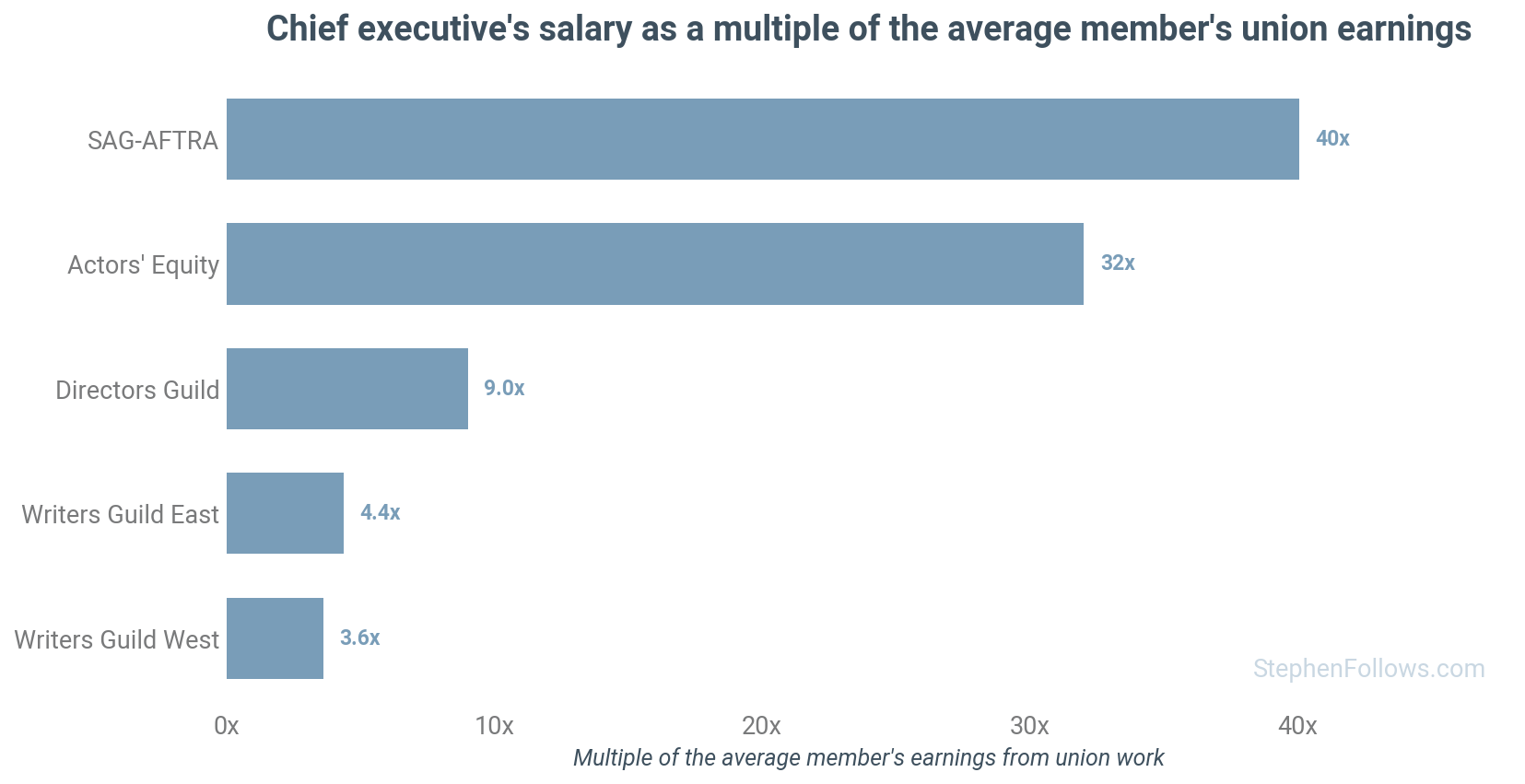
Let’s remember that this is a two-sided calculation. If a CEO’s salary is higher, the multiple will rise, but it will also rise if the member’s average income falls.
An average WGA West member earned about $224,000 from guild work, so Stutzman’s salary is 3.6 times that. An average active SAG-AFTRA member earned $27,460, so Crabtree-Ireland’s is 40 times. Actors’ Equity, the stage actors’ union, is close behind at 32, because its average member earned just $14,105 on Equity contracts.
Also, these are averages, which greatly flatter the actors. A small minority of well-paid performers (7% earned $80,000 or more in 2023) pulls the mean up a long way. In 2023 the union’s chief economist, David Viviano, said that only 14% of members earned the $26,470 then needed for health coverage.
For the typical SAG-AFTRA member, then, the multiple is far higher than 40.
Has the gap grown?
At SAG-AFTRA, yes.
Under Crabtree-Ireland’s predecessor David White, the multiple sat between 21.5 and 28 for eight years. It has been above 30 in every year since, peaking at 44 in the year to April 2025. Meanwhile, the writers’ line has barely moved.
The chart below tracks the same multiple each year since 2014 for SAG-AFTRA and WGA West. (I left out years when the boss’s pay included one-off payments, hence the gaps).
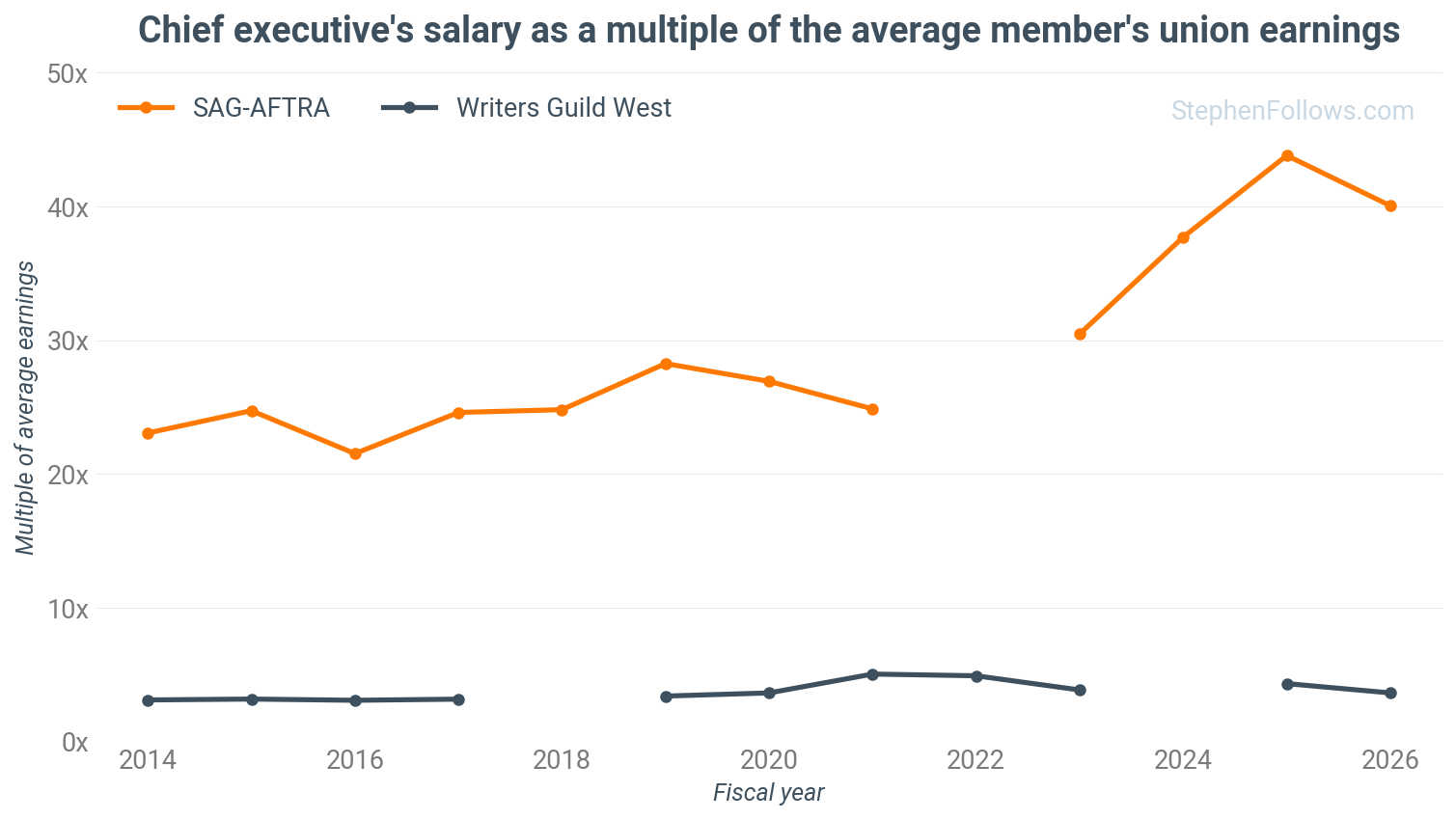
Between 2014 and 2026 the pay of SAG-AFTRA’s national executive director rose 97%, while members’ average union earnings rose 13% and prices rose 40%. In real terms (i.e. after inflation), the average actor’s union income has fallen by about a fifth, while the top job’s pay has nearly doubled.
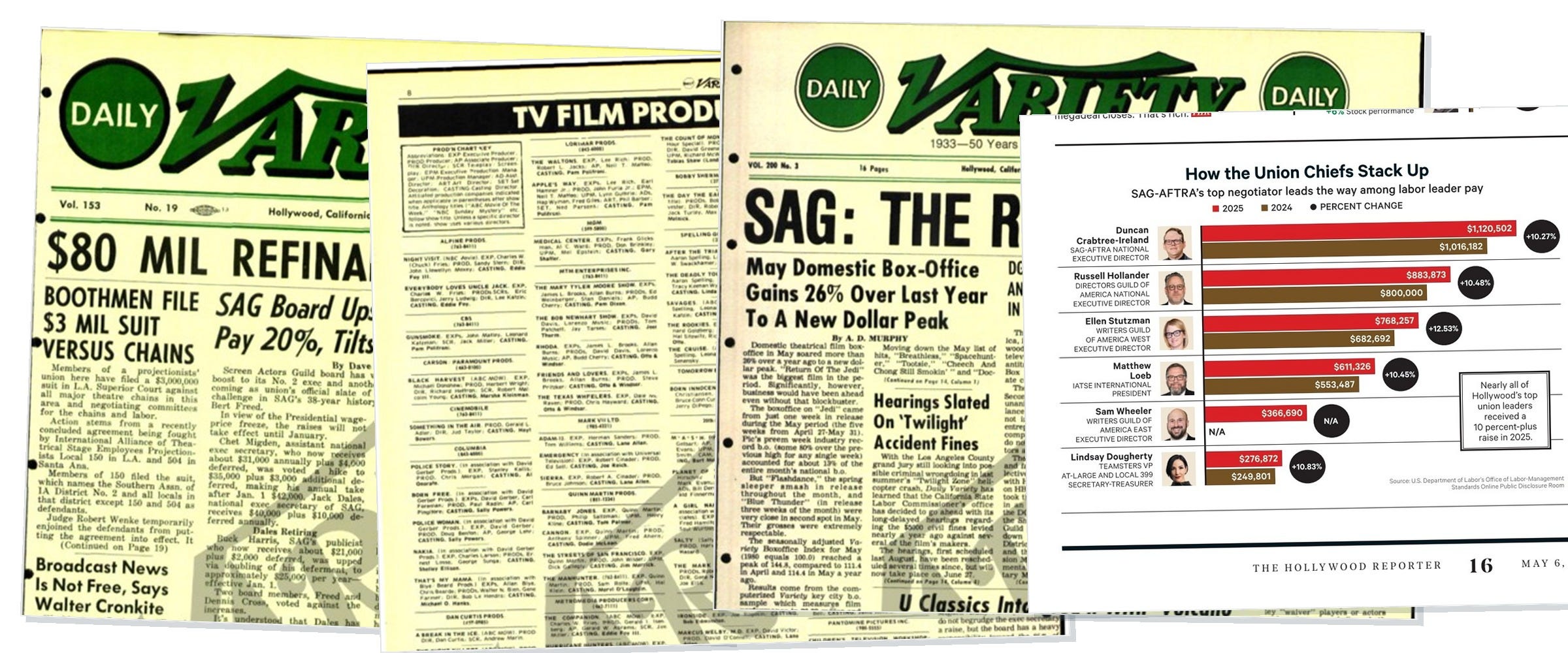
It isn’t a new complaint either. Back in 2015, Deadline pointed out that White’s 7.3% raise that year was almost three times the 2.5% rise he had negotiated for members on the film and TV contract.
Is that a lot for a union boss?
There is a reasonable argument that this is exactly how much he should be paid. That top talent commands top salaries, and this is all being done in the open (i.e. annual reports, public filings, etc).
Marick Masters, professor emeritus at Wayne State University, told The Hollywood Reporter in 2024:
The airline pilots, the professional athletes, the directors, the screen actors and the writers, they have a lot of highly paid people within their membership. The people that are in the upper end make a lot of money and they can afford to pay staff to represent them.
Most SAG-AFTRA members are not well paid, but there are a lot of them. Spread across 180,042 active members, Crabtree-Ireland’s salary costs each one about $6.11 a year. A WGA West member pays about $78 a year towards Stutzman, a DGA member about $43 towards Hollander, and a member of the Costume Designers Guild about $211 towards its executive director.
As a share of everything their members earn, the actors’ chief executive is the cheapest of the five guilds I could measure, at 0.022% of covered earnings (against 0.035% at WGA West and 0.054% at the DGA).
So while it’s true that he’s paid far more than the average actor, it’s also true to say that he costs each actor almost nothing.
Let’s zoom out and compare his figure to other union bosses (all of whom do very different jobs, but it’s the closest we can get to a comparable job).
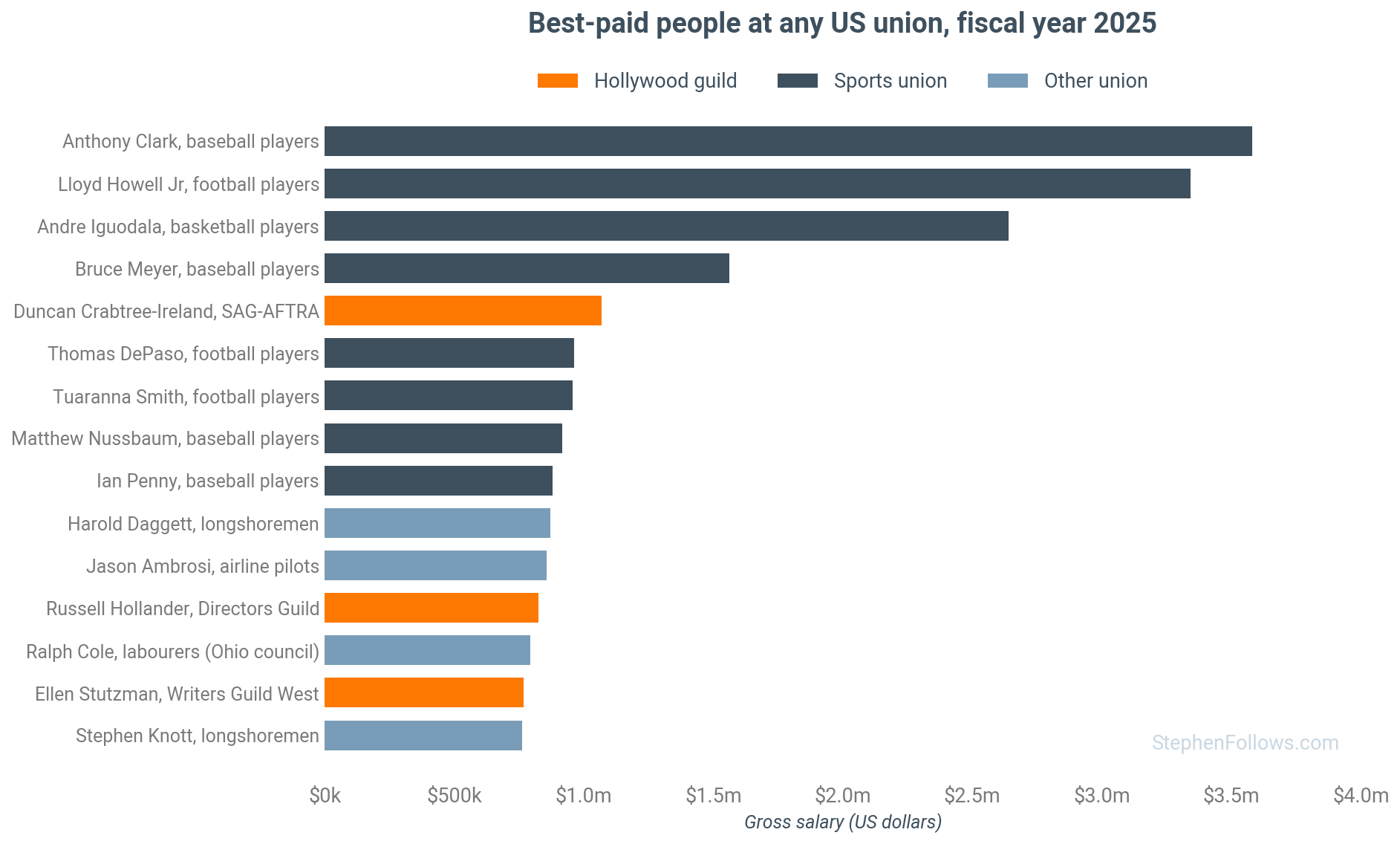
In fiscal years ending in 2025, 592 people at US unions were paid a gross salary of $300,000 or more. Crabtree-Ireland was fifth on that list by salary, and the four people above him all worked for players’ unions in sport.
Outside baseball, football and basketball, nobody in American labour was paid a higher salary.
Union leaders tend to point to the other side of the table instead. The Alliance of Motion Picture and Television Producers, which negotiates for the studios, files a tax return rather than an LM-2, and its most recent one shows its president (Carol Lombardini, who stepped down in April 2025) receiving $4,232,240 in pay in 2024 (including a $2,125,000 bonus), plus $43,548 of other compensation. Measured the same way, that’s about three times Crabtree-Ireland’s 2024 package.
Tax returns also cover other Hollywood bodies. The Producers Guild isn’t a union, but its return shows its chief executive, Susan Sprung, receiving $730,000 (including a $125,000 bonus) plus $39,500 of other compensation in 2024. The Academy’s chief executive, Bill Kramer, received $1,080,015 plus $60,727 in 2024. On the same basis, Crabtree-Ireland’s package that year was $1,366,117.
Is it only the top job?
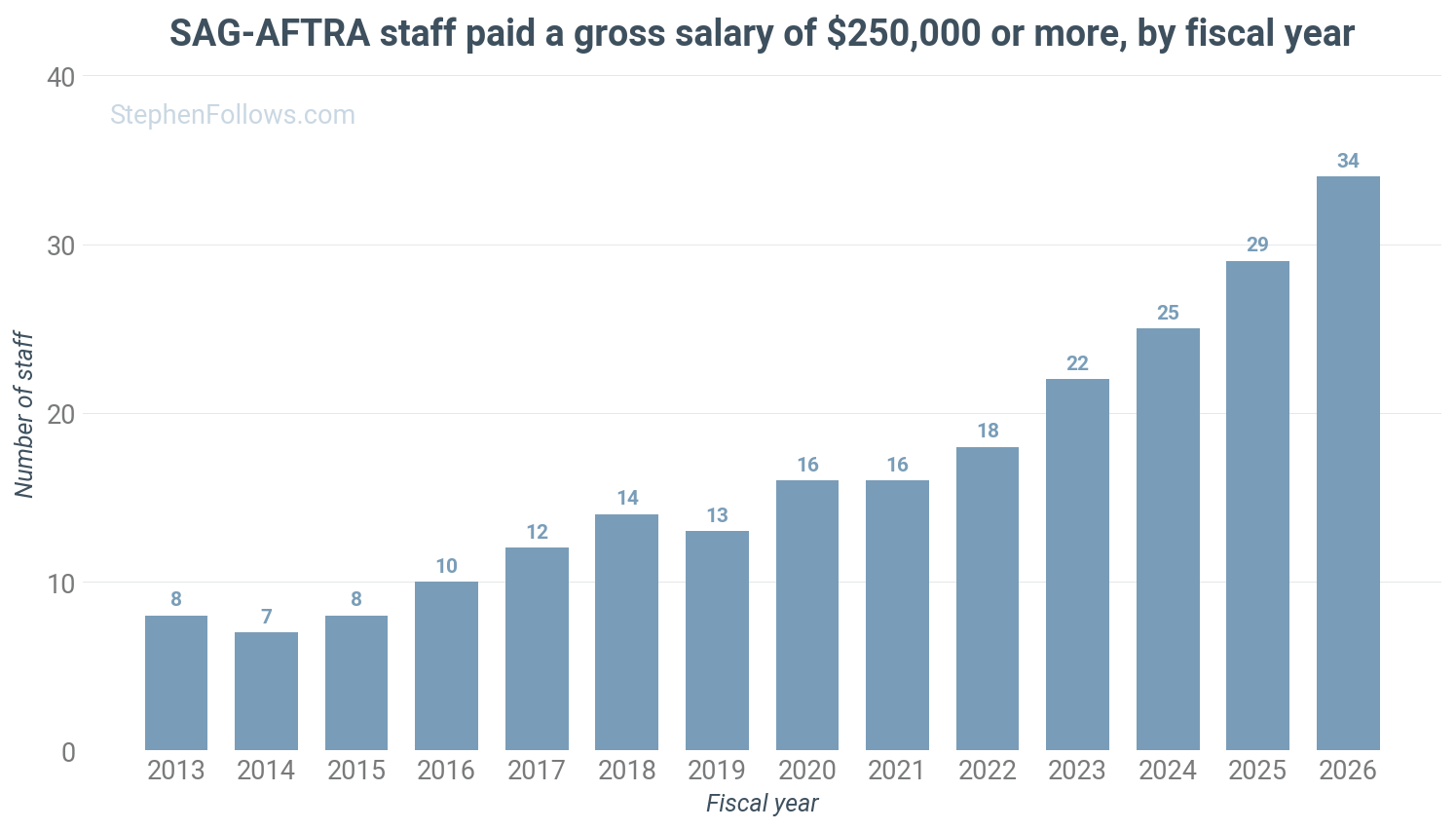
In a display of true worker solidarity, it’s not just the top role that receives a high salary. In the year to April 2026, 34 SAG-AFTRA staff were paid a quarter of a million dollars or more, with four earning more than $500,000.
That’s up from eight being paid over $250,000 in the year to April 2013. Over the same period, active members grew by 7%, from 168,593 to 180,042.
None of this proves the pay is wrong. Running a union of 180,000 members through a strike, a pandemic and the arrival of AI is a serious job, and the board voted 98.3% in favour of keeping him.
But I think the gap between the people who run Hollywood’s biggest union and the people who pay for it has widened, for reasons tied to the health-cover row. Over the last decade, the union's top has done well. The typical member hasn’t.
The pay in Crabtree-Ireland’s new contract will appear in SAG-AFTRA’s filing at the end of July 2027. I suspect Drake Bell won’t be the only actor reading it.
Notes
Pay, membership and dues figures come from the annual financial reports (Form LM-2) that unions file with the US Department of Labor, published in its Online Public Disclosure Room. I used the bulk yearly files for 2000 to 2026, downloading 2024 to 2026 afresh on 27 October 2026 (the department’s listing was last updated on 25 October 2026). Unions were selected by their Department of Labor file number, not by name. Each union keeps its own fiscal year. SAG-AFTRA, IATSE’s international office, both writers’ guilds and Actors’ Equity have filed for fiscal years ending in 2026, and the DGA, the IATSE locals, the Teamsters and the musicians’ locals for calendar 2025. Key figures were checked against the department’s online report viewer and matched to the dollar.
By ‘the person running’ each union I mean the hired chief executive where a union has one (national executive director or executive director), otherwise the principal elected officer who runs the local (business agent, business manager, business representative or president). I chose each one by hand from the filing. In three cases someone else was paid more in the latest filing: the Motion Picture Editors Guild’s retiring director, the Art Directors Guild’s former director and a Teamsters 399 vice-president. Teamsters 399’s Lindsay Dougherty is also paid by the international Teamsters union, which isn’t included in her $171,159.
All pay figures are gross salary as reported on the LM-2, before allowances and expenses, unless I say otherwise. They exclude pension and health contributions. Years that included a one-off payment are left out of the year-by-year comparisons: SAG-AFTRA 2022 (accrued holiday on promotion), WGA West 2018 (a one-time bonus, according to the guild’s then president), WGA East 2009 and the Screen Actors Guild 2005 (both departures).
These are estimates, worked back from each guild’s dues income using the rates stated in its own filing for the year in question. SAG-AFTRA charged $241.32 a year plus 1.575% of covered earnings through April 2026 (its help centre now lists base dues of $246.14), with the earnings cap rising from $500,000 to $1 million over 2023 and 2024. WGA West charges $25 a quarter plus 1.5%, WGA East $40 a quarter plus 1.5%, Actors’ Equity $176 a year plus 2.5%, and the DGA $62.50 a quarter plus 1.6% of earnings above $10,000 (1% on residuals).
The results are means per voting member (active members at SAG-AFTRA and the DGA, current members at WGA West, members in good standing at WGA East), not medians. Earnings above each guild’s cap are invisible to this method, which pulls the averages down and the multiples up. Dues are recorded when paid, and work dues are billed on the previous calendar year’s earnings, so the timing is approximate.
The Department of Labor defines the dues line as “regular dues, working dues, etc.” and has fees reported separately, so I have treated initiation fees as falling outside it. The DGA figure counts all earnings-based dues at 1.6%, so it is a floor. Crew locals mostly charge flat quarterly dues, so this method can’t estimate their members’ earnings, which is why they don’t appear in the multiples.
Reasonable alternative assumptions (about initiation fees, dues relief and earnings above the cap) put SAG-AFTRA’s multiple anywhere between about 25 and 60, so 40 is a central estimate. The gap with the writers’ guilds holds under all of them.
WGA West’s count of current members fell from 11,799 to 10,338 in its latest filing, which pushes its per-member average up. SAG-AFTRA’s active count includes many people with no union earnings in a given year, which is part of the point.
The Producers Guild, the Academy and the AMPTP file IRS Form 990s instead of LM-2s, and SAG-AFTRA files one as well as its LM-2. Their figures come from ProPublica’s Nonprofit Explorer and report pay for the calendar year (2024 in the latest returns), including bonuses, pension contributions and benefits. The AMPTP’s return names its president only as “Ee No 1001 (President)”. Lombardini held that post until April 2025.