


At last year's London Film Festival, top British producer Tessa Ross discussed what would help Britain's independent producers most. She said:
I have a sort of dream, it's a mad dream, but yes, I would love it if you would cashflow the tax credit. It would be amazing…that pressure is taken away.
The UK already has a very stable and generous tax credit scheme, especially for lower-budget films, thanks to the recent Independent Film Tax Credit, which has a headline rate of 53%.
What Tessa was calling for wasn't more money, but sooner money.
And the reason is that, with film tax credits, time really is money.
This is front of mind for me right now as Phil Hunt and I prepare for our film finance webinar in a few weeks. One of Phil’s many businesses lends money against film tax credits, so he knows this topic very well. In January next year, we also have a full-on six-session online course called Advanced Film Financing.
You can join our free webinar here:

What is a film tax credit?
A tax credit is about as close to guaranteed money as a film gets.
It's money a government pays to a production in return for spending in that country (or state). It's calculated as a percentage of what the film spends locally, and it goes to every film that meets the rules. The rules are normally a mix of a cultural test, a minimum local spend and a local company to make the claim.
And some of these programmes can make a significant contribution to the film’s budget:
The UK has a headline rate of 34% of qualifying spending, or 53% for lower-budget films.
Ireland pays 32% (40% for some lower-budget films).
Australia pays 40% to feature films made for cinemas.
New Zealand pays 40% to local productions and 20% to international ones.
France pays 30% to international productions shooting there (40% for films heavy in visual effects).
The snag is that, in most countries, the production only receives the money after the film is completed (and after they have submitted all final paperwork). Most of a film’s budget is spent during the shoot and must be paid weekly. Very few suppliers or crew will be willing to wait six months for their invoices to be settled.
So the producer has a problem - they have pretty certain money coming but bills today. Into this gap, a number of specialised lenders have sprung up. They advance the producer money, in return for a fee.
How much do films rely on tax credits?
When I studied the finance plans of over 100 films budgeted at $1m or more, I found that 92% relied upon some form of tax credit.
The exact mix differs by country. It would be very strange for a European or British film not to use them, but many American projects have a much harder time accessing that money.
Among those films, the credit supplied a median of 27.5% of the budget. The chart below shows the median for each country with at least four films using a credit.
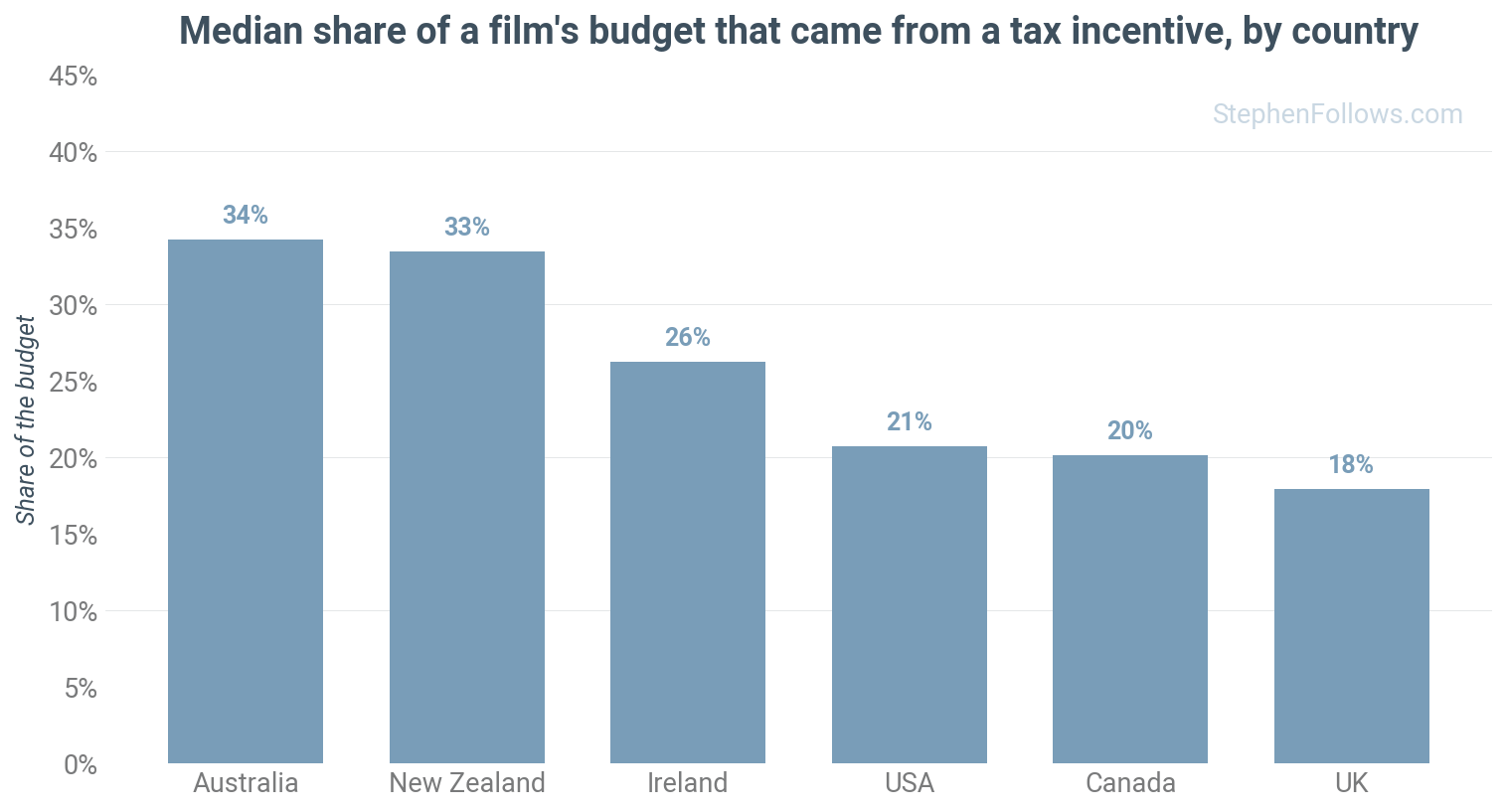
Australian films got about a third of their budgets this way (34%), and British films a little under a fifth (18%). If the British figure looks low against a 34% headline rate, it's because the credit applies only to qualifying money spent in the UK.
So for most of these films, somewhere between a fifth and a third of the budget was money that a government had promised but hadn't yet paid.
How hard is a film tax credit to apply for?
Getting the money is rarely as simple as filling in a form. I went through the small print on 86 film tax credit schemes around the world, and found that ALL require at least two separate applications (36 need three or more).
The chart below shows how often five common requirements turn up.
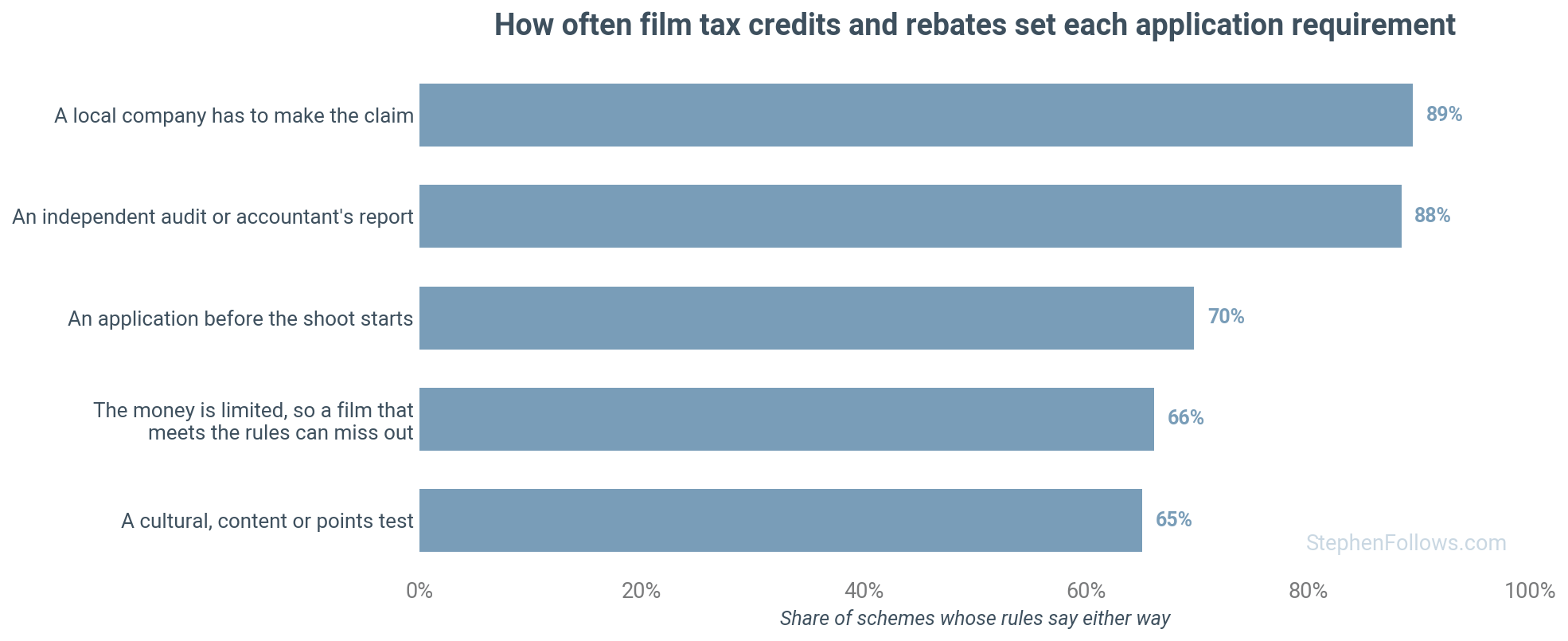
89% want a local company to make the claim and an independent audit or accountant’s report. Audits aren’t cheap - in Georgia, it costs from $5,000 for a small production to $25,000 for a large one.
And qualifying isn’t always enough. In two-thirds of schemes, the money is limited, so your film could meet all the requirements but still be unlucky if the pot has dried up. (California approved 39 of the 145 applications it received in 2021-22).
The only survey of producers I could find is for the UK (published by the tax authorities) in which 56% of 164 recent claimants said making a claim was easy, and 15% found it difficult.
At what stage is the money provided?
58% of the tax credits I studied pay after the film is finished, either through the production company’s tax return or after an audit and certification process. This is the situation for the biggest programmes, including the UK, Australia, Canada, France, Germany and several American states (New York and California among them).
Another fourteen (including New Zealand, the Czech Republic and Estonia) pay after the film is finished, but promise to do so within about three months of the final paperwork.
Only eleven pay a meaningful chunk during the shoot. Ireland lets a producer claim “up to 90% of the expected tax credit based on budgeted expenditure during the course of the production of the film”, and Denmark’s rebate pays 70% in advance.
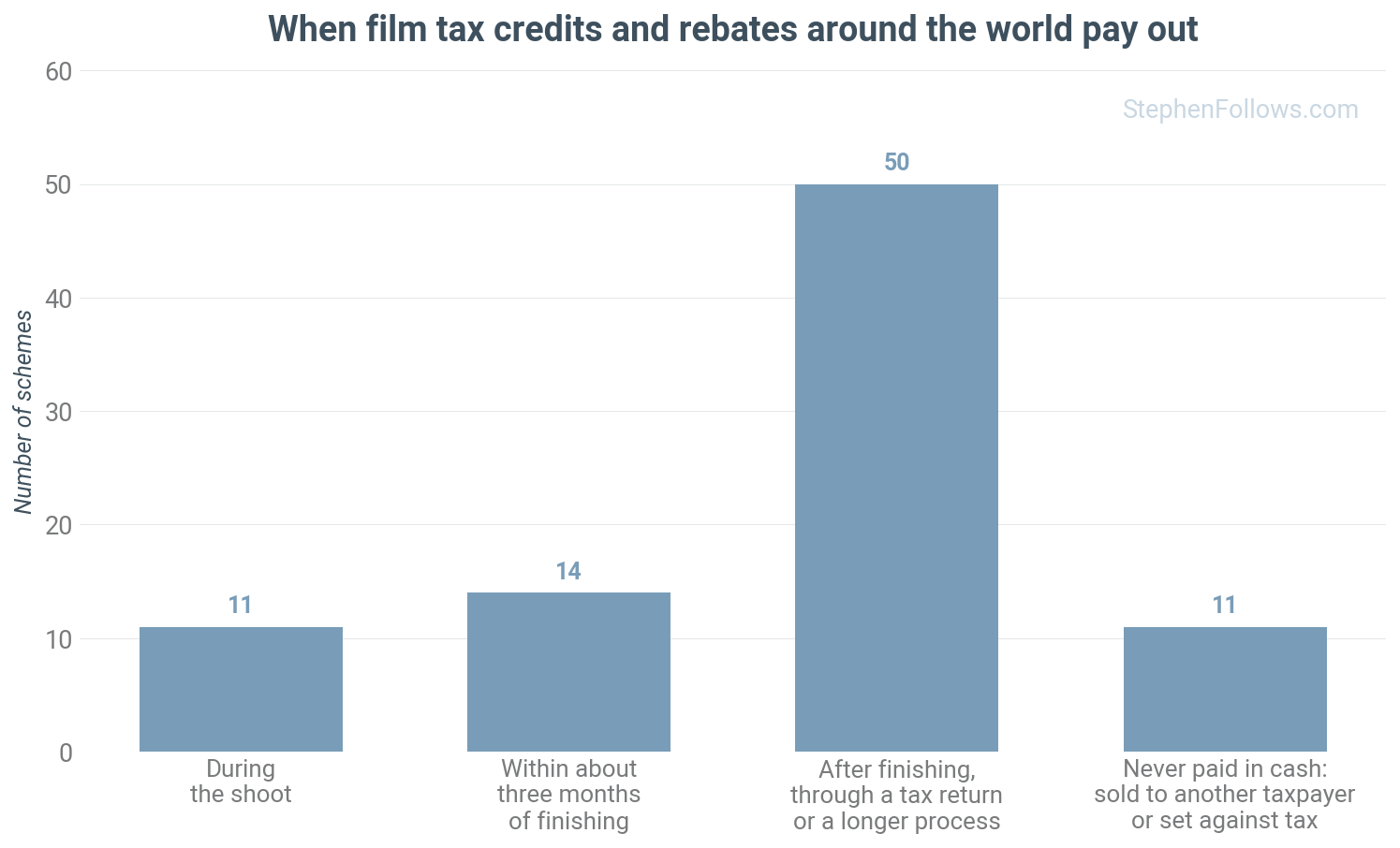
Interestingly, the last eleven never pay cash at all. With these, the credit can only be set against a tax bill, so a producer who doesn't owe much tax has to sell it to someone who does. Georgia works this way, giving producers "the option of selling the tax credit to a Georgia taxpayer". According to The Hollywood Reporter, those credits often sell for around 90 cents on the dollar. Italy and much of Spain's system work similarly.
How long is the wait after the film is finished?
So a producer will get the money late - but how late?
Not all programmes publish real numbers on turnaround time, but below is the best I could find on how long producers have to wait, a mix of measured averages (in orange) and official targets (in blue).
The quickest I found was Estonia, which aims to process the final report within 30 days and pay within 10 working days.
New Zealand allows itself three months plus ten business days.
Canada has two clocks, one after the other. First, the certifying office works to a 180-day target. Then the tax agency aims to process the return in 60 days (120 if it audits the claim).
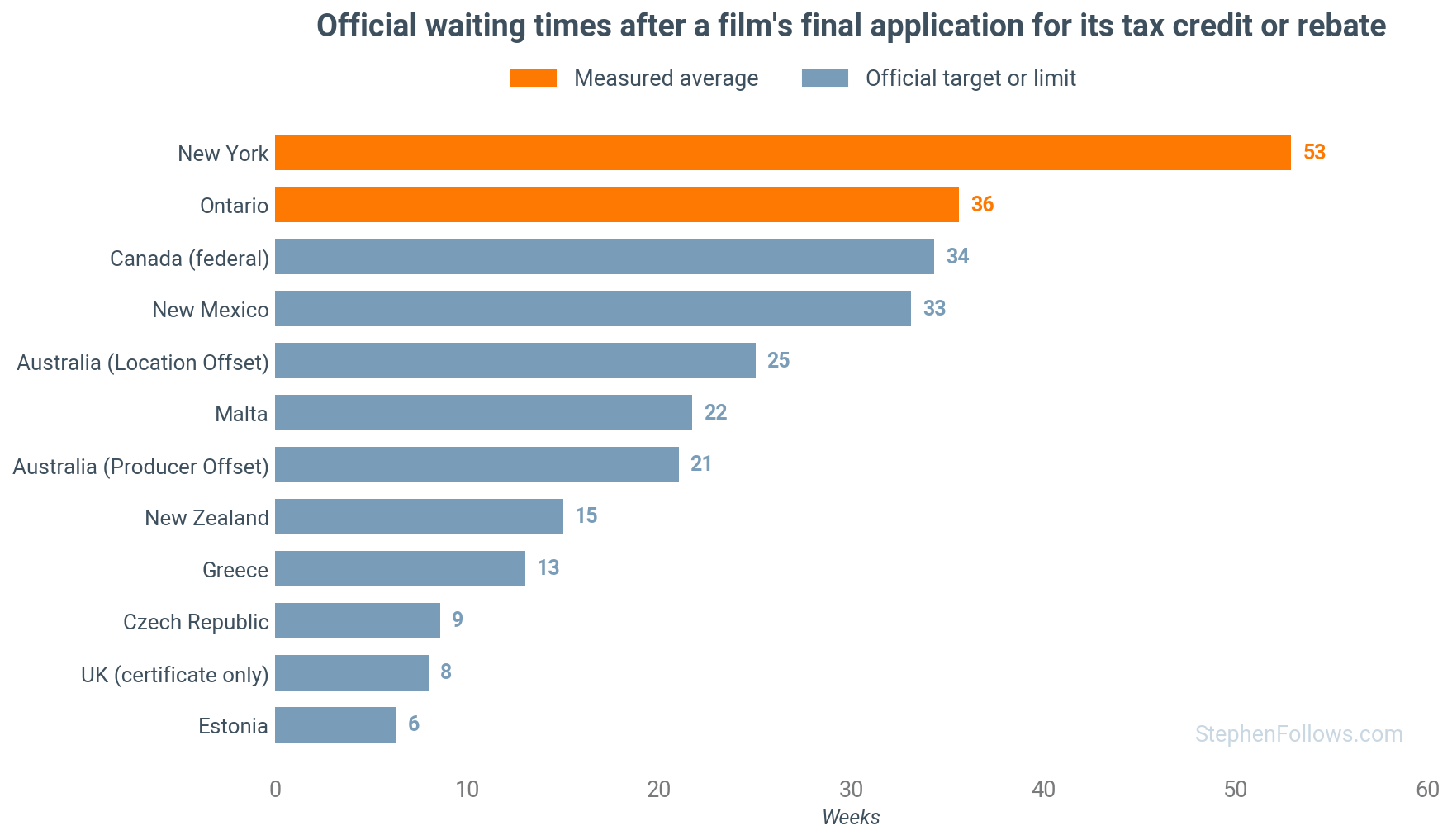
We have to take official targets with a pinch of salt. Greece officially claims it pays rebates within three months of the decision certifying the project, but last year it had a backlog of more than €100m owed to dozens of productions.
In 2023, John Hadity of Entertainment Partners described the situation with the New York tax incentive like this:
In 2013 it was taking six months for the final application to be processed and the certificate issued. Today it takes 20 months.
Since then, New York has improved. The state's own review found that the average time from final application to the credit being issued fell from 569 days for 2021-22 projects to 370 days for 2023-24.
Who steps in to solve this timing issue?
With all the time it takes to receive real money (both the official process plus delays), producers can be short a lot of money for many months. This is where private lending comes in to fill the gap.
Twenty years ago, when the UK’s film tax relief launched, one financier expected producers to be left with only about two-thirds of the credit after lenders took their share (rates have improved significantly since then).
It's easy to see lenders purely as a cost. However, a credit nobody will lend against is worth much less. In 2007, New York's credit couldn't legally be signed over to a bank, meaning only producers who could wait up to two years for their money could shoot there. In 2023, producer Pam Koffler said that a four- or five-year wait for a New York credit ruled the state out for one of her films, which shot in New Jersey.
Some governments have decided to take on the lending role:
Quebec’s film agency lends producers up to 95% of their expected credit (at below-market rates).
France's tax rules allow a producer to sign the future credit over to a bank as soon as the film has provisional approval.
New Zealand lets the interest on a loan against its rebate count as qualifying spending, so the rebate pays for part of its own delay.
How much of the credit reaches the film?
If a private lender fills the ‘gap’, they will charge a fee to cover the risk they are taking on and to make a profit.
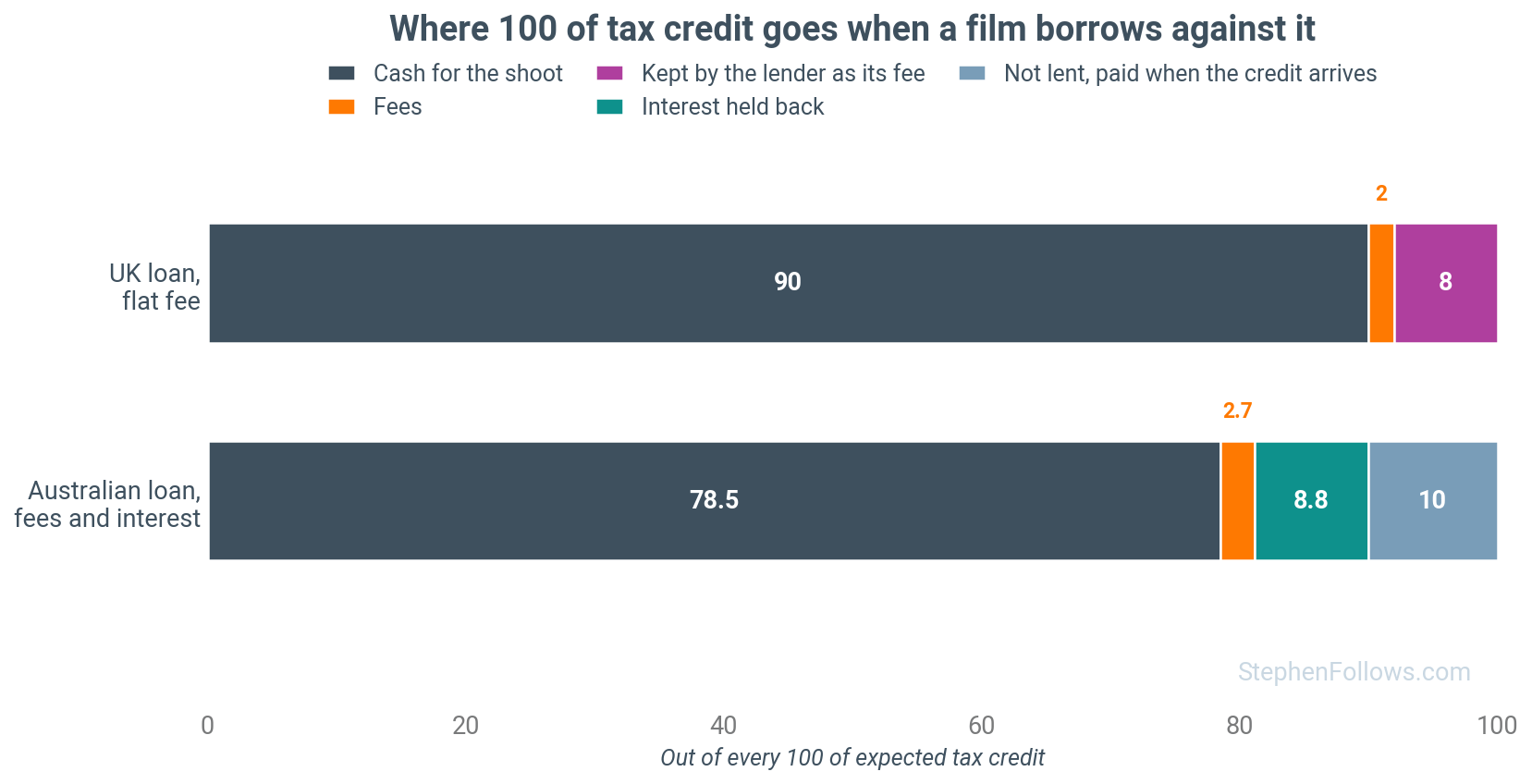
Going by the loan documents I studied, British loans typically charge a fixed fee, advancing 92% of the expected credit and keeping the other 8% as their fee. Sometimes there is also a further 2% fee on the credit, paid out of the advance. Interest is not typically charged on the amounts.
In Australia, loans are more likely to pay out 90% of the expected credit, with a 1% arrangement fee, a second fee of 2% to 2.5%, plus interest at a median of 8% a year. On the first day, the lender will hold back a median of 9.75% of the loan to cover expected interest.
The chart below shows expected tax credits for each deal type. British film producers end up with about 90% of the tax credit in time for it to be spent on the short, with Australian producers getting slightly less at 78.5% spent on the shoot, with Australian producers getting 78.5% up front and another 10% once the government pays.
This doesn’t include the other costs of time and legal advice that the producer will encounter in arranging and servicing this deal.
Timing is everything
Tax credit lending has settled into a regular pattern in what they offer. The amount of money each loan is for is already set (i.e. the tax credit amount that will be paid, multiplied by the share that is paid upfront) and the terms are very similar across deals. So the only thing left to affect the cost of the lending is the time frame.
The longer the wait for the government to pay out, the longer the lender has their money tied up and at risk.
Variety quoted Phil a couple of years ago talking about his concern over timeframes:
There are tons of issues out there. Hungary ran out of cash and didn't pay for a period; Greece had a slowdown and hit problems. Everywhere has slowed down including the U.S. and Canada. And if a U.S. state shoves you to next year, you've got an expensive timing problem.
What can a producer do to reduce the cost
If you are a film producer facing the need to advance your tax credit entitlement, then there are some things you can do to maximise the amount you actually receive:
Claim early. In the UK, you can claim at the end of each accounting period on an interim certificate. Ireland pays up to 90% during production. New Zealand's rebate for local productions allows an interim claim once a film passes a spending threshold (Variety reported that New Zealand's interim payment saved on production "nearly 40% of the interest costs").
Get it right first time. Almost every official clock only starts once the application is complete. Screen Australia says "the majority of applications currently being submitted [are] incomplete or contain errors". In New York, producers told Filmmaker Magazine that using one of the state's prequalified accounting firms was much quicker.
Pay attention to tax year ends. If the credit comes through a tax return, the company's year-end decides when you can file. A film that wraps a month after the year-end may wait most of a year longer than one that wraps a month before.
Ask the lender what happens if the credit is early. On a flat fee, an early credit makes the loan more expensive annually. On an interest-based loan, check that unused interest comes back.
Do your research and plan accordingly. Budget for the wait that films have actually had, which is usually longer than the one in the guidelines.
Want to know more about film finance?
If you want to hear Phil and me talk about film finance, then we have a webinar coming up in early December that you can sign up for free:
And in January next year, we have a full-on six-session online course called Advanced Film Financing.
Appendix - How do tax credits differ from other types of public money?
If you’re new to the world of film finance, you may be confused about how tax credits differ from other forms of public money (often called “soft money”), so I thought I’d spend a few minutes laying out the difference.
Broadly speaking, a film might benefit from four types of public funding:
A grant is a handout (i.e., not to be repaid) from a selective body (they take submissions, and a panel chooses who gets money). It’s typically paid before production or on a schedule of when it is needed to be spent.
Repayable public money is also chosen by a public body, but they will take a portion of the film’s income and/or profits.
An automatic tax credit or rebate goes to every film that meets the rules. Nothing needs to be repaid.
Tax relief for the investor. The film doesn’t directly get the money, but it does get investment, and the investor can lower their personal tax bill. In almost all cases, the investor will receive a share of the film’s earnings.
The first type, grants, is the “best” money because it doesn’t need to be repaid and you don't give up any of your film’s income. Eurimages, the Council of Europe’s co-production fund, treats any award of €150,000 or less as “a non-refundable subsidy”. It pays 70% once the agreement is signed and the shoot has started, and the last 30% at the end. Understandably, this is the hardest to raise!
Repayable public money looks similar, but the funding body will take a cut of the film’s future income. Above €150,000, a Eurimages award becomes an advance that is “repayable from the first euro of each co-producer’s net receipts”. Similarly, the BFI’s production funding is recoupable by the BFI, which also takes a share of profits and of the copyright.
Some funds hold back some of the money they are repaid for future grants to the same people. Through the BFI’s Locked Box, 25% of what the BFI recoups (rising to 50% once it has half its money back) is set aside for the producer, writer and director to spend on future projects.
An automatic tax credit or rebate goes to every film that meets the rules, with no committee choosing between projects. This is what we have been looking at in the main part of today’s article. The rules are normally a mix of a cultural test, a minimum local spend and a local company to make the claim. In the UK, a film has to be certified as British and spend at least 10% of its core costs in the UK. That earns a credit of 34% of qualifying spending, or 53% for lower-budget films (on the first £15m of core costs).
Finally, there’s tax relief for the individual investor. Here the benefit goes to the investor, so the film only gains if the relief convinced someone to invest who otherwise wouldn’t have. For example, a UK investor using the Enterprise Investment Scheme gets 30% of their investment off their income tax bill.
The first two types are paid as the money is needed, and the final type is a problem for the investor rather than the producer. So when people complain about the timing of tax money, they normally mean the third type - automatic tax credits or rebates.