


This article is part of my ‘Big Ideas’ series, in which I help readers understand complex issues within the world of film. Today’s article includes a bonus report for paying subscribers, titled “Predicting Movie Hits” (download link at the end of the article).
In the past couple of months, two films made silly amounts of money. Obsession was made for about $750,000 and has already grossed $297 million worldwide, and Backrooms earned $257 million worldwide on a $10 million budget.
This is the dream every film investor has when funding a movie - a relatively small bet pays off hugely.
Despite seeming similar on the surface, these two movies took a very different approach to financial risk. Obsession was sold to Focus Features for around $15 million at last year’s Toronto Film Festival, eight months before release. Conversely, A24 financed Backrooms itself (with Chernin Entertainment) and kept both the risk and the upside.
Taken together, these films reveal a lot about how the film industry treats risk, money and approaches to business.
So I thought it was a good time to tackle one of the most common questions I get asked:
How do you make money investing in movies?
There are many answers to this, so today I’m going to focus on how people make a sustainable business investing in movies, given that:
The movie industry has massively asymmetrical returns, with ‘the hits’ providing huge returns, while ‘the rest’ delivering big losses with almost no post-release assets to recoup from. (If you buy a house and house prices tank, you still have a house. If you invest in a film and it doesn’t hit, then all you have is your ‘Associate Producer’ credit and maybe a crew jacket).
It is very hard to predict whether any single film will be a hit. This is even harder than the industry likes to admit, and provably so, especially given that the key things which can be useful mild indicators of success are rarely known at the financing stage.
This means you need a business model that doesn’t rely on luck. You need to find a model that goes beyond picking winners and pays off over time. (Either this or be honest and just enjoy the gambling).
So let’s dig into these things and learn how some people, professionally, generate returns over time.
I should point out that I am about as far from a lawyer or financial advisor as one can get. None of this is financial or legal advice, and you should absolutely seek that kind of advice out before making any decisions.
Only a small number of movies matter
Possibly the single most important idea to grasp about the film business is power laws. This is where a small number of examples take home most of the rewards.
Most things in life cluster around an average. A good example is human height. Almost everyone is near the middle, nobody is fifty feet tall, and the average tells you what to expect from the next person.
Film money does the opposite. A few films tower over the thousands beneath them, and the gap is enormous.
Below are the worldwide box office receipts for 49,834 films (converted to 2026 dollars). As you can see, there is no “typical” film.
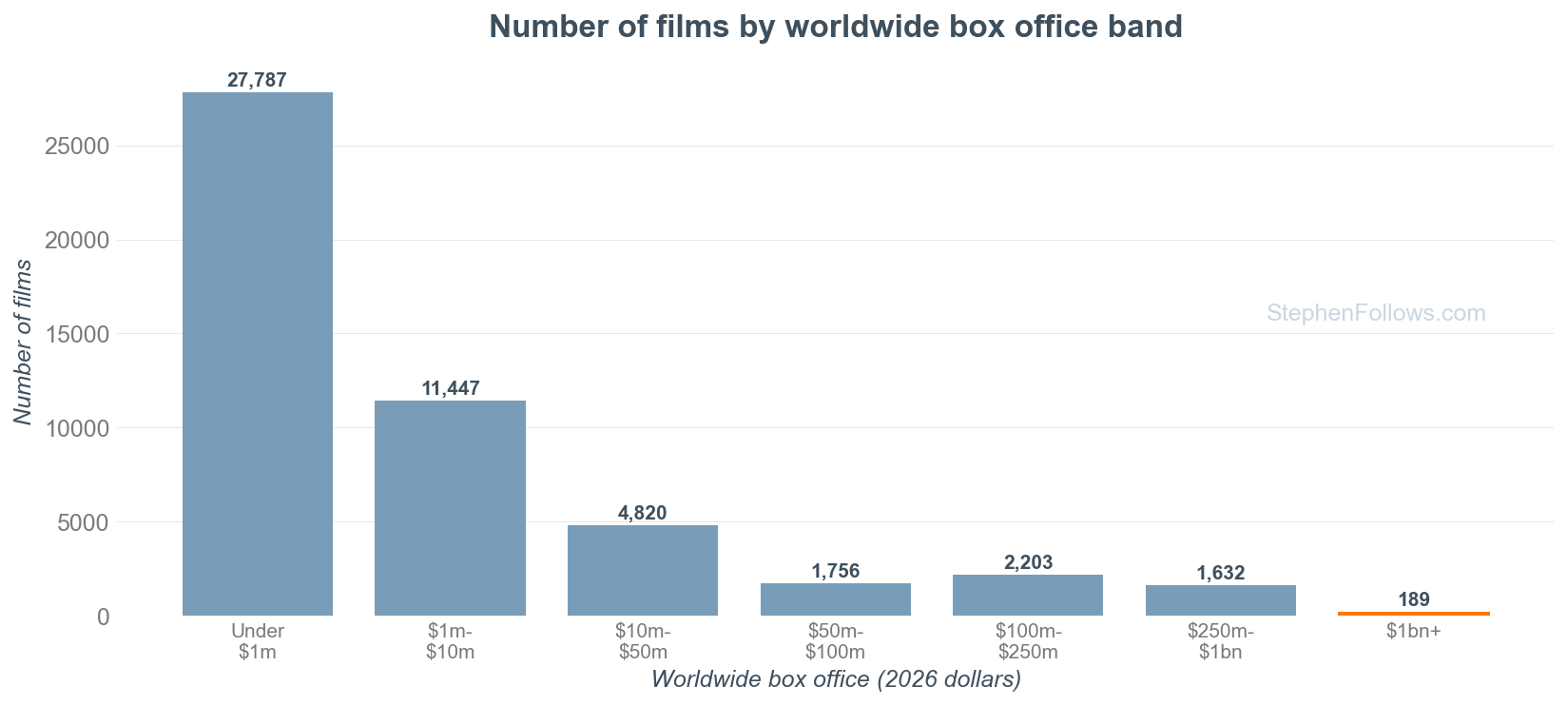
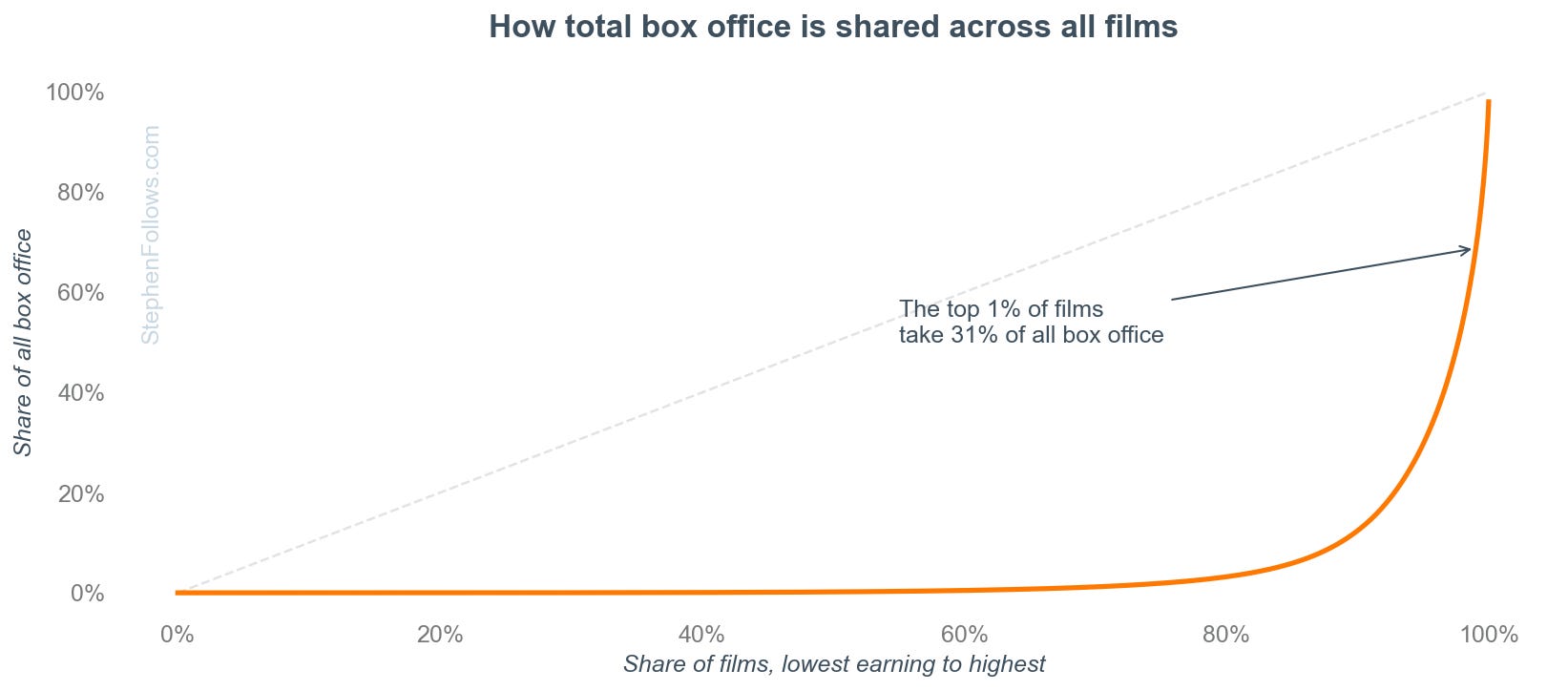
Another way to look at the same data is to line up every film from the lowest-earning to the highest-earning and ask what share of the total each slice represents.
The top 1% of films take 31% of the total box office. The top 5% take just over 70% of it.
And this effect has actually been growing in recent decades.
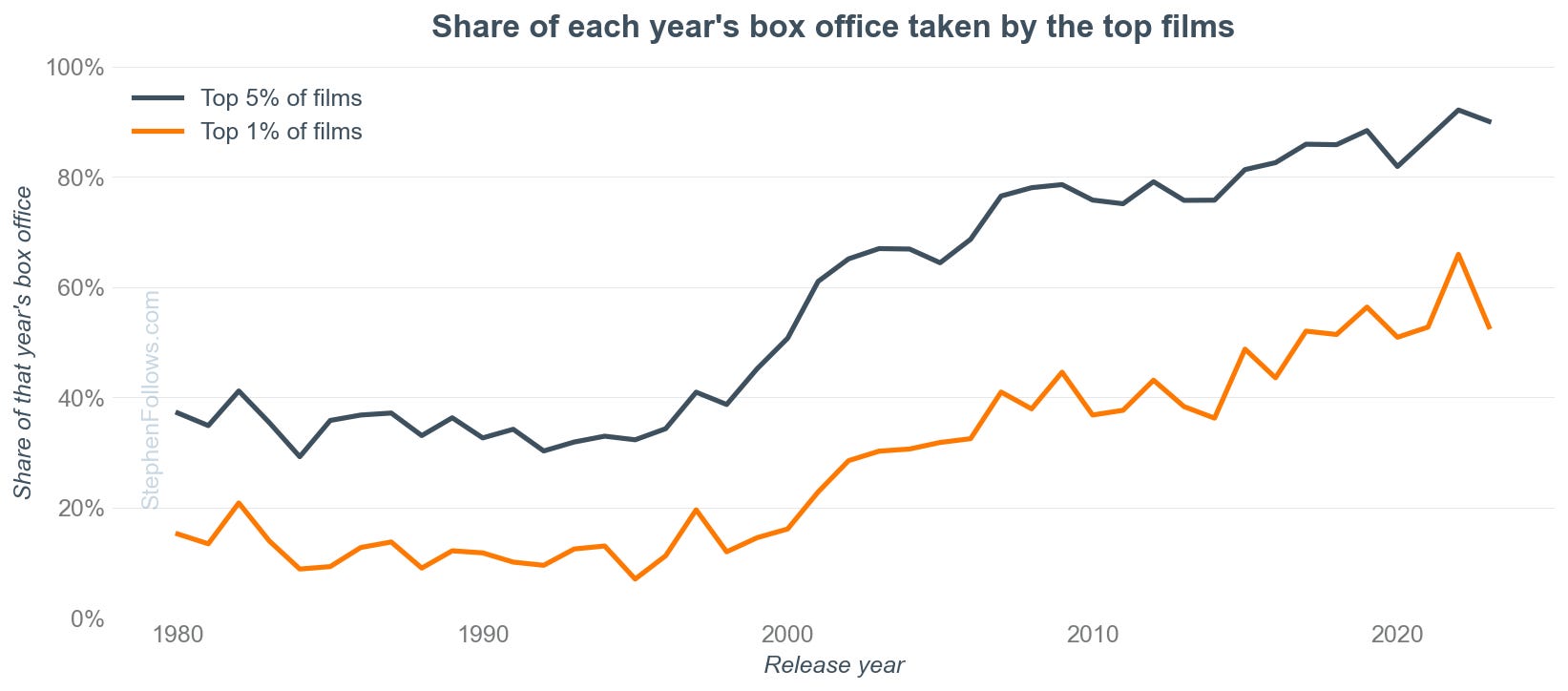
So a tiny number of films carry the whole industry. Which means most films must lose money, and they do. Big time. Statistically, if someone asks you to invest in a movie and you are interested in making money, your answer every time should be a resounding “Hell no!”.
They may be able to show you averages from the past of their type of movie, but in reality, the “average film” is a fiction. There is the tail, and there is everyone else.
Soooo… how do we work out which movies will sit in that vaunted ‘tail’ position so we can back them?
People have tried very hard to predict it
For forty years, economists, marketing professors and computer scientists have tried to crack film prediction, using budgets, stars, scripts, trailers, tweets and, lately, AI.
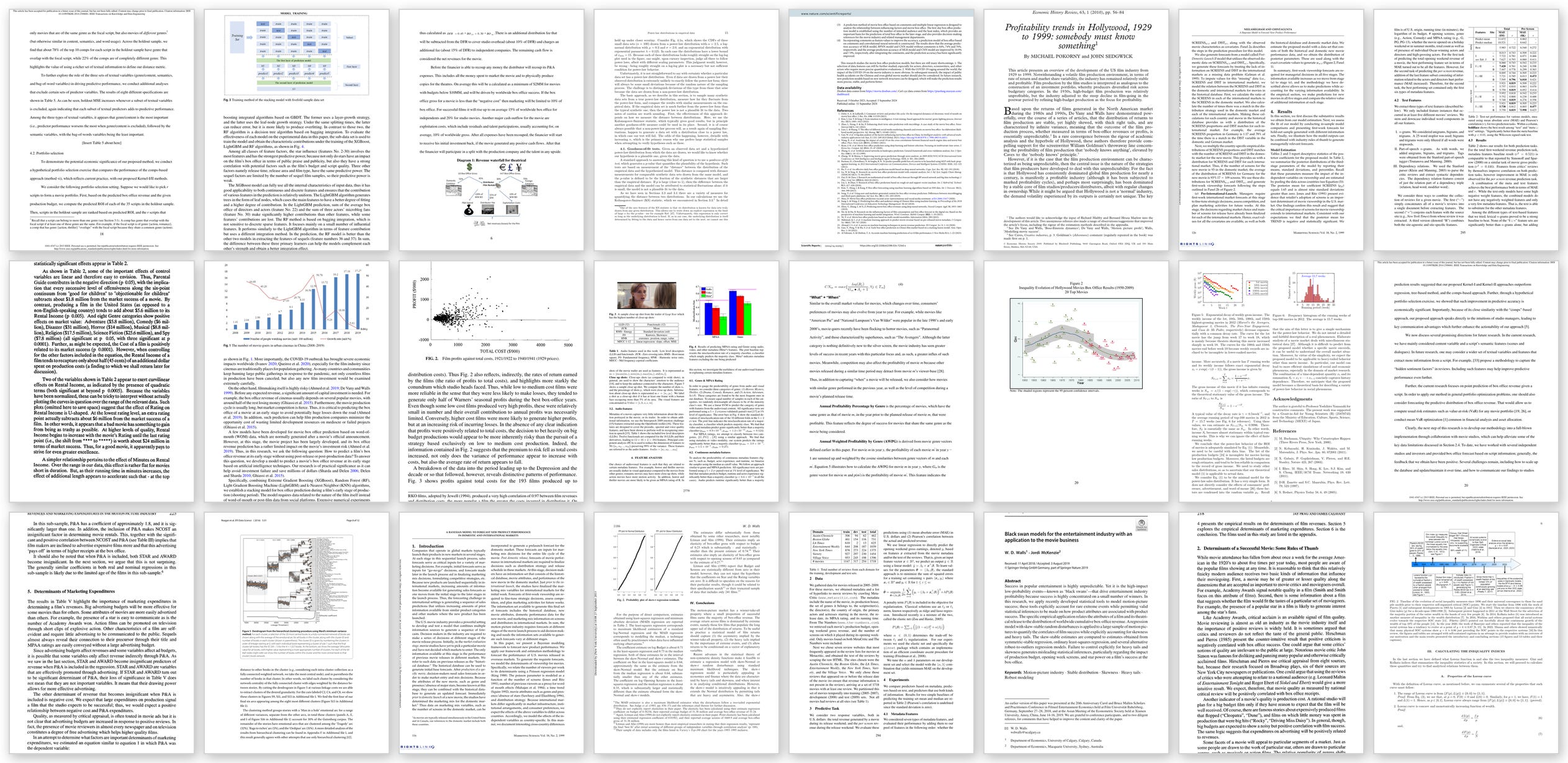
I have read that whole body of literature and written a companion guide you can download, study-by-study, with what each one found and whether it holds up.
Subscribers can download a free copy of my “Predicting Movie Hits" report at the end of this article, summing up the academic literature on the topic.

Here’s the overview of the picture from academics:
The numbers in brackets are the year of publication. This matters a lot as the film economics have changed dramatically over the past decade, so many of these studies would not be replicable with modern movies.
The biggest useful single factor in estimating a film’s eventual revenue is the budget. This can be used to explain 70% of revenue, but, sadly, only 22% of profit, because bigger budgets have higher bars to clear. (1999)
A screenplay carries enough signal to tilt a slate of bets. (2007)
Other meaningful factors include genre, an Oscar and good reviews. (1983)
Activity on a film’s Wikipedia page a month before release accounts for roughly 77% of the opening weekend. (2013)
A film’s stars do not reliably move the return once everything else is accounted for, a result that keeps reappearing across the decades. (1993)
Web search data and social media buzz add almost nothing once you know the budget and how wide a film opens. Most “signals” are just another way of measuring what the studio has already spent. (both 2010)
Film critics predict success, but do not cause it. They spot the quality the audience would have found anyway. (1997)
Many of the most eye-catching results lean on the opening weekend to “predict” the total, which jumps the explainable share from 45% to 97%. To my mind, that is reading a result, not forecasting one. (2000)
Underneath it all, the maths itself (1999) is brutal. Box office is so heavy-tailed that forecasts have, in the authors’ words, “zero precision”, and even today’s best AI (2025) is at its worst on exactly the smaller films an investor most needs help with.
Outside of academia, there is a cottage industry of services within the film industry, happy to sell you tools as you try to illuminate the unknown. These fall into five broad groups:
Theatrical forecasting firms predict box office for films already on the release calendar. These include Gower Street Analytics, Boxoffice Pro, The Numbers, Numero, and fellow Substacker Shawn Robbins at Box Office Theory.
Tracking and testing firms survey audiences before release to gauge awareness and intent, which becomes the trade’s tracking numbers, such as National Research Group, Screen Engine/ASI, MarketCast, The Quorum, Comscore.
Signal trackers, such as prediction markets (Hollywood Stock Exchange, Kalshi and Polymarket) and firms inferring meaning from crowds, search and social activity (Parrot Analytics, Spectura, Emberos, RecoBee).
Greenlight predictors have been a holy grail for decades, estimating revenue from just a script or cast package. Sounds straightforward, but many fall prey to the “average film” fallacy we saw above. It’s been a turbulent corner of the sector, with many falling by the wayside (Epagogix and ScriptBook) and some still active (Cinelytic, Largo.ai, StoryFit, Vault AI, CineCockpit).
Comparable-title report builders provide real (or calculated) revenues of past films. These are an everyday tool of indie financing, despite producers' rampant cherry-picking when using them for ROI calculations. Companies in this space include Nash Information Services, FilmProfit, FilmProposals, Cinelaunch, Slated, Callaia.
These types of services are good at providing aggregate market-level estimates, detailing what’s happened before, and in predicting performance in the weeks leading up to release.
However, single-film pre-production revenue prediction is more of a wild west, with bold, uncredible claims lacking independent validation.
Some prediction companies have meaningful offerings, such as nifty tools, relevant advice, and a large number of data points, but many are also in the business of using marketing spin to sell false certainty to unwitting new entrants.
Regardless of the scale of snake oil in this sector, it’s certainly true to say that no one has yet been able to devise a reliable way to spot enough hits, early enough in the lifecycle of a movie, to be able to build a credible business on.
(Side note: If any company in this space wants me to independently verify their claims, then please do get in touch. Seed and Spark did this a decade ago, and I was happy to validate their claims).
How to succeed in business without really predicting
If “We only invest in hits” is not a viable business strategy in film, what is?
Here’s the key idea that allows people to overcome the hurdles we’ve seen so far:
Unpredictable is not the same as random
There is an oft-repeated phrase in the industry from screenwriter William Goldman:
No one knows anything.
The thing is, people have edited the original quote to change its intended meaning. They use it to mean “Everything is unknowable”, whereas the full quote is closer to “Nothing is certain”. Here’s the full line from Adventures in the Screen Trade:
Nobody knows anything...... Not one person in the entire motion picture field knows for a certainty what’s going to work. Every time out it’s a guess and, if you’re lucky, an educated one.
So it’s not true that no one knows anything. In fact, many people know a lot. Hollywood has run the global film industry for over a century with surprisingly little change, given how unpredictable any one movie can be.
This is because while betting on any one particular movie is a risky proposition, there are numerous things people can reliably and successfully do to build a profitable business in the film industry.
It’s about shifting the core question from “How do I pick the winner” to “How do I change my relationship to the risk”.
Below are 18 approaches professionals use to sustainably make money, none of which require predicting a film’s appeal or outcome. Think of these more as aspects of risk management than as a playbook you can just follow by the numbers.
1. Make many films, not one
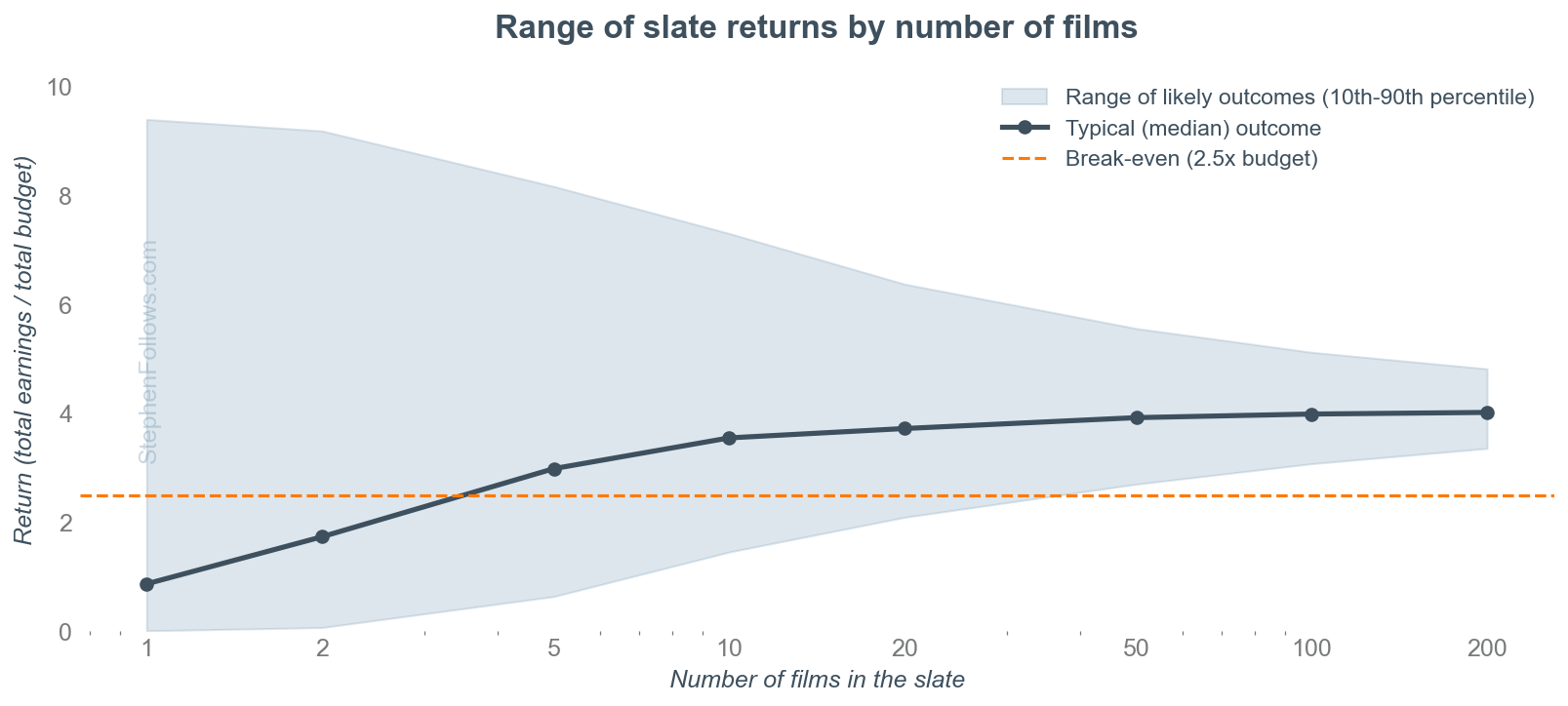
An interesting quirk of the asymmetrical nature of film returns is that volume converts an unpredictable bet into a dependable distribution. In short, if funding a movie is basically gambling, making a whole bunch of them is basically owning a casino.
The chart below illustrates what happens as you stop betting on one film and start betting on many. The individual films are as unknowable as ever, but suddenly it looks a little more like an actual business.
So if you are fortunate to have access to vast amounts of capital (and nothing less risky or with better upside available to you), here are some things you may wish to consider:
Build a slate so winners cross-subsidise losers, and you stop caring which is which. This is a core part of the philosophy of Hollywood studios.
Co-finance slices of many slates, taking 10% of fifty films rather than all of five. A good example was Legendary’s long partnership with Warner Bros.
Run a low-budget volume factory where one breakout pays for years of misses. Paranormal Activity, made for about $15,000, took $194m, kicking off Blumhouse’s stellar horror-based business model.
Turn one hit into a franchise, a fresh roll with dice that already landed once. Predicting the release date of a sequel or next instalment of a much-loved franchise is a safer bet than any random film (albeit I don’t think the backers of Joker 2 would have much time for this suggestion!).
