


Last week I had a (good-natured) email exchange with a reader who asked a follow-up question to my piece entitled 'Are movies dominated by a small number of old male composers?'.
The research found that 95% of film composers were men, and that just the top 20 film composers accounted for 48.2% of box office gross over three decades.
The reader posited that this wasn't an issue as it was a matter of choice and pointed out that women dominate other roles. They suggested that if we studied casting directors then we would find the exact same situation but inverted.
Never one to shrink from a challenge, I took up that task. I gathered data on all live-action movies released in US cinemas between 2000 and 2019, skipping 2020 as the lack of cinemas makes it hard to keep the criteria consistent. There are more details on my methodology at the end of this piece.
What percentage of casting directors are women?
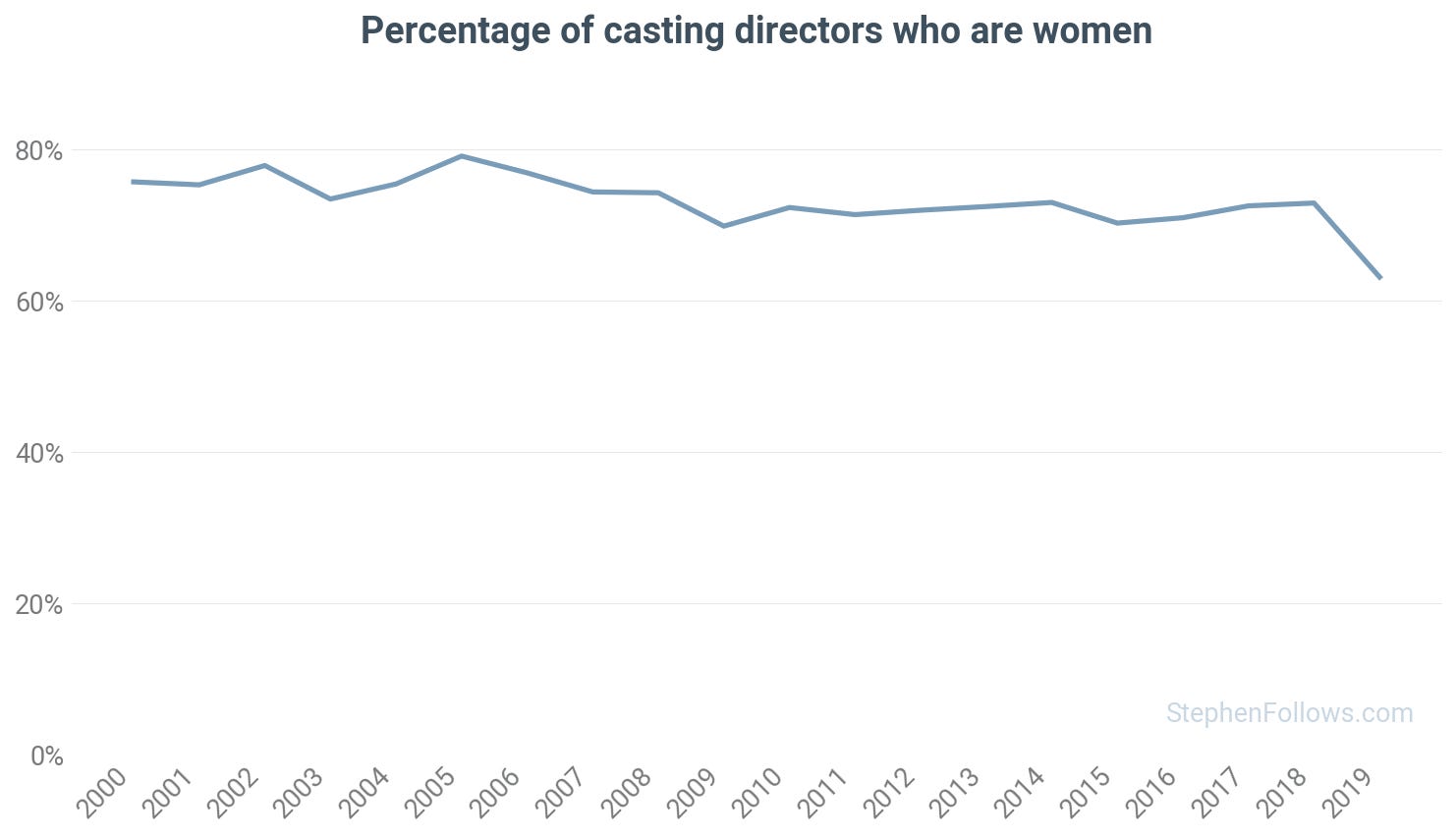
Let's start by looking at the gender split among casting directors. Of all the major creative roles on movies, casting directors are most heavily dominated by women, with 73.5% of such credits going to women. This result has been fairly consistent across the twenty years I studied.
In fact, most jobs in the casting departments are taken by women, albeit not quite to the same extent as with the top job of casting director. In the chart below, 'Other casting staff' include assistants, associates, interns, co-ordinators and other such roles.
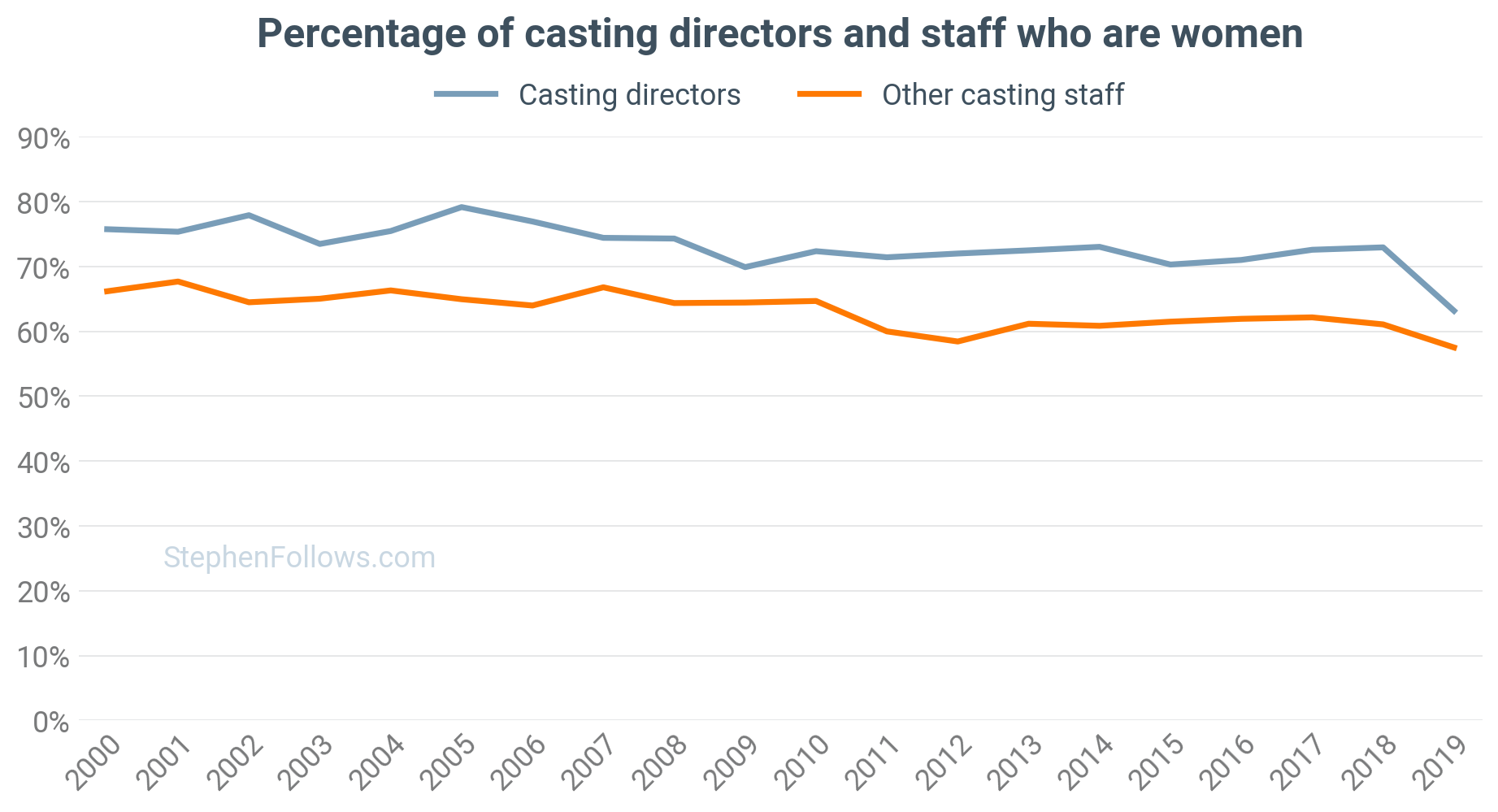
So while it is true that the vast majority of casting directors are women, it's not as stark a result as that of composers (where 19 out of 20 were men).
Is the casting world dominated by a small number of women?
Next we turn to look at whether the marketplace is dominated by a handful of individuals. I identified 1,452 people who had received at least one casting director credit in the decade up to, and including, 2019. The most prolific of those was Mary Vernieu, who cast Knives Out, Promising Young Woman and Looper, to name but a few of her many credits. In fact, Mary's credits account for 2.1% of all casting director credits over the decade.
However, the composer analogy was linked to share of box office gross, not just sheer number of credits. The top spot here goes to Sarah Finn, who cast many of the Disney and Marvel epics. 11.4% of the US box office gross over the decade went to movies she is credited as having cast.
This reflects a power law that exists in many parts of the film industry. In this case, it's that the most successful casting directors are wildly more successful than most of their peers. The three bars below illustrate this in action.
The first (labelled as 'People') focuses on the number of individuals involved, revealing that 57% of people who receive any casting director credit do not go on to gain a second. The second bar ('Credits') shows that 48% of casting director credits go to people who earned more than ten such credits. The final bar ('Budget') shows the share of the combined production budgets, revealing that 66% of the money is spent on projects cast by people with more than ten credits.
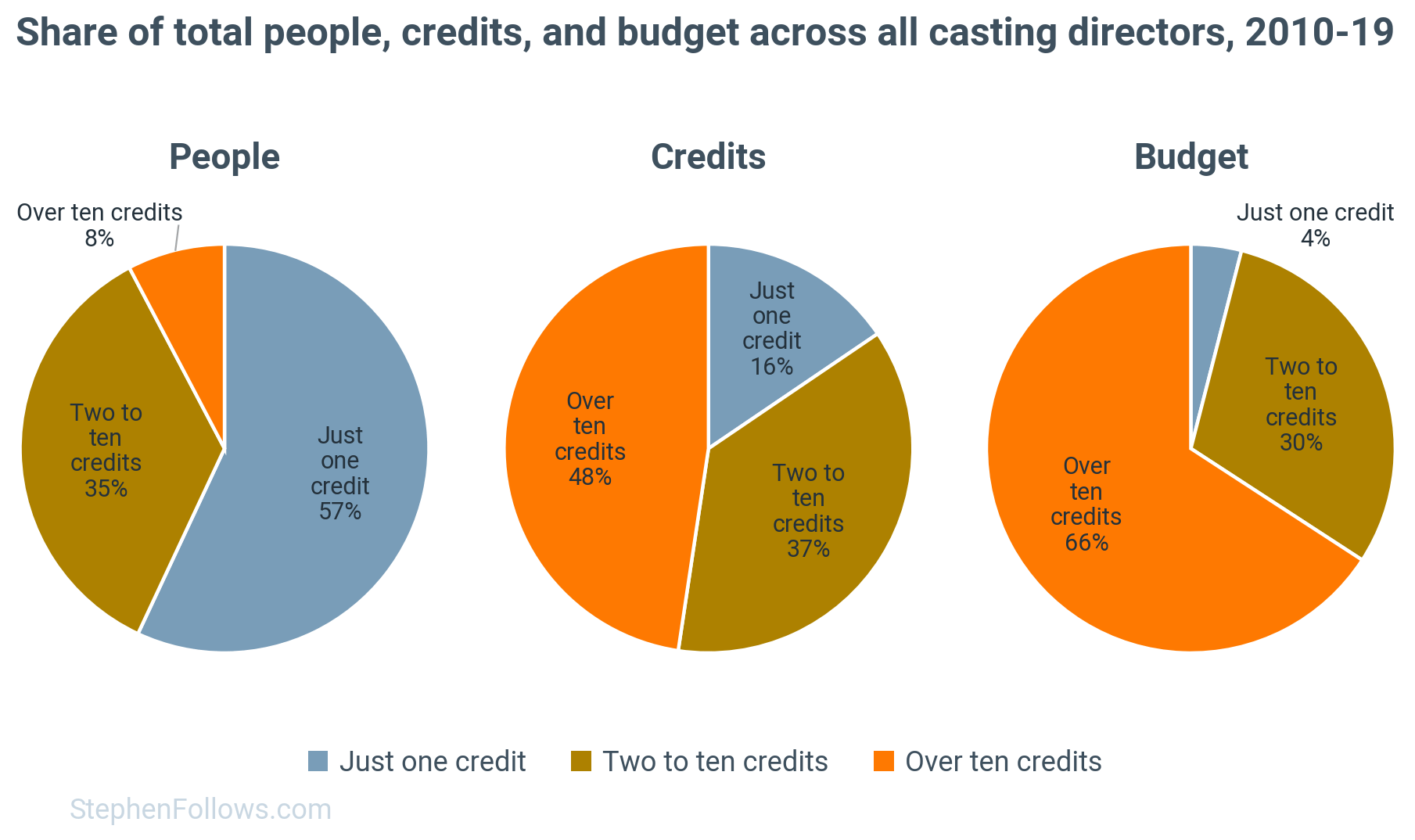
In the case of composers, the top 20 credited people worked on projects which accounted for 48.2% of the worldwide box office gross. The figure is about the same for casting directors, with the top 20 accounting for 46.0% of collected income, against 46.5% for composers when each film is counted only once.
So was the reader right to suggest that the stats on casting directors are the inverse of composers? Yes and no. While the vast majority of casting directors are women and a small number of people receive the lion's share of the attention, the gender split is not as extreme as it is with composers, though the top 20 account for about the same share of the box office.
A few other casting director stats...
Before we finish, I wanted to share a few other things I found in the course of today's research. Across the movies I studied that credited a casting director, 55% had just one casting director, 32% had two, 9% had three and 4% had more than three.
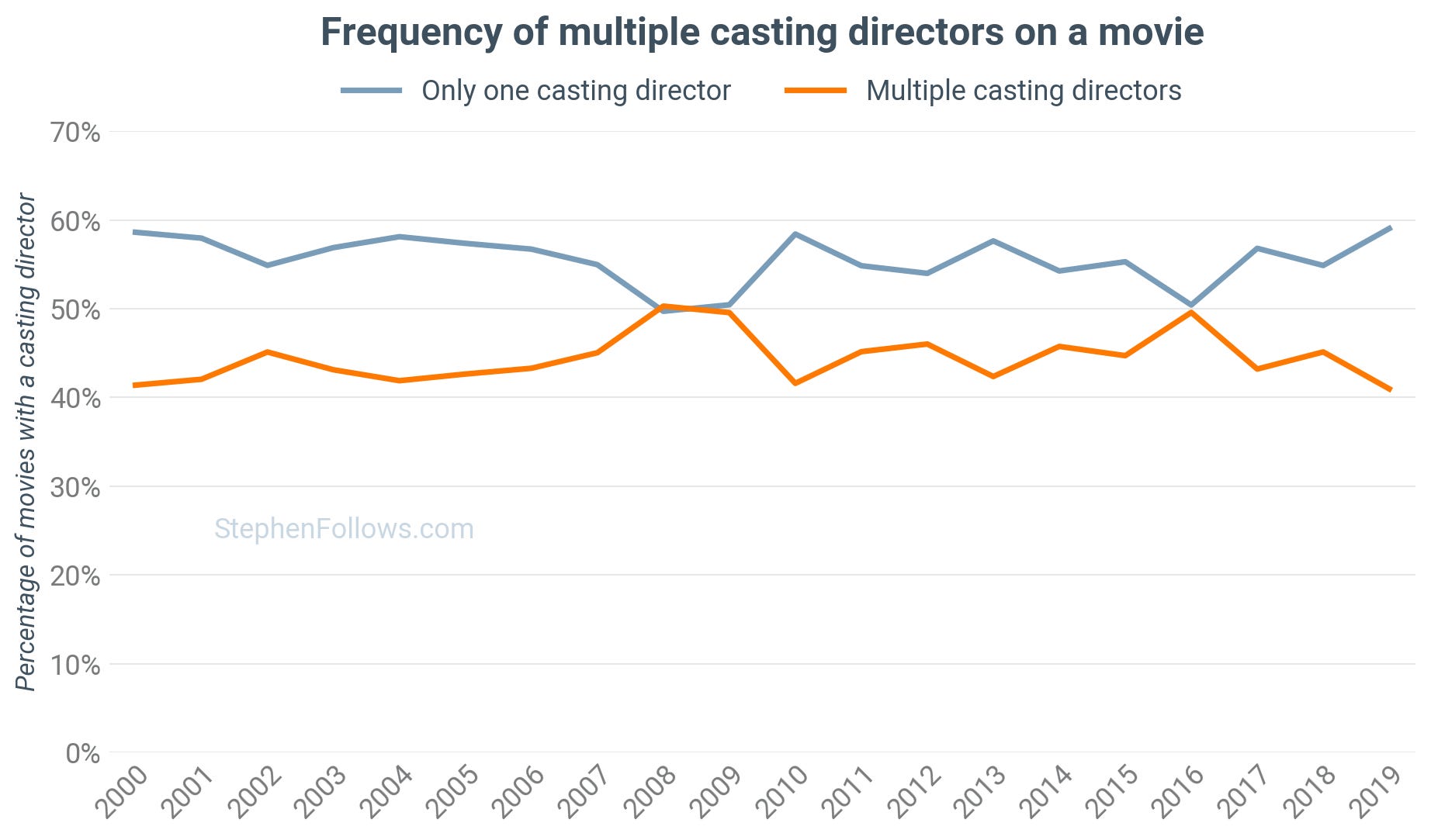
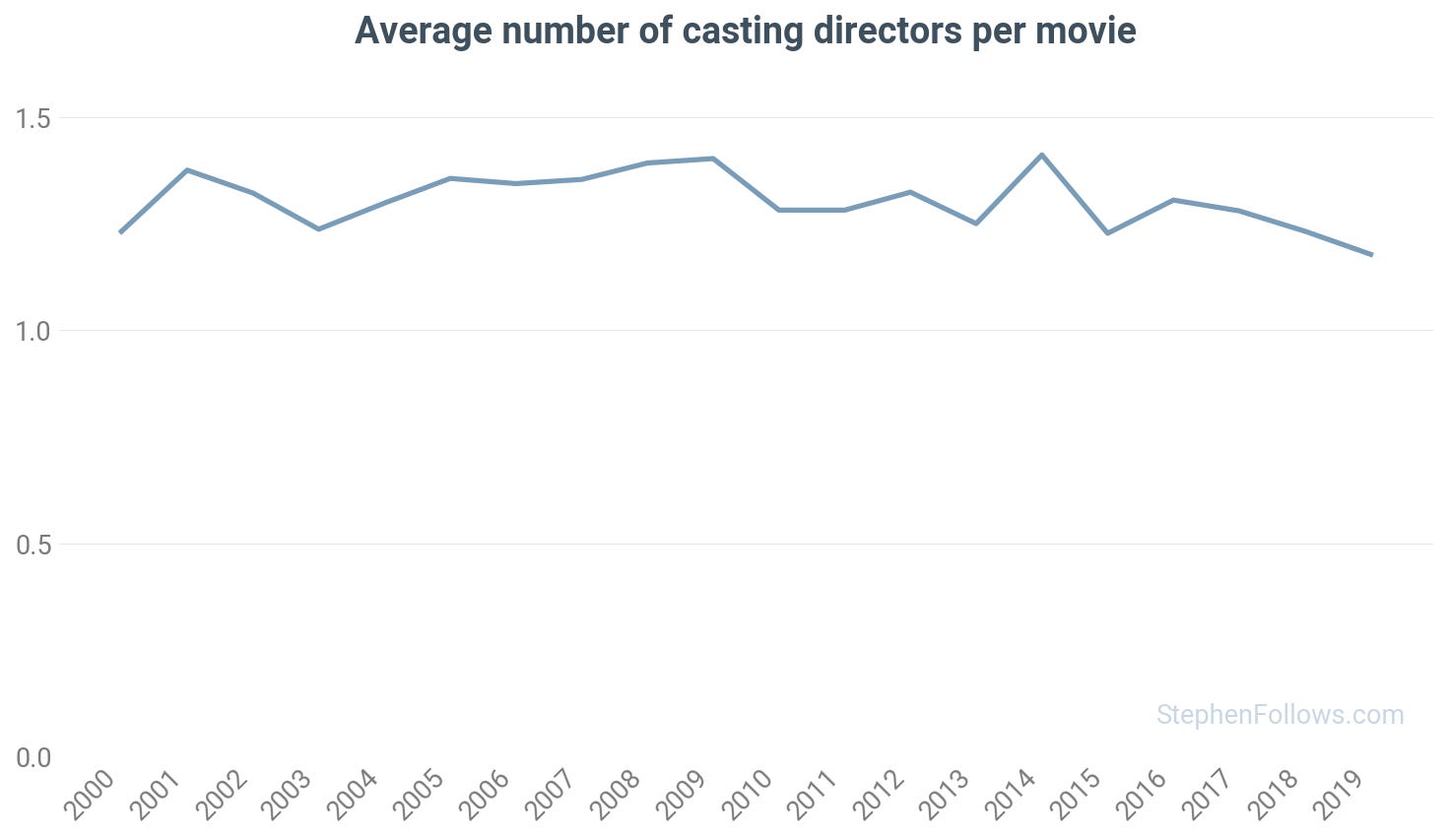
We saw previously that the gender split among casting directors had remained pretty static over the past two decades. The same is true for the average number of casting directors on a movie, averaging at 1.3 across all titles. Given the huge changes we've seen in other roles over this period, it is noteworthy that the casting world seems to have held firm over such a long period of time.
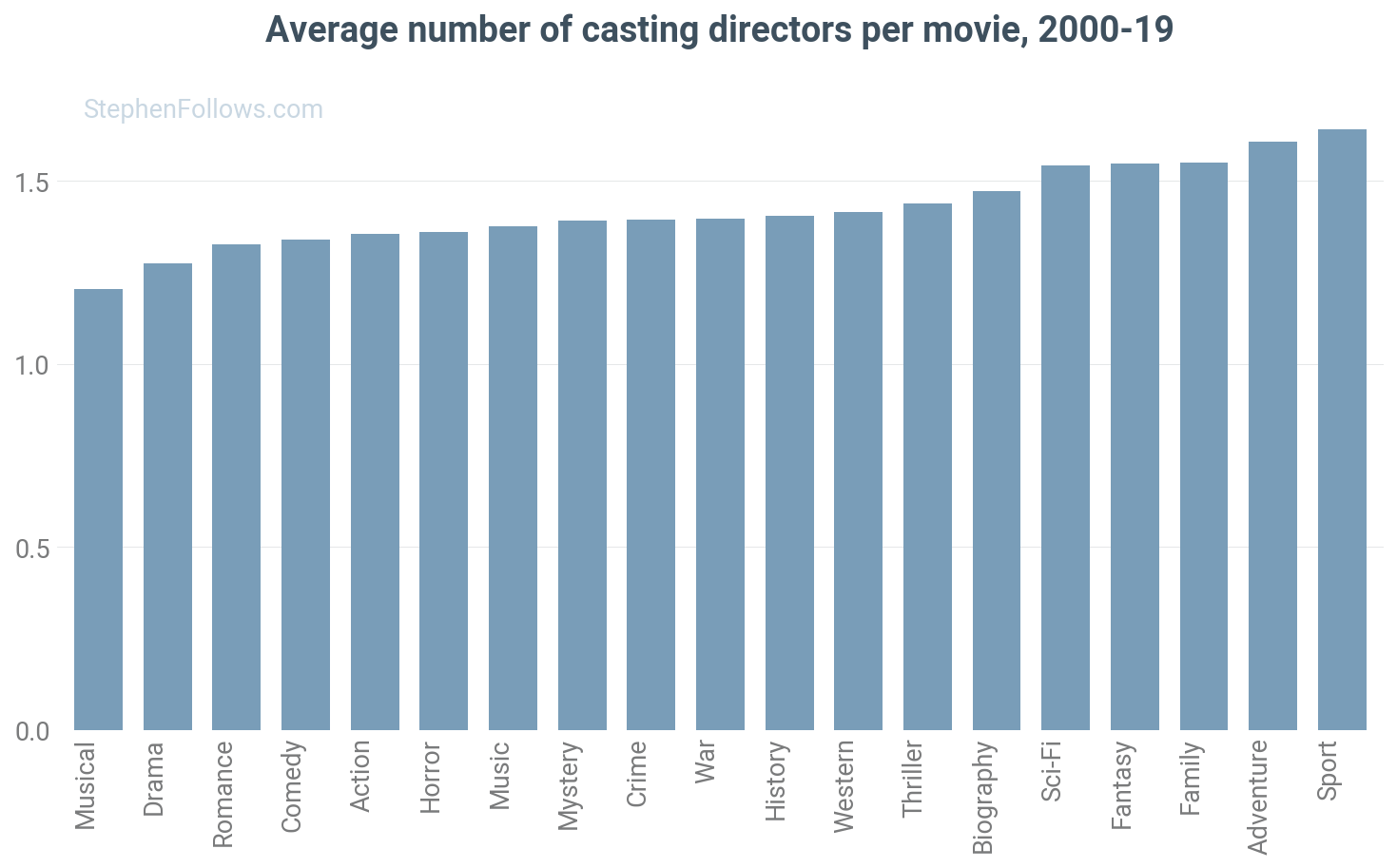
Finally, the genre of the movie appears to only have a very mild effect on the number of credited casting directors. Musicals had the fewest (an average of 1.2 per movie) and sports movies had the most (1.6 per movie).
Notes
Today's research looked at live-action feature films which opened in North American cinemas between 1 January 2000 and 31 December 2019. The raw data comes from IMDb, The Numbers/OpusData and Wikipedia.
I was rather surprised that one in five movies do not credit a casting director in online listings. This is due to a mix of producers submitting incomplete credit lists and the people involved not bothering to add their past credits. The movies which lacked casting director credits span the budget range, meaning that some may genuinely not have had a dedicated casting director (i.e. micro-budget productions where people fulfil many roles) while others may be projects cast by highly experienced casting directors who no longer need to rely on online credits for future work.
To determine a person's gender, I used publicly available data, pronouns (such as in biographies) and first name analysis (i.e. if 99% of people called Daniel are male then I have regarded every Daniel with an unknown gender as male). If there was anyone for whom I could not reliably determine a gender, then they were not included in the charts which show a percentage split. These ‘unknown’ people accounted for just 2.3% of the credits.
I appreciate that this research takes no account of gender fluidity or other forms of self-identification. That’s not a conscious choice but rather a consequence of doing research at this scale. If anyone can suggest a way of taking this on board in the research process then I am very keen to hear it. Please drop me a line and we can talk it through.