


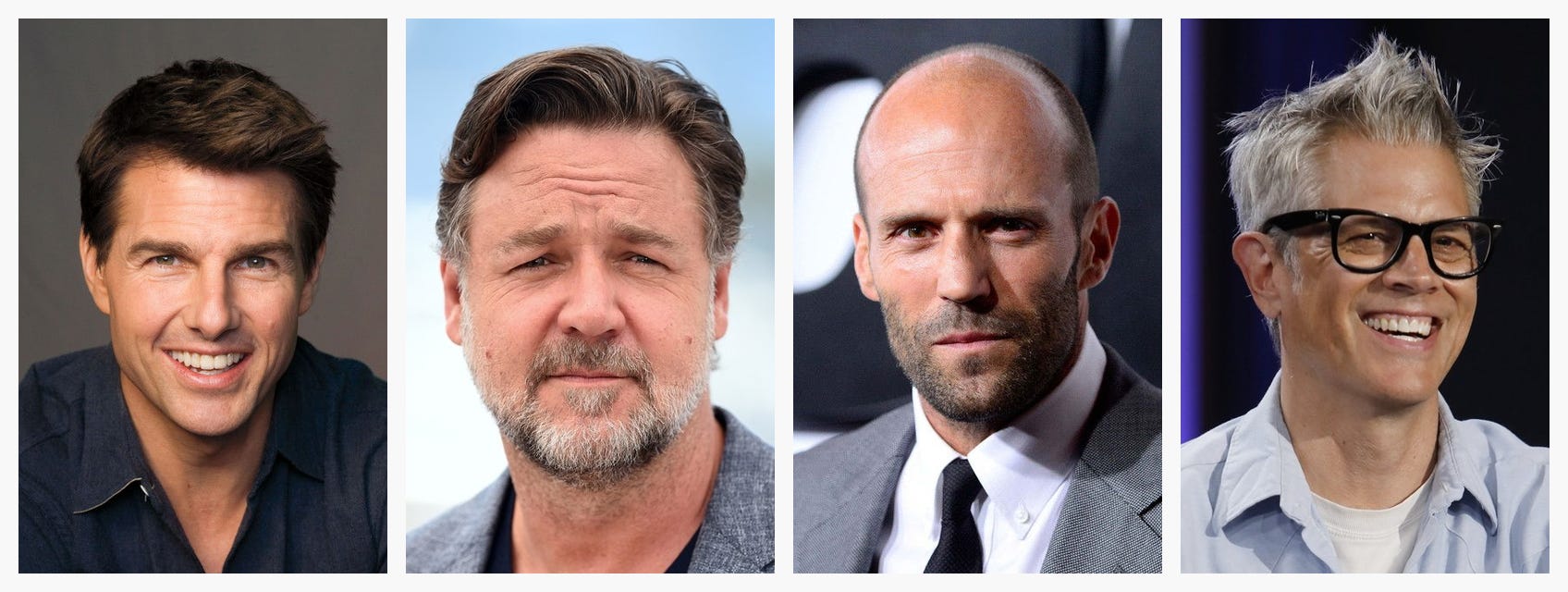
At CinemaCon last week, five of the most-hyped announcements from the major studios were headlined by actors aged 58 or older.
Top Gun 3 with Tom Cruise at 63
Highlander with Russell Crowe at 62 and Dave Bautista at 57
The Beekeeper 2 with Jason Statham at 58
Jackass: Best and Last, promoted with a tearful goodbye from a cast mostly north of 50.
To see what was actually happening beneath the headlines, I took every action-tagged film from 1980 to 2025 with reported box-office or budget (4,053 leads accross 2,171 films) and worked out the age at release for every actor.
The results tell us three things:
The over-50 action cohort is at a historic high.
It is broader than any previous era.
And, on the evidence of the last six years, it may already be narrowing again.
The scale of the shift
More than a third of action lead roles in the 2020s are going to actors who are at least 50. That share has more than doubled since the turn of the century.
The 1990s, interestingly, is the youngest decade of action cinema in the dataset. The 1980s had a handful of durable older leads, including Roger Moore, who finished the Bond run at 58, Sean Connery, still working, and Clint Eastwood, who pivoted to Firefox at 52.
By the 1990s, most of that cohort had aged out, and the newer generation (Bruce Willis, Harrison Ford, Nicolas Cage, Sylvester Stallone, all still in their forties) was genuinely younger on screen than what came before or after.
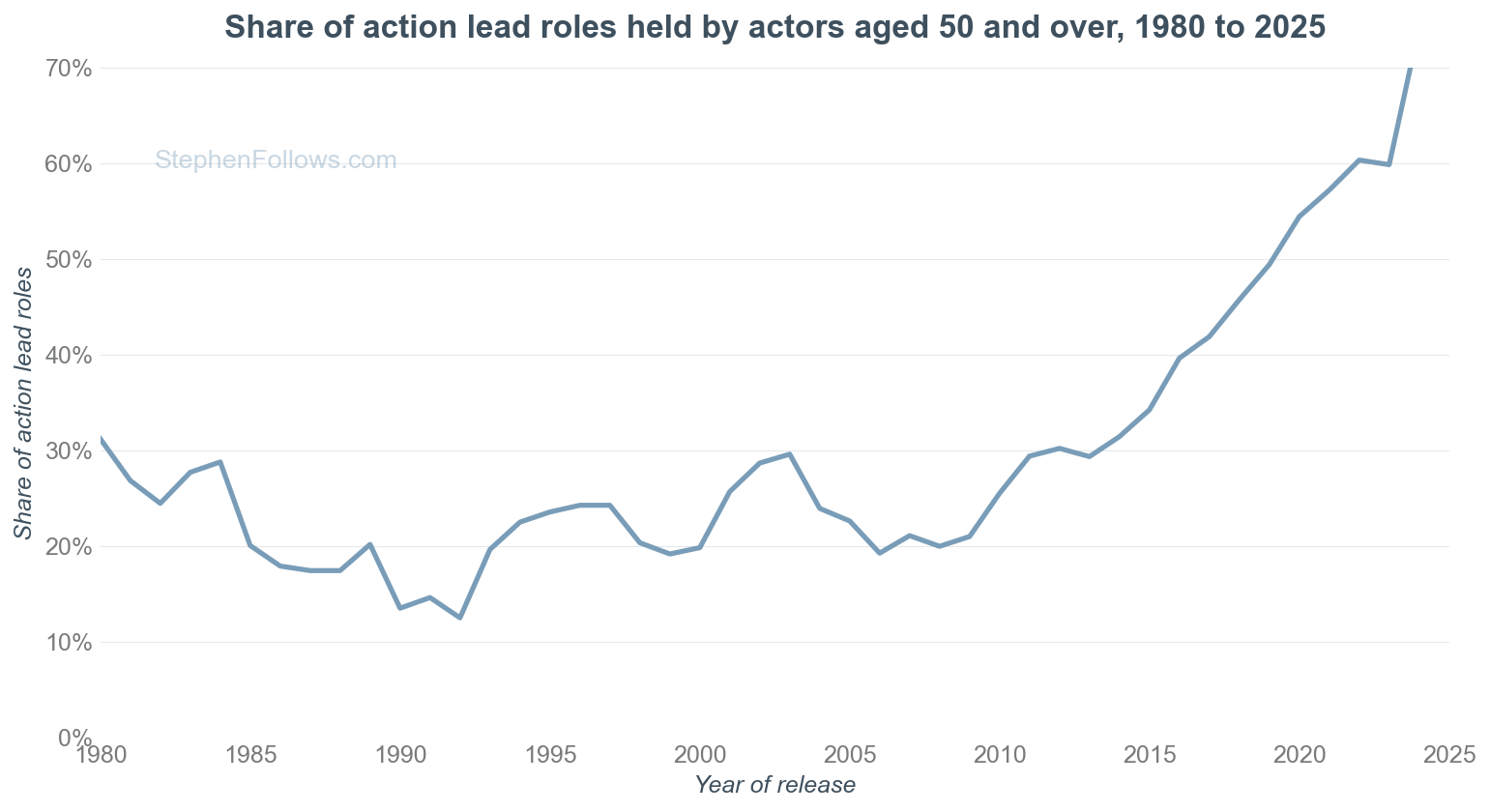
One claim often made is that just four names (Tom Cruise, Liam Neeson, Keanu Reeves and Jason Statham) are stacking the deck. However, taking those four out of the 2020s drops the over-50 share from 37% to 35%. The cohort, in other words, does not depend on a handful of famous names.
How broad is the cohort?
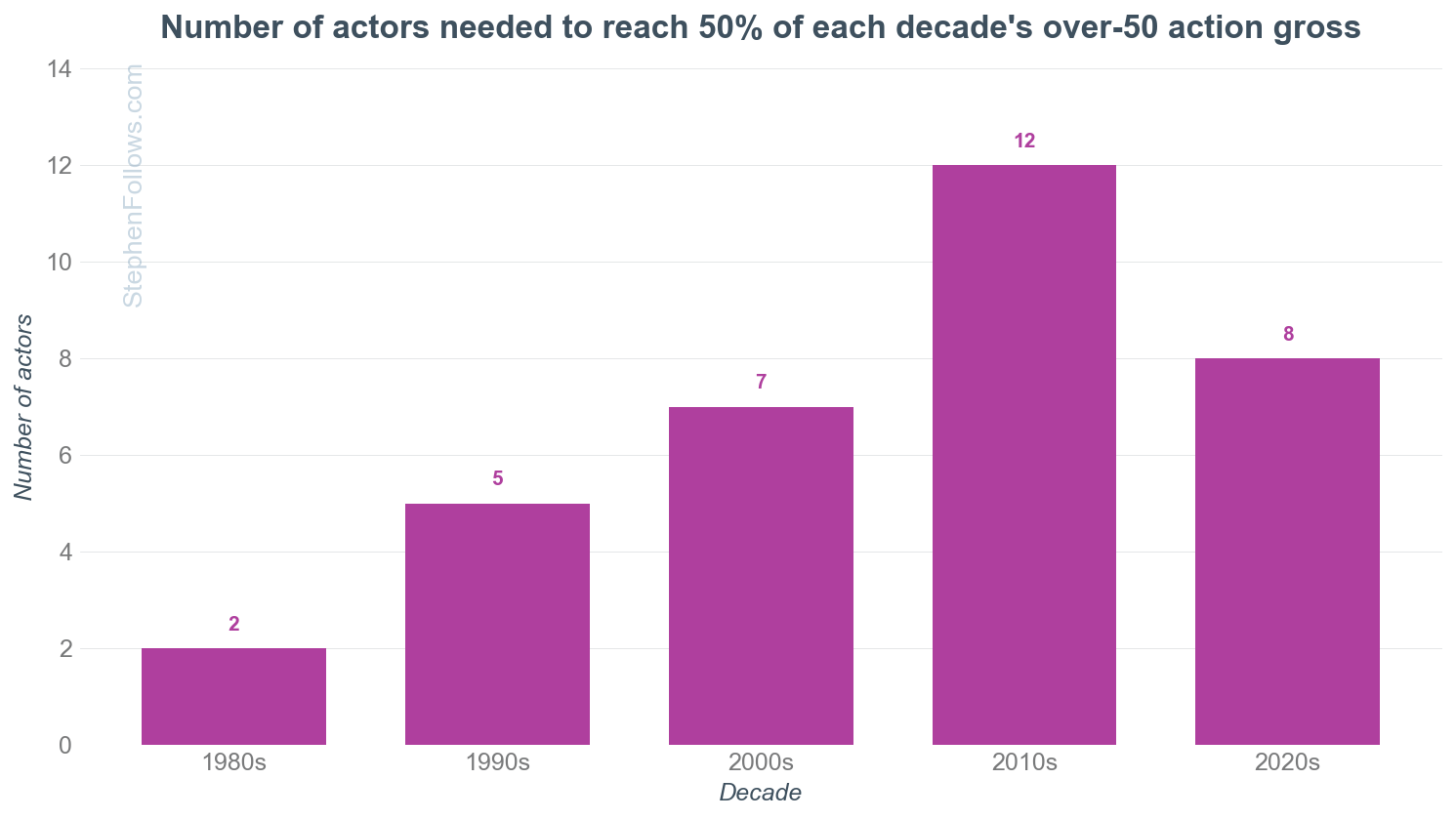
One way to see the breadth directly is to ask how many actors you need to reach 50% of the decade’s over-50 action-gross.
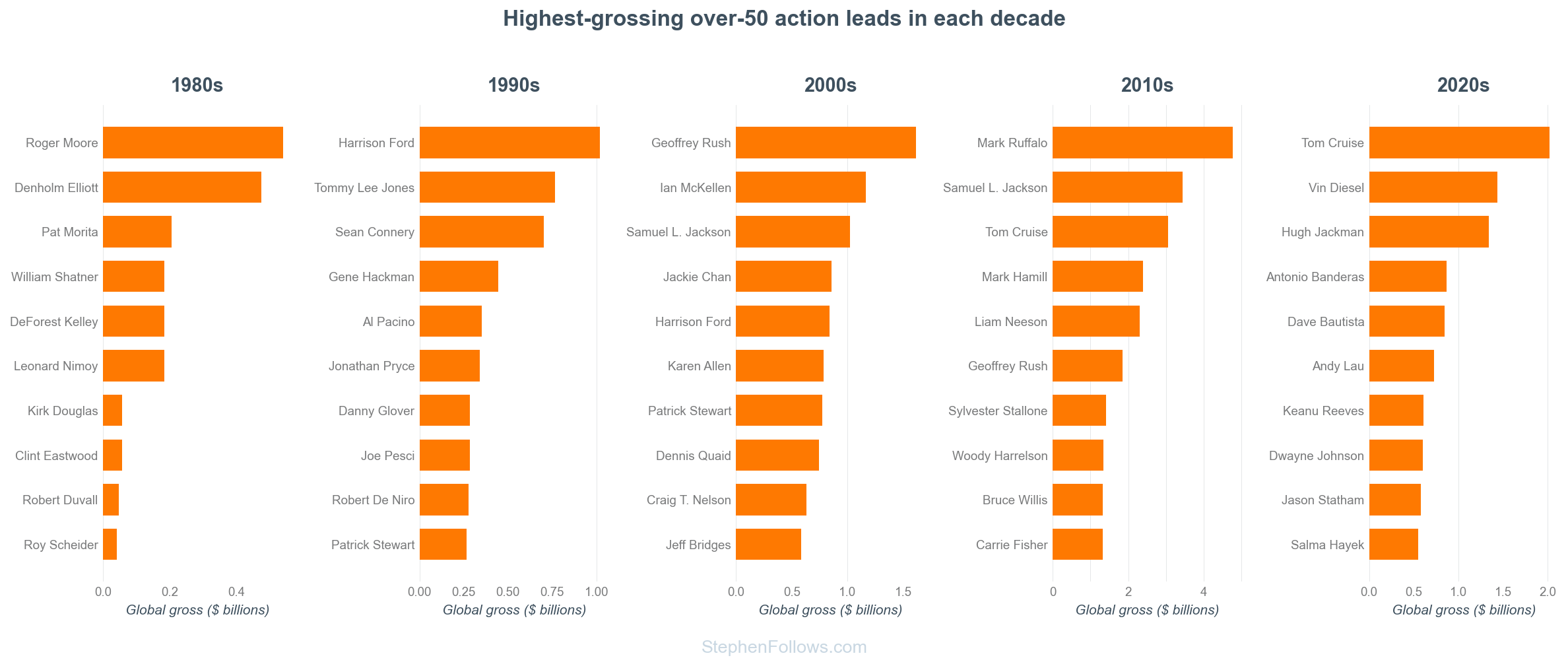
In the 1980s the answer was two. Roger Moore alone was 30% of the decade’s over-50 action box office, and one other actor got you to half the total. By the 2010s, the answer was eleven. The 2020s, so far, is seven.
The names behind those numbers tell a parallel story.
The 1980s cohort was Roger Moore and Denholm Elliott (the latter thanks to Raiders of the Lost Ark).
The 2000s were led by Geoffrey Rush from the Pirates of the Caribbean films and Ian McKellen from The Lord of the Rings (perhaps they are “leads in action movies” but few would call them “action leads”).
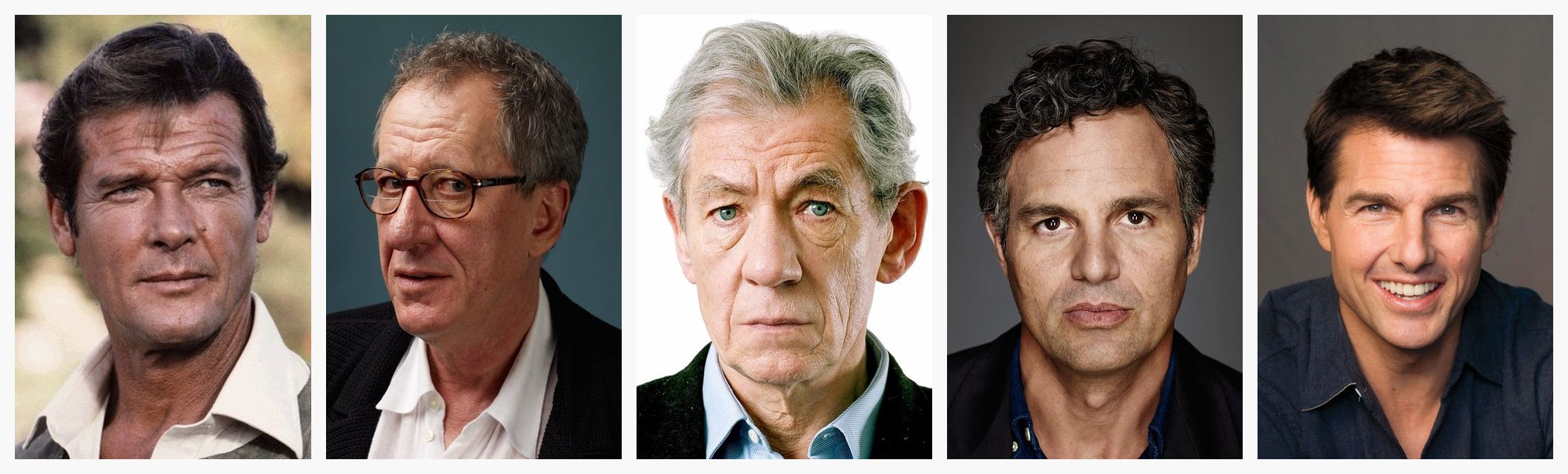
The 2010s top ten was Marvel-adjacent, with Mark Ruffalo with the two Avengers: Infinity War and Avengers: Endgame entries, Samuel L. Jackson across the Avengers: Infinity War run, Mark Hamill returning for The Last Jedi, along with Tom Cruise, Liam Neeson and Sylvester Stallone.
A second way to see the breadth is to subdivide the action tag by hybrid subgenre. The over-50 share is not evenly distributed across the family.
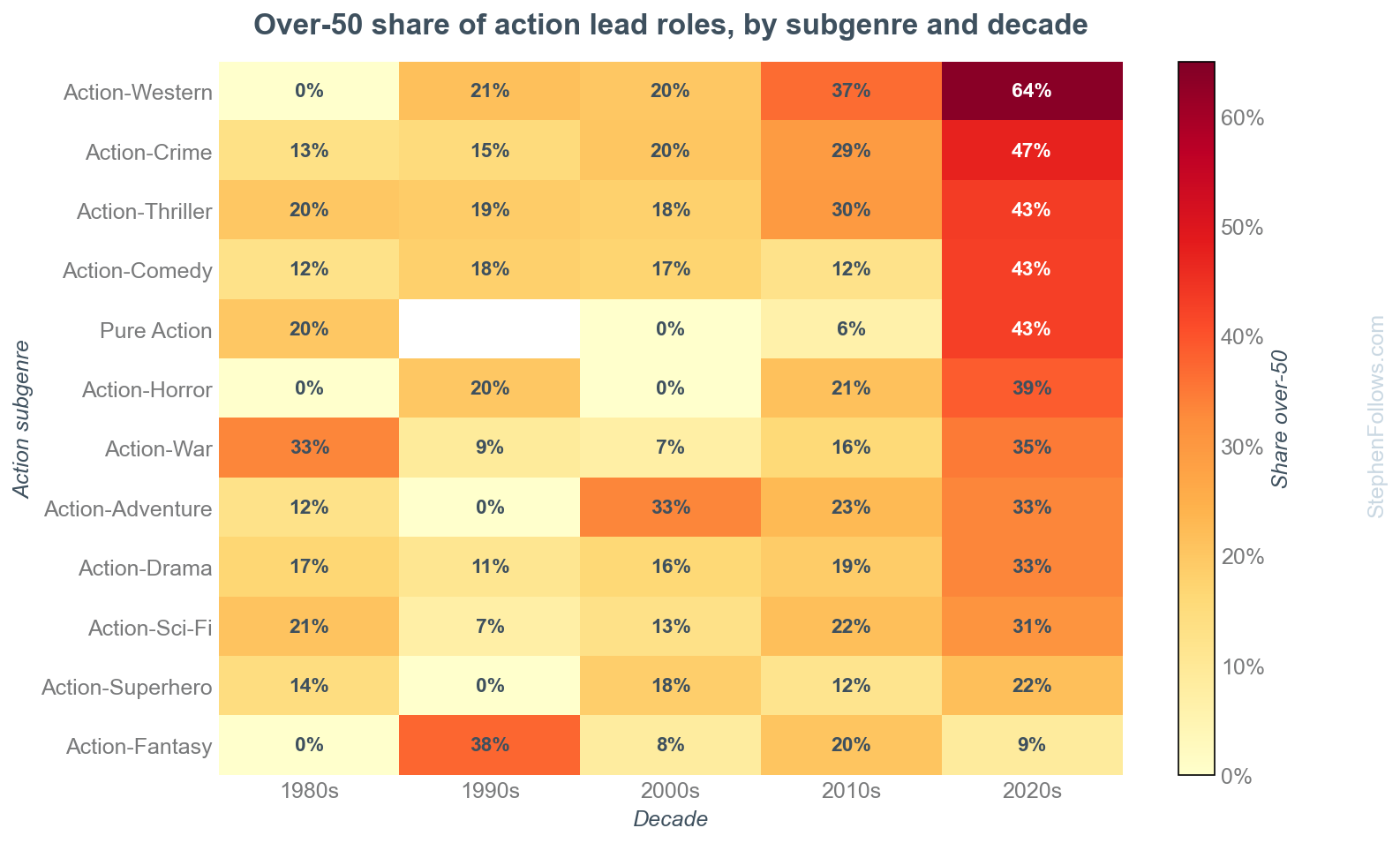
Action-Western (64% over-50 in the 2020s), Action-Crime (47%) and Action-Thriller (43%) have aged the fastest.
Action-Superhero is the youngest subgenre across every decade. The category most associated in the popular mind with the over-50 boom turns out, in the data, to be the part of action cinema where lead actors are most reliably in their thirties.
Two forces that actually built the 2010s
Pulling the rise apart, two mechanisms show up clearly in the numbers:
The late-bloomer wave
The franchise-retention effect
1. The late-bloomer wave
This includes actors whose first lead action role came at age 50 or older, such as Liam Neeson did with Taken at 54.
92 men made their first action-led appearance after 50 during the 2010s. Some were already famous actors pivoting into a new genre, such as Bob Odenkirk with Nobody at 58, Tom Hanks with Captain Phillips at 57, and Ben Kingsley with a parallel action career in his late sixties.
Others were international leads entering Hollywood distribution for the first time, from Rajinikanth to Anil Kapoor. The cumulative effect was to widen the supply of over-50 action leads far beyond the long-tenured Hollywood names.
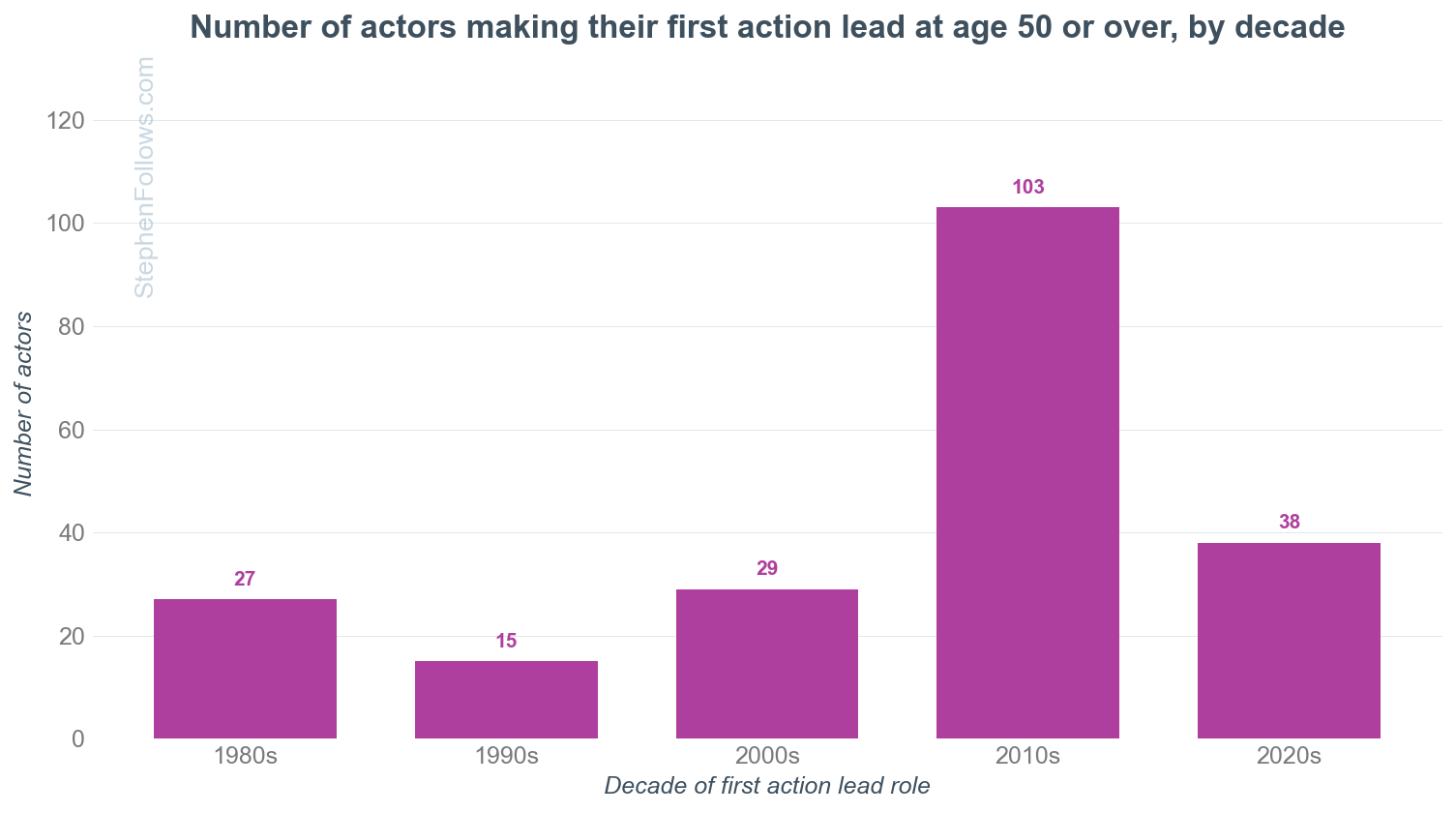
The 2010s also produced the first meaningful cohort of women (17) making a first action-led appearance at 50+. Before that decade, the number was tiny.
2. The franchise-retention effect
The second force is the opposite of late-bloomer debuts. It is actors who started an action franchise young and are still in it over 50.
20 actor-franchise combinations in the dataset fit that description. The longest spans, by years between first and latest entry
Harrison Ford, Indiana Jones - 38.9 to 81.0, five films, 41-year span
Mark Hamill, Star Wars - 31.7 to 68.2, three films, 36-year span
Arnold Schwarzenegger, Terminator - 37.2 to 72.3, four films, 35-year span
Tom Cruise, Top Gun - 23.9 to 59.9, two films, 34-year span
Tom Cruise, Mission: Impossible - 33.9 to 61.0, seven films, $4.14bn global
Vin Diesel, Fast & Furious - 33.9 to 55.8, eight films, $6.12bn global
Hugh Jackman, X-Men - 31.8 to 55.8, eight films, $4.65bn global
Bruce Willis, Die Hard - 33.3 to 57.9, five films, 24-year span
Keanu Reeves, The Matrix - 34.6 to 57.3, four films, 22-year span
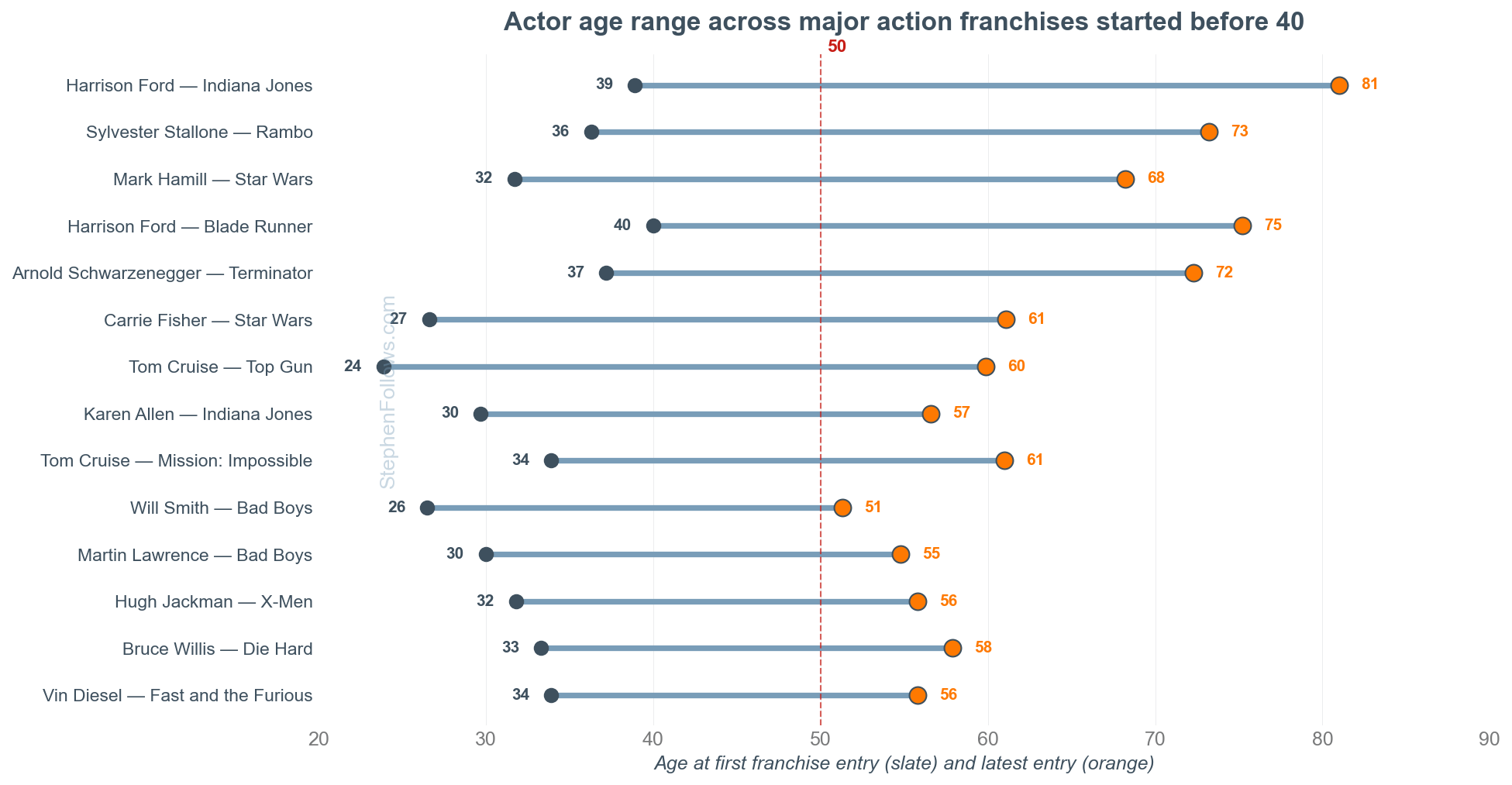
These two forces (i.e. more actors starting late, more actors staying on) combined to make the 2010s the broadest over-50 action cohort in the data. Marvel ensembles expanded it further, even though the superhero subgenre itself skews young.
Why do I think the 2020s are the peak?
The breadth that defined the 2010s is already giving way. The top five over-50 actors’ share of the decade’s gross has risen from 31% in the 2010s to 41% so far in the 2020s. Eleven actors reached 50% of the 2010s over-50 gross; in the 2020s, that number is seven. The trend is narrower.
Several specific 2010s mechanisms are visibly weaker in the 2020s.
The Marvel ensemble cast members who anchored the Avengers: Endgame run have fragmented or exited.
The John Wick franchise is in a gap year with Ballerina‘s softer reception shifting the baton to Donnie Yen.
Liam Neeson announced in August 2025 that he is stepping back from action at 73 (while, as he conceded, still having three action films in the pipeline).
Bruce Willis has retired.
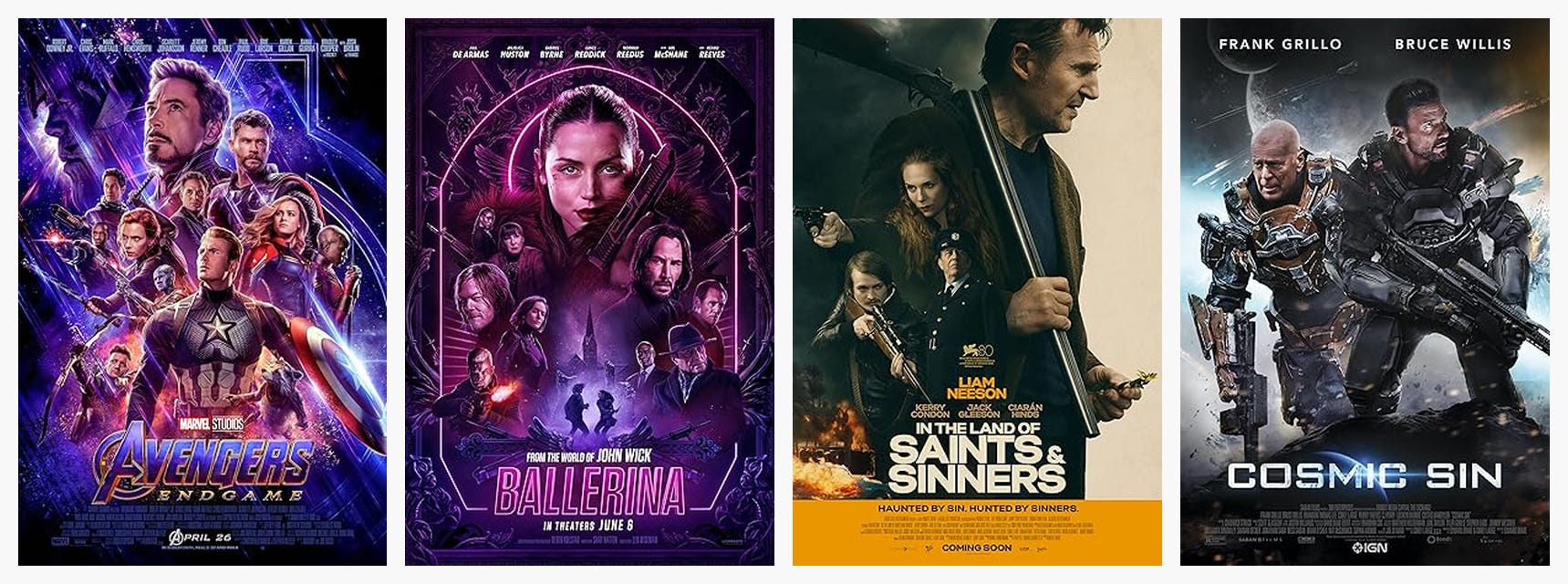
And the late-bloomer wave itself appears to be slowing, with the pace of first-action leads at 50-plus looks, based on partial 2020s data, below the 2010s rate.
Cruise alone accounts for 13% of the 2020s over-50 action gross, with Vin Diesel, Hugh Jackman, Antonio Banderas and Dave Bautista filling out the top five. The cohort is still enormous by historical standards, but it is narrower than that of the previous decade.
It is still early in the decade, and a single breakout late debut can shift the maths. Ma Dong-seok in Korea and Shah Rukh Khan in India are arriving in the dataset in ways they weren’t before, and Bob Odenkirk may yet produce a third Nobody sequel.
But the trajectory, based on the data to date, is downward in breadth even as the ageing itself continues.
Which generation takes over?
The 2020s over-50 cohort will be in their mid-sixties by the end of the decade. Cruise is 63, Jackman 57, Statham 58, Diesel 58. The pipeline question is real, even if the data does not support the strongest version of it.
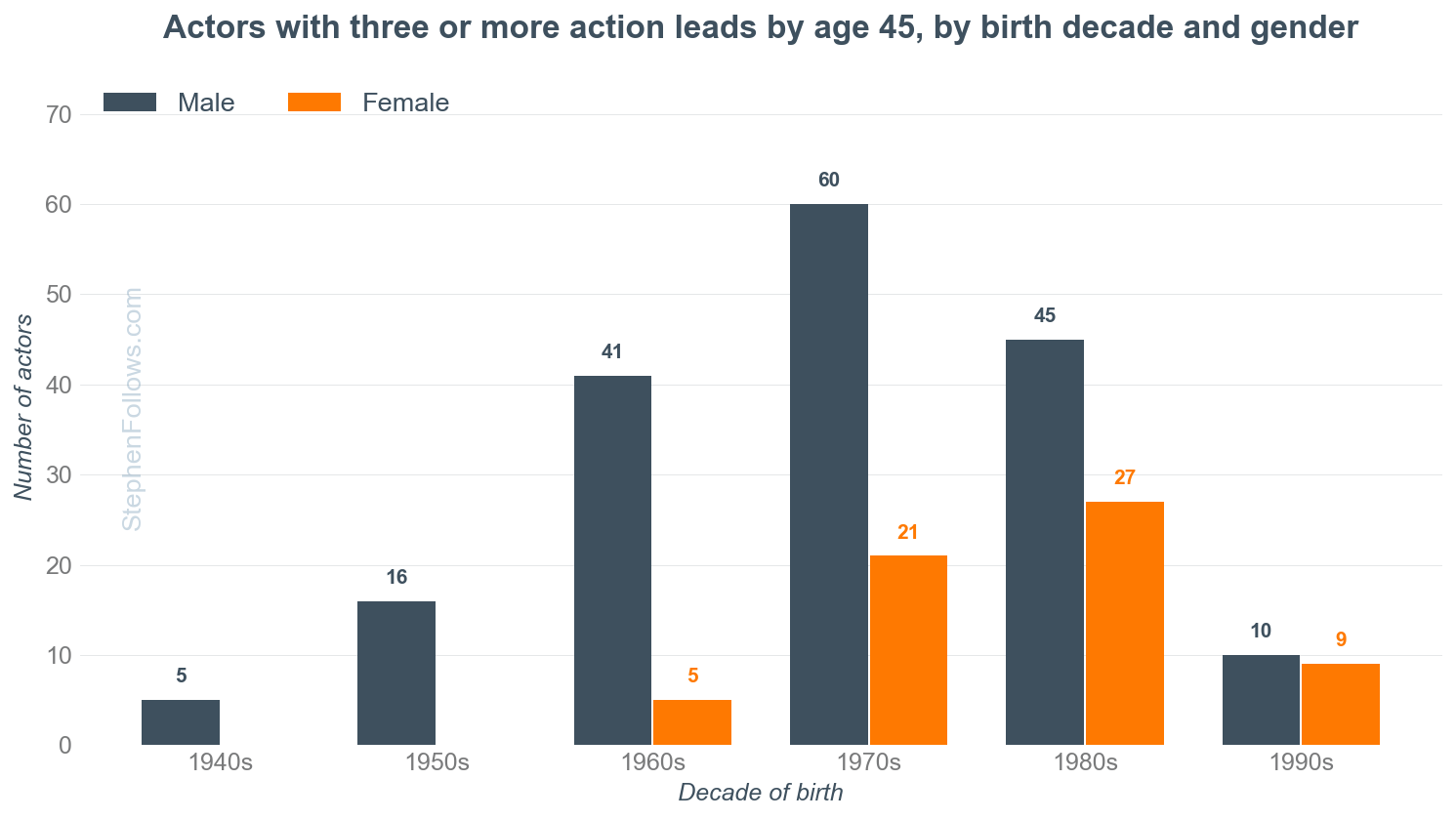
The 1970s-born male cohort (as in, Cruise’s actual peers, plus Dwayne Johnson and the Chris Hemsworth generation) is the peak for men in the dataset. 60 men born in the 1970s have three or more action lead roles by age 45. The 1980s-born cohort has produced 45.
For women, each successive decade of birth is the highest. Five women born in the 1960s reach three action leads by 45; 21 for the 1970s; 27 for the 1980s. That is the female pipeline quietly growing, mostly under 50.
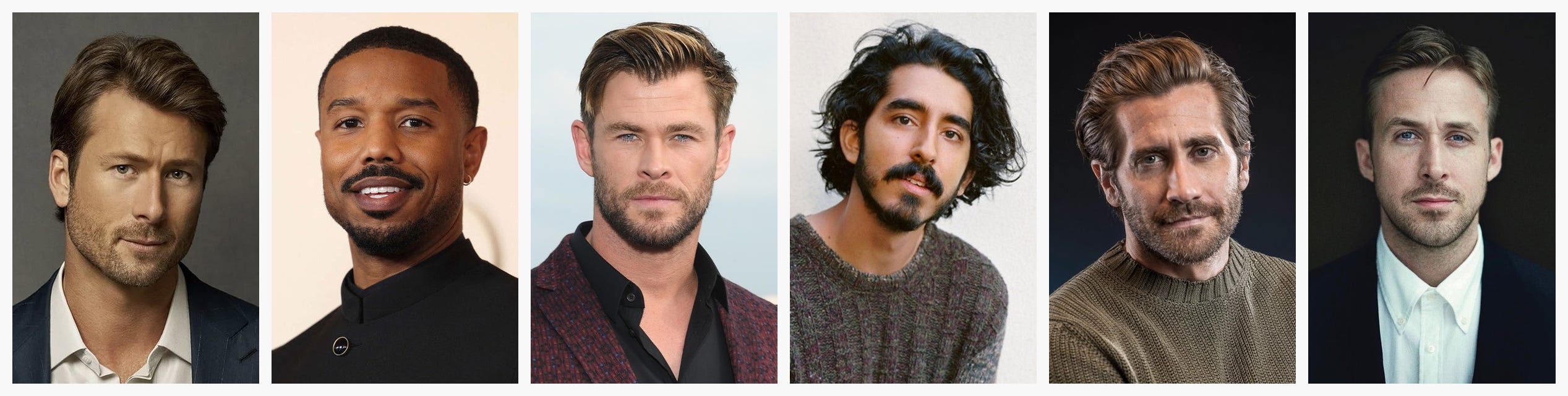
Among the 30- to 45-year-old names with an anchored action credit in the last two years
Glen Powell (36) — The Running Man (November 2025) is his first proper action-headliner swing
Michael B. Jordan (39) — Thomas Crown Affair directing and starring, unclear franchise ambitions
Chris Hemsworth (42) — Extraction 3 in development, Marvel commitments winding down
Dev Patel (35) — Monkey Man and follow-ups
Jake Gyllenhaal (45) — Road House (2024) went streaming-only
Ryan Gosling (45) — The Gray Man and The Fall Guy both underperformed
Although these are some heavy hitters, none have yet had what Cruise had in his thirties. Namely, five or six consecutive $200m-plus hits, building audience confidence in the actor as a franchise anchor.
It takes sustained output and sustained studio backing to produce that kind of brand. The open question is whether the industry has the appetite for a twenty-year bet on a single face, as it did in the 1990s.
Epilouge
Before you run to Polymarket to bet on the ‘End of Older Action Stars’, consider that the 2020s still have space to change course. Cruise, Statham, Diesel and their peers are still working and still selling tickets. Top Gun 3, The Beekeeper 2 and Mission: Impossible — The Final Reckoning are not under-performers. Older Bollywood leads (i.e. Shah Rukh Khan with Pathaan and Jawan at 58, Rajinikanth) are filling in from outside Hollywood. F1 at Pitt’s $30m Apple payday showed that an over-60 can still launch a new property.
But the breadth that made the 2010s feel unprecedented is narrowing. The ensembles that widened the cast have fragmented. The late-bloomer wave is slower than it was. The top of the cohort is concentrating again, with seven actors now reaching half of the decade’s gross, up from eleven in the 2010s. The generation coming up behind looks talented but not yet proven at the franchise scale.
Shah Rukh Khan, at 60, has been calling himself ‘the last of the superstars’. The data from Hollywood suggests he is slightly premature, but the bench behind him is thinner than the slate would suggest.
The over-50 action-star boom is real, but on current evidence, it is beginning to tip, with the cohort ageing in place and the ranks behind it thinner than they were a decade ago.
Notes
Today’s research examined every action-tagged film released between 1980 and 2025 with a reported budget or worldwide box-office figure. That gave me 2,171 films and 4,053 lead-role observations across 1,764 unique actors.
A ‘lead’ is anyone billed in the top three positions and credited as ‘Leading’ or ‘Lead Ensemble Member’ in the cast list, i.e. broadly, the actors whose faces end up on the poster.
I subdivided the IMDb ‘Action’ tag into twelve hybrid types (Action-Crime, Action-Thriller, Action-Superhero, Action-Sci-Fi, Action-Fantasy, Action-Comedy, Action-Drama, Action-Horror, Action-War, Action-Western, Action-Adventure and Pure Action). It is a slightly clumsy taxonomy, but it lets the genre-specific patterns surface.
Ages were calculated from each actor’s date of birth and the film’s release date. About 1,800 of the 2,200 lead actors matched cleanly; the rest are excluded from the age analysis.
All box office figures are in US dollars, not adjusted for inflation. I treat gender as binary because that is how the film industry has captured the data until very recently.
Data came from Opus Data, IMDb, OMDb, Wikidata, and trade reporting from Variety, Deadline, and The Hollywood Reporter for the 2026 CinemaCon slate.
The lead for Highlander isn't Russell Crowe or Dave Bautista but Henry Cavill; he is 42.
Great article, Stephen, but as action stars, don't you mean MCU and DC characters? Hollywood is not casting 30-50 year old men in original, high concept movies anymore. They stopped doing that 15 years ago. Everything is IP-related. Chris Evans even complained of this, having played Captain America in 11 MCU movies including cameos, while not having any time to play other action/thriller characters or even be offered good scripts as he was always "on retainer" for Marvel/Disney.
Jason Statham seems to hold the entire cinematic B-movie market as the ONLY mid-budget star investors and studios will back and even he is getting cliched now.
The remaining real action stars, trained in martial arts and/or naturally athletic do consistent Video on Demand like Scott Adkins, Frank Grillo and Michael Jai White.