


The question I get asked most is how to raise the money needed to make a film.
My stock answer usually starts with asking if they are looking for funding or financing.
Funding is money given because someone believes in you or the project (crowdfunding, family, a friend who fancies seeing their name in the credits).
Financing is money where the person putting it in expects to get it back.
Your first film will probably be funded. Your second will probably need financing.
Over the past couple of years, I’ve gone deep down the rabbit hole of the paperwork behind movies. Along the way I’ve been talking every week with Phil Hunt. Phil co-founded Head Gear Films in 2002 and has executive produced more than 300 feature films. Few people have financed more independent films.
As a result, in January 2027, Phil and I are running Advanced Film Financing, a live course for producers and financiers on films over $1m, including producers stepping up to their first.
Today I am sharing five things I learned through this investigation that I couldn't have known by simply Googling or asking an AI to guess. They are:
How much do private investors actually put into a film?
How much does it cost to borrow money for a film?
Can you trust a sales agent’s estimates?
How much does a producer actually get paid?
Who gets their money back first?
1. How much do private investors actually put into a film?
Let’s start with private investors. When a US company sells shares privately, it has to file a Form D with the Securities and Exchange Commission within 15 days of the first sale. This reveals how much the company is trying to raise, how much it has sold and to how many investors. I found 757 film raises among them (2008 to mid-2026) and crunched the data.
The typical film set out to raise $1m. Three investors bought in, each putting in about $54,000, and the smallest cheque the company would take was $10,000.
Only 16% reached the amount they were looking to raise, and nearly three in ten raised nothing. The typical film reached just 10% of its target.
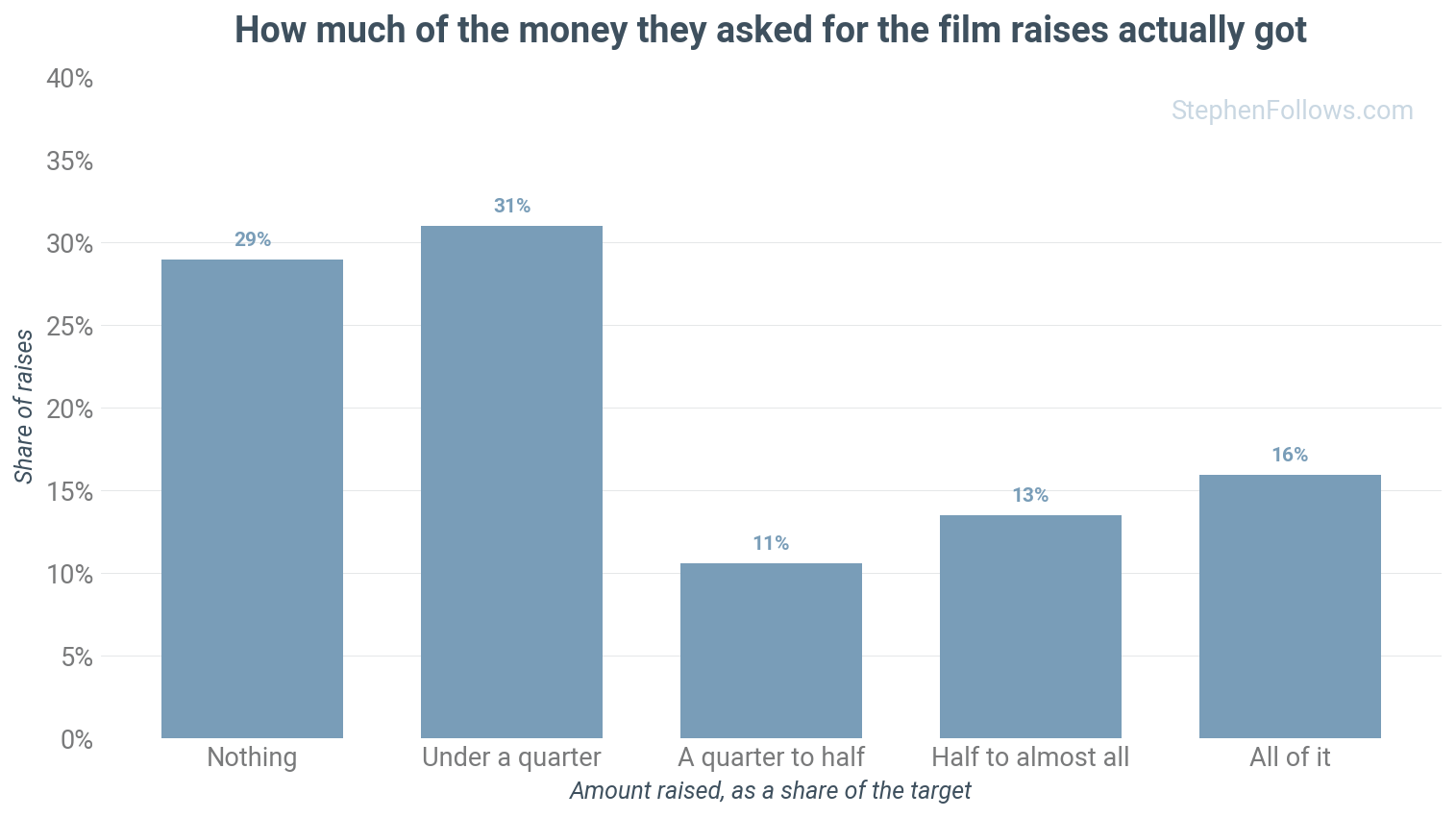
Whatever the paperwork calls it, much of this money looks more like funding than financing.
2. How much does it cost to borrow money for a film?
Another form of film financing is borrowing. The equity investors we saw previously take a much bigger risk (i.e., unsecured investment and a poor place on the revenue waterfall), but they take most of the upside if things go well.
By contrast, lenders are typically the last money in, the first money out and may have secured the money against the film or other assets.
Below are the rates I calculated from 160 real film loans across 137 films made since 2018, for three different types of film lending:
A tax credit loan is lent against the tax relief a government has promised to pay once the film is made.
A pre-sale loan is lent against a distributor’s signed contract to buy the film for its country.
A gap loan is lent against the territories nobody has bought yet, based on the sales agent’s estimate of what they will fetch.
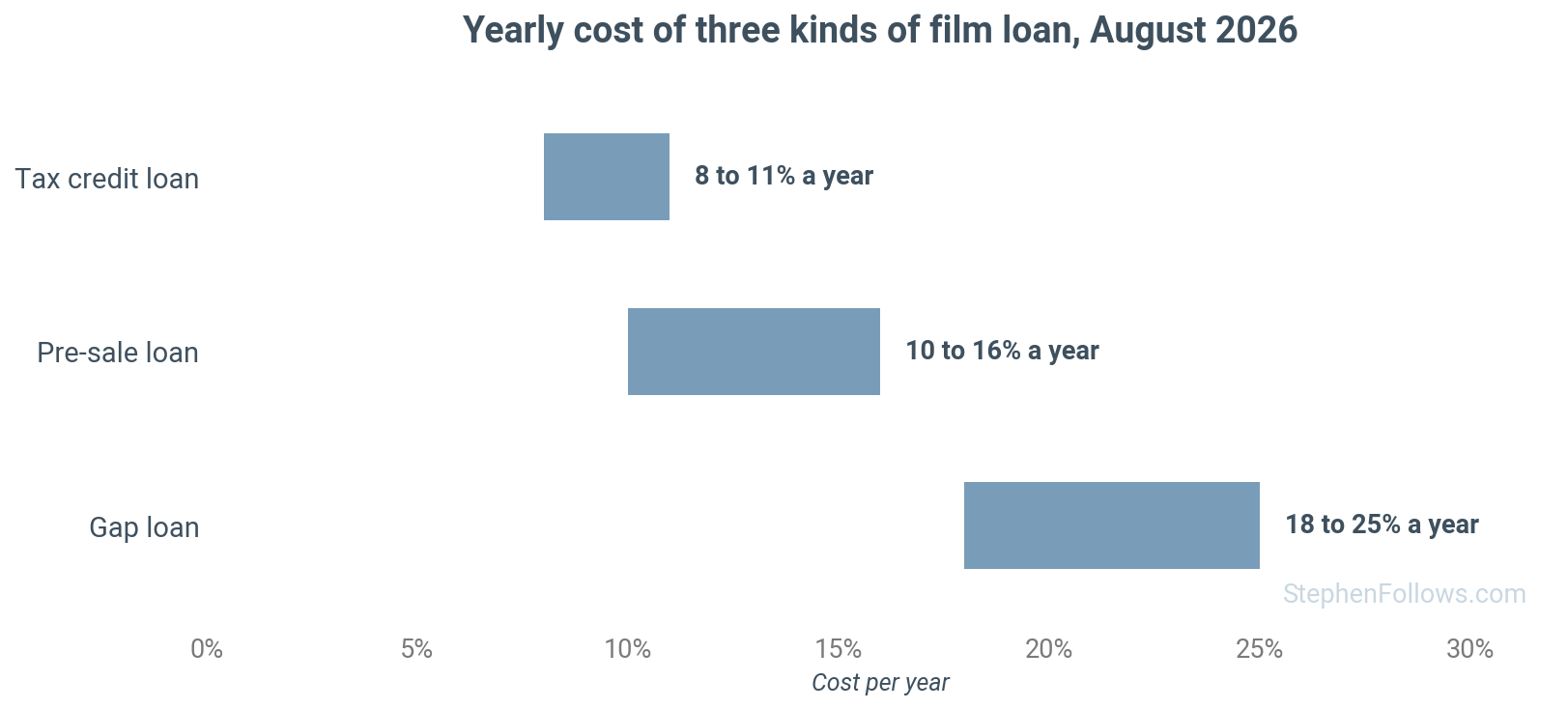
As in our normal lives, the riskier the lending is, the more the lender will charge you for it.
A government’s promise is about as safe as it gets, so a tax credit loan costs 8 to 11% a year.
A distributor’s contract is a little less certain, at 10 to 16%.
An agent’s guess about countries nobody has bought yet is much less certain, so a gap loan costs 18 to 25%.
There’s a fourth kind that wouldn’t fit on the chart. A bridge loan tides a film over until its financing is signed, and it costs 75 to 200% a year, because if the deal never closes, the lender can lose everything.
Despite pre-sale loans being one of the most common loans in independent film, I couldn’t find a single lender that publishes its rate. The only way to know is to know someone in the business and/or ask for a quote on a case-by-case basis.
3. Can you trust a sales agent’s estimates?
Some lending and investment may be based on sales estimates. These are figures from the sales agent, guessing how much they think they can sell the film for to distributors worldwide.
Sales estimates typically list every territory with two prices.
The ‘ask’ is the price the agent will open with.
The ‘take’ is the price they expect to accept.
I crunched the numbers on 1,120 real territory estimates and discovered that the agent usually opens at double the ‘take’, and everyone knows it. The ‘take’ is the figure to pay attention to. Good sales estimates should be fairly accurate on a territory-by-territory basis, as the sales agent knows the market and the delay between setting the figures and trying to realise them is typically short.
However, there is a sting in the tail. The one-pager the sales agent gives you estimates prices for every territory in the world. But many territories never sell.
Of 80 independent films I had data on, the typical film sold 58% of what its agent expected to take in total. Only 11 of the 80 (14%) sold the whole sheet at the take or better.
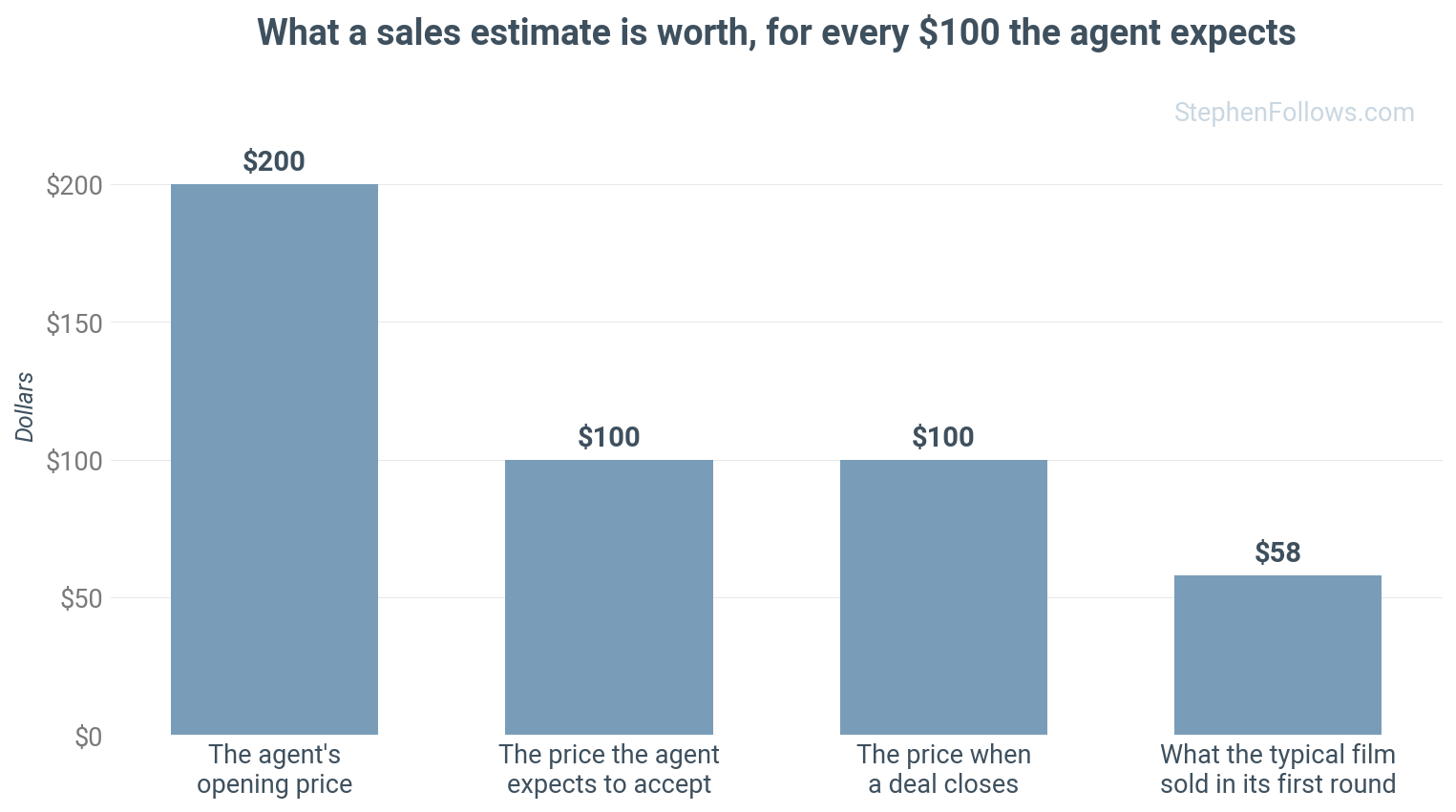
This is one reason sales estimates are rarely accepted as loan collateral. When I spoke to Phil about estimates, he told me about arguing with talent agents who treated a sales estimate as loan security.
It’s not collateral because it’s not a promise to pay. It’s an estimate of what the film might achieve given the sales in any specific territory.
That’s why a gap lender cuts an agent’s numbers before lending against them, and why it still charges 18 to 25%.
(Phil also pointed out that most film lenders are spending other people’s money too, borrowed from banks, funds or their own investors. Those backers expect a return that matches the risk, measured against everything else in the world they could put their money into. If gap lending paid less than that, nobody would lend to the gap lenders).
4. How much does a producer actually get paid?
Of the independent films I studied from 2018 to 2025, the median producer’s fee was 8% of the budget.
The typical producer’s share came to $94,874. This sounds pretty healthy until you factor in time. Producers with careers of five years or more make a median of one feature every 2.2 years, which turns the fee into roughly $43,000 a year, before tax, before company costs, etc.
Oh, and before they are asked to defer their fee. This is where a producer agrees to be paid later, out of the film’s possible future income, so that the budget can close.
While that can sometimes mean they get their compensation, albeit late, in many cases that’s akin to forgoing the figure entirely. A 2025 Producers’ Roundtable survey found that 94% of UK producers who had deferred a fee never received it.
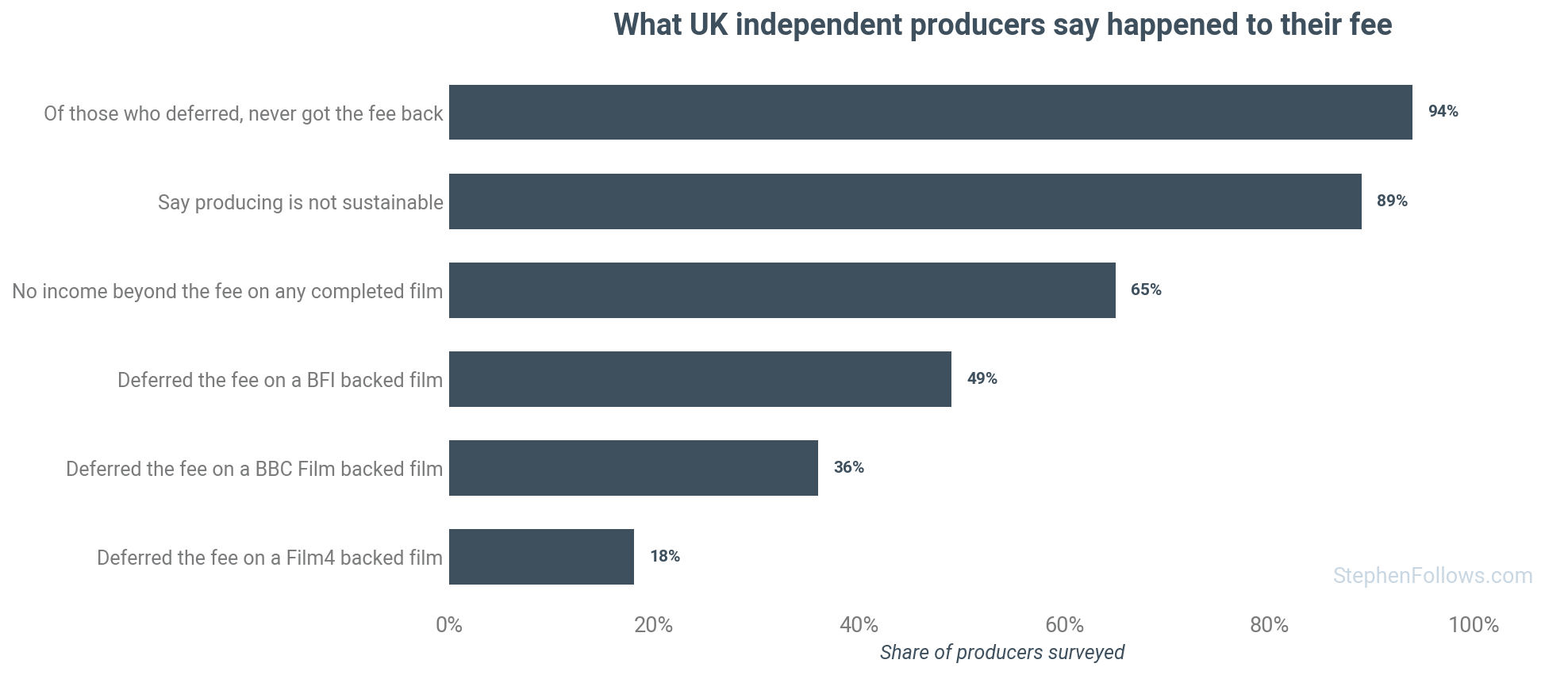
Deferred fees are paid near the end of the line, after almost everyone else, so in practice deferring a fee usually means giving it away.
5. Who gets their money back first?
Film financing is complicated, but if I had to boil it down to a few simple rules of thumb, one would be ‘Get paid back first’.
Easier said than done, so maybe I could tweak that to “Only do deals when you’re first”.
Money usually flows back from income in the following order:
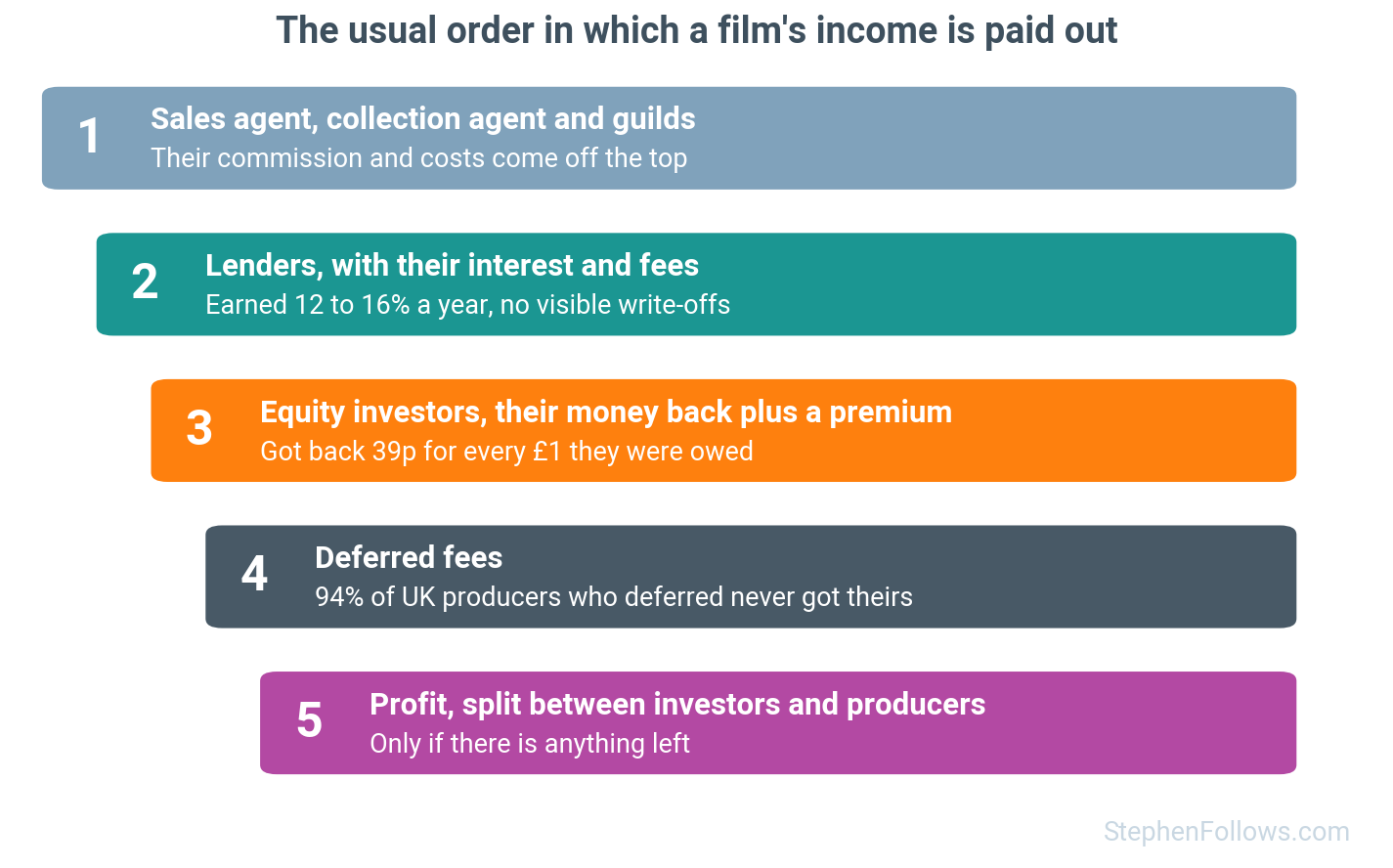
The lenders near the top did well. Across the loans behind the rates above, they earned a blended 12 to 16% a year. Those loans were secured on government promises and signed contracts, and they were repaid.
The equity investors (the people who buy a share of the film, and are paid back after the lenders) did badly.
Adam Leipzig put it nicely in his 2015 book, Inside Track for Independent Filmmakers:
Investing in films is a crapshoot, and a film is generally not a good investment unless you’re a big movie studio or a seasoned production company. Individual investors rarely get their money back, and they should make peace with that reality.
It’s an odd way round for a business to work. In a 2007 article, producer Todd Wagner said in New York Times Magazine article entitled “When the Producer Came to Town”:
In any other business, the high-risk investor gets paid back first, or if the business fails, is paid the highest percentage of the leavings. In Hollywood the studios get paid back first, for their distribution piece and the p-and-a. In no other business is that the case.
(“P-and-a” is prints and advertising, the cost of releasing the film.)
Investors accept the risk of a big loss for the chance of a big profit. And most often, it’s the loss.
Financing a film means showing everyone who expects their money back exactly where they sit in that order, and what has to go right before their turn comes.
What are Phil and I teaching in January?
For well over a year I’ve been talking every week with Phil Hunt. He lends to and invests in independent films for a living, which puts him on the other side of the table from most producers.
Advanced Film Financing is the live course we’ve built from those conversations. It’s for producers and financiers on films over $1m, including producers stepping up to their first. It follows one fictional film, The Long Dark, a £3.2m UK horror-thriller, from its first finance plan to its final statement. Every problem it runs into has a real event behind it, and because it’s made up, we can open its books completely.
There are six live sessions on Zoom, on Tuesdays and Thursdays from 12 to 28 January 2027, at 4pm UK (11am New York, 8am Los Angeles), 90 minutes each and all recorded.
You also get the workbooks and templates from the practicals
Our recorded Foundations course as a reference.
Access to an informal get-together with Phil and me in Berlin during the European Film Market.
Session 1 starts from your own project, so bring the one you’re working on. It won’t introduce you to investors or find you money, but it will show you how the deals work, so your conversations with the people who have the money go better.
It costs US$1,000 and enrolment closes on Friday 8 January. The details are at filmbusinessschool.com/advanced-film-financing.
Phil and I are running a free webinar called What you can’t look up about film finance, on Tuesday 8 December at 4pm UK (11am New York, 8am Los Angeles). Phil works through a realistic, fictional finance package and explains his thinking, and I show what my data says alongside it.
Everyone who registers gets the recording. You can sign up at filmbusinessschool.com/film-finance-webinar.
Thanks for sharing this, Stephen. I’m researching international private-investment incentives for feature films for the Canadian Media Producers Association. We’re looking at how much usable money reaches production and what producers retain, so this is very relevant.
A couple of questions: do the Form D figures reflect amounts raised when the filings were made, or were you able to track final fundraising outcomes? And which countries does the loan sample cover, with fees included in those annual rates or calculated separately?
Is there a methodology note or fuller analysis available that we could reference in the study?