


There are two different narratives I hear about AI in movies right now:
“We’re moments away from uploading a script and making movies!” (This is usually followed by the person trying to get me to look at a demo of their “ground-breaking” vibe-coded AI-to-storyboard start-up).
“It’s all hype and will burst any second, returning moviemaking to how it’s always been” (These folk also complain that GenZ don’t understand customer service and the generation below that can’t read).
Between these two outlier options sit the rest of us - curious, confused, and tired of having to work out what’s bullshit and what’s best practice.
I was recently asked by a highly experienced Hollywood VFX veteran what the lay of the land actually is today, so I thought I would dive into the facts and find out how things stand as of July 2026.
I sought out every report of a named film or show where AI genuinely did some of the work. I also looked at what the myriad of “AI-powered” tools, apps, and services are promising (taking special attention to which had real-world case studies and which did not).
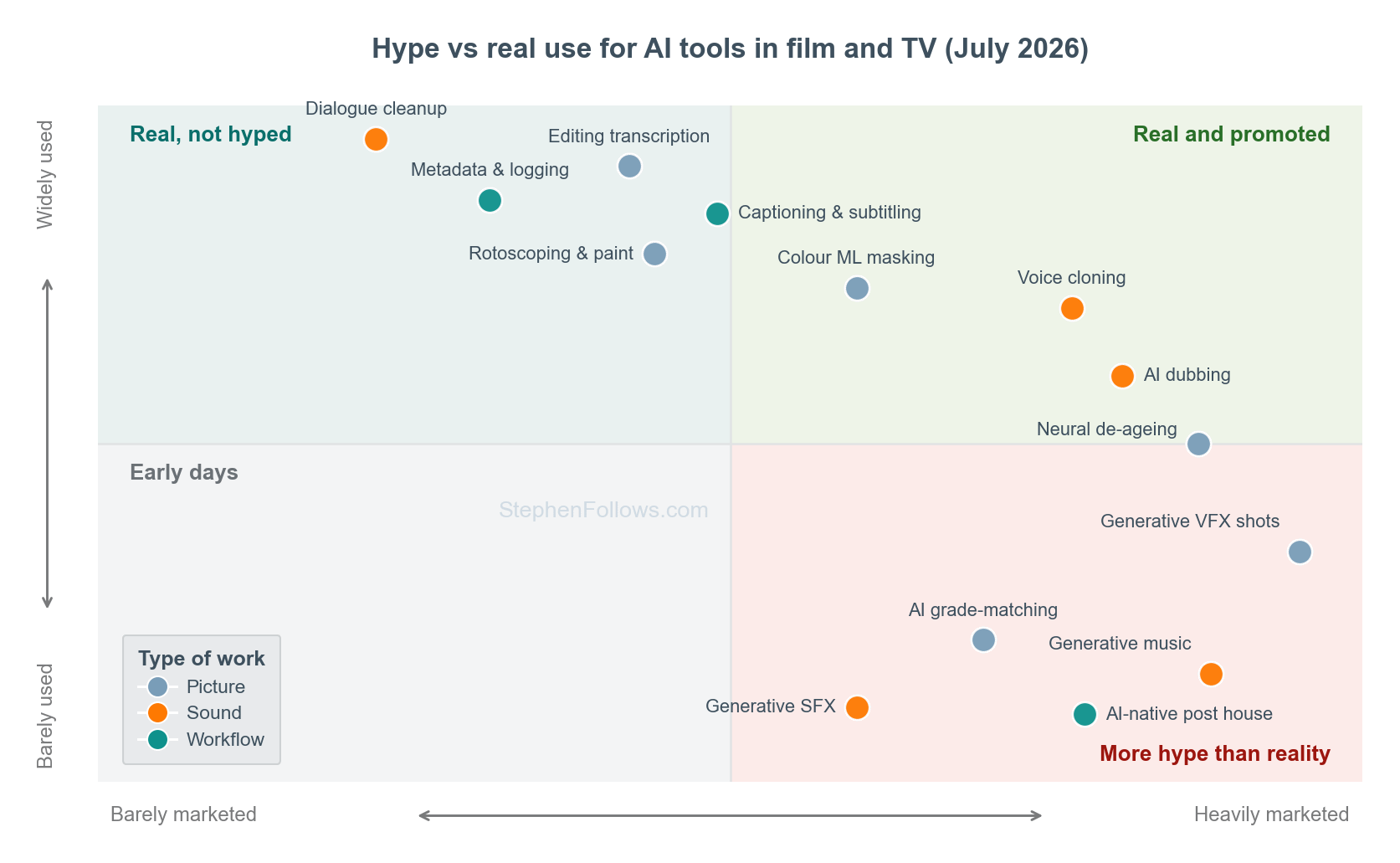
My main takeaway is that the AI solutions that are working in professional settings today are mostly the boring kind. They are not the ones which make for the most exciting/scary headlines, but the ones which save time and money.
The tools shouting loudest are often the ones doing the least, whereas some of the most useful ones don’t (or maybe don’t need to) do much public-facing marketing.
Below is an illustrative chart of how I see things:
Let’s dive into the details.
Where AI actually works in visual effects
Let’s start with what some might call the thin edge of the wedge. This is where AI is fully integrated and accepted by all. VFX artists use AI today to have computers perform the most tedious manual tasks, and to do so so much faster than humans can do alone.
A good example is on Dune: Part Two, where visual effects supervisor Paul Lambert needed to turn the Fremen’s eyes spice-blue across around a thousand shots. Instead of painting each one by hand, the team trained Foundry’s Nuke tool CopyCat (a small neural network you teach on a few frames) to do it. Foundry reported that 40% of those eye shots needed no manual touch-up at all.

Other examples include:
For Furiosa: A Mad Max Saga, the Australian house Rising Sun Pictures used its REVIZE machine-learning system to blend Anya Taylor-Joy with a younger performer across about 150 shots.
On Kingdom of the Planet of the Apes, Wētā FX ran a facial deep-learning system across more than 1,500 shots.
The Toronto company MARZ sells a beauty-fix tool called Vanity AI and says it has run on more than 27 productions.
AI has already come for people’s jobs, but it’s starting with the jobs no one wanted in the first place. The artist remains in charge, directing the robots toward a single, repetitive task.
This is clearly the safest ground for VFX companies to talk about AI use without causing a backlash. That’s because:
It is replacing work no one wants to do.
It does so without using anyone else’s art. The companies train on their own images and haven’t built a tool others can use to create new art.
We can all picture what’s happening, on a conceptual level - it’s not that scary.
Not all AI is AI, actually
Next up, we have “AI de-ageing”. We’ve been hearing about this for years, and the truth is, a lot of it wasn’t really AI. Well, not the Generative AI that we think of today, where you type in a prompt and get out a fully generated image.
In recent years, we’ve seen a de-aged Robert De Niro in The Irishman and a young Will Smith in Gemini Man. In the case of the former, ILM used a markerless capture rig and extensive traditional computer graphics, and for the latter, Wētā built a fully digital human. These are CGs made by hundreds of people, and where machine learning was used, it was more of a reference aid.
The visual effects supervisor on Gemini Man, Guy Williams, described it like this:
We didn’t even think of it truly as de-ageing; we thought of it as a complete creature replacement
A film that came closer to “AI de-ageing” was Robert Zemeckis’s 2024 film Here, which used a neural network rather than CG to de-age Tom Hanks and Robin Wright live on set. The company behind it, Metaphysic, ran the face replacement as the cameras rolled (albeit that’s not to say that what we saw in the final film was the real-time output).

So when you read that a film “used AI to de-age” a star, the question worth asking is whether they mean “Here,” or the other 90%, which is that skilled humans do the work.
Has generative AI reached professional screens yet?
But that’s not to say that Generative AI isn’t being used. An early example of such a project is El Eternauta, an Argentine Netflix series that used generative AI for a building-collapse shot. Netflix co-chief executive Ted Sarandos told investors a year ago that it was about ten times faster than the traditional method and that it was:
The very first GenAI final footage to appear on screen in a Netflix original.
So it was a year ago that just one AI-generated sequence making it to air earned a press release and headlines. Things are not as far along as some will have you believe.
