


Next week sees the start of the 51st edition of the Toronto International Film Festival, along with the inaugural year of its new sister event, TIFF: The Market.

I thought it was time to update my collection of tips for people travelling to Toronto for either event. I reached out to previous TIFF attendees and quizzed them on all manner of things to do with attending, getting the most out of the trip and what pitfalls to avoid.
In total, 271 producers, sales agents, distributors, buyers, programmers, funders and filmmakers have shared their collective 2,114 years of attendance.
TIFF TL;DR
Toronto takes place over eleven days in mid-September and is the industry's big autumn event.
If you had to sum it up in one word, it would be “audience”. There are many screenings, with high public attendance, and its audience award is a major bellwether for future success. Past winners have included American Beauty, Slumdog Millionaire, The King’s Speech, 12 Years a Slave and La La Land. In fact, nine of the last ten winners have gone on to receive a Best Picture nomination, so it’s a big part of the starting gun to the Oscar 2027 race and resultant punditry.

It’s also widely acknowledged as perhaps the friendliest of the major festivals, and it’s certainly been one I’ve enjoyed a lot. I will be in Toronto this year, speaking in the Perspectives strand of the Market Summit. If you are there, come and say hello.
This article is the result of a big survey I ran of past participants and research I’ve done based on available information. Each time a festival runs, they change a few things, so don't rely on it alone - if something is important, then check it out for yourself.
Time to tackle the TIFF tips!
Starting out
1. It is a good festival to be new at.
Many people described TIFF as far less intimidating than the average major film festival. Toronto is not Cannes (and no one cares what shoes you’re wearing).
“The festival has always been, in my opinion, very beginner friendly. Venues are easy to get in to, staff is nice and helpful, and the amount of sellers is very manageable.”
“Revel in a truly people’s festival where not just industry colleagues and filmmakers but people who enjoy cinema from the general public truly explore and enjoy cinema.”
2. Everybody is winging it (and even more so in 2026).
When I asked what people wish they’d known ahead of their first trip to TIFF, my favourite answer was:
“Try not to be overwhelmed. Everybody’s winging it.”

This is true of all festivals, given the high churn rate of industry participants, but even more so this year as it’s the first year of the new TIFF: The Market. No one will have attended before, and no one will quite know how it all works. Revel in that shared ignorance discovery.
3. Pick two or three goals and let the rest go.
A frequent refrain was about the need for focus. The people who seemed to know how to do TIFF well often mentioned that having a narrow goal was key.
“Focus on realistic 2-3 goals.”
“Carefully evaluate your goals well in advance, then identify the best ways to achieve them.”
“Pace yourself. Attend as much as possible if you have the energy, otherwise conserve it. There’s a lot to do.”
4. Talk to the person next to you in the queue.
This is advice I give everyone attending any film festival but is doubly true for TIFF. It was also the most repeated advice in my survey, given independently by respondent after respondent.
Everyone there has spent a lot of time and money to be in the same spot as you. They are likely to share many interests and passions as you, and may well prove to be an important ally in future endeavours. You’ll pick up free tips, warnings, recommendations, and suggestions. Plus, you know, humans are fun.
“The best networking comes from spontaneous moments of human interaction. Talk to the people standing next to you.”
“Talk to other people in the line-up, as you’ll never know who you can meet.”
“Networking is number one. Striking up a conversation with other film-lovers in line for a screening is a great way to make new connections.”
Queue Time is not dead time - it might even be the most productive part of the day (and it costs nothing).
Booking and money
5. Check the current pass tiers.
The accreditation structure was rebuilt this year around the market, so anything you remember (or read on a blog) about Industry, Premium and Buyer passes is out of date. There are now four tiers. Prices, eligibility and what each one lets you into are all on TIFF’s Market pages, and it is worth ten minutes because the tiers do genuinely different things.
Market. This is the pass I think most people will get. $590 early bird (to 19 June), $695 regular (to 28 August), $800 late or on site (from 8 September). Includes Press & Market screenings and market screenings on a first-come basis, plus rush tickets for public screenings.
Market+. $760 early bird, $895 regular, $1,030 late. Everything in Market, plus an advance ticket package of up to eight public Festival screenings, same-day tickets to public screenings, the networking business lounges and digital catch-up screenings.
Market+ Buyer. Same prices as Market+ ($760, $895, $1,030), but for verified buyers only. Everything in Market+, plus priority access to selected Press & Market screenings, up to sixteen advance tickets, and invitations to buyer-only events.
Market+ Access Canada Summit. $999 early bird, $1,250 regular and on-site. Everything in Market+, plus the Access Canada Summit day: main and second stage talks, workshops, a pitch market and roundtable meetings. Access Canada is The Hollywood Reporter’s Canadian industry summit.
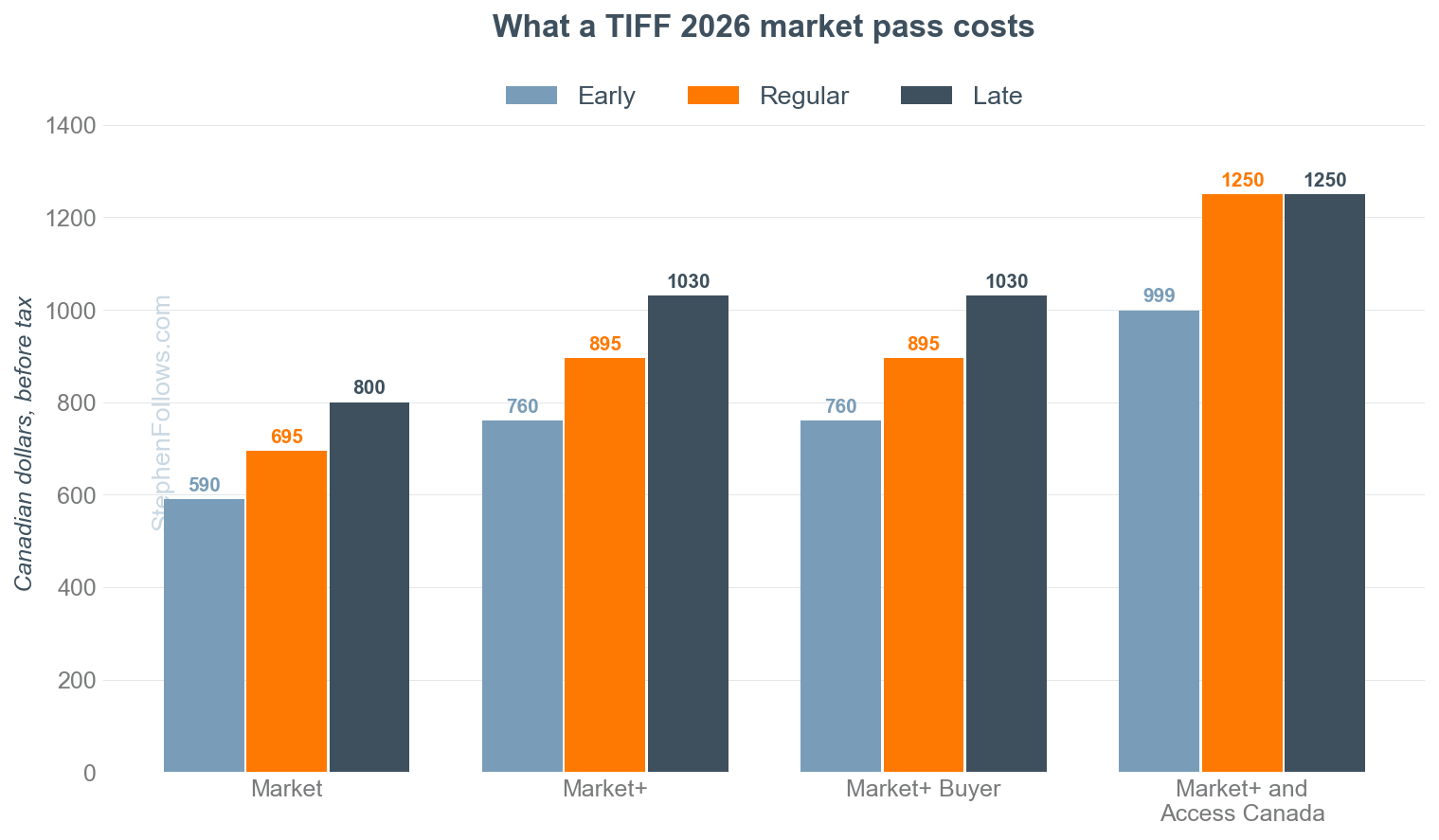
One warning before you set your heart on a tier - when I checked with TIFF staff on a draft of this article, they confirmed that the Market+ and Market+ Access Canada Summit passes have already sold out for this year.
Speaking of… if you are registering late, on-site registration and pass pick-up opens on 8 September on the main floor of the Metro Toronto Convention Centre.
6. Ask your national body before you buy direct.
This is the most useful money tip here, and yet few people do it. Member organisations negotiate discounts directly with TIFF. For example, the Canadian Media Producers Association offer members 30% off, and Screen Ireland and WIFT do the same. If you belong to a producers’ association, a guild or a national funder, email them first.
7. There are discounts for under-25s and students.
From a producer with twelve years of festivals behind them, filed under things they wish they had known sooner:
“There are great badge discounts for people under the age of 25, or those attending school.”
8. It’s not going to be cheap
Depending on where you’re coming from, no film festival is easy on the wallet. Toronto helps because it's a major city, so it avoids the monopolistic pricing associated with single-focus towns such as Cannes.
From the people I spoke to, the most common answer was between US$2,500 and US$5,000, and more than half of respondents came in under $5,000.
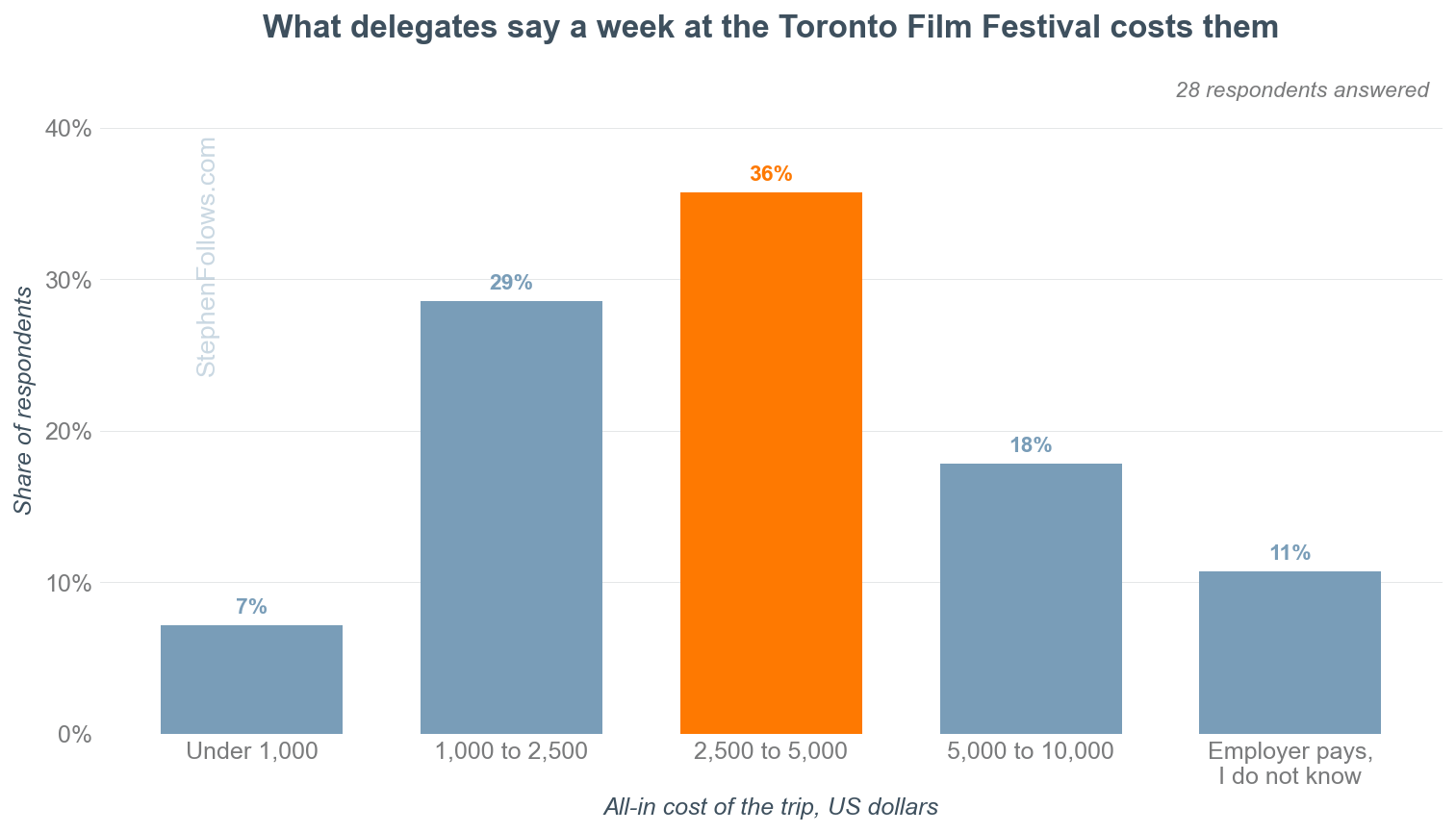
For context, that puts Toronto at the cheaper end of the major markets, in my estimation.
9. Book accommodation absurdly early, and stay close.
TIFF has historically opened its hotel bookings in May for a September festival. One respondent's advice was four words long:
“Stay as close as possible.”
10. Economise on food, not on days.
If you’re on a budget, the first things to consider are cheaper accommodation and eating frugally, rather than shortening your trip. The flights and pass are fixed costs, so a shorter trip only makes it more expensive when amortised to a ‘per day’ basis.
11. If you need a visa, register first.
TIFF will write letters of support for visa applications, but only for people who have already registered, and biometrics add time. Do it in that order.
As a UK citizen, I had to apply for an ETA. I received my approval within 30 minutes of applying, but a colleague was unlucky enough to have waited well over a week. Don’t leave this to the last minute!
The market nobody has been to
12. Walk the floor.
As TIFF: The Market is brand new; everyone will need to go through the same discovery process upon arriving. So allocate yourself enough time to wander the halls and really check out every corner. You’ll kick yourself if you end up missing some booth or freebie you didn’t take the time to find early on.
(This is true of all festivals and I have seen many a sad filmmaker discover the free Nespresso coffee stand at Cannes on their last day!).
This matters more than just free cups of coffee. Part of the reason to attend these events is to connect with the industry as it is right now. Taking the time to visit every stand, and maybe even chat with the people behind them, will do wonders for your industry knowledge, contacts, and confidence.
As a few people put it:
“Spend time at the Convention Centre so you can see the industry at work, look at the different pavilions and see what the different countries are presenting along with the film commissions. You’ll be able to learn a lot about trends, locations and other data, and meet lots of people that way.”
“If you bought an accreditation for the Market, visit the different pavilions and ask questions to the host and hostess.”
TIFF says the 2026 edition will be attended by more than 150 international sales, promotion, and distribution companies, around 230 exhibiting organisations (film bodies, sales companies and more) across 120+ exhibition spaces and hotel suites, and more than 430 market screenings (248 Press & Market screenings and 190 market screenings). The delegate target is 6,000 people from more than 80 countries.
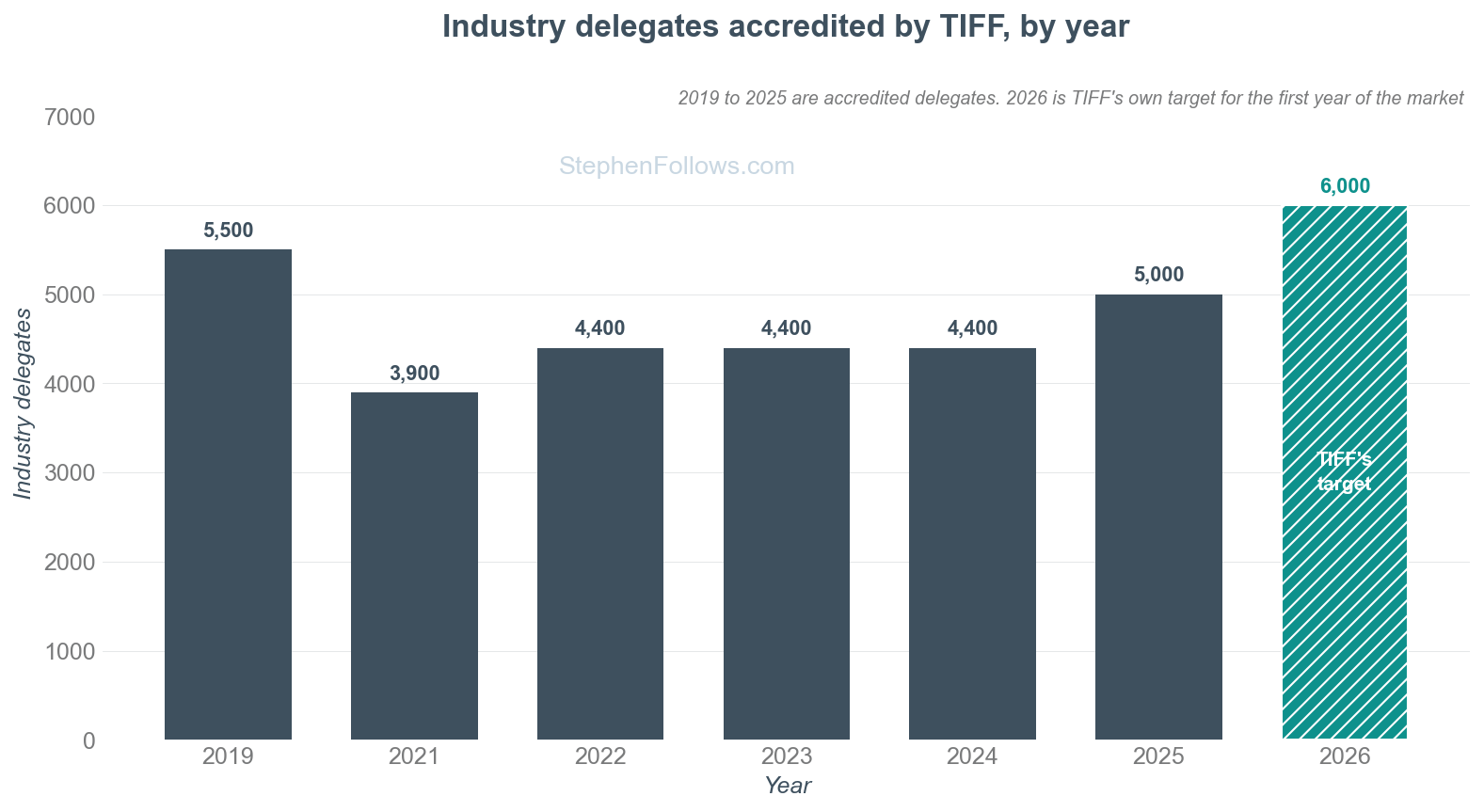
TIFF has launched a Market App for delegates this year, and downloading it before you land is the quickest way to get your bearings.
13. It’s about the people.
As the initial panic of the 2020 COVID-19 pandemic calmed down, many in the industry openly questioned the need for in-person events. The cost, hassle, and carbon footprint of such events all count against attending.
However, attendance figures since then at events such as Cannes and Berlin have proved that live events are here to stay. And in large part that's because there is something irreplaceable about being in the same room as other people. So remember that as you’re making your plans before and at TIFF. What has this opportunity provided for you that you can’t get on Zoom?
Some of my respondents put it like this:
“Honestly, I feel like markets are proof of life. You need to be seen IN PERSON by folks to remind them, especially after COVID, that you are still around and active.”
“New film contacts. But I’m not expecting to make deals. Make connections.”
“Meetings and connections that I can develop into relationships over time.”
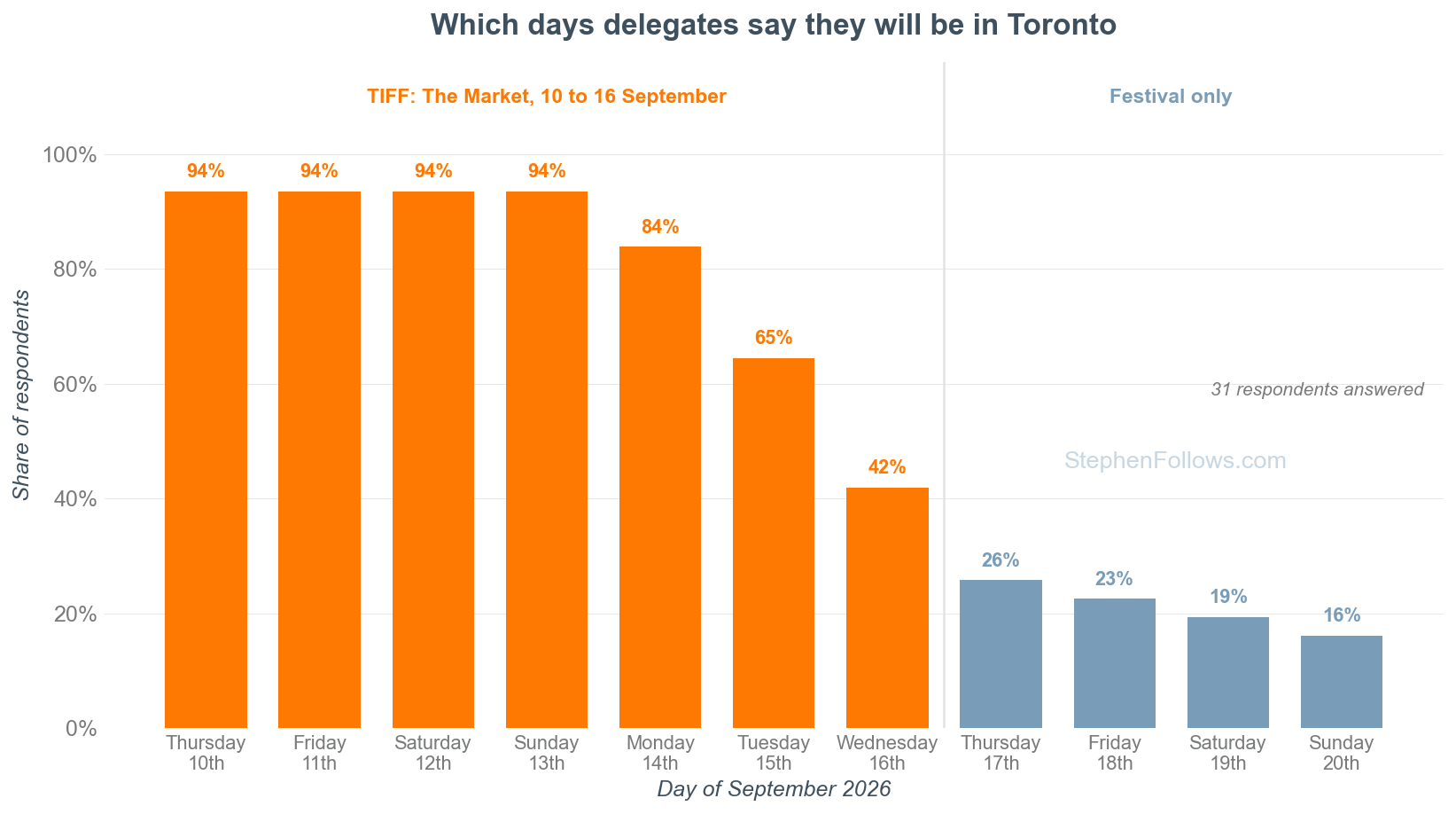
14. The market is seven days inside an eleven-day festival.
The market finishes on the 16th September, but the festival carries on to the 20th. If you are coming for business, the back half is quiet, and if you are coming for films, the business crowd will have gone home. Worth deciding which festival you are attending before you book flights.
This matches the general rhythm of film festivals more widely. The first weekend is where all the business folks head, no matter how long the event officially goes on.
15. The centre of gravity has moved south.
For years everything orbited the Industry Centre at the Hyatt Regency on King Street West. The market hub is now the Metro Toronto Convention Centre, with sales suites at the InterContinental and the Ritz-Carlton, and a new 1,200-seat theatre inside the convention centre itself. TIFF says everything sits within a twelve-minute walk.

The evenings have not moved, though. Respondents still name the restaurants and bars along King Street West as where the unofficial business gets done and where you actually bump into people.
16. Find your national stand on day one.
Whoever you are, somebody is there to represent where you are from, and being useful to you is literally their job that week.
In 2016 TIFF had national agency stands representing 38 countries. By last year that had shrunk to about 13 stands. This year the market relaunch has brought them back with interest. I count 92 national and regional film bodies with a confirmed presence, from around 40 countries, which is roughly half of what the Cannes market’s Village International offers and not bad for a first edition.
Being useful to you is literally their job that week, but check what kind of body you have. A national film institute or export agency (Unifrance, KOFIC, Screen Australia, Cinema do Brasil, the Swedish Film Institute) exists to help its filmmakers sell, and will introduce you to buyers, share who else from home is in town and often lend you a meeting table.
Films and screenings
17. See films. Be able to talk about them.
This came up more than anything except the queue advice, and one respondent, who programmed at TIFF for twenty years before moving into producing, framed it as a social rule rather than a cultural one.
“See a movie, don’t just do the market and events. If I am talking to someone and they can’t talk about a movie they’ve seen at TIFF, I tend to judge.”
Others put it more warmly:
“Take some time to watch some films. This is why we’re in this industry and always a great conversation starter.”
And, from a funding body:
“See as many films as you can between the meetings.”
18. Go to the public screenings too.
Toronto audiences are famously engaged and enthusiastic. So while you may feel the desire to hide away at Press & Market screenings, you’ll be robbing yourself of one of the best bits of TIFF.
Watching a film with 1,800 civilians who chose to be there is a different experience from watching it with six bored sales agents deciding not to buy it.
A TIFF veteran put it like this to me:
“Go to as many of the public screenings as you can, it’s so much more alive than Press and Market screenings.”
19. Press and Market screenings still reward turning up early.
(Quick note: What veterans call “P&I”, the old press and industry screenings, are now officially Press & Market screenings, so that is the label you will see in the programme).
Last year TIFF changed the rules around public screenings and now has assigned seating. So you may hear advice to show up as early as possible. While that would give you some lovely Queue Time, it won’t be as productive as it used to be.
However, Press and Market screenings are still first-come, first-served, so arriving early buys you everything. TIFF’s own house rule has long been fifteen minutes but the experienced delegates I spoke to suggested considerably more.
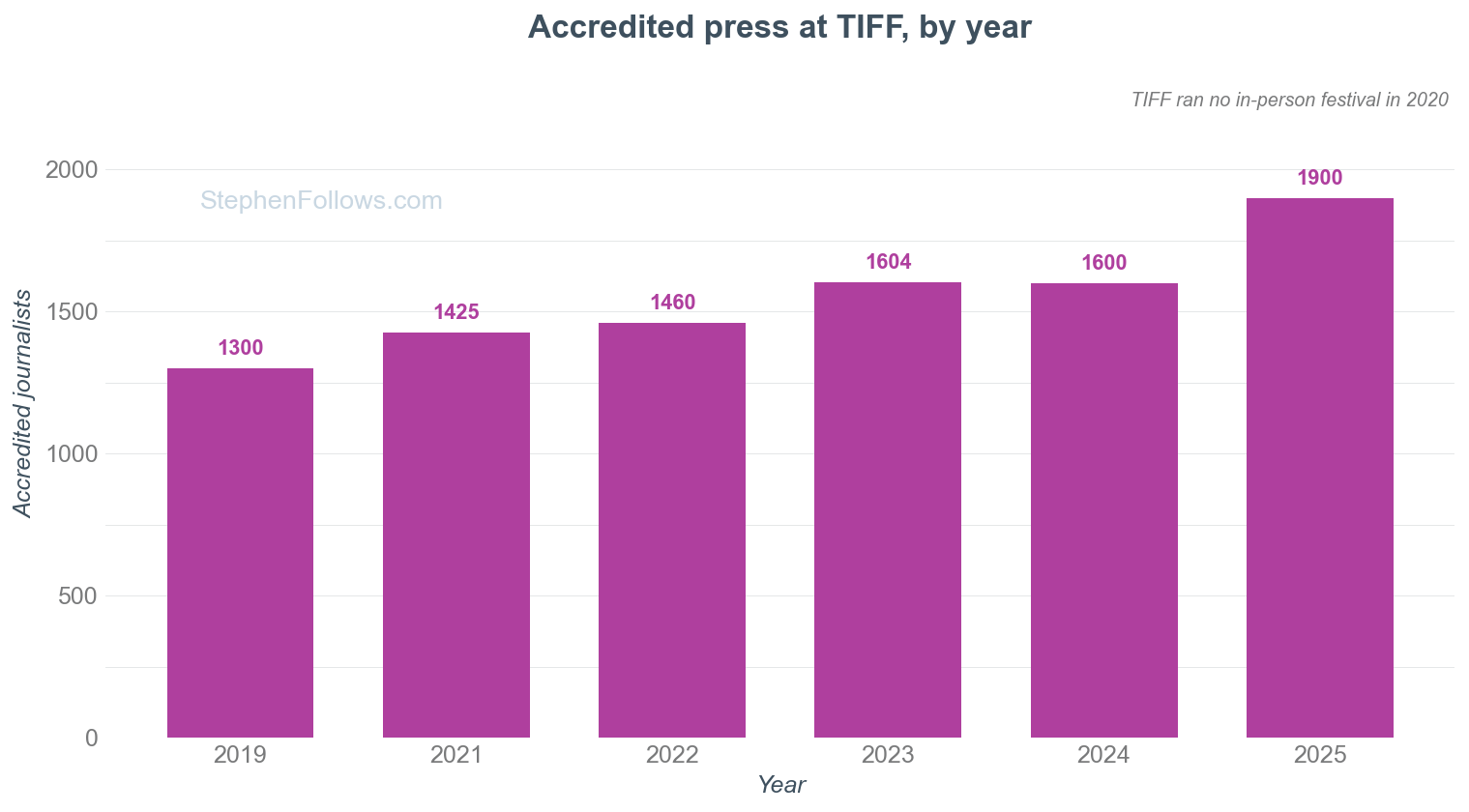
The number of films at TIFF has been slightly reducing in recent years, adding to the pressure to secure a screening room seat.
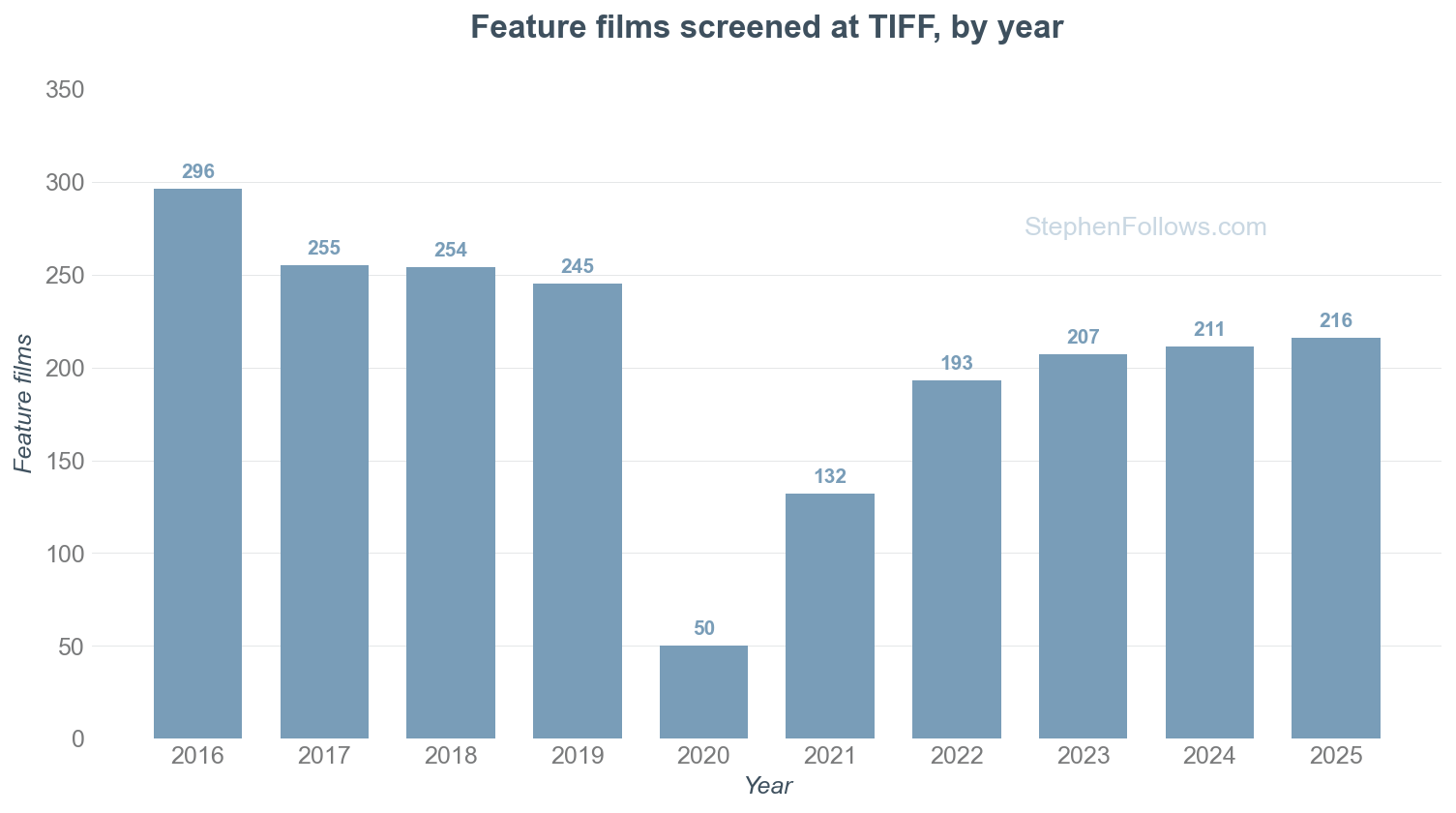
It is a squeeze from both ends, because while the festival programmes fewer films, it accredits more journalists.
One person put it like this:
“With less and less P&I screenings, plan on lining up way early for the bigger titles.”
They are right that there is less to go round. The festival programmes fewer films than it used to.
20. Your pass is not a ticket.
For public and combined screenings you need an actual ticket, which is collected against your pass. The long-standing rule is that the box office stops issuing them an hour before the screening starts, so don’t leave it too late.
21. Never accept ‘sold out’.
Rush lines work, returns appear, and pass holders can rush public screenings or pick up same-day tickets at a venue box office. Delegates also recommended TIFFR, a third-party scheduling tool, for spotting tickets that come back into circulation.
22. Book what you care about early.
A few delegates warned that the popular screenings fill well in advance and get pricier as they do. If you already know the three films you must see, buy those now and stay flexible on the rest.
23. Go to the odd ones.
Discovery and Midnight Madness came up repeatedly, and Midnight Madness in particular has a following that borders on the devotional.
“Make sure to check out the Midnight Madness films. The whole event is an amazing experience with a crowd like no other.”
“Watch films in the Discovery and Midnight Madness sections. Watch films that may not find distribution and could be great gems of world cinema.”
24. It is fine to walk out.
Cinephiles - please don’t come after me for this tip! I know that some hold fast to the opinion that you must stay until all the final credits crawl has confirmed no animals were harmed, but in speaking with attendees, a few brought up the idea that you need to prioritise your own time, and therefore leaving before the film finishes is acceptable. These are the folks trying to see four or five films a day and see an early exit as an acceptable, if undesirable, reality.
I’m not going to take a view on this (albeit I will note that this is absolutely not ok at any premiere or place you think the filmmakers are in the room!).
25. Look for the free screening on the last Sunday.
The audience award winner has traditionally re-screened free at Roy Thomson Hall on the final day, with tickets handed out at no charge a couple of hours beforehand. If you are still in town, the film the entire festival just voted for costs nothing.
The people part
26. Prepare more than feels reasonable, then leave gaps on purpose.
Almost everyone I spoke to suggested that you should prepare obsessively. They also said that the best things happen by accident. The way to have both is to build a schedule with holes in it.
“Start preparing a month before, research the people you want to meet with and be specific. What films did they work on, and why that matters for your own project. Don’t try to just meet for the sake of it. We’re all busy and appreciate it when you do 5 mins on google, rather than cold, blanket emails.”
A producer suggested to me the following system:
“Allow 30 minutes in your diary for your 20 minute meetings, to allow for previous meetings running late, or you yourself running late.”
27. Know what an ‘event’ actually is.
One veteran pointed out that it’s important to get context to what you’re going to.
“An event is not a party with free drinks for everyone who wants to party. It costs a lot of money, is a networking event, for those the hosts consider important for the purpose of the event.”
Somebody else put a similar thought a little more bluntly:
“If the guest list is open to the public, the party’s not worth going to.”
28. The film agencies throw the best parties.
I asked which organisations run the best events, expecting studios and streamers. Almost everyone named the funding bodies instead. The Canadian regional agencies came up repeatedly (”they know how to celebrate and profile their talent”), along with Ontario Creates, Telefilm, the Indigenous Screen Office, the British film organisations, Unifrance and the CMPA.
Such events are becoming rarer and rarer in the film industry, as everyone focuses on short, more focused festival experiences. So if you get a chance to attend one - go for it!
29. Dress one notch up from whatever you were planning.
Here is a tip I would never follow. Personally, I prioritise comfort and feeling at ease, but I can’t deny the logic of the following advice from a TIFF veteran:
“Dress for business. If you going to wear a t-shirt, put a jacket over it. It just a fact that folks are going to judge on first visual impressions, so don’t wear a Lucio Fulci Gates of Hell t-shirt... And act like you belong in the space you are in.”
30. On business cards.
For years, this was the most repeated advice at every festival: bring many business cards. TIFF stopped including this as official advice to attendees in 2018, and many fewer people brought it up in my 2026 research than in my 2016 survey.
That said, it’s not totally dead yet, and there are situations where a well-timed business card will increase your chances of building a long-term connection.
(Personally, I don’t bring them, but I do appreciate being handed a card. I photograph it and hand it straight back. The photo is searchable, and it does not fill my pockets with film festival flotsam.
If you are on a serious networking run, then there is no harm in carrying them. Just do not assume everyone wants one.
31. Follow the programmer, not the film.
This was new to me, and I think it is the cleverest tip in the survey.
“Regular TIFF participants follow their ‘own’ programmers and the films they invite. So for newcomers, pay attention to the programmer of a film you like and follow that programmer.”
32. If you have a film in the festival, it is more work than you think.
This is a rather niche tip as the vast majority of TIFF attendees are there to network or watch films, rather than promote one. That said, if this relates to you - firstly, congratulations, and secondly, make sure you do all you can to get the most out of this rare experience. It may be a while before it happens again, if ever - don’t let it pass you by.
As one experienced film professional put it:
“If you have a film in the festival, it takes a LOT longer to liaise with the festival and prepare materials needed and organise attendees than you realise, and when you are there as a Producer you need to wrangle them and press more than you thought. Also, enjoy how you too will be celebrated as a world class creative talent, in addition to Directors and Writers. It feels very special.”
Toronto, and staying upright
33. The city is welcoming and so is the festival.
Worth stating plainly, because it is what most distinguishes Toronto from its rivals, and why this is a good first festival.
“It’s much more relaxed then Cannes or EFM. Unusually for a festival or market, meetings can overrun.”
One respondent brought up the old industry adage that:
You flirt in Berlin, you kiss in Cannes, and you make it official in Toronto.
34. Be kind to the volunteers, and know why it matters more now.
TIFF runs on volunteers, and they are frequently cited as a highlight of the festival. I have found them keen, joyful, and great to chat with.
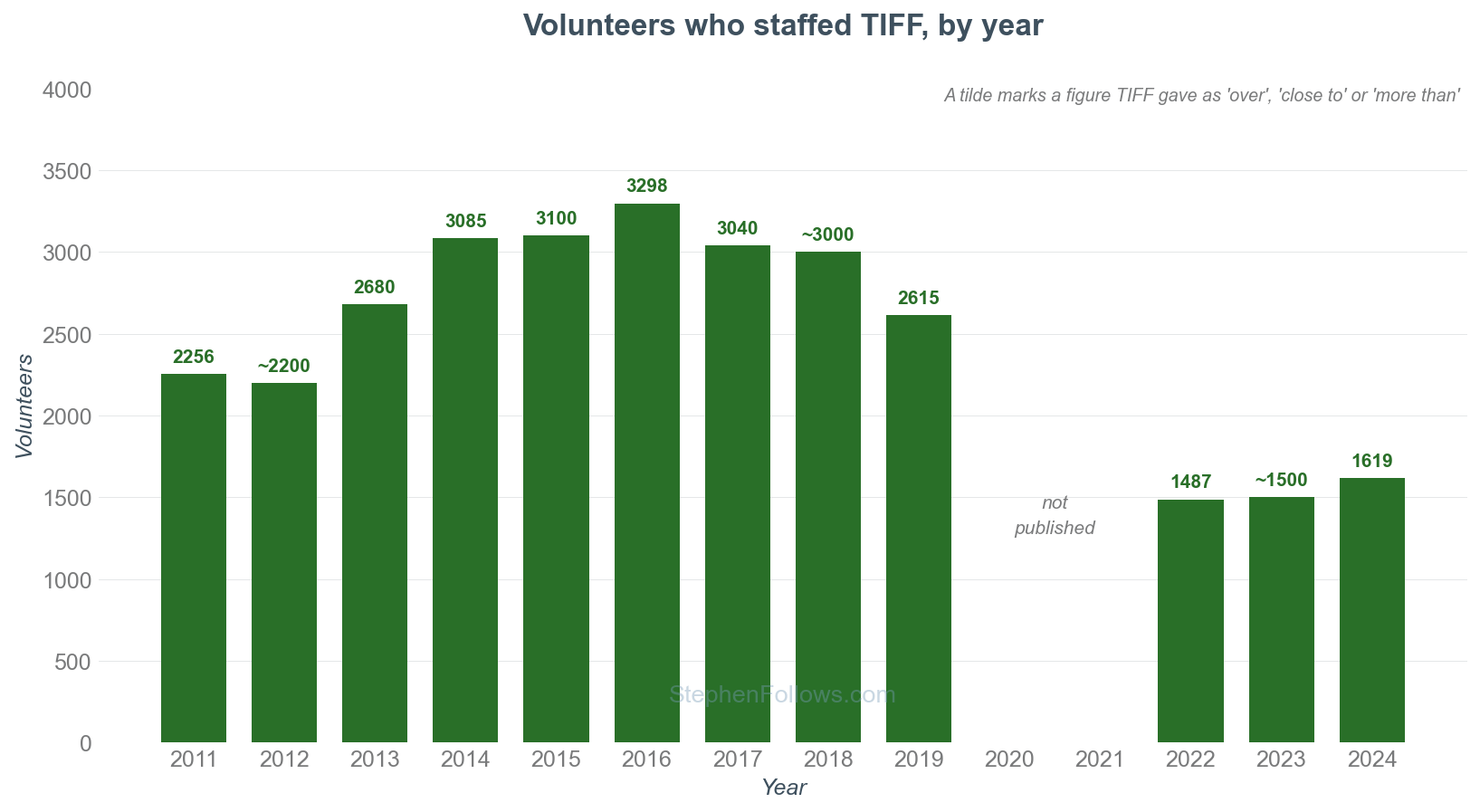
That said, there are about half as many as there used to be. Roughly 3,300 people volunteered in 2016, but by 2024 it was 1,619. The hours fell further still, from 106,610 to 43,410, so the ones who stayed are working shorter shifts as well. All of that, while the festival accredits more press than ever and has a brand-new market bolted onto it.
I have experienced this at the festival in the past and even in 2026. When sorting out my pass, I had a technical issue. I emailed the help address, expecting to have a long, drawn-out nightmare, but instead got a quick email back from someone offering to jump on a Zoom call with me and sort it. True to their word, a brief, friendly video call was all it took to solve my issue and brighten my day.
35. Pack for both, but not for the reason everyone gives.
There is a persistent belief among TIFF regulars that it turns cold after the first weekend. It does not, particularly, but September itself cools as it goes on; according to Environment Canada data:
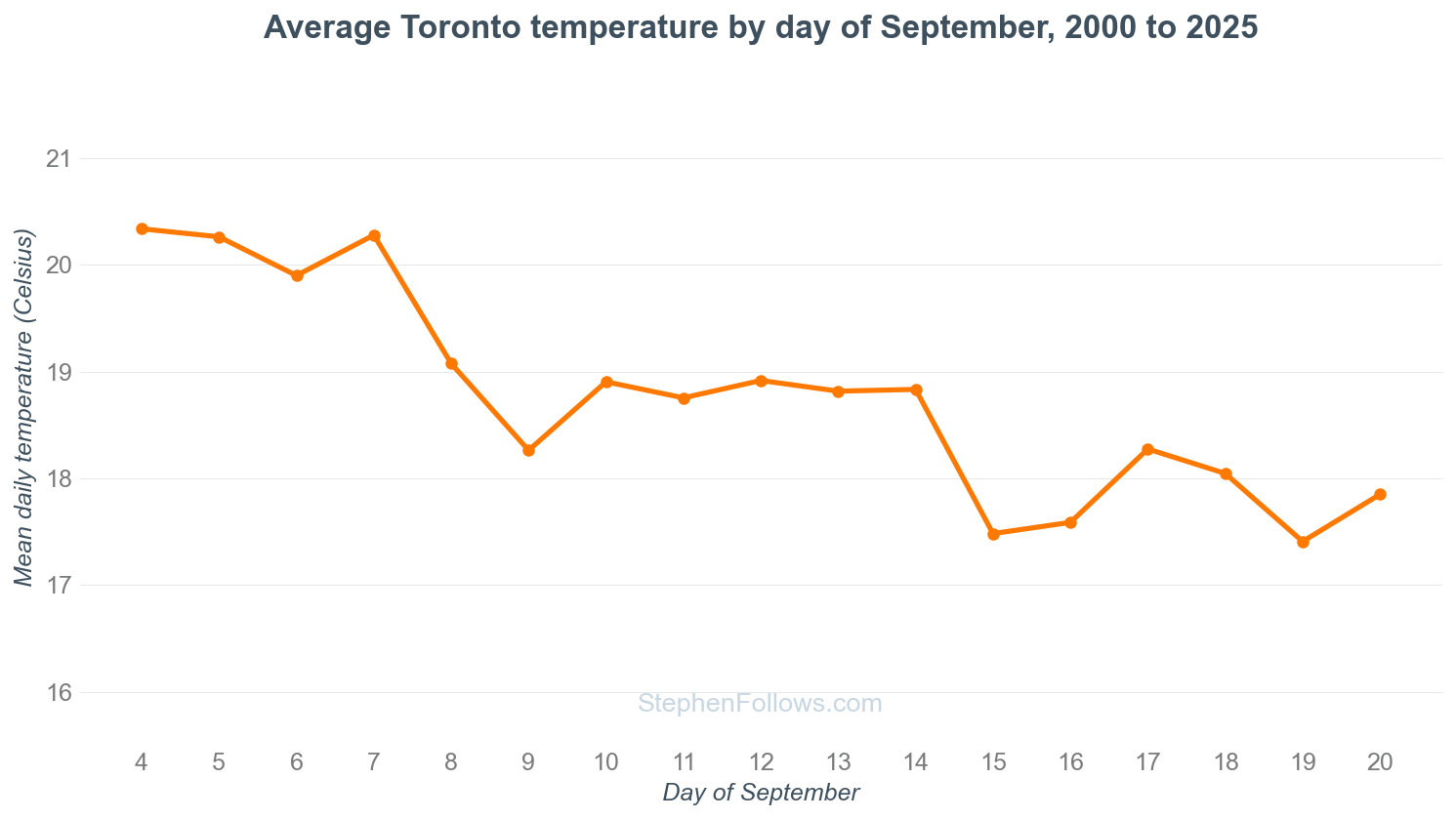
Toronto does cool as September goes on, by about 1.6 degrees between the start of the month and the middle. Bring layers because September in Toronto is variable. And bring something warm for indoors, which several people raised:
“Bringing a warm sweater for screenings as the cinemas can be rather cold. And so are the restaurants due to the aircon.”
I have spent the summer in London’s stifling heatwaves, with jaunts to industry events at the even hotter Munich and Locarno, so this is music to my sweaty ears.
36. Assume the internet will be awkward.
Festival wifi is a lottery, and it is genuinely hard to predict from year to year. It has certainly improved since 2016, but most film markets struggle when several thousand people arrive in one building with three devices each, and delegates still report problems.
If being reliably online matters to you, sort your own connection before you fly, such as a local eSIM.
37. Feet, water, snacks, sleep.
You will need:
Flat shoes, because you will walk much further than you think.
A water bottle.
Something edible in your bag, because you will otherwise skip lunch to make a screening.
And sleep beforehand, because you won't get much during.
38. Relax, and then follow up.
The best closing advice came from a producer of twelve years, and it is really a two-part instruction that most people only do the first half of.
“Relax. Enjoy it. Let it wash over you and let encounters happen. Go home and follow up with anyone you met. Then use what you learned to make 2027 really work for you.”
You cannot see everything, meet everyone or attend it all. Make your peace with that on the plane.
Notes
The survey. 271 industry delegates in total, carrying 2,114 collective years of attendance at the Toronto International Film Festival. I asked how long they had been going, which days they would be in Toronto, what advice they would give a first-timer, what they wished they had known, which organisations run the best events, and what the trip costs them.
People who fill in surveys about film festivals are people who like film festivals, and my newsletter readers are not a cross-section of the industry. I also ran a version of this exercise ten years ago, and it’s reassuring how much of the advice came back unchanged. I spot-checked all the tips to see if changes in how TIFF is run invalidated any of them.
Festival scale, volunteer and financial figures come from TIFF’s own annual reports and fact sheets, and from its charity returns to the Canada Revenue Agency. Where TIFF’s published presentation and its statutory filings disagree, I have used the filings. Weather data is Environment Canada daily records for the Toronto City station, 2000 to 2025. The historic delegate guidance comes from TIFF’s own Press and Industry Guide and its Guides for Industry Professionals, which it published up to 2019 and then stopped.
My research is independent of TIFF, but for full disclosure, I am speaking at TIFF this year (they have contributed toward the cost of my flights and given me a hotel room). I also ran the draft article past a few TIFF staff to ensure the tips still apply in 2026.
I’ve always wanted to know more about how Film Festivals work and this article gave me insights to the filmmaking industry that I never thought I needed! Going to TIFF is definitely going on my bucket list 💞👀