


Very few movies don’t contain some kind of moral message designed to show us a better path, a better way of living, or to teach us how to be better people.
In some cases it’s because the filmmakers have an agenda they wish to advance, but for the most part it’s because moral storytelling is what audiences respond to.
Producer Ted Hope calls movies “design for living”, in that they are structured to test values, model choices, and let us rehearse what it means to be good, brave, honest, or kind.
That doesn’t mean they’re all preachy. Producer Samuel Goldwyn famously said, “If you want to send a message, call Western Union.” But even the films that avoid direct statements usually land on some version of right and wrong.
I wanted to see what were the most common messages in modern movies so I analysed the plots and coverage of almost 6,000 movies released in the past decade.
High horses on the big screen
Some moral messages are easy to spot. For example, The Hunger Games: The Ballad of Songbirds & Snakes centres on power, consequences, and deception. Others are more ambiguous. Is Barbie a story about being true to yourself, or about rejecting rigid moral categories altogether?
It’s also true that while actual films themselves are static works of art, our appreciation and understanding of them are not. The same film may convey a different meaning to modern audiences than it did at the time. This can happen due to:
Changes in society, such as shifting attitudes toward authority, gender roles, or mental health meaning that Dead Poets Society, Fight Club, or As Good as It Gets now land very differently than they did on release.
Us as viewers changing, such as growing up enough to realise that Robin Williams played the villain in Mrs Doubtfire, not the hero #PierceBrosnanDidNothingWrong.
In early cinema, moral lessons were often explicit. Silent films and early talkies leaned heavily on themes like temperance, chastity, and justice, partly because narratives were simpler, but also to avoid backlash to the new medium.
The 1930s Hays Code formalised this, requiring that virtue be rewarded, crime punished, and authority respected. But by the 1960s and 70s, those rules collapsed. Filmmakers began to embrace ambiguity, letting stories explore doubt, corruption, and moral failure without clear resolution.
I chose to study the data behind last ten years of movies, as I am most interested in what we’re seeing our screens today.
Which morals show up most?
Out of all 5,931 films I studied, the most common moral message was courage in the face of fear or injustice. It appeared in 40.6% of titles. That includes everything from war epics to school bullying dramas to stories of quiet resistance inside broken systems.
Next came teamwork and community, followed closely by perseverance and resilience. These three formed a consistent top tier across almost every year in the sample.
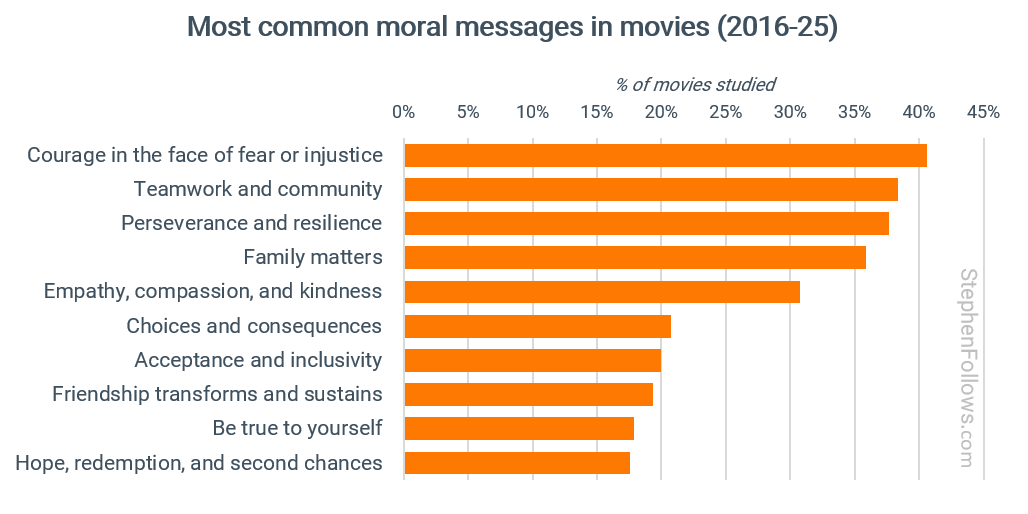
Let’s take a brief look at the most frequently seen moral lessons.
Don’t be scared, go to the movies
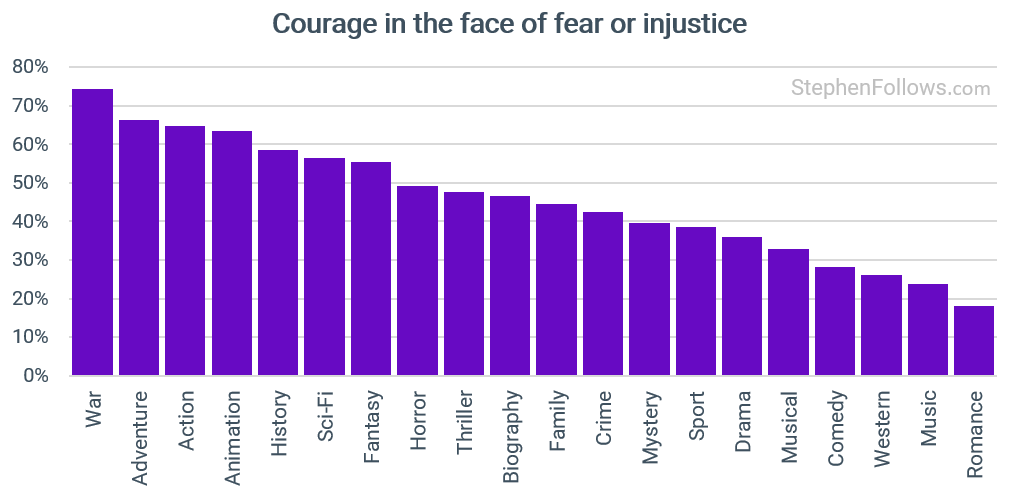
The most common message overall was telling tales of people doing the right thing, standing up to bullies / corruption / prejudice, and overall finding the courage within themselves to do what they know needs to be done.
Physical movies are the most likely to feature this moral lesson, such as war films (74.3%), adventure (66.3%), and action (64.6%). These genres show people being rewarded for risk, sacrifice, and moral clarity. The threats are often physical, but the films frame them as tests of character.
1917 and Dunkirk frame survival as secondary to duty, The Woman King blends physical courage with political defiance, and all the many Batmen has taught us that courage is open to anyone (well, any buff billionaire with a backstory).
Teamwork makes the dream work
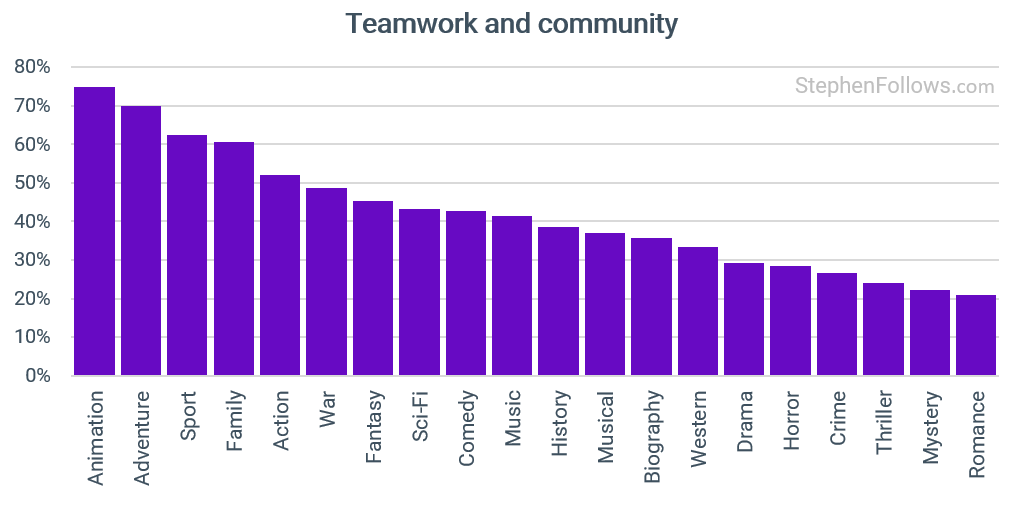
The second most common moral lessons were that of working together, supporting one another, and pooling strengths achieves more than going it alone.
It was most common in animated movies, featuring in three-quarters of the animations I studied. A good example is Disney’s Encanto, centres on a family whose powers only work when they stay emotionally connected.
It’s also common in adventure, family, and sports stories, where ensemble casts are central and collaboration is built into the plot. These films tend to end with group resolution, such as a restored family, a team victory, a community uplifted.
It’s far less present among the genres which deal with the dirtier sides of life, such as crime (26.7%), thrillers (24%), and romances, at just 20.9%.
Don’t give up (unless in a horror movie)
Almost 37.7% of all films are encouraging you to have perseverance and/or resilience.
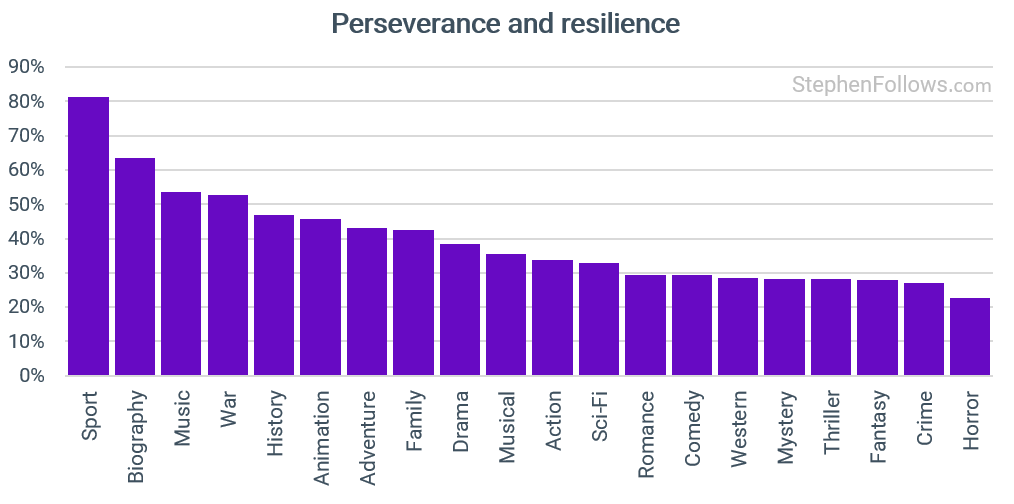
The shape it takes can significantly alter between genres, For example:
In sports dramas like King Richard or Creed III, perseverance is physical and repetitive and the effort becomes spectacle (i.e. training montages, injury recoveries, comeback arcs, etc).
Whereas, in biopics like Lion or The Theory of Everything, it’s psychological. The characters push through memory, illness, or trauma.
It changes again in sci-fi or survival films, where it becomes technical, such as The Martian (although given this, Interstellar and Saving Private Ryan, one could argue is that the moral messages is ‘Matt Damon is always going to need rescuing, but he seems nice, so let’s try’).
In family and animated films, perseverance usually pairs with identity. Moana, Turning Red, and Soul all show protagonists learning to keep going without knowing where they’ll end up.
What these versions have in common is that often the character(s) can’t avoid the hardship but can decide what to do next.
It’s interesting that message is least present in horror and crime films - almost like those two genres are encouraging you to just give up.
Honesty is rising. Acceptance is fading.
The moral lessons I’ve covered so far have been fairly omni-present over the decade of films I studied. However, there are morals which are on the rise, and others on the wane.
Acceptance and inclusivity (i.e. don’t judge by looks, status, or stereotypes; differences are strengths, etc) has declined significantly. It’s hard to say to what degree this is related to criticisms over woke ideas and themes (I researched an adjacent topic a few months ago, in the article entitled Can we measure if movies have become "too woke"?).
By contrast, honesty and integrity has risen (well, stories of honesty and integrity - I don’t think anyone would claim it has risen in the wider world!)
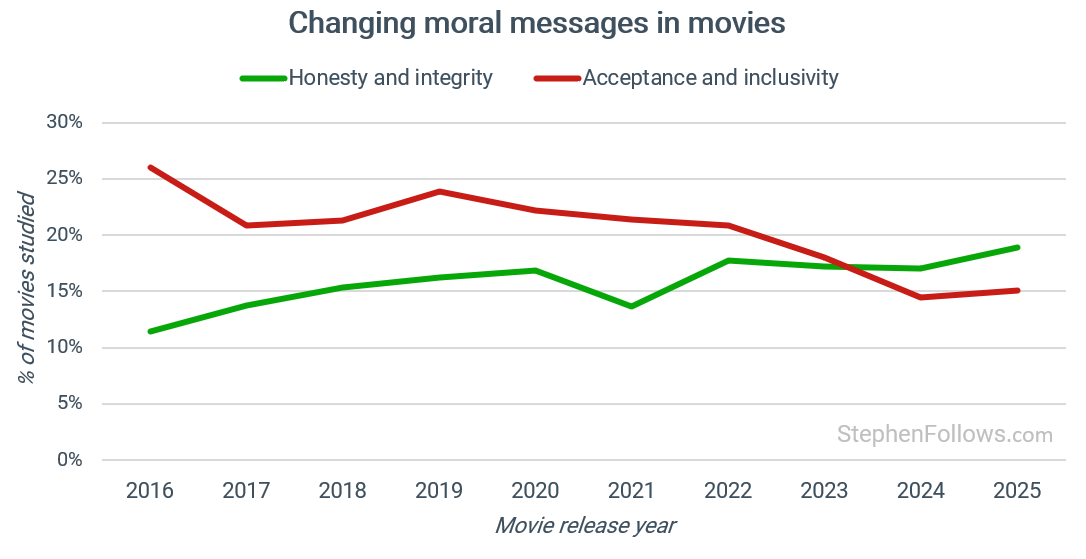
Films that once emphasised identity and inclusion now lean more on personal ethics and individual truth. Barbie contains both but frames integrity as the harder choice. The Holdovers makes decency its quiet centre. Even large-scale stories like Oppenheimer or The Batman reward characters for owning their failures.
The trend may also reflect broader fatigue. After years of industry-led messaging around representation, audiences may be more responsive to internal moral choices than to external validation.
Most moral films aren’t dramas
One last thing I spotted which I thought was interesting. The films which most frequently cover moral lessons to do with honesty, integrity, empathy and kindness are not dramas - they are the ‘lighter’ fare of family films and musicals. They both push characters to tell the truth, and reward them for doing so.
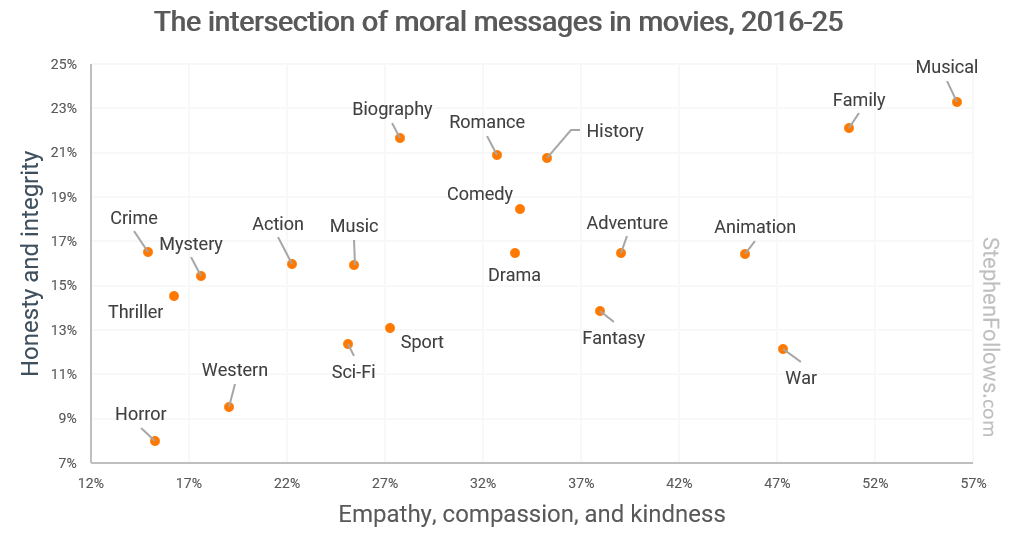
Musicals sit at the top right of the chart above, topping both axes. Their structure leaves space for emotional resolution. For example, The Greatest Showman, Dear Evan Hansen, and In the Heights all demand character growth and then make the final number hinge on it.
Family films often pair personal honesty with emotional repair. Paddington 2, Luca, and Turning Red each centre on characters learning to say hard things with compassion. These morals are rarely subtle, but they land.
At the other end, horror and thriller rank lowest on both empathy and honesty. That’s not surprising. These genres rely on fear, mistrust, and emotional isolation. The stories may still have internal logic, but the moral framing is darker or more ambiguous.
Notes
For today’s research I studied 5,931 narrative feature films released between January 2016 and June 2025. Only fictional, narrative-driven feature films were included. Movies could have more than one moral lesson, with the average movie in my dataset having 3.9. Messages had to be central to the outcome, not incidental to tone or dialogue. The genre classifications were from IMDb.
It is worth stating upfront that this is a topic that has a high degree of subjectivity. I tried to be objective and use a defined criterion but it’s not as simple as just counting numbers. The aim was to identify the presence of clear moral messages expressed through plot resolution, character development, or thematic emphasis.
I tried to apply my criteria objectively and evenly, meaning that the results should be familiar to any movie fan. If you think I left out a common moral lesson you see in movies, please do add it in the comments and I’ll go back and study it.
Finally, movies don’t HAVE to have a moral message. In my opinion, The Wolf of Wall Street is fascinatingly devoid of any moral lessons or growth, despite its length and breadth. Quite the cinematic achievement.
Let's do No Country For Old Men