


Next Thursday, I shall be joining many in the film community in wintry Berlin for the Berlin Film Festival and European Film Market.
(If you’re going to be in Berlin too, reach out, and we can grab a coffee.
Berlin tends to be more compact and siloed than Cannes, but just as useful for understanding the market. You can read my summary of last year’s EFM here- Six big takeaways from the Berlin European Film Market 2025.

To prepare for meine Reise zur Berlinale, I have gone through the programme with a fine-tooth comb to get a sense of what awaits us.
I’ll go through it in detail later in the article, but here are the key themes as I see them:
The biggest conversation is about how to get through the next few years.
AI has become everyday work.
The franchise dream is being handled more carefully.
Audiences are part of the plan from day one.
Technology as tools rather than magic.
Environmental impact is something you now have to account for.
Fair work and representation are built into the conversation.
Rules and regulations are shaping what gets made.
If you’re attending, you may enjoy this year’s EFM, then you may enjoy my breakdown of tips from 237 film industry professionals - Tips for attending the European Film Market
Let’s start by looking at what the EFM has been about in the recent past, before going through those themes in more detail.
Two decades of EFM sessions
To put the 2026 programme in the right historical context, I began by reviewing the past 20 years of EFM sessions. It was a fascinating journey that showed perennial problems as true today as they were then, alongside things that seem like distant memories (3D, VR, and NFTs, oh my!).
But in those new buzzwords and technologies, the same themes keep popping up. Virtual reality echoes earlier optimism around 3D cinema. NFTs replay familiar arguments about ownership and scarcity that are at the heart of most value extraction. Perhaps direct-to-fan platforms are just the latest version of many a producer’s long-running ambition to bypass distributors.
After reading a whole bunch of old EFM programmes, Internet Archive snapshots and contemporaneous press reports, here’s what 20 years of EFM sessions felt like to me:
Late 2000s to early 2010s - An industry trying to steady itself. In the late 2000s and early 2010s, the programme reflects a sector facing economic shocks and structural fragility. Financing, public support, and market confidence dominate the agenda with headlines like “EFM Industry Debates to focus on crisis“ (2009) and “Europe’s Film Industry in Crisis” (2013), squarely placing the focus on stability and survival.
Early 2010s - Digital tools as a source of hope. As the decade turns, attention shifts toward technology as a possible corrective. Online distribution, audience access, and new financing routes are framed as ways to bypass weakening intermediaries. Sessions like “Crowd Funding – How to Harness the Power of the Online Audience” (2012), and “Buying and Selling World Cinema: Reaching Audiences in the New World” (2012) capture this period of optimism.
Early to mid-2010s - Technology moments that dominate the halls. Certain years are shaped by the rise of a single technology that briefly defines the conversation. The 3D cycle is unusually visible, from “3D – Fab or Fad?” (2011) to “3D After the Hype” (2013), just a few years later. Comparable arcs later appear around VR and blockchain, each receiving concentrated attention before settling into narrower use.
Mid-2010s - More responsibility pushed onto producers. As traditional gatekeepers lose some authority, producers are encouraged to take greater control over financing, rights, and distribution. Independence is increasingly framed as a practical requirement rather than a creative preference. Panels including “Producers as Self-Distributors” (2015) and “Producers as Entrepreneurs“ (2016) reflect this shift in responsibility.
Mid-2010s to late 2010s - The rise of series thinking. From the mid-2010s onward, television and series began to take up a larger share of the conversation. Long-form storytelling, platform relationships, and recurring IP change expectations around scale and value emerged in the introduction of Drama Series Days (2015) and sessions such as “The Boom in High-Quality TV Series – European Drama Goes Global” (2016).
Late 2010s - Contained experimentation. Later in the decade, experimentation becomes more contained. New ideas are tested in workshops, labs, and side programmes rather than presented as sweeping change. “Market Innovation – How to Get Things Moving?” (2017), the launch of the VR NOW Summit (2018), and “Blockchain in Motion” (2019) feel like they are part of a more cautious approach.
From around 2018 onwards - Values moving into the main agenda. Around 2018, issues of sustainability, inclusion, and working conditions gained consistent visibility across the programme. These topics, once treated as peripheral, begin to shape how production is discussed more broadly. Sessions like “Why Diversity Matters in the Film Industry” (2018) and “Strategies for Green Production and Financing” (2018) mark this shift.
Early 2020s - technology as infrastructure. In the early 2020s, technology is discussed less as a possibility and more as part of daily operations. Data, platforms, and automation are assumed components of the production process. “AI: Film’s New Normal?” (2020) captures this change in tone.
What EFM 2026 has in store for us
And that brings us to the present moment. There are 131 sessions taking place over just seven days.
As I’ve shown in previous research, although film industry events may at first seem to span several weeks, they are almost always focused on the first weekend.
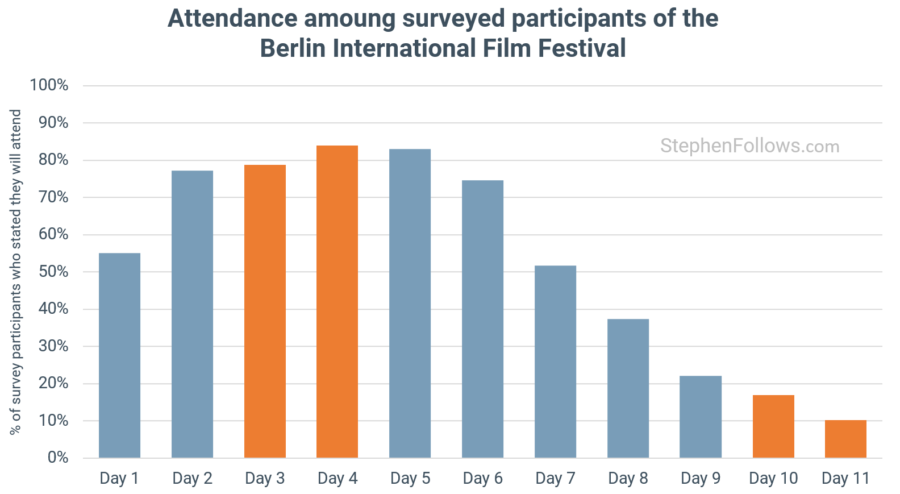
And EFM 2026 is no exception. Anecdotally, I have heard a number of people say they’re flying in only briefly, with few expected to stay past Monday.
We can see this reflected in the event programming. Although the sister event, the Berlin Film Festival, takes place over eleven days (12th to 22nd February), the market will focus on just four days (Friday 13th to Monday 16th February).
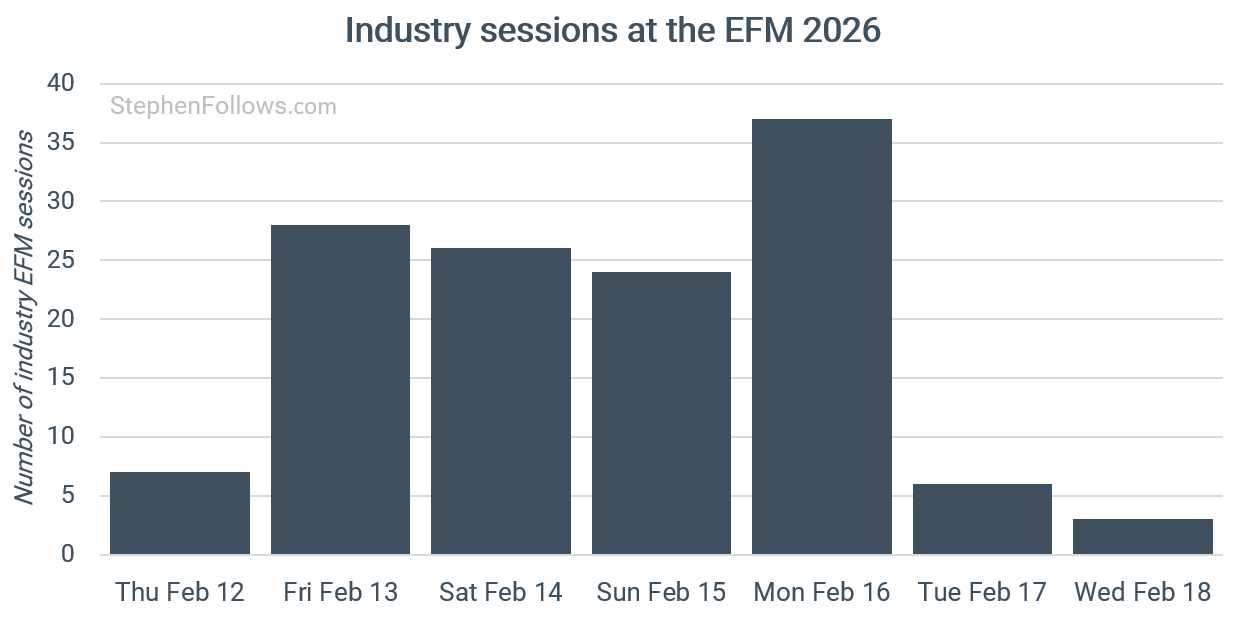
Reading between the lines of those 131 sessions, the key themes seem to be:
The biggest conversation is about how to get through the next few years. The strongest theme across the programme is an industry that is focused less on growth and more on managing risk, tightening operations, and staying viable in a prolonged, tough market. Sessions: State of the Industry; State of Finance; How To Thrive in a Challenging Market.
AI has become everyday work. AI is something already embedded in development, financing, marketing, and decision-making workflows. Sessions: From Hype to Help: Real-World AI Use Cases Worth Your Time; Does AI Need You More Than You Need It?
The franchise dream is being handled more carefully. There is caution around IP expansion, with conversations focusing on when cross-media ambitions add value and when they actively weaken projects. Sessions: Hard Truths about Transmedia: What Works. What Doesn’t.; Worldbuilding Across Media
