


Hollywood cinema is not known to be a bastion of truth. It’s a place where entertainment and expediency are prioritised over accuracy and authenticity.
It's frequently claimed that NASA uses the 1998 blockbuster Armageddon as a management training tool, asking its boffins to list all the factual errors they can find in its bombastic 150-minute runtime (reportedly up to 168 errors by some counts).
Hollywood is largely unbothered by this type of criticism. On the DVD commentary track for Armageddon, Ben Affleck asks the film’s director, Michael Bay, why it was “easier to train oil drillers [to become astronauts] than astronauts to become oil drillers”, to which Bay responds, “Shut the fuck up”.
Nonethe less, I do care about errros. Alot.
I collected a dataset of over 200,000 errors reported by the public across almost 12,000 movies and classified them. (There are more details on my methodology in the Notes section at the end).
Let’s see just how wrong movies are…
What’s an error?
Before we get into the details of specific error types, it helps to split the data into two broad groups:
Story errors. These are errors created at the script stages, such as plot holes, incorrect facts, how things work, geographic impossibilities, inaccurately detailed historical events, character logic failures, factual mistakes, or anachronisms.
Filmmaking errors are those caused by the physical process of making the film, taking place mostly (but not exclusively) on-set, such as continuity slips, crew in frame, equipment visible, audio issues, etc.
In most genres, filmmaking mistakes are more common than story mistakes. They account for roughly two-thirds of mistakes in musicals (67.4% of errors are filmmaking-based), horror (67.2%), fantasy (66.7%), and comedy (66.7%).
In these genres, viewers are more likely to point out continuity issues or production slips than problems with the underlying logic or research. My theory is that this is because these genres feature more fantastical stories or characters, so facts count for far less.
At the other end of the spectrum, we have more grounded genres, such as war (43.8%), biography (32.8%) and history (31.8%). In historical films, more than two-thirds of reported mistakes concern the story or the facts rather than filmmaking techniques.
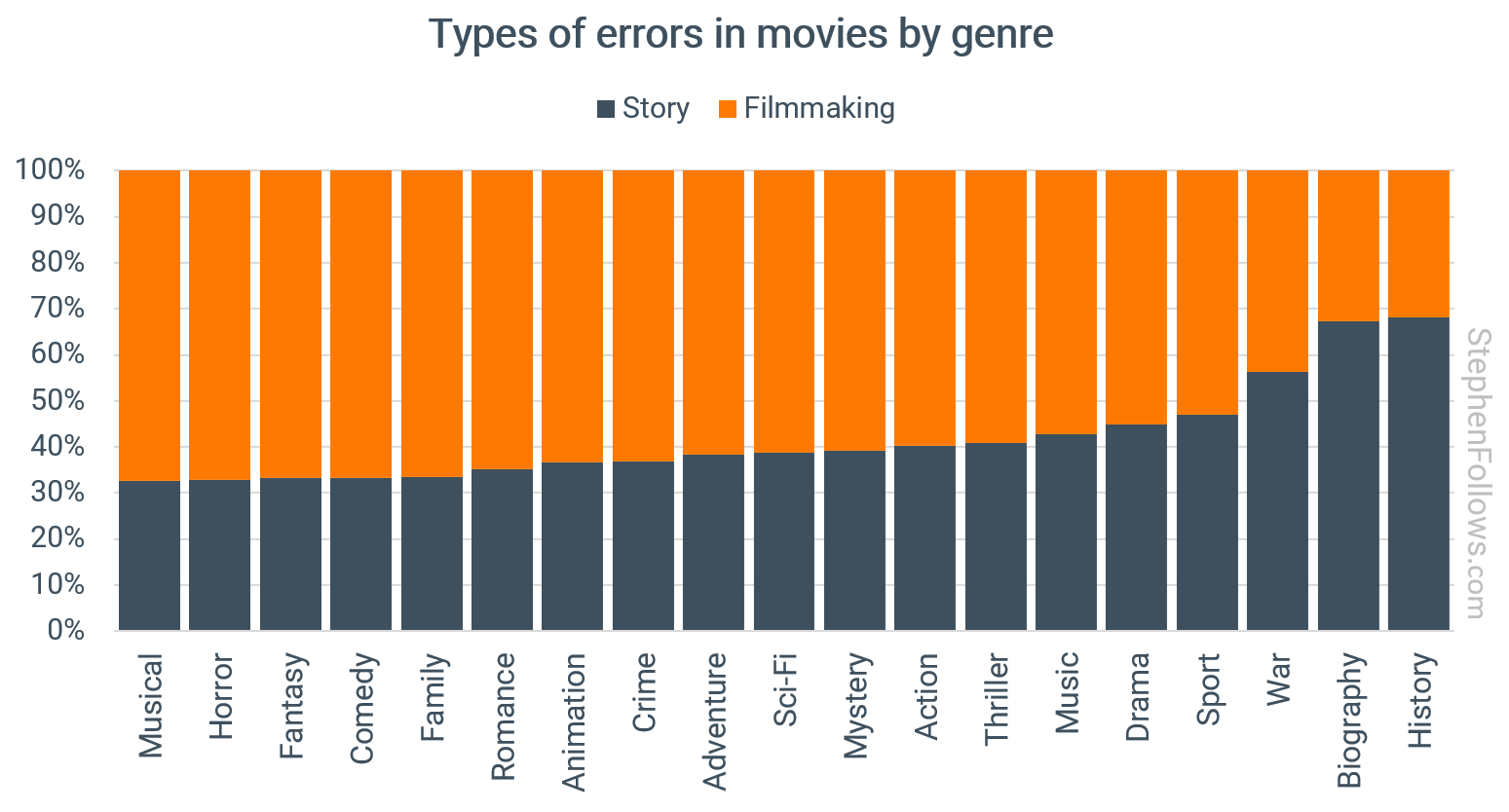
So when a genre trades on realism or real-world knowledge, the more we as the audience focus on research and internal logic. In genres built around spectacle or heightened reality, attention shifts towards visible production errors.
How many films make factual errors?
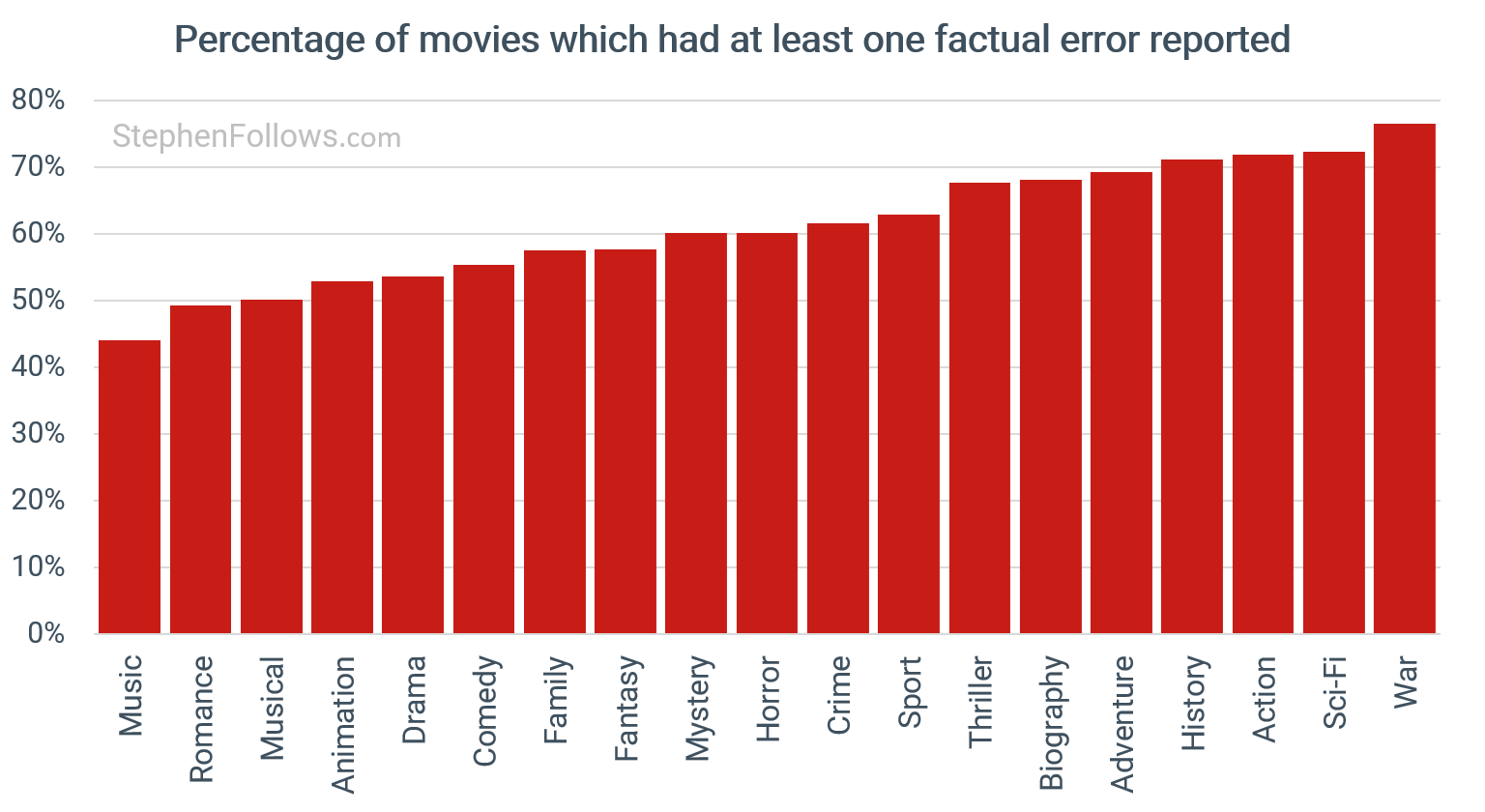
Factual mistakes are the most common type of error, even in these least scrutinised genres. 44.1% of music films had at least one reported factual mistake, followed by romance (49.3%) and musicals (50.2%).
At the high end, there are two different factors at play:
In historical (71.2%) and biographical (68.1%) films, the pressure comes from documented reality. Over three-quarters of war films have reported factual errors. We compare what we see on screen with what we already know (or think we know) about events, dates and people.
In action (71.9%) and sci-fi (72.3%), the pressure comes from systems. If a film builds a world around physics, engineering, or technology, we are on the lookout to see whether those systems behave consistently.
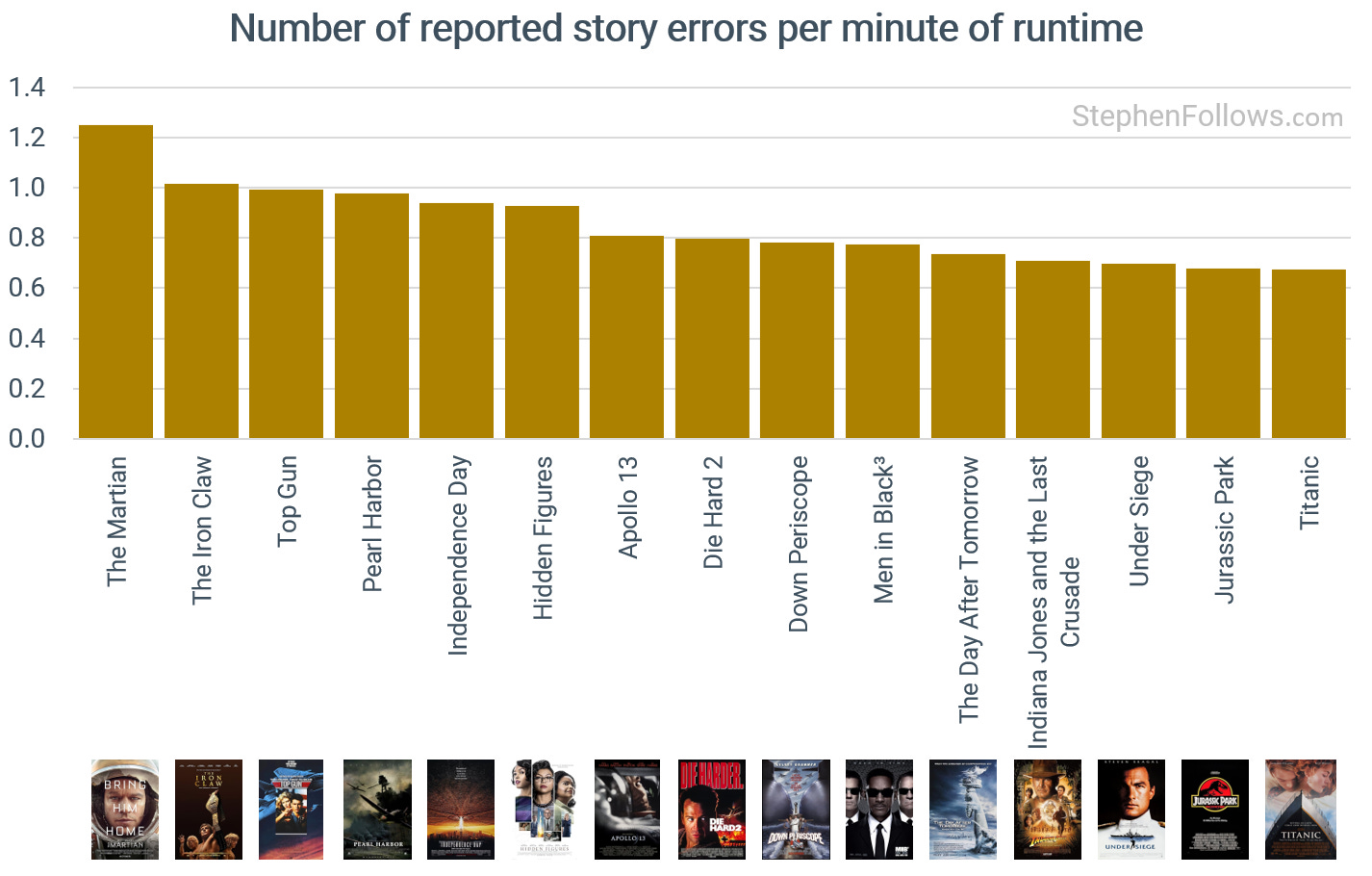
Part of my work for Guinness World Records is determining the best criteria to answer subjective questions. So if one were to ask, “What is the wrongest film?” then my first stab at an answer might be The Martian.

The Martian has the highest number of reported story errors per minute of screen time.
Among the movie’s alleged inaccuracies are:
Mars itself is wrong: storms with enough force to tip hardware, plus Earth-like sunsets/Sun size and near-Earth gravity.
Space physics is fudged: objects float during acceleration, and astronauts change direction in microgravity without pushing off anything.
Comms and maths are dramatised: near real-time messaging despite 4–24 minute one-way delays, and orbital mechanics treated as needing days/supercomputers.
Life support is off: suit pressure/oxygen readings don’t add up, decompression protocol is ignored, and the “Hab fabric” patch behaves impossibly under pressure.
Chemistry/engineering shortcuts: hydrazine reaction explanation doesn’t fit the scene; mismatched voltages would fry Pathfinder; display units/labels are wrong.
Farming is overstated: perchlorate-toxic soil untreated, sunlight/water assumptions optimistic, and potato planting/seed quantities don’t match the crop shown.
The list goes on…
How many films feature continuity errors?
Moving on from story errors, we should now look at filmmaking errors. These are the ones that reveal the artifice of movie-making and can take us out of the story and its world.

The most common of these were continuity errors, in which something changes between shots meant to take place at the same moment. Popular examples include:
In Pulp Fiction, bullet holes are visible in the apartment wall behind Jules and Vincent before Marvin fires the shot that supposedly creates them.
In Harry Potter and the Philosopher’s Stone, the level of drink in Harry’s goblet shifts between cuts during the Great Hall scenes, despite no one touching it.
In The Dark Knight Rises, Batman’s cowl switches from damaged to intact and back again during the same street fight sequence.
In Pretty Woman, Julia Roberts’ croissant turns into a pancake between shots during the breakfast scene, then back again.
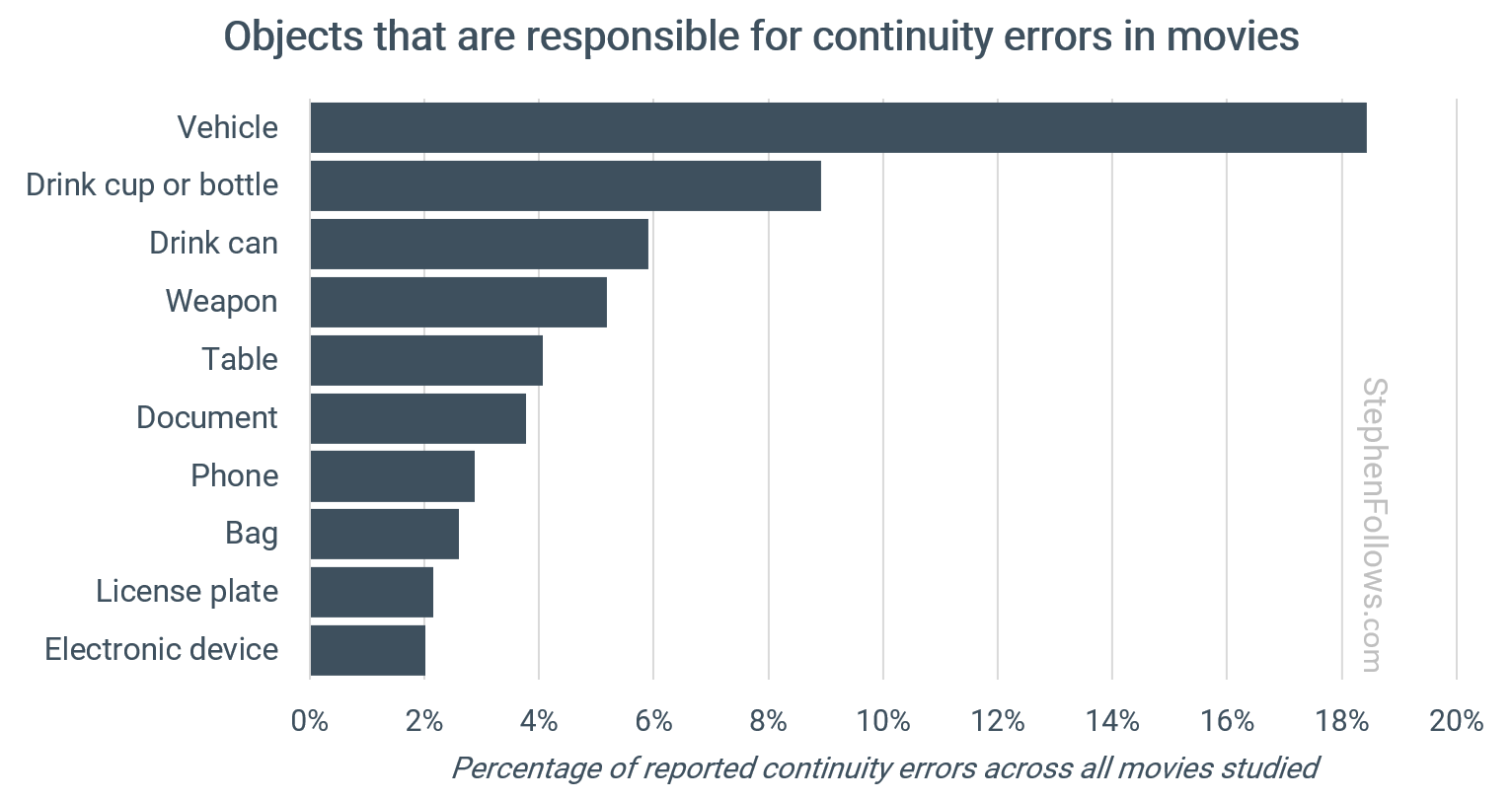
When we drill down to the objects that cause the most continuity issues, we get a sense of the scale of the challenge filmmakers face when trying to shoot a coherent 90-minute story over multiple months in a semi-random order.
Cars and trucks are at the top, containing the obvious challenge of trying to get traffic to do the same thing for multiple takes, or to accurately predict how a yet-to-happen crash will affect a vehicle you need to shoot in now.
Small handheld items don’t face this problem, but can be easily changed on the spot and feature in a close-up. Hence, why drinks and weapons are the next biggest challenges on-screen.
Which areas cause the most anachronisms?
A close cousin of both factual and continuity errors is anachronisms. These occur when something in a film does not belong to the time period in which the story is set.
These include:
Oppenheimer features 50-star flags at Strauss’s 1959 hearing.
Sully includes an orange “Empire Gold” New York souvenir plate in a 2009 airport scene.
Men in Black 3 uses the wrong Spanish flag for its 1969 setting.
Braveheart shows people wearing baseball caps and driving modern white vans. (I wish I were joking).

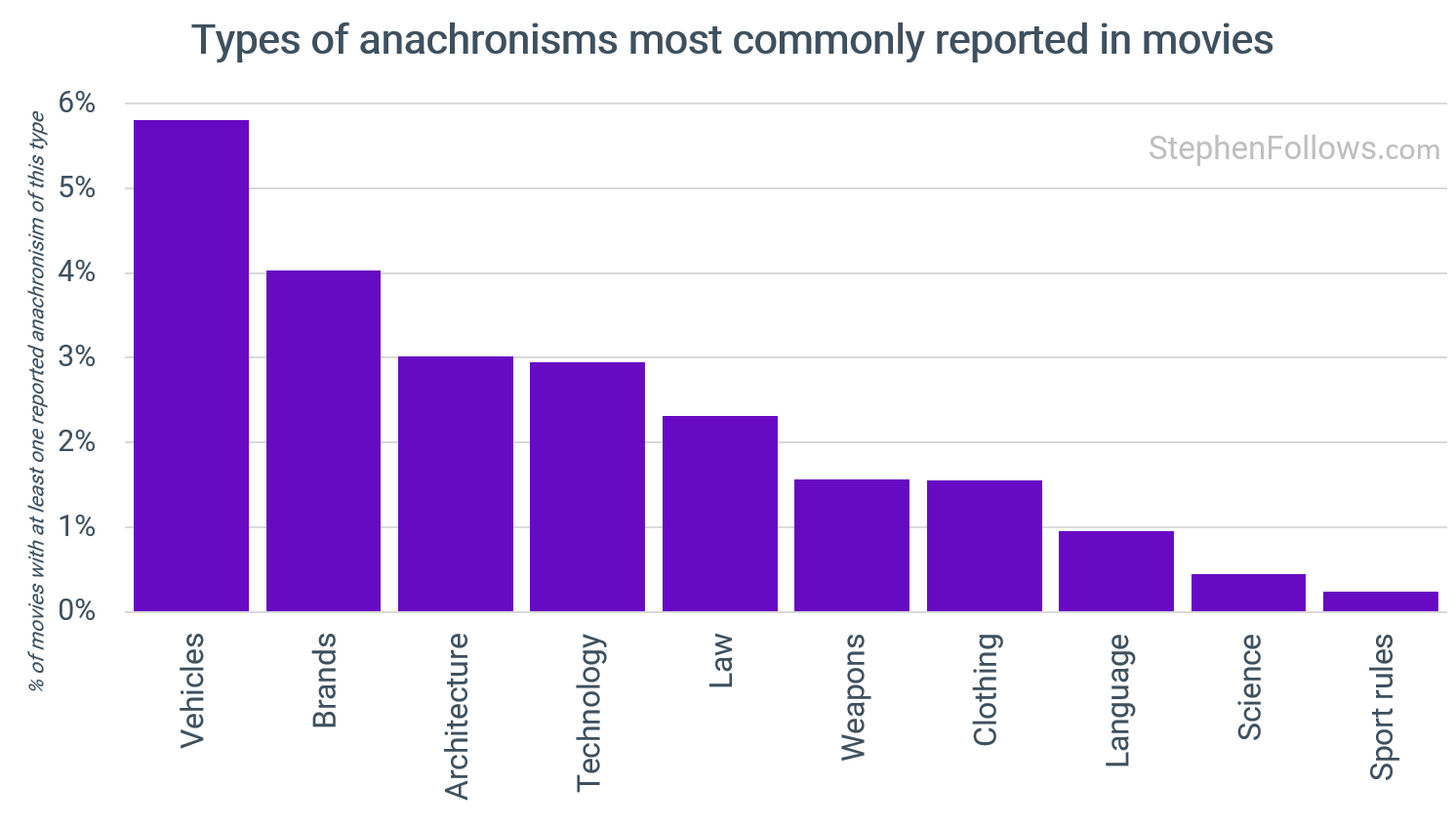
The data here again reflects the complexity of accurately depicting vehicles in a movie, with almost 6% of movies featuring some kind of wrong or anachronistic vehicle on screen.
The next most common areas are brands (i.e., the product was unavailable during the period or at the location where the movie is set), architecture, and technology.
Where do films most often break the laws of physics?
Even if the filmmakers get the right object on screen, audiences notice when it behaves incorrectly.
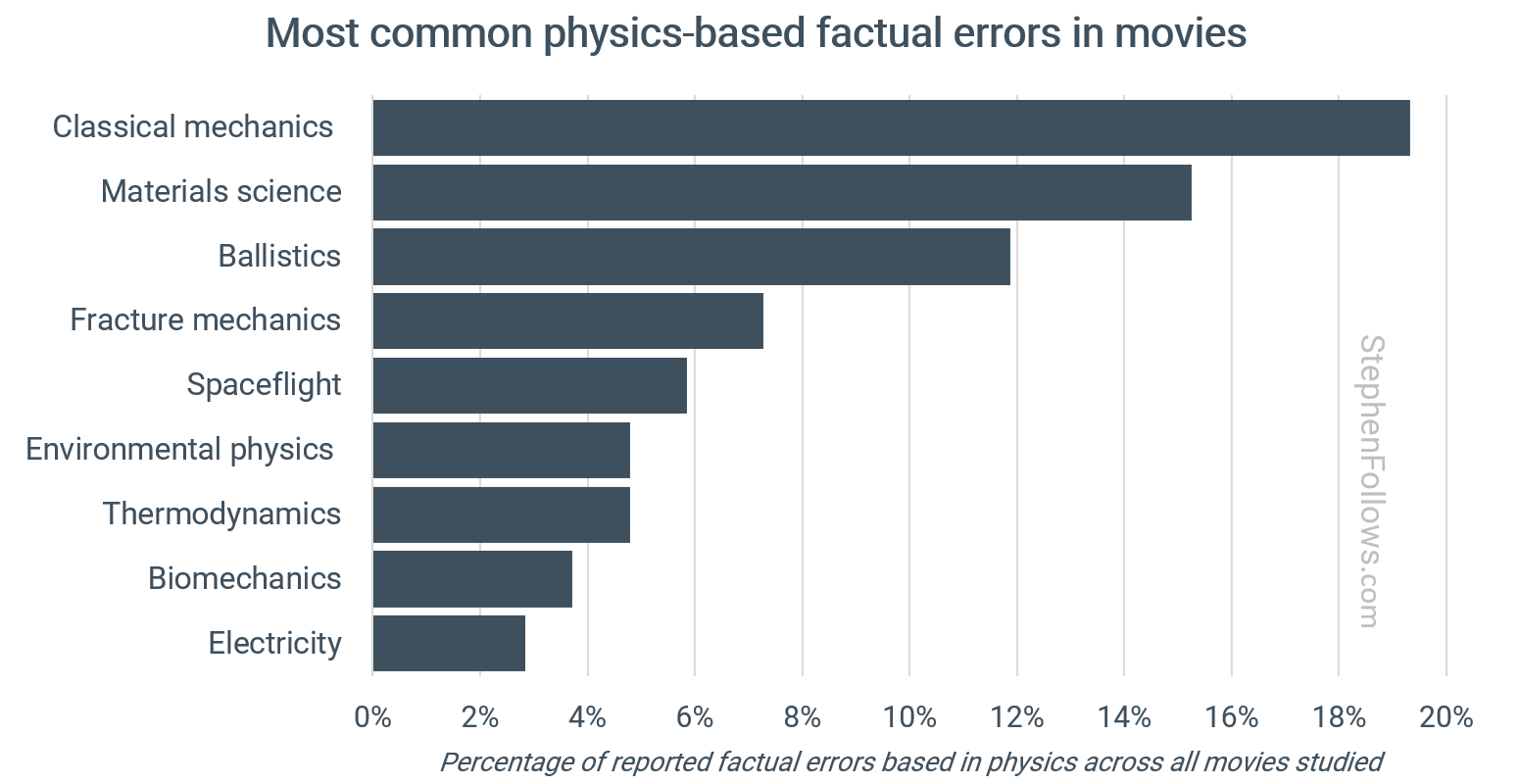
I searched all the factual references related to physics and examined what dominated. The most common such complaints centre on classical mechanics, such as forces, motion, inertia, falls, and impacts - pretty much the core elements of an action movie.
Next, we have materials science (15.2%) and fracture mechanics (7.3%), i.e. what bends, what snaps, what shatters, and what somehow survives a hit.
There’s too much in this topic for one article, so I shall return to it next week to look at plot holes! Ensure you’re subscribed to get the info first.
Notes
This research examined over 200,000 issues or errors across 11,842 movies released between 1930 and 2025. My initial sources were IMDb, Wikipedia, and other movie sites.
Given that these are errors reported by the public, there is a strong bias towards larger, more closely scrutinised movies. We can’t track every frame of every movie and generate new data, partly for time reasons (I’ve got other stuff on, you know), but also because much of this area remains subjective. One person’s error is another person’s legitimate movie detail. For example:
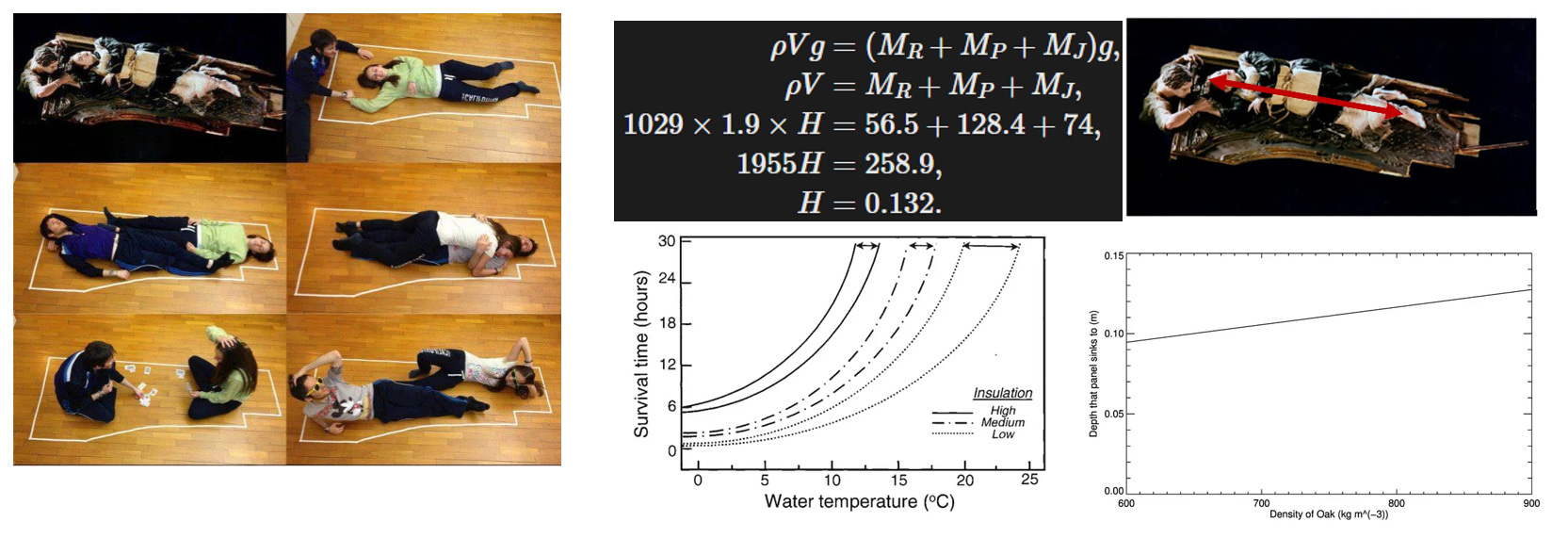
Is Rose's refusal to share the ample floating door space in Titanic a plot hole or just selfish character behaviour from someone who has gone off her holiday bit of rough?
In the Star Wars universe, is the stormtroopers’ inability to hit a stationary target a story error, or a stark warning of what happens when military costumiers prioritise fashion over function?
Maybe in James Cameron’s 1997 epic, Titanic, the disappearing handbag in the Andrews conversation is not a continuity error but rather error-free evidence that Rose is a world-class thief, trained in high-society sleight of hand since birth.
Or in Titanic, is Rose’s seeming inability to calculate basic buoyancy physics a character error, or a damningly accurate illustration of the education level of snobs of the time?
We just can’t be sure. Oh, wait, we can.
Does the extremely low success rate suggest that story errors may play a larger role than filmmaking errors in determining outcomes?
If that’s the case, could it be that filmmaking errors are simply easier to recognize, while story errors remain more subtle?
Which raises the intriguing question: how might we go about discovering story errors in the first place?
People have a huge tolerance for plot holes; examples include Interstellar, Ready Player One, and Knives Out. All three movies are illogical as hell, yet people love them. I always think it's evidence that humans are bad at reasoning and logic. No wonder the most hated curriculum is math.