In ten days, I’ll be on the Croisette for the Marché du Film, the business end of the Cannes Film Festival.
To prepare, I have gone through the conference schedules for this year (as well as 2024 and 2025) to see what these 742 events reveal about the film business in 2026.

I’ll go through it in detail later in the article, but here are the key themes as I see them:
The conference is shrinking (slightly). The 2026 edition has fewer sessions and about 16% fewer programming hours compared to recent years, despite an increase in attendance.
AI is fully integrated. 2024 was about whether AI mattered, whereas 2026 is about what AI agents do for sales teams, how to license a synthetic voice, and how to plug an AI compositor into a virtual-production pipeline.
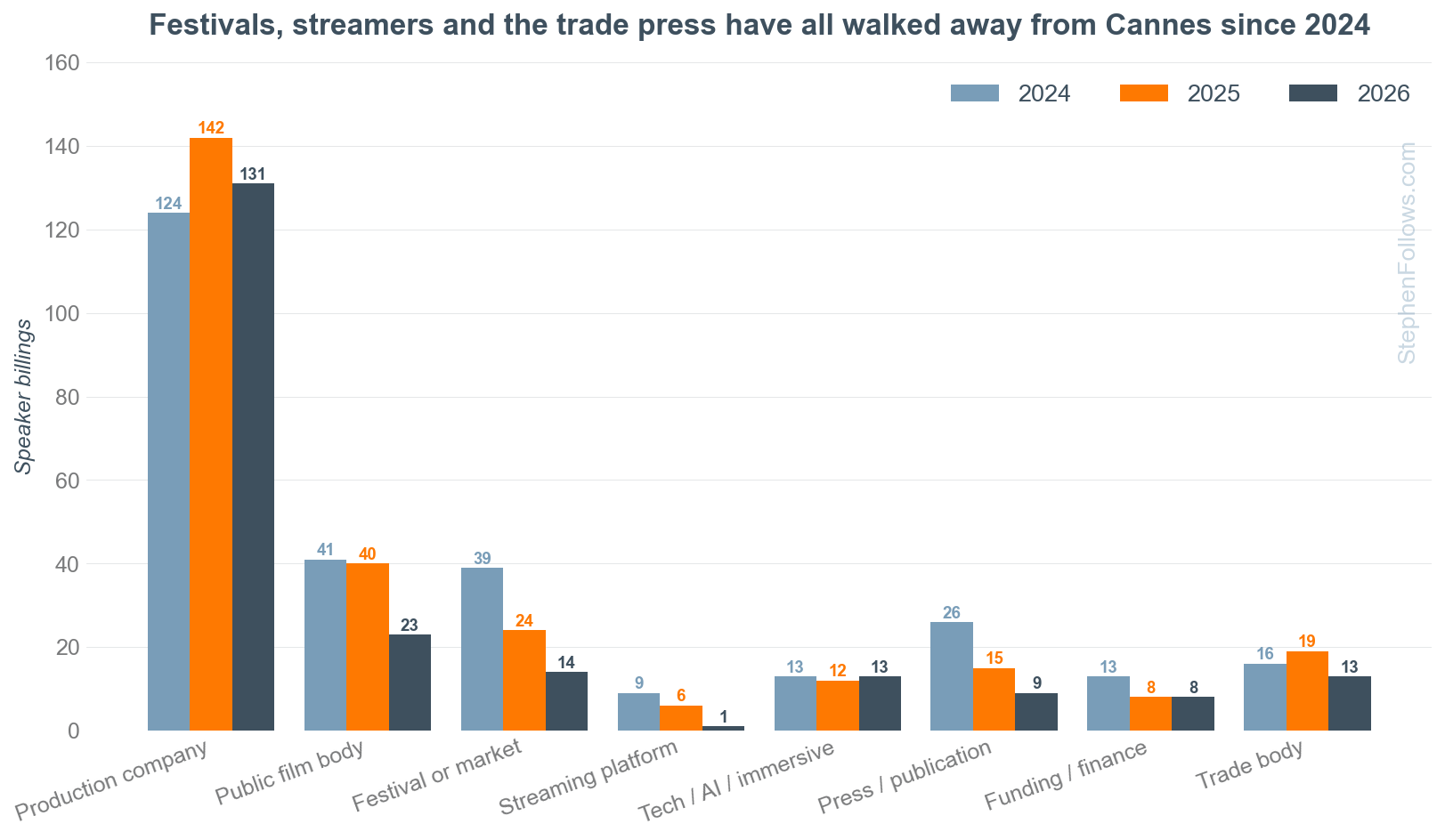
The streamers have stopped showing up. Netflix, Amazon, Apple and Disney have gone from nine speaker billings in 2024 to one in 2026. Whatever Cannes is for now, it isn’t appealing to streamers.
Co-production is the survival mode. When financing is tight and audiences are fragmented, splitting the budget across borders is how you keep working. 32 sessions in 2026 are explicitly about it.
Virtual production is going hands-on. It launched last year as a panel strand, but this year converted 13 of 17 sessions into workshops. The conversation has moved from “should we?” to “how do we?”.
The values agenda has thinned. Diversity and inclusion content has nearly halved. Sustainability is one event in 243. Mental health is two. Whatever the industry is talking about in 2026, it isn’t the values conversation it was having in 2024.
Creators are being grafted onto cinema… cautiously. The brand-new Creator Economy Summit on 17 May is six panels in one day with Scalable, Meta and YouTube. Cinema is now talking to TikTok-native creators on cinema’s terms, not theirs.
Let’s look at each in turn…
1. The conference is shrinking (slightly)
Despite the festival being the world's largest film market, its conference offerings are shrinking.
In 2024 the Marché ran 260 conference events totalling 379 hours of programming, but this year that’s dropped to 243 events and 318 hours. The mean event length has also shrunk, from 88 minutes in 2024 to 79 minutes in 2026. The schedule is doing fewer things, more briefly.
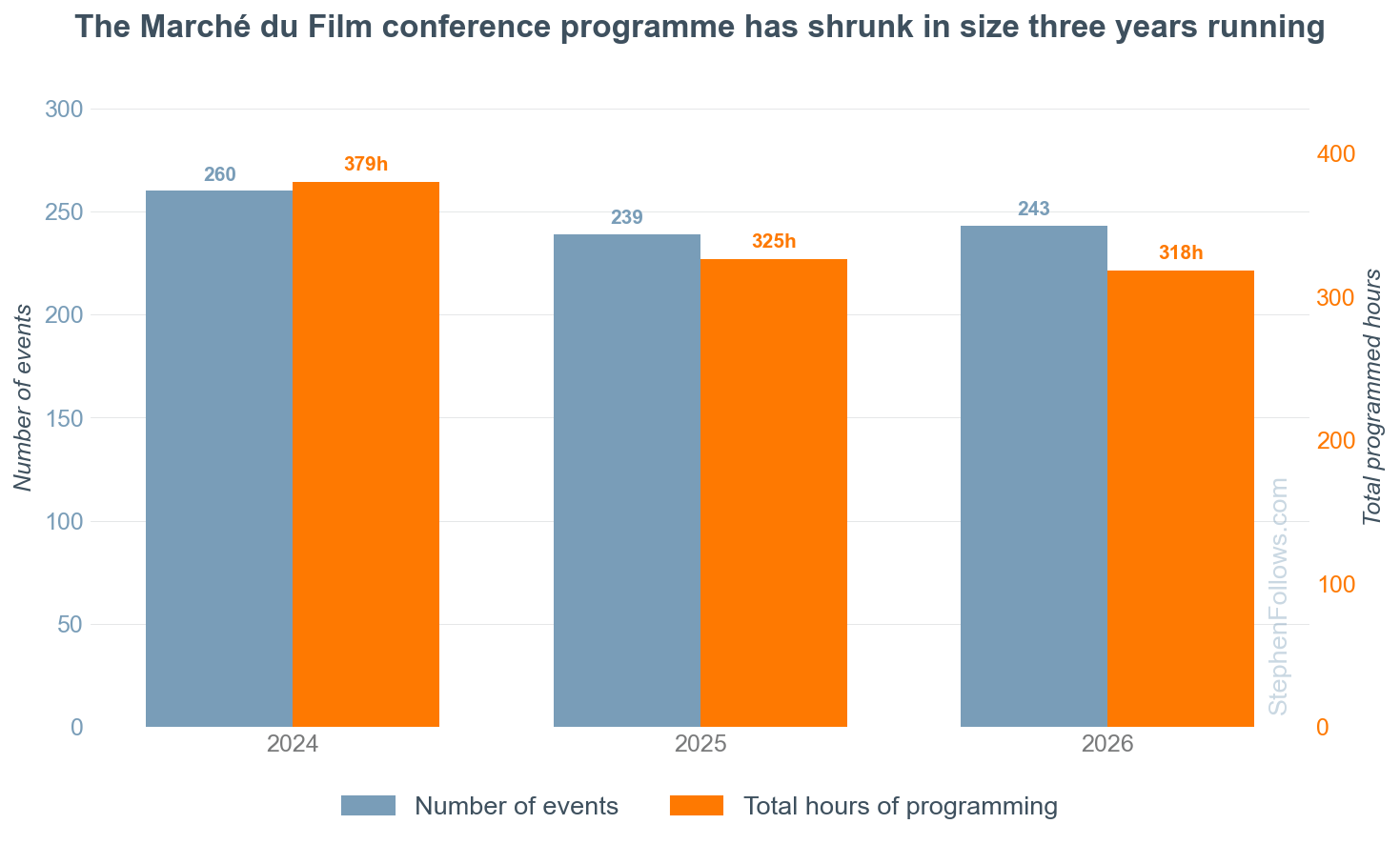
The Marché itself reports growing numbers of accreditations, and the side-strands keep multiplying so this isn’t a lack of willing attendees. Rather, it’s a curatorial set of decisions that has meant the schedule has been trimmed year after year.

Another such decision is that Cannes 2026 seems to have converged on a single format. 48% of all conference events in Cannes are multi-speaker panels. Panels are the only format that has grown across all three years. They went from 95 in 2024 to 116 in 2026, a 22% rise. Almost every other format is flat or shrinking.
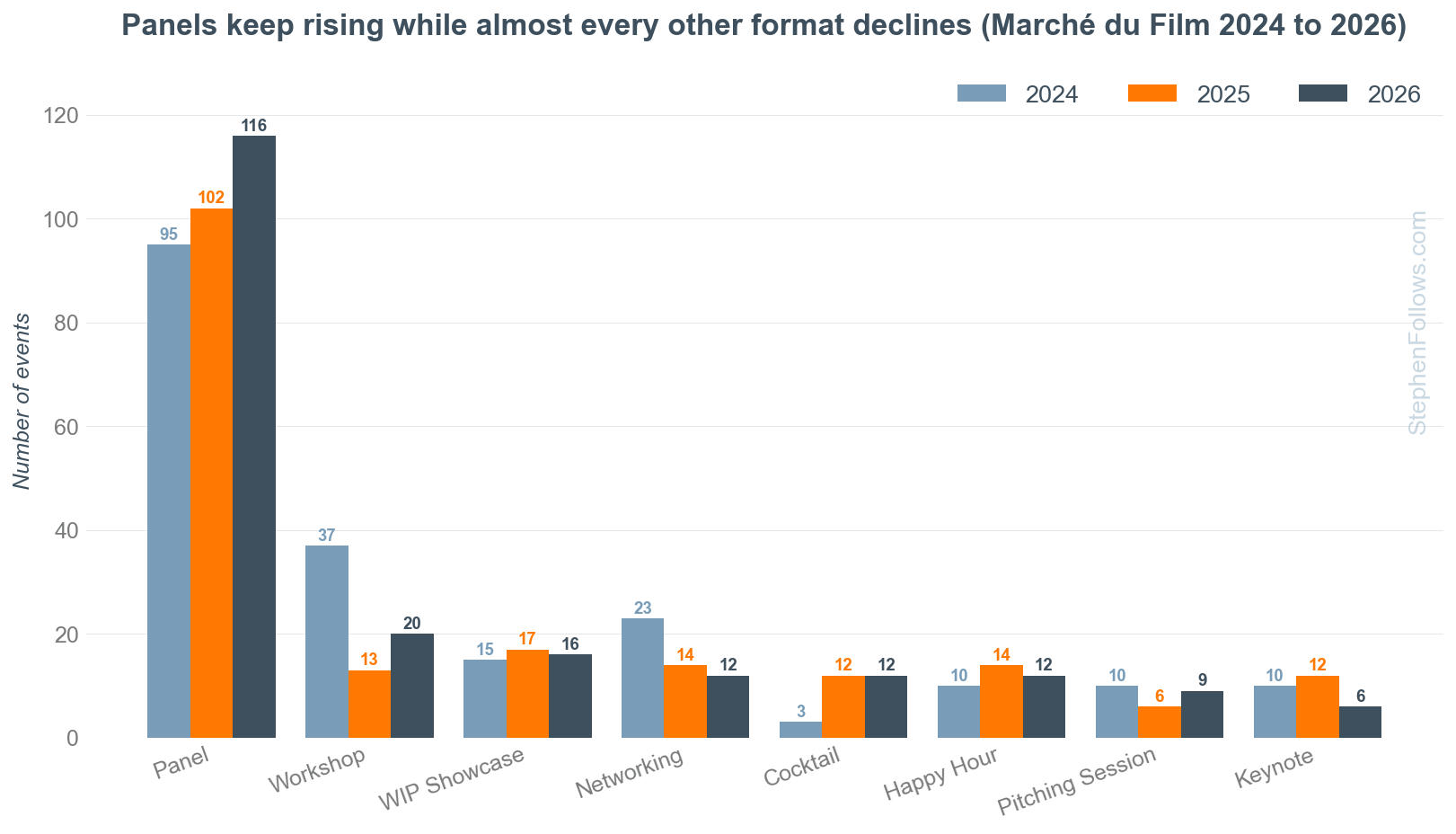
My theory is that it is a mix of programming-equity question (panels can include four sponsors at once), and partly a product of market forces (a sponsor will pay to have its CEO on a panel, whereas it is much harder to sell a slot in someone else’s keynote).
So if you’re hoping to hear a single experienced voice speak at length about their craft, the Marché might disappoint. But if you want six middle managers from different companies offering carefully coordinated takes on what AI means for distribution, then you’re in for a treat.

2. AI is fully integrated
27 events mentioned AI in 2024, 21 in 2025, 31 in 2026. The 2025 dip looks like fatigue after the immediate post-ChatGPT bump. In 2026 it’s back, stronger, and at a higher share of the total schedule.
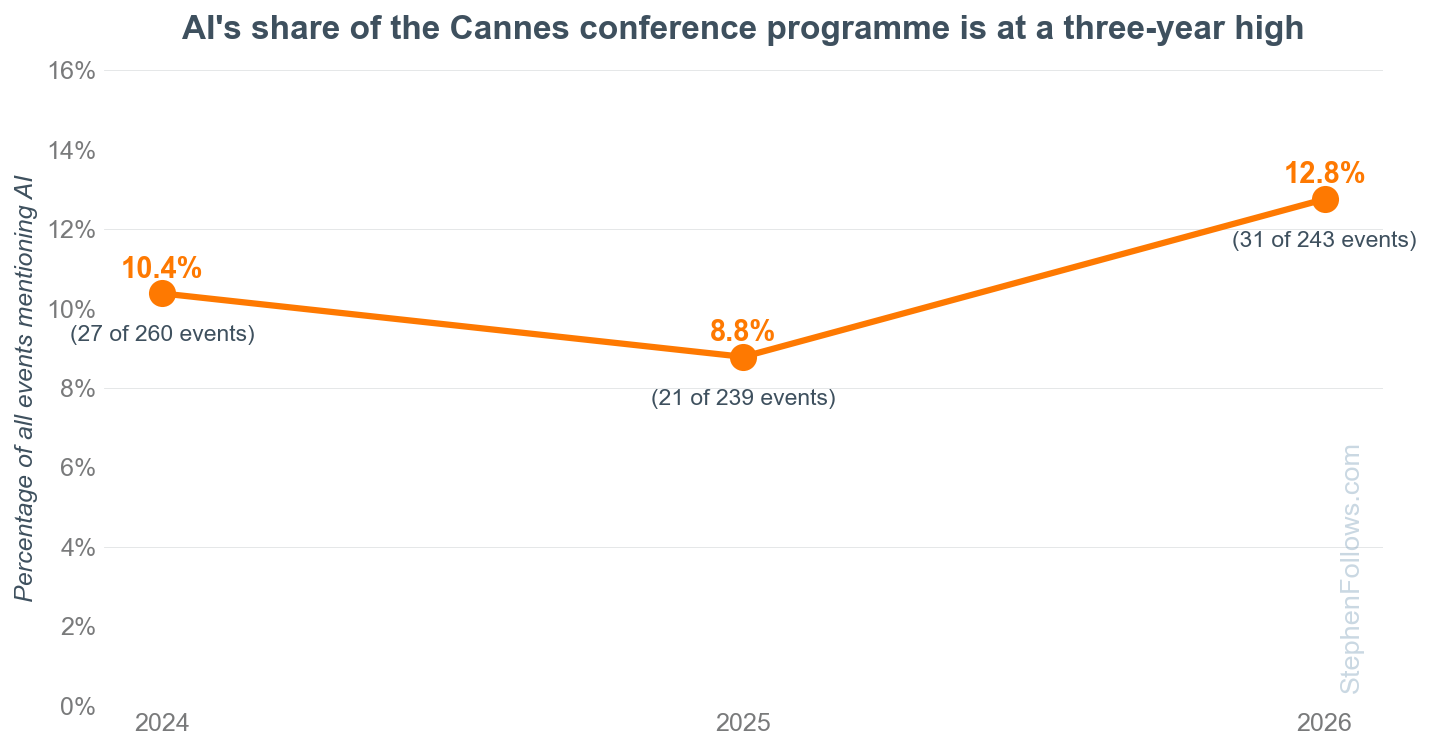
The framing of AI has also shifted. 2024 panels were “AI for filmmakers, what does it mean”, “Curious Refuge: case studies in AI cinema”. By 2026 the sessions are more like middle manager meetings:
How AI Agents Give Top Sales Teams an Unfair Advantage
AI Meets IP: Voice, Rights and Creative Control
From Legendary Studios to AI Pipelines in Film Music
There is even an “AI for Talent Summit” running across two invitation-only sessions on Friday 15 and Saturday 16 May. AI in casting agencies is now its own conference-within-a-conference.
Two things missing from the 2026 AI line-up are notable. Neither OpenAI nor Anthropic has any speaker presence, despite 31 AI-related sessions. The companies on stage are AI-tooling startups serving film (Phonoma, Respeecher, Eros Innovation, Largo, Wonder Dynamics, Dreamina AI). The frontier-AI companies that drive the underlying conversation are not there. Make of that what you will.

3. The streamers have stopped showing up
Looking at who’s speaking, we get an interesting story of change. The three areas in decline are:
Festivals (39 in 2024, 24 in 2025, and 14 this year)
Streaming platforms (9 → 6 → 1)
Trade press (26 → 15 → 9)