


Erwin M. Schmidt reached out to point me to a new study of the survival rates of on-screen geologists in movies titled “Geologists on the silver screen—the sequel”.
Four geologists at the University of Gothenburg spent more than a decade keeping a list of every film they could find that featured a geologist. Across the 141 movies they tracked, the on-screen geologist died 34% of the time. Usually quite early, and often moments after explaining that the volcano is about to go off.

Erwin asked me:
How does the fate of geologists in movies compare with that of other jobs?
This is exactly my kind of question as it’s core to the work I do creating new movie records for Guinness World Records.
So I turned to the data to see just how slated geologists are. Whether their luck had eroded, their prospects had hit rock bottom, and their odds of survival were, frankly, being taken for granite.
I studied 43,983 movies to track the fate of 328,538 characters who shared 10,112 different job titles and experienced a combined 69,832 on-screen deaths. I can only study the data available in screenplays, film synopses, and plot descriptions, so there’s a certain amount of bias. I have included more about my methodology and data at the end of the article in the ‘Notes’ section, which might be better called ‘Pedant’s Corner’ (or should that be Pedants’ Corner? I mean, it’s not really a corner….)
What are the most dangerous jobs in movies?
Across all the 328,538 characters for whom I could determine both a job title and their fate, 21.3% died. Bummer for them, but great for us, since we now have a baseline. Being a named character in a movie has a 1-in-5 death rate.
It’s three times more dangerous to be a Commando in a movie than an average character. They came out as the ‘Most killed’, with almost two-thirds of them not making it to the final credits. Then, a terrorist, a gunman, a revolutionary and, naturally, a sorcerer.
Half of all movie assassins die, which, for a job that is entirely about killing other people, is a remarkable number of own goals.
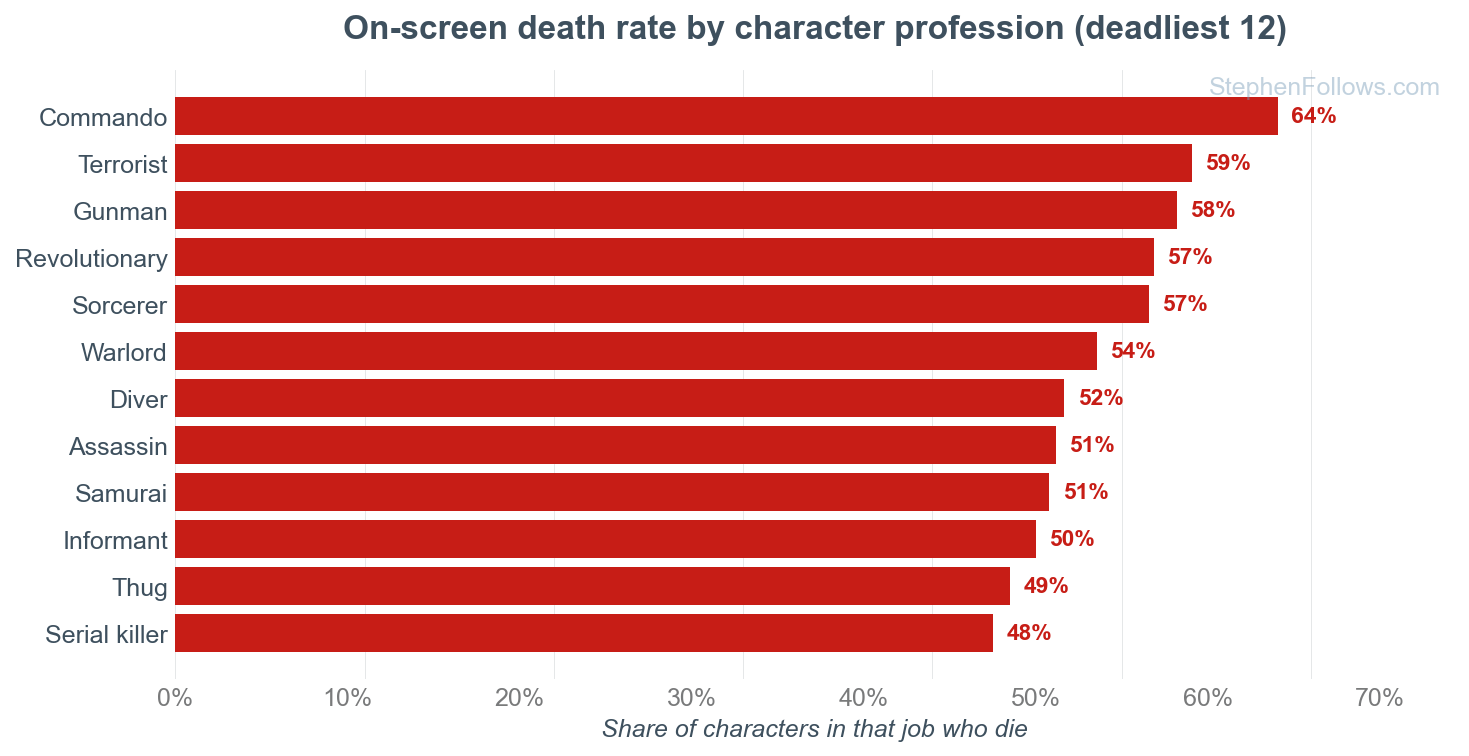
Jobs that seem the safest include wedding planner, matchmaker, illustrator, manicurist or sportswriter.
What even is a job?
Some of the entries on that previous chart are not jobs in the traditional sense. For example, one could see serial killing more as a calling than as gainful employment. Other roles, which may not seem like real jobs at first glance, do pass muster, such as those of an informant or a thug.
Also, if there are any young people using today’s data to inform their future career choices (as I imagine many are), then they may feel underserved by discovering that jobs such as commando, terrorist, gunman, and revolutionary have high death rates. They are people whose entire job is violence, and of course, they die, because a film about armed men is usually a film about armed men shooting each other.
So let’s remove the jobs that are centred on violence and those that people do for the love of it. Oh, and wizards and such - I removed jobs that kids today would be foolish to aspire to.

This reveals that the deadliest ordinary on-screen job, once the soldiers and the sorcerers have gone home, is that of a diver, with a 52% mortality rate.
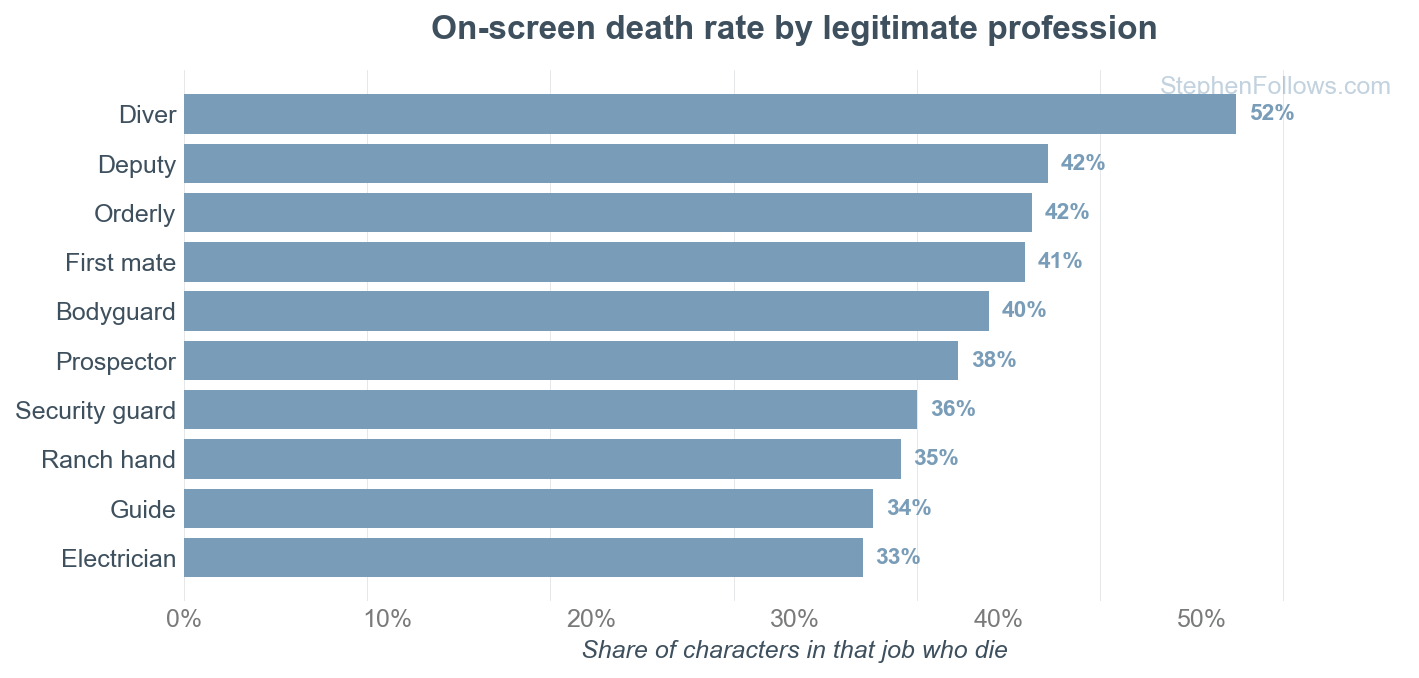
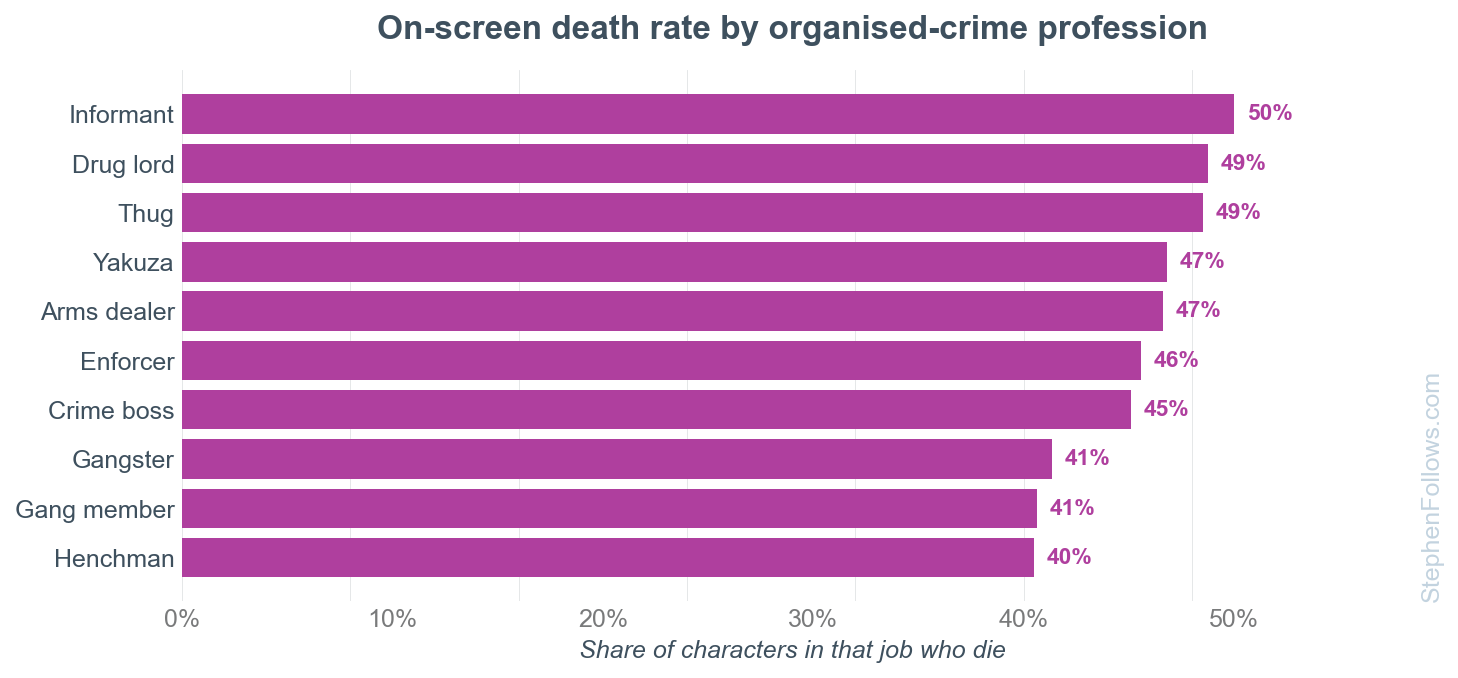
Just in case any of you were thinking of a long career in crime, the data suggests you should aim for middle management. The pay and benefits beat frontline work, but the death rate is lower than that of the criminal C-suite.
Below are the death rates for jobs with organised crime (I left out the disorganised crime roles, as that veers into hobby territory).
It’s less about your job than the world in which you do it
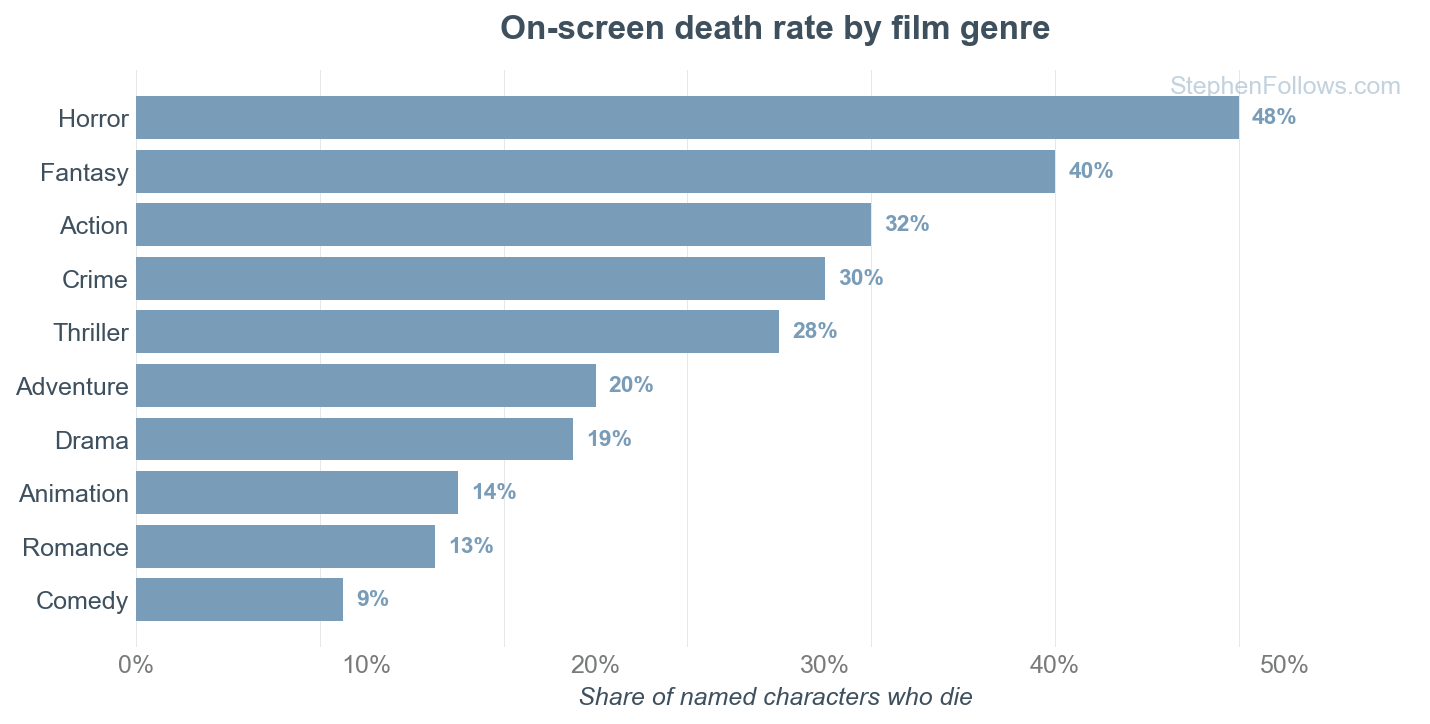
So far, I have been focusing solely on the characters' jobs, whereas we get an even stronger set of survival cues from the movie in which those characters operate.
Unsurprisingly, horror films have the highest death rate, with almost half of all characters (for whom I could determine both their employment and their fate) dying.

It’s not about bad jobs, but bad people
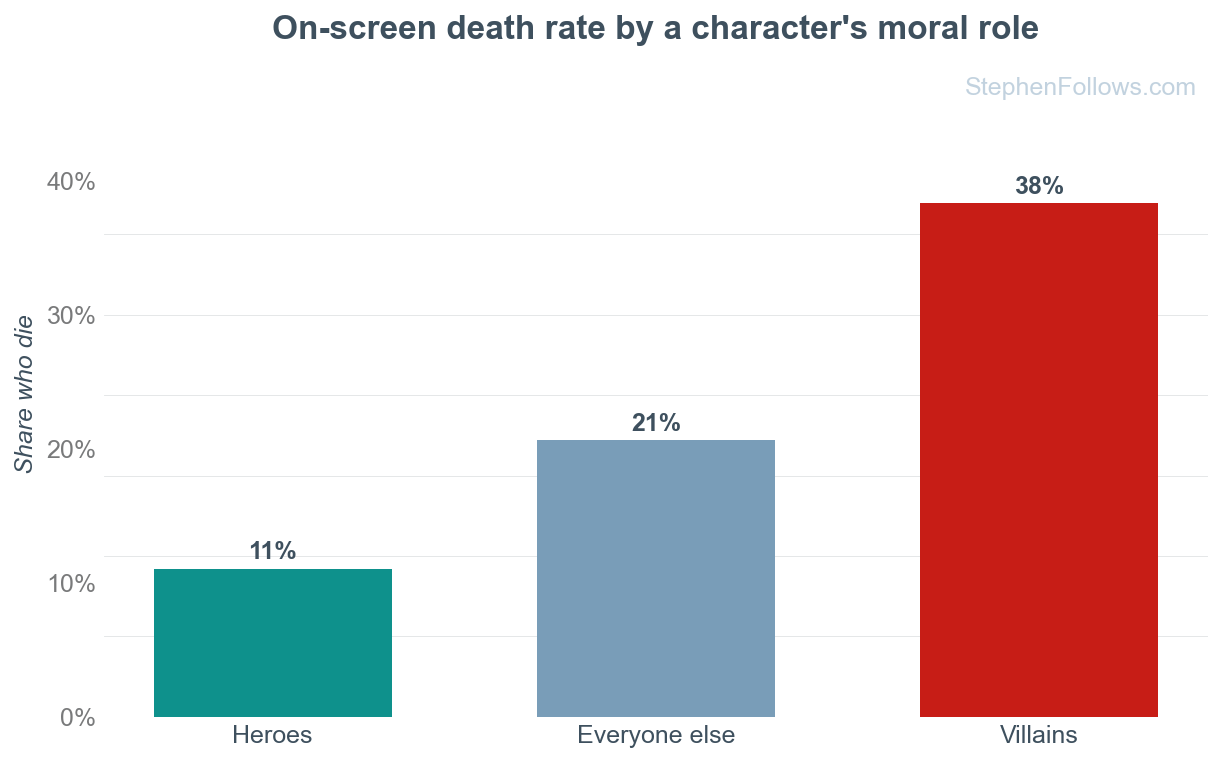
Unlike in real life, villains die way more frequently than good people (38% vs 11%).
On screen, being the bad guy is very nearly a death sentence, which mirrors what the Gothenburg geologists found: 77% of those they called “evil geologists” died. (I am slightly suspicious of just how much harm an evil geologist could do, given the timeframes they are used to working with, but I’m not going to mansplain evil geology to leading geologists).
The traits of a deadly job
It’s at this point that I have to be honest with you - I have very little experience with proper jobs. I have what people kindly call a portfolio career, which mostly means I do several odd things at once. Over the years, my professional work has included:
Film data analyst
Running a story agency
Inventing new world records
Writing puns for headlines of the horoscopes in The Sun newspaper
Giving Kanye West tax advice
I like to think of myself as “business feral” - i.e. hard working but barely employable.
So, when it comes to deciding what is and is not a ‘proper job’, I have very little to draw from. Case in point: see below for the job traits I thought we were worth investigating death rates for.
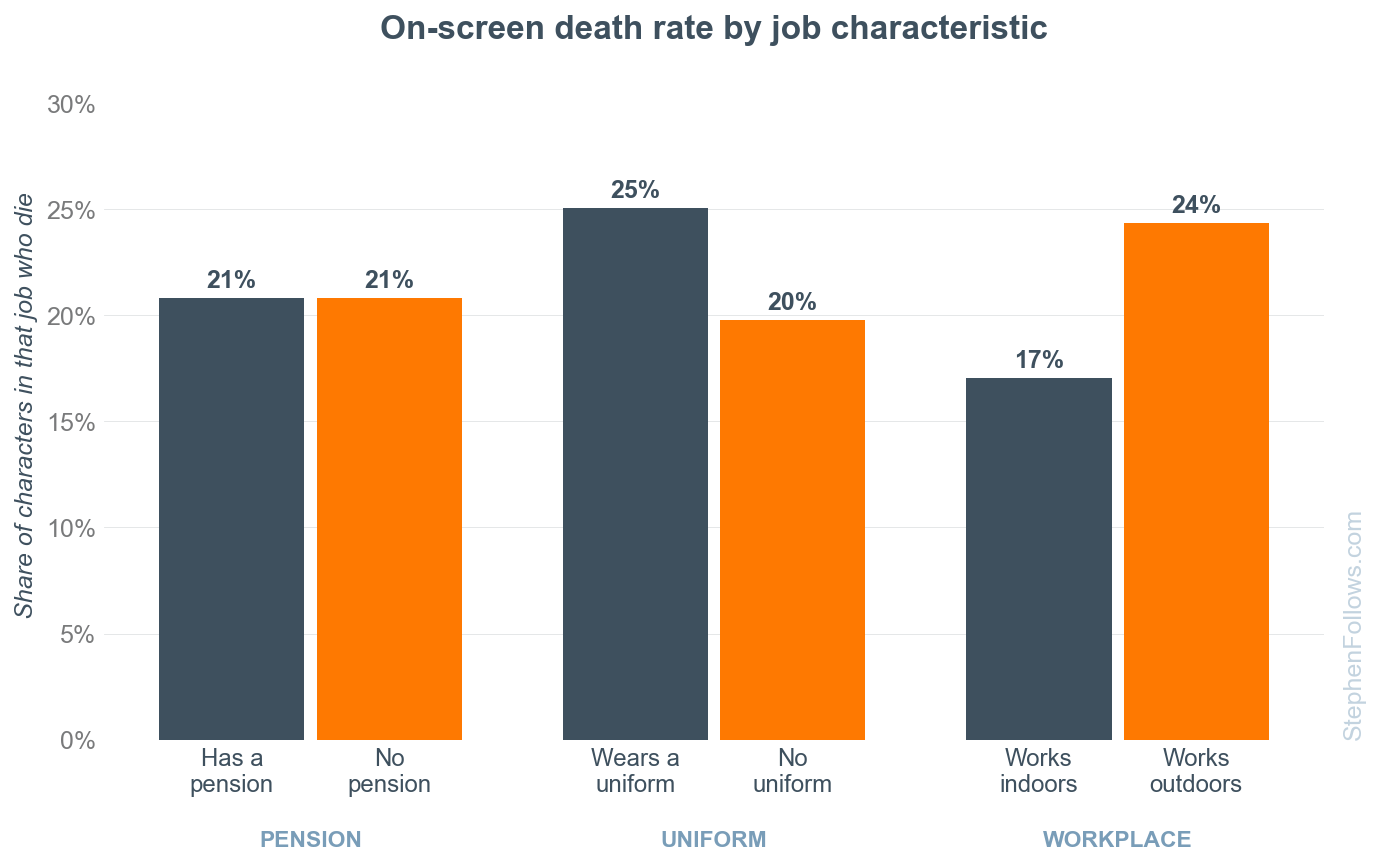
Other things I tested included:
Money does not save you. A surgeon on $240k a year dies about as often as a cleaner on $34k (correlation +0.02).
Automation risk does not matter either (+0.08), so the robots and the screenwriters are after different people.
And the jobs children dream of are mostly safe, the lone doomed dream being that of an astronaut.
The two biggest correlations were:
The first is real danger, but only one kind. Cinema has no idea which jobs shorten your life in a non-visual sense (i.e., those with poor working conditions or associated with negative health outcomes). But the jobs that can kill you in a single dramatic accident, the fisherman, the pilot, the miner, the lorry driver, die on screen too (correlation +0.5).
The second is gender. The more men do a job in real life, the more it dies on screen (-0.43). Soldiers, pilots and bodyguards die constantly, whereas nurses, hairdressers and secretaries mostly live. It’s such a strong link that job titles ending in ‘man’ are the deadliest suffix in cinema and jobs ending in ‘ess’ are the safest.
So what have we learned?
Nothing useful.
The fact that I’m unemployable also means I’m unfirable. Sorry :/
Notes
I analysed 43,983 feature films and extracted 328,538 named characters. For each one I recorded a stated or strongly implied job, whether they died on screen, and how. I was working from plot summaries and, for a large share of the films, full screenplays.
A character’s job only got recorded when the film bothers to mention it, so the sample leans towards jobs that matter to the plot. This measures the conventions of screen storytelling, not real life. Genre drives the raw body count more than any single job, so the figures are best read as relative standings rather than your personal odds. In my tests, I found that plot summaries missed about 15% of the deaths a full screenplay would reveal, though they get the running order of jobs right.
The geologists were the obvious test, since the Gothenburg team had already counted them by hand. My method puts the geologist death rate at 31%, against their 34%, which is close enough to trust the wider net.
Eleven jobs turned up in twenty films or more without a single death between them, which seemed too good to be true, so I had each one stress-tested for counter-examples. About half cracked (a circus impresario mauled by a bear, a studio boss with his throat cut, a ski instructor lost to an avalanche, a chambermaid strangled in the billiard room, and an ice hockey player). But five held firm, with no verified on-screen deaths at all: wedding planner, matchmaker, illustrator, manicurist, and sportswriter.
The original study by Sturkell, E., Sjöqvist, A., Björklund, L. and Johnsson, A. (2026), ‘Geologists on the silver screen, the sequel’ was published in Geology Today, 42(2), pages 82 to 86, which is open access and worth a read. It is the source of the 34% geologist death rate and the 77% ‘evil geologist’ figure, and of three lovely examples: Dr No (1962), where 007 shoots the evil geologist, Prometheus (2012), where one is killed by aliens, and Dante’s Peak (1997), which somehow finds room for seven heroic geologists at once.
‘Dangerous in real life’ comes in two flavours, and they behave very differently.
For deaths actually on the job I used the US Bureau of Labor Statistics Census of Fatal Occupational Injuries
For the jobs that non-visually shorten life overall I used UK Office for National Statistics occupational mortality.
Pay is from the BLS Occupational Employment and Wage Statistics
The share of each job done by women from the BLS Current Population Survey
Automation risk from Frey and Osborne’s ‘The Future of Employment’ (Oxford Martin School)
Public trust, which predicted nothing, is from the Ipsos Veracity Index.
The ‘dream job’ measure was my own best calibration to childhood aspiration rather than hard official numbers. All correlations are rank-based (Spearman), so they describe whether the order matches, not the exact sizes.
Great read and thought provoking as always. I found myself wondering about the missing representation in films - what are the most popular jobs that don’t ever get mentioned (or rare jobs in films). Different study for someday. Thanks for your fact finding and humor.