


This is the first of a multi-part research project that I’ve been working on for some time.
I have been collecting public data on the backgrounds of top film directors to investigate things like class, nepotism and the importance of film school.
We’re going to start this week with a look at how many top film directors attended film school.
And then next week we’ll look at the outcomes of those films - i.e. is going to film school correlated with making successful / good / profitable movies?
How many directors went to film school?
I looked at educational history of the directors at the helm of the 1,250 top grossing films since 2000. There is much more detail of my methodology in the Notes section at the end of the article.
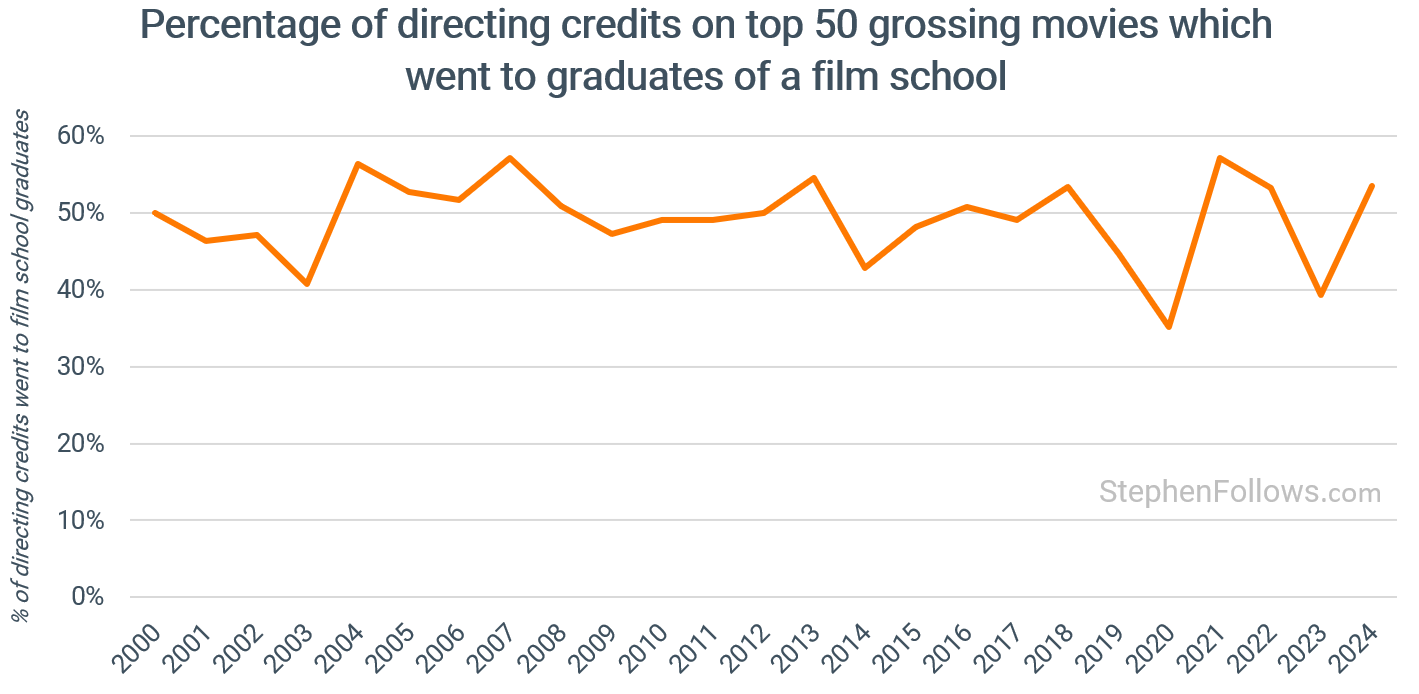
Across the cohort, I could find evidence that 49.3% had attended a film school.
This has been fairly static over the past quarter century.
What types of films do film school graduates make?
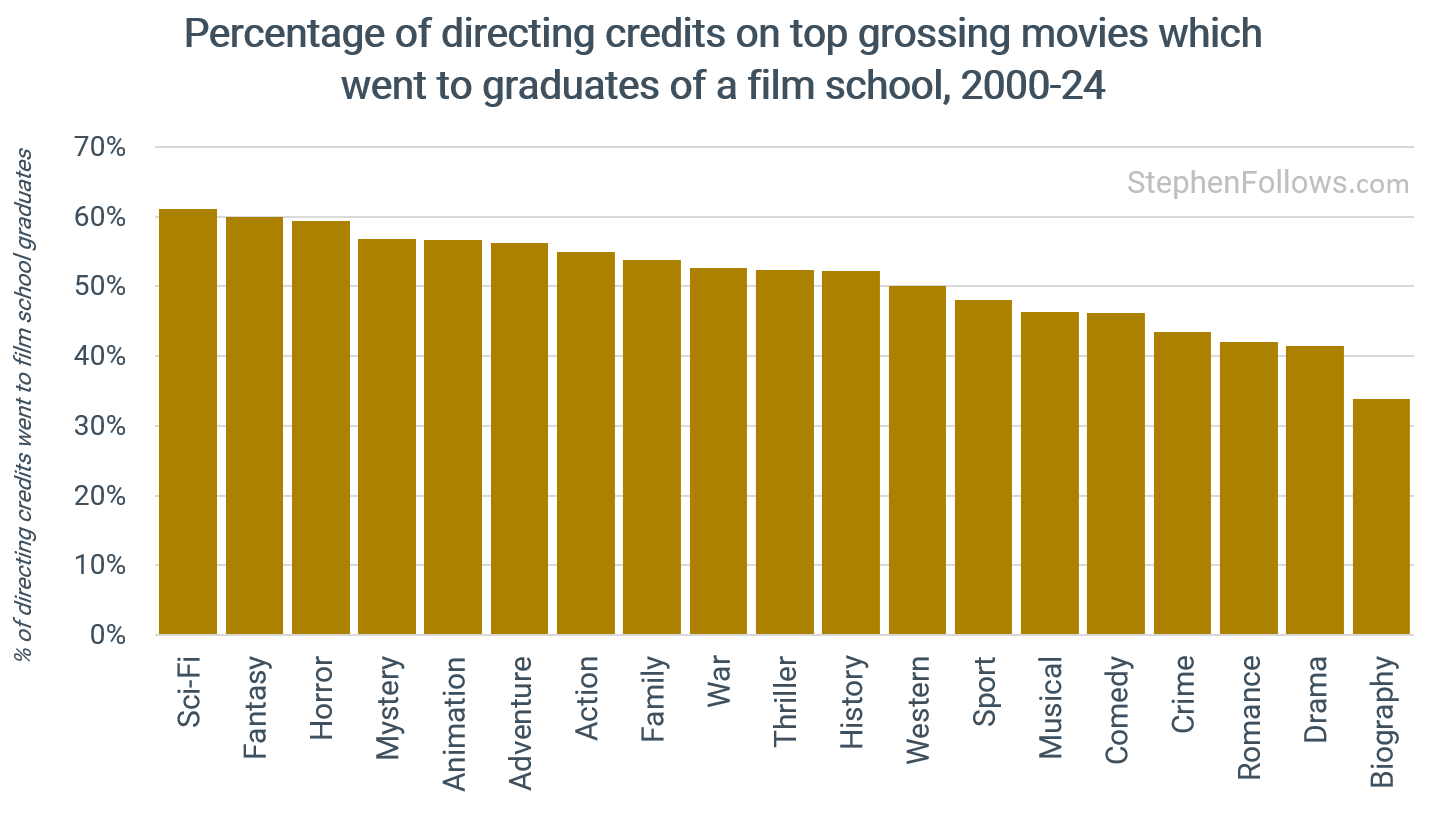
The genres which feature a greater degree (if you’ll pardon the pun) of film school graduates are sci-fi and fantasy films. These are typically made by big studios, whereas the genres at the other end of the spectrum (romance, drama, and biographies) are often made at a smaller scale.
Do film school graduates get to direct bigger movies?
This is confirmed when we look at the budgets of the movies. Film school alumni are in the majority among the directors’ chairs of films costing over $73 million but are a minority among movies under that figure.
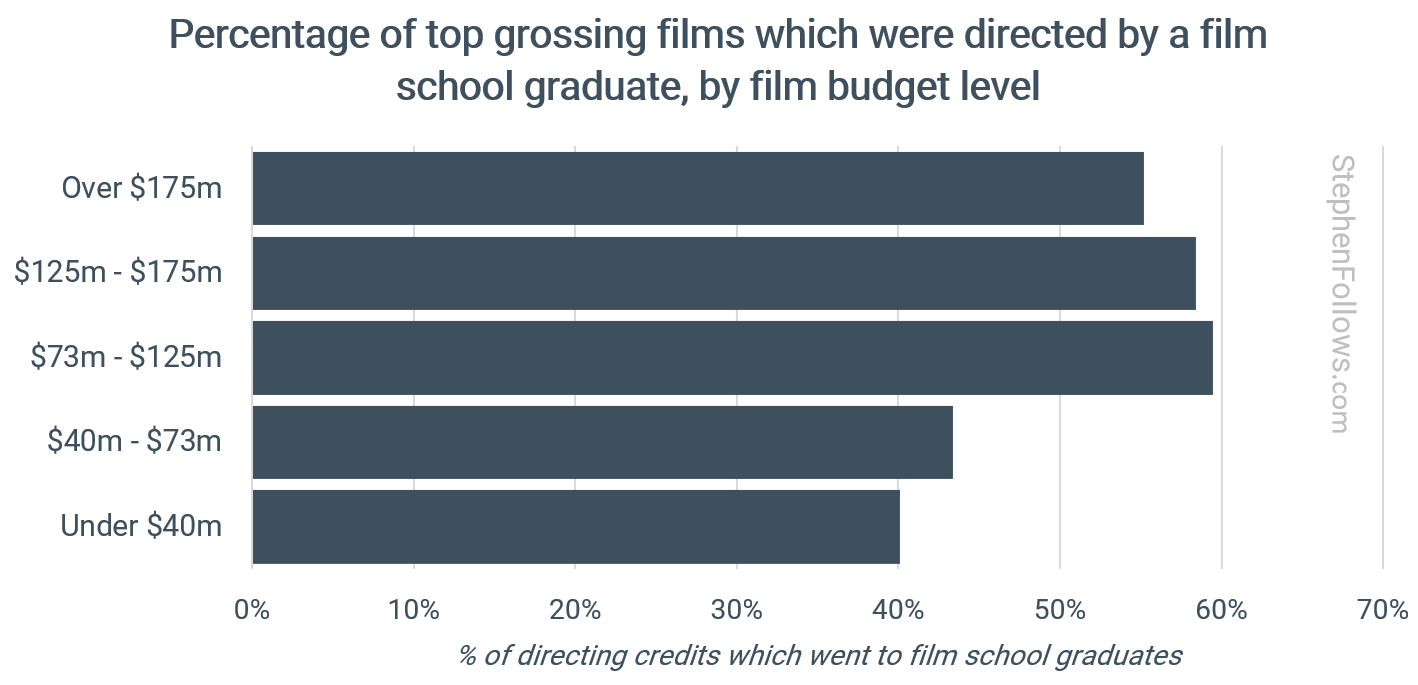
This dataset doesn’t contain many truly low budget movies as it’s looking at the 50 top grossing films of each year, which don’t typically feature many small scale productions.
Next week I am going to share data on whether to movies made by these film school graduates are better, more successful and profitable than those by people who didn’t attend film school.
Should a wannabe director go to film school?
I’m sure this topic will raise the ire of many folk, both those for and against attending film school. It’s a hot topic and one people are keen to share their views on.
I’m all for that, and to help I thought it would make sense to add a few top-line thoughts on why a wannabe director might choose to either seek out or skip out of film school.
The case for attending film school
There is much to be said in favour of choosing to attend a film school, including:
Access to working filmmakers. Most tutors will be (or have been) working film professionals. Plus, some top programmes offer internships, labs and showcases that are designed to push you in front of top film professionals who could hire you.
All the gear (and some idea). Schools give you access to stages, kit, crew and post facilities you can use to shoot fast and often. During my time at film school, hire companies would often take pity on us and allow us to hire top-end kit for next to nothing, but only because we were covered by the school’s insurance policy.
A cohort of fellow film nerds. Recognised credential. You’ll find many people who share your passion for film and desire to get films made. Lifelong partnerships and working relationships are forged at film school.
Honesty and feedback. Classes force deadlines and critiques that speed up iteration and craft. There’s nothing like having to show your work to tutors and fellow students to bring home the reality that good work is hard to make.
Cronyism. Sorry, alumni network. Established schools maintain communities that generate introductions years after you graduate.
Martin Scorsese said of his time at NYU:
It was [my cinema professor Haig Manoogian] and this school that taught me I could be more than crazy
George Lucas described his time at USC thusly:
…once I got to film school and learned about movies, I just fell in love with it.
And Jane Campion said of Australian Film, Television and Radio School (AFTRS):
There was a really interesting group [at film school] when I was there… definitely there were a lot of people with an art school touch, and we bonded a lot. We used to do the night shift at school and taught each other.
The case against attending film school
On the other side of the ledger we have:
It can be beyond-crazy expensive. For one year, on-campus the tuition cost alone for USC is around $73k, NYU Tisch is $67k and UCLA is $74k. I’m not singling these institutions out - the whole thing is very expensive. Plus you need to include the cost of accommodation, travel, food, weed, and books. (This might be a moot point if you’re lucky enough to live somewhere with free education such as Scotland, Germany, Greece, Argentina, Brazil, and the Nordic countries).
Echo-chambers of non-average folk. Due to the selective nature, and the high costs, you’re not studying with a broad demographic of people. In my experience teaching at private film schools, I witnessed a large number of people who could be classed as ‘children of the rich who want to be “studying” in London but not, you know, actually studying"‘.
It may not help your career. Next week I’m going to share what the data reveals on this topic, but for now it’s enough to say that attending film school is not like how lawyers have to pass the bar, or how doctors have to go through many years of rigorous training. A degree from a film school opens no doors in and of itself.
You don’t need to. So much information is available online, in books, in short courses, or can be learned on the job. When you had to learn the intricacies of shooting on film there was a stronger case for film schools being your best route but the world today is awash with ways to learn and hone your craft.
And there are no shortage of indie filmmakers lining up to take a pop at the idea of formal film school training, starting with Quentin Tarantino who said:
Trying to make a feature film yourself with no money is the best film school you can do.
When people ask me if I went to film school, I tell them, ‘No, I went to films,'”
James Cameron is glad he didn’t go:
One of the best things that happened to me was that I didn’t go to film school. … I didn’t study film aesthetics because I figured it becomes too solipsistic – it’s just about other movies. You need … life experience, so you have something to say… not just based on other movies.
Paul Thomas Anderson refers to film school as “a complete con”:
My filmmaking education consisted of finding out what filmmakers I liked were watching, then seeing those films. I learned the technical stuff from books & magazines… Film school is a complete con, because the information is there if you want it.
Finally, Terry Gilliam tackled the topic with his trademark subtlety and delicacy when saying:
Film school is for fools. Live and learn how to make films. I didn’t go to film school. I just watched movies in the cinemas. And probably my greater education was actually making films, so… watch movies, get a camera, make a movie. And if you do it enough times, eventually you start learning how films are made.
Statement of interest
I am very interested in this topic! I have been connected with film education, both formal and informal, for all of my adult life. The data I’ve shown today are just counting the publicly available facts, so I don’t think I’ve added any subjective perspective to them. But, just to be safe, I thought it might be helpful to declare my background on the topic.
I went to film school. I got a 2:2 in Film Production at the Surrey Institute of Art and Design. For those unfamiliar with the UK educational system, that’s a poor grade at a middling institution.
I went on to teach in the evenings and occasional modules at the Met Film School in my 20s. My office was in Ealing Studios alongside the Met and the money I received from teaching producing kept my production company afloat and my rent paid.
I ended up teaching at film schools around the world, from New York to Nashville, Manchester to Malaysia, Belfast to Beaconsfield.
In the years leading up to the pandemic I used to teach twice a year at NYU. At Tisch I would teach filmmakers how to use data, and at Stern I would teach lawyers not to. I also ran short courses with NYU’s fantastic Production Lab.
Finally, I have been the Chairman of the Central Film School in London for just over a decade (although I will be stepping down this year).
On the other hand, I have been a loud, enthusiastic advocate for non-formalised film training. These often form a decentralised syllabus for filmmakers who can’t afford the time or money to attend film school, or who enter the industry later in life. I’ve taught on 100s of short courses, lectures, workshops, etc. In many cases I have seen how this approach has worked out better for those who might have otherwise attended a formal film school.
Overall, I would say I am neither pro nor anti film school.
There are many things it does well, and I have seen many students thrive under the creative, supportive environment it can provide (not to mention the kit, chums, and challenges).
But I am also deeply concerned by the costs involved, and have witnessed myself that not all tutors, courses or schools are providing good value. There are so many more ways to get your ideas shot, seen and sold these days that film school doesn’t mean what it used to.
So it’s a case-specific solution. Good for some, not for others.
Notes
Todays research looked at everyone credited with directing a movie between 2000 and 2024 inclusive that was in the top 50 grossing movies at the Domestic box office each year. That’s 682 people, sharing 1,417 directing credits, across 1,250 films.
The charts show percentage of directing credits, by the year the film was released. I was not able to find biographical information of every person. If I found nothing on their education then they were excluded but if I found evidence that they studied something other than film, then they counted as ‘not a film school graduate’.
I focused on graduate and postgraduate film schools, rather than short courses.
This research relies on self-reported public information being easily accessible. This opens it up to no end of limitations from lying, to private people, to the vagaries of what attended means (i.e. some attended but were kicked out or performed poorly).
Correlation does not equal causation. In fact, 100% of people who think it does, die. So we have to be careful how much we read into the fact someone did or did not go to a film school.
By their very nature, top film schools are highly competitive and so are likely to attract the very best students. This means we would expect to see them outperforming those who were not selected even if the school had little or no effect on their talent or career. (A very similar effect been proven in repeated studies related to selective schools in America).
Interesting what the data supports. The film school vs. no film school question depends on the individual. Everyone learns differently. While the built in network and connections are vastly greater going to school, nothing is more valuable than learning and growing while doing. Thanks for sharing.
Great stuff, as usual. The educational costs here in the US are sky-rocketing almost regardless of what program you enter. I think of Ryan Coogler living in his car while he was going through the USC cinematic arts program. And that was 15 years ago!