


I’ve written about the data behind Hallmark movies a few times before. So it was great fun to sit down with Pulitzer prize-winning data journalist (and good friend) Walt Hickey of NumLock to talk all things Hallmark.
The conversation we had is in the video above, and I’ve also included a load of fun facts below.
Have a Merry Christmas!
How many Hallmark Christmas movies are there?
Hallmark has made a large number of Christmas movies, and the number has increased steadily over time.
Since 2000, Hallmark has released over 300 Christmas-themed TV movies. That figure sits within a broader catalogue of more than 800 Hallmark TV movies overall. In other words, roughly one in three Hallmark TV movies is a Christmas film.
The growth has not been linear. In the early 2000s, Hallmark released only a handful of Christmas titles each year. By the late 2010s, output had reached the point where Hallmark could premiere close to one new Christmas movie per week during the final quarter of the year.
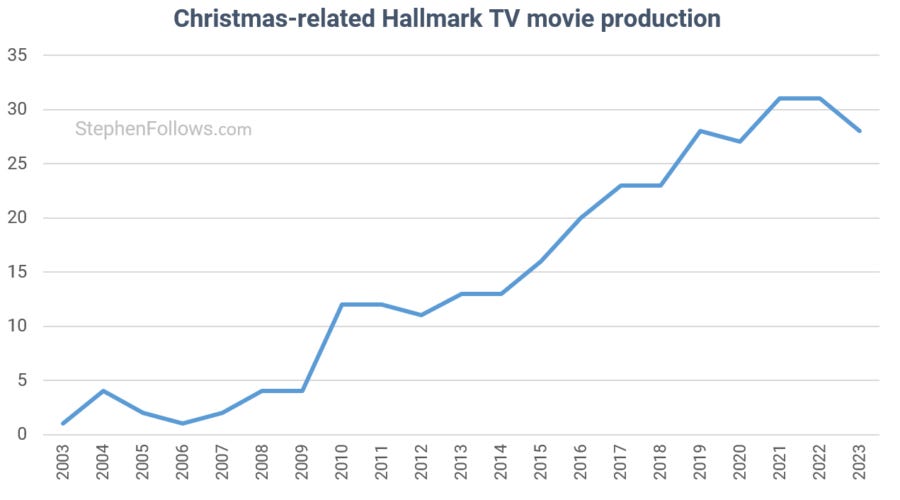
Christmas is Hallmark’s favourite time of the year
Hallmark Christmas movies are heavily concentrated in the final months of the year.
Around one-third of all Hallmark TV movies are first released in November and December, despite those months accounting for less than a fifth of the calendar. No other period of the year comes close in terms of volume.
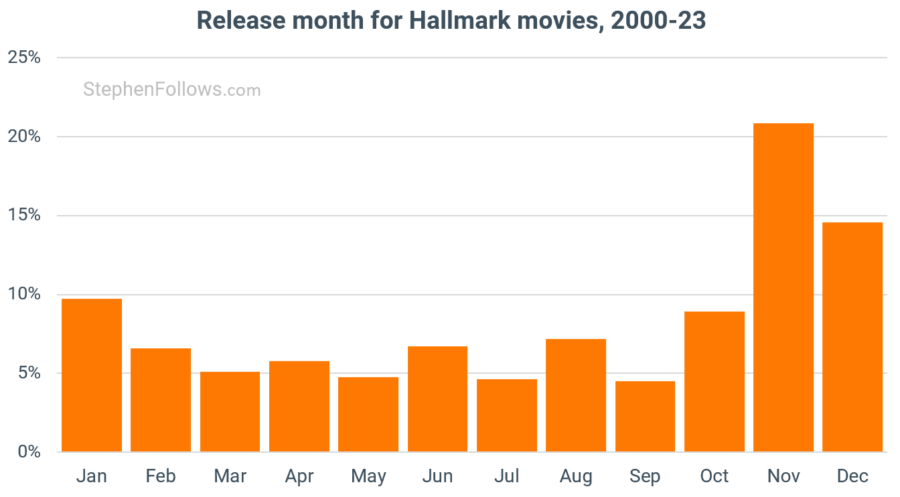
Hallmark programmes its Christmas movies into a fixed seasonal window, with premieres scheduled multiple times per week as the year draws to a close. The result is a compressed release pattern that resembles event television more than film distribution.
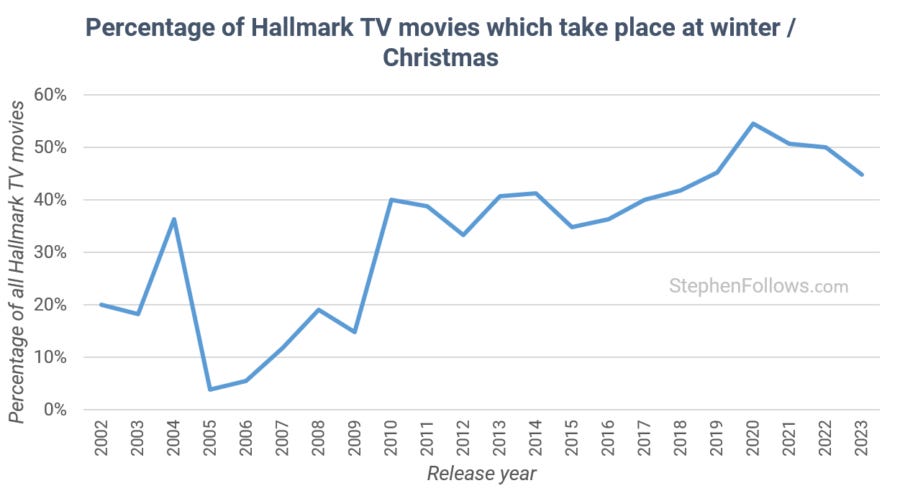
Why Hallmark Christmas movies operate differently from feature films
Hallmark Christmas movies resemble feature films in form, but not in function.
They are feature-length, self-contained, and narratively complete. However, they are commissioned, financed, and scheduled more like television episodes than theatrical releases. The same buyer commissions the films and the same audience consumes them.
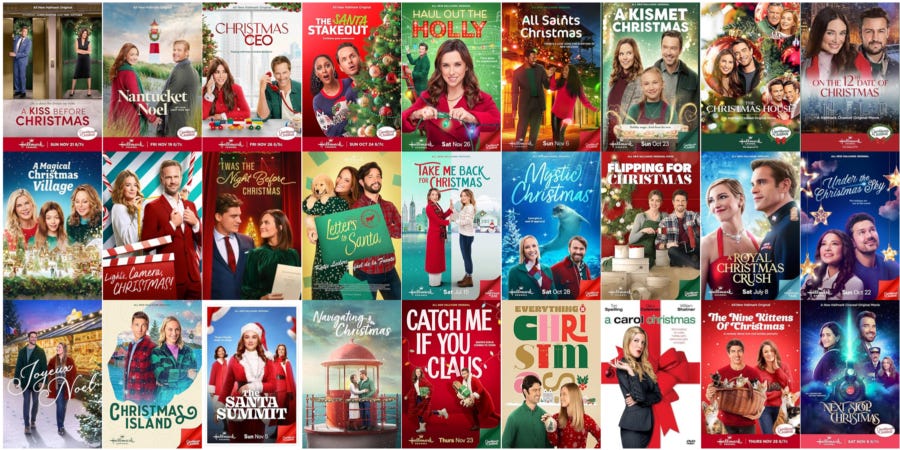
Most feature films are produced as prototypes. Even highly derivative films are expensive enough that each one carries material downside risk. Hallmark TV movies do not operate under that logic. They are produced within a repeatable pipeline, with known budgets, known audiences, and predictable performance ranges.
That distinction changes how creative decisions are made. Feature films optimise for differentiation. Television optimises for retention. Hallmark Christmas movies sit firmly in the second category.
At this scale, volume constrains behaviour. Individual films stop being discrete projects and become interchangeable units within a schedule. Decisions that were once optional start to repeat, because repetition reduces risk.
So maybe instead of asking “Why are they so similar?” we should be asking “How do they make them different?”!
Hallmark has created a repeatable playbook for their movies
At this output level, Hallmark needs written guidance to ensure each new production is on point and adheres to ‘The Plan’.
Multiple writers and producers who have worked on Hallmark TV movies describe receiving a detailed set of rules and guidelines before production begins. Below are verbatim quotes from their real bible (with my framing and editing for clarity).
1. Keep love light and true
They describe the core of what Hallmark wants as “light romantic comedies with a heartwarming ending“. The Hallmark bible says
“This is always our A story. Our needs to have layers and depth, and we need to see a clear arc from her and from her love interest. How do they help each other to change for the better?“
“Our content is not sexual in nature at all (a kiss is enough to show the romance in our movies), and we usually save this moment for the end when our lead gets her fairytale ending.”
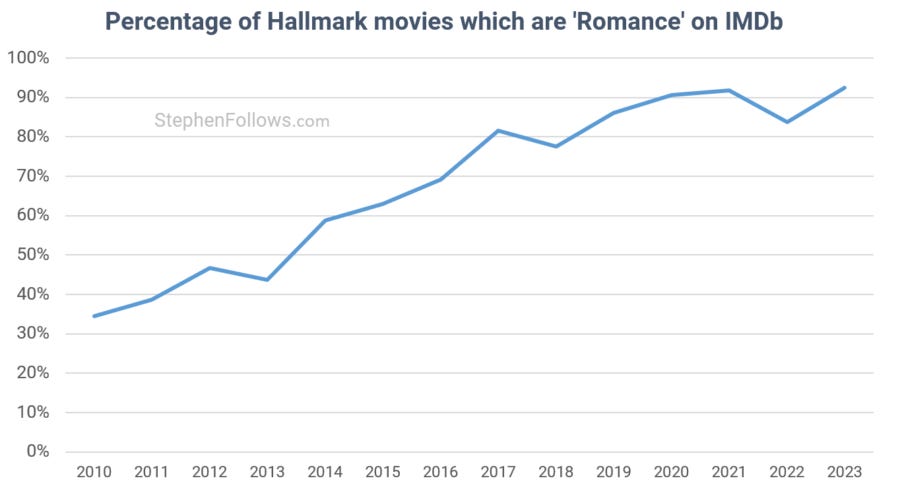
This strong preference has built over time, with Hallmark doubling down on what resonates with their audience.

2. Make us believe in your characters
Hallmark has a narrowly defined character archetype they want to tell stories about. They feature:
“A strong female lead (early to mid-thirties)”
“Character setup is crucial for us -we want to know about their hopes, dreams, things that make our leads tick“
They have an easy-to-understand, aspirational profession, which, apparently, does not include acting: “We don’t like our female and male leads to be actors and actresses as their jobs in the script unless the whole concept revolves around that“.
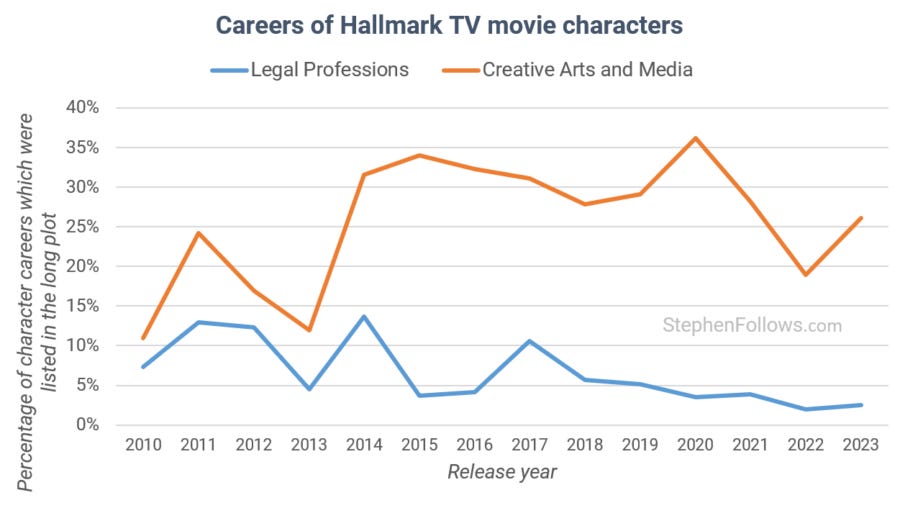
When I crunched the numbers on the Hallmark movies in my database, I found that the most common jobs are that of lawyer, chef and teacher.
If we zoom out for the specific job title and look at the area in which they work, we can see that the creative arts rule the roost, accounting for 26% of all jobs by clearly defined characters in Hallmark TV movies.
3. Let structure guide thy narrative
Their ideal story structure is defined as:
“Script should be 105-110 pages typically“
“9 Act Structure“
“Act 1 is 23-25 pages“
“The other acts are shorter but should be generally consistent – 8-12 pages usually“
“Midpoint is at the middle of act 4“
“Acts 7/8 -needs to be the low point/breaking point before things get better“
“Act 9 is often 7-10 pages“
“Total runtime we aim for is 86:30 and then after we screen the producer’s cut internally, we will “typically take it down to 84:00 (with credits)“
Further story guidelines include:
“Want establishers at the top of the movie to set up the city or town.”
“We typically like a lot of banter between our leads as they’re getting to know one another.”
“Strong conflict drives the leads apart toward the end of the movie (only to get back together in Act 9).”
“Let funny/joke moments play out and don’t blow through them when editing when all is said and done”
“For any crying scenes, we don’t like too much crying. We like to see emotion and hold beats on those to play things up, but we don’t like to get too dramatic.”
“We love to see pets in our movies {and we have a cat and dog -the Happies -that can potentially be the animal talent). That being said, we have very strict pet dos and don’ts. They cannot be off their leashes or outdoor animals. They cannot ever look like they’re in danger of getting hurt or abused in any way.”
“We’re generally not fans of montages […] or slow motion.”
“We don’t like karaoke or singing scenes in our movies and no bowling.”
The desire to avoid bowling seems an odd one at first, but I guess it’s one of the things they’ve discovered over so many productions, which presents a challenge to either production or the creative.
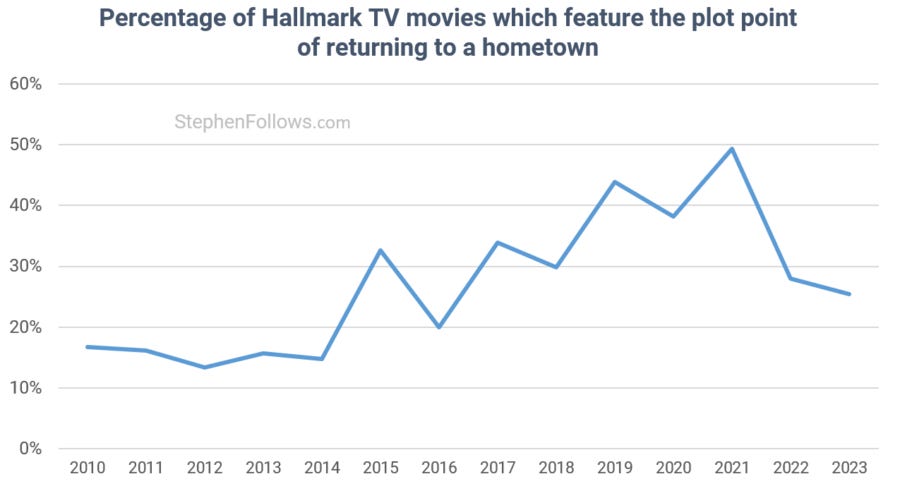
The location being a feature of the plot is a growing trend for such movies. I was surprised to discover just how many such movies have the theme of returning to a hometown. Given the rise over the past decade, this must be a conscious choice on behalf of the execs at Hallmark.
4. Know thy audience
Hallmark defines their audience as “Women aged between 25 and 54″ and say “we don’t like to stray far from what we do. It’s kind of a ‘if it ain’t broke, don’t fix it’ mentality”.
5. Honour the family, but don’t tell their tales
The Hallmark bible defines the content of their TV movies as “…very family friendly and PG/G in nature. A rule of thumb when watching our movies is you want to be able to watch with your 80-year-old grandmother and your 5-year-old niece/nephew“.
Further, guidance declares, “We don’t do cursing, dirty jokes, innuendos etc.” and “We can’t say the Lord’s name in vain“.
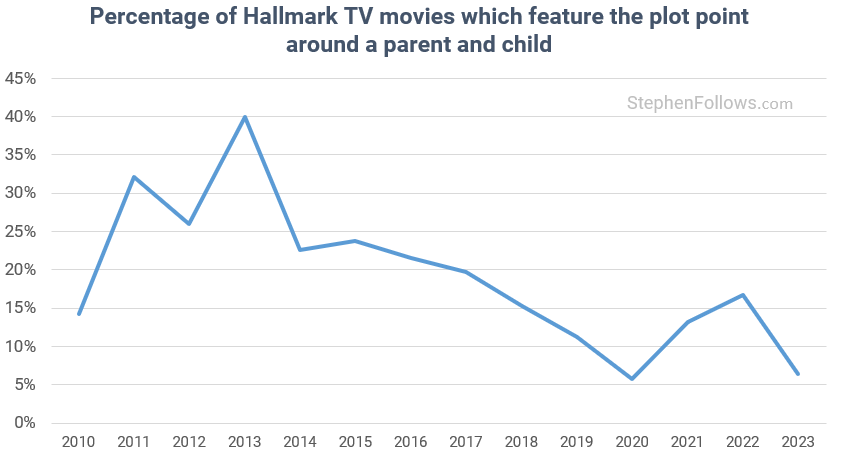
One detail that stuck out to me was that although Hallmark wants to appeal to family audiences and to stay ‘family friendly’ when it comes to objectionable content, they are losing interest in telling stories primarily around family dynamics.
6. Seasons are sacred
And probably one of the things they’re most famous for – Christmas is a BIG deal for them.
“Lean into the holiday/give leads a POV about the holiday (this is especially the case for Christmas. We like a lot of holiday traditional elements and, more importantly, to give our leads a strong point of view of the holiday).”
“If the movie is for a specific season (Valentine’s Day, Spring, Summer etc.) we like that season to almost feel like a character in the movie with lots of imagery.”
“We also like to see our characters doing lots of wintery/Christmassy things -ice skating, baking cookies, sledding, building snowmen, making snow angels, kissing under the mistletoe, hanging stockings, drinking hot chocolate, picking our or cutting down a Christmas tree, decorating the .house/tree with holiday decor etc.”
“For Christmas -we always need snow or the remnants of snow and lots of holiday decorations (in a tasteful way).”
If the movie is for a specific season (Valentine’s Day, Spring, Summer etc.) -we like that season to almost feel like a character in the movie with lots of imagery.
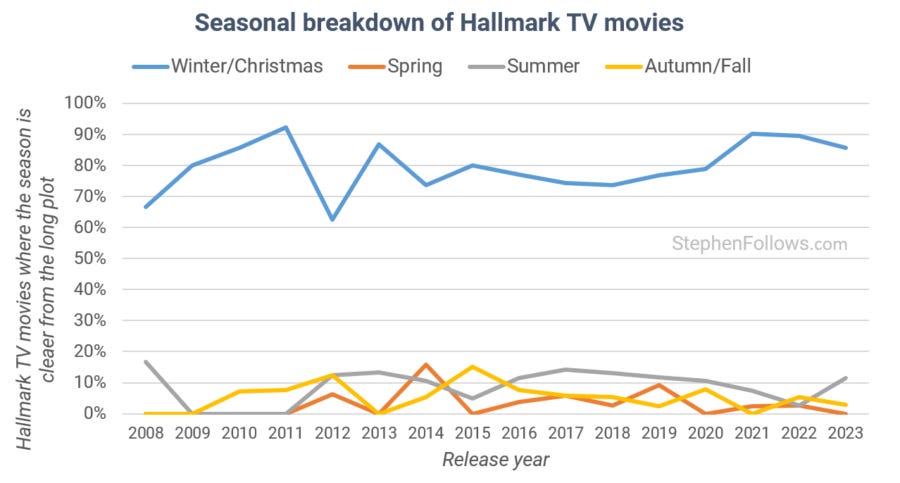
And all this works!
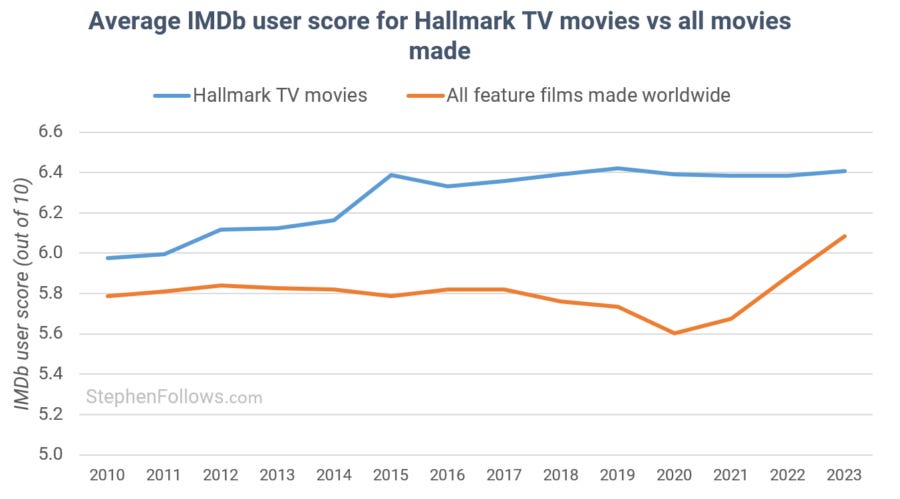
It can be easy to be cynical about the quality of TV movies, especially when comparing them to epic, arthouse film festival darlings (well, not all), but this is an unfair comparison. Hallmark deeply understands its audience and consistently delivers what it wants.
This is reflected in the IMDb audience scores for the movies, which are meaningfully higher than the average feature film. Over the past 14 years, Hallmark movies have had an average IMDb user score of 6.3 out of 10, whereas when we look at all movies made, they have had an average IMDb user score of 5.9.
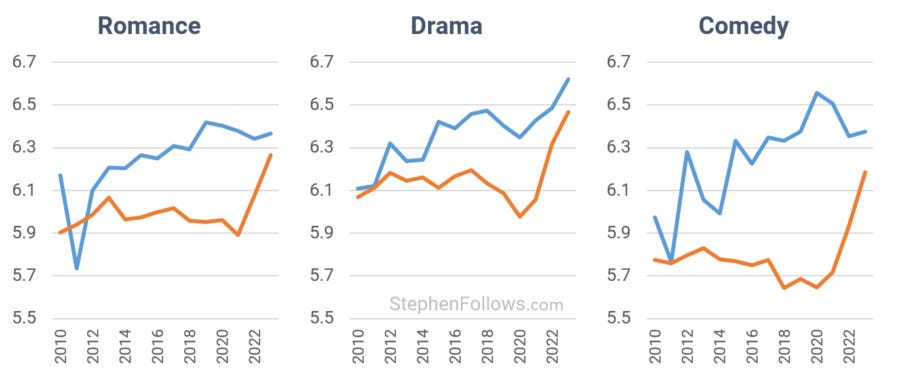
This is especially true in the core genres they seek to serve.
So there you have it - a whistlestop tour of Hallmarks’ Christmas machine.
Note
I’ve been a bit loose with some of my wording for simplicity’s sake and because I know I have a wide range of readers, some very knowledgeable about the intricacies of the film industry and some who are new to the topic. So here is a little more on the ‘inside baseball’ of the Hallmark marketplace.
I have lumped all “Hallmark TV movies” together, as if they have a single route to market. In fact, Hallmark sources these titles in two ways. About three-quarters of them are bought or licensed from outside production companies, with Hallmark only making the remaining quarter in-house. They seem to spend more money than the latter group. The budgets for the licensed titles seem to be around half a million dollars or less, whereas their in-house productions sometimes go over $2 million.
Wanting to watch a feel-good movie might be a universal desire, but the commercial market for these particular movies relies very heavily on the domestic audience. Their in-house productions are made for their own channel, with international sales bringing in a few hundred thousand dollars at most.
So, while it’s true that Hallmark isn’t making most of the movies directly, it is clearly the market-maker and the principal buyer.
If anyone wants to look at a good case study of a company pumping out such movies, check out the work of MarVista Entertainment, who have over 700 titles under their belt.
Great post! But I am curious about the bowling ban - any quotes or evidence on if it’s a production nightmare (ie location costs, sound problems, lighting issues?) or a story issue (ie Hallmark audiences don’t bowl, bowling attracts hooliganism)??