


On Monday, Robert Pattinson was announced as the next James Bond. Few people saw this coming, not least because he's the first film star to get the job.
When Sean Connery was cast, he hadn’t been the first-billed actor in a feature film, and George Lazenby hadn't even been in one. Pattinson has been first-billed in 12 and has already carried Twilight and The Batman. He sits around 131st on IMDb's fame ranking (Daniel Craig was around 818th when he got the part).
I have engaged with this news in two ways:
A fun video under my guise as The Film Data Scientist.
An article with a bit more of an industry focus. See below this video.
The video above is the fun version of that story. Now let’s look at the version for those of you who have to make these decisions for a living.
I’m going to tackle two things:
Does Robert Pattinson’s past work look anything like Bond films?
What does a film series actually get when it hires a star?
For the first, I ran 13,487 films through a custom-built, over-engineered Bond detector. For the second, I went through every film series in my database and found 474 occasions when a running series handed its lead role to someone new, and looked at what happened next.
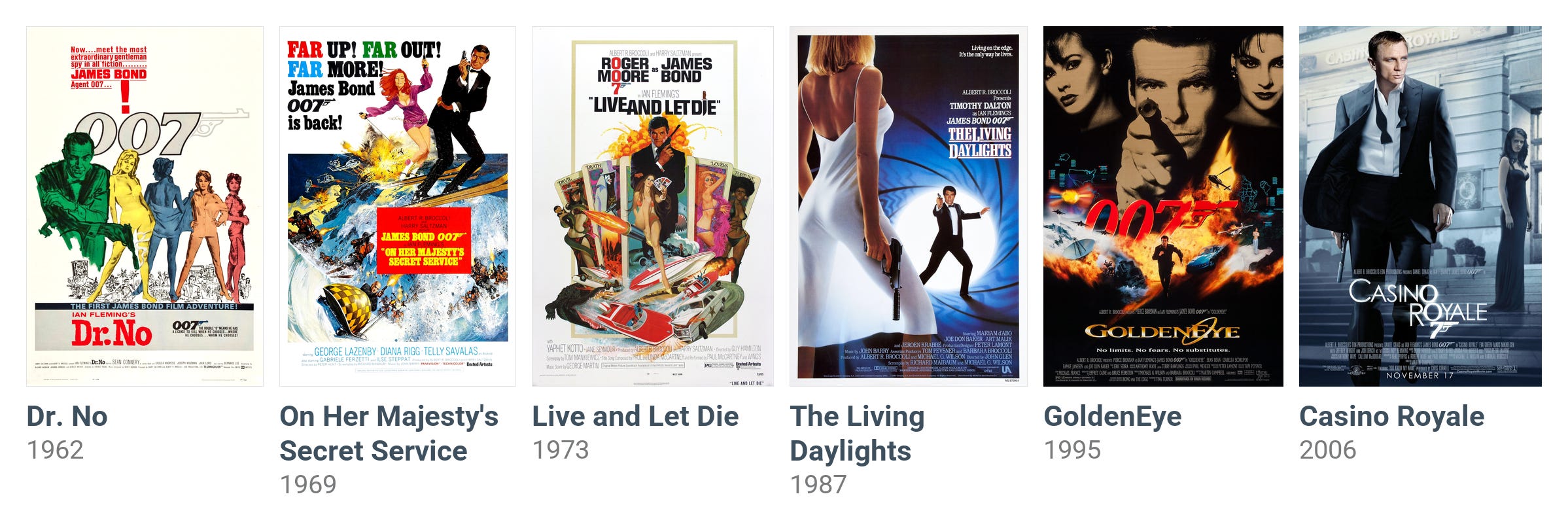
Do Pattinson's films look like Bond films?
Let's start with the detector. I studied 13,487 feature films and scored a whole host of visual, audio, and quantifiable data points from each. This let me determine a Bond film's fingerprint and rate every other movie on that scale.
On the chart below, every dot is a film.
Left to right is how much it looks like a Bond film.
Bottom to top is how much it looks like an action film.
Robert Pattinson's 29 films are in orange, and the ten directed by the next Bond director, Denis Villeneuve, are in teal.
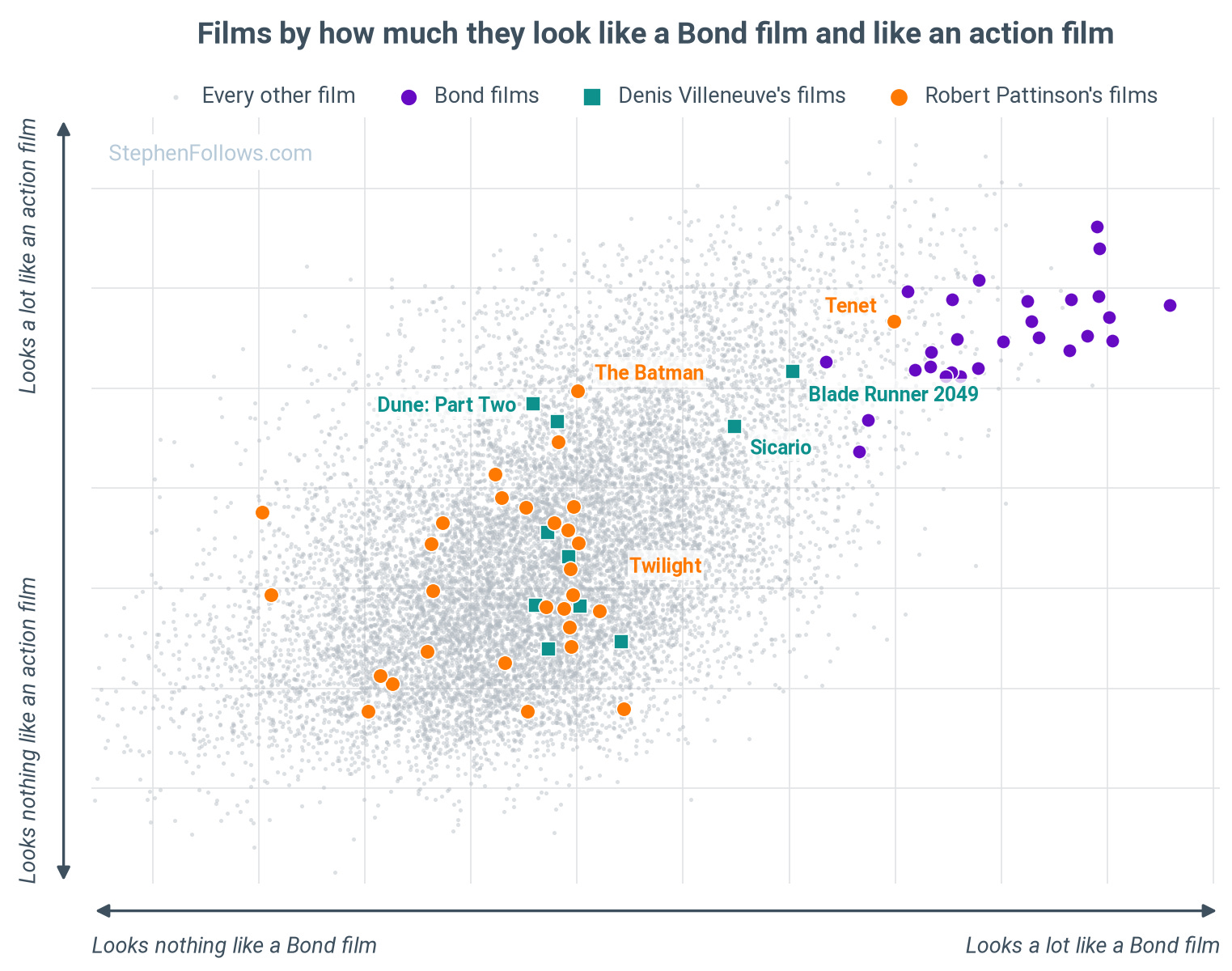
As you'd hope, the Bond films sit together in the top right corner. Among the other films, 97% score lower than the least Bond-like: Casino Royale.
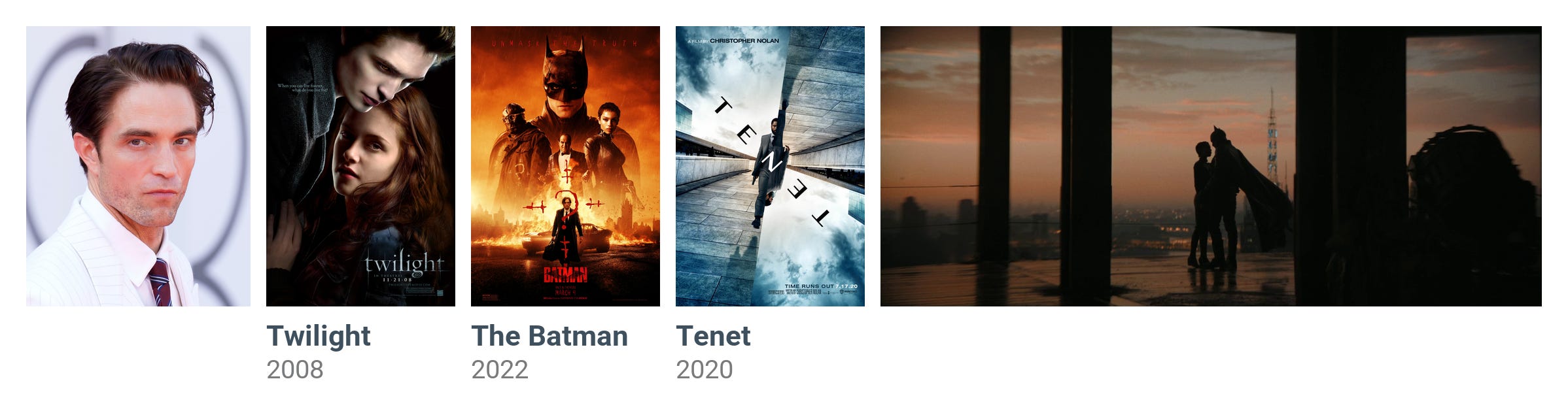
Only one of Pattinson's films is up there. Tenet looks more like a Bond film than 99% of the library, while his typical film sits in the middle (ahead of about half of all films), and The Batman looks a lot like an action film but not much like a Bond film.
Villeneuve is much the same. Blade Runner 2049 looks more like a Bond film than 95% of films, and Sicario more than 90%, but his typical film is ahead of 55%, and both Dune films sit around the middle.

Who has been making Bond films all along?
With a detector, I can also ask the opposite question:
Which actors and directors, with no connection to Bond, have careers which look the most like it?
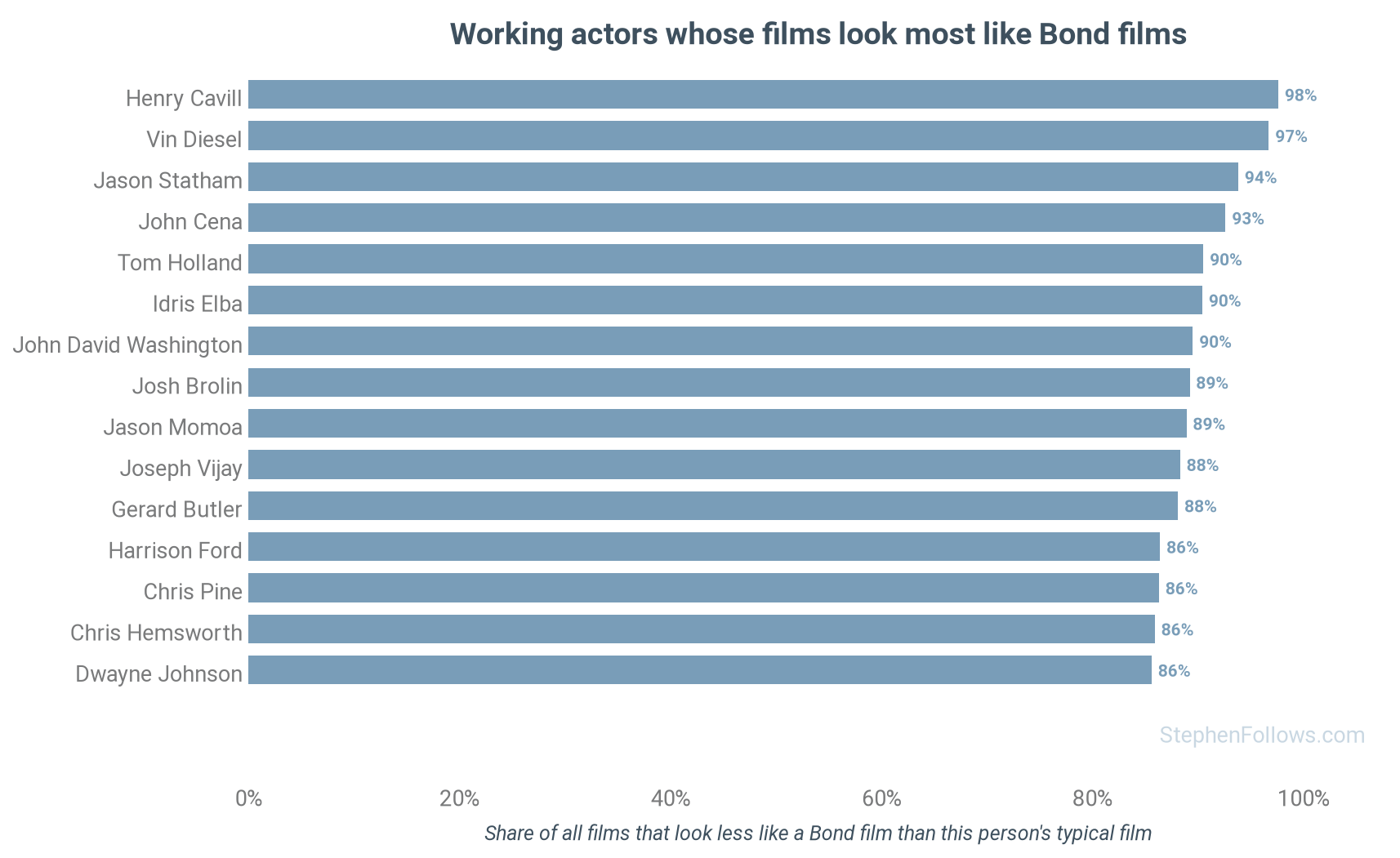
For actors, I took everyone who has been first-billed in at least five live-action films in my dataset, has never appeared in a Bond film and has had a film out since 2022. That left 252 people, whom I ranked by how Bond-like their typical film is.
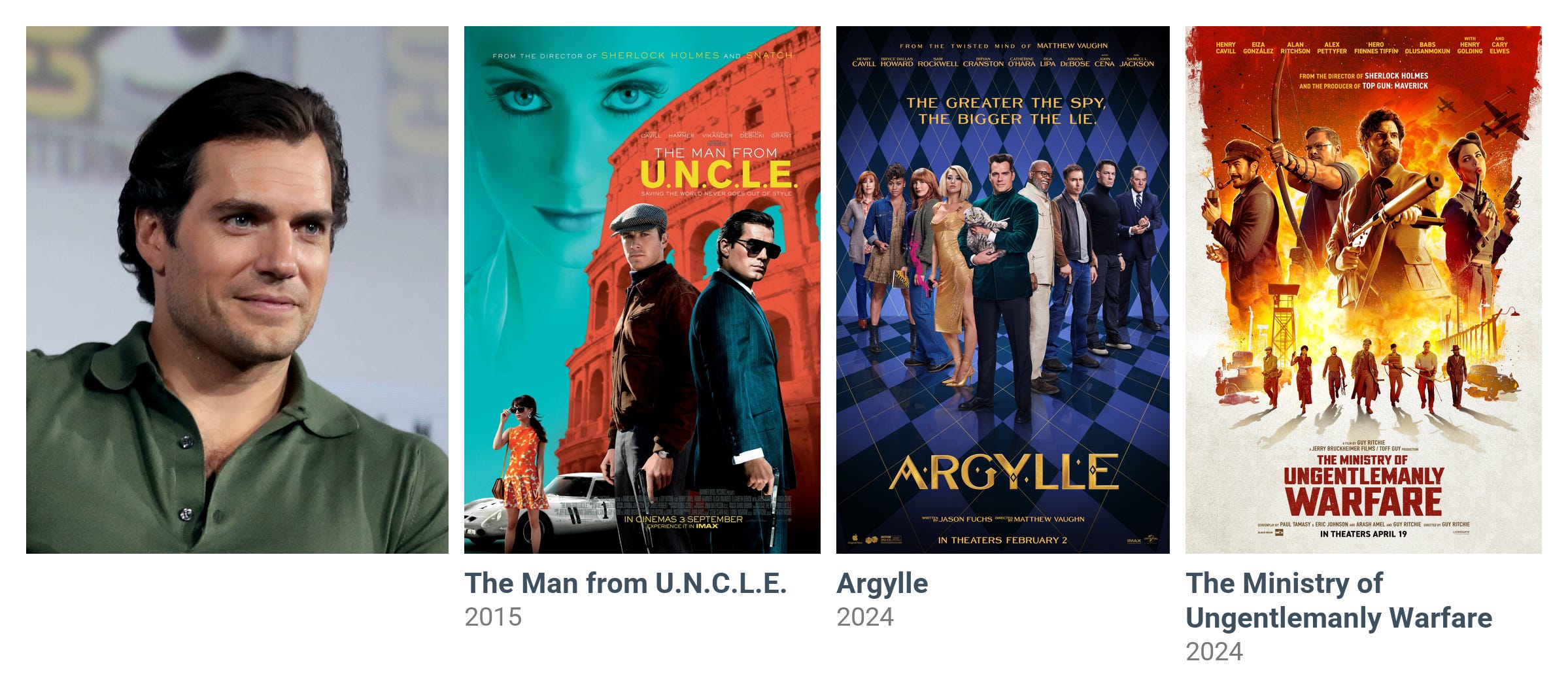
Henry Cavill is top. His typical film looks more like a Bond film than 98% of the library, and six of his nine first-billed films are in the most Bond-like 5% (including The Man from U.N.C.L.E., Argylle and The Ministry of Ungentlemanly Warfare).
Thanks to the Fast and Furious films, Vin Diesel is second, with Jason Statham third and Idris Elba sixth. Tom Cruise is 17th, although 14 of his 37 films are in that top 5%.
Pattinson is 116th of the 252.
When I ran the same exercise for directors (five or more films in my dataset, never directed a Bond film, a film out since 2022), I was left with 241 people.
Christopher McQuarrie is top, thanks to four Mission: Impossible films. In second place is Siddharth Anand, who directed the Indian spy films Pathaan and War, and third is Matthew Vaughn with the Kingsman films. Christopher Nolan is seventh (Inception, Tenet and Batman Begins are all in the top 5%).
Villeneuve is 120th of 241.
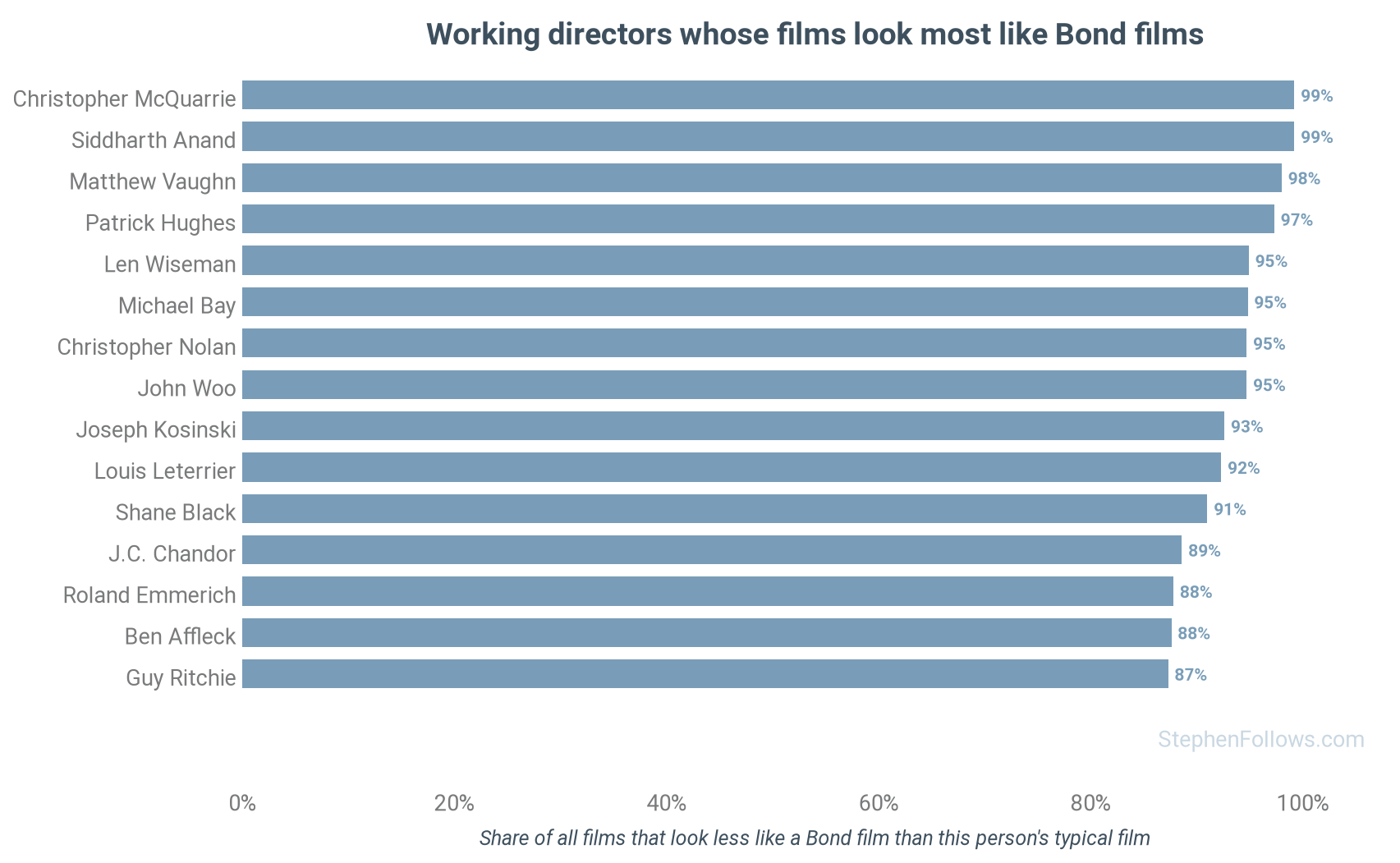
So the star and the director of the next Bond film each sit almost exactly halfway down a list of the people whose past work feels Bond-esque.
That’s not to imply that any future Bond film should be the average of those that came before. The least Bond-like Bond film is Casino Royale, and it's also the highest-rated on IMDb.

What it does show is that Amazon have cast a wide net creatively, and hired beyond the obvious ‘Bond box’. They went for mastery over mimicry.
Will this pay off? Obviously, we won’t know the creative output until we see the film they make together. But we can cast our eyes back to other instances where a franchise was put in the hands of an already established actor.
What happens to the takings when a series changes its lead?
When assessing the business case, we need to benchmark against expected performance. I looked at the data behind sequels' financial performance and noted whether the lead was the same or different.
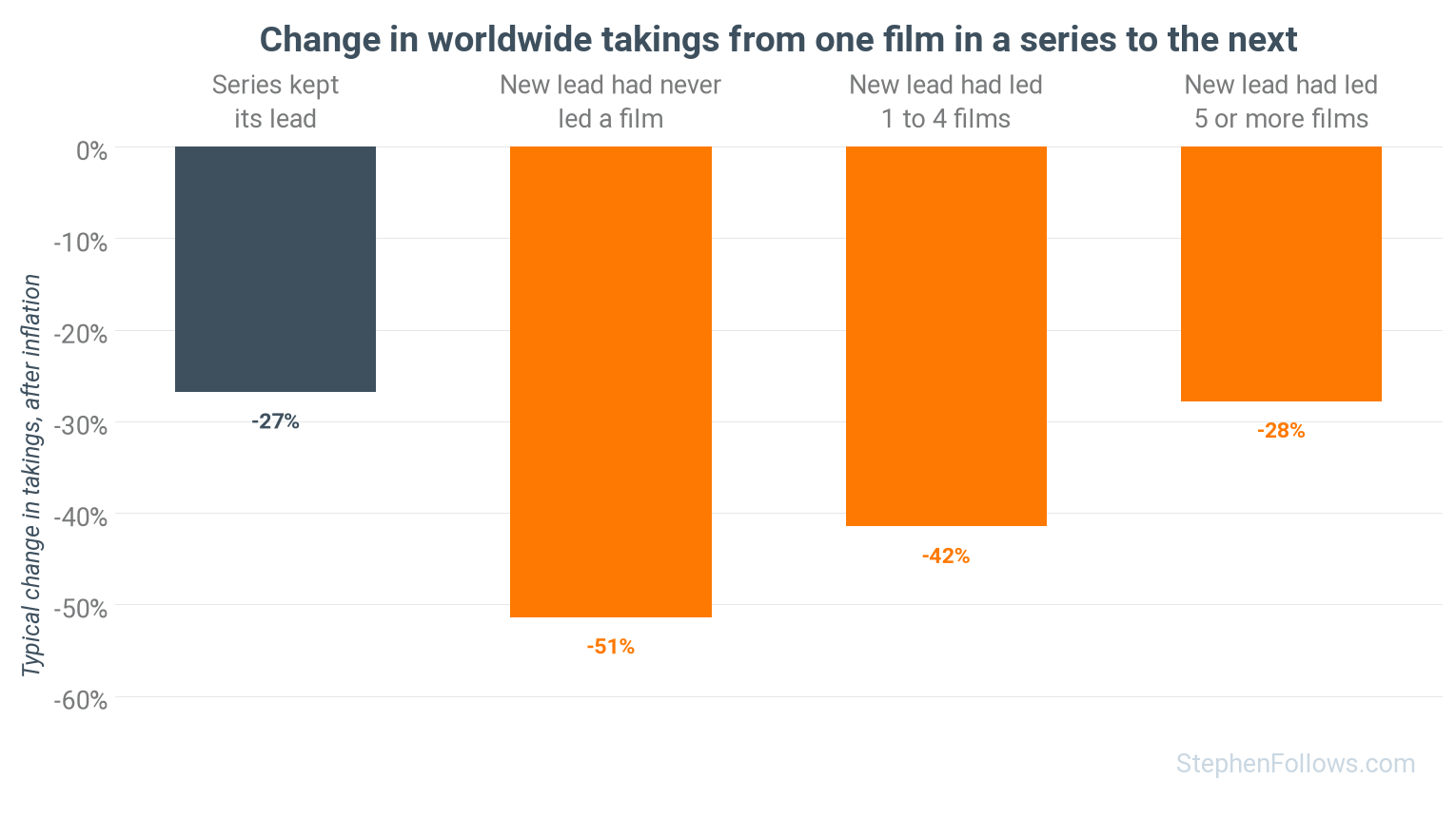
When a series keeps its lead from one film to the next, the follow-up typically grosses 27% less at the worldwide box office (after adjusting for inflation).
In the chart below, you can see the typical change (the median, i.e. the middle value) for 436 lead changes since 1960 where I have box office figures for both films, grouped by how many films the new lead had already been first-billed in.
If the new lead had not previously headlined a film, takings typically fell 51%.
With one to four earlier leads, they fell 42%.
With five or more, they fell 28% (almost exactly what happens when nobody is replaced at all).
So an untested lead is a risk.
For films since 2001, IMDb's STARmeter (a weekly ranking of how often each person is looked up on the site) tells the same story. New leads from its top 500 were followed by a typical fall of 23%, and those ranked below 5,000 by a fall of 44%.
However, a softer fall is not growth.
Only 115 of the 436 lead changes (26%) were followed by a bigger film, about the same as for sequels which kept their lead (28%). And on that measure, the stars have no edge at all. Among films with a top-500 lead, 31% beat the previous film, and among those with a lead ranked below 5,000, 33% did.
Does a star keep the series going?
Often, a change of lead signals a series in trouble. To see how much trouble, I took the 366 changes of lead up to 2019 (which gives each series time to make another film) and looked at what came next.
About half of the series never made another film, and that barely moves with the fame of the new lead. After hiring a first-timer, 47% carried on. After hiring someone with five or more leads behind them, 48% did.
Nor does the new lead tend to stay. Only 35 of the 366 (10%) went on to lead a second film in the series.
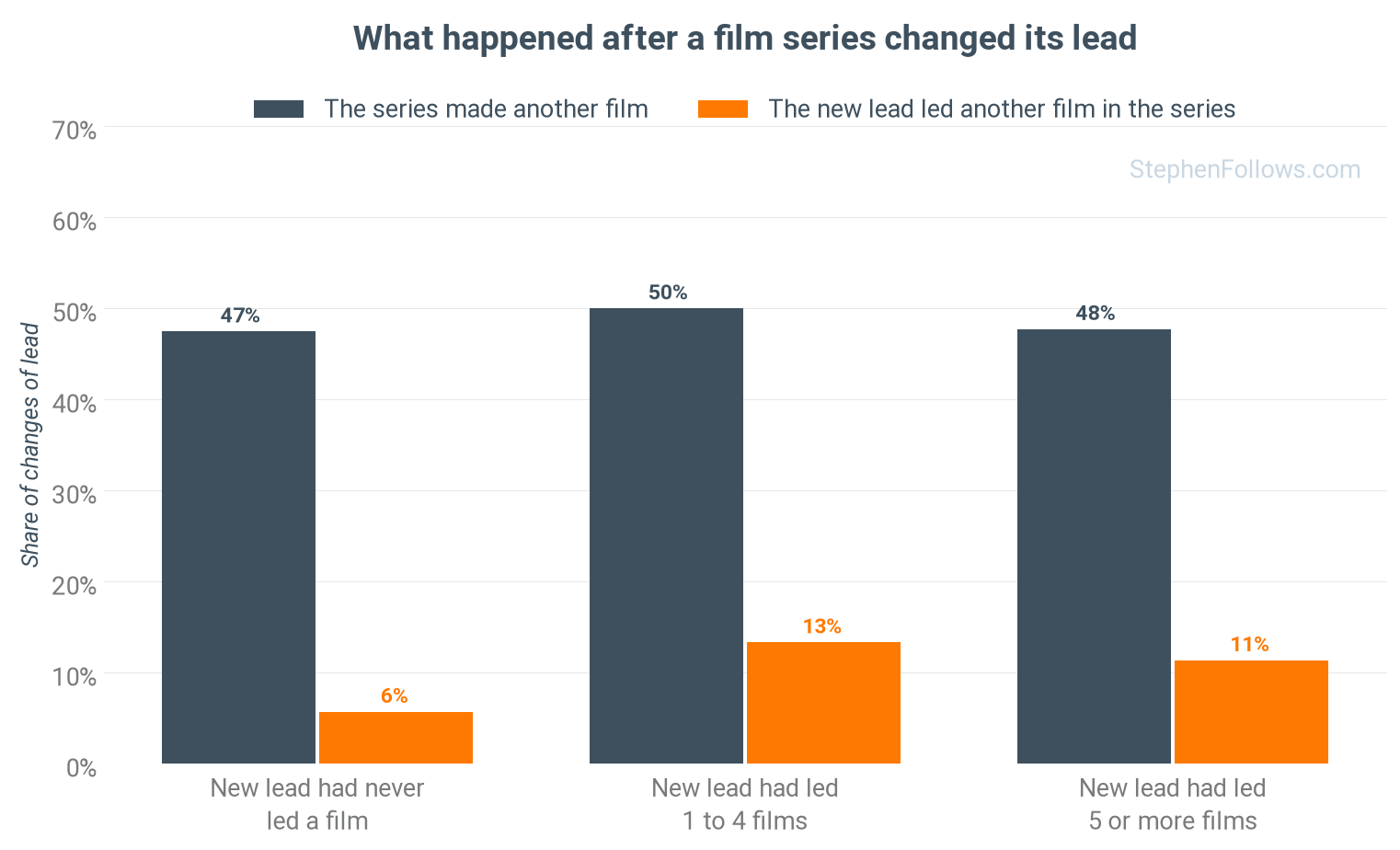
Bond is the exception - five of the six Bonds came back, and between them they've made 25 films.
Is Hollywood casting more stars in these roles?
The Bond star casting bucks the recent trend of Hollywood being less likely to insert a star into an existing franchise.
For the chart below, I took the 292 lead castings since 2001 in major series (those whose biggest film took $200m or more in 2025 dollars) and calculated the share that went to someone already in the STARmeter top 500.
There’s no upward trend. From 2001 to 2005, the share was 44%, and from 2021 to 2026, it was 28%. With between 47 and 70 castings in each period, a swing of ten points is within the noise, so the recent fall is the only move I’d take seriously.
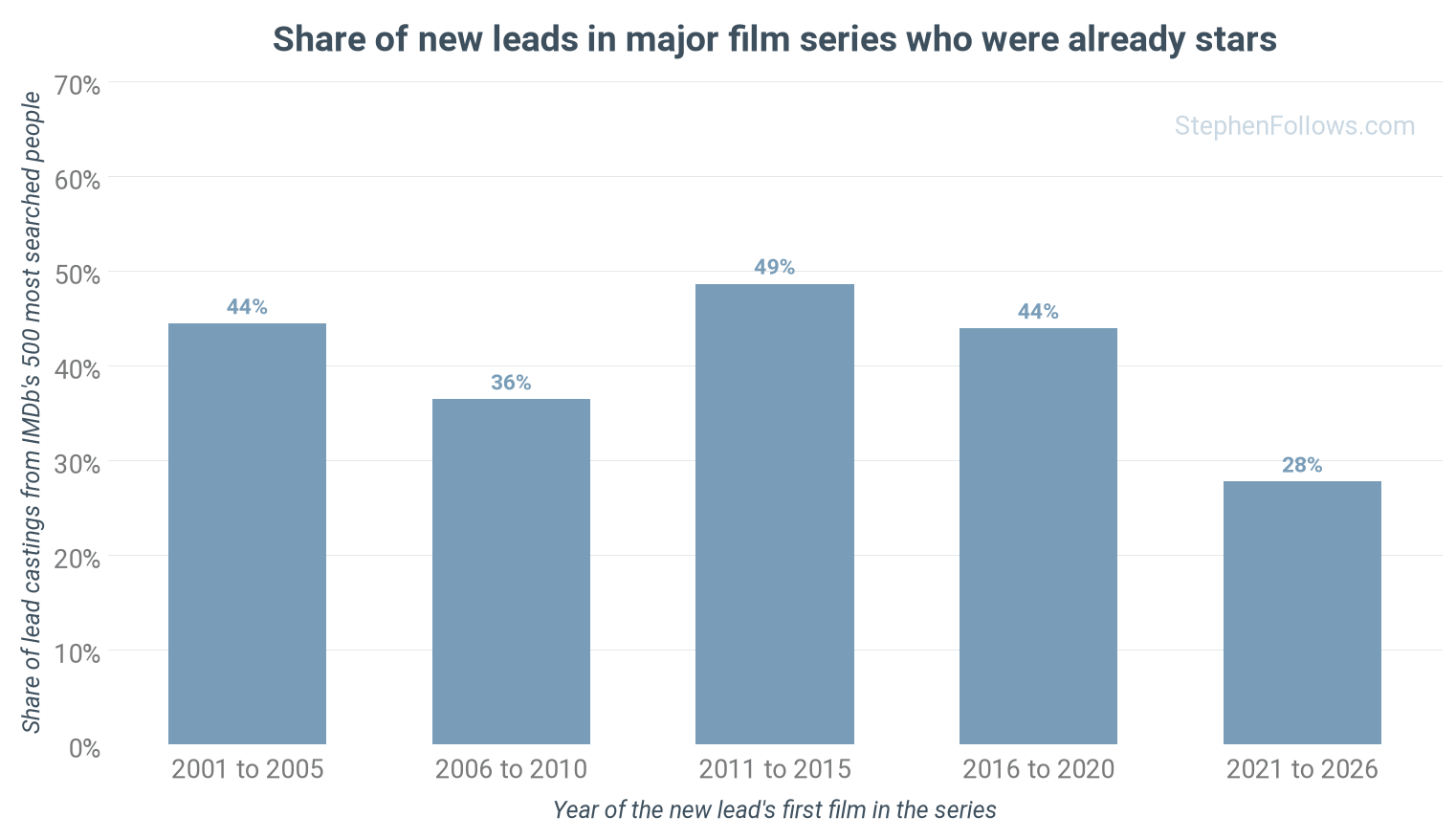
The big series have lately been hiring cheaper and less familiar leads, and Pattinson's casting runs counter to this.
What about the characters who keep being recast?
James Bond belongs to a small club of characters who have outlived several of their stars. In my data, the five most recast heroes are Bond, Batman, Superman, Spider-Man and Jack Ryan, with 18 recasts between them.
The chart below shows the change in takings for each one, compared with the film before.
Here the pattern flips. The ten new leads who weren’t established (fewer than five first billings, and outside the STARmeter top 500) were followed by a typical rise of 19%, and six of the ten beat the film before. By contrast, the eight established stars were followed by a typical 10% fall, and three of the eight beat the film before.
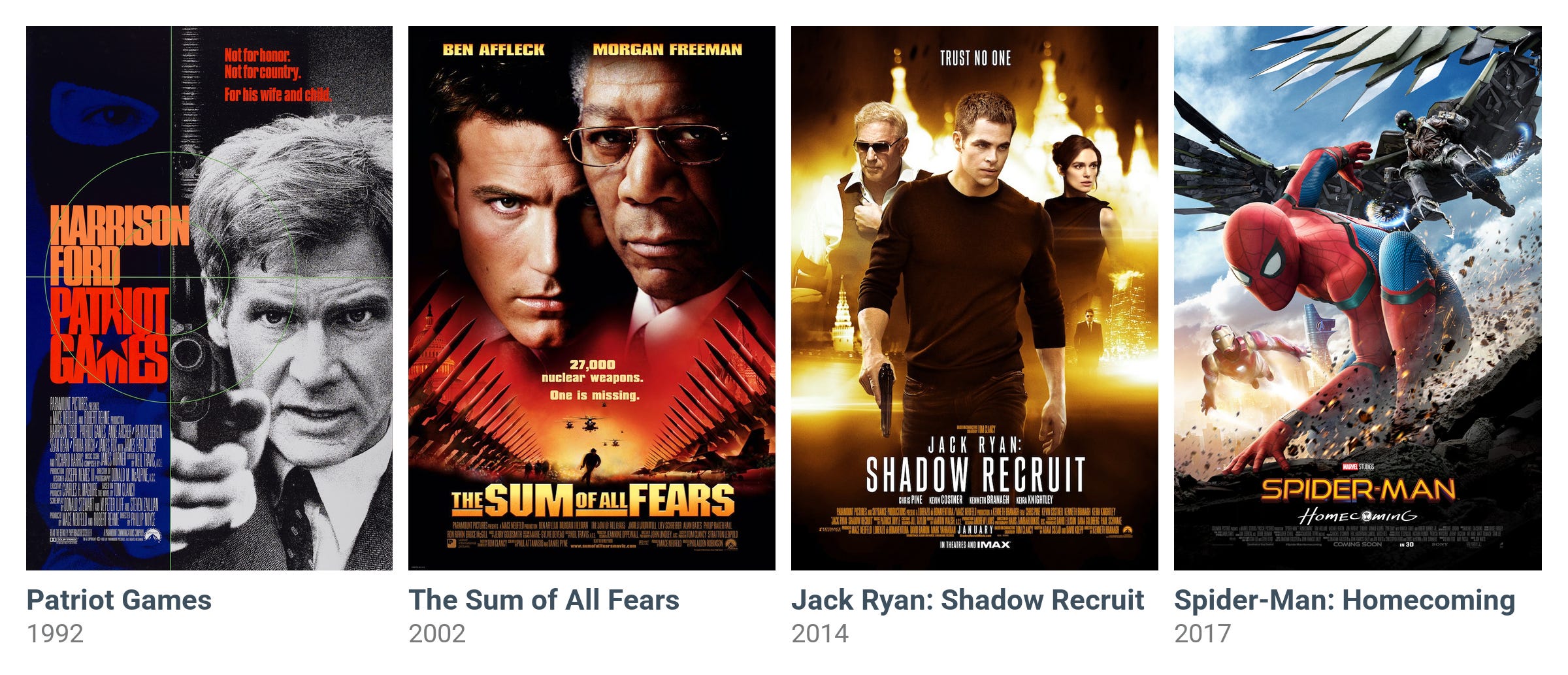
Jack Ryan hired three stars in a row (Harrison Ford, Ben Affleck and Chris Pine) and shrank each time, whereas Spider-Man hired Tom Holland, who had never been first-billed in a film, and grew.
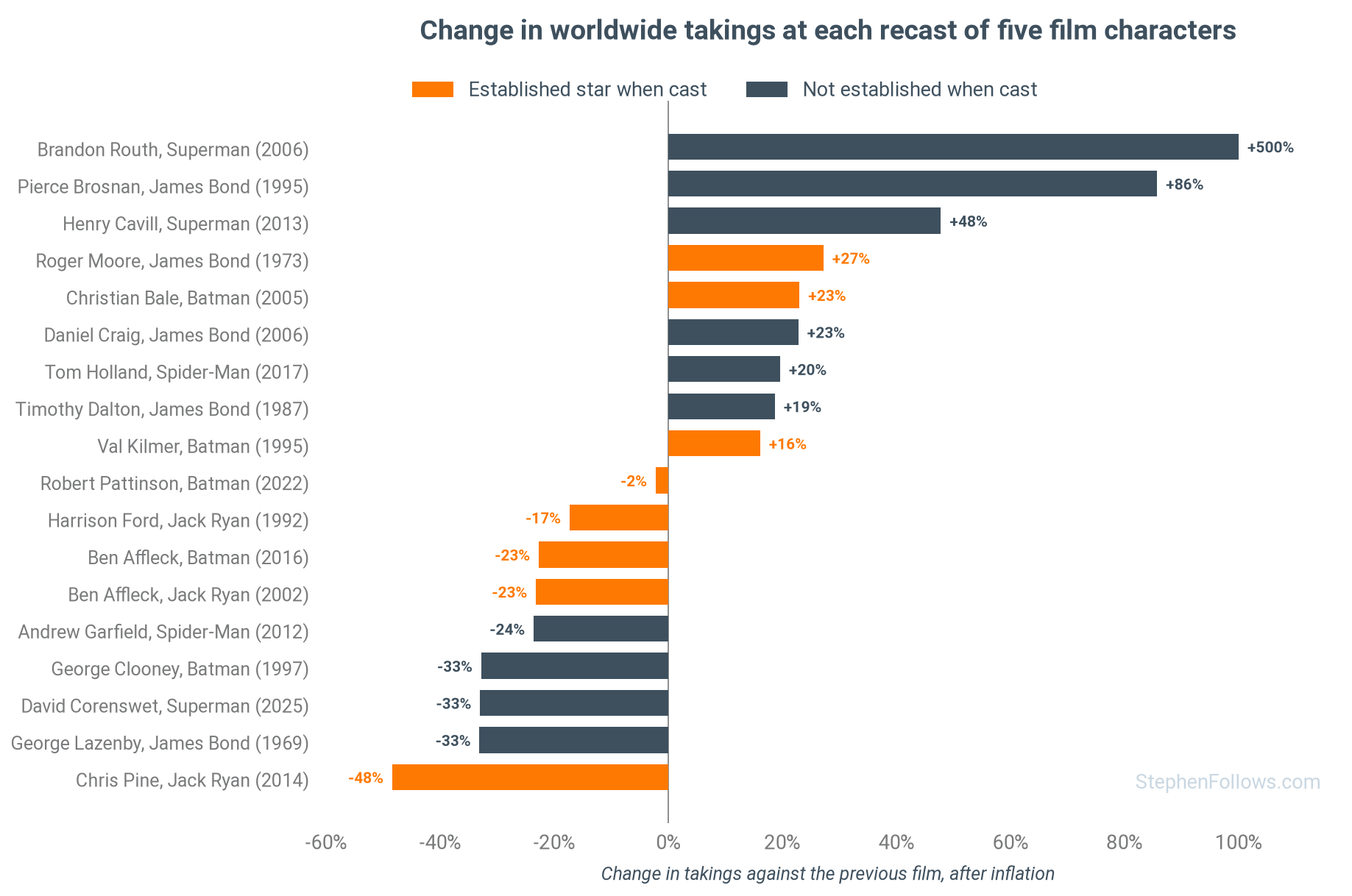
Of course, this is only 18 films, so it's a pattern to look at and not a result to lean on. Three of the comparisons also span a reboot or a long gap. On the chart, Brandon Routh's bar is cut short because his film is measured against Superman IV: The Quest for Peace, which came out 19 years earlier.
Bond itself is the cleanest case. In real terms, four of the five new Bonds' first films took more than their predecessor's last film, and only one of those four men (Roger Moore) was established when he got the job. For Pattinson, the bar is No Time to Die, which took $902m in 2025 dollars.
He has been here before. When Pattinson took over as Batman, The Batman took 2% less than Justice League, the film before it in the series, though it did so on a little over half the budget and with a Metascore 27 points higher.
Epilogue
At the end of the day, none of this will matter when the new Bond film emerges (in 2028, maybe?).
If it’s as good as the past films of its star and director, then Amazon will be showered with praise. But if it follows a path reminiscent of the waning, constantly rebooted DC cinematic universe, we can expect a flurry of people claiming it was doomed the moment the casting was announced.
Personally, I’m excited. I think both Robert Pattinson and Denis Villeneuve are fantastic artists at the top of their game. With Amazon backing them, they will hopefully not want for budget or support.
Notes
The film series, order of the stars, and ratings come from IMDb. Box office and budgets come from OpusData and The Numbers, adjusted to 2025 dollars with the US consumer price index.
A film series is any group of two or more live-action feature films filed under one franchise name. A film's lead is the first actor in IMDb's star order. A change of lead is the first time someone leads a film in a series they had not appeared in before. Of the 474 I found, 102 are the same character played by a new actor (Bond, Batman, Jack Ryan) and 372 are a new lead playing a new character in a running series. 436 have worldwide takings for both films.
I've left the first films of series out of the takings and survival figures. A series only enters the data once it has a second film, so every first film would look like a success.
'Established' means five or more earlier first billings, or a place in the STARmeter top 500. The STARmeter rank is the middle rank over a year which ends 30 months before the film came out, which is early enough to sit before most casting announcements. For the Bonds, I used the year before the announcement.
IMDb's star order is not always the lead. For example, Batman & Robin lists Arnold Schwarzenegger first. I corrected the cases I found in the named series, and I haven't checked every small series film by film.
The video counts Pattinson's leading roles as films in which he was billed first or second, which gives 24. This article counts first billing only, which gives 12.
Animated films are left out of the lists of actors and directors, and anyone with fewer than five films in the library isn't ranked.
'Typical' means the median throughout.