


This article is part of my ‘Big Ideas’ series, in which I explore the evolving landscape of the film industry. Each instalment combines data, research, and analysis to go deep on a trend, idea or case study to reshape the film business over the next decade.
There is a hard truth about cinema-going that many in the exhibition sector don’t seem to want to admit.
When you ask the public why they don’t go to the cinema more often, one reason always appears on top. But in the many conversations I’ve had with industry insiders over the years I’ve heard repeated denials or downplaying of this factor.
Today I’m going to look what the data says, detail the industry's strange resistance to reality, and share an interview I conducted with Tim Richards, Founder and CEO of Vue International, who has completely changed his mind on this topic.
What is the biggest barrier to cinema-going?
So what is this common barrier? Is it the screening technology, the seats, the on-site facilities, the cleanliness, the movies on offer?
Nope. It’s price.
To illustrate my point, I’ve gathered survey data from a range of countries that asked people directly about what stops them from going to the cinema more often.
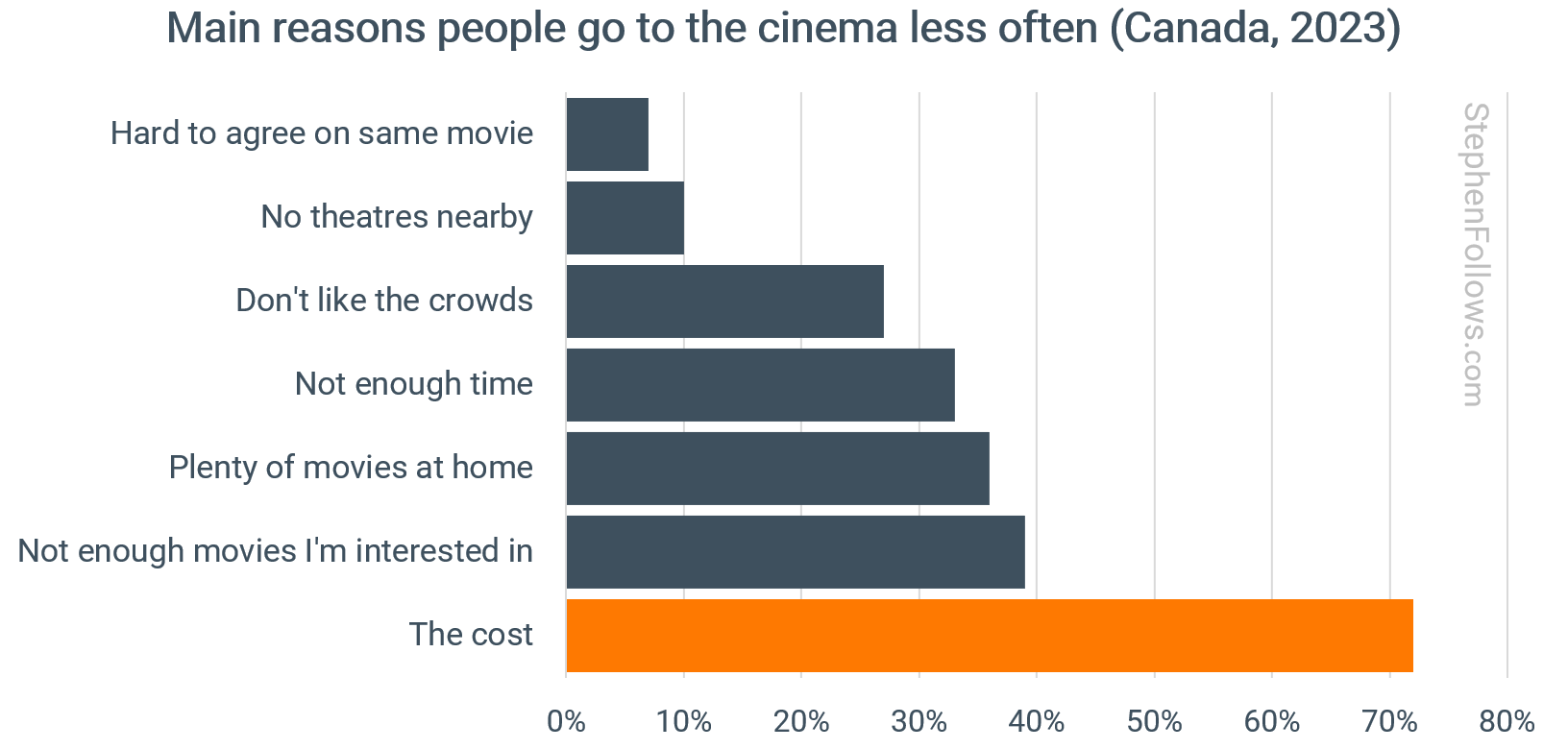
Let’s start in Canada where a 2023 Telefilm survey of 2,000 Canadian adults found that 72% of surveyed Canadians cite the cost of tickets as the main reason they don’t go more often, far ahead of any other factor.
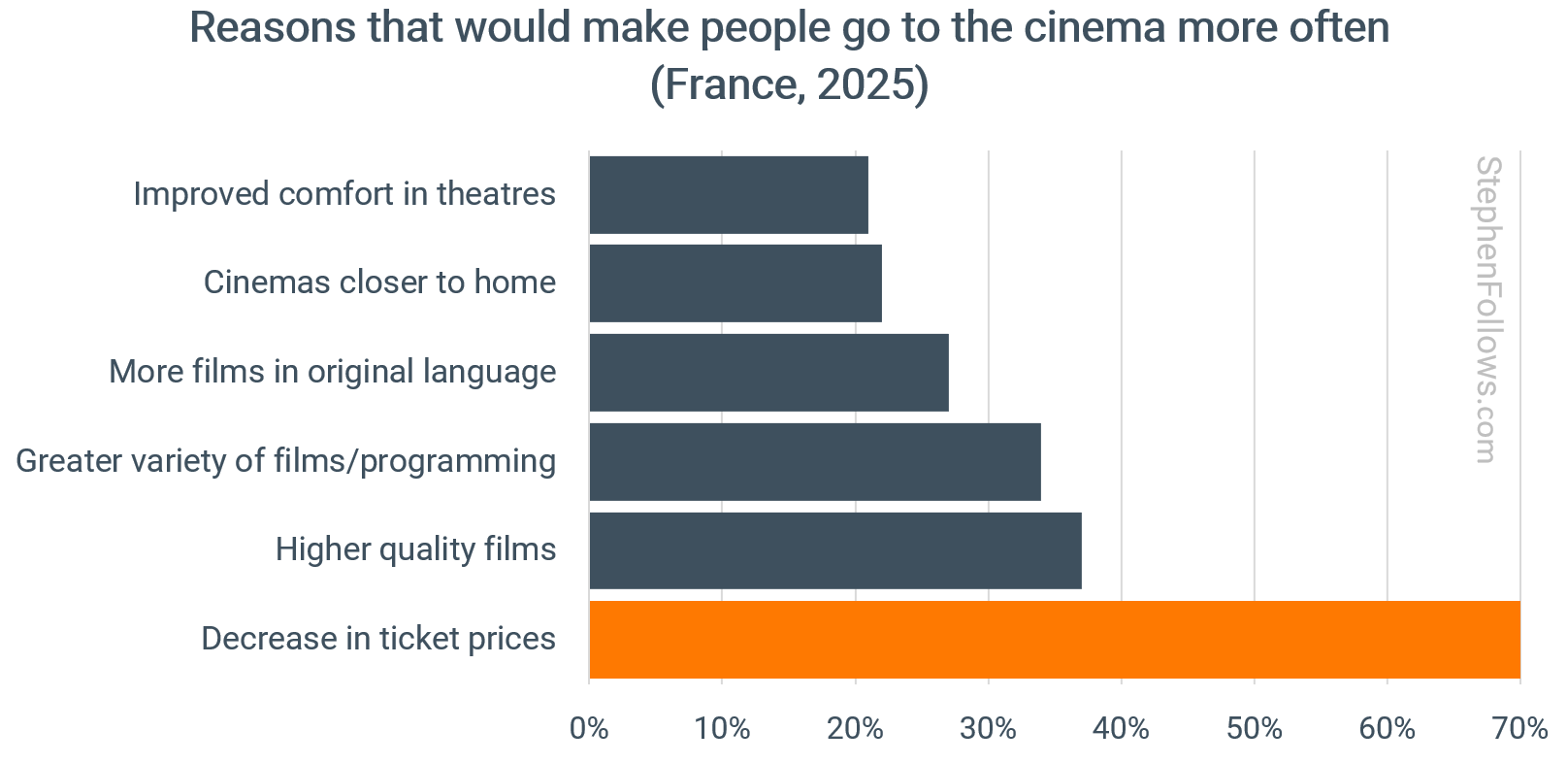
In France, a recent Ipsos–CESI study of 1,000 French adults found that 67% respondents said a rise in ticket prices would make them go to the cinema less often. At the same time, 70% said lower ticket prices would encourage them to go more frequently.
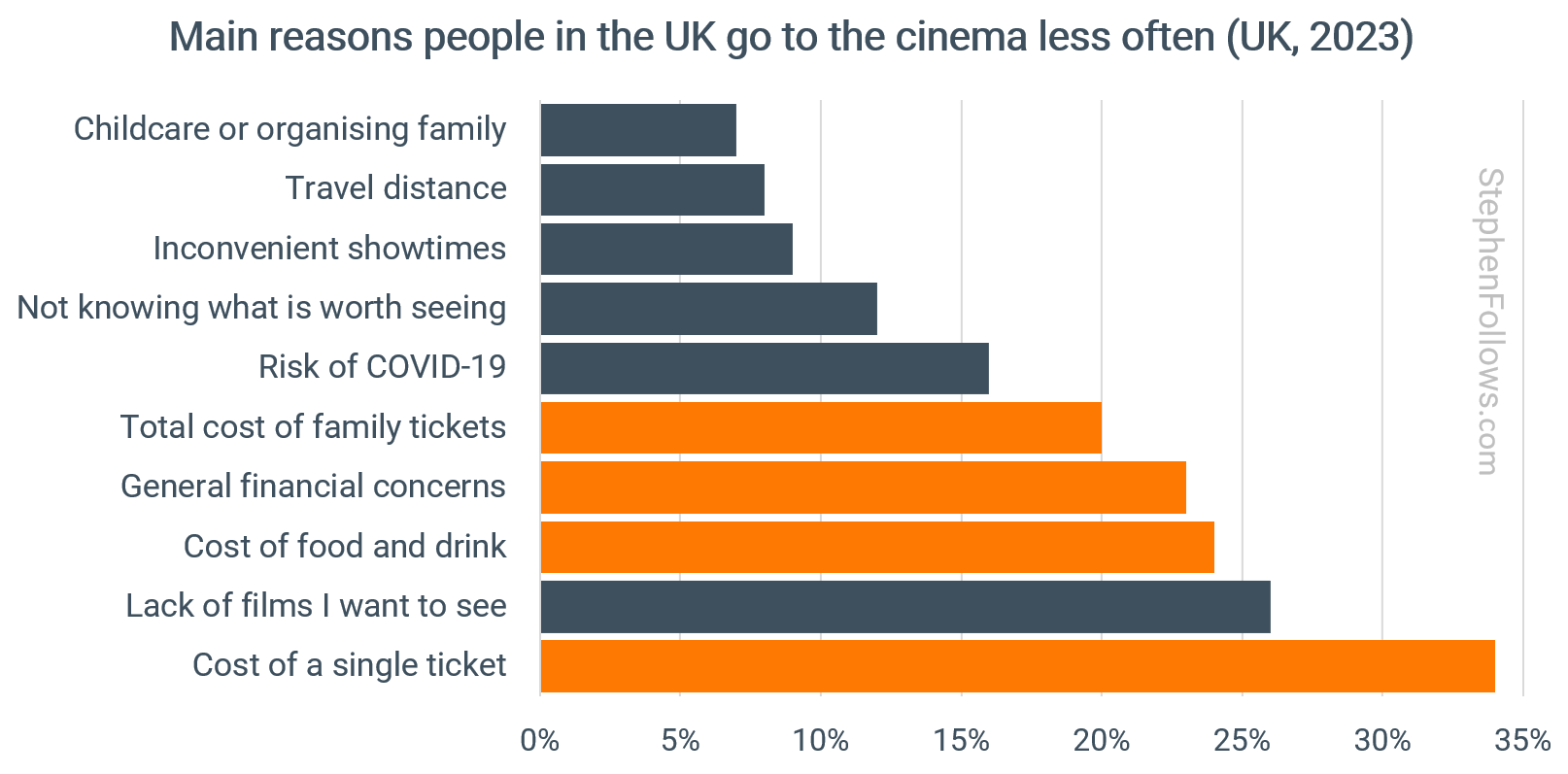
In March 2023, the BFI surveyed 5,000 UK adults for their “The Wider World of Film” report and found that the single biggest brake on cinema-going is cost. 34% of adults named the cost of a single ticket as the main reason they went less often.
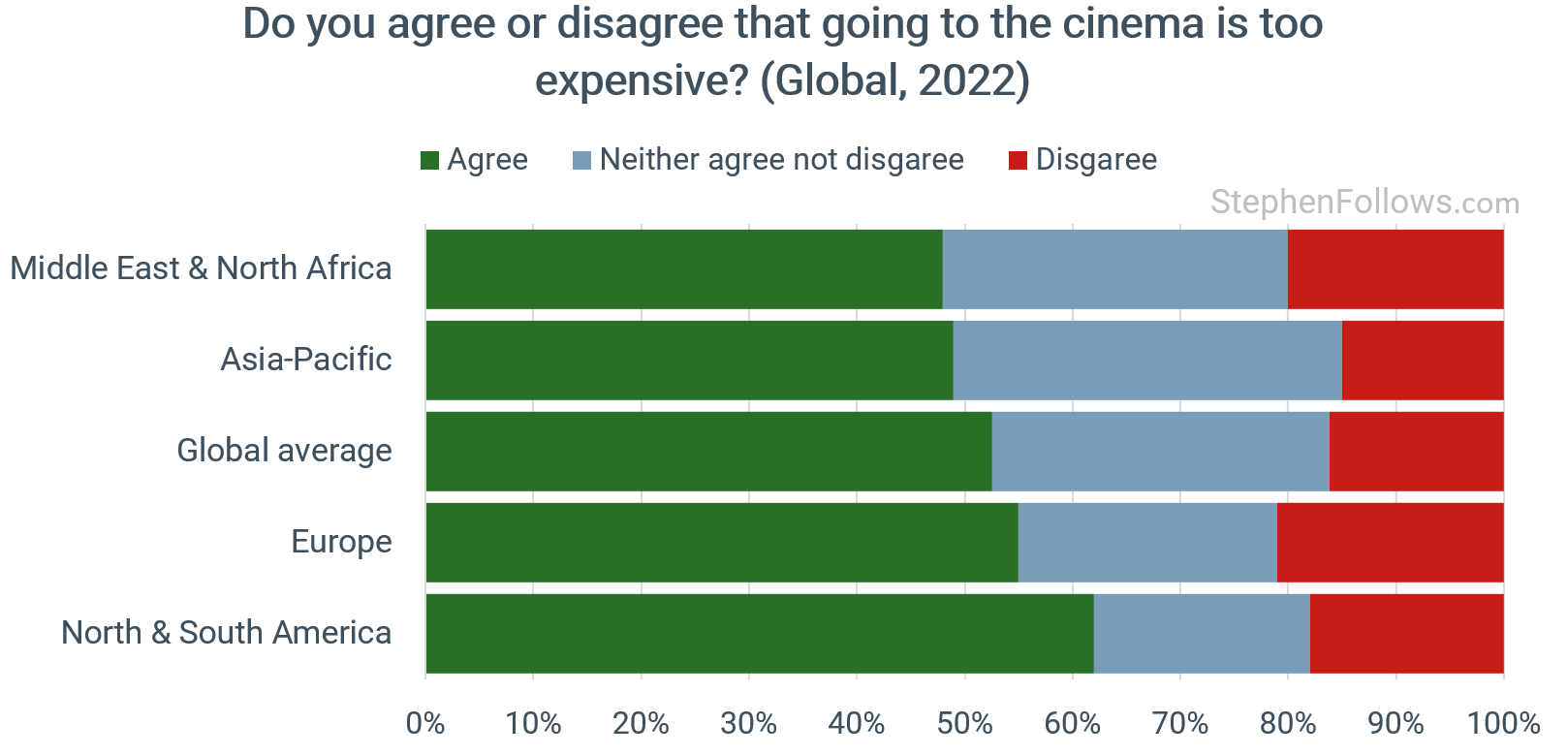
If we zoom out to take a global view, the picture remains the same. A YouGov study carried out in August 2022 asked people whether they agreed with the statement “Going to the cinema is too expensive.” Half of respondents agreed, with only a minority disagreeing.
Modelling suggests that lowering the cost could have a big effect on attendance overall. A study of 5,000 Italians in 2022 by the Italian cinema association ANEC, modelled different post-pandemic recovery scenarios. They found that when tickets are priced at €8, attendance could rise by as much as 69%. At €12 the projected increase dropped to just 5% and two-thirds of regular cinema-goers disappeared.
What is the cinema industry’s reaction to this?
By now you have seen a pretty overwhelming case that the public say that price is a major barrier to increased cinema attendance. And yet if you were to speak to people within the exhibition sector of the film business you would get a very different view.
In 2014, Tim Richards, CEO of Vue International, told the Screen Film Summit that:
Any dialogue that helps drive attendance is a good thing but pricing is not it: absolutely not it.
We’re in an industry in which people will pay virtually anything to see a film they really want to see. If there is a film they do not want to see they will not go even if it is free.
Pricing is typically third or fourth on the scale [of concerns]. Parking is number one.
And this is a fair common view. I have heard it expressed countless times over the industry by senior people close to the exhibition sector and within major studios. They either dispute the data or just don’t agree that the cost of a cinema ticket is all that important.
I think this comes down to different mental models of why people choose to go to the cinema in the first place.
Those who work in film place most (maybe all?) of the decision-making process on the movie itself. I.e. who’s in it, what is it about, the reviews, the marketing, etc.
But for the public at large it’s a lot more to do with their personal situation. i.e. How much will it cost, who will come with me, can I get a babysitter, is it a hassle to get to, etc.
Therefore, when a Studio Exec sees a $50 million box office haul for their new movie they imagine that that a 10% price increase would have produced a $55 million gross, and feel that the cinemas left money on the table.
I reached out to Tim Richards to see if his view was the same. I was surprised to learn that in the past decade he has performed a 180 degree turn.
He started by laying out Vue’s perspective at the time he spoke at the Summit in 2014
For the first 15 or 20 years of the company’s life, we were premium pricers. We had the best cinemas, the youngest estate, and we weren’t shy about pricing.
Around 2017 he started to worry that the industry’s price growth was unsustainable.
I remember looking at a very simple graph of CPI inflation indexes across all our markets in Europe and then looking at ticket prices. You could see the acceleration. You can do that for a couple of years, but you can’t keep doing it every year.
