


Andrew Sarris, in his 1963 essay “The Auteur Theory and the Perils of Pauline” reflected on the emerging idea of a film auteur like this:
After a given number of films, a pattern is established, and we can speak of the Rays, of Ophuls, Renoir, Mizoguchi, Hitchcock, Chaplin, Ford, Welles, Dreyer, Rossellini, Murnau, Griffith, Sternberg, Eisenstein, Stroheim, Bunuel, Bresson, Hawks, Lang, Flaherty, Vigo, as we speak of artists and authors in other media.
Thirteen years later, Hitchcock put it more pithily:
Self-plagiarism is style.
Both were saying the same thing from opposite ends of the room. Sarris saw the pattern across a director’s films as what earns them the title auteur. Hitchcock saw the same pattern as a method, chosen on purpose.
Either way, the claim is that a real director leaves a visible mark across the films they make. I wanted to see whether that was actually true.
So I took 2,970 live-action features, directed between them by 190 different people, and for each director, I measured how similar their films were to one another. Every director had to have at least four features in the sample, because below that, the score gets noisy and tells you more about the individual film than about the director. There are more technical details in the Notes section at the end.
Just for the avoidance of doubt, I’m not implying that being visually consistent is either good or bad. Sometimes a director is making very different films on purpose, and a new look is part of the point. Sometimes a director refines one look over a career, and the repetition is the point.
The directors whose films look most like each other
I used image embeddings of all shots in the movies to generate a Consistency Score. This is a single value per director which reveals how much more alike a director's films look than a random batch of films from the same genres and decades.
A score of zero means the films are no more or less alike than a random batch.
A high positive means they cluster tightly together.
A negative means they scatter even more than the baseline.
At the top sits Taylor Hackford with a consistency score of +0.38.

Below him, the list mixes directors who lean into a very specific genre lane (horror, family comedy, franchise action) with a couple of names more familiar to cinephiles. Alfred Hitchcock sits at position 7. He is the only director in the top ten who is routinely called an auteur in the traditional sense.
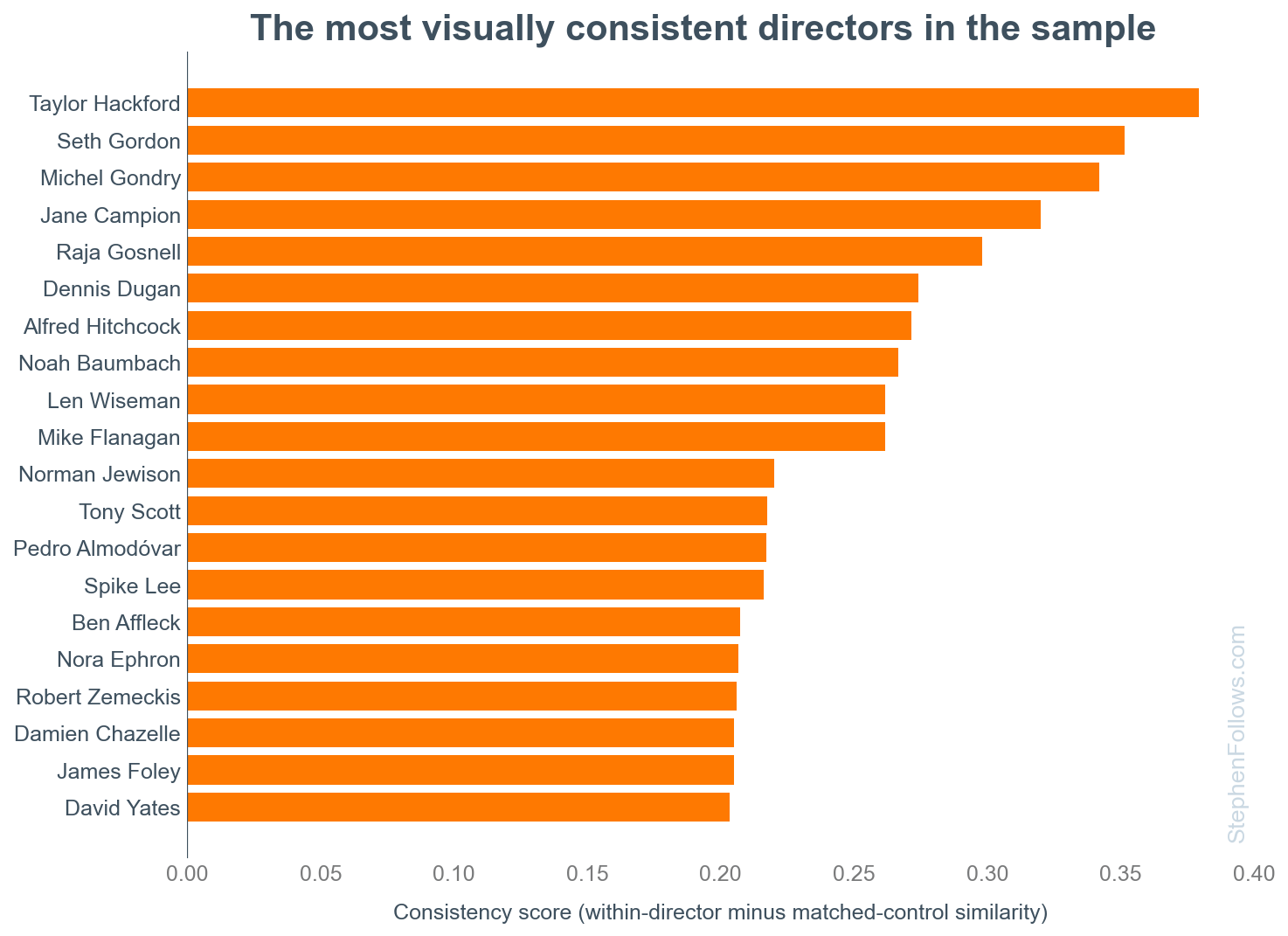
Hitchcock storyboarded every scene in advance and arrived on set, treating filming as the execution of a finished plan so it iis not surprising that his films shared a visual language.

What happens when a director changes the cinematographer?
But directors do not work alone. The film’s final visual style is a collaboration with the cinematographer (also known as Director of Photography, or simply “DP”).
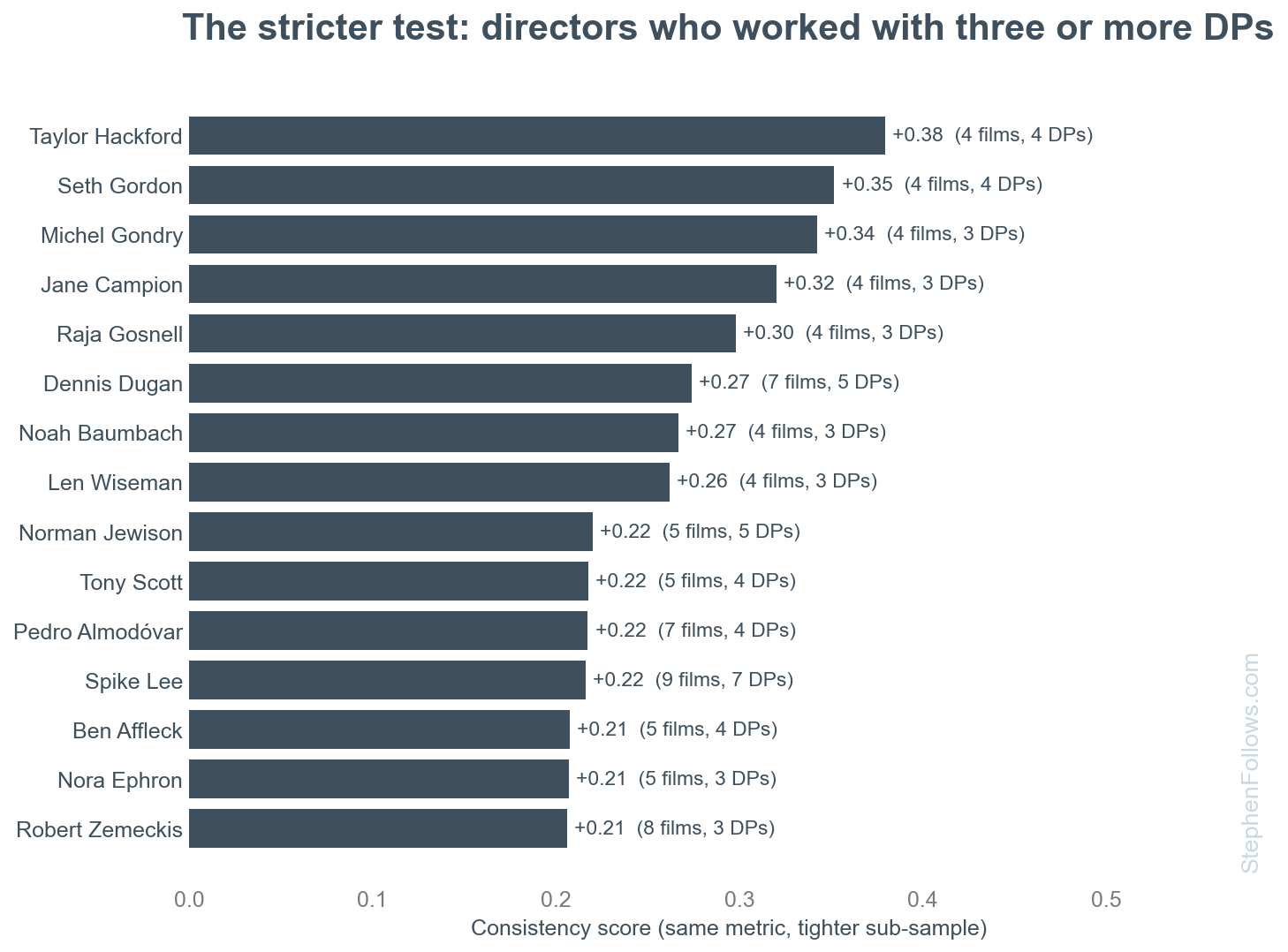
So I wanted to see what happens to the numbers when we narrow the list to directors whose films span at least three different cinematographers. The top of that filter is the same core names as before, because several of them were already three-plus-DP directors, but we lose Hitch.
The directors who reinvent their look for each film
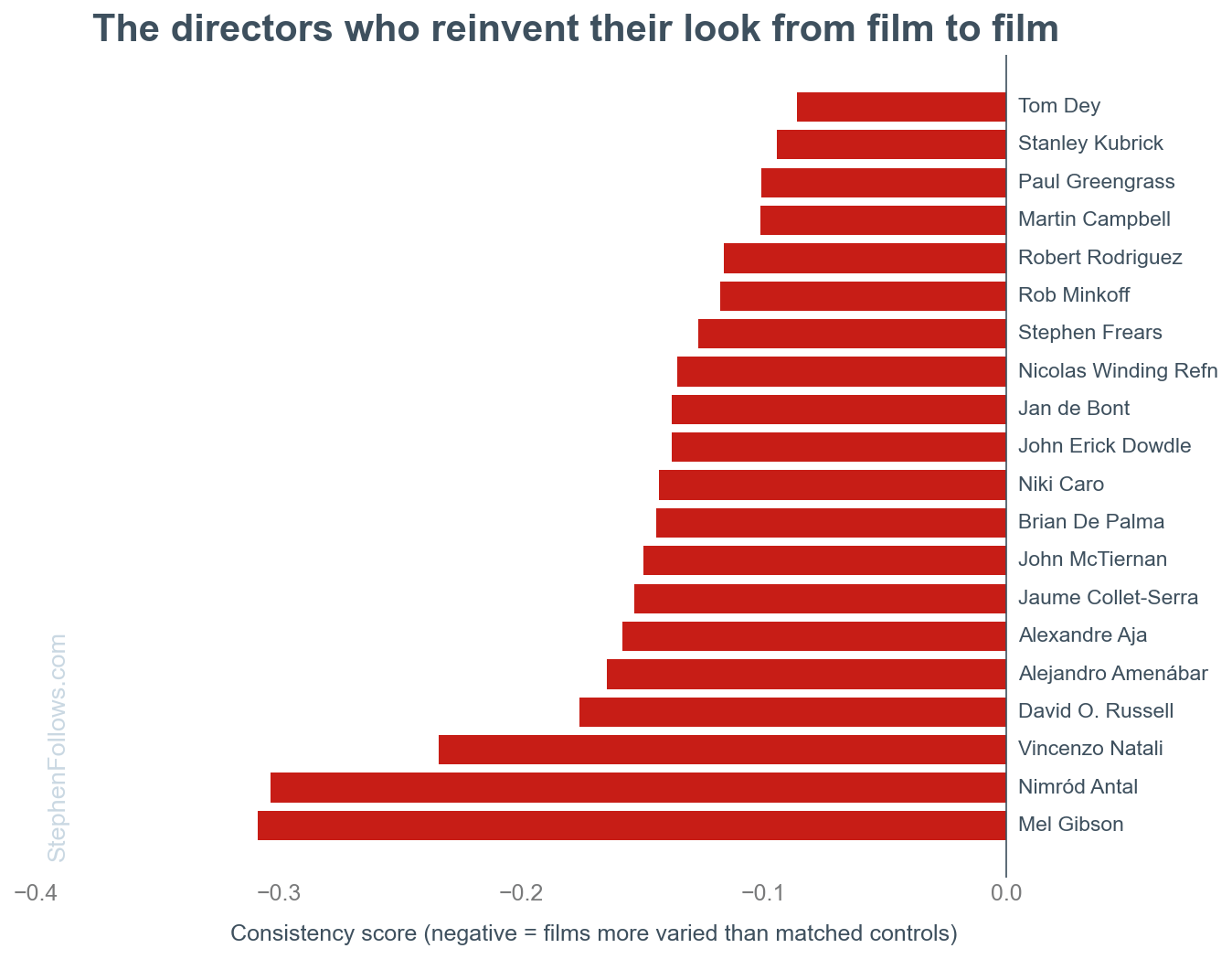
At the other end of the ranking sits Mel Gibson, followed closely by Nimród Antal and Vincenzo Natali.

Most of the names in the bottom cohort are not the ones a reader reaches for first when asked to picture an auteur. Some are genre specialists working across horror, thrillers and action (Alexandre Aja, Jaume Collet-Serra, John McTiernan). Others are career directors whose filmographies happen to span wildly different territory (Brian De Palma, Niki Caro, David O. Russell).
What they share, by this measure, is that the films they actually made look strikingly unlike each other.
The directors who work this way are often explicit about why. Danny Boyle has made the case for reinvention as a creative discipline:
Always changing genres, making very different films is a good idea. It’s a way of making yourself feel vulnerable again, getting back to that innocence.
Steven Spielberg said of Stanley Kubrick:
He kept saying, I want to change the form. I want to make a movie that changes the form. And I said, Well, didn’t you do that with 2001? He said, Just a little bit, but not enough. I really want to change the form.
Consistency is not the same as distinctiveness
Our metric so far is good for answering the question ‘Does this director’s filmography repeat itself?’, but we can use the same underlying data to also answer another question. Namely, ‘Does this director look unlike other directors?’
A director’s filmography can be tight and generic, or, conversely, varied and unmistakable.
So I calculated a Distinctiveness Score, which measures how far a director’s average film sits from the nearest other director’s average film in the same measurement space. Higher means their work sits further away from everyone else’s.
If we plot both metrics on the same chart, we get to see four quadrants:
Consistent and distinctive (top right). The classic auteur zone. Films that look like each other, and like nothing else in cinema. Repetition that adds up to a signature.
Varied but distinctive (top left). Every film is a reinvention, yet every film still sits somewhere unusual on the map. The signature is in the ambition rather than in any single composition. You cannot mistake the filmography for anyone else’s, even if you cannot mistake one film for another either.
Consistent but generic (bottom right). Films that look like each other, but also like plenty of other directors’ films. Usually, a genre specialist working inside a narrow lane, where the commercial logic of the genre is doing as much work as the director is.
Varied and generic (bottom left). No through-line, no signature. Working directors taking whatever script the week brought them, inside a part of the map that is already well-populated.
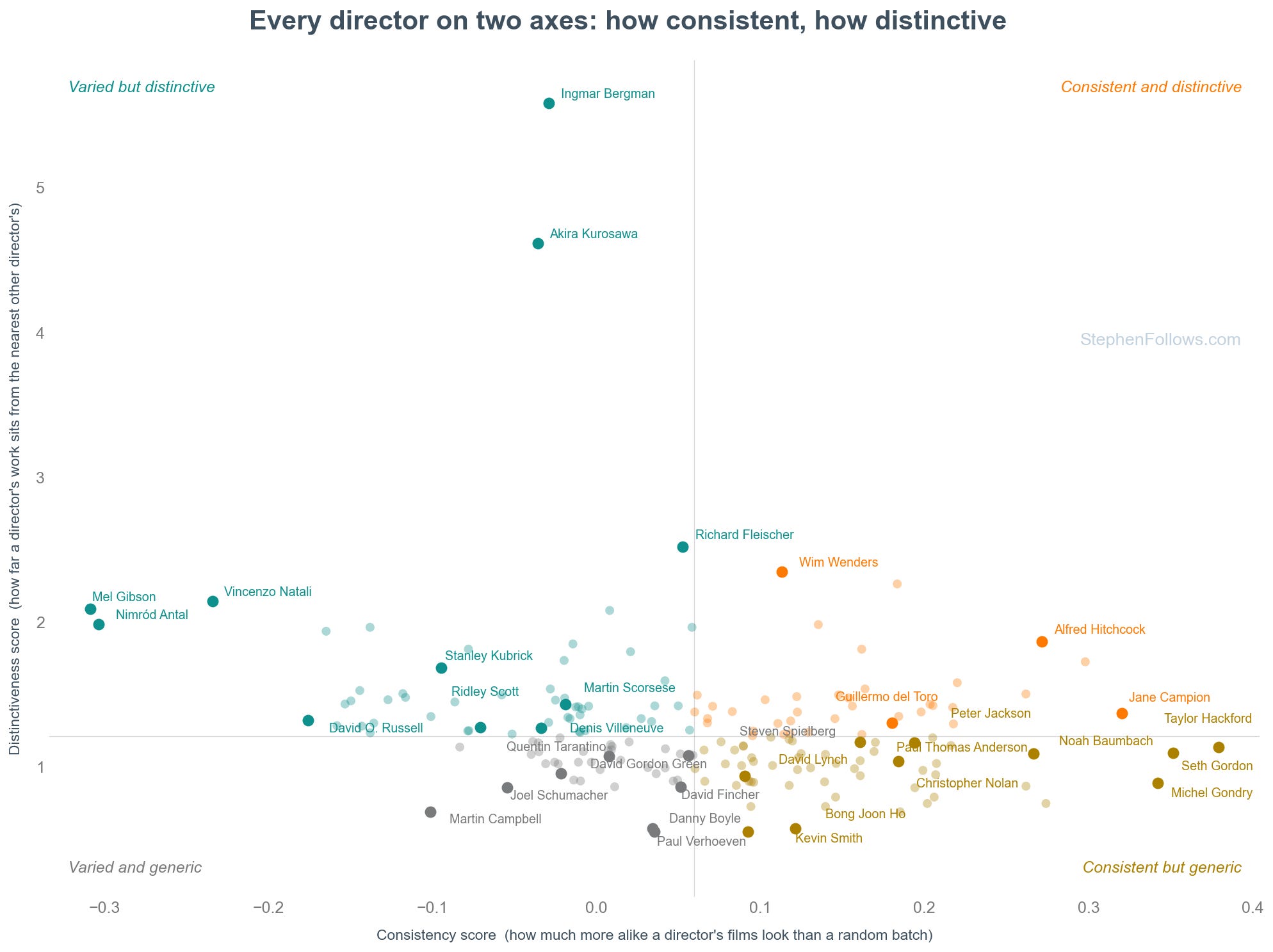
This shows us that two commonly cited aspects of the auteur label (i.e., a director with a visual style and a director who presents unique work) don’t always go hand in hand.
In future research, I’m going to quantify the extent to which the key creatives affect the final film’s visual style.
Notes
For every director with four or more live-action films in the sample, I computed the average similarity between the films’ image fingerprints, then subtracted the average similarity of a matched random sample of films from the same genres and decades.
A positive score means the director’s films hang together more tightly than a random mix of the same genre and decade.
A negative score means the opposite.
Near zero means a filmography is no more or less consistent than the matched baseline.
In the sample were 190 directors, 260 cinematographers and 2,970 live-action features. Documentaries and animation are excluded. Directors or cinematographers whose careers are primarily in animation are dropped, since animated films are a very different beast.
Each person needs at least four films in the sample to appear on the leaderboards; directors below that threshold are excluded because their scores would be noisier than meaningful.
Each film is represented by a summary fingerprint derived from stills taken at every detected scene boundary. The fingerprint captures overall composition, subject and palette, enough to tell apart a Wes Anderson frame from a Michael Bay frame at a glance, though not enough to know which lens was on the camera. Cosine similarity between two fingerprints gives a single number for how alike two films look.
When a director works with one cinematographer across every sampled film, their consistency score also carries the DP’s fingerprint. The three-plus-DPs chart is there to surface that.
Directors with three or more films inside a single franchise (for example Harry Potter or John Wick) score higher because the franchise brand enforces a look.
The measure captures composition, not dialogue, sound, music, editing rhythm or thematic preoccupation. Several directors whose signatures lie outside the frame, such as Lynch in texture and sound, or Tarantino in dialogue and shot-type idioms, appear lower than their reputations suggest.
For the scatter chart, each director has a centroid in a standardised feature space built from sixteen composition metrics. Distinctiveness is the distance from that centroid to the nearest other director’s centroid. Higher means further from everyone else.
I see Kurosawa in your sample, but was Ozu? I was thinking he would be among the top.