


In previous years, I have run a deep data dive into whether Die Hard is a Christmas movie, and also tried to predict which will be the next controversial Christmas movie.
This year, I wanted to take a look at the changing landscape of Christmas movies. I.e. which movies are (or are fast becoming) heavily associated with the festive season, despite not featuring Christmas in their narratives.
To fire up the Christmas canon, I analysed ten years of daily Wikipedia pageviews for more than 160,000 films. By comparing December activity with the rest of the year, we can identify which titles are becoming more closely associated with Christmas.
We’re going to cover:
What are the top Christmas classic movies?
What are some fast-rising new Christmas Classics?
What are some non-Christmassy Christmas Classics?
Is Die Hard firmly in the Christmas Canon or just a fleeting meme?
Let’s start with stone-cold Christmas classics and then start looking at what’s changing.
What are the top Christmas classic movies?
I defined a Christmas Classic as a movie which is:
Popular - It received at least 100,000 views over the past decade, and at least 3,000 views in December 2024.
Seasonal interest - December had to be one of its two busiest months in four of the past five years, and December had to account for 15% or more of its annual views.
Not a flash in the pan - I.e. it had at least five years of data, so the pattern reflects long-term behaviour rather than a one-off spike.
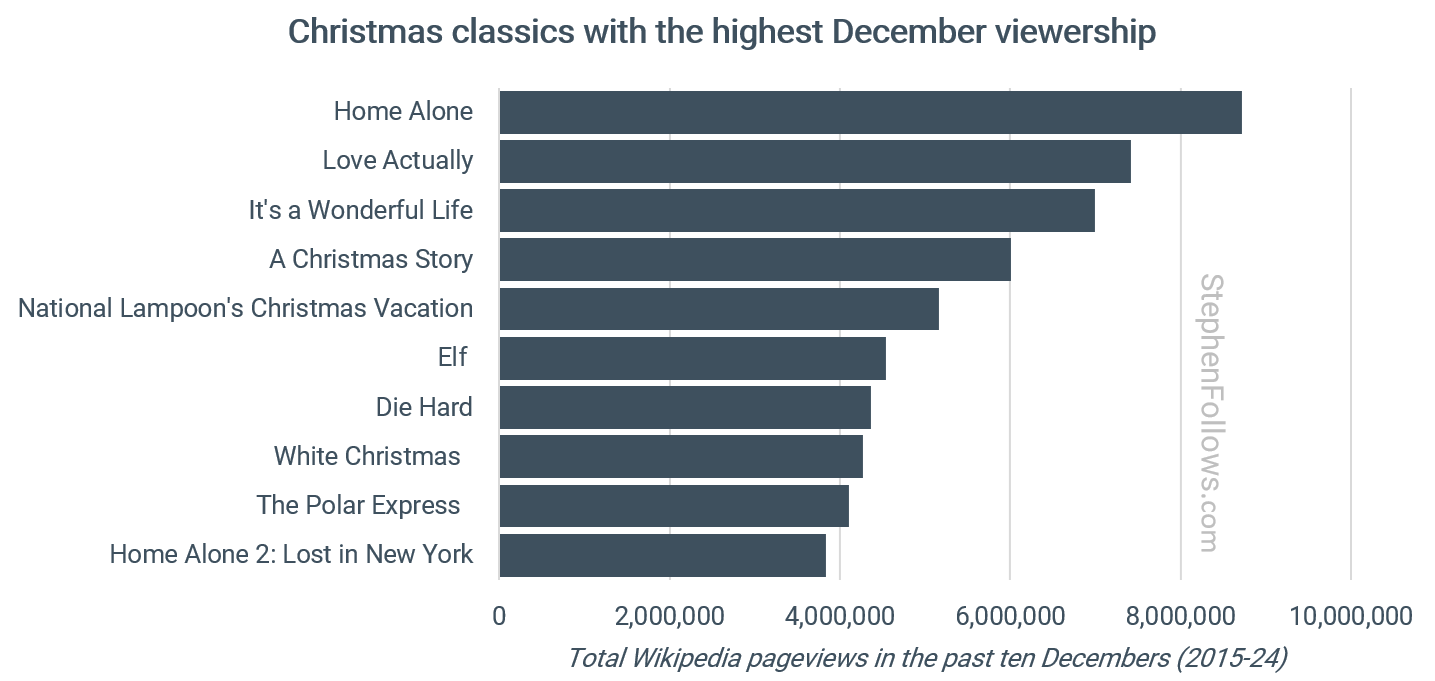
364 movies met this criterion. If we look at the most popular overall, then Home Alone, Love Actually, and It‘s a Wonderful Life come out on top.

When we look at the monthly page views, the Christmas bias is immediately apparent.
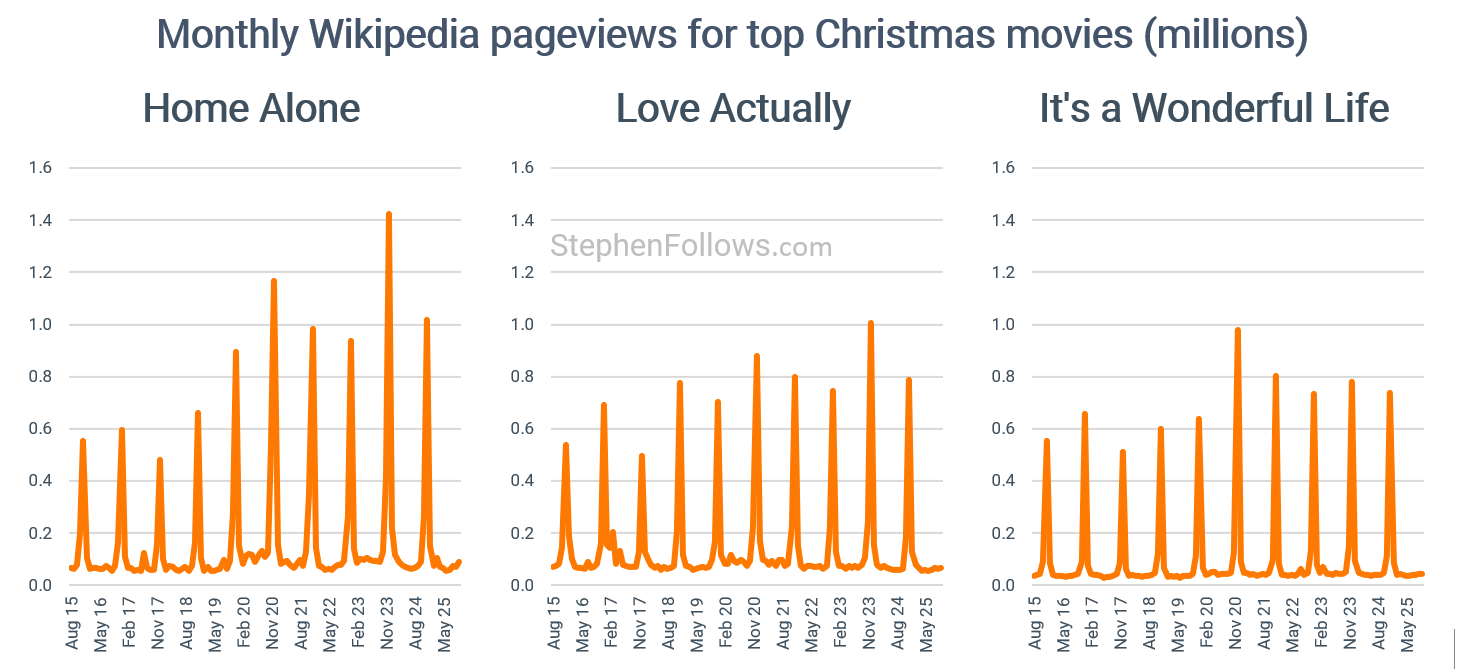
There is a slight difference between a movie that can be enjoyed all year (i.e., Home Alone) and one that would feel out of place at any other time (i.e., A Christmas Carol).
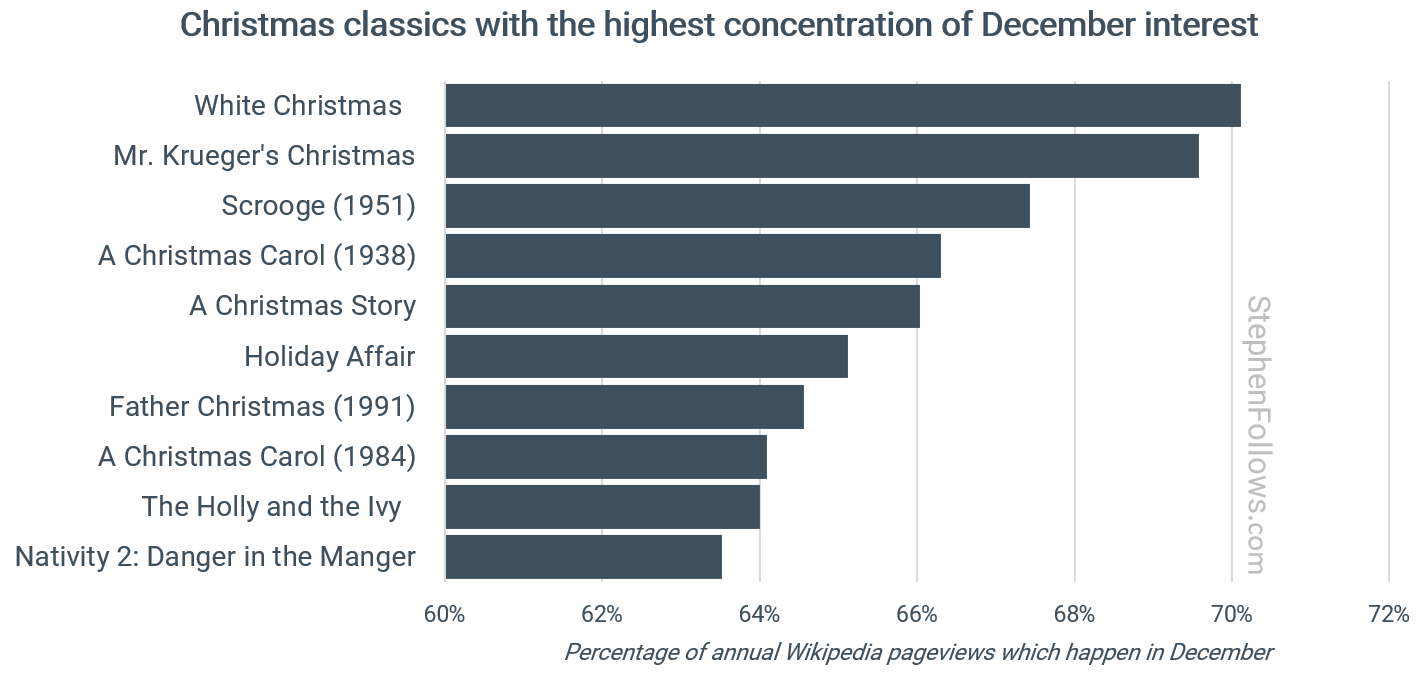
So if we reorder the Christmas Classics by how important the month of December is, we get a list of what I’m calling Concentrated Christmas Classics. Unsurprisingly, these seem to have Christmas in the title.
Now that we have a model for what a Christmas Classic looks like, we can go hunting for newer additions to the canon.
What are some fast-rising new Christmas Classics?
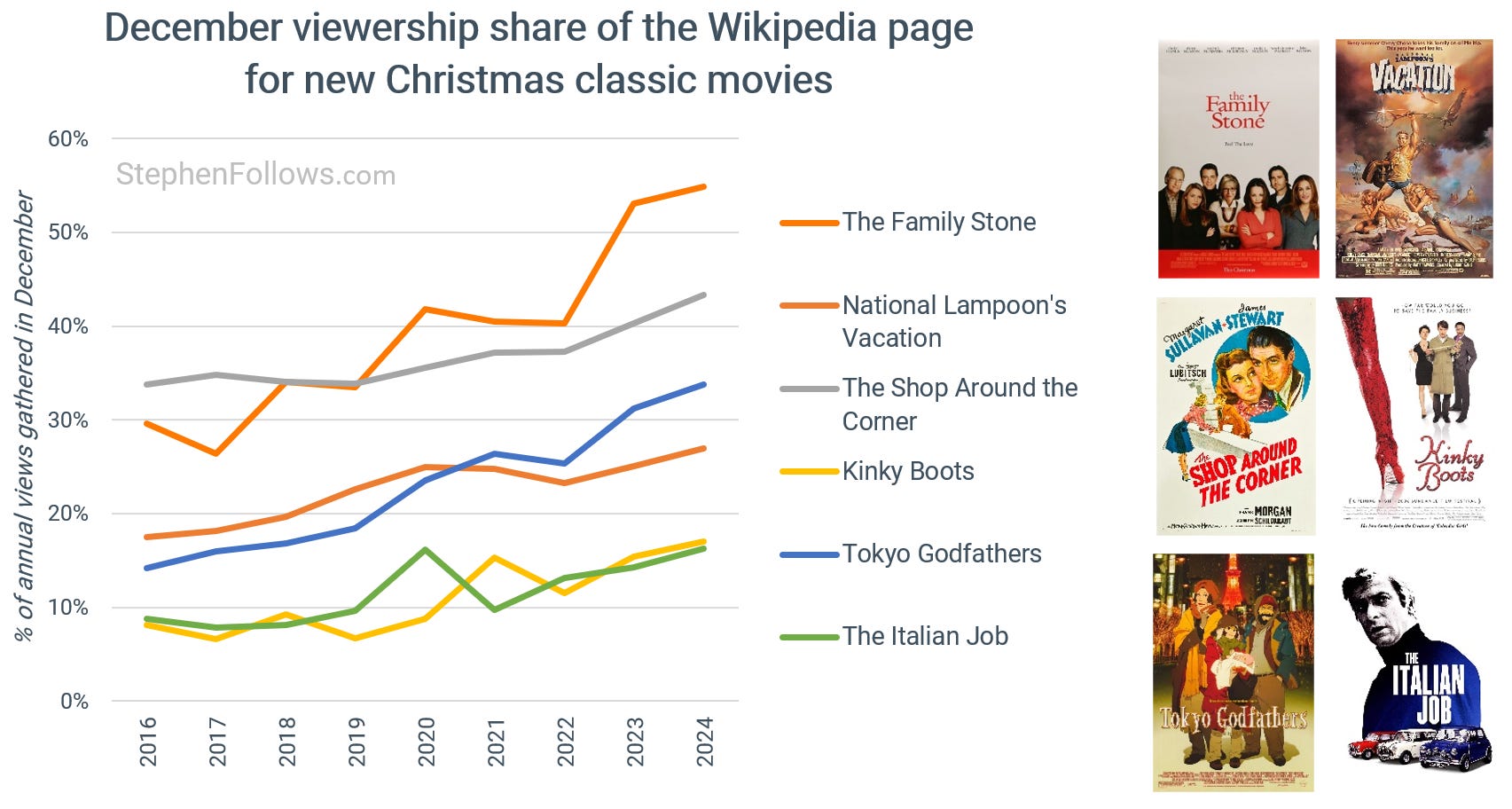
The films we’ve seen so far have been Christmas Classics for many seasons past. But some movies are both gaining in popularity and strengthening their association with Christmas, what I’m calling Consistently Climbing Christmas Classics.
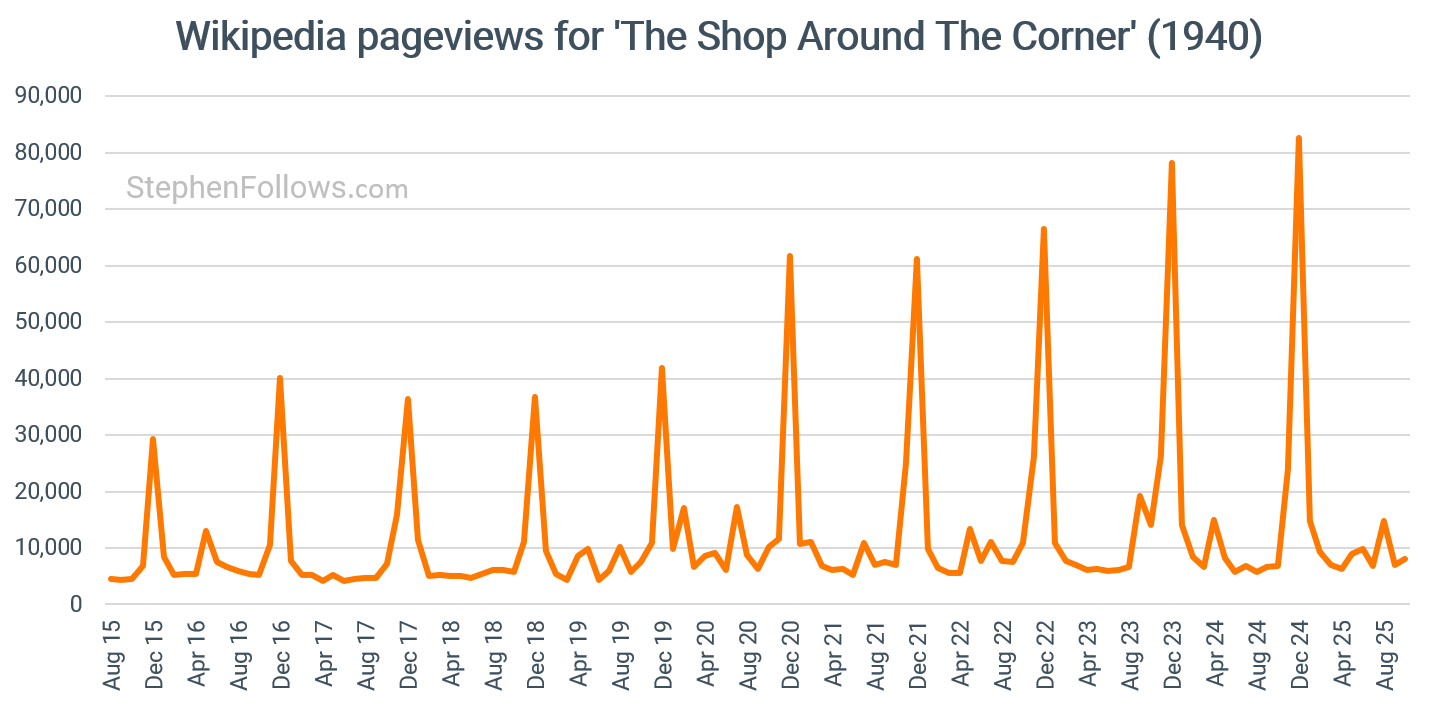
A good example is the 1940 classic, The Shop Around The Corner (later remade as You’ve Got Mail). Its December peaks have become noticeably stronger over the past decade, suggesting people now actively seek out at Christmas.
The two fast-growing mainstream Consistently Climbing Christmas Classics are Tokyo Godfathers and The Family Stone.
What are some non-Christmassy Christmas Classics?
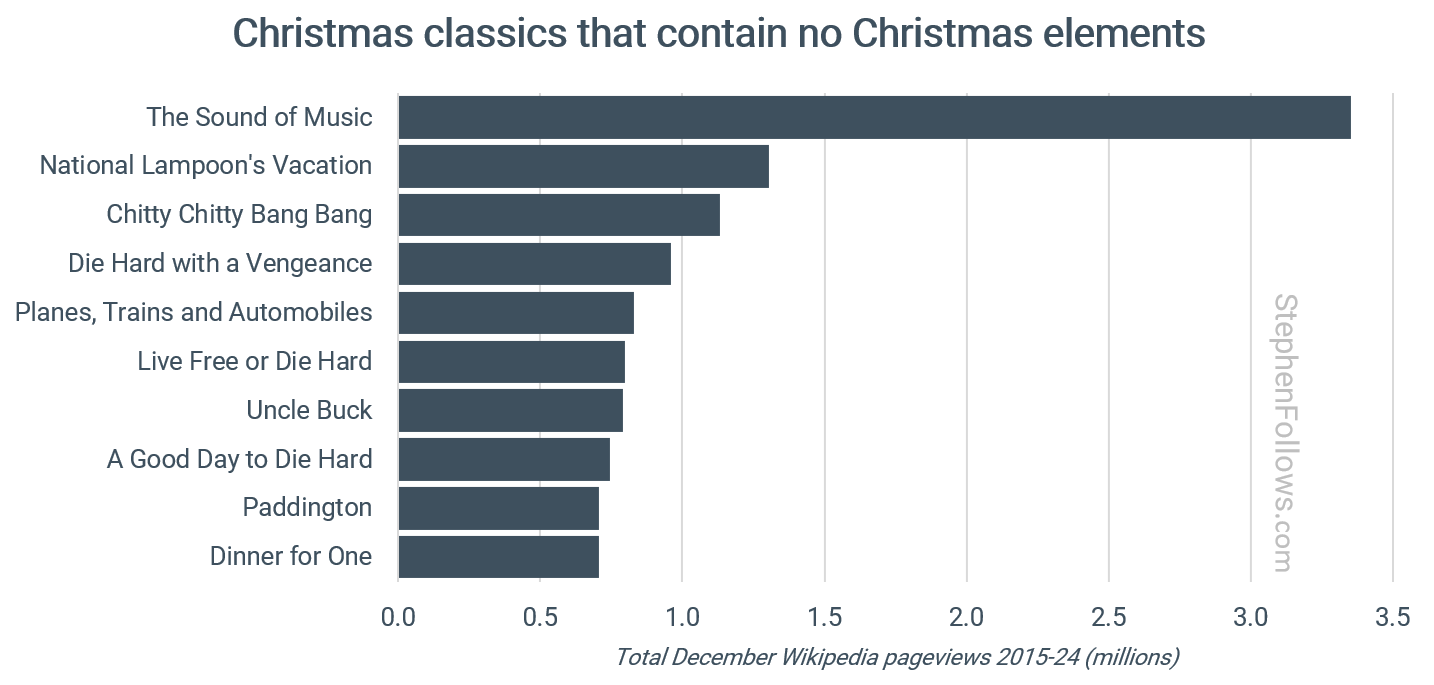
Of the 364 Christmas Classics I found, just over a third have nothing to do with Christmas in their narrative. These are what I’m calling Cuck Christmas Classics. I.e., movies that have cultural relevance around the holiday season, despite not narratively suggesting they should.
The most popular of these are The Sound of Music, National Lampoon’s Vacation, and Chitty Chitty Bang Bang.
They tend to fall into four categories:
Xmas-coded stars, such as Richie Rich (starring Macaulay Culkin), Planes, Trains and Automobiles (starring John Candy, who made a brief but iconic appearance in Home Alone), Uncle Buck (starring both Culkin and Candy) and Muppet Treasure Island.
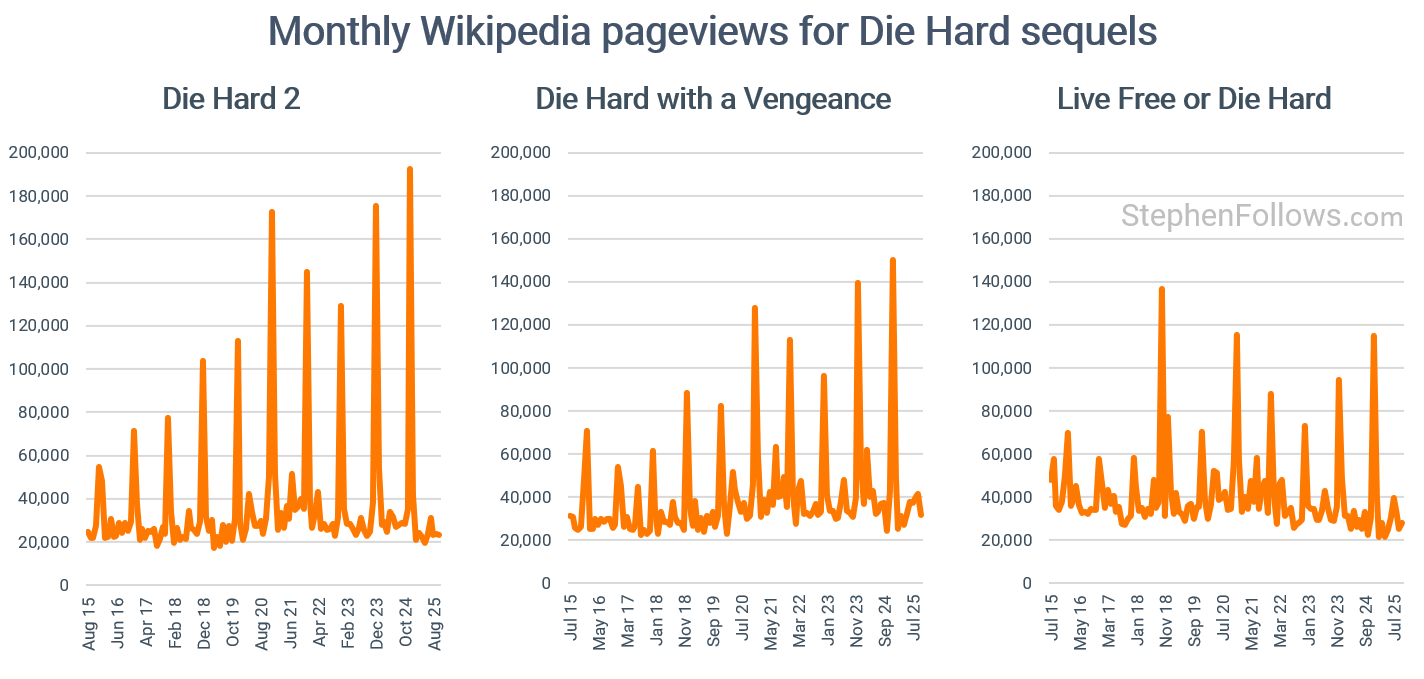
Shared universe. I.e. being part of a series or universe which contains a Christmas Classic, including Gremlins 2: The New Batch, National Lampoon’s Vacation, and Die Hard.
Musicals, such as The Sound of Music, Chitty Chitty Bang Bang, Seven Brides for Seven Brothers, High Society, and Oliver!.
Comfort watches include The Italian Job, Ghosts of Girlfriends Past, and Kinky Boots.
The seasonal interest in sequels of Christmas Classics is particularly striking.
Is Die Hard firmly in the Christmas Canon or just a fleeting meme?
Almost a decade ago, I conducted a deep data dive into whether we should regard Die Hard as a Christmas movie. The research emerged from a session I was teaching for MA students at Birmingham City University. I’d stumbled onto the topic when looking for a way to get the class to consider the different lenses through which a feature film can be viewed (artistic, commercial and cultural).
Each student had a strong instinctive response to whether Die Hard was a Christmas movie, but when I challenged them to make the case, it proved more complicated than they expected.
At the time, the outcome of the research was the following:
Artistically = Probably. The film is set on Christmas Eve, uses Christmas music (Christmas in Hollis), and references “Christmas” 18 times in the script. It weaves in Christmas themes such as family, reconciliation and symbolic “snow” in the finale. But there are many other movies which pass each of these tests, which we do not regard as Xmas Classics.
Commercially = Absolutely not. Fox released it in July (US) and February (UK), far from the November–December Christmas window, and marketed it entirely as an action film with no Christmas imagery or holiday messaging.
Culturally = Increasingly so. It originally appeared only occasionally on Christmas lists but was gaining ground, with rising inclusion in user-generated IMDb Christmas lists — an early sign of shifting perception.
So back then the answer to “Is Die Hard a Christmas movie?” was “It wasn’t, but it is becoming one.”

Since then, the meme has blown up, and even the annual debate is itself evidence of cultural relevance. But the question now is whether it’s going to remain in the Christmas canon or whether it was just a fun argument that peaked and will fade.
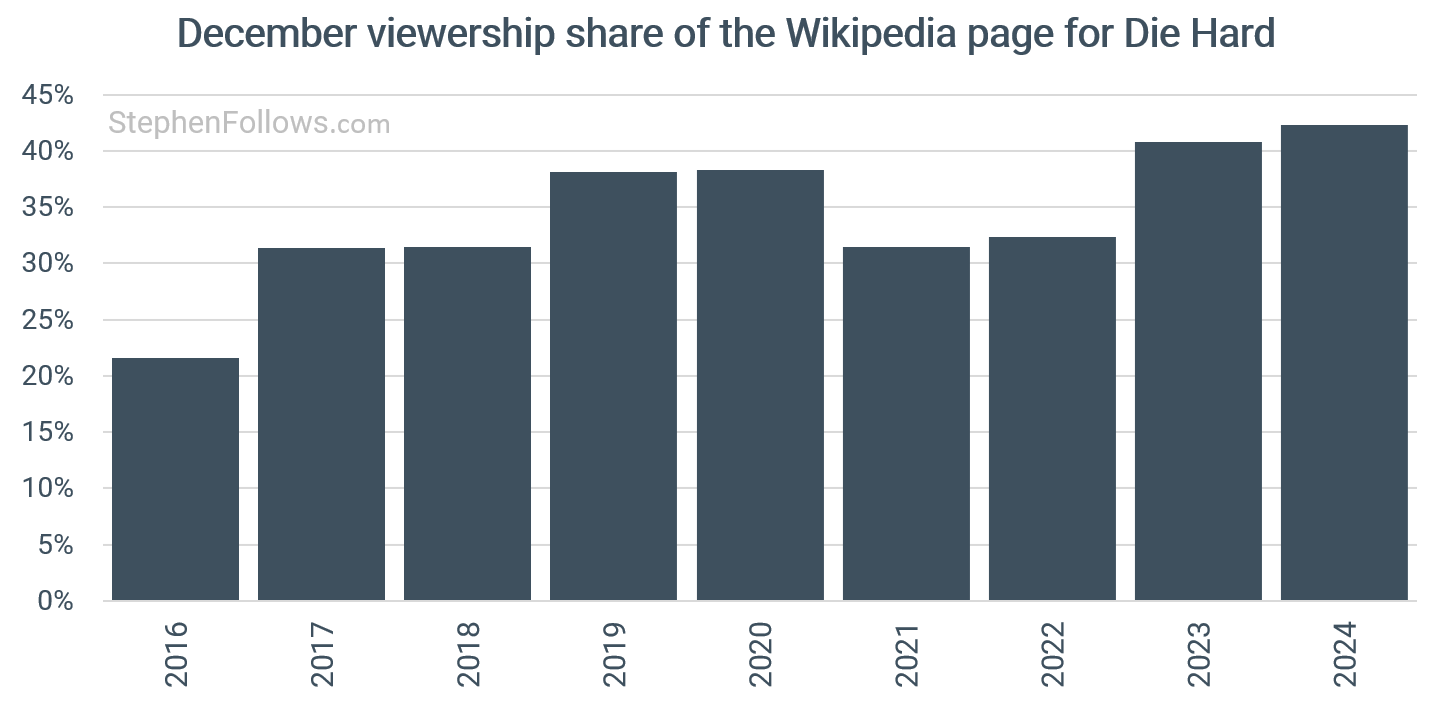
The Wikipedia pageview data suggests that Christmas interest in the movie peaked in 2020, and faded a little after that.
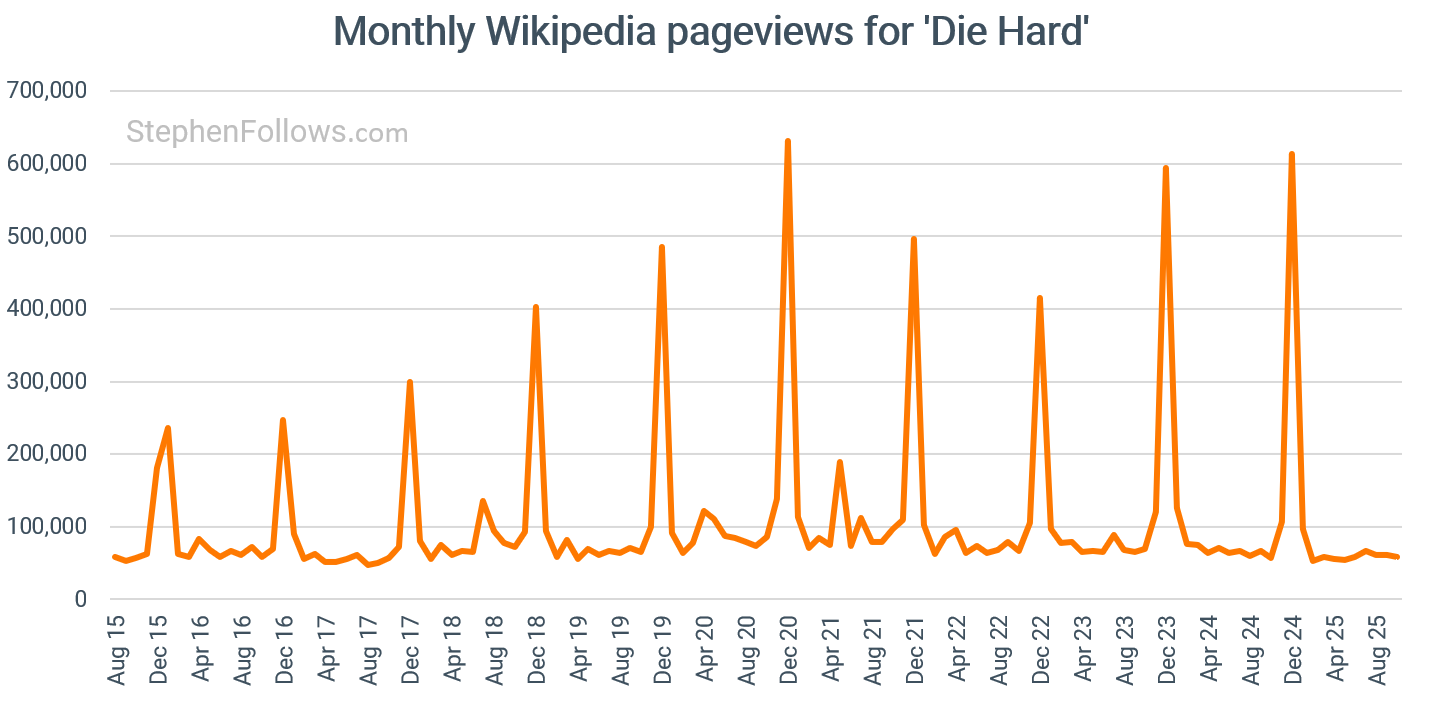
But an important part of Christmas relevance is not total views, but the skew towards December. And here we can see evidence that Die Hard is solidly in the Christmas collection.
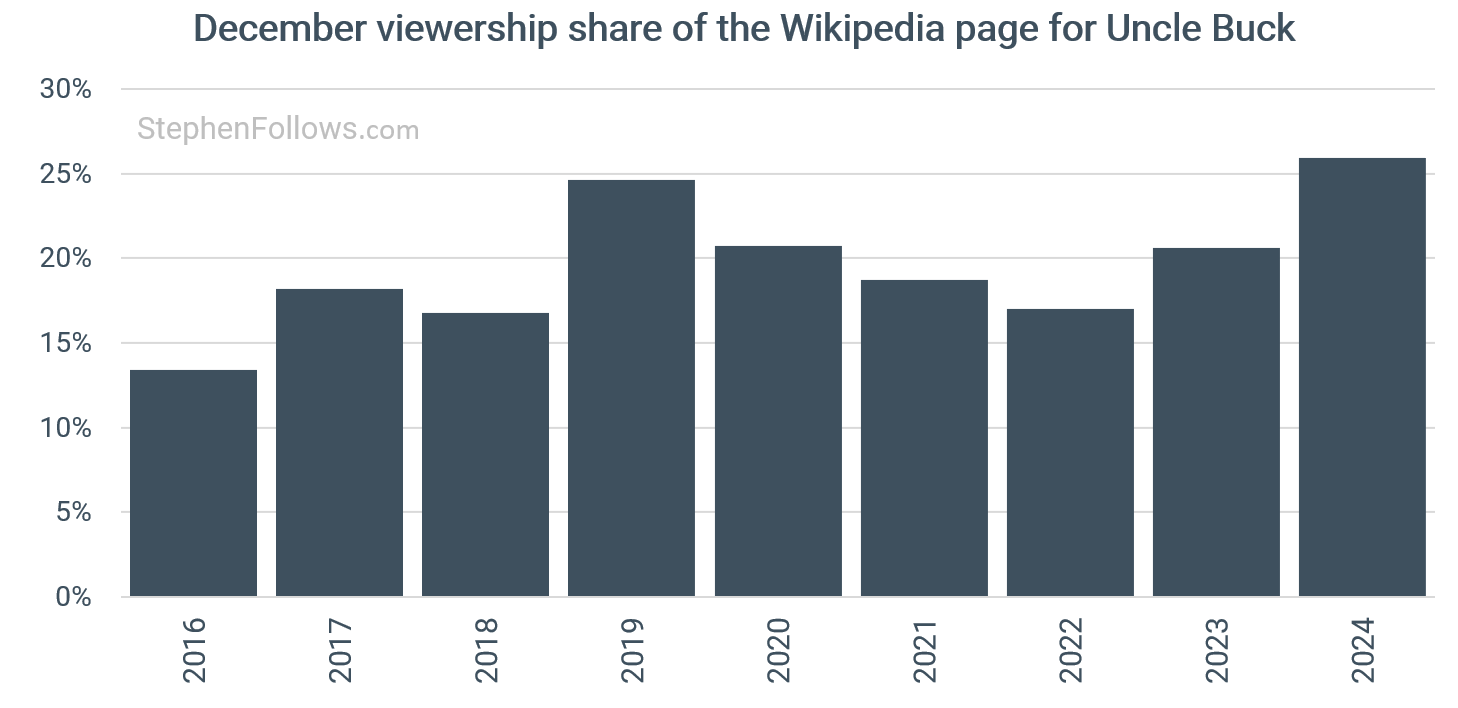
In 2019 I predicted that Uncle Buck would be the movie we argue over (After Die Hard, what’s the next most contentious “Christmas” movie?). That hasn’t happened just yet, but the movie has started to increase its Christmas appeal so it’s still possible.
Notes
The dataset consists of daily Wikipedia pageviews for feature films from July 2015 to October 2025. This allows us to see not only how many people look up a film during December, but also whether seasonal interest in it is increasing.
To be called a ‘Christmas Classic’ in this article, a film had to fulfil the following criteria:
Enough overall interest: at least 100,000 total Wikipedia views across the ten-year dataset.
Clear seasonal association: December had to be one of its two strongest months in at least four of the past five years (to avoid random spikes).
A meaningful seasonal footprint: the most recent December needed 3,000+ views.
Sustained data: at least five years of December data must exist.
Recent seasonal strength: the latest December must account for at least 15% of its total annual views.
With any criteria, there may be some outliers. Within my criteria above, something has slipped in unexpectedly.
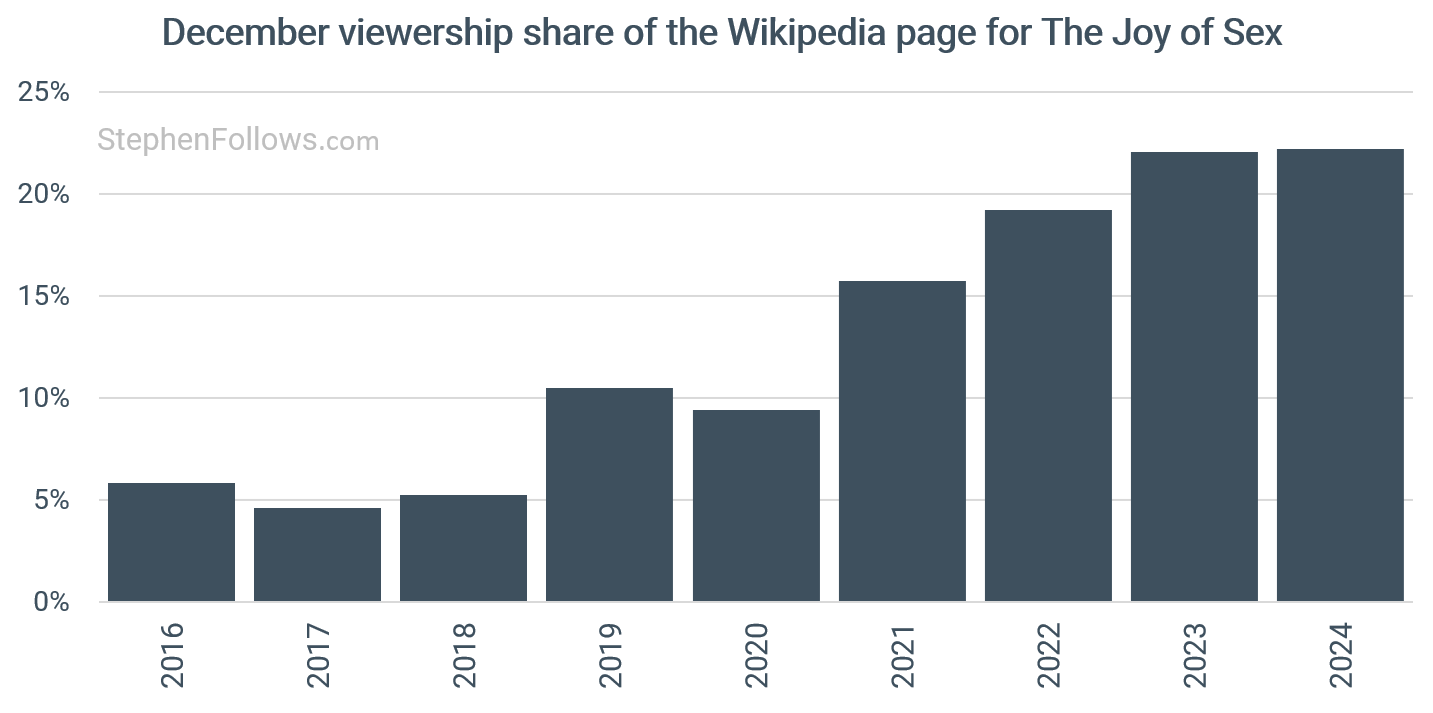
The Holdovers is an instant Christmas classic - I would expect to see it in future lists as a) it is set at Christmas and b) encapsulates what Christmas can be for many people i.e. antagonism (which eventually thaws to reveal humanity.)
For some strange reason that I can’t explain. ‘Field of Dreams’ is the film I revisit every Christmas.