


Digger, starring Tom Cruise, opens today. Apparently it cost $125 million to make, but Deadline’s current tracking estimates its ‘domestic debut prospects’ at ‘around $20M’. Deadline is not alone - Box Office Theory gives it a range of $17 million to $26 million.

This got me wondering how accurate box office predictions are in the few days up to release.
On the one hand, you'd think it would be straightforward to use surveys to gauge people’s intentions, given that the opening is only a few days away.
On the other hand, so many of the reasons when and why I go to the cinema are down to whim, cultural moments, and reviews - all things tracking might struggle to price in.
So I took a quick look at what the data reveals. I tracked opening-weekend forecasts from the major film trade press (The Hollywood Reporter, Variety, Deadline, and Screen Daily) for 1,184 American wide releases between 2006 and 2025. I then checked them against the real box office grosses to see how they fared. (This only covers films whose forecast somebody chose to print, which is a little under three in five wide releases -more on this in the Notes at the end).
What even is tracking?
Tracking is a bit like the film industry’s political polling. Research firms survey a sample of the public in the weeks before a film opens and ask a handful of questions. Have you heard of this film? Are you interested in seeing it? Is it your first choice this weekend?
The answers are compared with those for previous movies, and that comparison produces a forecast for the opening weekend.
Although today’s research uses figures in the pulic domain, the business is private at its core. The studios pay for the surveys, and the results go to them, not the public. The best-known firm, National Research Group, was founded in 1978, and by 1999 the Los Angeles Times reckoned it had its fingerprints on nine out of ten major studio films.
What you and I get to see is whatever reaches the trade press. Sometimes that is a figure a studio has chosen to share, sometimes it is a leak, and sometimes it is a reporter’s own estimate. Of the forecasts I found, only one in four was credited to tracking by name, and fewer than one in fifty named the firm behind it.
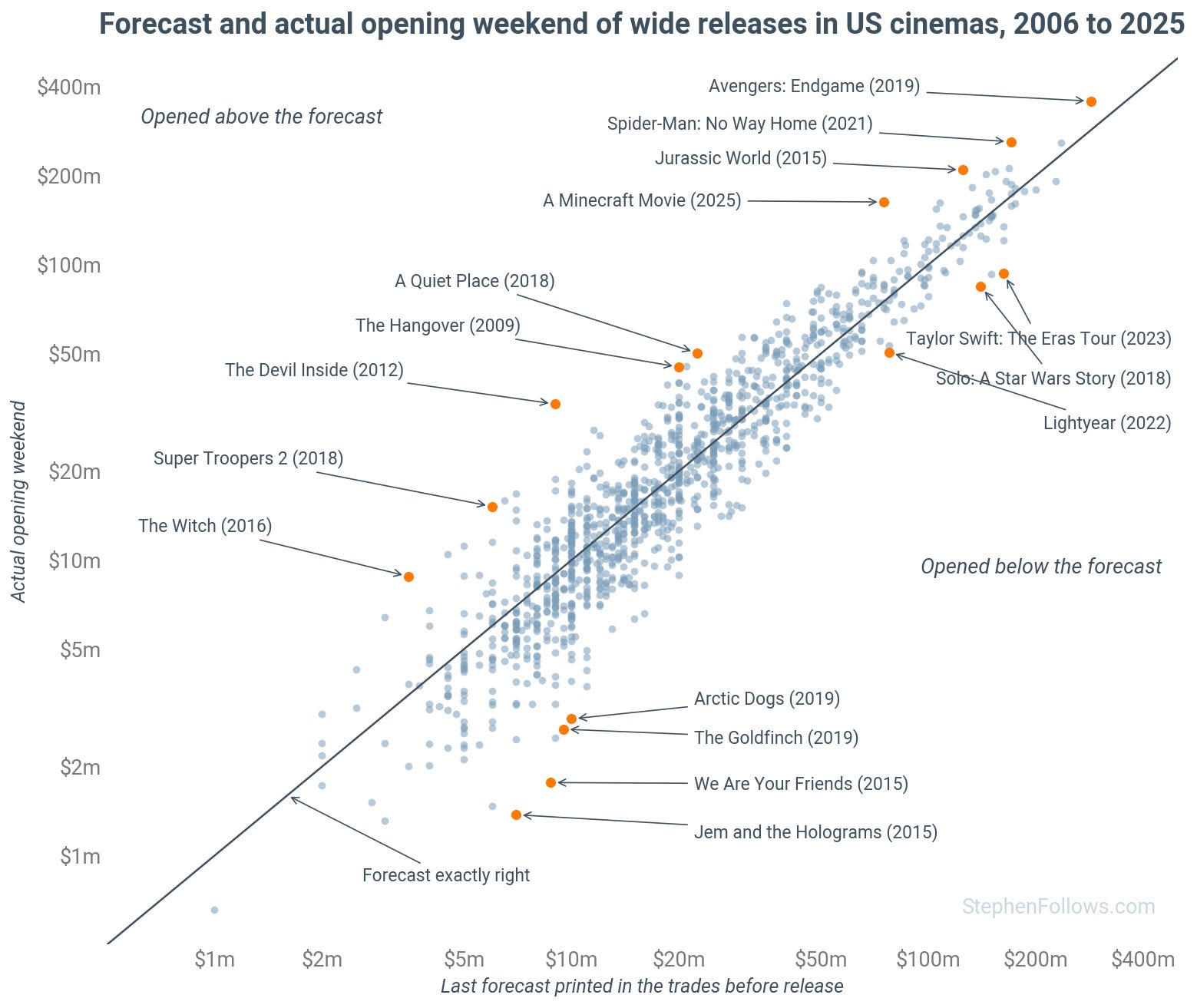
If we plot all 1,184 movies I tracked on a scatterplot, comparing the prediction and the reality (thanks to OpusData), we can see that most guesses are pretty good.
Both scales are stretched so doubling takes up the same space everywhere, meaning a dot a centimetre off the line is wrong by the same percentage whether it is a $5 million film or a $200 million one.
The median film opened at 0.97 times its forecast, and 46.9% of films opened above their number, so as a group the forecasts lean neither way.
Let’s look at last weekend to get an idea of this in practice. On 23 September, Variety printed forecasts for four films opening two days later.
Avengers: Endgame Encore was tracking at $25 million to $28 million and took $26.1 million.
Heart of the Beast was projected at $17 million to $20 million, and took $20.0 million.
Primetime had the same $17 million to $20 million range, but was slightly lower at $19.2 million.
Forgotten Island was ‘aiming for $15 to $17 million’ and opened to $13.0 million, which Rotten Tomatoes called ‘an incredible disappointment’.

The smallest forecast of the four was the one that missed. And we see this pattern on a much larger scale, too.
Which films have the greatest margins of error?
The bigger the movie, the more reliable the tracking is likely to be.
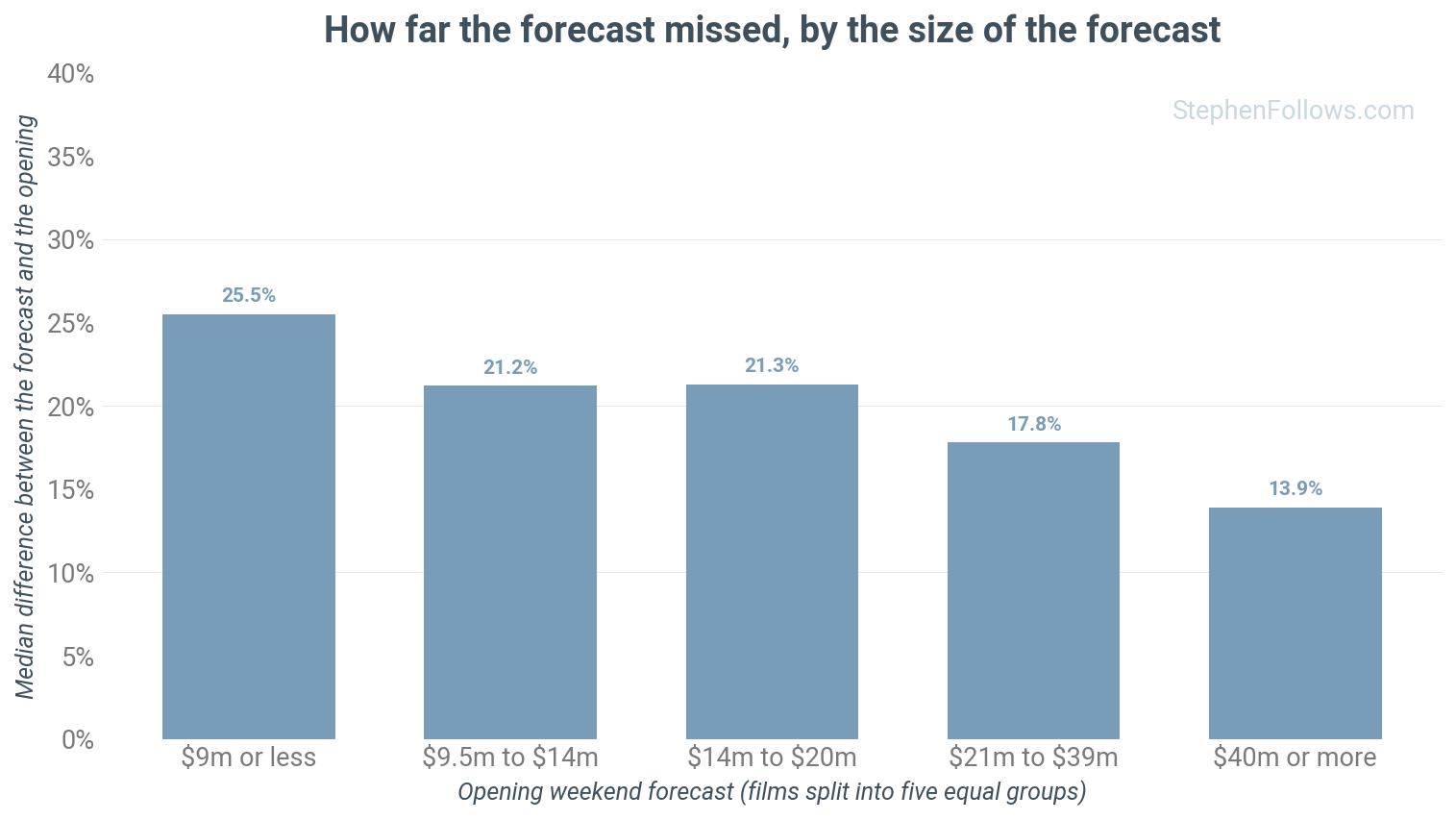
I sorted the 1,184 films by forecast size and split them into five groups of roughly equal size, between 220 and 246 films each. Below is the typical miss in each group, meaning the median gap between the forecast and the opening, as a percentage of the forecast.
Across all movies, the typical forecast misses by 19.9%, but this changes when you account for movie size. Films with the smallest forecasts typically miss by an average of 25.5%, whereas the largest miss by just 13.9%.
Is it the kind of film that's hard to call?
When I first looked at this, I suspected that dramas, standalone films, original screenplays, R-rated films and films from smaller distributors would be the hardest to call. And they are - but not for the reasons I had assumed.
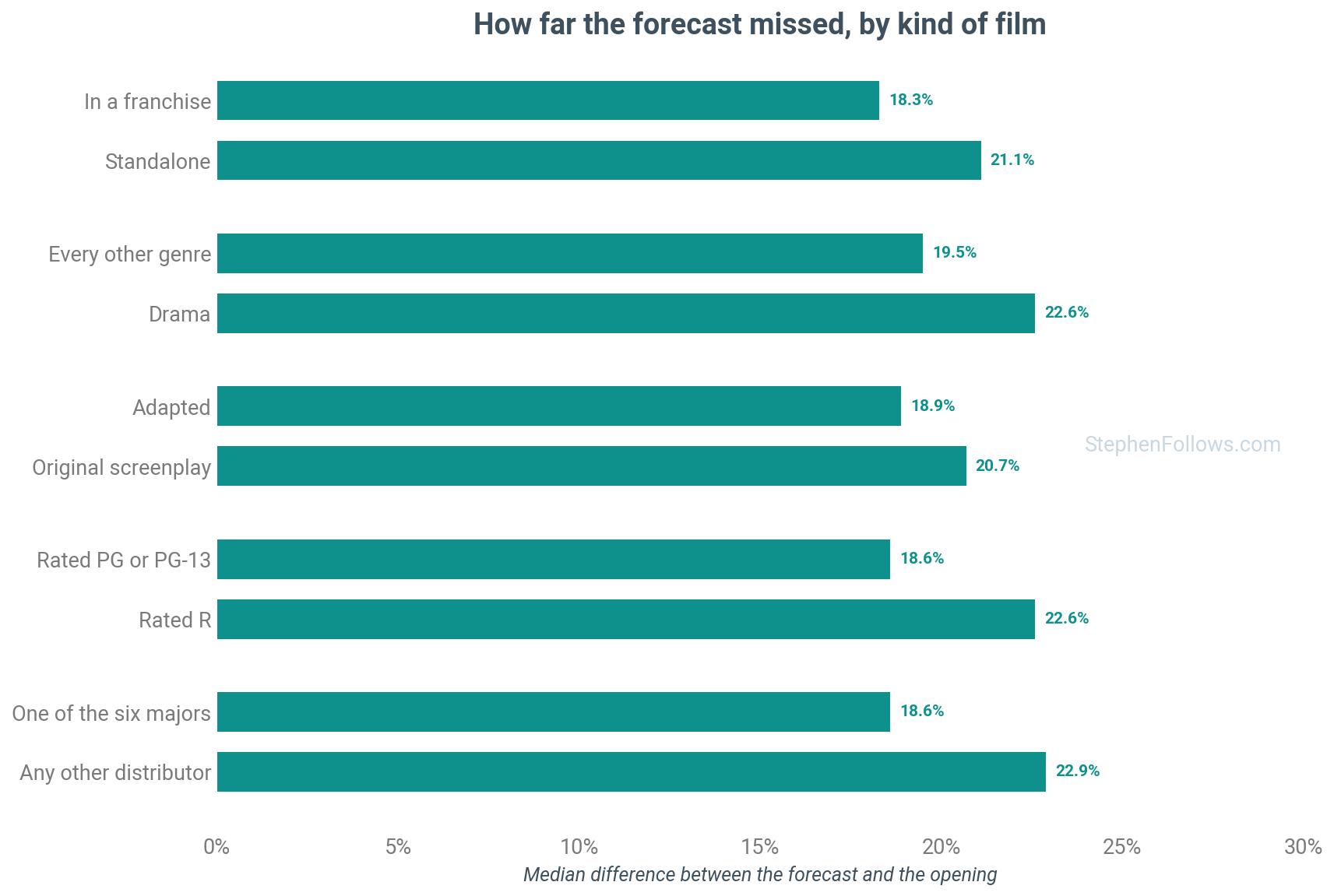
Below is the typical miss for five film types across all 1,184 films (1,164 for the ratings, because G-rated and unrated films are left out). The smallest group is the dramas, at 158 films.
Standalone films are missed by 21.1% and franchise films by 18.3%.
Dramas by 22.6 % and every other genre by 19.5.
Original screenplays by 20.7% and adapted material by 18.9.
R-rated films by 22.6% and PG and PG-13 films by 18.6%.
Films from outside the six major studios by 22.9% and films from the majors by 18.6%.
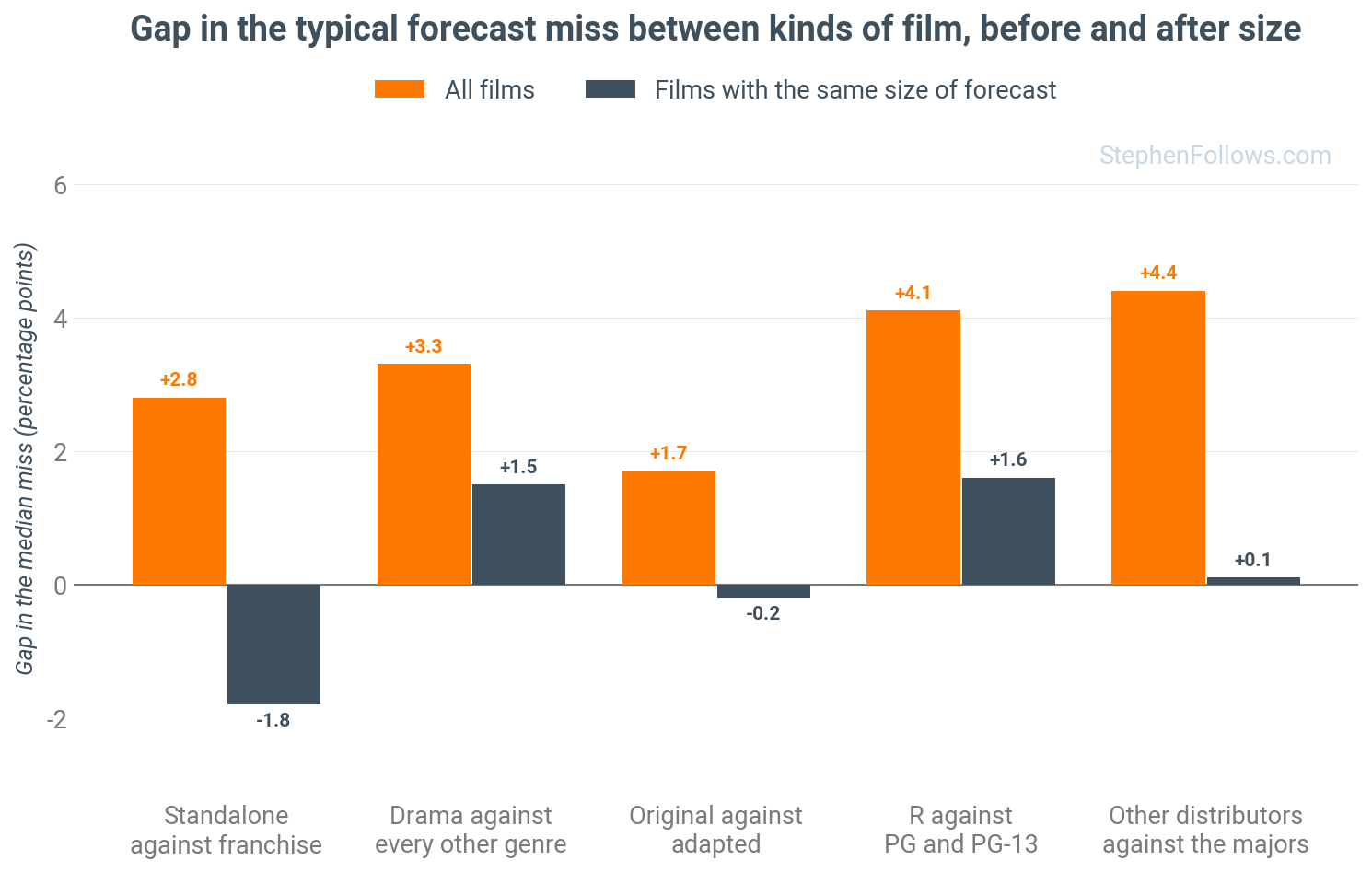
It is tempting to add those up and conclude that a standalone, original, R-rated drama from a small distributor is on the wrong side of five separate effects. But these aren’t the ones that are really making the difference - it’s scale.
Each of those groups is also forecast to open small. The typical standalone film was forecast at $12.0 million and the typical franchise film at $32.6 million. Dramas were forecast at $12.0 million against $18.5 million for everything else. Films from outside the majors at $10.0 million against $21.0 million.
So I compared like with like. The chart below shows the typical miss gap between each pair, first across all films (orange) and then between films with the same forecast size (slate). A bar above zero means the first-named group is harder to call.
Are big films missed by less money?
No. They are missed by more.
Everything so far has been in percentages. Below is the same miss counted in dollars, by what the film cost to make. It covers the 1,128 films with a production budget on record, with at least 251 films behind each bar.
Films costing under $25 million were missed by a median $2.5 million. Films costing $100 million or more were missed by $7.0 million, almost three times as much, even though as a percentage they were the best forecast of the four groups, at 15.2% against 24.8%.
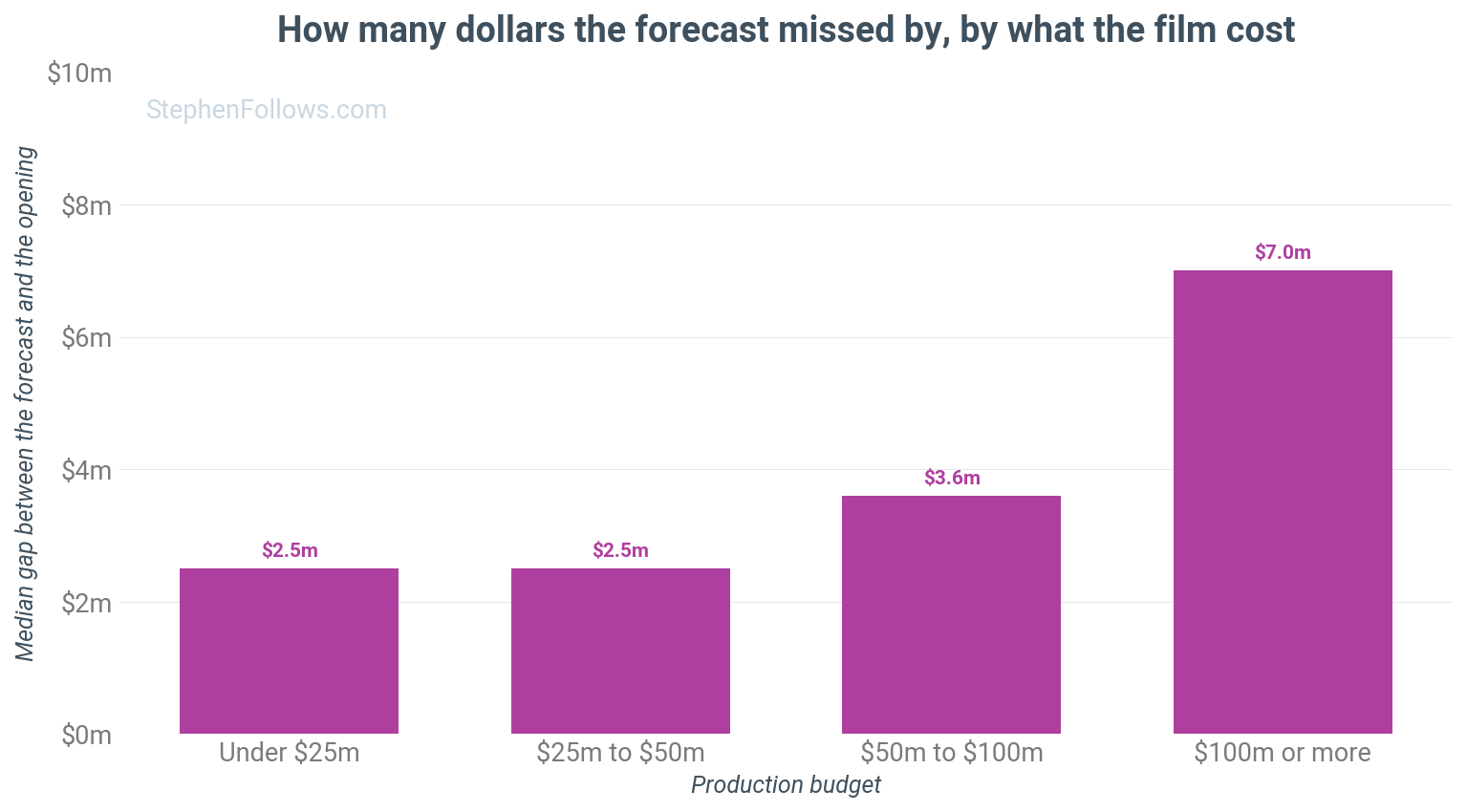
So big films do not land in a narrower range. The range is wider in dollars. It is only narrower as a share of a much bigger number. When three-week tracking had Spider-Man: Brand New Day opening at $180 million to $190 million this July and it opened to $360 million, the miss was $175 million. Only 14 of the 1,184 films in this study took more than that in their whole opening weekend.
Which measure matters depends on who you are. A cinema deciding how many screens to give a film cares about the percentage. A studio finance team cares about the dollars, and for them the big films are the risky ones.
How far ahead are these forecasts made?
Tracking inside a studio arrives three weeks before release and firms up as the opening approaches. What reaches print is mostly the number they have on the week of release.
Of the 1,184 scored forecasts, 69.5% were printed on the day the film opened and 97.2% inside two days of release. Only 14.9% of movies had a usable forecast printed more than a week out, and 7.2% more than a fortnight out.
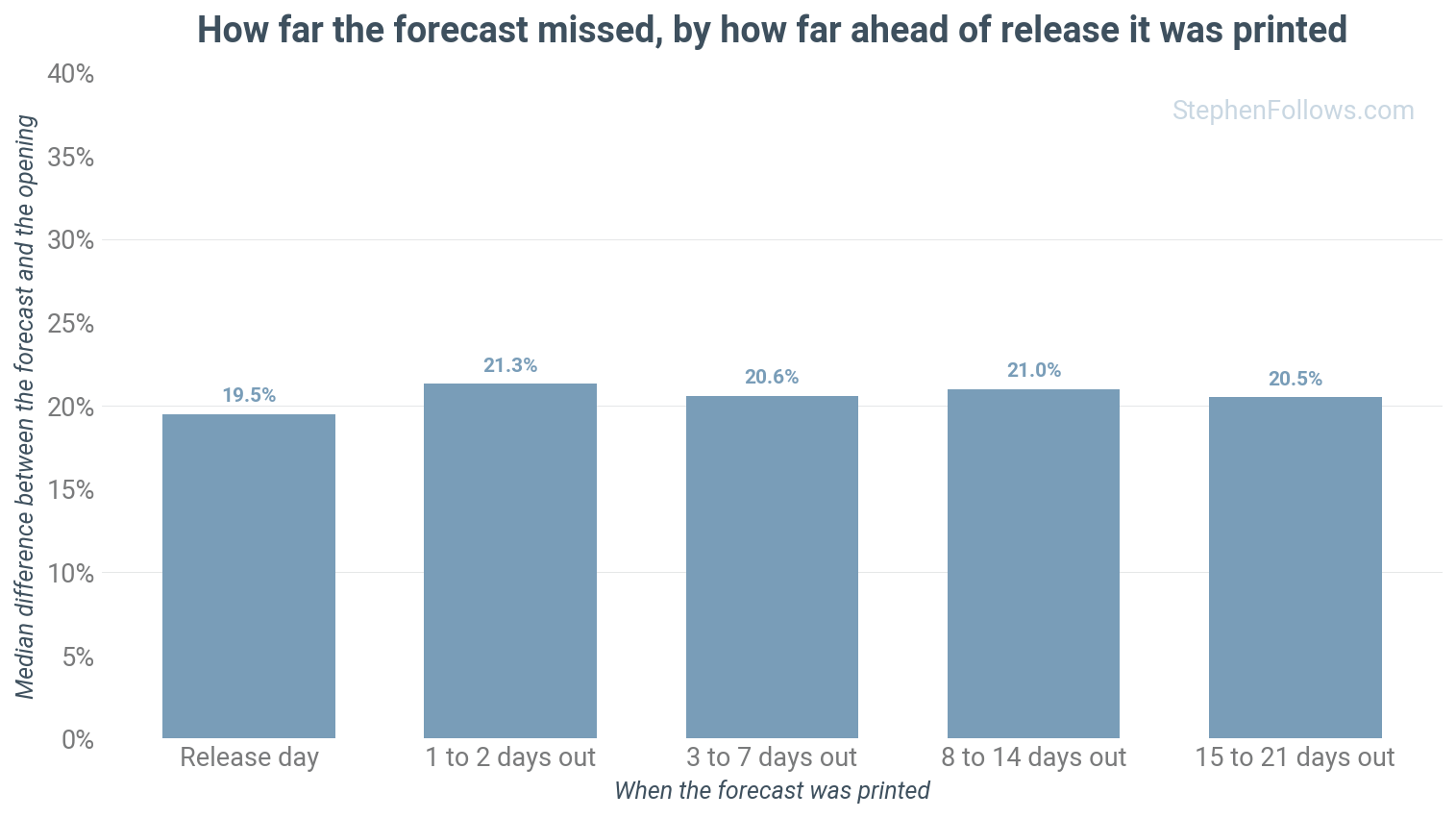
Below is the typical miss for forecasts printed at each distance from release, taking the last one printed inside each window for every film that had one.
A figure printed in the third week before release missed by 20.5% and one printed on the morning of release by 19.5%. Whatever makes a film hard to call, the last fortnight of survey data does not fix it.
What might be driving this?
The data can show that small forecasts miss by more. But that doesn’t explain why.
Here are my best guesses:
Small numbers are more naturally erratic. A tracking survey measures awareness and intent. For a film few people have heard of, that is a small number with a large error, and a swing of a few million dollars either way is a big percentage.
Bigger films have bigger marketing budgets. A large campaign should make the opening safer because fewer people are left to persuade in the final days. Studios don’t publish marketing costs, but production budget is a rough proxy and carries some weight. Between two films with the same forecast size, the more expensive one was missed by less. This is another reason why Digger is so interesting - a $125 million film with just $20 million forecast is an outlier.
Bigger films are built for an audience. Test screenings, known characters and sequels with a track record should all (in theory) remove surprises.
Advance ticket sales. Event films sell a meaningful share of their opening weekend before it starts, which gives forecasters hard numbers to work from. Maybe they have a peek at the answer sheet before the test.
Wider releases average out local variation. A film on 4,000 cinemas is in every kind of town, so a bad night in one region is covered by a good one elsewhere. I can actually test this theory as OpusData provides opening cinema counts, and it holds up. Among films forecast at under $10 million, those opening in fewer than 3,000 cinemas were missed by 26.9% and those in 3,000 to 3,499 by 19.3%. Among films forecast at $10 million to $20 million, the typical miss falls from 24.9% to 20.6% to 17.0% as the release gets wider. Above $20 million, the pattern disappears.
Release dates are chosen and defended. Big films claim their weekends years ahead, and smaller films move out of the way, so a big film rarely faces a surprise competitor.
Notes
Today’s research includes every film released in the States between 2006 and 2025 that opened in 2,000 cinemas or more and which recorded an opening weekend gross. That’s 2,046 films. Of those, 1,765 had some kind of forecast printed, and 1,184 had one that can be scored. Everything here rests on what the trades chose to publish.
I looked at forecasts printed in Variety, The Hollywood Reporter, Deadline, or Screen Daily, published from 21 days before a film’s release to 3 days after, that named the film and included both a dollar figure in millions and a forecast word.
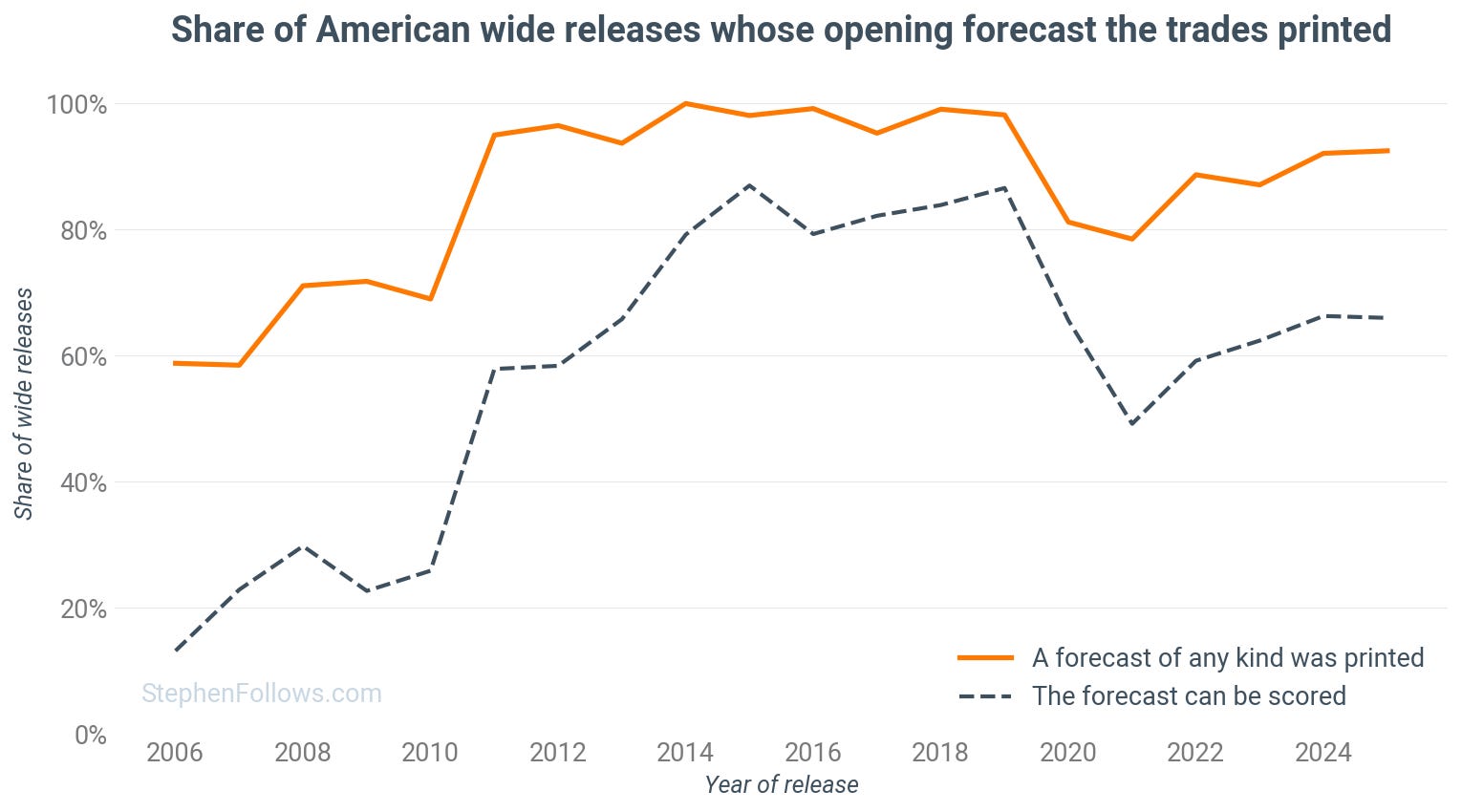
Interestingly, before 2011 the trades printed far fewer forecasts. In 2007 they published one for 58.5% of wide releases, whereas from 2011 onward the figure runs between 78.5% and 100%.
My model measured the miss as the absolute difference between the logarithms of the opening and the forecast. With the forecast, the budget, franchise, drama, the source of the figure and the number of outlets, only the size of the forecast and the budget are significant. Adding original screenplay, R rating and major distributor changes nothing. Adding the opening cinema count, the count is significant; the size of the forecast and the budget each fall just short, and franchise films are slightly harder to call. The forecast and the cinema count correlate at 0.78 on a logarithmic scale, so the three measures of size overlap heavily, and I would not lean on any one of them. The full model explains 8.6% of the variation (of the 1,128 films with a budget figure on record).