


While at film school I did all I could to avoid lessons around film theory and film appreciation. I regret it now, and so as an adult I have resolved to watch more of the very best movies made over the past 125 years.
What’s very frustrating is that filmmakers keep making more seminal films, and film scholars keep adding to ‘the canon’. It’s quite unfair as I’m still playing catch up.
By ‘the canon’ I mean the informal but widely acknowledged body of films considered essential viewing by critics, historians, educators, and institutions.
With new films added every few years, it stands to reason that some older ones might lose ground. This isn’t a strict one-in-one-out system, but certain forces do make films fade from prominence:
Fashion show. Canons reflect the aesthetic priorities of their time. As collective taste evolves (especially around pacing, tone, or subject matter) older styles can fall out of favour.
Context matters, and shifts. We’re always learning more about the circumstances in which films were made. That includes the politics of their production, the personal behaviour of filmmakers, and the broader ideologies embedded in the work (e.g. Birth of a Nation and Triumph of the Will, plus the works of Woody Allen and Roman Polanski).
Who’s asking? As more critics and curators from outside the historically dominant regions contribute to these lists, the canon expands. That expansion means more films from underrepresented regions and communities, and less space for overrepresented ones.
Gotta see it to appreciate it. Some films stay in conversation because they’re visible, while others fall away due to limited availability. Restorations, repertory screenings, and streaming revivals have pushed films like Yi Yi and Sátántangó, into wider awareness.
It’s all academic. Academic syllabi shape generations of critics and voters, and so when their courses shift their case studies, that affects what’s people see and appreciate. For example, In the Mood for Love has become a staple in courses on romantic drama and visual design.
That’s not ok (now). Some films age poorly due to outdated or offensive content. The dog in The Dam Busters being named the N-word, or Mary Poppins having its rating raised over the use of “Hottentot,” are reminders that acceptability shifts.
Lists are literally zero-sum. Top 10s and 100s are, by definition, zero-sum. There’s limited space, so even a small shift in attention (such as a retrospective, anniversary, or critical reappraisal) can nudge films on or off the list.
This got me thinking - which films are falling out of fashion within the debate of “the best films ever made”?
Seeing and hearing Sight & Sound’s poll
I decided to focus on Sight & Sound’s once-in-a-decade poll which has been running since 1952.
It is the longest running, regularly repeated poll of critics and filmmakers, and offers consistent ranks and vote counts across eight cycles from 1952 to 2022. This means while it’s not the official arbiter of ‘the canon’, it is a reliable proxy that shows change over time.
The poll’s electorate has grown and diversified over the years, with just 63 critics being quizzed in 1952, to 122 in 1982, 101 in 1992, 145 in 2002, then 846 in 2012 and 1,639 in 2022. The most recent cohorts include programmers, curators, archivists and academics.
The most recent poll lists the ‘Greatest Films of All Time’ as (in order):
Jeanne Dielman, 23, quai du Commerce, 1080 Bruxelles (1975, Chantal Akerman, Belgium/France).
Vertigo (1958, Alfred Hitchcock, USA).
Citizen Kane (1941, Orson Welles, USA).
Tokyo Story (1953, Yasujirō Ozu, Japan).
In the Mood for Love (2000, Wong Kar Wai, Hong Kong/France).
2001: A Space Odyssey (1968, Stanley Kubrick, USA/United Kingdom).
Beau travail (1998, Claire Denis, France).
Mulholland Drive (2001, David Lynch, France/USA).
Man with a Movie Camera (1929, Dziga Vertov, Ukrainian SSR/USSR).
Singin’ in the Rain (1951, Gene Kelly, Stanley Donen, USA).

What are some recent additions to ‘the canon’ of great cinema?
So many films are produced each year, and so much of the public noise around movies is on the popcorn fare, that it can be hard to remember which new works of great cinematic art have also been released.
Here’s a rundown of a few films released in the past few decades which have entered Sight & Sound’s top 100 list:
Parasite (2019, Bong Joon Ho, South Korea). Best rank 90.
Portrait of a Lady on Fire (2019, Céline Sciamma, France). Best rank 30.
Get Out (2017, Jordan Peele, United States). Best rank 95.
Moonlight (2016, Barry Jenkins, United States). Best rank 60.
Tropical Malady (2004, Apichatpong Weerasethakul, Thailand). Best rank 95.
Mulholland Drive (2001, David Lynch, United States). Best rank 8.
Spirited Away (2001, Hayao Miyazaki, Japan). Best rank 75.
The Gleaners and I (2000, Agnès Varda, France). Best rank 67.
In the Mood for Love (2000, Wong Kar Wai, Hong Kong). Best rank 5.
Yi Yi (2000, Edward Yang, Taiwan). Best rank 62.

Recent additions have much more diverse origins, both the countries they were made in (for example, there are many more from Asia) and the profile of the filmmakers behind them (from Varda and Campion to Denis, Sciamma and Dash).
The genre and form of the films have also expanded. Animation (Spirited Away) sits next to essay‑documentary (The Gleaners and I), queer cinema (Beau travail, Portrait of a Lady on Fire), slow cinema (Sátántangó, Tropical Malady), horror (Get Out) and contemporary US indies centred on identity and class (Moonlight, Daughters of the Dust).
In with the old
It’s not just new films which have been recently added. Some older films which made their way into the list for the first time in 2022 included:
News from Home (1976, Chantal Akerman). 2022 rank 52.
Daughters of the Dust (1991, Julie Dash). 2022 rank 60.
The Watermelon Woman (1996, Cheryl Dunye). 2022 rank 146.
Le bonheur (1965, Agnès Varda). 2022 rank 153.
Symbiopsychotaxiplasm: Take One (1968, William Greaves). 2022 rank 169.
One Way or Another (1977, Sara Gómez). 2022 rank 196.
Je tu il elle (1974, Chantal Akerman). 2022 rank 226.
Oh, Sun (1970, Med Hondo). 2022 rank 244.

First‑time entries seem to arrive in waves. The 1962 and 1972 lists consolidated mid‑century European art cinema and post‑war classics. The 2002 poll pulled in a set of late‑20th‑century titles that had matured into consensus. The 2012 and 2022 editions added contemporary works that crossed the threshold surprisingly quickly (Parasite, Get Out, Moonlight) alongside slow-burn classics that had built a case over decades (In the Mood for Love, Mulholland Drive, Sátántangó).
Also, I spotted that Paul Verhoeven’s 1995 “classic” Showgirls received seven votes in 2022. This ranks it joint 405th, so outside of the official ‘Top 250’ but not absent.

Which classic films are on the wane?
To try to find the films falling out of fashion I created a ‘Forgotten Score’, based on the Sight and Sound data.
It took in the best ever rank the film has scored and its most recent standing. I narrowed down to films that had ever been in the top 100 but which were outside the top in the 2022 poll.
Below are the films, in order, which seem to be at most risk of being fired from the canon:
2 or 3 Things I Know About Her (1967, Jean-Luc Godard, France). Best rank 41. 2022 rank 462.
Gertrud (1964, Carl Theodor Dreyer, Denmark). Best rank 25. 2022 rank 136.
L’Âge d’or (1930, Luis Buñuel, France). Best rank 24. 2022 rank 553.
The Travelling Players (1975, Theodoros Angelopoulos, Greece). Best rank 46. 2022 rank 405.
The Godfather: Part II (1974, Francis Ford Coppola, United States). Best rank 11. 2022 rank 104.
La Terra Trema (1948, Luchino Visconti, Italy). Best rank 9. 2022 rank 553.
Ivan the Terrible (1944, Sergei Eisenstein, Soviet Union). Best rank 6. 2022 rank 405.
Viridiana (1961, Luis Buñuel, Spain/Mexico). Best rank 7. 2022 rank 405.
Three Colors: Blue (1993, Krzysztof Kieślowski, France). Best rank 89. 2022 rank 462.
The Eclipse (1962, Michelangelo Antonioni, Italy). Best rank 73. 2022 rank 196.
Belle de jour (1967, Luis Buñuel, France). Best rank 54. 2022 rank 1652.
Diary of a Country Priest (1951, Robert Bresson, France). Best rank 47. 2022 rank 462.
Raging Bull (1980, Martin Scorsese, United States). Best rank 18. 2022 rank 129.
The Passenger (1975, Michelangelo Antonioni, Italy). Best rank 44. 2022 rank 292.
Nazarin (1959, Luis Buñuel, Mexico). Best rank 20. 2022 rank 1105.
The Grapes of Wrath (1940, John Ford, United States). Best rank 13. 2022 rank 668.
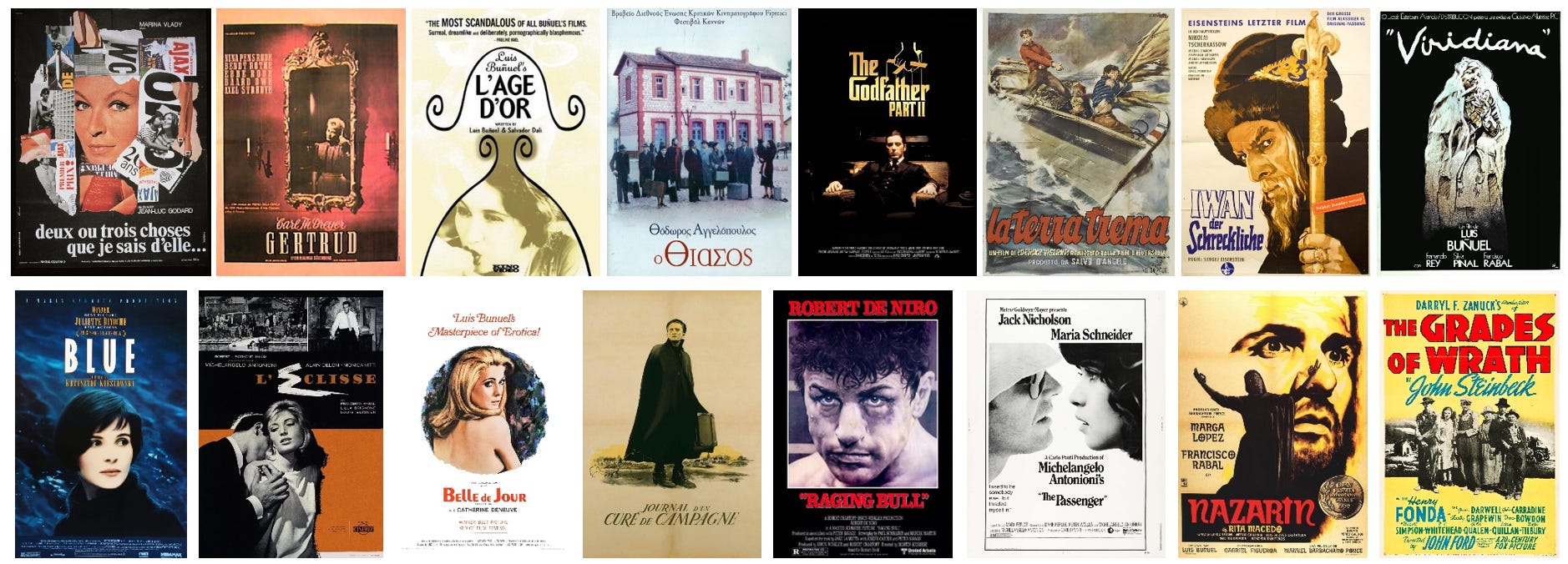
To be clear, I’m not saying anything negative about these films. They have not got worse, nor will they ever been forgotten. They are just the ones whose star seem to shine a little less brightly than in previous years.
Notes
The most recent data is nicely available on Sight & Sound’s website but the 20th century polls are slightly more opaque as they were only in the printed editions. However, Katie Donia (CUNY) has done God’s work in creating the “Complete Sight & Sound Greatest Films of All Time Database” by reading through those old editions.
Thank you to Isa for our conversation which led to this and to tipping me off about Katie’s work.
This post is fantastic and informative. I appreciate the Complete Sight and Sound (CSS) website for its exciting rankings. While I’m accustomed to the American Film Institute’s (AFI) top 100, the CSS rankings prompt a discussion on the criteria and reasoning behind them. It’s intriguing stuff. Thank you, sir.
I love this!
I think it was like 10-12 years ago that Bill Hader came out with his list of favorite films. That started me on my quest to revisit films I either hadn't seen in a long time or at all.
That led me to the book, "1001 Movies You Must See Before You Die" by American film producer Steven Jay Schneider. It was first published in 2003 and was updated every year from 2007 to 2021.
I grabbed every edition and compared them. If we take every film ever included, I believe there are actually 1,167 movies we should see before we die.
I found it interesting to track the changes over time in the book. There were more American films at first, but they evolved to include more non-US films.
I'll be the first one to admit that non-US films have a hard time making it in the US for a myriad of reasons. I'd love to see a list of the top whatever number non-US films.