


In Die Hard, Holly Gennaro asks Hans Gruber, “What’s going on?”, only to receive the less-than-clear response, “The child is about to touch the stove.”
Poetic thieves aside, Reese Witherspoon has a name for this kind of moment. In an acceptance speech at Glamour’s Women of the Year Awards in 2015, she said:
It’s my most hated question. I dread reading scripts that have no women involved in their creation... because inevitably, the girl turns to the guy and says, ‘What do we do now?’... I’m serious. Go back and watch any movie, you will see this line over and over.

What she’s saying certainly rings true, but to what extent is this happening? Is it getting better, worse, or staying the same? And how does this change when the screenwriter is a woman?
I studied 2,607 movies (script and on-screen action) to learn more.
How often are female characters seen/heard?
Let's start with how much characters speak, then move into what they’re saying.
I gathered 2,607 screenplays of produced feature films and tagged each line by speaker. Using the actors' gender, I looked at how much women speak on screen.
Women speak 30% of the dialogue in the average screenplay, though this varies widely across movies.
In 37% of films, women speak less than a fifth of the words, while only 16% give women half or more of the dialogue. Women have the most lines in just under a quarter of films, with men taking the most in just over three-quarters of movies.
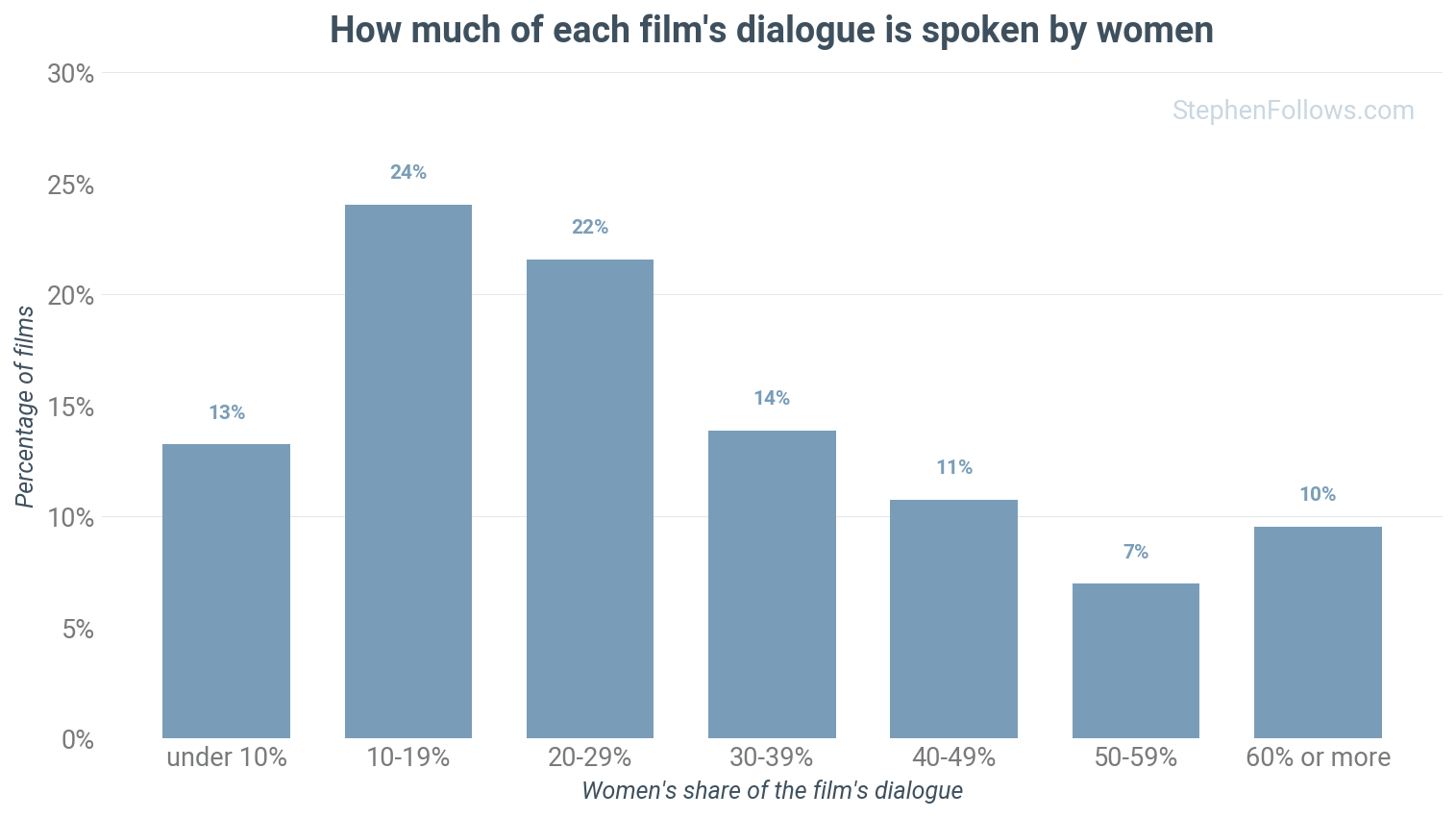
The same imbalance shows up if we look at the data scene by scene. Of the 164,540 scenes in which two or more characters speak, 35% have only men talking. Only 7% have only women talking (i.e. roughly one scene in fifteen).
What we hear is only half of it, though. I also counted the faces that appear on screen, detected in one frame from every shot, for 2,002 of the same films. Each dot on the chart below is one movie.
Speaking - The further to the right a dot sits, the more of the script’s dialogue is spoken by women.
Existing - The higher a dot sits, the more of the faces on screen are those of women.
Broadly, they rise and fall together, which makes sense, since we don’t often see a bevy of mute women or hear disembodied women’s voices (well, I don’t in the movies I watch).
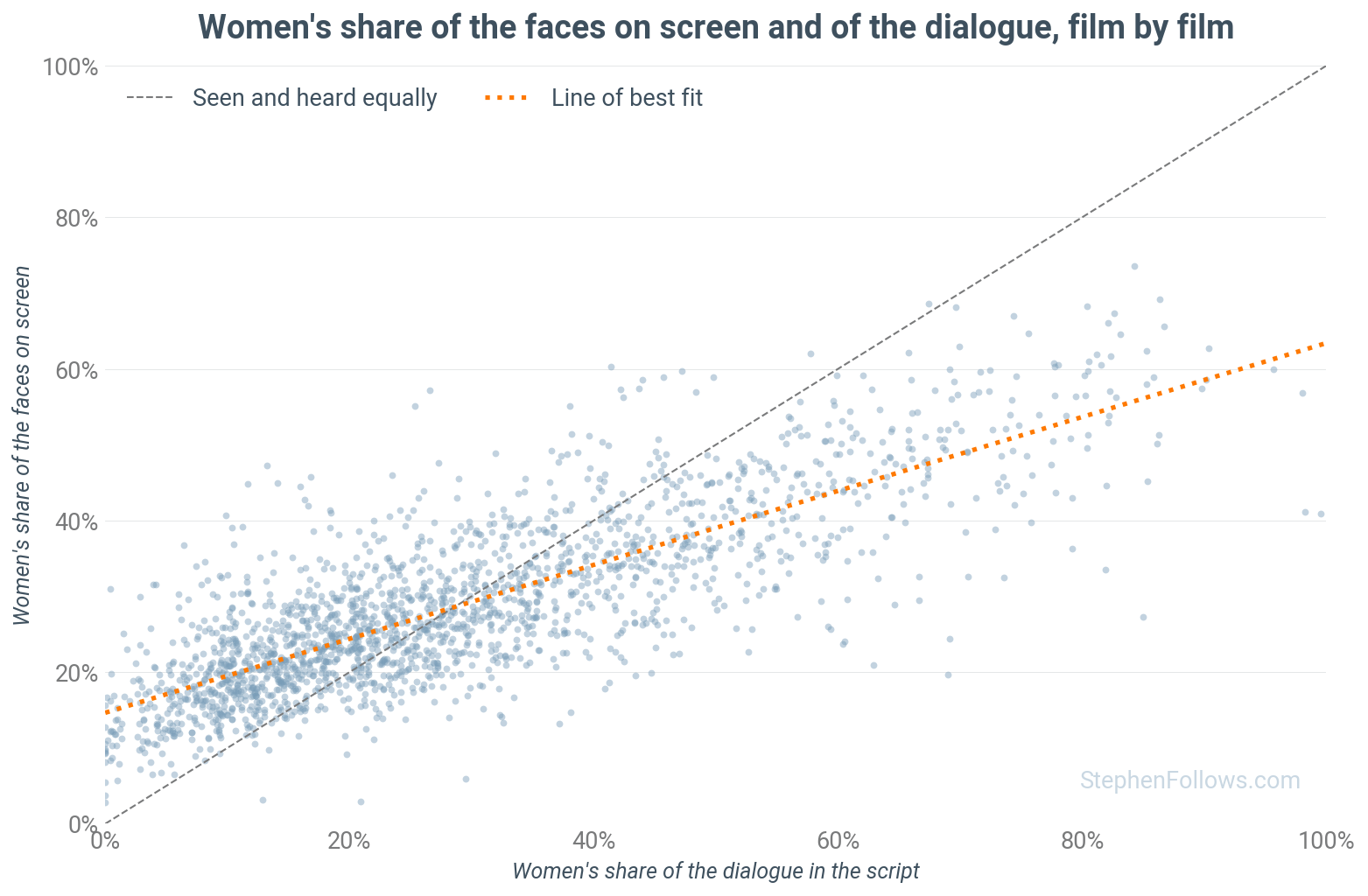
Across these films, women make up 29% of the faces on screen and speak 29% of the words, so a script that gives women more to say tends to become a movie that puts them on screen more often.
But take a look at the ends of the cloud. In films where women speak under a fifth of the words (12% on average), they’re still 17% of the faces on screen, i.e. present but mostly silent. And in films where women do most of the talking (64% of the words, on average), they’re only 52% of the faces, because the camera keeps finding men.
How do screenplays describe women?
The first time a character appears in a screenplay, their name is written in capitals alongside a short description, such as “KAREN, late 40s with a confident air”. I found those introductions for 41,558 speaking characters.
A woman’s introduction references her physical looks (beautiful, pretty, attractive, sexy, etc.) in 11% of cases, compared to just 3% of the time for a male character.
Some of these descriptions are necessary to convey a key trait of the character, but most are not. Here is how The Wolf of Wall Street introduces Naomi:
NAOMI, 24, blonde and gorgeous, a living wet dream in LaPerla lingerie.
By contrast, this is the whole of the introduction Inception gives its lead:
COBB, is 35, handsome, tailored.
I’m hardly the first to spot this. Taika Waititi told the Los Angeles Times in 2017:
There’s one word I hate in all scripts in Hollywood at the moment in describing women, and that is the word ‘badass’... It’s a dumb male writer’s way of saying, ‘Ah, uh, she’s like, she, uh, she’s tough.’ Then straight after that it’s like, ‘She’s badass, but she’s got a beauty about her. And she’s sexy. Unconsciously sexy.’
Across all the scripts I studied, women were much more likely than men to:
Be described by their looks (3.4 times as likely)
Have their character cry (3.4x)
Be directed to look afraid (1.5x)
Ask “Are you okay?” (1.4x)
Ask “What’s going on?” (1.3x)
Men were more likely than women to:
Be directed to grin (2.3x)
Be directed to shout (1.4x)
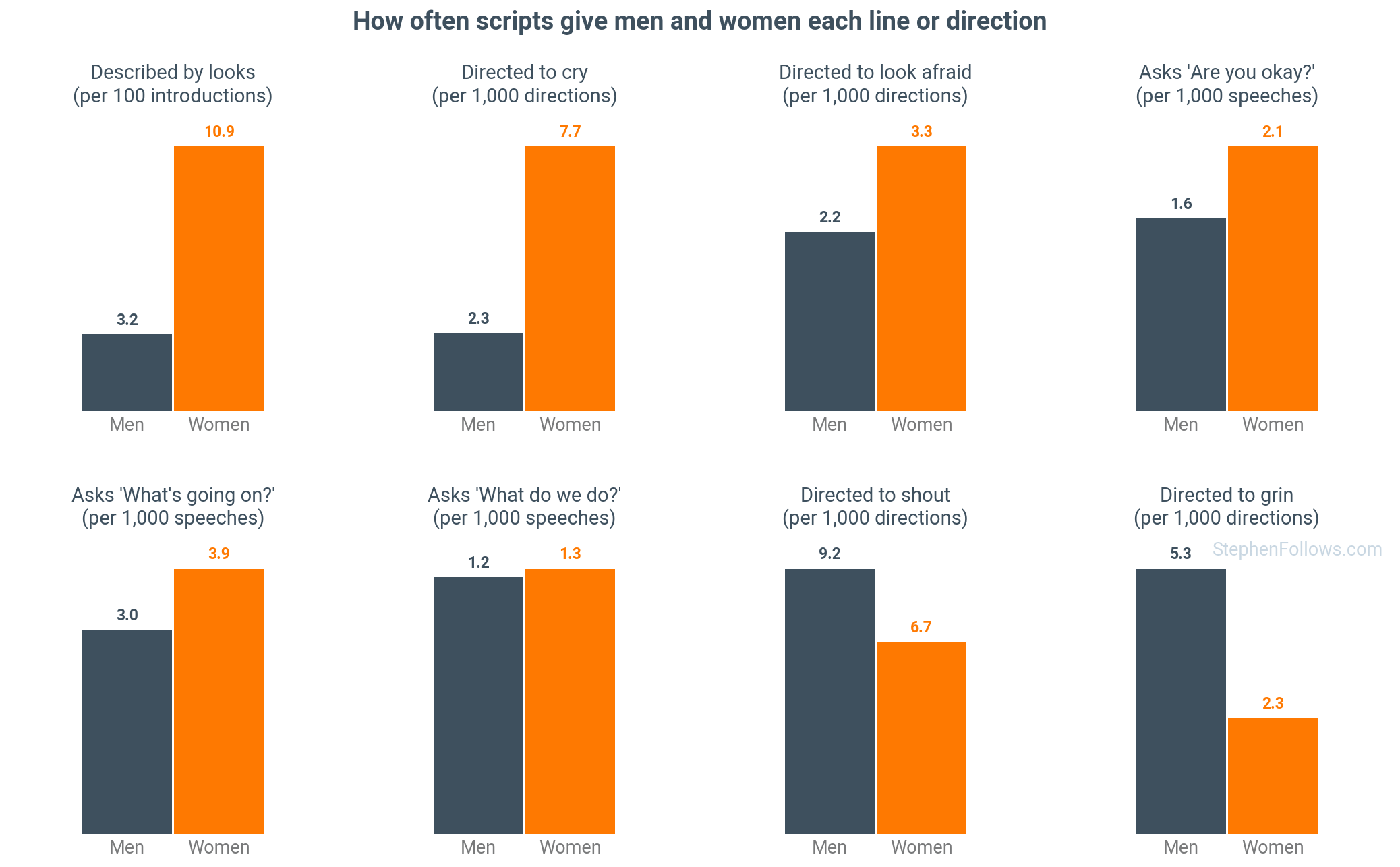
Which brings us back to Witherspoon. In scripts written only by men (not quite her “no women involved in their creation” definition but close when it comes to script), women ask “What do we do?” about the same number of times that men do (1.06 times for every 1 from a man).
Huh.
But if we zoom out from the exact wording Reese Witherspoon suggested and look at a closely related issue, we can see what she meant.
Female characters express confusion (such as “What’s going on?”, “What happened?”, “What was that?”) 34% more often than their fellow male characters, in scripts written by men.
The gap is widest in action films, where women ask “What’s going on?” 1.8 times as often as men.
A good example is the script for Iron Man. Pepper Potts walks into the wreckage of Tony Stark’s living room and asks, “Are you going to tell me what’s going on?”. The stage direction reads “(never looking at her)”, and his line is “Get my house in Dubai ready. I want to throw a party.”

What changes when women write the script?
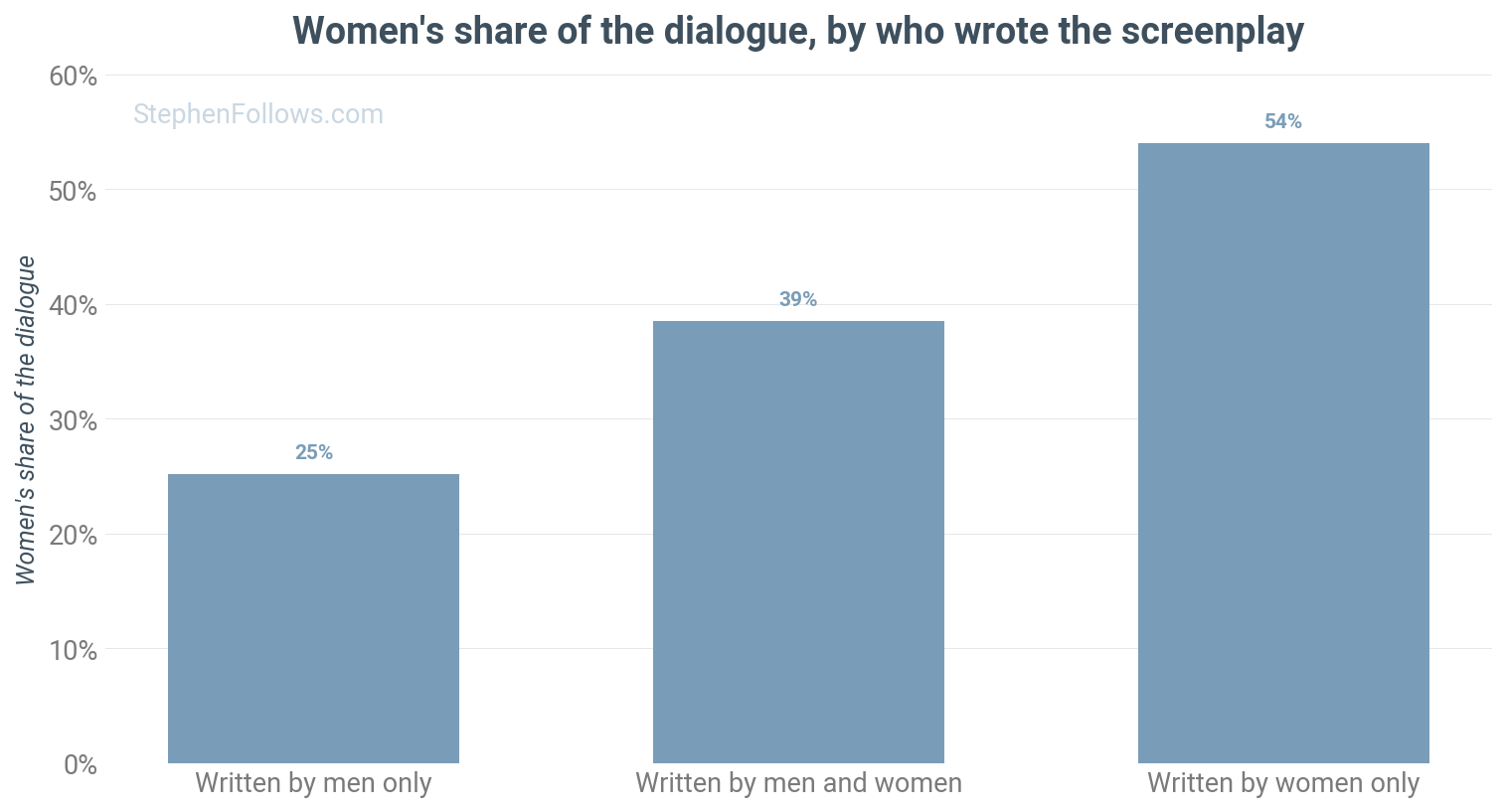
I identified the gender of the credited screenwriters for 1,700 films. Of those, 1,401 were written only by men, 178 by mixed teams and 121 only by women, and the chart below shows women’s share of the dialogue in each group.
Scripts written only by women give women 54% of the dialogue, more than double the 25% in scripts written only by men. Mixed teams sit in between at 39%.
The difference goes far beyond the number of words spoken.
Female characters have the most lines in 66% of scripts written only by women, against 15% of those written only by men.
Scenes where only women talk make up 21% of scenes in women-written scripts and 4% in men-written ones.
The same pattern appears in screen time, with women making up 41% of the faces in films written only by women and 27% in films written only by men.
You might expect this to be the director’s influence as much as the writer’s, but the data suggests that it is mostly the writer. In films with neither a woman writer nor a woman director, women speak 25% of the words. A woman director alone takes that to 32%, a woman writer alone to 41%, and both together to 51%.
Types of stories
We should remember these aren't isolated factors. Female writers may be hired for stories already about women, and I can’t fully separate the writer from the story they were hired to tell.
The chart below shows women’s share of the dialogue in the eight genres with 100 or more films in the dataset, which together cover 2,538 films.
Action films give women the least (21%) and horror the most (39%), with drama and comedy close behind horror at 37% and 35%.
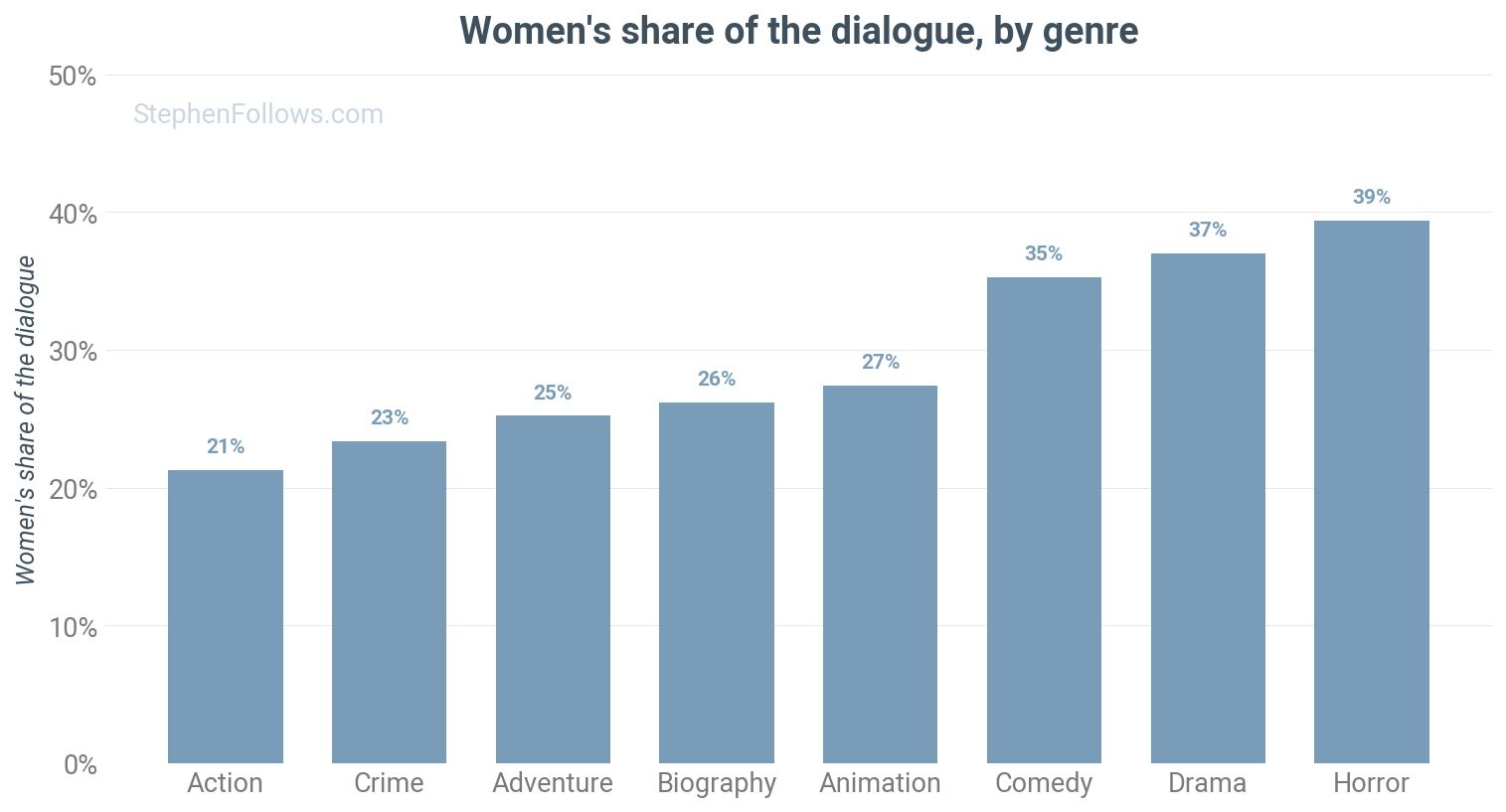
While genres differ, the same pattern persists within them. In action films, men-only scripts give women 20% of the words and scripts with at least one woman writer give them 29%. In comedy it’s 27% against 52%, and in drama 33% against 46%.
So far, the data makes a pretty persuasive case that hiring more women as screenwriters would do wonders for how much female characters get to say and do on screen. (Again, this is not a groundbreaking thought!)
Nothing I’m about to say undermines that.
But we should also consider another factor - the environment in which those scripts were created. Scripts are not created in a vacuum. They are part of a culture we all live in, developed in an industry with norms, and shaped by a wider system of audience expectations.
Would more women writers in the 1980s have changed things?
The history of sexism in the film industry could fill a book. It has. Many books. Many, many books. In fact, so many that I am barely scratching the surface with these links. So forgive the narrow focus here.
I picked two moments when Hollywood was formally accused of shutting women out. In the early 1980s, the Directors Guild of America complained to the federal Equal Employment Opportunity Commission of “wholesale discrimination against women” (as Variety put it on 13 May 1983), then sued Warner Bros. and Columbia Pictures on behalf of its women and minority members (The case eventually failed on a technicality).
Susan Smitman, a co-chair of the guild’s women’s committee, warned Variety in October 1985 not to read too much into a few success stories:
Because Martha Coolidge is doing features, and because Amy Heckerling is doing features, and Susan Seidelman is doing features, and Lisa Gottlieb is doing features doesn’t mean women are working.
Thirty years later, in 2015, the same commission opened an investigation into the hiring of women directors, and later charged every major studio. So we have two moments in time to compare.
The chart below shows women’s share of the dialogue in films released from 1978 to 2025, smoothed as a three-year average, with those two moments shaded.
After the first, nothing moved. Women’s share of the words sat at about 25% before it, during it and for a decade after. After the second, it climbed from 30.5% in the decade before 2015 to 40.5% since 2020. That rise also coincides with #MeToo and the arrival of streaming.
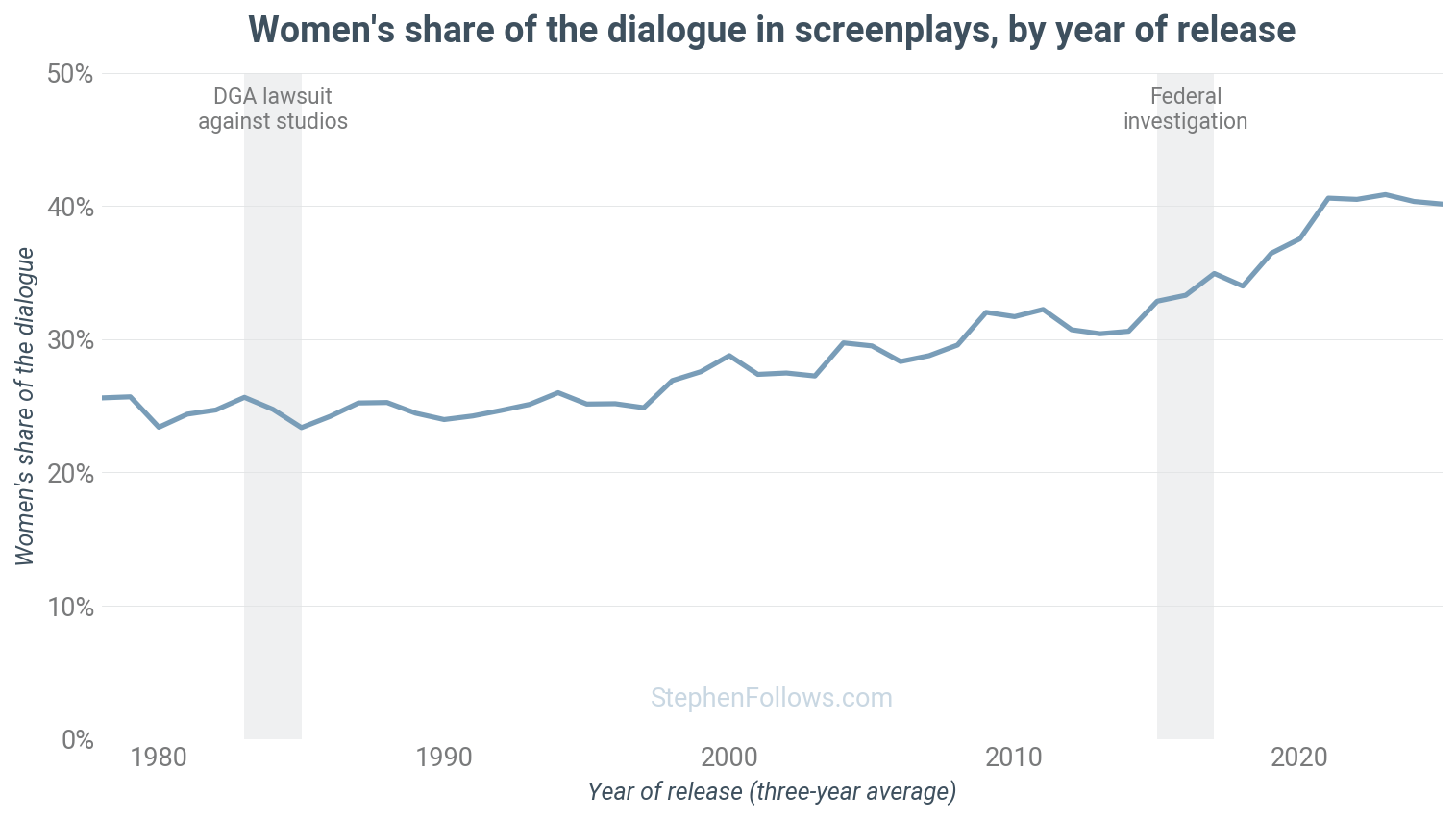
Over the same period, the share of films with a woman credited on the screenplay rose from 10% in the 1980s to 32% in the 2020s.
So did the change happen because more women got to write, or because writing itself changed?
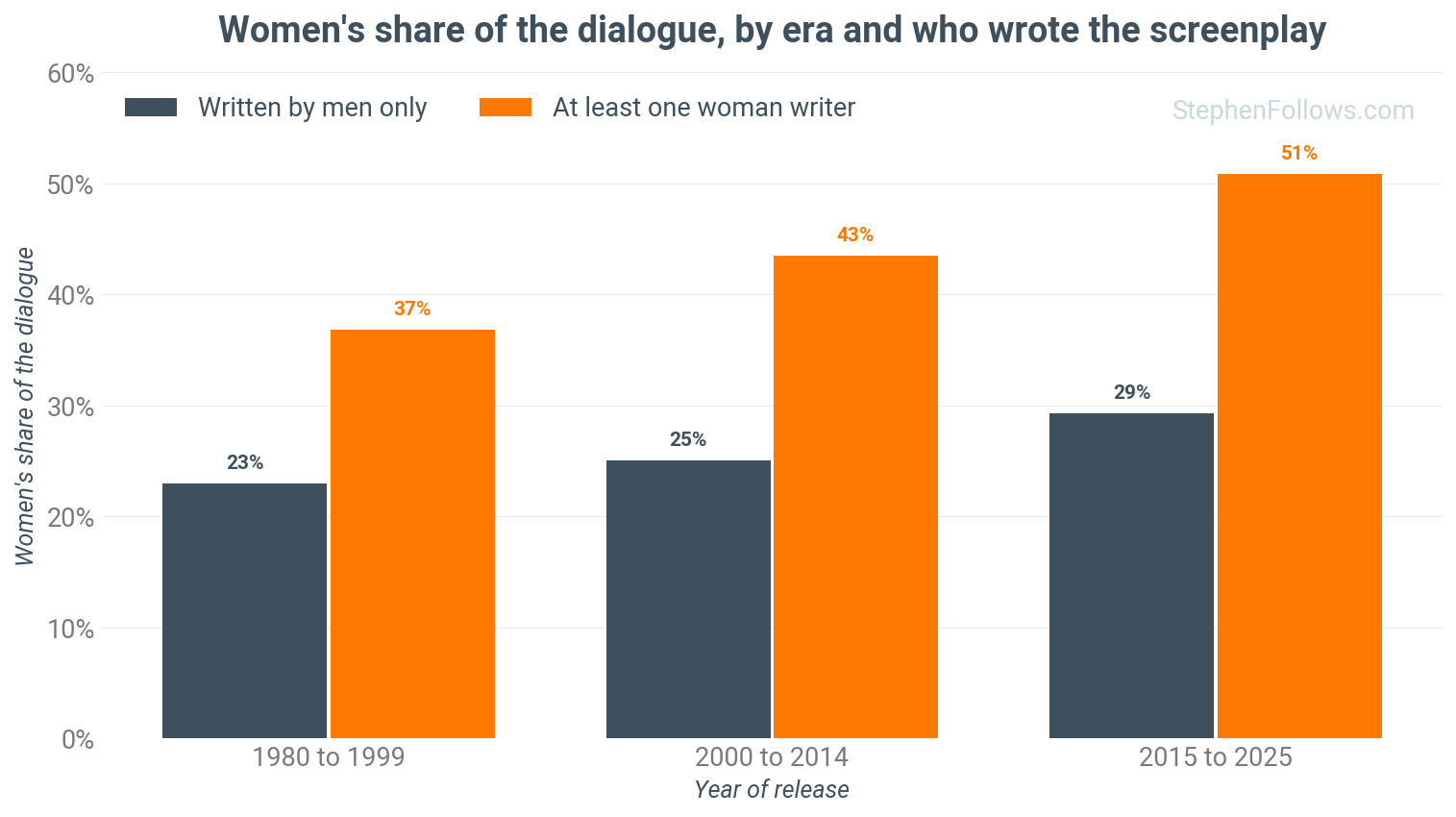
The chart below splits the 1,557 films released since 1980 with known writers into three eras, then breaks them down by who wrote the script.
Two things jump out:
First, women writers in the 1980s and 1990s already had far more to say than the men around them (37% against 23%).
Second, both groups have increased since then. Men-only scripts went from 23% to 29%, and scripts with a woman writer went from 37% to 51%.
To separate the two effects, I took the scripts from 1980 to 1999 and asked what women’s share would have been with today’s mix of writers. The actual figure was 25%. With today’s mix, it would have been 27%. With an even split of men and women writers, it would be 30%. The real figure for 2015 to 2025 is 35%.
In other words, we’d have seen more lines for women if more women had been let in during the 1980s. But only about a fifth of the change since then came from the mix of writers, and the rest came from everyone writing differently.
We can see the same effect even more clearly in the data on descriptions:
In 1980 to 1999, scripts introduced 13% of women with a looks word, regardless of whether men or women wrote them.
By 2015 to 2025, it was 8% for men-only scripts and 7% for scripts with a woman writer.
This means that fall had nothing to do with who was writing, as both groups dropped together.
In the end, my answer to the headline question is yes and no. More women writers would have meant more words for women, more scenes between women and more women on screen, both then and now.
But the women writing 40 years ago described women’s bodies much like the men around them did, and what changed how women are described on the page was culture, which changed for everybody at once.
Notes
Today’s dataset comprises 2,607 feature screenplays of films released between 1931 and 2026. Most are English-language and American, and they lean towards well-known films (this is not a random sample of every film ever made). The 2020s figures rest on 283 films, and the scripts from recent years that circulate may lean towards awards contenders.
I classified every line of every script (dialogue, action, scene heading, etc) and linked each speaking character to the actor who played the role. (And I created extra checks to catch annoying things such as a flashback to a younger version of a character credited to the adult actor… grrrr).
Gender is the performer’s recorded gender, which is usually but not always the character’s (voice roles and cross-gender casting are the exceptions). Non-binary performers are kept in the data but are too few to chart.
Speakers that could not be linked to an actor (crowds, ‘Guard #2’ etc.) were excluded, which accounted for 4.6% of all dialogue words. A film is included in the share figures only if at least 70% of its dialogue words could be linked to a gendered actor: 2,582 of the 2,607 films. Averages are calculated per film.
An introduction is the first time a speaking character’s name appears in capitals in the action text before they speak. I found one for 41,558 characters, tracking words such as beautiful, beauty, pretty, attractive, gorgeous, stunning, lovely, sexy, cute, striking, knockout, hot, bombshell, alluring, seductive, sultry, voluptuous, curvaceous, curvy, shapely, handsome, good-looking, rugged and chiselled. Much like myself.
Stage directions are bracketed directions within dialogue, such as “(tearful)”, and are counted per word of direction.
Crying covers tears, tearful, crying, cries, sobbing, sobs, weeping and teary.
Afraid covers frightened, scared, terrified, afraid, fearful and panicked.
Grinning covers grin, grins, grinning, smirks, smirking, chuckles and chuckling.
Shouting covers shouts, shouting, yells, yelling, roars and bellows.
The “What do we do?” family covers what are we going to do, what do we do, what should we do, now what and what now.
The “What’s going on?” family covers what’s happening, what’s going on, what was that, what is that, what happened and what does that mean.
Writers are those credited for the screenplay itself (”screenplay by”, “written by” and so on). Story and source credits (such as the author of the novel) and uncredited writers are left out. Writer gender was known for 1,700 films and director gender for 2,458. In the 907 films where the writers’ gender wasn’t known, women speak 33% of the words, close to the overall average.
The faces come from a separate analysis of the footage, in which a face-detection model labelled each detected face by apparent gender. This dataset includes 2,002 of those films.
In 2016, Hanah Anderson and Matt Daniels published an analysis of 2,000 screenplays for The Pudding, counting only characters with 100 or more words and matching them to IMDb. On the 1,406 films in both datasets, its average share for women is 28.3% and mine is 28.0%, and the correlation between the two, film by film, is 0.97 (where 1 would mean they always move in step). The main disagreement is Network, where its published data has no entry for Faye Dunaway's Diana Christensen. In my count, she has more words than anyone else in the film, and women speak 35% of the dialogue, against 5% in its figures.
Women writers may be hired for stories that already centre on women. Splitting by genre and budget narrows that explanation but cannot rule it out, so these differences may reflect differences between scripts, and the data can’t say what caused them.
The amount of studies on this makes it pretty clear that the sexism in Hollywood is hurting it. One decade long study found that any film with a woman as either writer, director, producer or editor made on average 25% more money than a film without a woman in one of those roles. I've helped found two Women in Film organizations and I can almost instantly tell when a script submitted to me is written by a man vs a woman.
Another great statistical reckoning.