


On 21 September, Paramount Skydance settled an antitrust case with California and 11 other states and agreed to an unusual deal.
After it merges with Warner Bros. Discovery, the combined company must release at least 30 films a year in US cinemas for two years, then 32 a year for three years after that.
If they miss any release targets, they must pay a $30m fine per movie, mostly going toward union health and pension funds. Not only that, if they then don’t make up the shortfall within six months, they forfeit Miramax!
What makes it so unusual is that nothing like it has been imposed on a Hollywood studio before, and no single company has released 30 films a year nationwide since 2007.
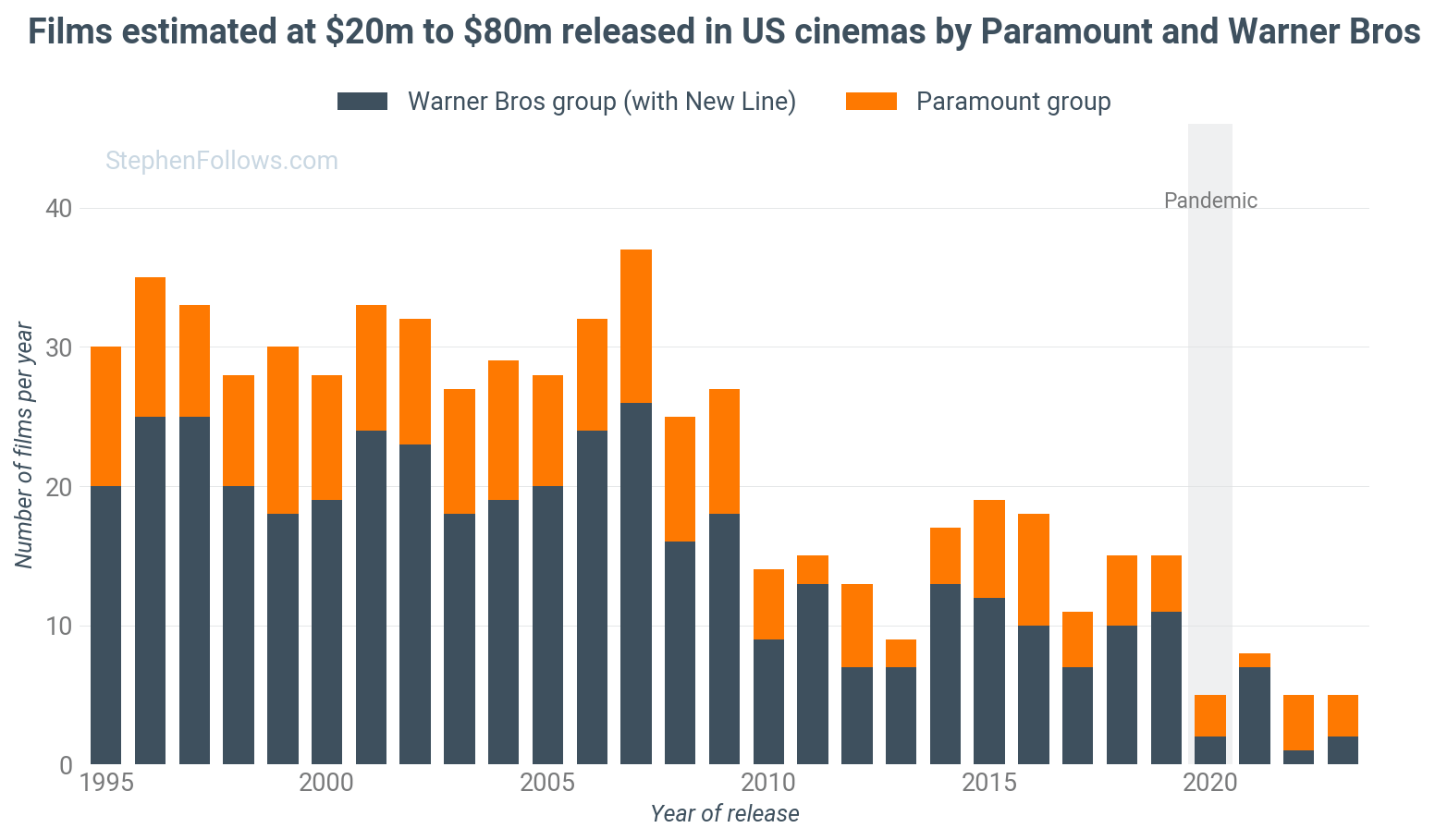
Paramount and Warner Bros., between them, are on track for 28 this year. In my data, their combined slate fell from 71 US cinema releases in 2007 to 22 in 2023.
In all, this settlement is twelve US states trying to legislate the middle of the film business back into existence.
Specifically, they are looking to restore “mid-budget” movies, something many people have claimed is dead. These include:
Matt Damon has said the mid-budget movie is dead in at least six interviews.
Steven Soderbergh said it in 2013 and again in 2025.
A coalition of 5,767 film workers said it in an open letter against this very merger.
I decided to dig into what people are claiming, what a mid-budget movie even is, and what the data reveals about what happened to them.
What did Paramount and Warner Bros actually release?
The settlement doesn’t require all 30 to 32 movies to be mid-budget. At least four a year must be independent films, six must be blockbusters, and at least 20 must also be wide releases. The movies can’t be cheap or AI-made, but otherwise the new company can allocate its money as it sees fit.
It seems unlikely they will commit to making 30 films costing over $100m, given that no year from 1995 to 2019 saw more than 43 US cinema releases with a reported budget over $100m (in 2026 dollars), not to mention the huge risks in capital cost and market saturation.

So we’re left assuming that the deal will produce a big increase in “mid-budget” movies. And this is a type of movie both companies have avoided in recent years.
Between 1995 and 2007, the two companies (and their affiliated entities like New Line and Paramount Vantage) released between 27 and 37 mid-budget films a year (films I estimate cost $20m to $80m in 2026 dollars, more on how below).
It peaked in 2007 at 37, but in both 2022 and 2023 it was just five. Mid-budget films made up more than half of their output every year from 1995 to 2009 except 2004, and 23% in 2023.
How to investigate a vague claim
“The mid-budget movie is dead” is almost industry lore by now. To investigate it, I had to narrow it down. So I found 70 instances of people talking about the topic.
46 were claiming the mid-budget movie has gone
12 said it is back
12 sit on the fence (including myself nearly a decade ago).
I logged what they claimed, their evidence, and what they meant by “mid-budget.”
The evidence trail is thin. 25 of the 70 claims were just someone stating it from their industry experience (albeit many were informed industry experts). 14 pointed to the box office performance of a few select films, 10 recycled a statistic from somewhere else, three quoted a studio executive, and 10 offered no evidence at all. Only 8 did some actual number crunching. Tsk tsk. Sounds like a job for me.
They couldn’t even agree on how much a movie has to cost to be classed as “mid-budget”.
29 stated a budget range, with minimums from $500,000 (Matthew Weiner, in Flavorwire) to $50m (The Ankler, December 2025), and the top end running from $15m to $100m, all in today's dollars.
It’s not even consistent for one person. Matt Damon alone has used $25m to $60m, $15m to $60m and $20m to $70m in different years.
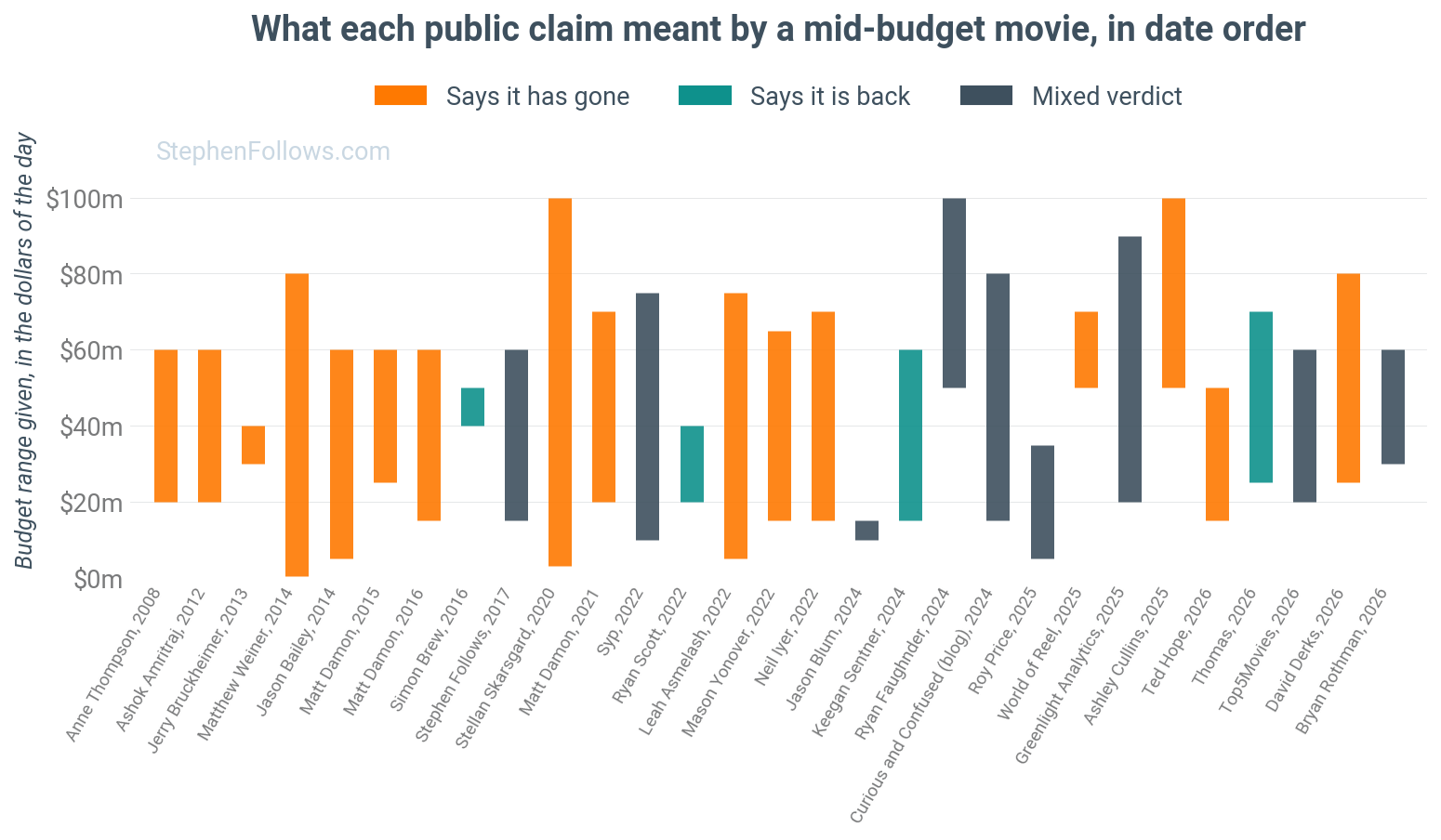
The median definition has a floor of $20m and a ceiling of $60m. Great, now we have our definition to study, right?
Hmmm, well, yes and no. We can do that, but the coverage is getting very patchy.

Let’s start with the data we have and then talk about why that method is weakening.
What the published budgets show
In the second half of the 1990s, movies costing $20m to $60m (inflation-adjusted to 2026 dollars) accounted for 31% of the cinema releases with a public budget, on average. Twenty years later, that was down to 24%.
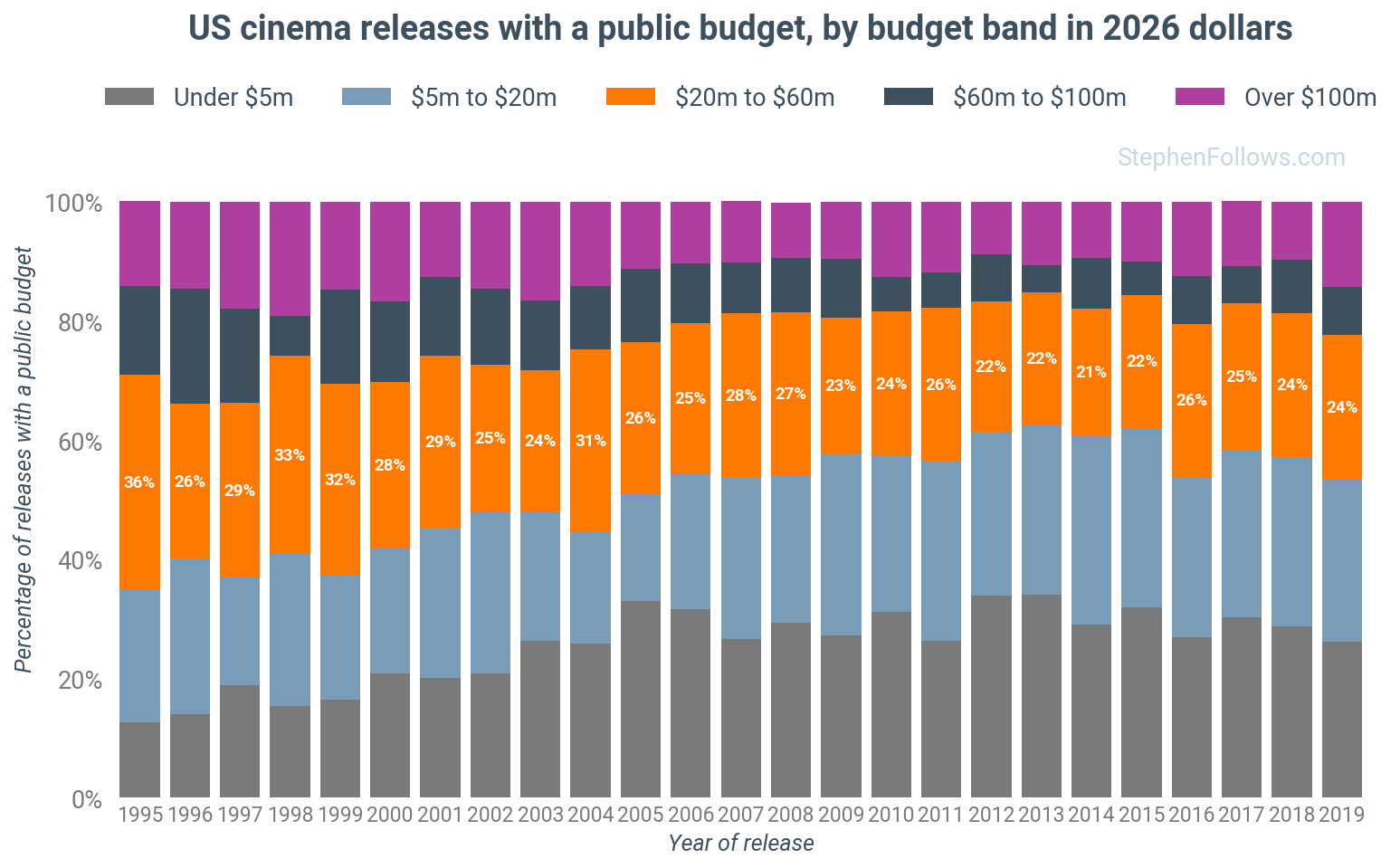
Given how each commentator created their own floor and ceiling, I thought I’d see how much of a difference there is between definitions.
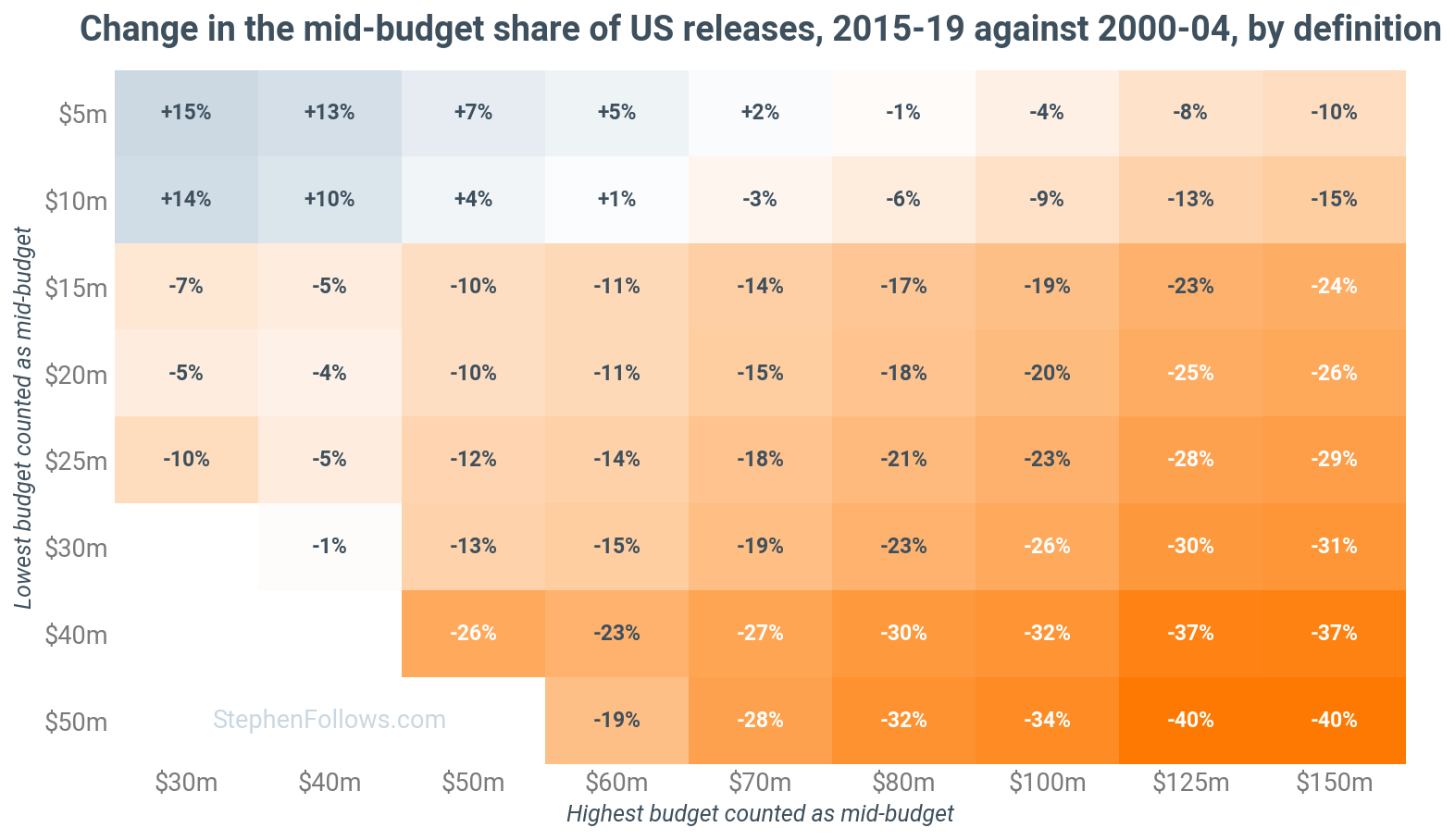
Quite a bit, it turns out.
If you think a “mid-budget” movie is one costing between $10m and $60m, then its share of budgeted US cinema releases actually rose slightly, by 1%, between 2000-2004 and 2015-2019.
However, if you feel that $40m and $100m are fairer limits, then it fell by 32%. Every definition with a floor of $15m or more shows a fall. The ones that start at $5m or $10m, with a low ceiling, show a rise.
But this isn’t the end of our number-counting woes.
So far, we have only been counting films with a reliable, public budget figure, which over-index towards studio films and wide releases. As I wrote last year, coverage of movie budgets has fallen through the floor in recent years (“No-one knows how much movies cost to make anymore”).
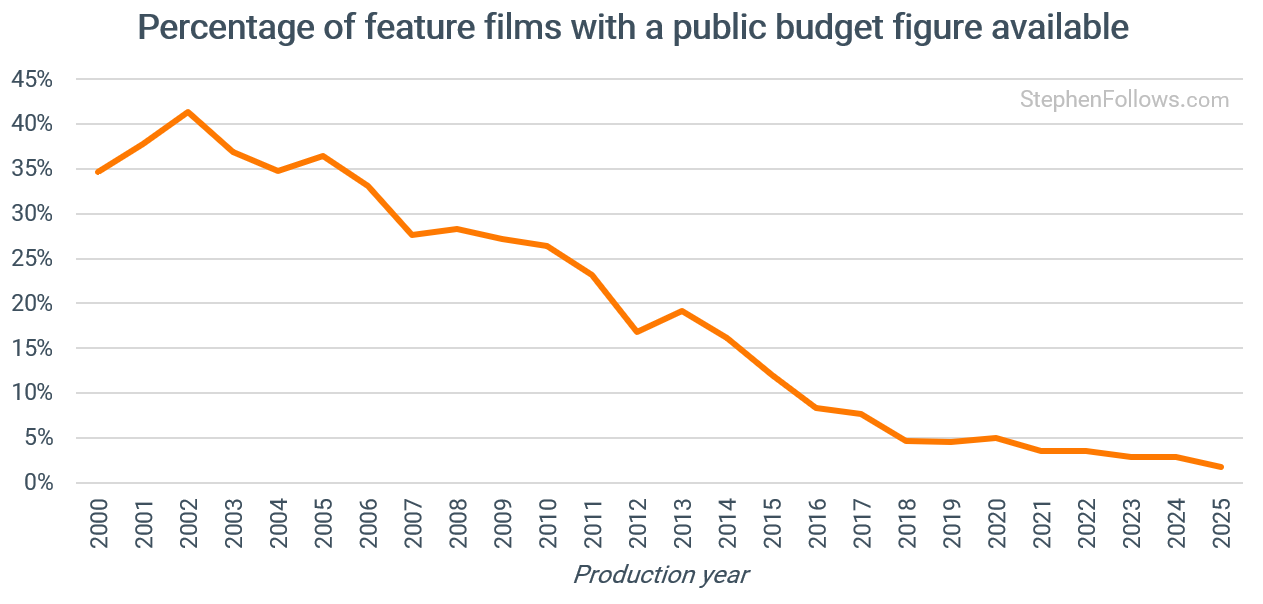
So we can’t just look up the budget on IMDb or The Numbers and start number crunching.
We have to find another way.
We’re going on a mid hunt
Over the years, I have found strong correlations between budgets and the number of people who work on a movie. It makes sense, since crew costs make up a huge share of the budget, with the production period accounting for between 56% and 74% of the total cost.

I used IMDb crew counts and budget figures for 6,519 US cinema releases to build and test a model to detect mid-budget movies. (I also checked that crew size tracks real, audited spending, using California Film Commission tax credit figures for 281 films, as we cannot trust published budgets.)
The model sorts films into five budget bands, and its middle band is a little wider than the median claim, at $20m to $80m in 2026 dollars. That is because most of the claims were made years ago in the dollars of the day, and a $60m ceiling from 2015 is about $80m today. As the definitions chart above shows, any band with a floor of $20m falls, whichever ceiling you pick.
When tested on movies outside the training dataset, it was right seven times out of ten when it said a film cost $20m to $80m. More importantly, it does not tilt the middle up or down. For films from 2020 to 2023, years the model never saw, the true mid-budget share among films with a known budget was 21.9%, and the model estimated 20.9%.
I then used the model to estimate a budget band for each of the 15,824 US cinema releases, and then, for every feature film on IMDb with a crew list, whether it reached a US cinema.
This revealed what has happened to “mid-budget” movies. They were released in US cinemas at a rate of:
102 to 116 a year in the late 1990s
99 to 127 a year in the 2000s (with a peak of 127 in 2008)
74 to 103 a year through the 2010s
47, 52 and 62 in 2021, 2022 and 2023.
The cinema middle is less than half what it was at its 2008 peak. (My data stops at 2023, because credits for newer films are still arriving.)
The orange bars on the chart below show where the rest went. They are films at the same scale that never played in a US cinema but start with a logo from Netflix, Amazon, Apple, Disney+, Hulu, Max, Paramount+ or Peacock.
For example, in 2022 the list includes Enola Holmes 2, Spiderhead, Hustle, The Greatest Beer Run Ever and All Quiet on the Western Front.
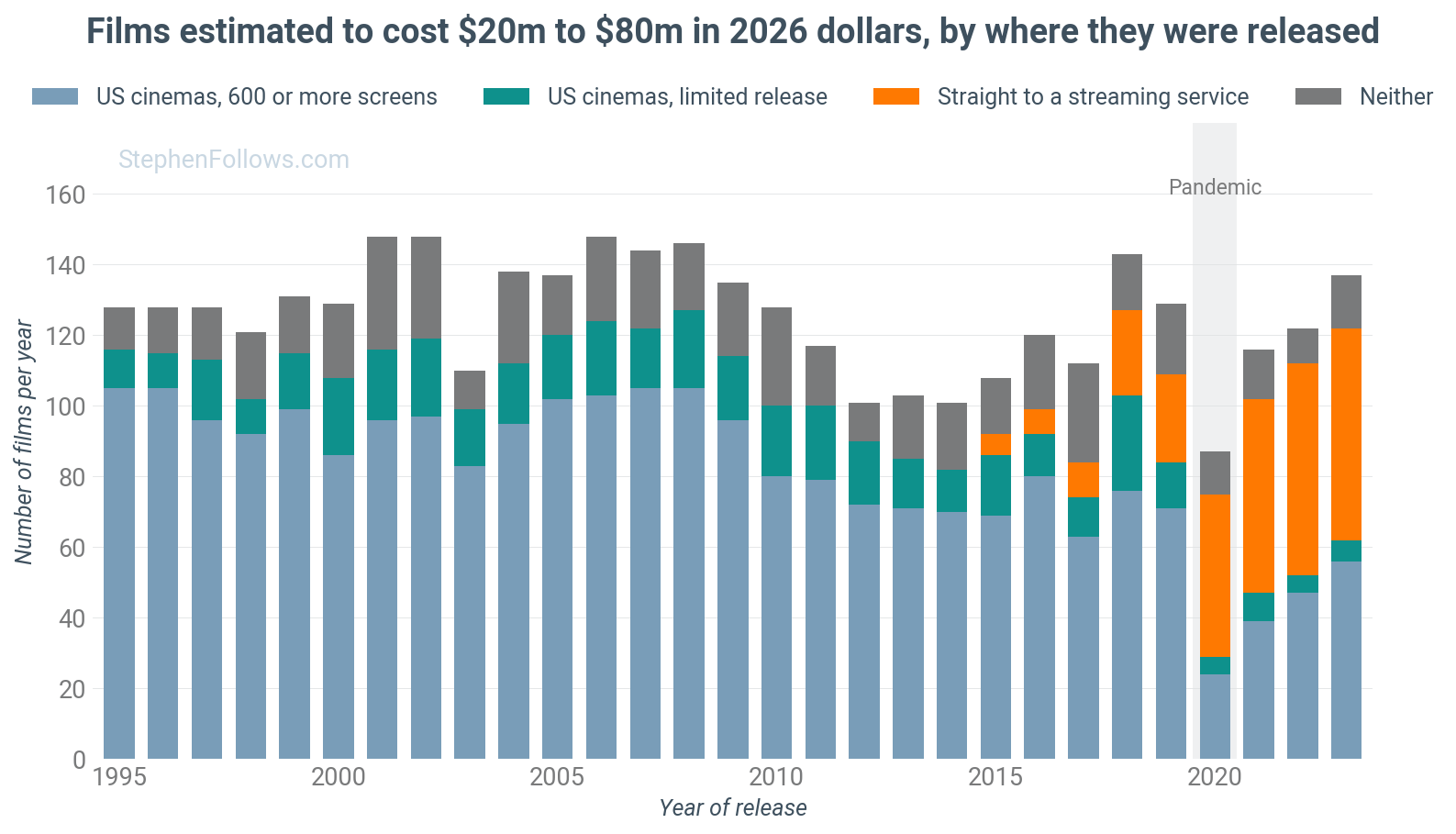
If we add the streaming films to the cinema releases, then we see that the middle did not disappear - it split.
Half still opens in cinemas, and half just appears somewhere on the home screen of a single streaming service.
If you are a cinema owner, or a filmmaker whose career depends on a theatrical release, that is a disappearance. If you are counting films, it is a relocation.
Which half went?
Before I go, I want to dig a little deeper into a more niche aspect of the “mid-budget movies are dead” debate.
Many people speaking or writing about the shift say it’s not just the number of movies that’s the problem. It’s that this shift disproportionately hurts a certain type of movie.
Matt Damon has lamented the loss of the drama that was his “bread and butter”, and says “Courtroom dramas, all that stuff, they can’t get made”.
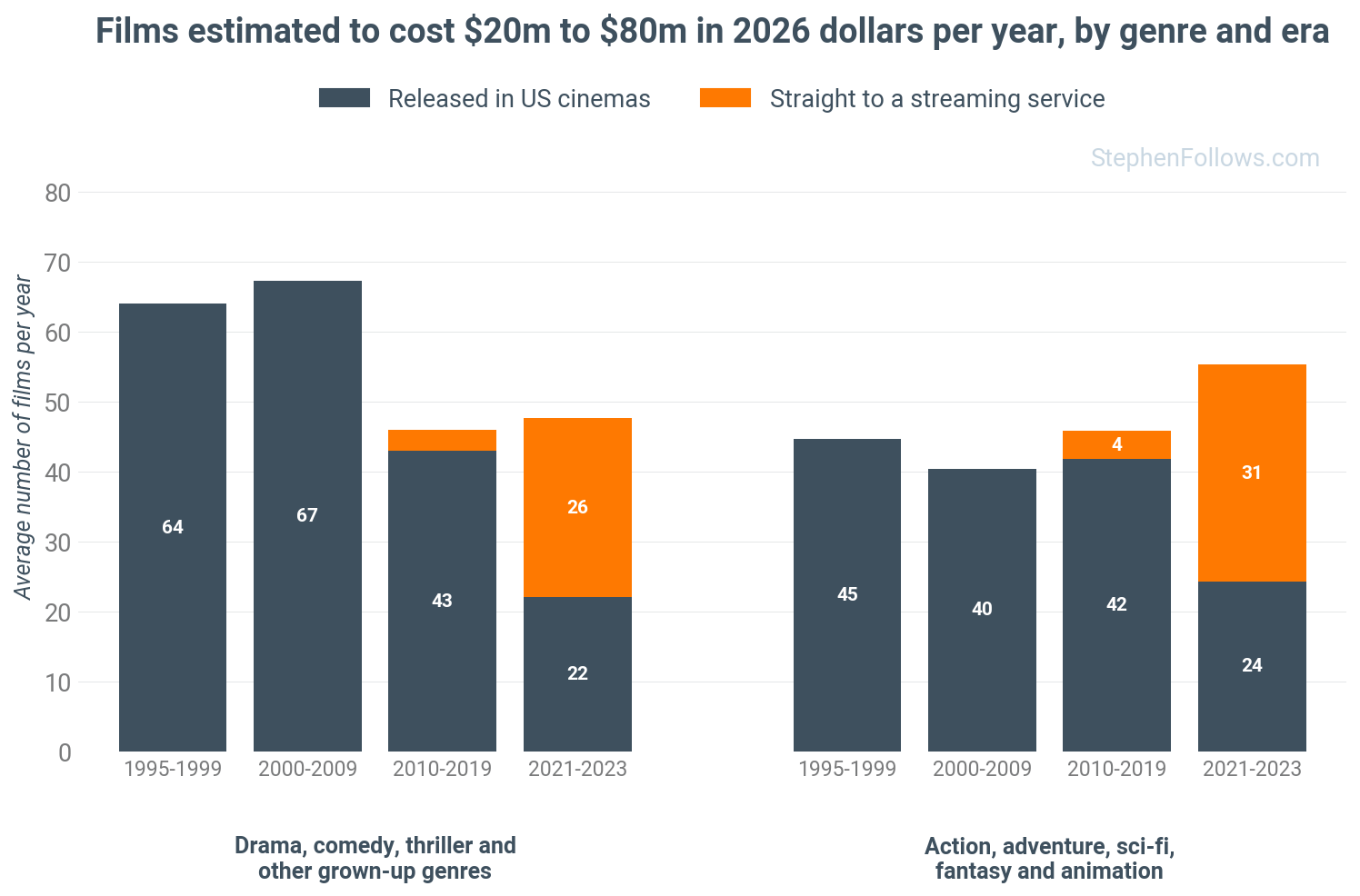
So I split the mid-budget movies I found into two groups:
“Grown-up”, including drama, comedy, thriller, crime, romance, biography and the other things adults used to go to the cinema for.
“Spectacle”, meaning any film action, adventure, science fiction, fantasy or animation.
(Horror is a small third group, left off the chart and covered in the Notes).
The chart below shows the average number of films per year at $20m to $80m in each genre group across four eras. Dark blue shows cinema releases, and orange shows straight-to-streaming releases.
The two groups went in opposite directions. Spectacle films grew by more than a third, from 40 a year in the 2000s to 55 a year in 2021 to 2023, and most of the growth went to streaming. Grown-up films started well ahead and fell by 29%, from 67 a year to 48.
So, is it true that “mid-budget movies are dead”?
We’ve learned three things:
Everyone who says the $20m to $80m film has left cinemas is correct. The timing they usually give (i.e the DVD collapse from 2008) is right too. The cinema middle peaked in 2008 and had lost a third of its count by 2013, before the streamers had started making their own movies. Streaming didn’t cause the first stage of the decline, but it did absorb the second.
Everyone who says the films are no longer being made is wrong about half of them. Mid-budget action, animation and fantasy films are made in greater numbers than ever. It’s just that more of them now come from Netflix, Apple, and Amazon than reach a cinema, and they don't get a poster outside a cinema. The mid-budget drama and comedy are made less than they were, by more than a quarter, and play in cinemas a third as often. The studios stopped, and the streamers that picked up action films picked up fewer dramas.
Everyone who says it is back, on the strength of one or two hits a year, is reading noise. The cinema middle has averaged 47 to 62 films a year for three years. It ran at 99 to 127 a year through the 2000s. One good summer doesn’t change that.
Which brings us back to the settlement. The states have bought 30 films a year, four of them independent and a fifth of them blockbusters. What they have not bought is a single $40m drama, because nothing in the terms says what the other 20 films have to be.
If the merged company fills them the way the two studios have filled their slates since 2019, the middle stays where it is now, on a streaming service, and the states will have legislated more of the same.

Notes
I built my claims dataset on 70 public instances of the claim, from October 1995 to August 2026, one per speaker per occasion, with repeats of the same interview in other outlets not counted again. Twenty-nine give a floor and a ceiling, in the dollars of the day, that I could confirm on the original page or a syndicated copy. Four more gave figures I could not confirm, or point values instead of a range, so I left them off the chart.
The film set includes every IMDb feature film released from 1995 to 2025, joined to The Numbers, excluding documentaries. A US cinema release means a theatrical release strategy, a US opening theatre count on IMDb, or a domestic gross in The Numbers; wide means 600 or more screens at the widest point. Budgets come from IMDb, The Numbers, and Wikiedpia (The Numbers preferred), and are inflated to 2026 dollars using the US consumer price index. My earlier studies found that the average $100m-plus Hollywood blockbuster costs about 12.5% more than stated, and that only 70% of claimed UK indie budgets were even broadly accurate,
My mid-budget prediction model is a gradient-boosted regression of log budget on log counts of distinct people, crew, cast and 20 departments, log opening theatres with a flag for whether a count exists, running time, animation and wide-release flags and release year, fitted on 4,889 US cinema releases from 1995 to 2016 with a budget and tested on 1,630 held-out films from the same years. Held-out results: R-squared 0.82, typical error a factor of 1.7, correct band 71%, $20m to $80m precision 0.705 and recall 0.76. Out of window on cinema releases: 2017 to 2019 R-squared 0.84 and band accuracy 72%, 2020 to 2023 R-squared 0.84 and 74%. The second model drops the theatre features and scores films with no US cinema release. On streaming films with a known budget, it gets the band right 67% of the time but slightly undercounts the middle (13.4% against a true 15.8% for 2020 to 2023), so the streaming counts are, if anything, low.
IMDb credits keep arriving for years after release. Comparing crew counts I took for 4,000 top-grossing films in March 2018 with the same films in 2026, a crew list was 85% complete two years after release, 90% at three to four years, and 95% to 97% from five years on. Counts for films released from 2021 were scaled up by that curve before scoring, which moved the estimates by one to four films a year.
The California check uses 281 feature films with an approved California tax credit, 2009 to 2025. The correlation between the number of crew hired and audited qualified spend is 0.77.
Mid-budget horror ran at about eight films a year in cinemas in the 2000s and nine a year, including streaming, from 2021 to 2023
No, they are not true. Objectively and obviously, these claims are not true.
20 million is a mid budget! I don’t know any independent filmmakers who can raise that. It still seems there is a focus on Hollywood, (unless there are tons of indies doing 20mil movies.) I Propose there should be an industry centered on micro budgets below 5mil. Is that possible using union crews and talent?