


I saw Spider-Man: Far From Necessary over the weekend and, like everyone else in the cinema, I sat through the entire end crawl to watch the ‘post-credits scene’ that has become so ubiquitous among superhero movies.
On the one hand, it’s great to see so many people get the recognition they deserve for working on such a big endeavour. On the other hand, I just wanted to get home.
But it reminded me of some research I conducted earlier in the year that I haven’t yet published. I built a system to detect when the end credits begin in a movie and tracked the data for over 6,500 movies over the past 105 years of cinema.
How long are end credits these days?
Across all 6,515 films, the median end credits sequence runs 4 minutes 26 seconds. Half of all films sit between three and six minutes.
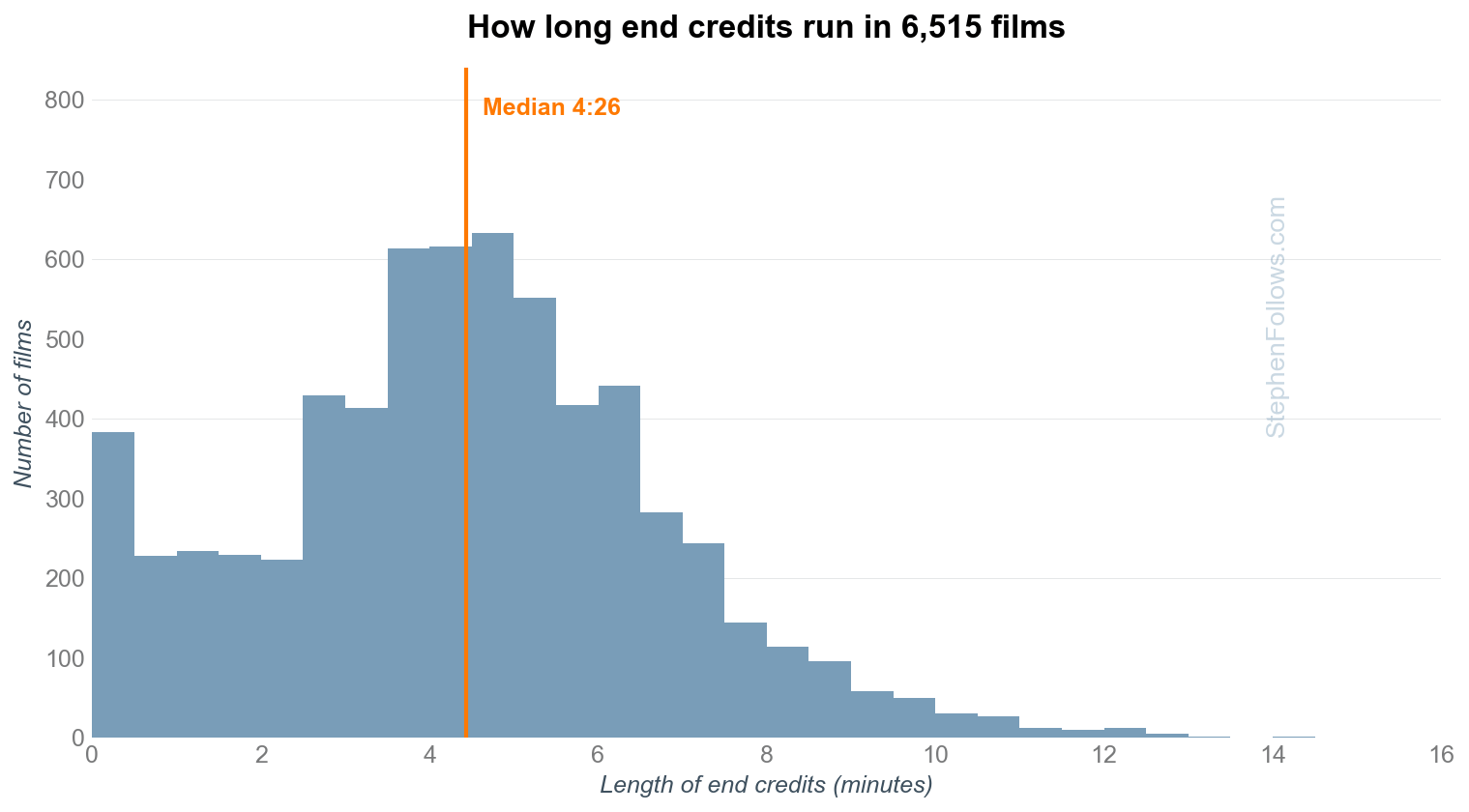
If this feels unusually short to you, that’s because it’s changing.
Have end credits got longer?
In a word, yes. Spectacularly.
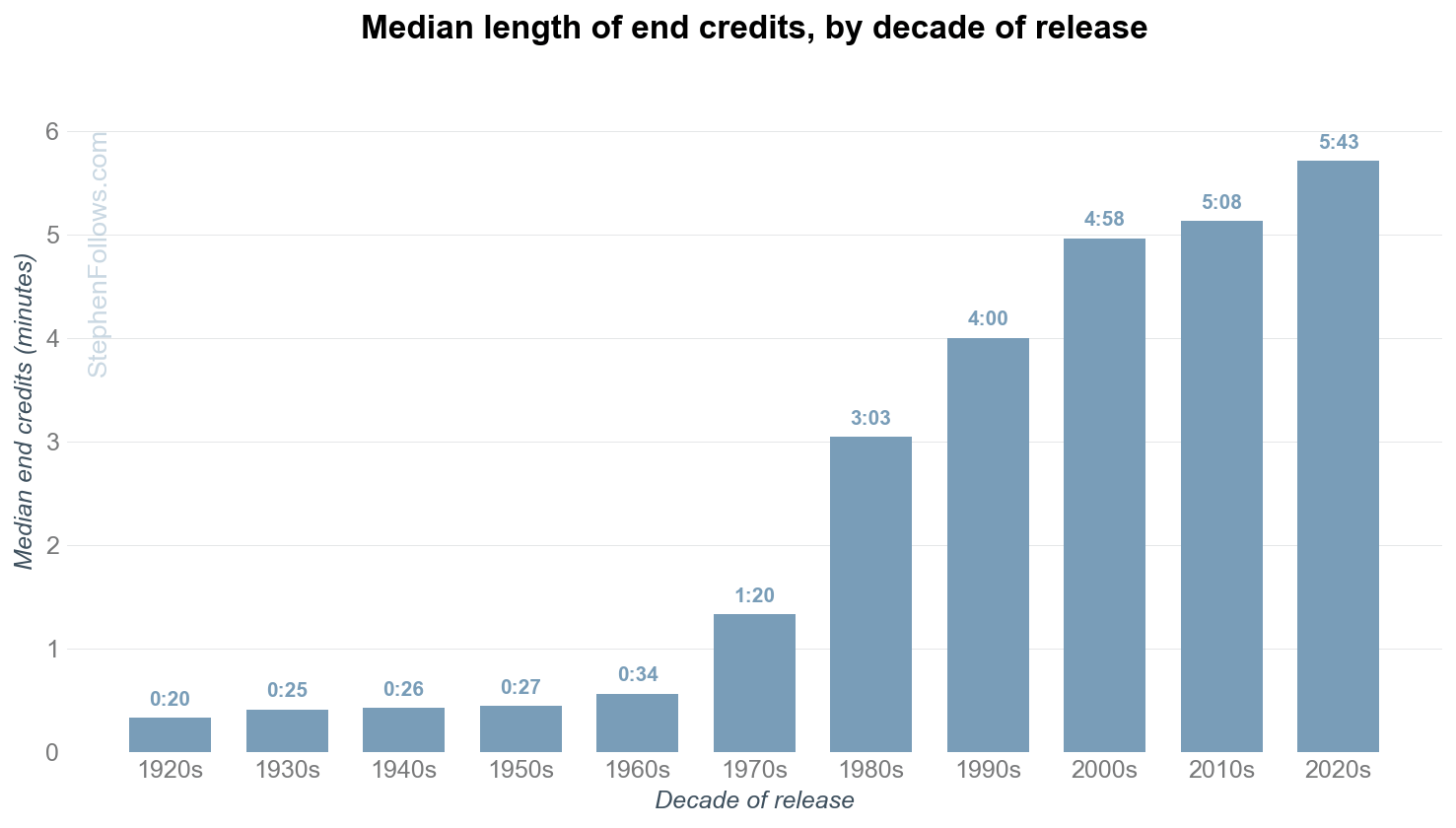
For most of cinema’s first seventy years, the end of a film was exactly that - it ended. A typical film of the 1930s, 40s or 50s ended with a cast reprise or a simple “The End” card (’Fin’ if you were fancy). The median credits length didn’t shift much over forty years, going from 25 seconds in the 1930s to just 34 seconds by the 1960s.
Long-time readers will spot my familiar refrain that “Something weird happened to cinema in the 1970s” and today we see yet another example. End credits changed dramatically, more than doubling in length within the decade, and then doubling again over the 1980s.
By the 1990s, end credits were 4 minutes long, and they've kept climbing ever since, reaching 5:43 for films released in the 2020s.
Current movie credits are almost thirteen times longer than those of the 1950s.
Which films have the longest credits?
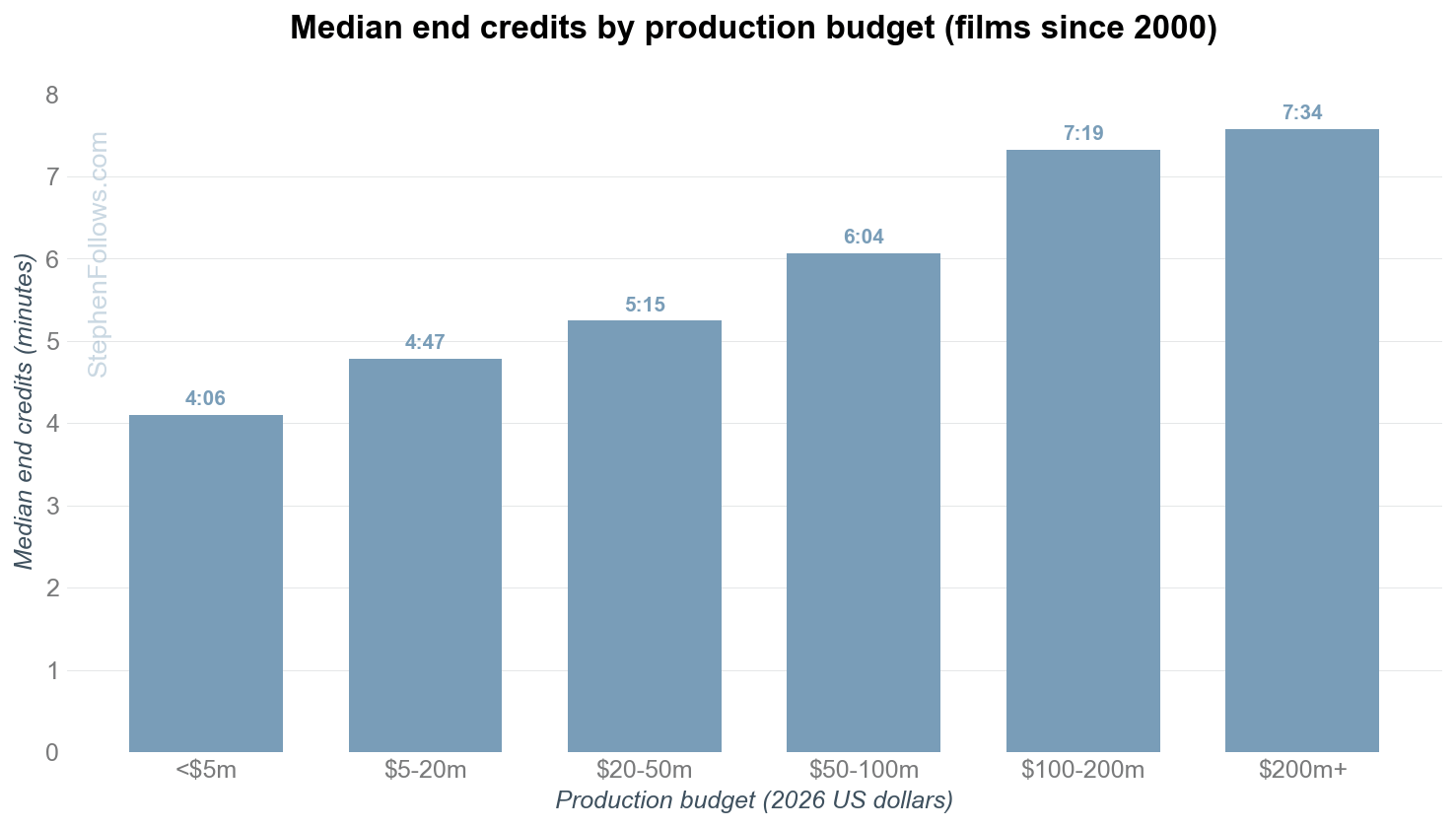
The films with the biggest budgets, unsurprisingly, have the longest credits.
Of everything I tested, production budget is the strongest predictor of credit length, at least for films made this century. This makes sense, as that's what they're spending all that money on - people, companies, vendors, etc
This is a fairly new correlation. We can use the Pearson correlation coefficient to give us a single number for how connected two sets of data are, with zero meaning no correlation and plus one meaning perfect positive correlation.
There was no connection between credit length and production budgets in the middle of the last century (1960s = 0.08, 1970s = 0.07), but as credits got longer, the connection grew (1990s = 0.33, 2000s = 0.39) until the modern era, where it’s up to 0.5.
The same is true of the number of people involved. How many crew a film credits explains its credit length far better than how many actors it has (0.44 versus 0.18), and once you account for the crew, cast size tells you nothing at all.
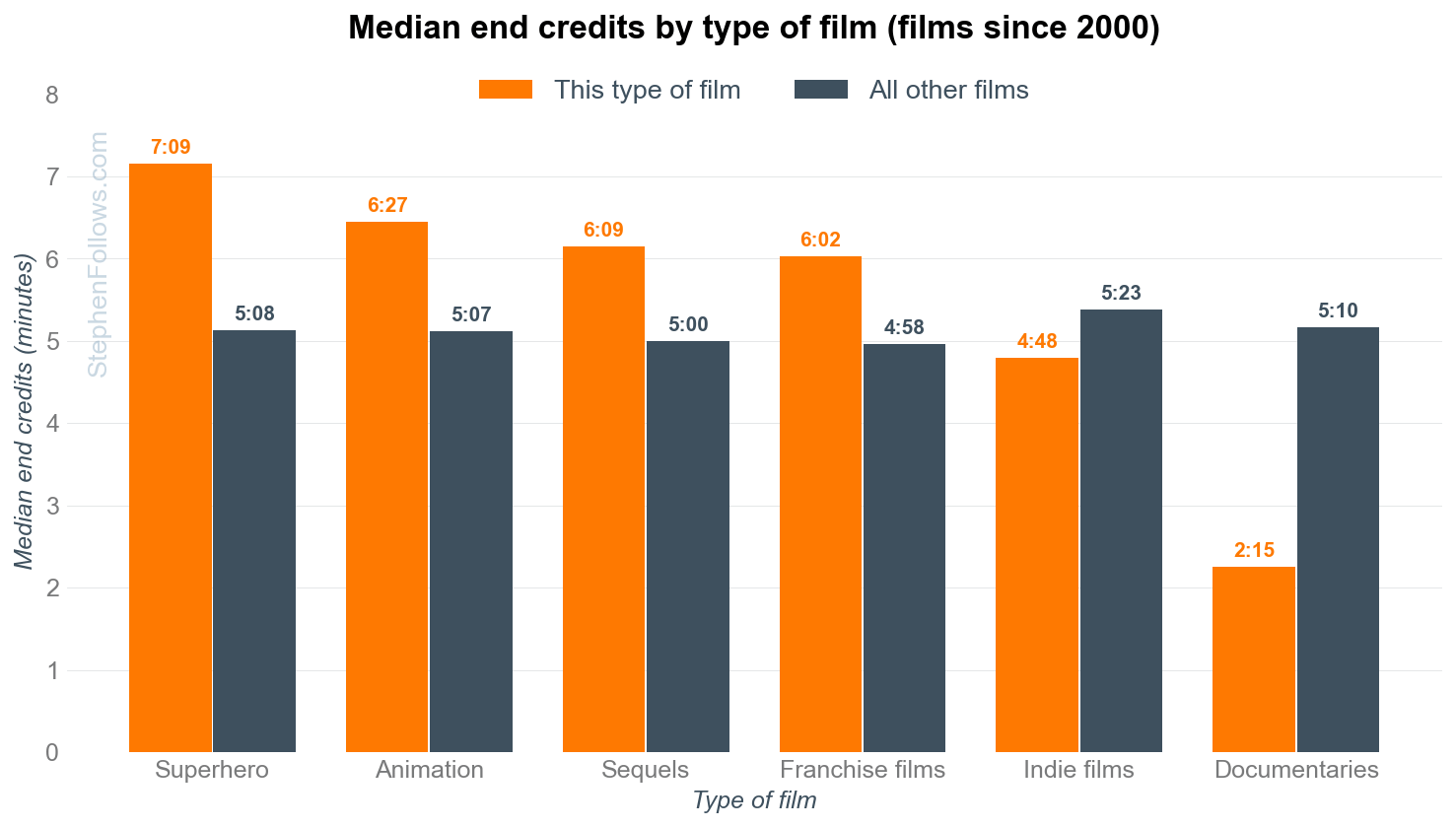
Animations have the longest credits, with documentary credits having the shortest - just a third of their animated cousins.
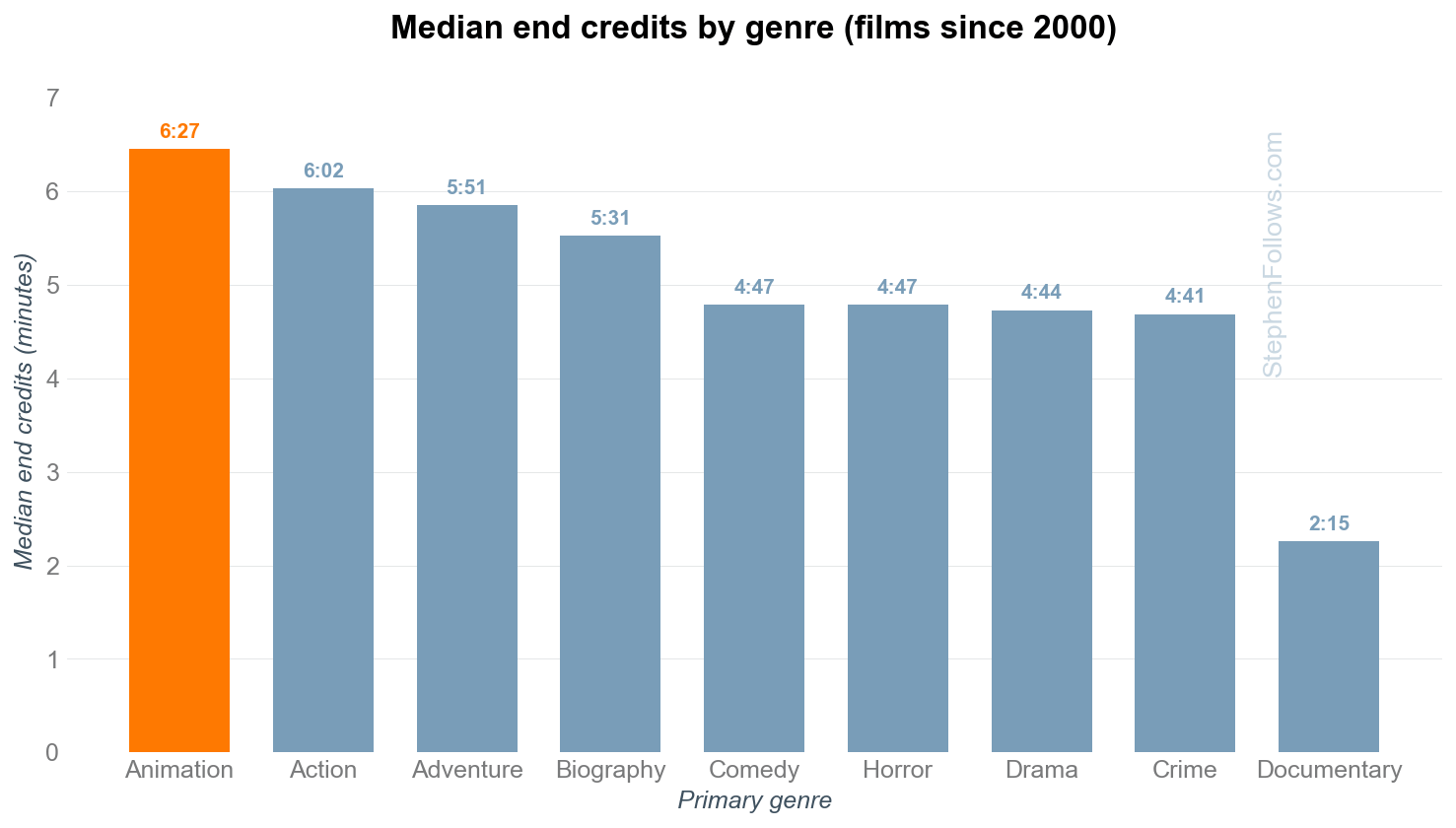
And when we drill deeper into the types of movies, we see an even clearer culprit - Marvel et al. Superhero films run a median of 7:09, compared with 5:08 for everything else.
Why are credits getting longer?
The data can’t give us a definitive reason this is happening, but I think the four most likely causes are:
Freelancers need credits
The credits moved
The VFX boom
Nobody is in charge
1. Freelancers need credits
Under the old studio system, most film workers were salaried staff and simply weren’t named on screen. The Wizard of Oz (1939) ended with on-screen titles listing eleven names, and one of those was a dog.
The Paramount Decree of 1948 broke up the studios’ vertically integrated empires and the studios fired many of their permanent staff. Filmmaking shifted to a freelance, project-by-project business, meaning a screen credit became more important in securing the next job.
2. The credits moved
As more people angled for an on-screen credit, the main roller had to move from before the film to after it. Until the late 1960s, credits mostly ran at the start of the film, where the audience had no choice but to sit through them, so they stayed short.
Films like Around the World in 80 Days (1956), West Side Story (1961) and 2001: A Space Odyssey (1968) pioneered pushing them to the end, and by the 1980s the modern pattern was standard.
Once the names moved to the end, where nobody had to watch them, there was no longer any pressure to keep the list short.
Industry guilds had a role in this. When The Empire Strikes Back (1980) opened without traditional front credits, the Directors Guild objected (their rules required the director’s name up front if anyone’s was there), and the guilds fined George Lucas a quarter of a million dollars. He paid up but called it extortion, and resigned from both the DGA and the WGA.
The current rules that survive today mandate surprisingly little about end credits, other than the actors’ agreement, which requires that at least 50 cast members be listed in the end titles. Almost everything else in the crawl (the technicians, the drivers, the caterers, the accountants) is there by custom rather than by contract.
3. The VFX boom
The department that has seen the biggest growth in recent decades is that of visual effects. Avengers: Infinity War (2018) credited 5,109 people and over half of them (2,659) were in the visual effects department. Modern tentpoles farm work out to 13 or 14 VFX companies at once, each of which submits its list of names.
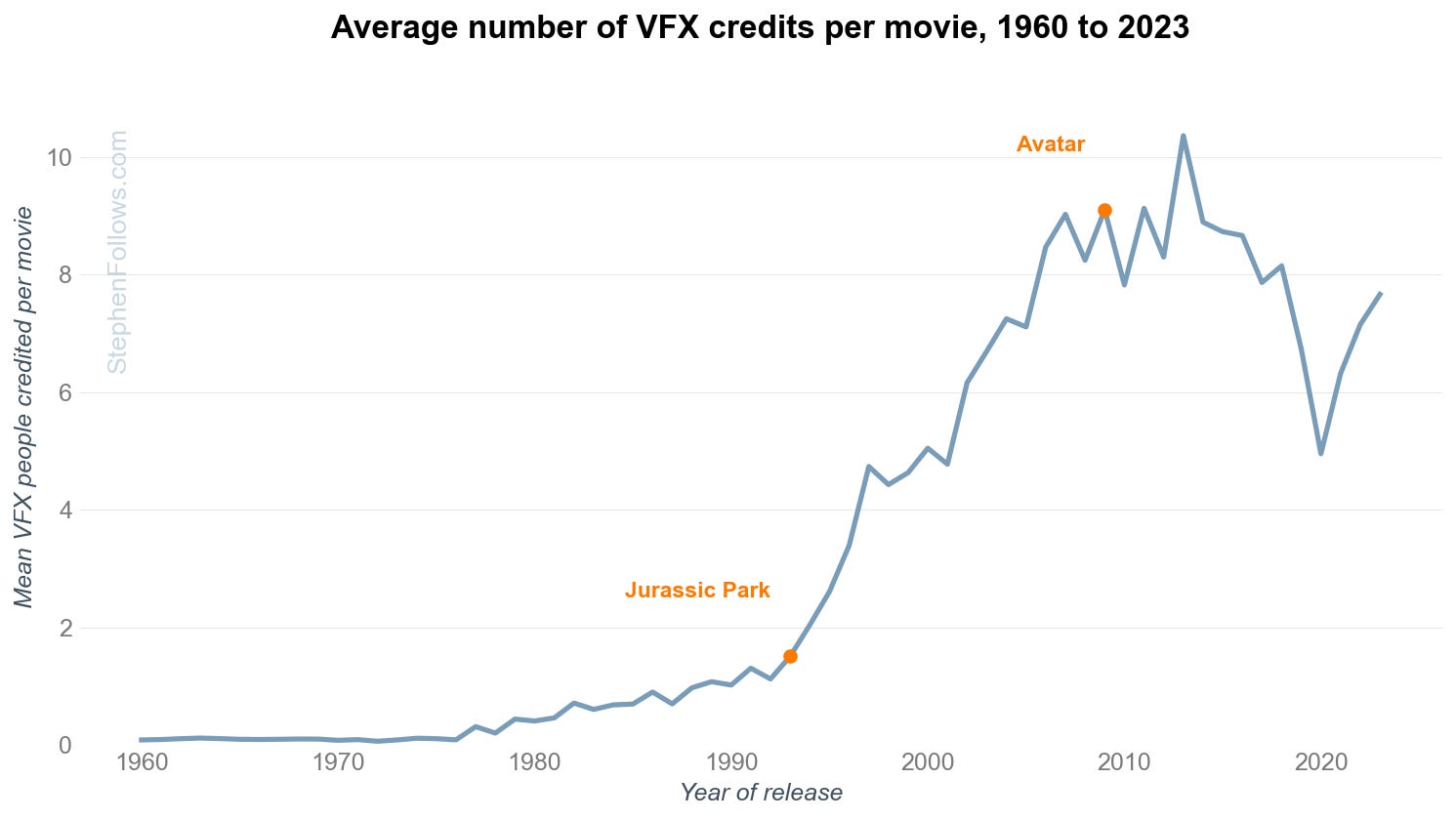
Across all movies the numbers are far smaller, but the shape is the same. VFX went from under half a percent of all crew credits in the 1970s to around 12% today, or roughly one crew credit in eight.
The bitter irony is that even fifteen-minute credit rolls leave people out. Studios cap how many names each VFX vendor may submit (insiders told me around 40 names is a common maximum, no matter how many people actually did the work, and ILM’s John Knoll has publicly opposed the practice).
In my earlier study of 4,113 films, 7.5% of crew credits went officially uncredited, with stunts (25%) and VFX among the worst affected.
4. Nobody is in charge
The WGA limits how many writers can share a writing credit and the Academy caps how many producers can collect the Best Picture Oscar. But no body anywhere caps the total length of end credits. Without a countervailing force, inflation naturally set in.
Some of this credit-grabbing is down to the increasingly complex way films are funded. Many film tax incentives legally require an on-screen thank-you: Georgia’s famous programme grants an extra 10% tax credit in exchange for embedding a five-second state logo in the finished film, and New Mexico, Louisiana, New York and California all have their own statutory versions.
We see the same pattern in almost every unregulated issue involving credits. In previous research I’ve shown how the average number of executive producers per film has more than doubled since 2000.
And then there's a general sense of freedom to play with the credits. Pixar began listing “production babies” (children born to crew during production) with Toy Story in 1995, and WALL-E (2008) credited 58 of them.
But the all-time GOAT of credits has to be Hot Shots (1991), which included a recipe for a brownie topping.

Marvel has changed public attitudes to end credits
And as an appropriate post-script, I wanted to briefly talk about the post-credits scene, which is likely older than you might think.
Possibly the first proper post-credits sequence was at the end of the 1966 Dean Martin spy comedy The Silencers. Twenty years later, Ferris Bueller implored audiences to “Go home!”. But Marvel industrialised the practice, starting with Iron Man in 2008.
This has slowly changed public views on watching all the credits, dividing along generational lines. In a 2024 YouGov poll, 93% of over-65s consider leaving before the credits finish perfectly acceptable behaviour, compared with 69% of 18- to 29-year-olds.
At the same time, the battle is going the other way with home viewing. Streaming services have decided that credits are a problem to be engineered away. Netflix say that their Skip Intro button is pressed 136 million times a day, and autoplay countdowns routinely squeeze the credits into a corner before the first name has scrolled past. Filmmakers have pushed back with limited success. The credits took fifty years to conquer the end of the film, and the technology companies un-conquered them in about five.
Notes
The dataset covers 6,515 feature films released between 1920 and 2025. Credits length here means the time from the first frame of end credits to the end of the entire film. That means anything else sitting in the file after the credits start (mid-credits scenes, post-credits stingers, bonus material) is counted too, so franchise films with stingers will read slightly long. My research skews towards well-known, English-language films, and the early decades are thin (19 films from the 1920s, rising to several hundred per decade from the 1970s). Cast and crew counts come from IMDb, which lists people who never appeared in the on-screen crawl, so I've used them as a measure of production scale rather than a literal count of scrolling names.
Stephen, did you look at the shift from celluloid to digital projection as an economic factor facilitating the growth of end credit length? 4 - 6 minutes of end credits on celluloid could add several weeks of labor depending on whether they were white on black or if they were over filmed footage, and would equate to another 400-600 feet of film that would have to be processed, printed, and shipped to theaters. *great content and humor (“:Far From Necessary”) per usual!
Good stuff, and thank you for sharing!
Virtually everything by the Zucker Brothers et al had fantastic credits - parody just ain't the same these days, sadly.