


For most of movie history, a movie had one producer.
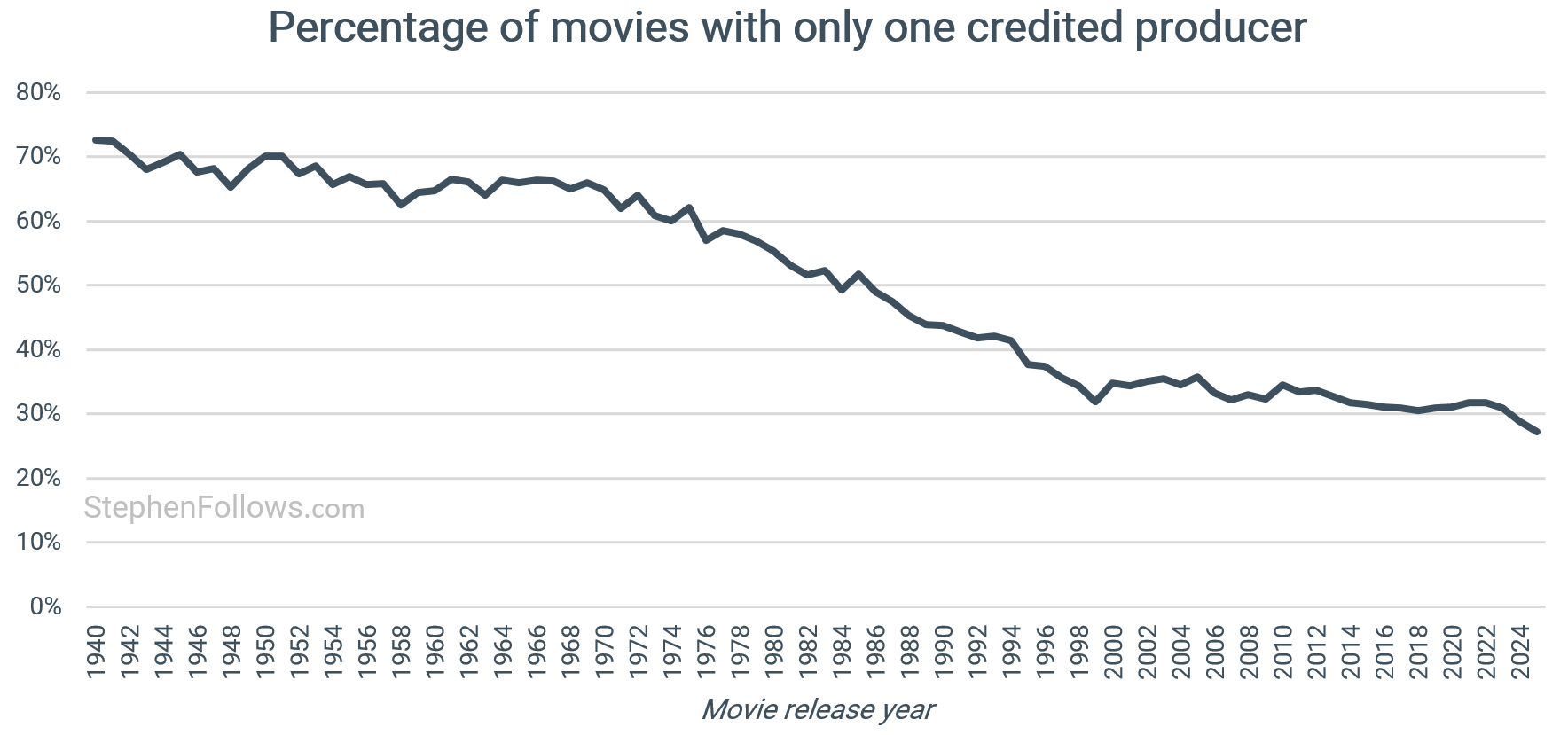
In the 1940s and 1950s, the vast majority of movies credited just one producer. Even through the 1970s, producer teams were small and stable.
That world is gone.
In 1940, almost three-quarters of films were produced by a single producer, whereas by 2025, that had fallen to barely a quarter.
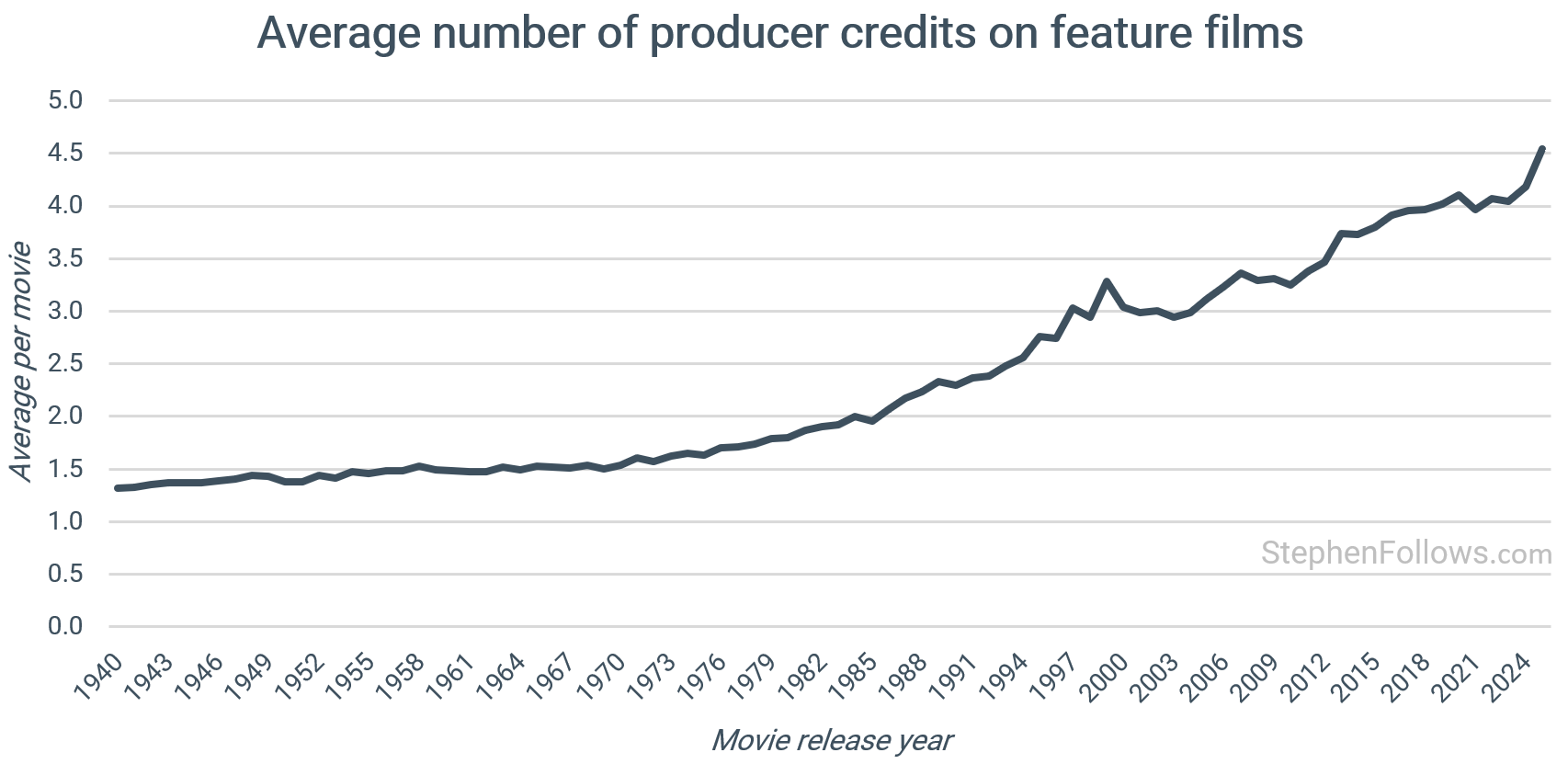
Today, films average 4.5 producers per credited film, up from 3.0 in 2000. This is a 50% increase in just over two decades.
Not all producers' credits are created equally. There are six major types of producers:
Producer is the (or one of the) overall project lead(s), akin to a CEO.
Executive Producers operate at a high level, not day-to-day work.
Co-Producers help get the film made, likely with a single focus.
Line Producers are all about the mechanics of the film shoot.
Assistant Producers are the most junior of the producing credits involved with the making of the film.
Associate Producer is a nebulous term of diminishing value.
I’ll go through each in a little more detail as we come to their data.
The “Producer” credit
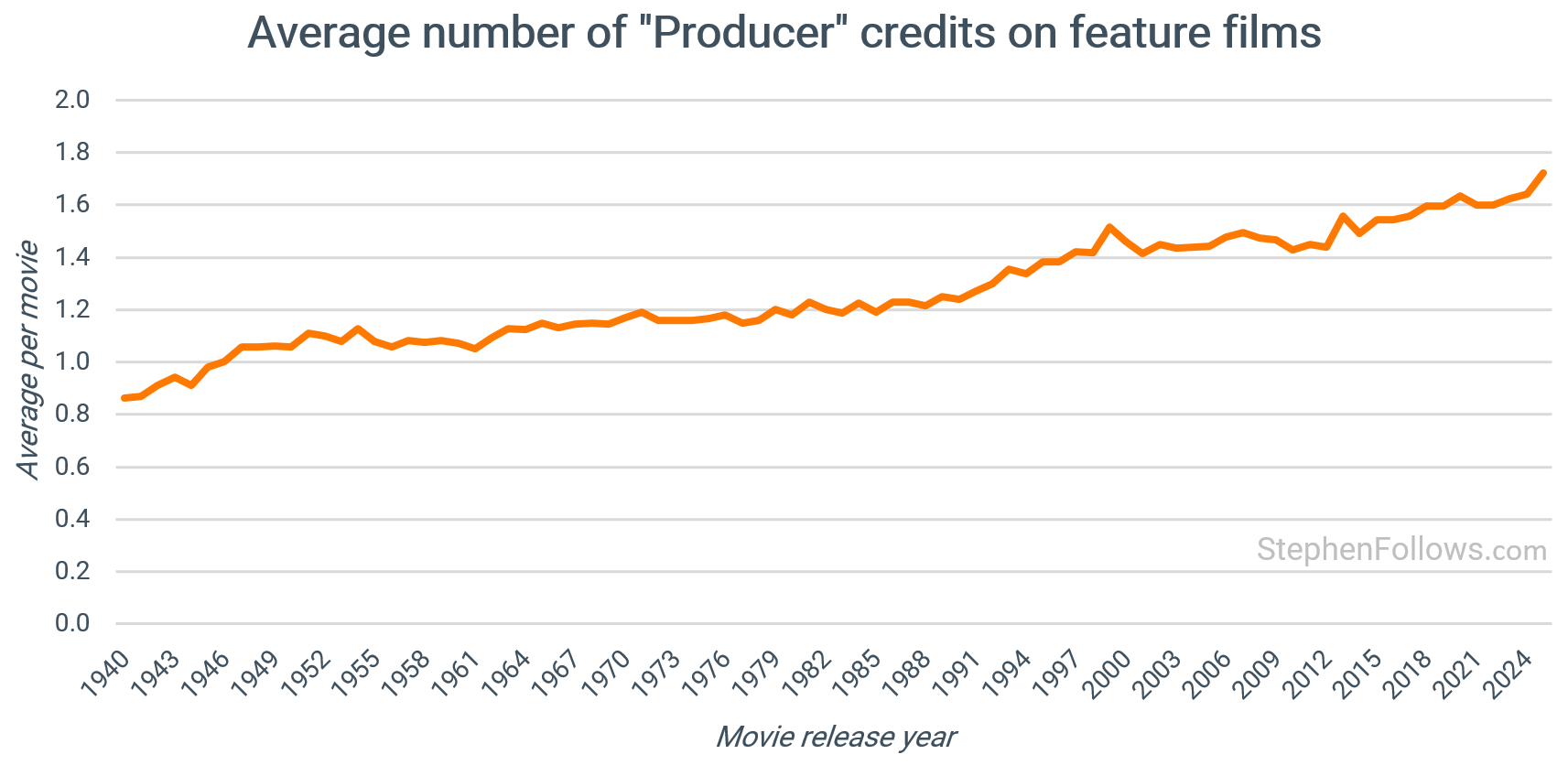
When someone gets a “Producer” credit, they are rightly seen as a key creative and managerial lead on the project.
Regardless of whether it's one or multiple people receiving this credit for a movie, it signals that they were key to making the film. This will most likely include developing the project, assembling the key team, securing financing, and overseeing the film from development through release.
The “Executive Producer” credit
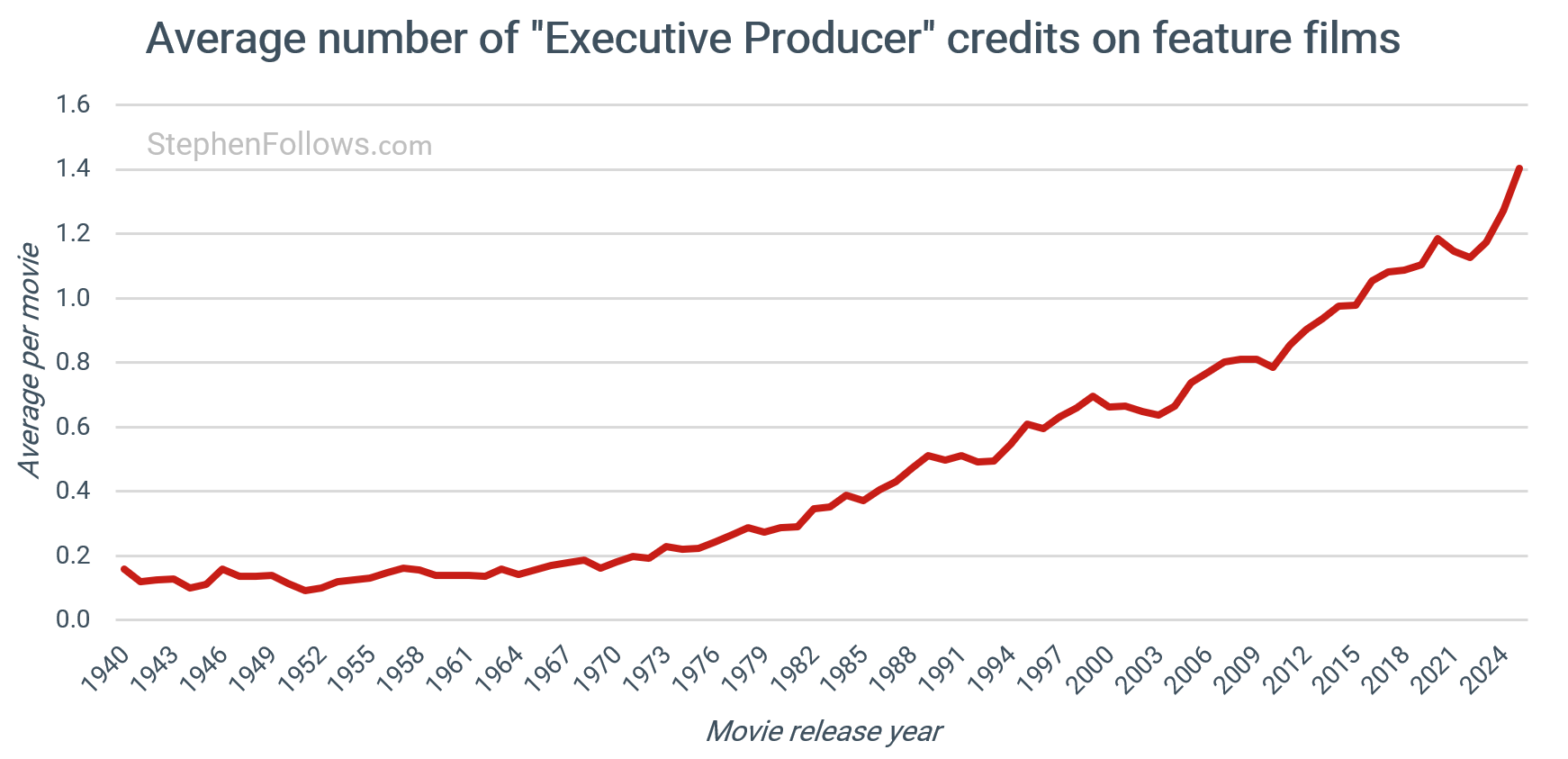
An Executive Producer is traditionally a senior figure who helps secure financing, studio backing, rights, or the attachment of major talent to the film. Their contribution is most likely to be at a high level rather than in day-to-day production management.
The number of Executive Producer credits has more than doubled since 2000, up 111.9% over the past century.
Other producing credits
Three of the remaining major producing credit types are more directly tied to the making of the movie.
Co-Producers are supporting producing partners who share responsibility for delivering the film, often managing a specific part of production or representing a collaborating company or production entity. So if you film in France for some of the scenes, then you might have a French Co-producer who was the lead on that part of the shoot (or financing).
Line Producers are responsible for the practical execution of the film, including budgeting, scheduling, hiring crew, and ensuring the production runs on time and on budget.
Assistant Producer credits are an entry-level producing credit, often given to someone stepping up into producing for the first time or taking a big leap in their career. It will be assumed they worked hard on making the movie.
That leaves us with the Associate Producer credit. I understand that in the middle of the last century, this credit often did the job we now use “Co-Producer,” i.e., a partner for a particular aspect of the production.
However, in modern parlance, it’s all too often regarded as a variety credit, given to placate someone who needed to be brought onside (e.g., access to money, talent, or location). In David Mamet’s brilliant film about filmmaking, State and Main, they describe the Associate Producer credit as being “what you give your secretary instead of a raise”.

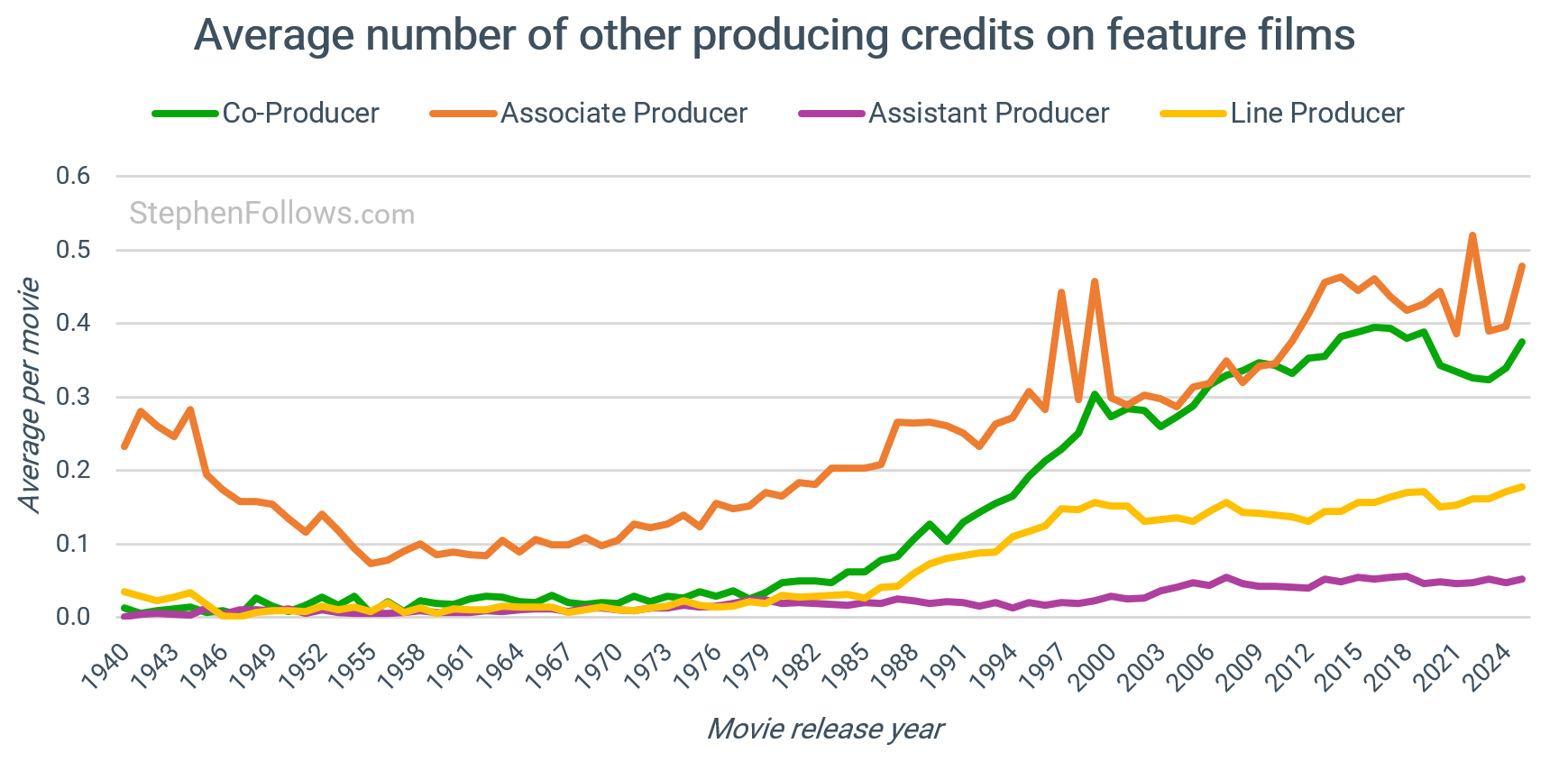
Interestingly, Line Producer credits have not changed much in recent years (a 16.8% increase between 2000 and 2025). This is likely because filmmaking has not changed in ways that would require additional Line Producers, but also because they’re not seen as attractive credits by those looking for a title bump.
Not so the other three.
Co-Producer credits increased by 36.9%
Associate Producer credits are up by 59.9%
Assistant Producers have almost doubled, up 80.8%.
How the scale of production affects the number of producers
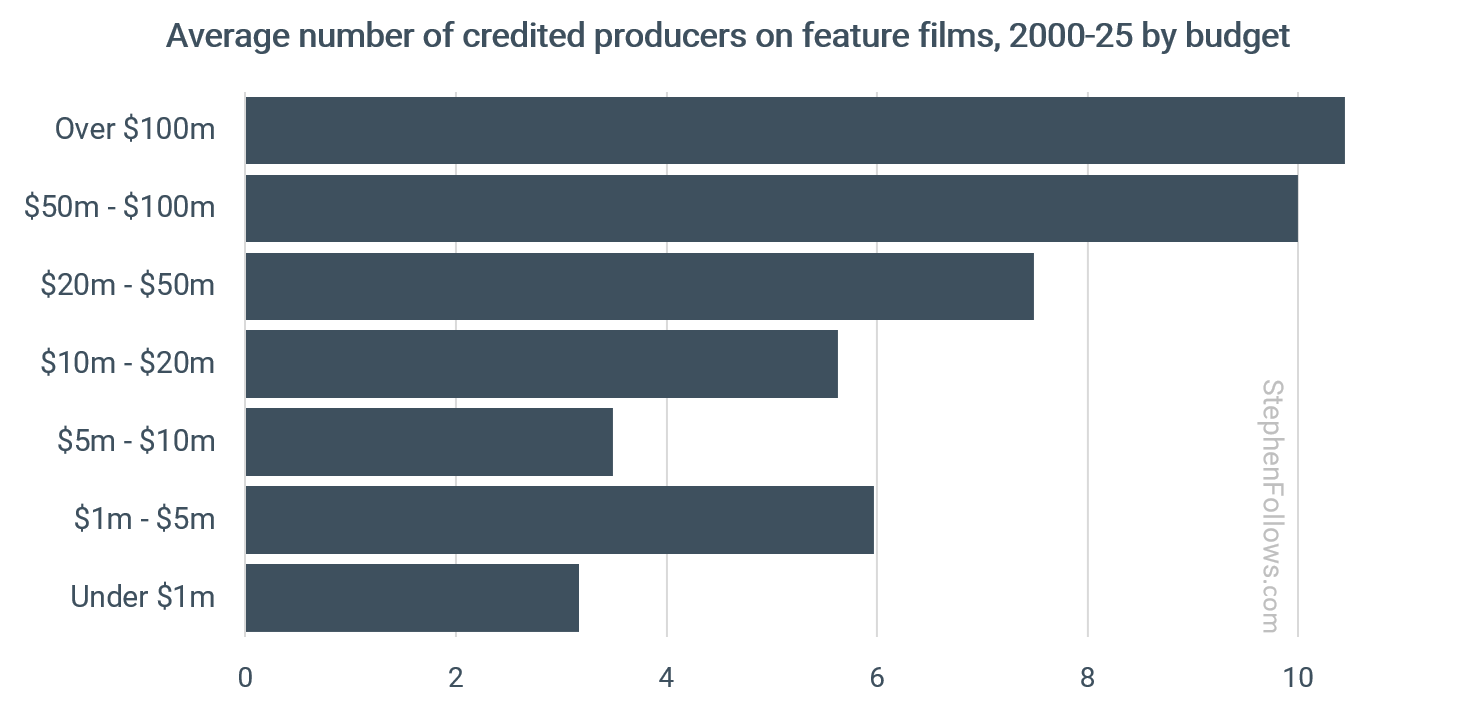
Generally speaking, films grow in complexity as their budgets increase. It’s not linear, nor universal, but a film costing over $100 million will have more moving parts than a micro-budget production. Therefore, it is perhaps not surprising that the number of producers increases with budget level.
Films costing over $50 million have, over the past quarter century, averaged 10.2 producers (of all types).
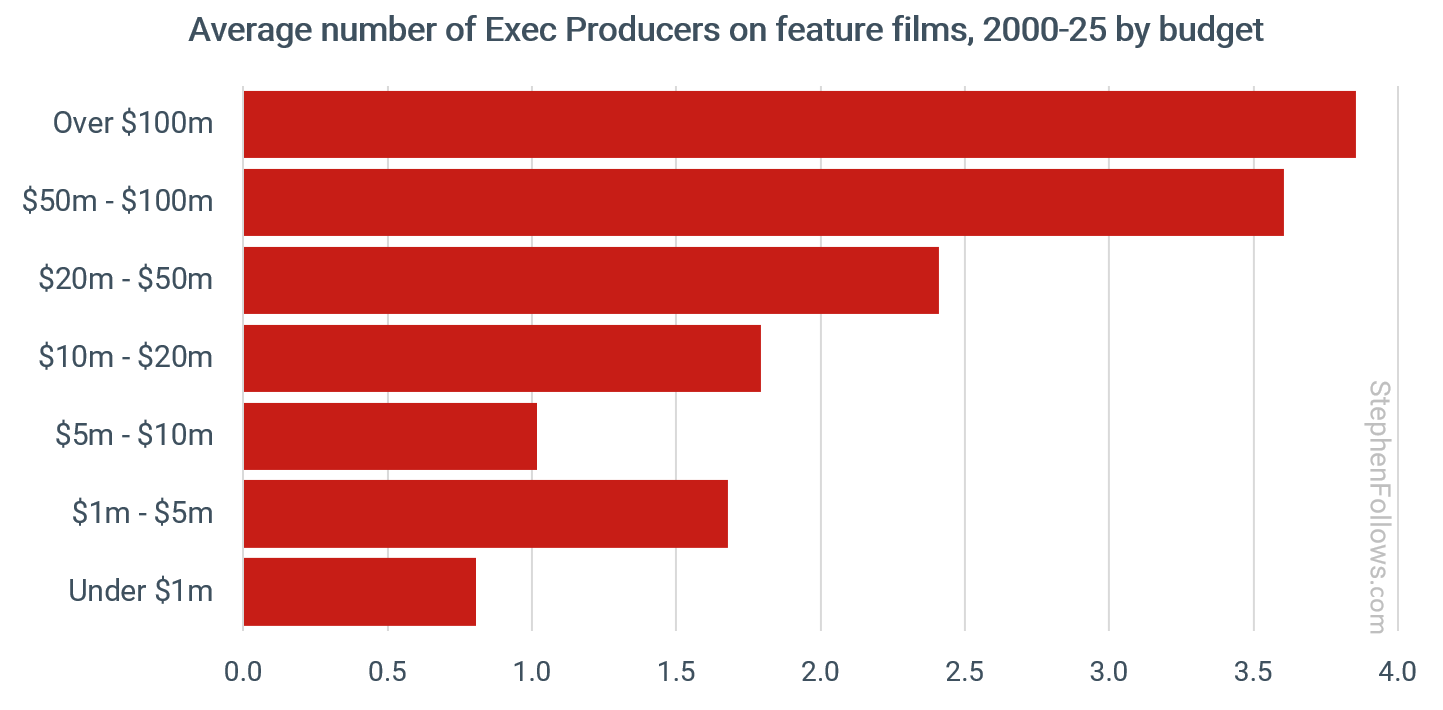
The greatest increase is among Executive Producers as we move up the budget levels. On average, a film costing over $50 million will have more than twice as many Execs as a film costing under $20 million.
How do you get to be a producer?
In the simplest terms, you produce a movie, and you slap your name on it. That means you:
Find a script (i.e. write one, buy one, or hire a writer)
Raise the money from investors, tax credits, and loan sharks.
Spend the money hiring people to plan, shoot, edit and finish the film.
Hopefully, do deals to release the film in festivals, cinemas and home entertainment.
You submit your credit to IMDb. Voilà - you are now a producer. (Technically, you were a producer the whole time, Dorothy, as the act of producing is what makes you a producer, but this is the point at which you get the show off at parties).
???
Profit
However, in the real world, things get a lot more complex. On most films, a vast number of people and companies work together to make a film happen. Who exactly has the right to anoint someone with a producing credit will depend on the exact contractual relationship between the parties.
Receiving a producing credit is one of the levers that people have to close a deal. I.e., you might say to an investor that they will get an “Executive Producer” credit if they invest money in your film.
And in other cases, credits are awarded in exchange for securing scripts, IP, talent, money, distribution deals, locations, and more. Anytime a real producer wanted to sweeten a deal, they could offer some form of producing credit.
Which meant that people started demanding it, seeing it as a shortcut to status, respect, and showing off at their high school reunion.
Acting like a producer
One aspect of this inflation is the growth of major actors also receiving producing credits. There are a number of notable actors who are also prolific producers in their own right. Few members of the public realise that some of their favourite stars, such as Danny DeVito, Robert Redford, or Clint Eastwood, are also respected producers.
Even if they did not start out producing movies, sometimes an actor can gain so much power that they rise above their ‘acting’ label to become the main driver of a franchise. Rather than saying “Tom Cruise acts in Mission Impossible”, it’s fairer to say that “Tom Cruise IS Mission Impossible”. His work behind the scenes of the franchise is producing at its purest.
In the 1940s and 50s, it was rare for an actor to be credited as a producer of any type. The rate of actor-producers rose sharply in the 1960s and 1990s, nearly doubling between 1986 and 2009.
Over the past two years, we’ve seen this level off to the point that about one in eight people with a producing credit on a movie also receive an acting credit.
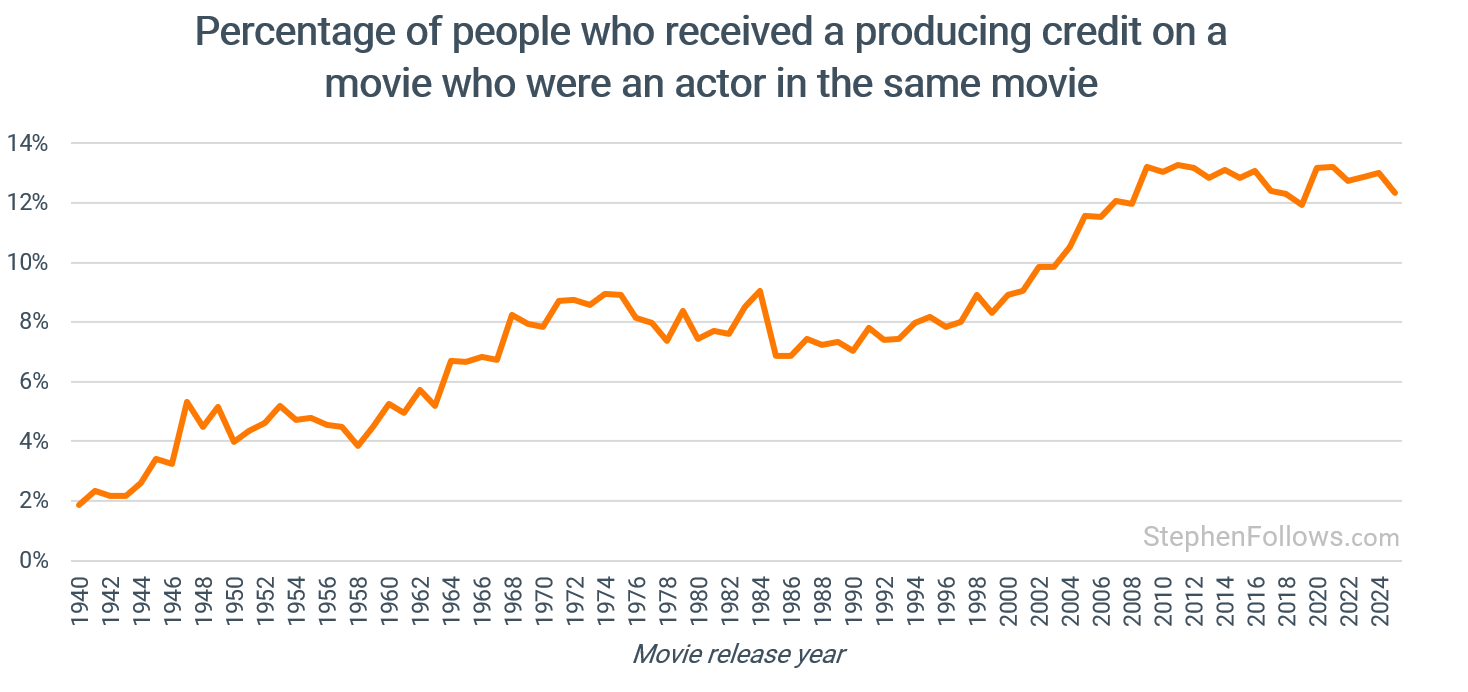
As well as the rise of genuine hyphenates, part of this huge growth has been the trend of major actors demanding more status and attention by also securing producing credits.
Amanda Seyfried recently admitted that she had no idea she was an executive producer on The Housemaid until she spotted it on the call sheet three weeks into filming, saying that her agent had negotiated the credit without telling her. She said:
It’s one of those vanity credits… I didn’t do shit to make that movie. I only acted in it.
To be fair, I give Seyfried credit for admitting publicly that it was an empty title (great, now I’ve added to the problem by giving her another credit), although she could have done what Scarlett Johansson did and asked to have her Exec Producer credit removed when she didn’t think she earned it on Thunderbolts*.
As credits were given away freely, inflation took hold
This fragmented, power-based, bespoke credit system is why we’re seeing such credit inflation. Put simply, no one is regulating it. Anyone can make anyone else “a producer” at any time for any reason.
This is very different to most other major roles in Hollywood. The Writers Guild of America (WGA) determines writing credits, and the Directors Guild of America (DGA) determines directing credits through formal arbitration systems, but producers are typically classified as management rather than labour. This historically left the assignment of producer credits largely in the hands of studios and financiers.
The writers’ and directors’ crediting rules arose because creators felt that producers were abusing their positions to give themselves credit. (This is a time in which arrogant producers stole writing credits for themselves, while the humble producers stole writing credits under a pseudonym). However, with producers, there is no third party - they’re doing it among themselves.
On a film-to-film basis, this wasn’t a problem, but as credit inflation took hold, it was devaluing the whole idea of a credit. This came to a head at the Oscars in the late 1990s.
The first “Academy Award for Best Picture” were given to a film’s production company, but starting in 1950, the rules changed so that it went to the individual producers. Anyone with a “Produced by” credit was considered a winner and received a statuette.
When Shakespeare in Love won in 1998, five producers collected the award, even though later accounts said only two of them (David Parfitt and Donna Gigliotti) had done the traditional producing work. Of the other three:
Harvey Weinstein had taken a producer credit despite limited on-set involvement.
Marc Norman’s producer credit had been negotiated by his agent.
Edward Zwick retained his producing credit despite leaving the film.
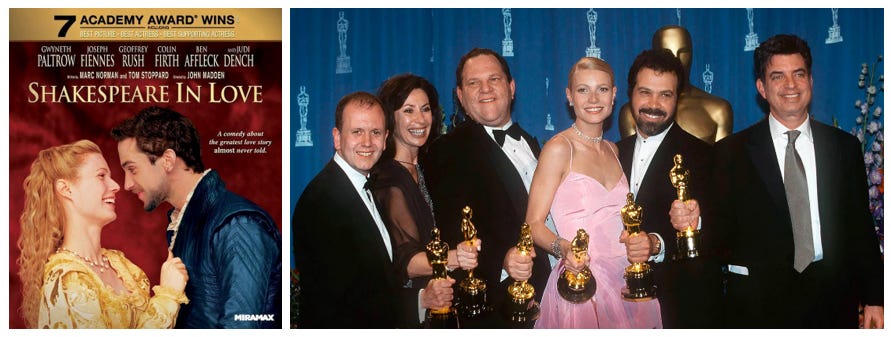
In response, the Academy introduced a new rule limiting the number of producers eligible for the Best Picture award to three. In order to be counted as an Oscar winner, producers now need to be one of up to three people who have an on-screen credit of “Producer” or “Produced by”, and have “performed the major portion of the producing functions”. If the producers of a movie can't agree among themselves who the three chosen should be, then the Academy’s Producers Branch steps in to make a ruling.
The Academy is not the only Hollywood body trying to determine the difference between real and variety-producing credits. The Producers Guild of America (PGA) introduced the “p.g.a.” Producers Mark in 2012, certifying which credited producers actually performed the core producing functions. Despite this, the “p.g.a.” mark is voluntary and does not prevent studios from adding additional producer credits.
Both bodies are trying to fight the tide from their little beacheads. In both cases, the rules are clear, defined, and fair. Yet producing a movie is messy and busy, and there will always be fringe cases, including:
Bob Yari assembled the financing for Crash and received a full on-screen “Producer” credit, but when he was excluded from Oscar recognition, he launched a series of lawsuits against the Producers Guild and the Academy. He argued that their opaque process had reduced him to a mere “money man” and cost him both prestige and financial upside. He lost on appeal.
Long‑time producing partners Ron Yerxa and Albert Berger developed Little Miss Sunshine from an early script, championed the writer, and helped pick the film’s first‑time feature directors. Five producers were certified by the PGA, but the Academy picked the other three producers as the only official nominees. The pair were gracious at the time, but have since been more open about their frustration in feeling like the Academy’s arbitrary cap was erasing years of their work. The backlash led the Academy to soften its rules to allow more than three producers in “rare and extraordinary” cases.
Boyhood took 12 years to make, and over that time, Jonathan Sehring and John Sloss provided long‑term financing, logistical support, and protection so that Linklater could shoot for a few weeks each year and retain creative freedom. They both received full “Producer” credits on screen, but the PGA ruled that only Richard Linklater and on‑set producer Cathleen Sutherland qualified for the “produced by” mark.

Why are there more Executive Producers today?
While these efforts to regulate the full “Producer” credit are imperfect, they are at least trying. Until very recently, there has been no comparable movement to regulate Executive Producer credits.
And because of this, the most acute form of this credit inflation is among Execs. As noted at the start of this article, the average number of Executive Producers on movies has increased by 112% since 2000.
This is down to a number of factors, including:
Indie financing comes from more sources. Independent films often assemble budgets from multiple investors or financing partners. Each party expects recognition, and Executive Producer is the credit most commonly used.
Studio movies are assembled as packages. Modern Hollywood projects are built by attaching talent, rights, and financing before production begins. People who help secure one piece of that package are often rewarded with an Executive Producer credit.
Producer credits are unregulated. As we’ve learned, there is no check on studios awarding credits to anyone for any reason. Things like the “p.g.a.” mark and the Oscar limitation add some friction to the wording of “Producer” credits, but not Executive Producer credits.
Actor contracts increasingly include Exec Producer titles. Agents have realised it’s something they can demand on behalf of their client, and in many cases, it’s an easier win than actually getting more money. Amanda Seyfried put it best when she said, “I didn’t do shit to make that movie. I only acted in it“.
They’re free. Exec Producer credits are used to compensate people without increasing salaries. The industry is in a major state of fear and flux, so giving away credits in lieu of money feels like an obvious solution.
So what now?
With credit inflation becoming rampant, industry efforts to push back are hardening.
In 2024, a group called Producers United launched with around 80 established producers (currently 281) and has since pushed for clearer standards on who actually qualifies for a producing credit.
They want studios to tie “Producer” credits to specific duties, such as participating in prep, sharing budget responsibility, and approving key hires, and to stop using Executive Producer titles as negotiation currency.
Variety neatly summed up their fight with the headline “Hollywood Career Producers Are Battling Actors, Greedy Managers, Penny-Pinching Execs and Stolen Credits to Survive“.
Time will tell how effective they will be. The history of Hollywood is one of people having to fight tooth and nail to protect their rights, credit and value. Nothing is given for free.
What’s new here is that typically, the producers were regarded as the people you need to fight, not the victims.
Notes
It’s worth noting that all of this applies only to movies. Television production has a whole different relationship with producer credits, and especially Executive Producer credits. TV is more of a writer-led industry, so many forms of producer credit relate to writing and showrunning (i.e., managing overall production and the other writers).
The 2025 Argentine film Death of a Comedian cited 10,123 Associate Producers. I excluded this title from the statistics as I thought it was heavily skewing the real picture. I don’t like manually excluding titles, partly for data-science reasons and partly because film is a business of outliers. However, here it swamped the overall picture, and I thought it did a disservice to the reporting of reality to include it.
Despite removing it from the average calculations, I wanted to highlight it here because it is a good example of another way people use producer credits. Thousands of fans purchased small investment bonds that helped fund the film, and each investor received an Associate Producer credit in return. The model was organised through the Comunidad Orsai collective and raised roughly $1.85 million from more than 10,000 micro-investors.
The sheer scale of the credit list created an unexpected technical challenge. IMDb normally requires credits to be entered individually, so manually uploading over ten thousand names would have taken months. Instead, a community programmer wrote an automated script that bulk-submitted the names to IMDb’s system, allowing all investors to appear in the film’s official credits database.
Honestly, thank you for this breakdown - I've often seen screen upon screen of different producer titles, and now I finally understand them!
"The 2025 Argentine film Death of a Comedian cited 10,123 Associate Producers." is a sentence to savour.