


To aid an episode of Matt Belloni’s podcast The Town with the Hollywood producer Todd Garner, I was asked to crunch the numbers on longer movies.
It’s a question I’ve looked at before on this site, most recently in 2019, but a lot has happened in the past six years. One pandemic, two strikes, three Spider-Men, a four-hour Justice League and a flood of streaming.
A recent poll of 2,000 Americans found the ‘ideal’ movie length is 92 minutes. Only 2% said they were comfortable with films over two and a half hours. And yet nine of the ten highest-grossing films of all time run over two hours, and three of them cross the three-hour mark.
So what’s going on? Let’s look at the numbers…
The headline paradox
If you look at every film produced worldwide, the average running time has barely changed in decades. It has hovered around 100 to 103 minutes since the 1980s. In 2024, the average film was 103.6 minutes long.
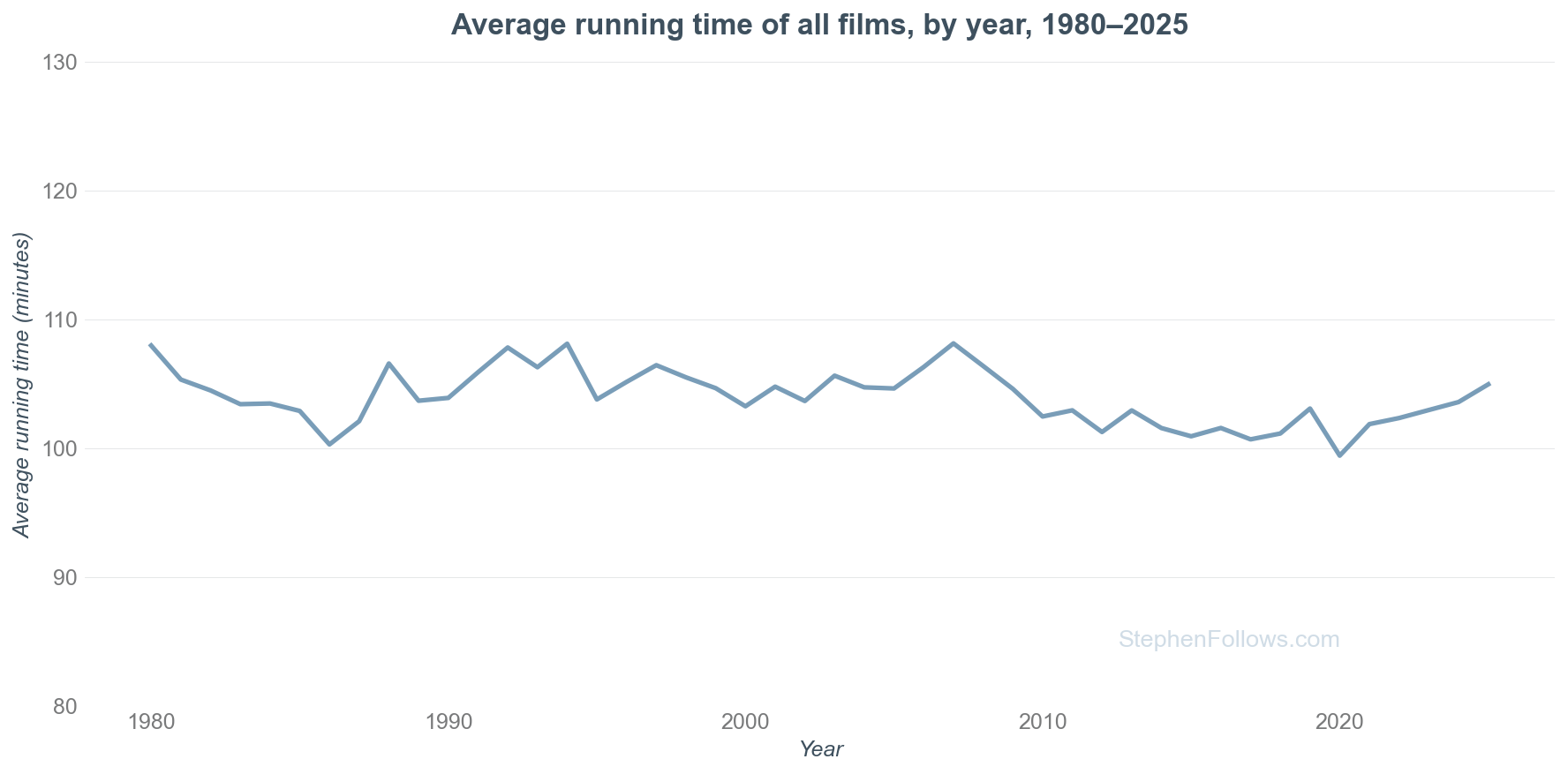
If this doesn’t match your experiences, that’s because this is all the films released, not the ones people actually watch.
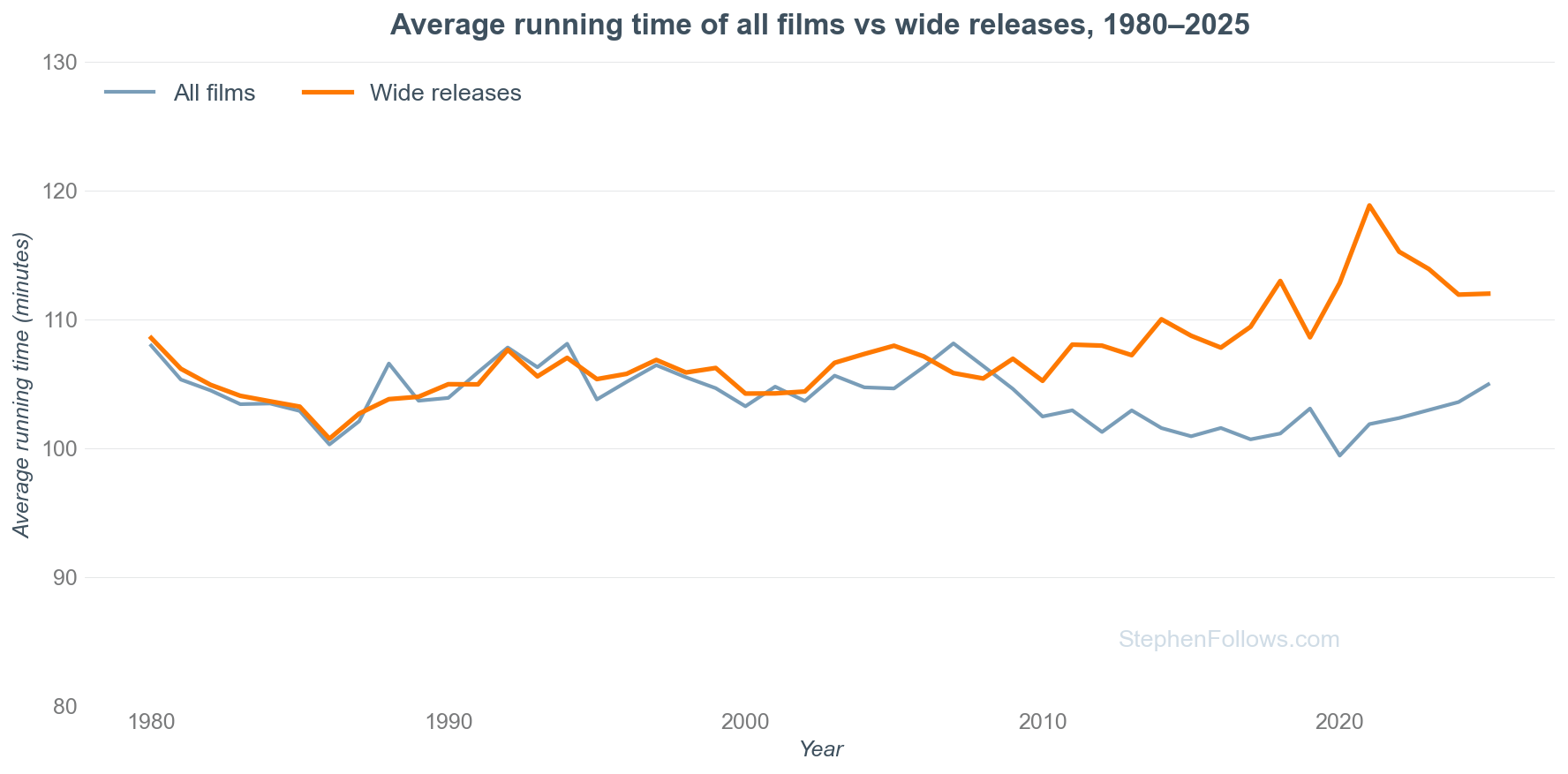
Wide theatrical releases (the films that open in hundreds or thousands of cinemas across North America) averaged 106 minutes in the early 2000s. By the 2020s, that figure had risen to 114 minutes.
This means that if you’re a regular cinemagoer, you are now routinely sitting through films that are around ten minutes longer than they were a generation ago.
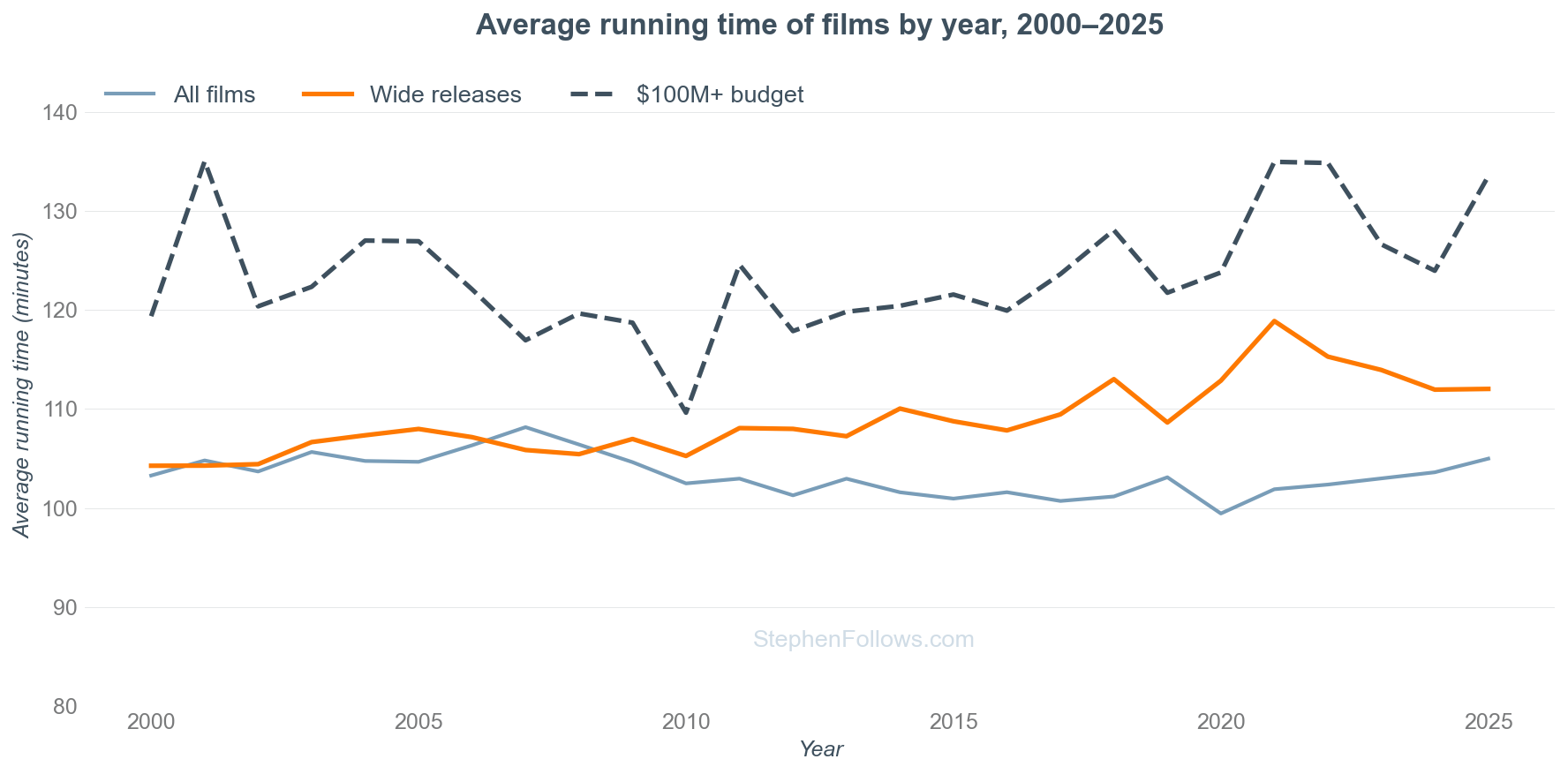
And the biggest-budget films ($100M+) have pushed even further, pulling the theatrical average up with them.
By the way, pre-show trailers and adverts have ballooned too. Most major chains now run 20 to 30 minutes of material before the feature starts, meaning that your cinema trip has got longer at both ends.
The two-hour film is taking over
Averages can mask what’s really going on underneath. So I split every wide release into runtime buckets and compared the decades.
In the 1980s, around 14% of wide releases ran over two hours. In the 2020s, it’s 32%.
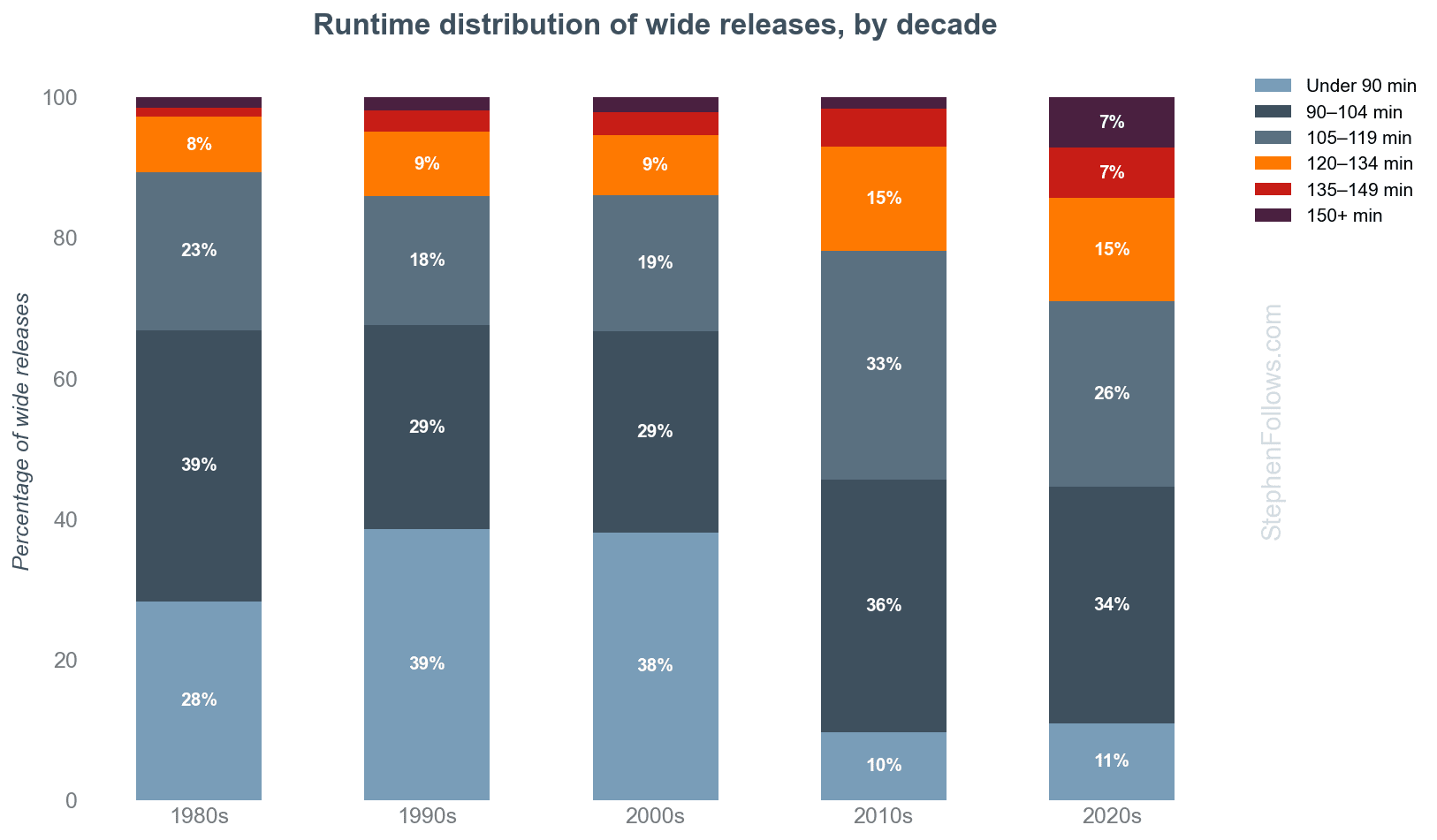
At the other end, the ‘short feature film’ (i.e. a commercial feature film, rather than a “Short Film” which students and early stage filmmakers might make for practice, showcase or ego) has all but vanished from mainstream cinema.
In the 1980s, roughly 13% of wide releases ran under 90 minutes. In the 2020s, that’s down to 7%.
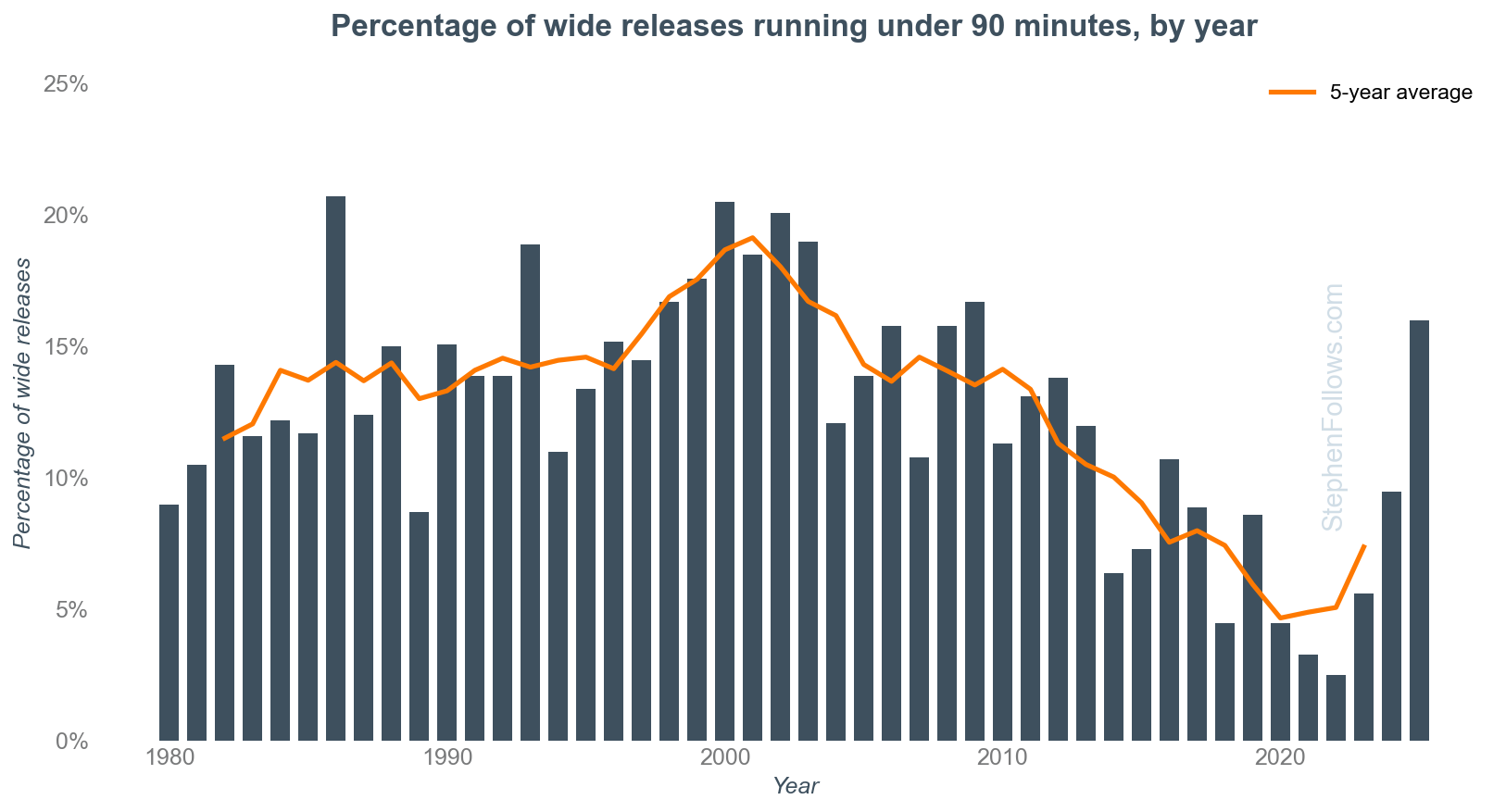
Initially, I thought this might be short films sneaking into the data, but no, it seems shorter feature films are dying out. The vast majority are 75 to 89-minute features. Animated family films like The Land Before Time at 69 minutes, the odd Woody Allen at 79, that sort of thing.
The whole distribution has shifted upwards. While there are some outliers dragging the average up, it’s more the case that the entire middle ground has moved. The 105-to-119-minute film is now the most common runtime bracket for a wide release, and the two-hour-plus film is no longer unusual.
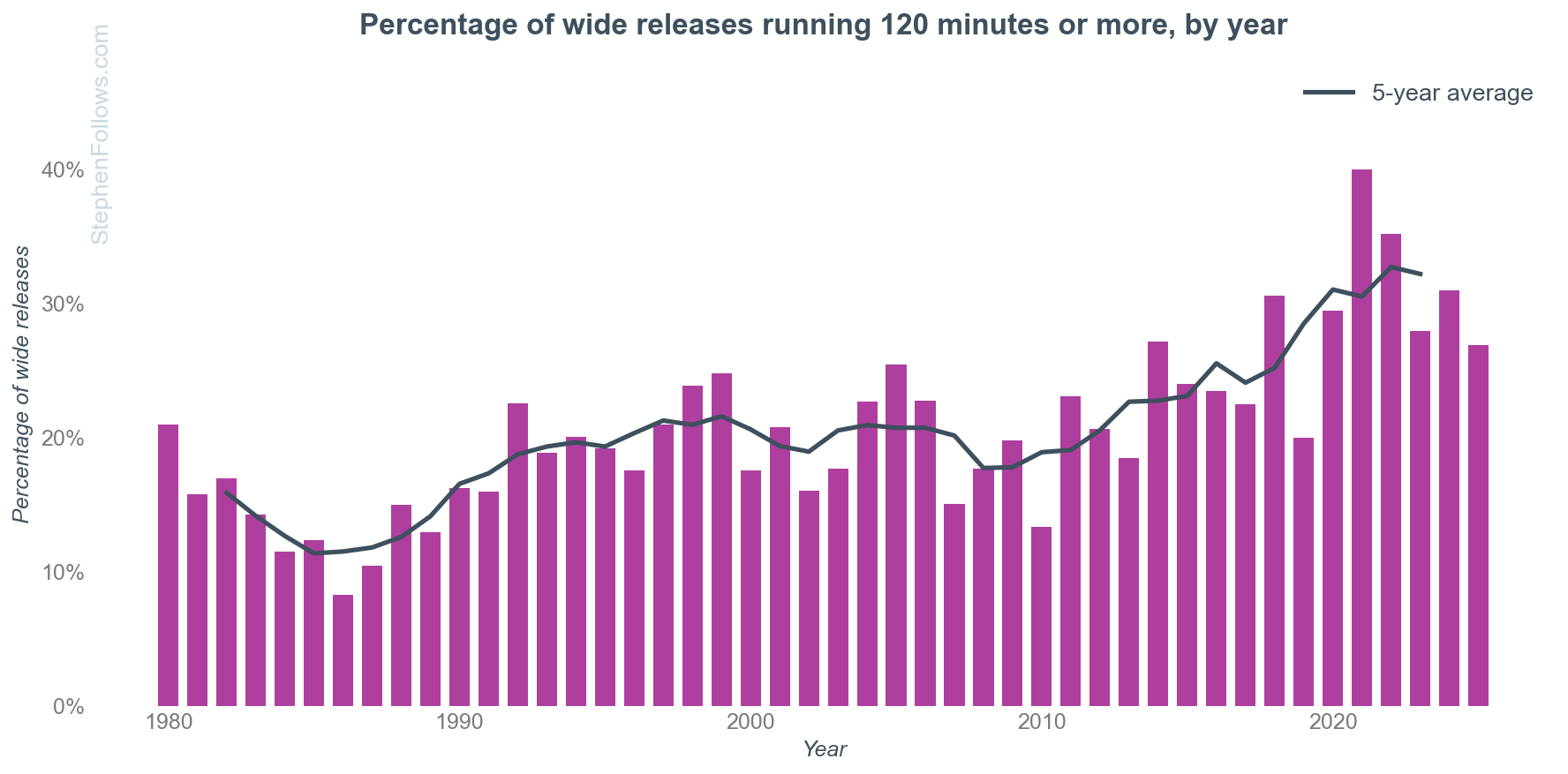
Very long films have proliferated dramatically. In the entire 2010s, only a handful of mainstream Hollywood films crossed the three-hour mark.
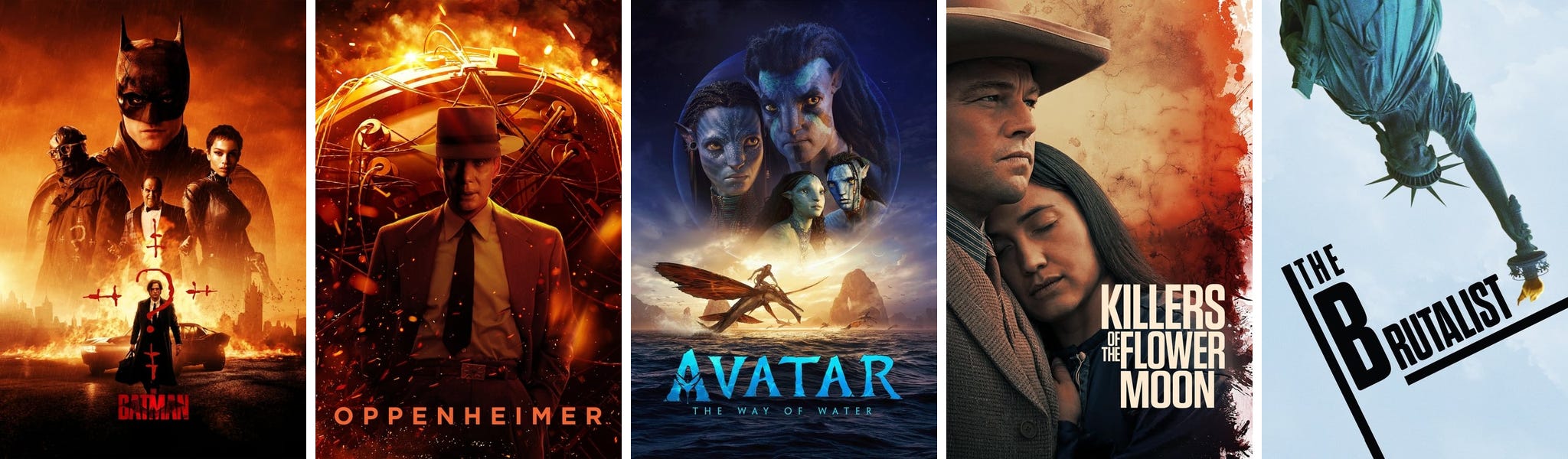
In the past couple of years, we’ve had The Batman (175 min), Oppenheimer (180 min), Avatar: The Way of Water (190 min), Killers of the Flower Moon (206 min) and The Brutalist (215 min).
Which genres are responsible?
Not all genres have inflated equally. Action films have grown the most (hence why Matt invited Todd to speak about it on the show).
The average wide-release action film ran 103 minutes in the 1980s. By the 2020s, that had increased to 128 minutes, up 25 minutes.
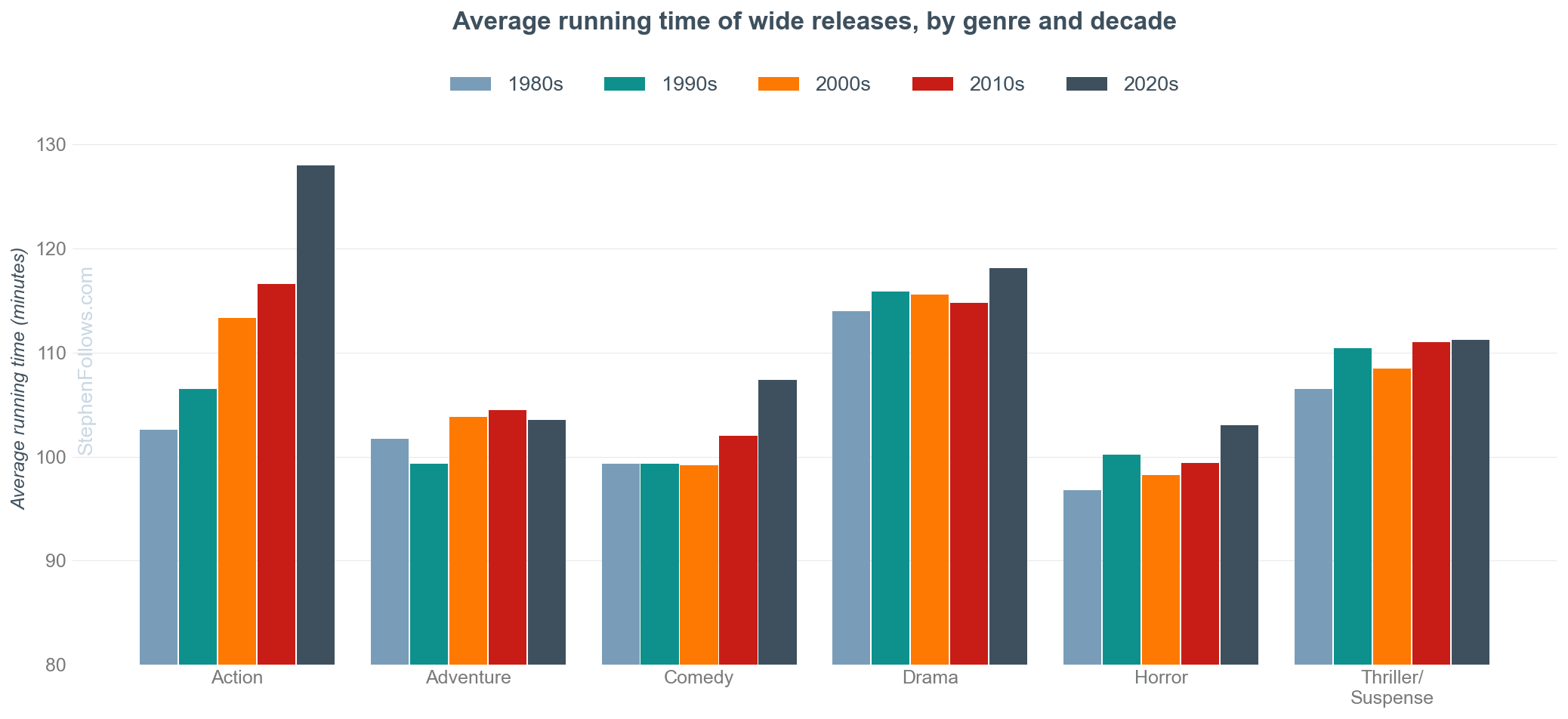
Comedy and horror have crept up too, but not to the same degree. Wide-release comedies held steady at 99 minutes from the 1980s through the 2000s, then nudged up to 107 minutes in the 2020s. Horror went from 97 minutes to 103. C
Overall, we can see that runtime inflation is concentrated in genres with the highest budgets and set-piece costs.
This makes sense. A comedy needs to land its jokes and get out, and a horror film needs to sustain tension, not test endurance (like Get Out). When I last looked at horror runtimes in 2019, It: Chapter Two at 169 minutes was longer than 99.78% of all horror films made in the prior 20 years.
Even animation has crept up. Disney Renaissance films in the 1990s typically ran 83 to 95 minutes (The Lion King is 88 minutes, Aladdin 90, Beauty and the Beast 84). Modern Disney and Pixar features cluster around 100 to 118 (Moana 113, The Incredibles 115, Incredibles 2 118).

The franchise escalation effect
The obvious suspect is the franchise machine. Surely it’s all those Marvel sequels and cinematic universes bloating the schedule?
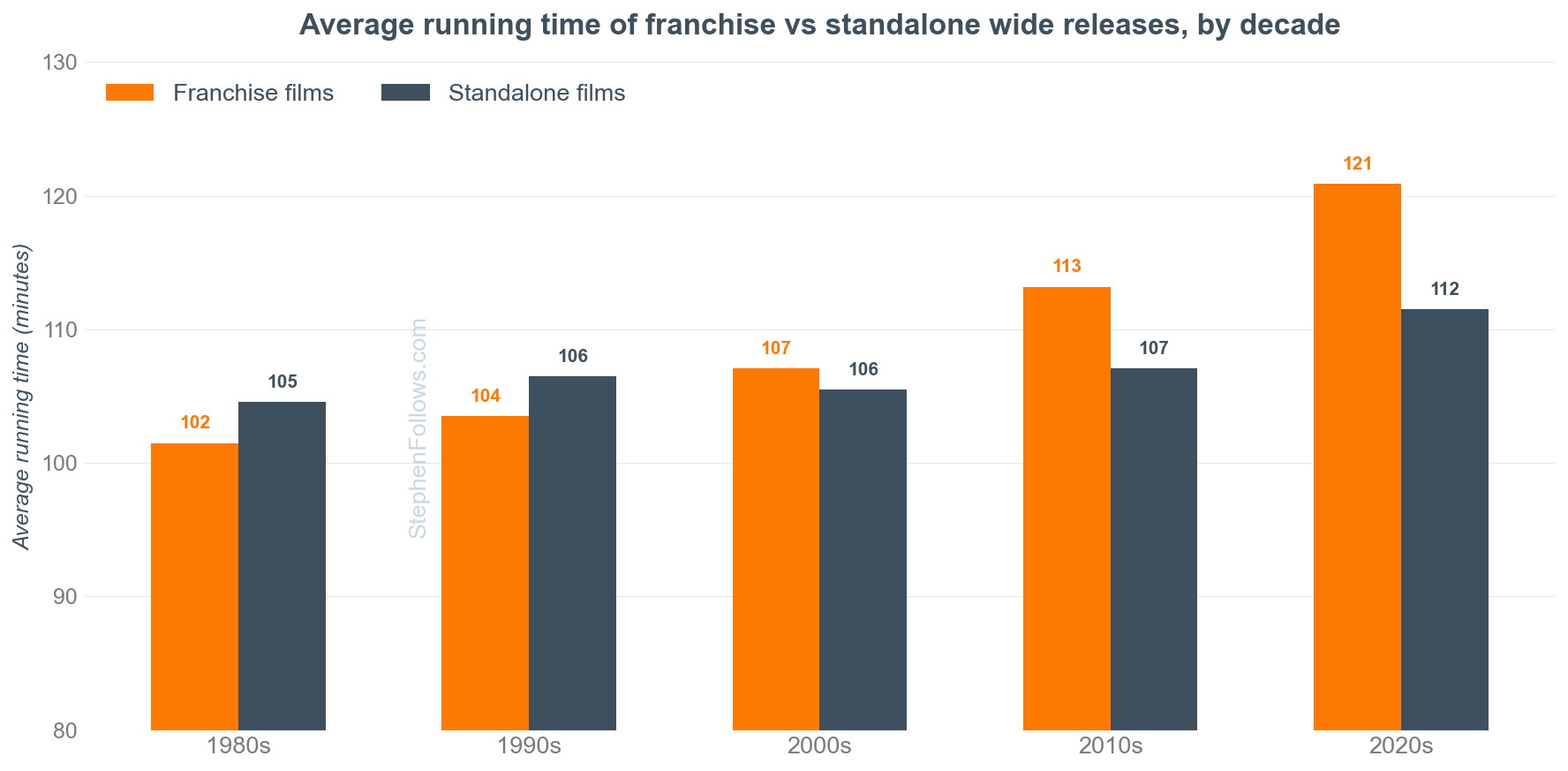
Kinda. In the 1980s and 1990s, franchise films were actually shorter than standalones by about three minutes. The typical franchise entry was a tight, efficient sequel like Lethal Weapon 2 or Home Alone 2.
That changed during the 2000s and has been widening since. By the 2020s, franchise films averaged 121 minutes versus 112 for standalones (i.e. a nine-minute gap).
The crucial point is that both have got longer, with standalones going from 105 minutes to 112 minutes, and franchise films from 102 to 121.
What the franchise data does reveal is a pattern of escalation within individual series. Each instalment tends to run longer than the last, as though runtime is part of the promise that each sequel will be bigger than its predecessor.
The Star Wars sequel trilogy averaged 143 minutes per film, compared with 125 minutes for the original trilogy (18 minutes more per film).
Indiana Jones and the Dial of Destiny (142 min) ran 27 minutes longer than Raiders of the Lost Ark (115 min).
No Time to Die (163 min) was the longest Bond film in the franchise’s 60-year history, more than 50 minutes longer than Dr. No.
The Fast & Furious franchise hasn’t had a sub-two-hour entry since 2009. Every film since Fast Five has run 130 minutes or more.

Follow the money
Budget turns out to be a stronger predictor of runtime than franchise status, genre, or almost anything else.
Films made for under $10 million have barely changed in length over four decades. But films budgeted at $100 million or more now average about 130 minutes, up from around 122 minutes in the 2000s.
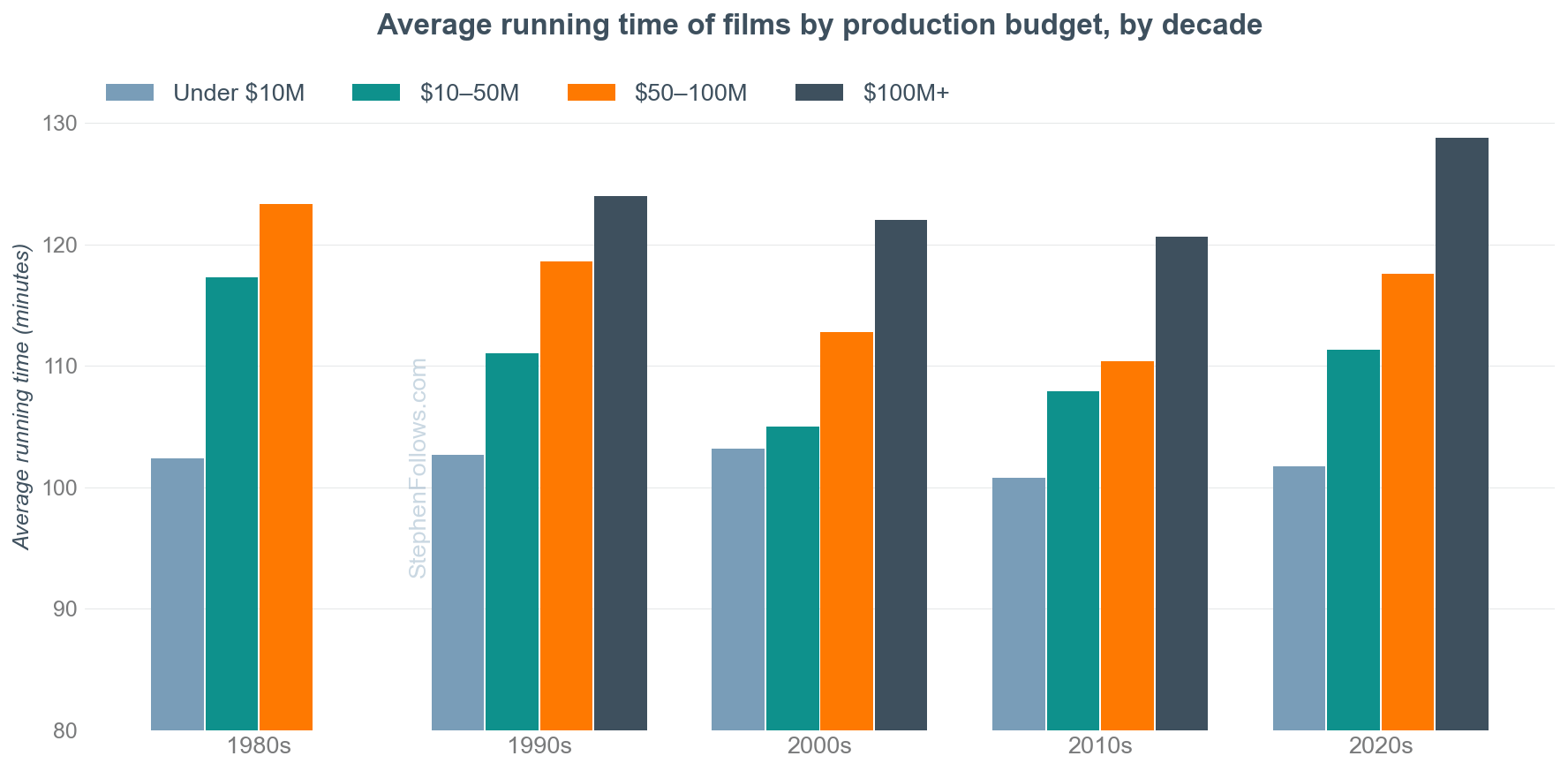
My read on this is that a studio spending $200 million on a film wants every set piece on screen and for the audience to feel they got their money’s worth from a premium-priced cinema ticket. Cutting twenty minutes might make for a tighter film, but it doesn’t make for a bigger event.
There's a strange quirk in how film exhibition works. In most cinemas worldwide, the ticket price is unrelated to the runtime. A three-hour film consumes 50% more screen time than a two-hour film, but the ticket costs the same.
There are exceptions:
Germany has a formal surcharge system (Überlänge) used by major chains, with fees kicking in at 120 minutes and rising in brackets.
Kinepolis in Belgium adds €1 for films over 130 minutes.
Viewshow Cinemas, Taiwan's largest chain, charges a tiered premium starting at NT$20 (about a dollar) for films over 150 minutes.
But these are outliers. The global norm is flat pricing, regardless of runtime. A three-hour film consumes 50% more screen time than a two-hour film, but tickets tend to cost the same.
From the audience’s perspective, a longer film is arguably a better value. From the exhibitor’s perspective, it’s a structural subsidy for long films that nobody has ever corrected.
So what’s going on?
I don’t have a single neat answer, but there are a number of things worth pointing to.
Digital projection removed the practical ceiling. Until 2017, most cinemas projected from 35mm film reels. Now they don’t, and a digital file can be any runtime. A standard reel held roughly 11 minutes of footage, so a movie like Avengers: Endgame at 181 minutes would have required 16 reel changes.
The economics of theatrical cinema have changed. Cinemas need each screening to justify a premium ticket price, and maybe a longer film can feel like a better value.
Studios want their big releases to feel like events. A three-hour epic signals importance in a way that a tidy 95-minute film doesn’t.
Shorter films have migrated to streaming. Between 1995 and 2009, Hollywood’s major studios averaged roughly 112 theatrical releases per year. Between 2010 and 2023, that fell to about 83.
The dual-window model has given directors a release valve. Ridley Scott delivered a 157-minute theatrical cut of Napoleon for Sony, followed by a 205-minute director’s cut for Apple TV+. The theatrical version plays the multiplexes while the extended version lives on streaming.
Directors with leverage are using it. Christopher Nolan, Denis Villeneuve, Martin Scorsese. These are filmmakers with the clout to deliver a three-hour cut and have the studio release it. In an earlier era, the studio might have insisted on cuts. Today, a long runtime from a prestige director is a selling point, not a problem.
And audiences keep showing up. Oppenheimer ran three hours and grossed $952 million worldwide. Avengers: Endgame ran 181 minutes and crossed $2.7 billion. Avatar: The Way of Water ran 190 minutes and made $2.3 billion. If audiences were punishing long films at the box office, studios would have course-corrected by now.
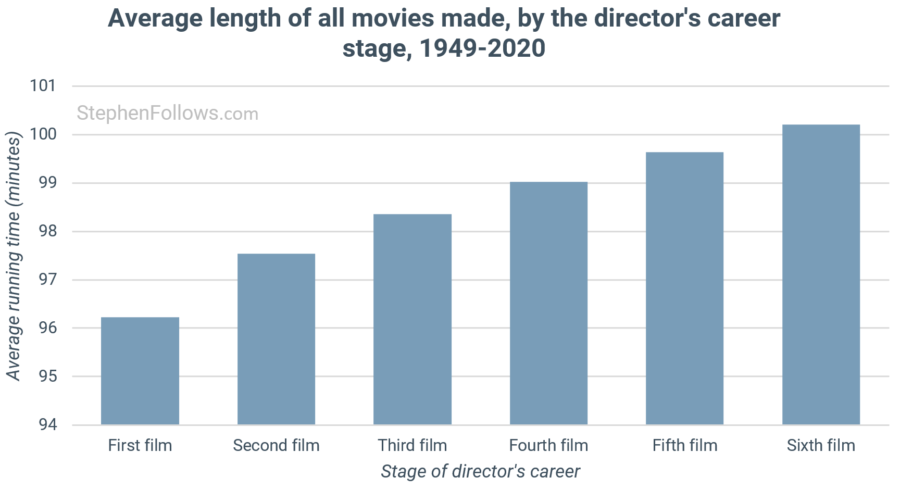
I looked at that penultimate point a few years ago in an article titled "Do more experienced directors make longer movies?" In a word, yes!
Epilogue - The intermission question
If films are going to keep getting longer, should cinemas bring back the intermission?
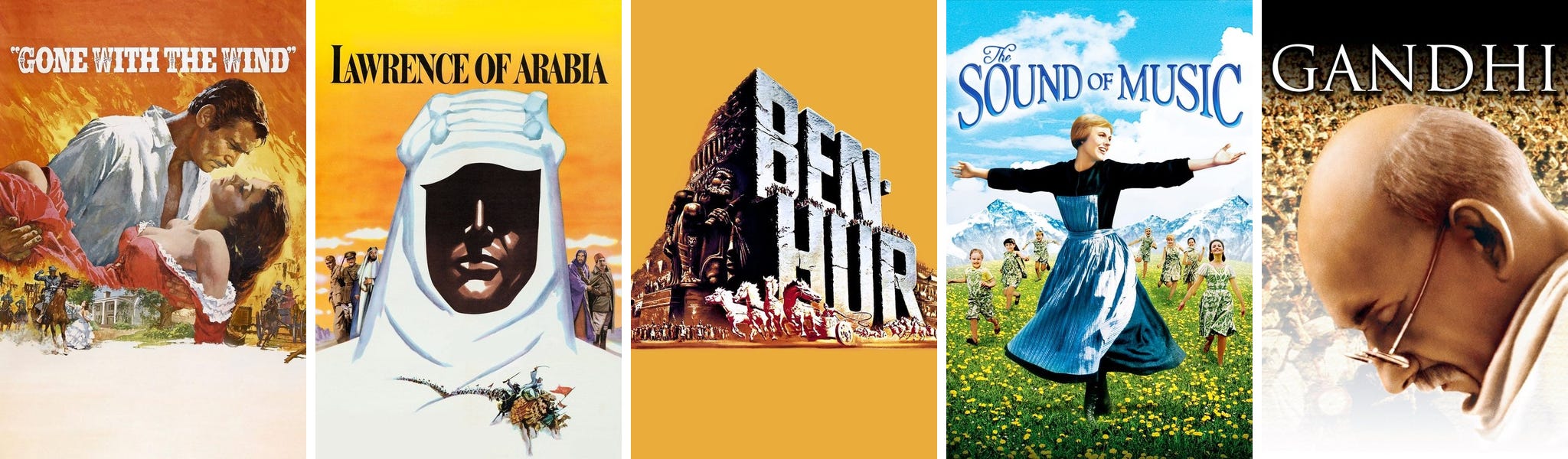
Intermissions were standard in cinema for decades. Gone with the Wind, Lawrence of Arabia, Ben-Hur, The Sound of Music all had built-in breaks. The last major wide release to include one was Gandhi in 1982. After that, they disappeared from Western cinemas entirely because exhibitors calculated that dropping the break would squeeze in one more screening per day.
Then in 2024, Brady Corbet’s The Brutalist brought it back. At 215 minutes, the film includes a 15-minute intermission designed into the script at a narrative pivot point. The reception was overwhelmingly positive and sparked a conversation about whether more films should follow.
Not everyone agrees. When an independent cinema in Colorado added an eight-minute break to screenings of Killers of the Flower Moon (206 minutes), Paramount and Apple contacted them and told them to stop. Scorsese reportedly made it clear that an imposed intermission was an insult to the film.
In India, of course, intermissions never went away. Every Hollywood film released in Indian cinemas gets a mandatory interval, including 84-minute animated films. Concession revenue during intervals accounts for 30 to 40% of Indian cinema revenue. Christopher Nolan has pushed for his films to be shown without breaks, but many Indian chains simply ignore him.
It’s a tension that isn’t going to resolve itself. Directors see the intermission as a violation of their artistic intent. Audiences (and their bladders) increasingly need one. As films push past three hours more and more regularly, the pressure will only grow.
Notes
The raw data for today’s research came from the OpusData/The Numbers database, which covers 36,431 films with runtime data. ‘Wide releases’ are defined as films with a wide release pattern in North America, as classified by The Numbers. Budget data is available for roughly 30-40% of theatrical releases and coverage drops to around 20% for the 2020s, so budget-based findings should be read with that caveat in mind.
"As far as I can discover, there is no cinema anywhere in the world that charges a higher ticket price for a longer film."
German here, it's very common practice here (and in other parts of the world too, I believe). It's called Überlänge. One of the biggest German movie chains:
> 120 mins +1 €
> 135 min +2 €
> 150 mins +3 €
https://cdn.cinemaxx.de/-/media/files/preisupdate_august2025/preisupdate_oktober2025/preisliste_kiel_september_2025.pdf?la=de-de
The last Theatrical movie here in the USA was Titanic in 1997 because of the long length of the movie. Because of streaming services, Social media and short clipped videos on Tik Tok and YouTube has made the attention span of young people shorter which is one reason people want shorter length movies under 2 hours. There are other reasons as well with how well movies are written, cinematography of how the movie is presented. Some of how greatest cinematographers are retired or dead now. The great directors like Coppola, Spielberg, Lucas and Peter Jackson, Christopher Nolan are masters of making longer than 2 hour movies that you want to set through and watch no matter how long it is in the past. This might be another reason why we need more great directors to make great longer movies. You have presented a great synopsis of the film industry though in your article Mr. Follows. Just an addendum of thoughts to your story.