


In early 1986, Frank Oz held preview screenings of Little Shop of Horrors in San Jose. He stayed faithful to the musical it was based on, so the movie climaxed with both Seymour and Audrey dying, the plant taking over Manhattan, and, in the final shot, eating the audience.
Warner Bros had told Oz that he needed at least 55% of the audience to select ‘recommend’. After the screening, the movie scored 13%. A follow-up screening in Los Angeles gave it 16%. Frank Oz described it like this:
For every musical number there was applause, they loved it, it was just fantastic... until we killed our two leads. And then the theater became a refrigerator, an ice box.
So he decided to reshoot the ending in which both leads live. A test screening of the new version got 50% ‘recommend’, and the movie became the version we have today.
That was forty years ago. And yet if you listen to film Twitter (or to my friends), you would think the happy ending has since died. Everything seems to be ‘Prestige gloom’, with bleak endings or, at best, ambiguity everywhere.
So I went looking for it, in the plots of 7,384 films and on the faces of the actors in their final minutes.
Would you like a happy ending?
The traditional happy ending is, in fact, two things:
It is what happens (the couple reunites, the hero survives, the villain loses).
It is also how the last minutes feel.
Those can disagree. For example, the hero of Gladiator dies at the end, but we are left feeling sated, and that justice has been meted out.
So I measured both. For what happens, I rated the plots of 7,384 movies on a six-point scale from happy to sad, depending on whether the protagonist survives and gets what they wanted, whether the couple ends up together, whether the villain wins.
For how it feels, I ran a facial-expression model over 1.57 million close-ups of 10,421 named performers and compared each film’s final 10% with its 65% to 85% stretch (where the darkest hour traditionally lives). A positive ‘ending lift’ means the ending reads warmer on the actors’ faces than the third act.

Two further checks, the music of the finale and the ending tags that humans apply in public databases, tell the same story, and all four are described in the Notes.
Did the happy ending die?
In a word, no.
Across the 6,509 films whose plot text describes the ending, half end happily, one in three ends bittersweet, and only one in six ends sad. The protagonist dies in one film in ten, and the villain wins in fewer than one in eleven.
For all the talk of prestige gloom, the plainly sad ending is no more common now than it was in the 1980s, and it is rarer than it was in the 2000s. The gloomiest patch on that chart is the 1970s, when only a third of films ended happily and three in ten ended sad.
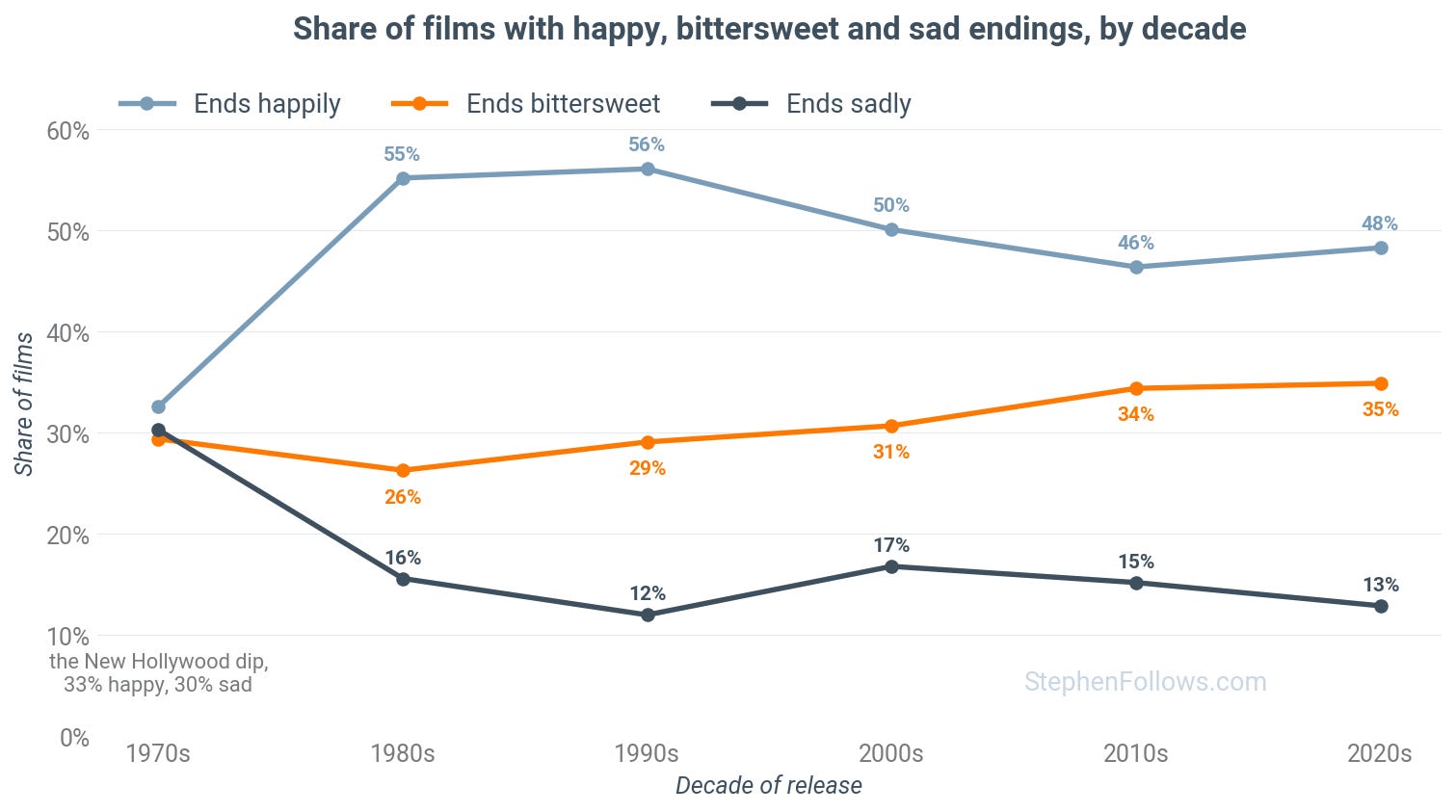
But what has changed is the rise of the bittersweet ending (that’s the orange line on the chart above).
Bittersweet endings have climbed from about a quarter of films in the 1980s to more than a third today.
So it’s not that we’ve had more tragedy, more successful villains, and no rise in dead protagonists (that has been flat for thirty years). Just fewer endings that are only happy, and more that mix the win with a loss.
Endings have just become… complicated.
Which movies went bittersweet?
When I first noticed this, I figured the real cause might be the shift in genre production over the years. But the data tells a different story. The drift isn’t because Hollywood makes more films that fit traditional sad genres, but because one of the happiest genres is changing its identity.
Action films used to have the most reliable happy endings in mainstream cinema. In the 1980s and 1990s, three-quarters of them ended happily. Since 2010 it is 56%, with the bittersweet share rising from a fifth to more than a third.
That single shift accounts for around half of the entire decline in happy endings. So the heroes are still winning, but it’s costing them a whole lot more.
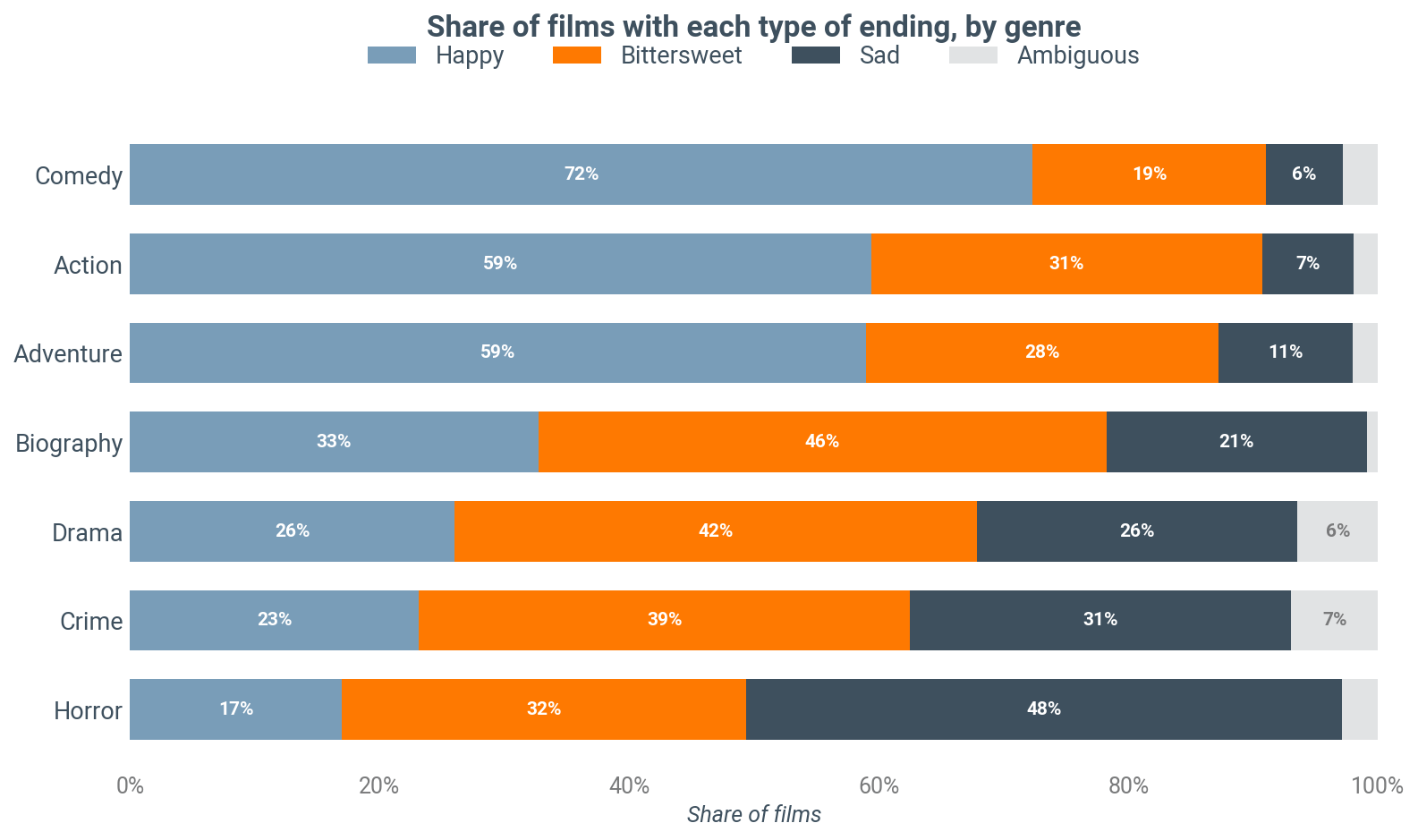
The other genres have moved far less, if at all. Comedy has stayed as sunny as it was forty years ago. Crime and drama softened a little. And one genre went the other way entirely, because biopics are happier than they used to be.
Is this just an American thing?
Half of films ending happily is a worldwide average, and the cliché says the happy ending is an American habit.
The phrase ‘Hollywood ending’ first appeared in mainstream newspapers in 1927, and was being sneered at even then. Ten years prior, a Photoplay editorial had already set out the theory:
American art, to reach the hearts of Americans, must be happy art. Good must triumph over evil. Love must find a way.
Irving Thalberg was less romantic about it. When MGM adapted Anna Karenina as Love in 1927, they shot two endings. They played the tragic version in New York, and screened the happier reunion version in rural areas. Thalberg’s explanation was that audiences in small towns:
…require a happy ending that they can understand or an unhappy ending that they can understand.
The small towns, he reckoned, had not understood the unhappy one.
Europe took the opposite view and has held it for a century. Douglas Sirk, who directed some of the most famous happy endings in American melodrama, said “All my endings, even the happy ones, are pessimistic“. Michael Haneke is blunter: “If you like to go home feeling reassured, you have to watch mainstream films.“
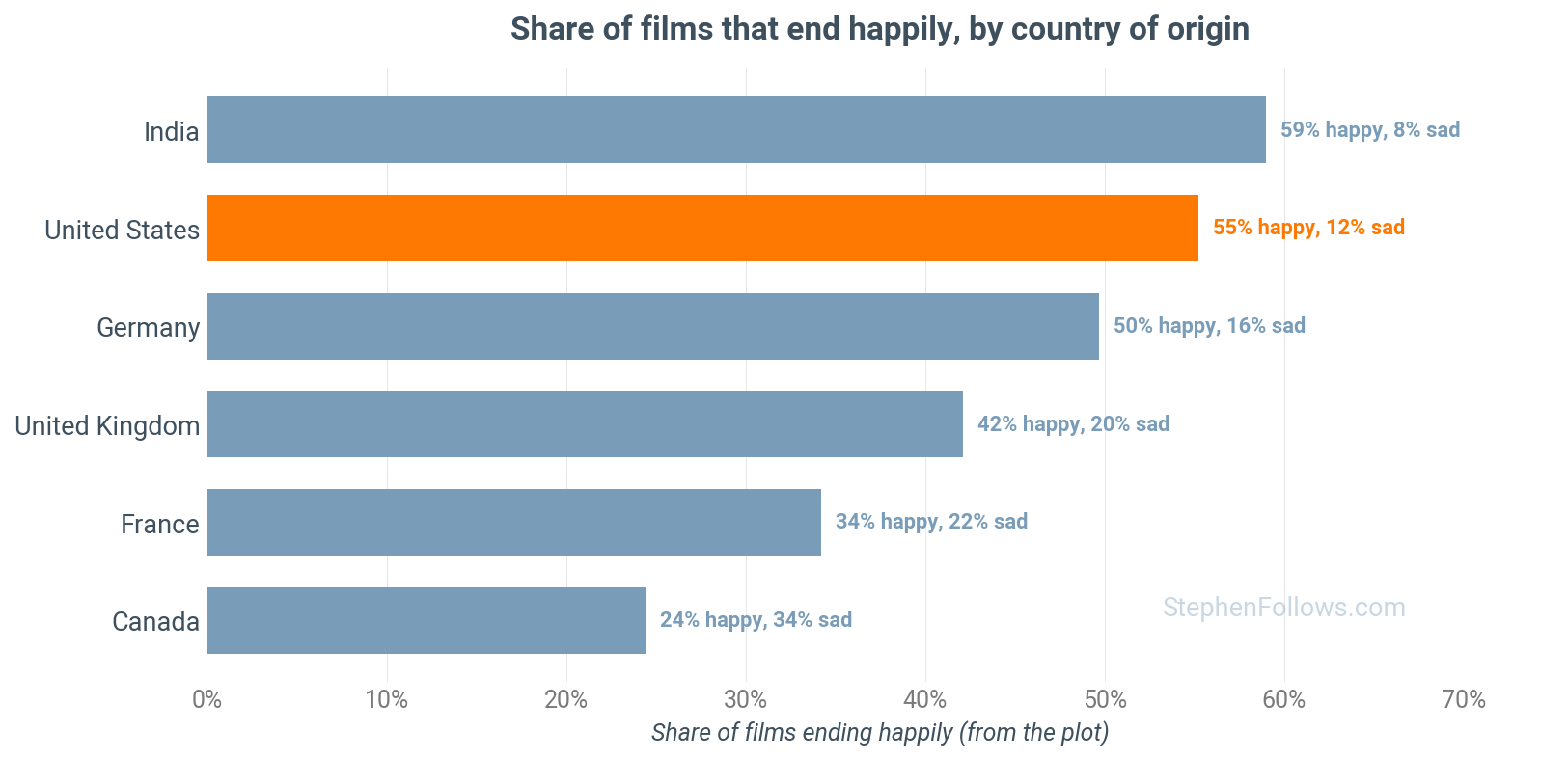
So does the data back the cliché that Hollywood wants to stick on a happy ending? Mostly.
American films end happily 55% of the time and sad 12%. French films are nearly twice as likely as American ones to end sad, which will surprise nobody who has been to the cinema in Paris.
But India has the happiest endings, at 59% happy and 8% sad.
Does a bittersweet ending still feel happy?
That is what happens in the plots. The other half of a happy ending is how the last minutes feel, and here the story is different.
The faces still deliver a rise in six films out of ten, exactly as they did when the plots were sunnier. The modern bittersweet ending is built to feel like a happy one used to. A good example is About Time, which is bittersweet (a final goodbye to a dying father, then a family breakfast) but whose finale the faces read through tears.
Hollywood has learned to make bittersweet feel like happy. How do you make a mixed ending feel like a rise? This is where we need to consider the story's shape.
As a graduate student in anthropology, Kurt Vonnegut argued that stories have shapes you can draw on graph paper. The University of Chicago rejected his thesis, and later gave him the degree anyway on the strength of Cat’s Cradle. His favourite shape he called Man in Hole:
Somebody gets into trouble, gets out of it again. It is not accidental that the line ends up higher than where it began. This is encouraging to readers.
In 2016, a team at the University of Vermont tested the idea on 1,327 novels and found six recurring shapes. I did the same thing with faces. Clustering the emotional arcs of the 3,146 films with enough close-ups spread across their whole running time produces five.
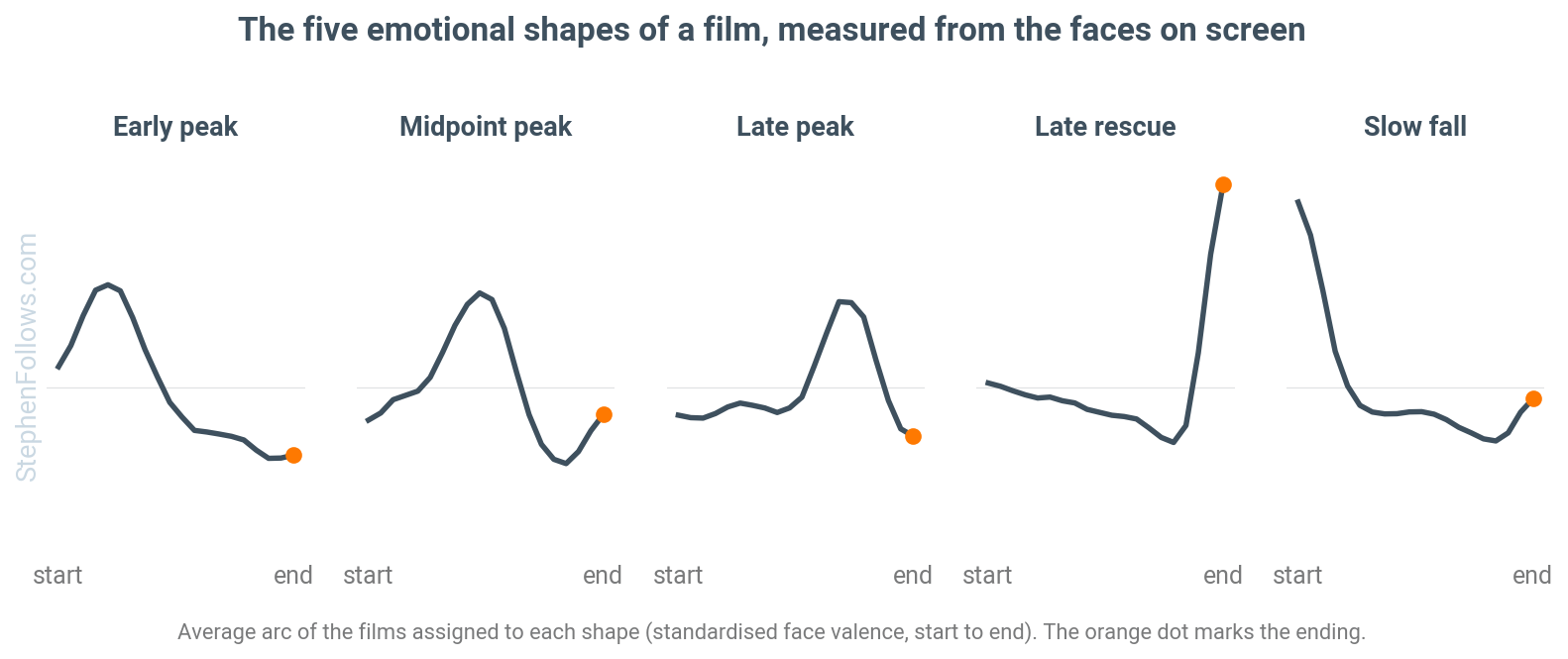
The two I want to focus on are ‘Late rescue’ and ‘Late peak’.
Late rescue is Vonnegut’s Man in Hole with the volume turned up to 11. Everything collapses in the third act and then the finale soars. It is the classic happy ending, and it is the most common shape in the data.
Late peak might look like a happy ending from a distance, but actually isn’t one. The film surges to its emotional high at the three-quarter mark and then deflates all the way to the credits. It is the victory lap that runs out of road.
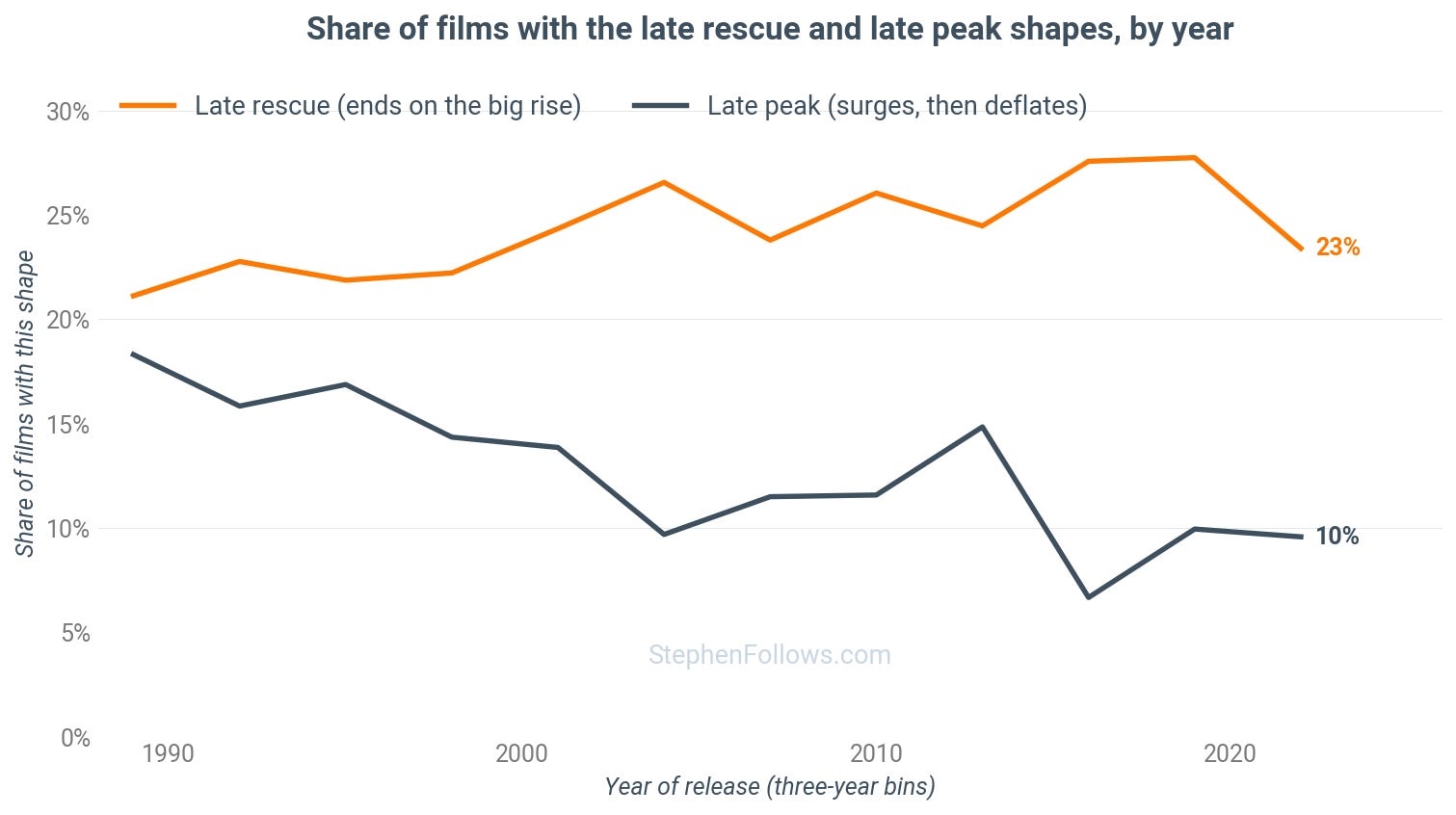
The classic happy-ending shape did not go anywhere. Late rescue accounted for 22% of films in the 1990s and 23% in the 2020s, and it hit its highest share on record in 2016 to 2019.
The shape that did die was the late peak, which halved from 17% to 10%. Films have kept the darkest-hour-then-rise template while dropping the ending that fades out after its high.
Which ending do audiences rate highest?
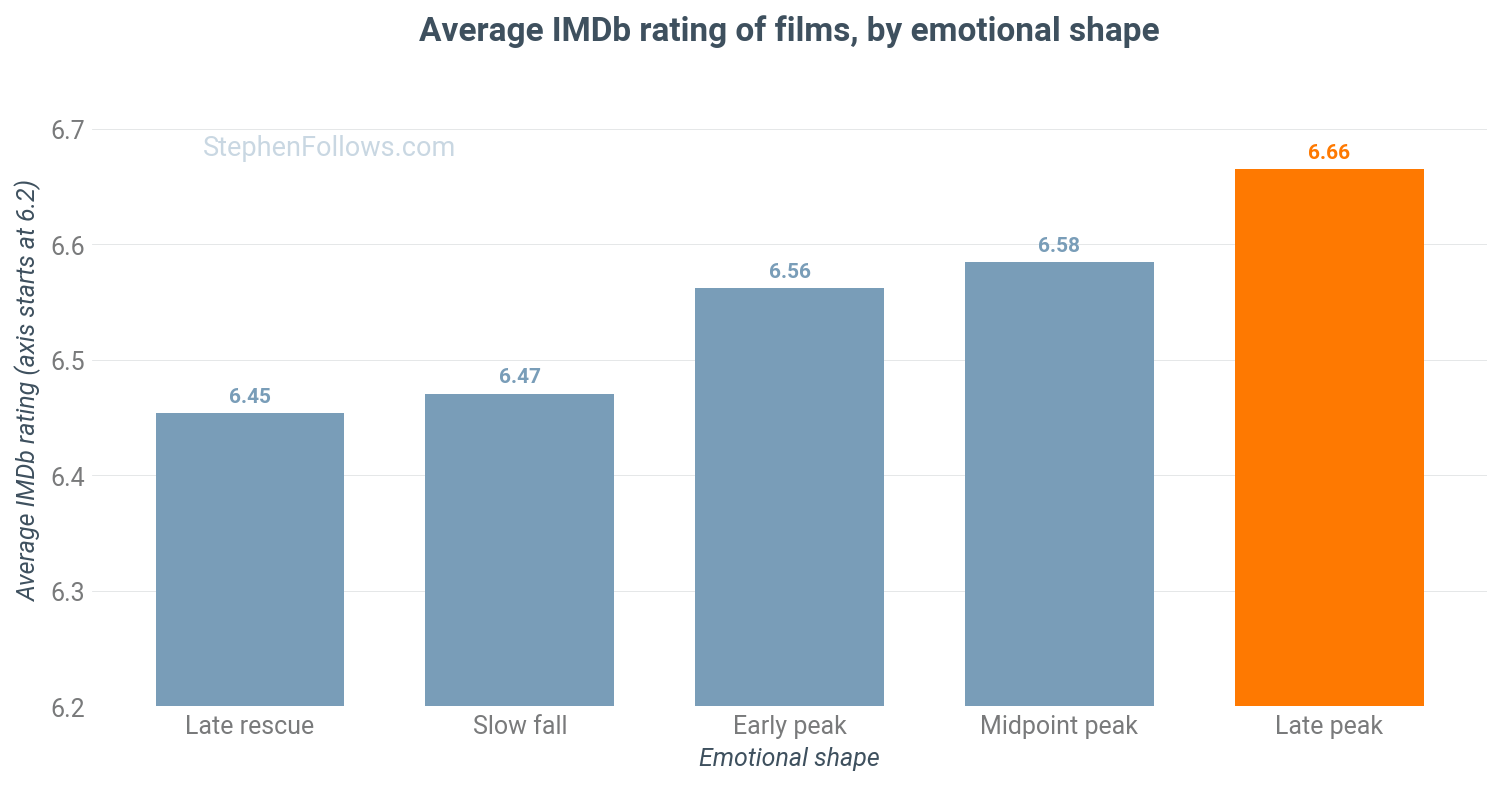
Hollywood may have misstepped here, since the template they’ve been killing off is also the best-rated one.
Films with a Late peak arc average 6.66 on IMDb, the highest of the five. The classic crowd-pleaser, Late Rescue, is the lowest at 6.45.
A 2021 study of 6,174 film scripts found the same split from the other direction. Man in a Hole films took the highest box office and scored significantly lower with IMDb users.
So Hollywood makes the shape raters reward least, and stopped making the one they reward most.
It turns out Hollywood isn’t deciding to change its mind… it’s us.
When did we stop rewarding misery?
For most of my lifetime, a sad ending earned a film a higher rating. We collectively decided that misery was a shorthand for seriousness.
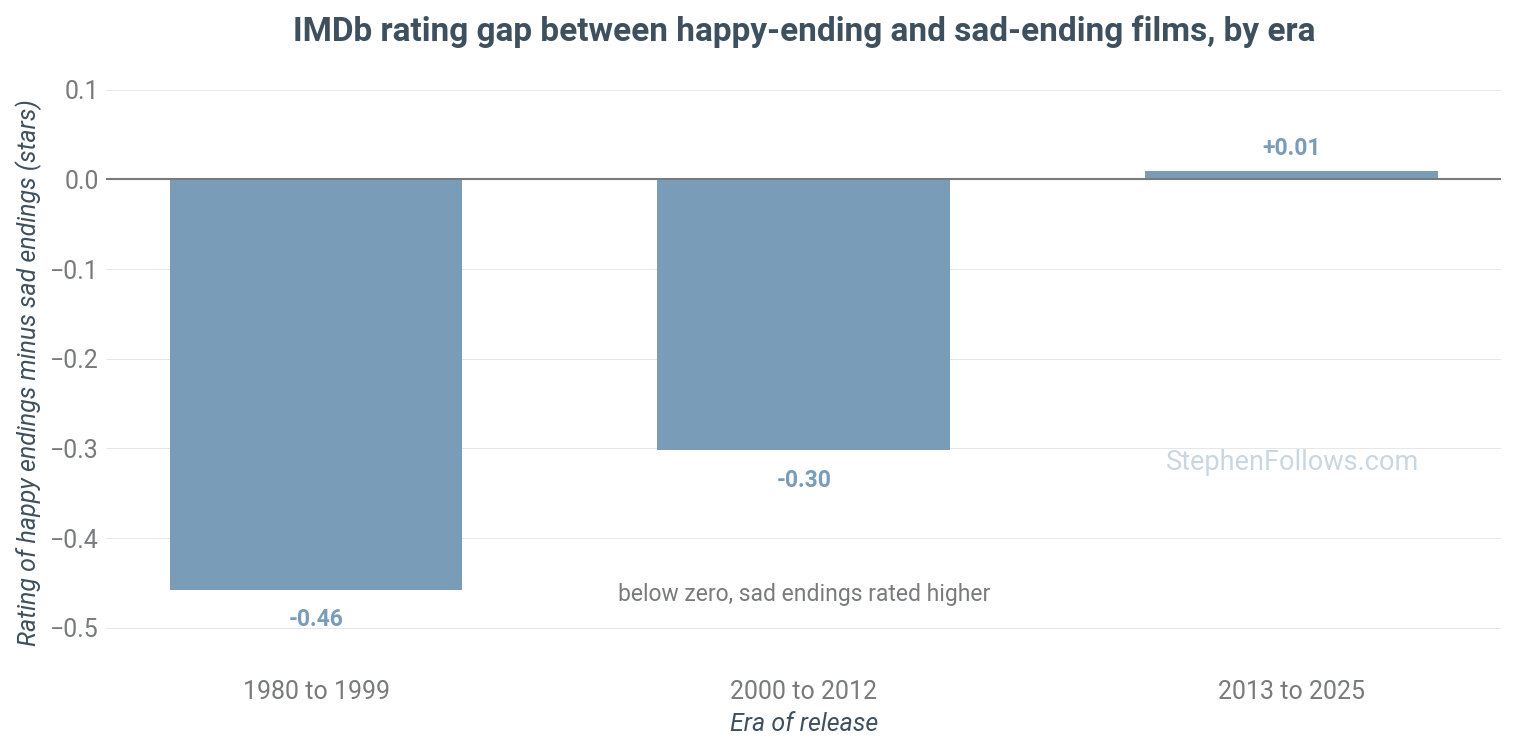
In the 1980s and 1990s, films whose plots end sadly were rated nearly half a star lower than films whose plots end happily.
In the 2000s, the premium was still a third of a star, and since 2013 it is one hundredth of a star. The faces version of the same calculation tells the same story, with the deepest valley in the 2000s.
The 2000s were peak misery-chic, as shown by how establishment film critics described the movies they reviewed.
Manohla Dargis called Children of Men “the kind of glorious bummer that lifts you to the rafters“.
Roger Ebert’s verdict on Revolutionary Road was “This film is so good it is devastating“.
When the 2008 Oscar nominations came out, the Christian Science Monitor noted that the leading films “were marked by merciless, unsentimental endings“, and film scholar Christopher Sharrett told the paper that “their critical reception... is really dependent on the public mood”.
But at some point, the consensus shifted.
In 2018 David Ehrlich of IndieWire gave the new wave a name, ‘nicecore’, arguing that “kindness can be a transformative force unto itself“ and crowning Paddington 2 “pretty much the ‘Citizen Kane’ of nicecore”.
By 2020 Vulture’s television critic wrote that “TV that makes us sad is not inherently better“ and called it a death knell for prestige.
That same year Americans streamed 57 billion minutes of The Office, a show that had ended seven years earlier.
And when YouGov asked British adults in 2024 whether they preferred a happy or a sad ending in a romance, 72% said happy and 5% said sad.
What do opening-night audiences say?
This pattern also shows up elsewhere. CinemaScore has been polling opening-night audiences since the late 1970s, handing people a card as they leave and asking for a grade from A+ to F.
I gathered its grades for 4,735 films, of which 1,514 are also in my faces dataset, and the two measures line up neatly. Overall, films that earned an A-range grade delivered a rise into the finale 72% of the time. At B-, that falls to 57%. (The C-or-worse tier ticks back up slightly, which is mostly bad comedies ending merrily, whatever the audience thought of them.)
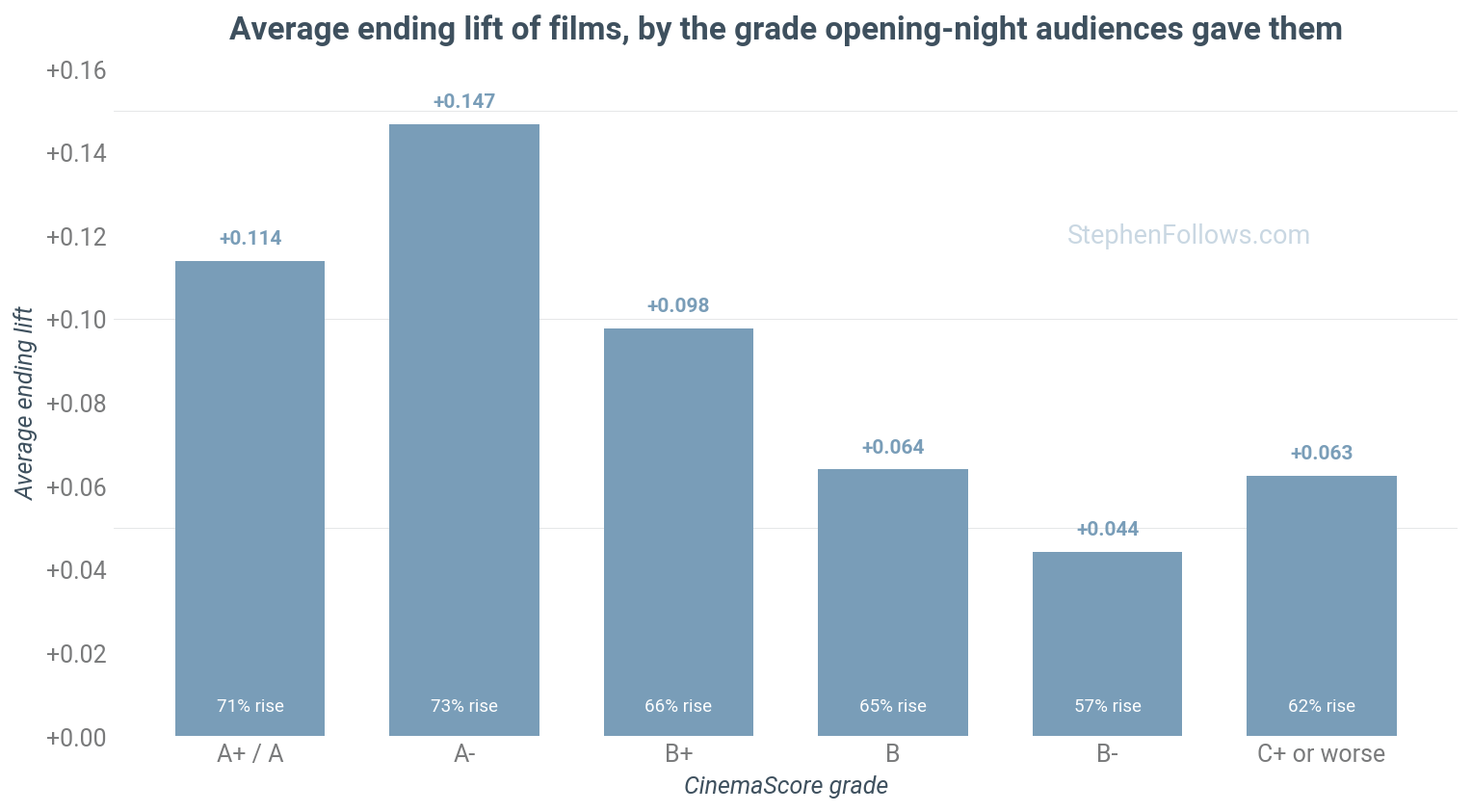
Looking at the results over time, we can spot the same trend we saw earlier.
Opening-night audiences have always graded a rising ending a shade higher, by about a third of a notch, through the 1980s, 1990s, and 2000s. Since 2013, that gap has doubled to two-thirds of a notch, and for the first time it is large enough to be statistically solid.
A rising-ending film now takes an A-range grade 40% of the time. A falling-ending film, 27%.
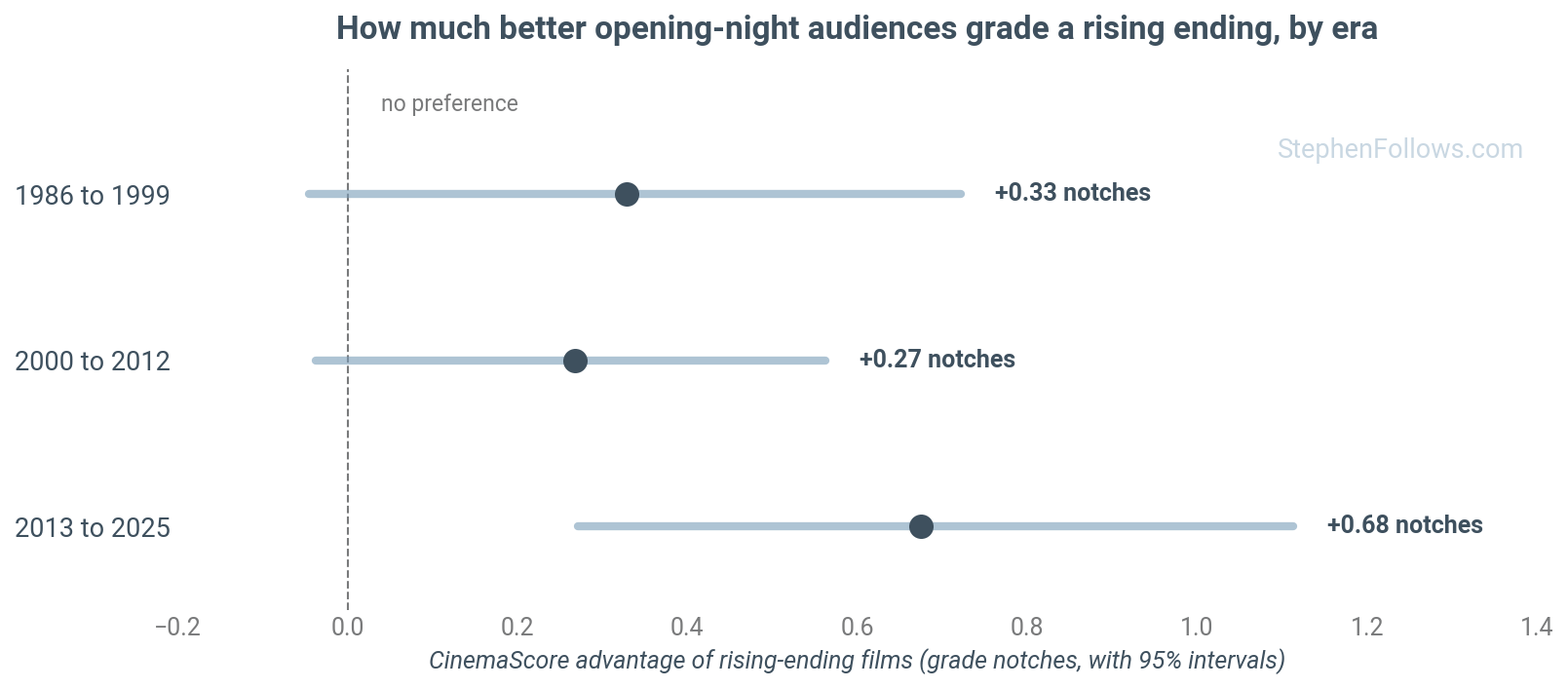
So both the rating that once paid a premium for misery no longer does, and the exit poll that always leaned happy now punishes the alternative harder than at any point since polling began.
Whichever measure you use, comfort has started to take precedence.
So is the happy ending dead?
On a positive note, half of films still end happily. Plus the classic ‘darkest-hour-then-rescue’ shape is as common as it was thirty years ago.
But we’ve changed. Audiences no longer treat a sad ending as proof of seriousness and the half-star ratings premium that misery earned in the 1980s and 1990s is gone. Opening-night crowds now punish a downbeat ending harder than at any time on record.
Things have become more complicated. A third of films now end bittersweet, up from a quarter, and the endings that used to be only happy learned to carry a loss, while still, on the actors’ faces, delivering the rise we came for.
So as the credits roll on this article, we’re left conflicted but we’ve learned something along the way.
The last word belongs to W. Stephen Bush, an editor at Moving Picture World, who wrote this in November 1915, when the movies were barely twenty years old and the argument was already going:
“Yes, we do strain things a bit to get the happy ending. We all know that the happy ending is not always true to the life we are supposed to reflect on the screen... Just the same the audiences will have the happy ending.”
A hundred and ten years later, they still will. They just take it with a tear in it now.
Notes
The plot readings come from a language model that reads each film’s synopsis and records a fixed rubric, validated against the ending tags that humans apply in public databases. The face data scores 1.57 million close-ups for emotional positivity, with face recognition matching actor identities. It reads faces, not plots, so tears of joy register as sadness, and single-film numbers should be handled with tongs. Everything here compares groups measured the same way, and it is correlation. The data can reveal trends but not the reasons behind them.
The data I’m drawing from is:
Synopsis shows story signals. I rated the emotional register of the plots of 7,384 movies on a six-point scale from happy to sad, depending on whether the protagonist survives and gets what they wanted, whether the couple ends up together, whether the villain wins. A language model scored the reading using each film’s synopsis against a fixed rubric, and 6,509 films had plot text describing the ending. The decade, genre and country charts all rest on this measure.
Faces for final feelings. I ran a facial-expression model over 1,571,000 close-ups of 10,421 named performers, with face recognition matching each face to an actor, scoring every face for how positive it reads. For each film, I compared the final 10% with the 65% to 85% stretch (where the darkest hour traditionally lives) to get the ‘ending lift’. A positive lift means the ending reads warmer on the actors’ faces than the third act. The five story shapes come from clustering the emotional arcs of the 3,146 films with enough close-ups spread across their whole running time. The model reads faces, not plots, so tears of joy register as sadness, and single-film numbers should be handled carefully.
Music means major/minor moments. From 30-second windows across 4,248 films’ soundtracks, I measured whether the score in the final minutes leans major or minor.
Tags tell trajectories. Finally, I used human-provided labels from keywords and tags in public databases for 2,011 films on ending-related tropes.
None of these work on their own, but their blind spots are different, and when I line them up, they combine to tell the same story. Happy plots come with rising faces, major keys and matching tags. Sad plots come with all three reversed.
Everything here compares groups measured the same way, and it is correlation. The data can reveal trends but not the reasons behind them
I find this article bittersweet but dig its rising end ... A+
This is terrific research. Must have been painstaking. Thanks so much! I've always loved Vinnegut's man-in-the-hole metric.