


Last month, I wrote about the career paths top directors took to direct a major motion picture.
One finding was that women were less likely than men to make a second film on the same scale. A few of you got in touch to ask for more details on this, so I went back to the numbers.
I studied the career paths of 1,765 directors, all of whom have directed a top-grossing movie since 1980. I looked at the professional work they had done since directing a movie that appeared on the ‘top 100 US-grossing’ chart that year. More detailed information about my methodology is at the end of the article.
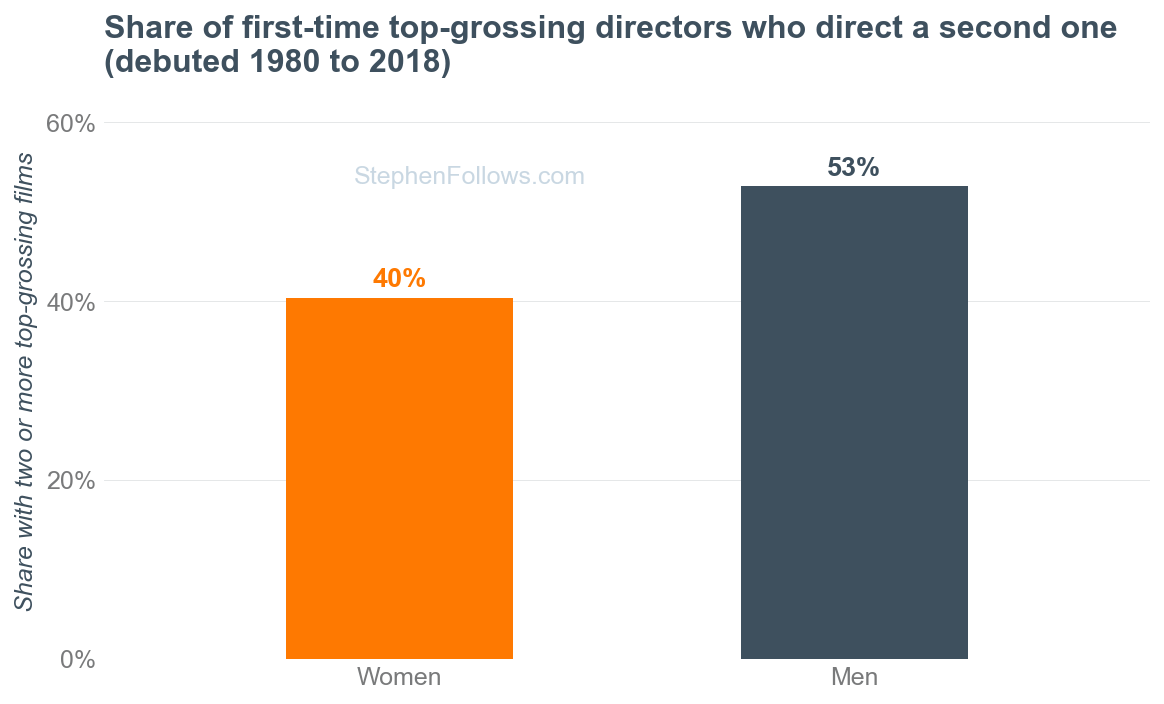
Among directors who reached the top 100 and had plenty of time to go again, 53% of men directed a second top-grossing film, but only 40% of women did.
So I wanted to know why. And the answer turned out to depend almost entirely on one thing: how well the first film did.
Does the size of the first film matter?
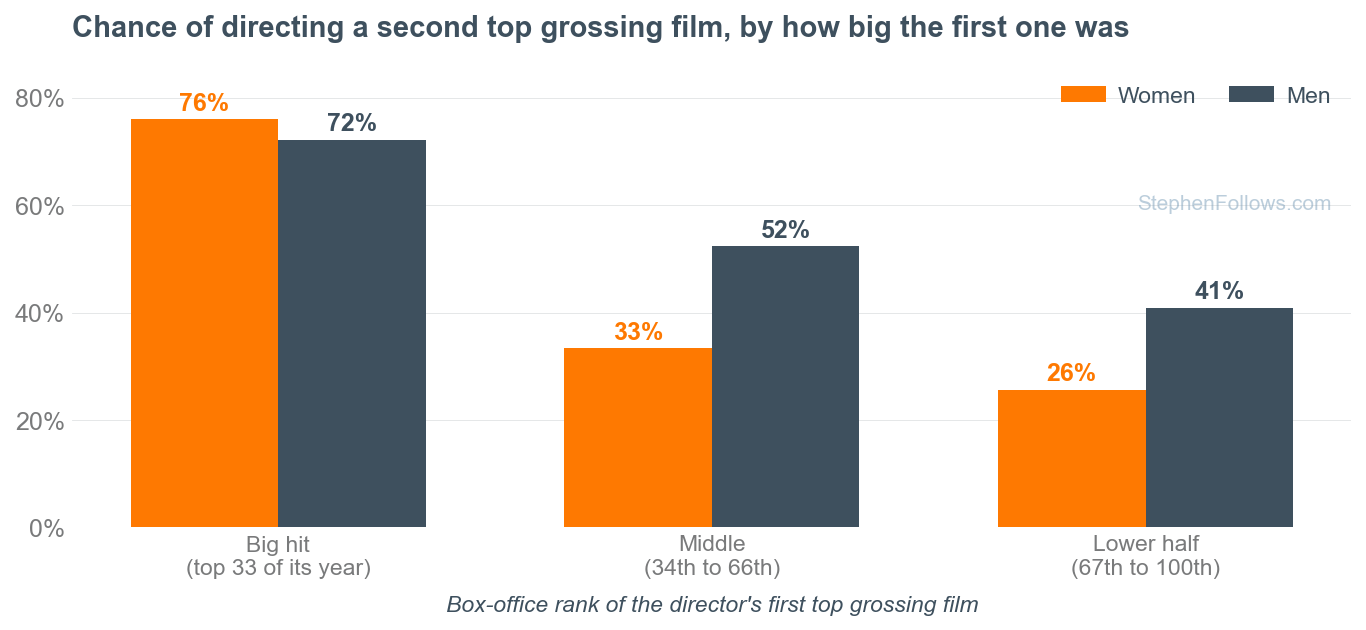
I sorted every director by the size of their first top-grossing film, using its US box office rank that year, and then checked how many went on to a second.
When the first film was a genuine smash (i.e. one of the 33 biggest of its year) the gap disappears. In fact, women actually do a touch better, getting a second film 76% of the time, compared to 72% for men.
This means that if you’re seen as a successful director, then your gender does not seem to matter much. Money talks!
(This is the same logic as the famous orchestra experiments, in which putting a screen between the musician and the panel sharply increased the number of women hired. A hard, objective signal leaves less room for bias.)
But if you fall short of expectations, a gender divide comes into play. Among directors whose first film landed outside the very top tier, 46% of men went on to have a second top-grossing film, but just 29% of women did.
You might reasonably wonder if that is about gender at all. Perhaps the female directors simply made smaller or less commercial first films, and are being judged on the film rather than on being women. I tested this with a model that holds the first film's size and the era it came out in steady.
Even when you line up a man and a woman whose first films performed identically in the same years, the woman’s odds of a second top-grossing film are about 40% lower.
A recent study of French cinema found the same asymmetry from the other direction, with box-office success raising a woman's chance of directing again far more than a man's.
What happens after a flop?
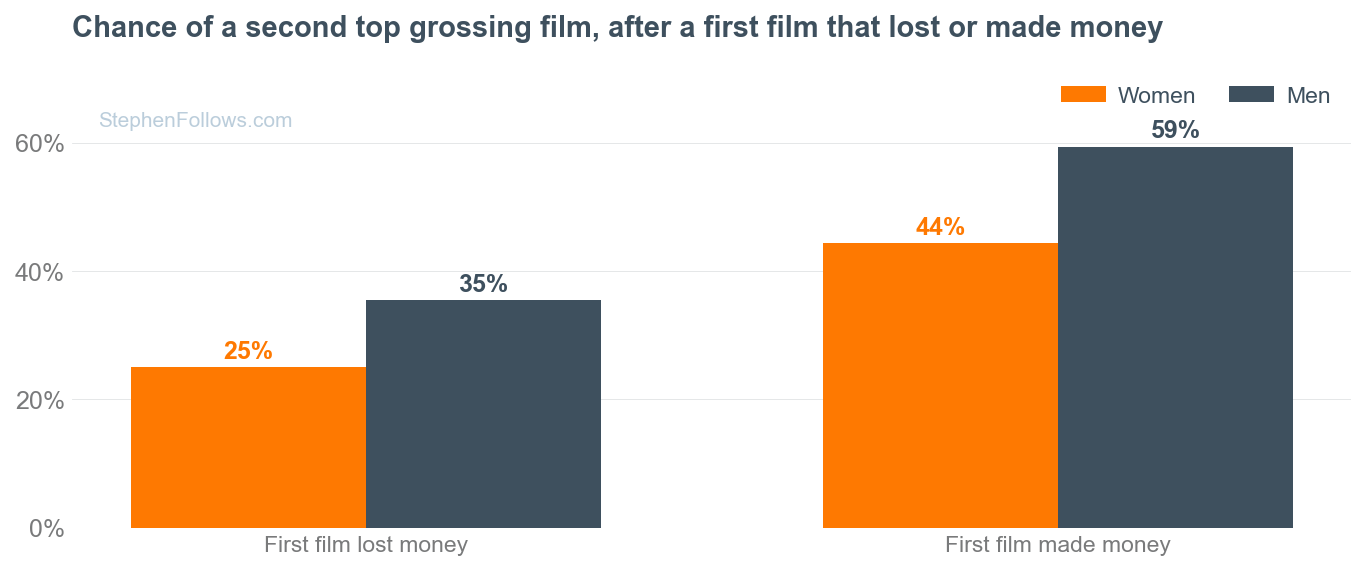
The sharpest version of this is what happens when a first film loses money.
When a director’s debut lost money at the US box office, the men still returned to the top 100 at 35%, versus just 25% for the women. When the first film made money, the men returned at 59%, the women at 44%.
A man is forgiven for a first film that underperforms. A woman, by and large, is not.
This is not unique to film. Economists have long found the same forgiveness gap in other high-pressure jobs. Female surgeons lose far more referrals than male surgeons after a patient dies, female financial advisers are more likely to be sacked and less likely to be rehired after misconduct, and women whose start-up fails are markedly less likely than their male co-founders to get funded again. Psychologists have a name for the underlying habit: a man’s failure tends to be read as bad luck, a woman’s as a lack of ability.
This is not news to the people at the coalface. Actor and director Eva Longoria put it like this in 2023:
The problem is if this movie fails, people go, ‘Oh Latino stories don’t work…female directors really don’t cut it.’ We don’t get a lot of at-bats. A white male can direct a $200 million film, fail and get another one. That’s the problem. I get one at-bat, one chance, work twice as hard, twice as fast, twice as cheap.
But did the women just step back?
Another suggestion, following the previous article, was that female directors may be stepping back from directing due to family commitments.
Directing a huge film is brutal on your private life, no matter your age, gender or support network, with 14+ hour days for the best part of two years. If anything, the economics would predict that women would bear the brunt of this. Claudia Goldin won a Nobel prize for showing that jobs which reward long, inflexible, always-on hours push out whoever carries the caregiving load, usually mothers.
Directing a tentpole is about as greedy a job as it gets, which makes what the data show all the more surprising. So do these demands lead to more women choosing to step back than men?
The data says no.
If women were leaving in their late thirties to raise children, you would see a bump in the ages at which they stop directing. As the chart below clearly shows, there is no baby bump.
The two curves sit almost on top of each other, and both peak around 60. Women who eventually stop directing make their last film at a median age of 61, the men at 60.
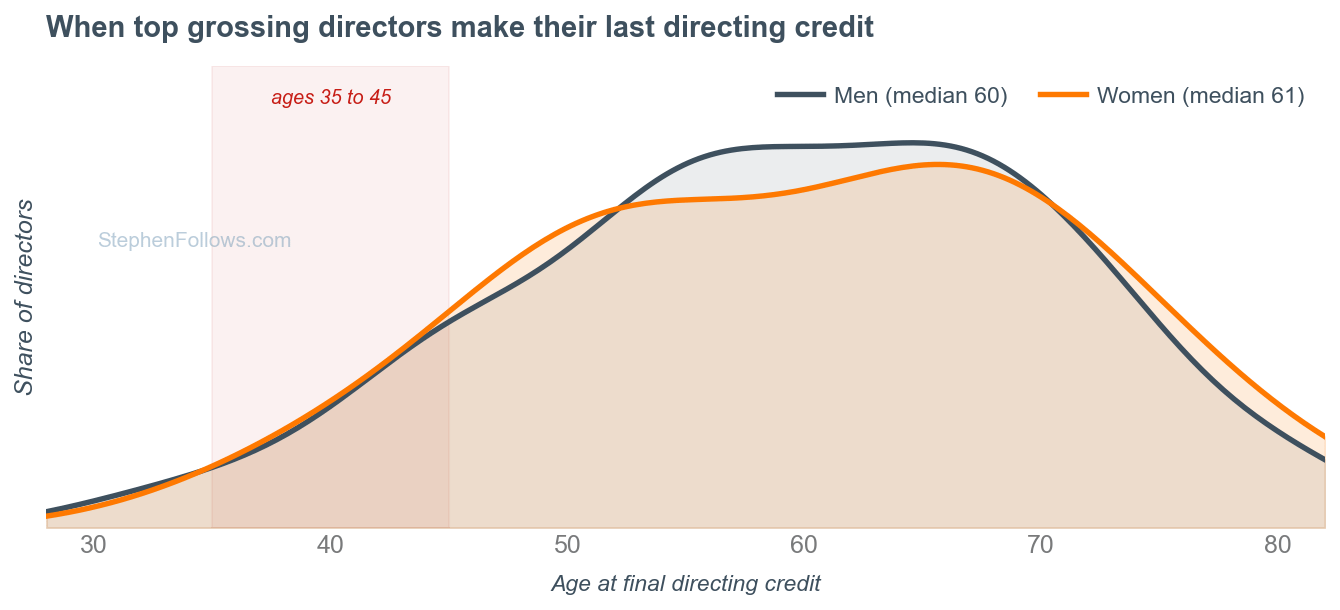
Only about one in ten of either gender makes their last film between 35 and 45. If anything, the women keep going a little longer, with directing careers that run about three years more than the men’s after their first big film.
The second convincing piece of evidence debunking the ‘women chose to leave’ myth is that the women who don’t get that second top-grossing film have not, for the most part, left directing altogether.
Among directors who never returned to the top 100, the women carried on directing other things, smaller films, television, shorts, at almost exactly the same rate as the men (86% against 88%). They actually directed slightly more of them.
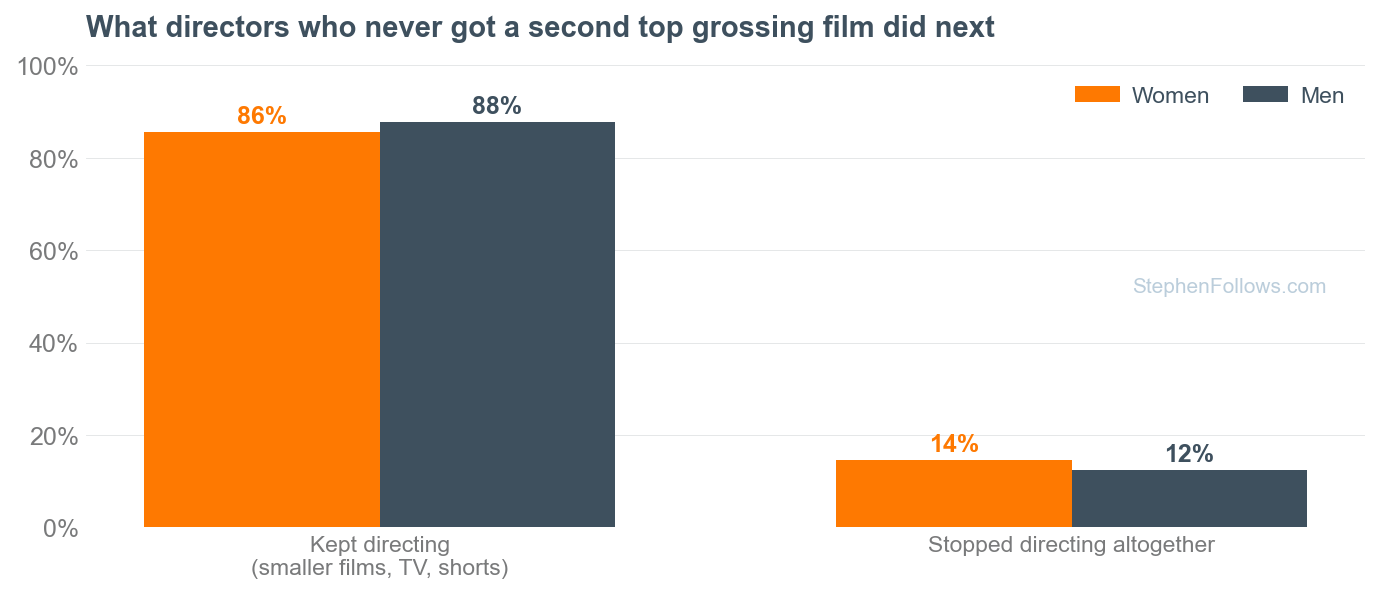
USC Annenberg reached the same conclusion when they asked the people who actually hire directors. In their interviews, work and family balance ranked well below gendered financing and male-dominated networks as the reasons women were missing.
The female directors did not stop directing, but the industry stopped offering them big jobs.
This fits something I found a decade ago in a study I conducted for Directors UK, that women were less likely to be handed a second, third or fourth film even after directing their first.
Epilogue
This is all rather depressing, but in the pursuit of finding an encouraging angle to end on, I will note that this is a narrow problem, and a fixable one.
The entrance is already roughly fair, and the evidence shows that women lack neither talent (their films score no worse with critics), ambition (in one study, 44% of female directors said they wanted to make big-budget films, even as most doubted they would get the chance), drive, nor staying power.
The thing that would move the numbers most is unglamorous and entirely within the industry's gift. Let women fail like men, and hire them back anyway.
Notes
For today’s research, I defined a “top-grossing film” as one of the 100 highest-grossing releases at the US box office in its initial year. A “top-grossing director” is anyone who directed a film that grossed over $100 million, and a “first-time” top-grossing director is one who reaches that group for the first time. Co-directors are each counted. My study covers first appearances from 1980 to 2025, 1,765 directors in all. This top-100 framing follows the USC Annenberg Inclusion Initiative’s annual analysis of the director’s chair, which I rebuilt to track each director’s career.
Box office data came from The Numbers, Box Office Mojo, and Wikipedia. Directors, prior roles, release years and dates of birth are from Wikidata, OMDb, IMDb, The Numbers, Opus and other data sources.
The headline second-film figures (40% of women and 53% of men) and all the splits below use directors who reached the top 100 by 2018, so everyone has had at least seven years to make another film. That is 1,399 directors.
A director is considered to have stopped directing if their last credited directing work, of any kind, was in 2021 or earlier. For the age analysis, I used directors who arrived by 2015 and have a recorded birth year. The “kept directing” figure counts any directing credit for a film, short, or television programme after the first top-grossing film, but not any additional top-100 films.
I measured the size of a first film by its US box office rank that year, splitting into the top third (ranks 1 to 33), the middle third (34 to 66), and the lower third (67 to 100). The “below the top tier” figure combines the middle and lower thirds. The female groups in these bands are small (25, 36 and 43 directors), so the individual bars are best read together rather than one at a time. The pattern runs the same way across all of them.
To check that the gap was not just women making smaller first films, I ran a logistic regression of whether a director made a second top-grossing film, against gender, the inflation-adjusted domestic box office of their first film (logged), and the year they arrived. Holding the first film’s size and the era constant, women had about 40% lower odds of a second film (odds ratio 0.60; 95% confidence interval 0.39 to 0.91; statistically significant).
The money-lost-or-made comparison uses the 936 first films for which I had a production budget, comparing the budget to the domestic box office. The group of women whose first film lost money is small (8 directors), so treat that particular pair as indicative rather than precise. The direction matches everything else.
A director’s gender was applied across their whole career, using their present-day identity. This is a very minor point from a purely data perspective, which is why it is in the Notes rather than flagged in the main article. However, I know it will animate some people on either end of a topic where feelings run high.
It’s relevant here as both Wachowskis identify today as transgender women, using the pronouns she/her, but were seen as men when they co-directed their first top 100 film The Matrix in 1999.
I cannot profess to have any special insight into the best way to tackle this. It’s a deep topic that many people feel aggrieved by. I would note that the comments section of this article is hardly the right forum to debate something as big as ‘What is a woman?’ No one is going to solve anything, nor change anyone’s mind.
Whichever perspective you take, this decision accounts for just 1.9% of the directing credits for the year 1999 and 0.27% of all directing credits I studied.
I genuinely want to hear from everyone in the comments. Feel free to share your thoughts, ask me anything, challenge me, etc. Just be nice to each other. I won’t delete comments I disagree with, but I will remove nasty ones.
I was at dinner with a VP from one of the Big Five Studios a few years ago, and we were talking about this reality. If a movie flops, for a woman it's seen as evidence she doesn't have what it takes as a director. For a man, he's still seen as having potential, and the failure is viewed as circumstantial. I think if you ran the numbers, you'd see the same thing for female showrunners on the TV side
Nice work! I keep drafting responses that get longer and longer so I’ll turn it into a post I think. Very interesting but the response is too specific and big and still evolving too much for a comment! It’s been holding my attention in a unique way. The contrarian in me I guess.