


I have received a few questions from readers about the path to becoming a top movie director, prompted by a recent Substack post entitled “The Annenberg Ouroboros” by Hollywood Gadfly.
The article critiques the work of the USC Annenberg Inclusion Initiative, which studies the gender of top-grossing directors, the festival circuit, animation, visual effects, and more. Hollywood Gadfly raised several objections to their work and methodology, including whether it is fair to treat the gap between the share of women directing at Sundance and the share directing top-grossing films as evidence of a broken pipeline.
The chart below is one such example of how Annenberg makes the case, highlighting the Sundance figure at 63.6% (in 2026) and the top-grossing directors at just 6.6% (2007-25).
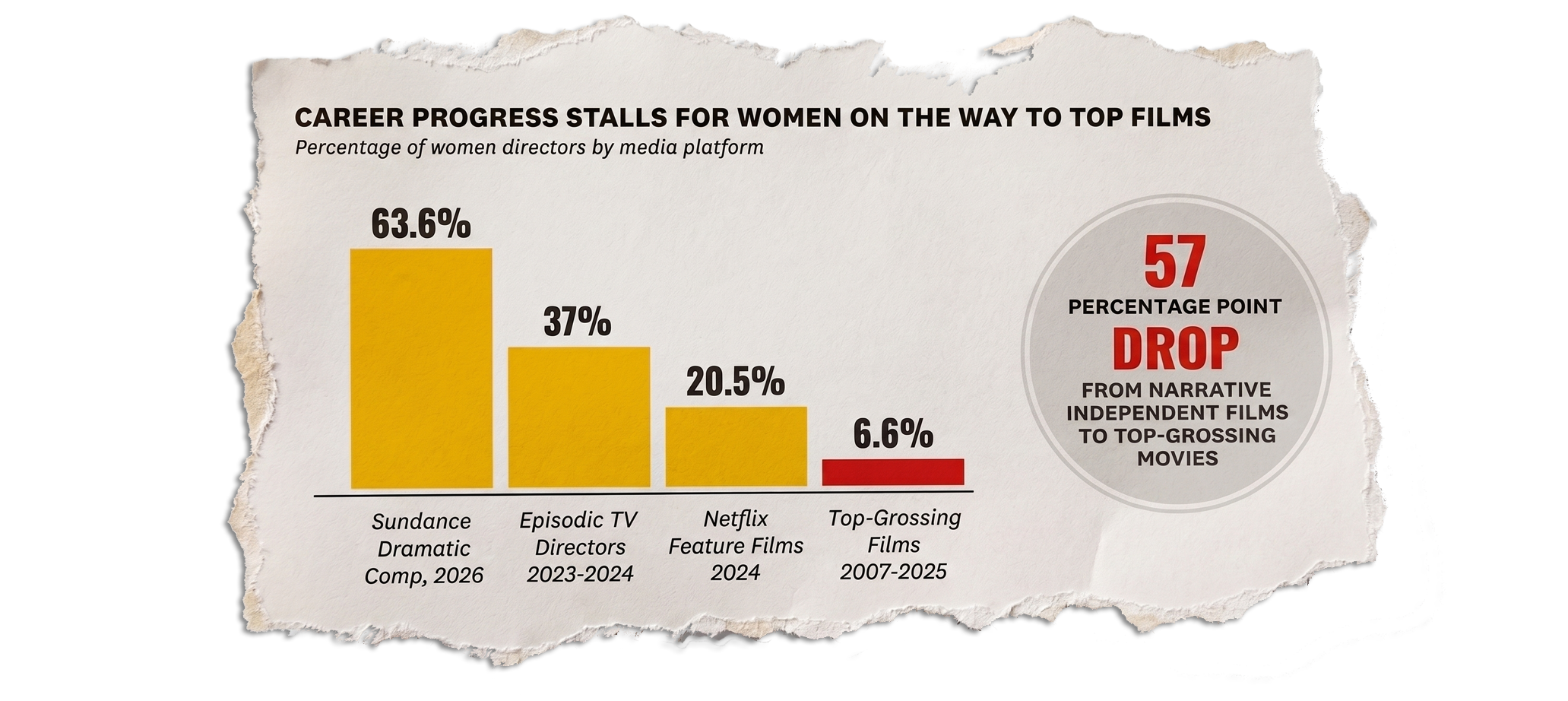
Leaving aside that these figures cover very different periods, this raises the question:
Is there a pipeline from being selected in the US Dramatic Competition at Sundance to top flight directing?
I studied the career paths of 1,765 directors, all of whom have directed a top-grossing movie since 1980. I looked at the professional work they had done before they directed a movie that appeared on the ‘top 100 US-grossing’ chart that year. More detailed information about my methodology is at the end of the article.
Incidentally, if this is a topic you’re interested in, you may enjoy the research I completed last year on the related questions: What percentage of top film directors went to film school? and Are directors who went to film school more successful than those who didn’t?
Where do directors come from?
I narrowed in on each director’s first appearance in the annual top 100 grossing films at the US box office.
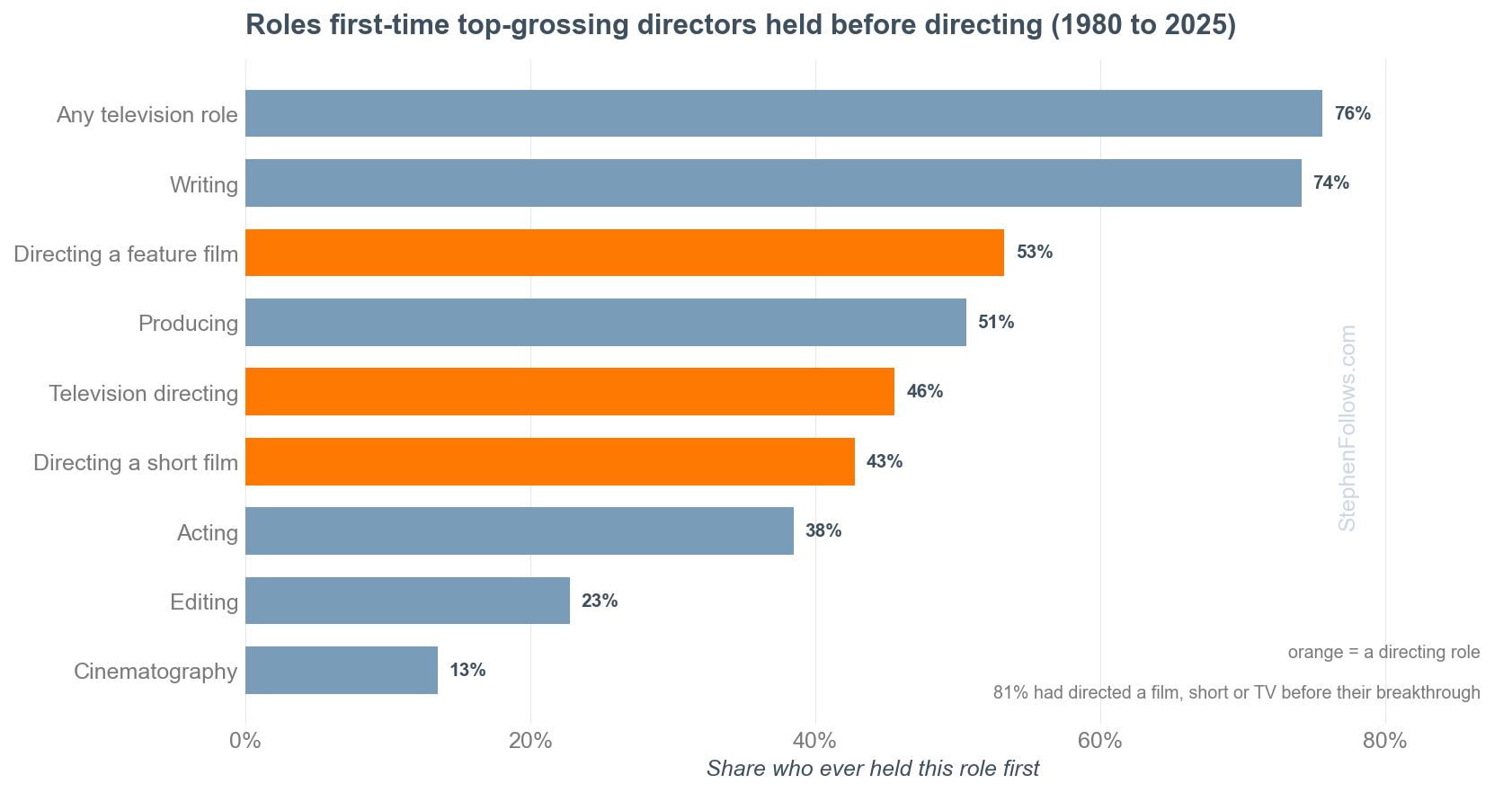
I looked at their past work, tagging it with several types of activity, which also means that one person could have multiple tags, since a few people just stick to one thing.
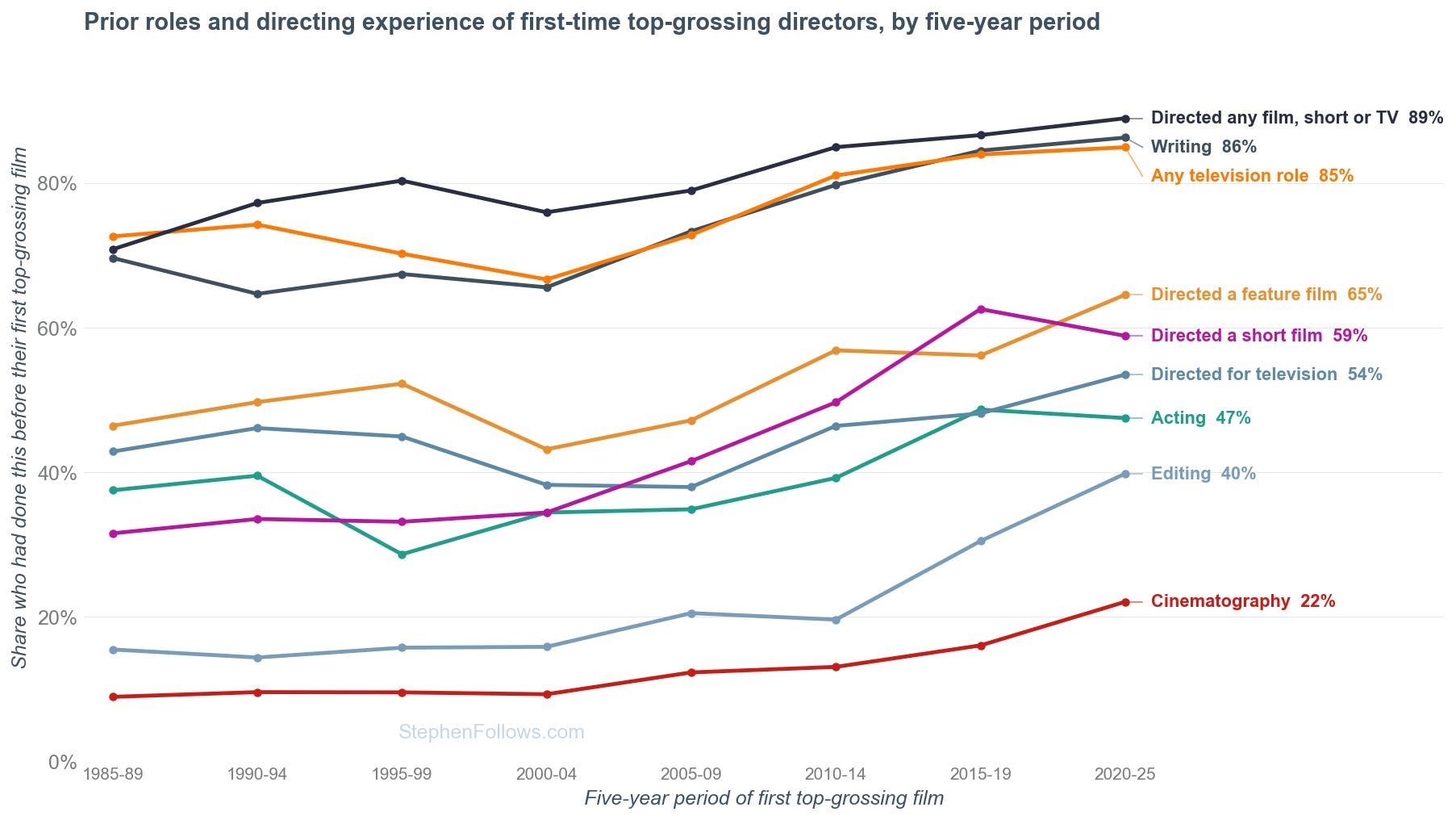
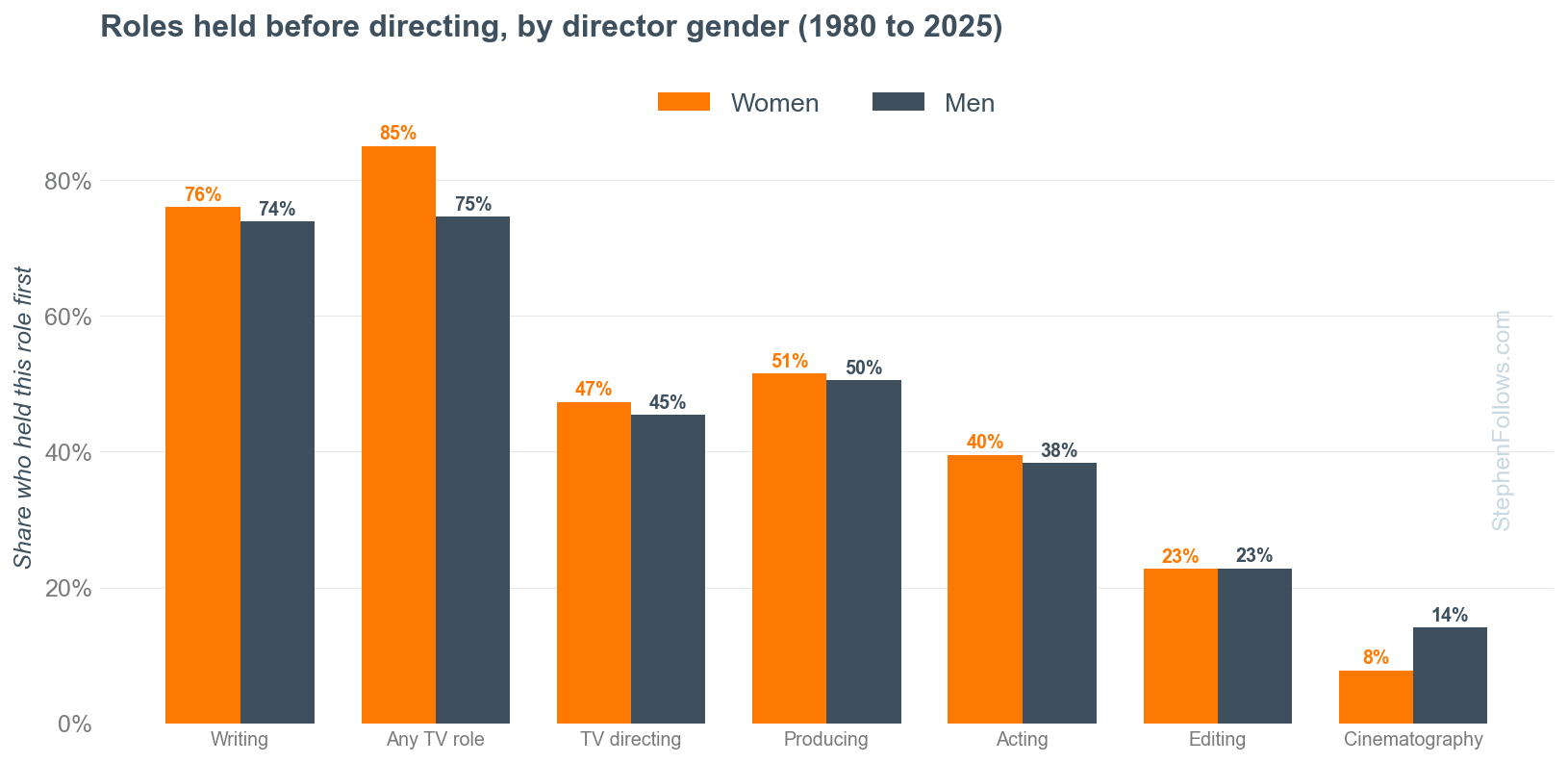
Three-quarters of them had worked in television prior to making their first top-grossing movie. Almost the same number had been credited as writers on a TV show or movie, and just over half had directed a feature film that was not one of the 100 highest-grossing movies in the year it came out.
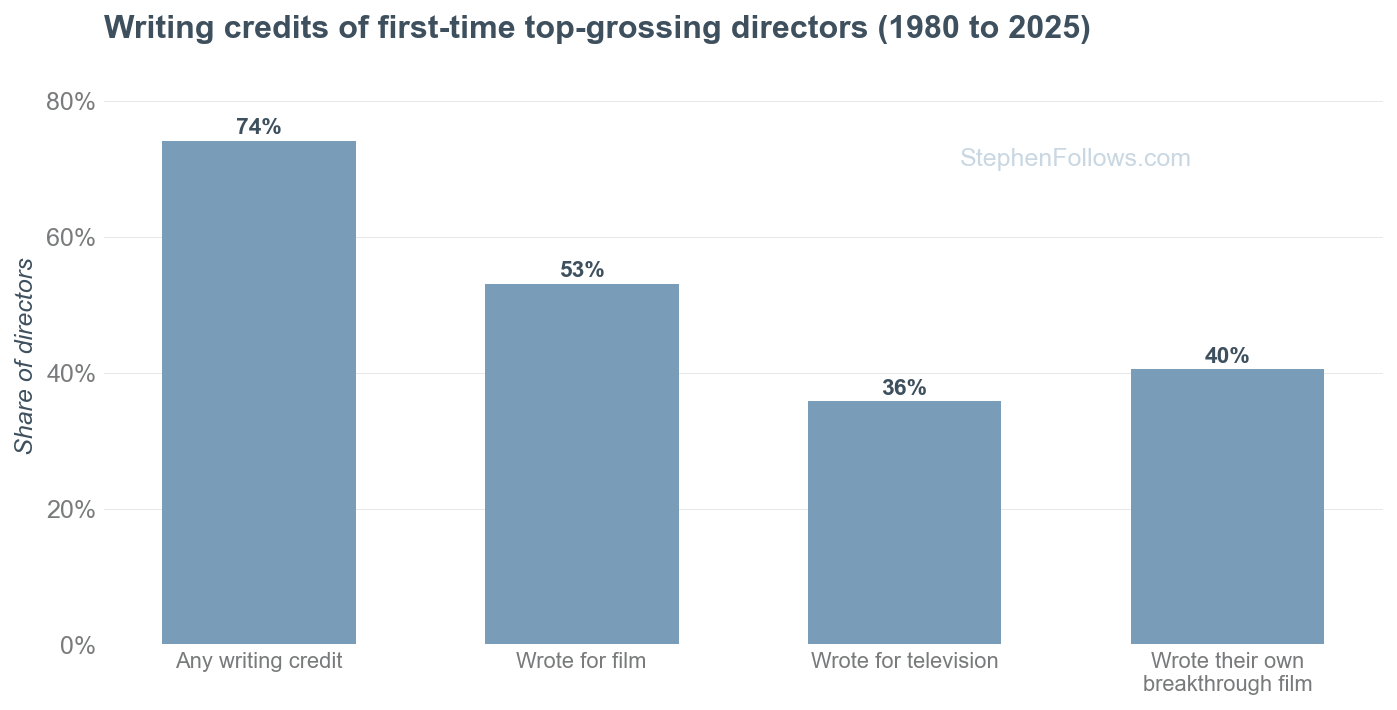
Given how big writing is, I thought I’d split that out. Writing movie screenplays was the biggest type of writing gig that top-grossing directors did before reaching the top 100.
So does the Sundance discovery pipeline hold up?
The core idea is that people who go on to become top directors are discovered on the festival circuit. Specifically, being in the dramatic competition at Sundance is a meaningful springboard to a studio career.
I tracked eighteen of the discovery markers - the competition strands at Sundance, Cannes, Berlin, Venice, Toronto, SXSW and Tribeca, the first-feature and new-director awards, and the celebrated short-film prizes, and I followed every director who hit each one forward to see how many later directed a top-grossing film.

16% of directors nominated at the Spirit Best First Feature award went on to top-grossing status. That’s slightly above Sundance (14%), an Oscar nomination for best animated short (11%), and the Discovery strand at TIFF (8%).
On the chart below, I have put most festivals in blue but highlighted the main competitions at Cannes, Berlin, and Venice in orange, as one could argue these are not really seen as ‘discovery’ competitions.
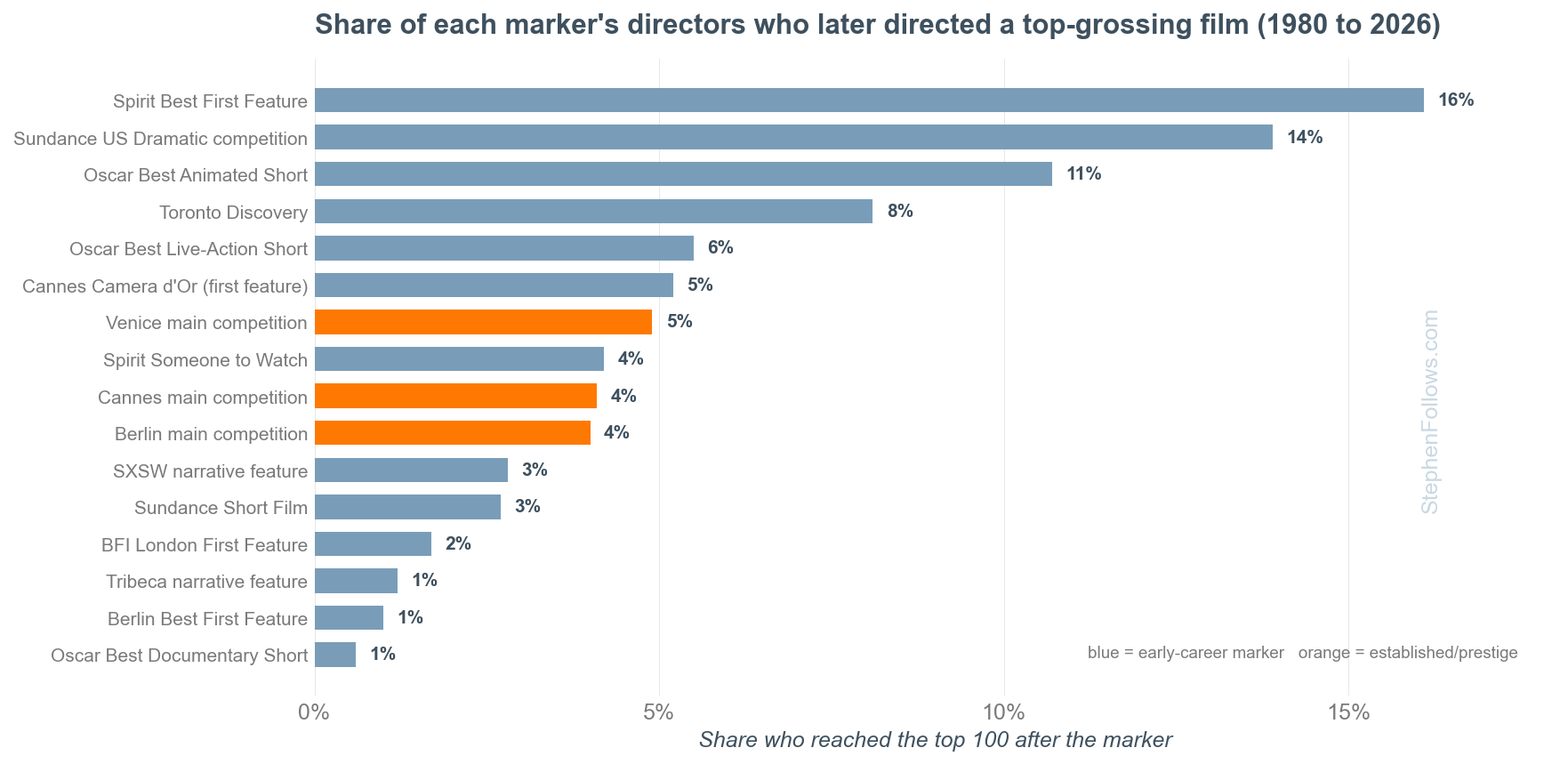
So Sundance is the second-best choice for comparison, but that’s from within a batch of pretty weak signals.
If you present a pipeline that is just “Sundance to top-grossing”, then you would be looking at a small minority of the people who actually make it, while the meaningful markers are having worked in writing and television.
What is the churn rate for top directors?
Another thing to consider when assessing the efficacy of using a pipeline model is the churn rate. i.e., how many people each year get to direct a top-grossing film for the first time.
Interestingly, this has been fairly static for three decades, but then it has started to rise in the past ten years. Until the mid 2010, around a third of directors of top-grossing films had not previously had a title in the top 100.
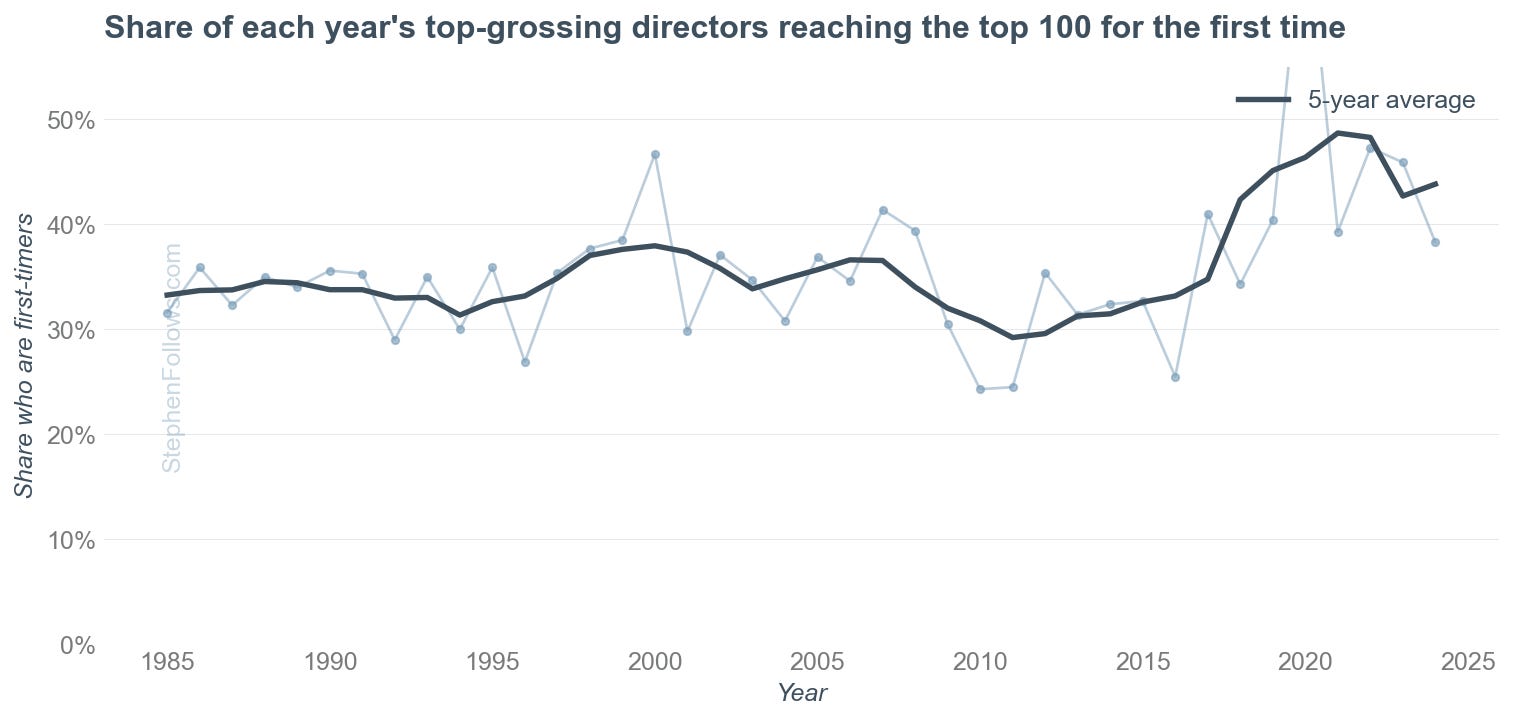
2020 was a freak year, thanks to Covid, in which 71% of directors in the ‘Top 100 Club’ were new (77 of 109 directors). This is affecting the five-year rolling average, but that’s not the sole cause of the recent rise. There was also a real, sustained step-up beginning around 2016, from a long-run norm near 33% to a new normal around 40% to 45%
The feeders themselves have shifted, too. Writing and television have always led, and both have grown more common among recent arrivals, with editing and acting rising alongside them.
Some of this is down to careers becoming more multi-stranded, and it’s possible that some of it reflects the fact that recent careers are simply better documented than those that began in the 1980s. Either way, the ordering is steady throughout, with writing and television on top the whole time.
Earlier this month, I wrote about how the average age of directors has risen a lot in recent years, so you may want to check out that article for context, too.
Do the routes treat women and men the same?
Now that we have a more detailed and nuanced picture of how people become top-grossing directors, we can split the cohorts by gender and assess the extent to which gender is a factor.
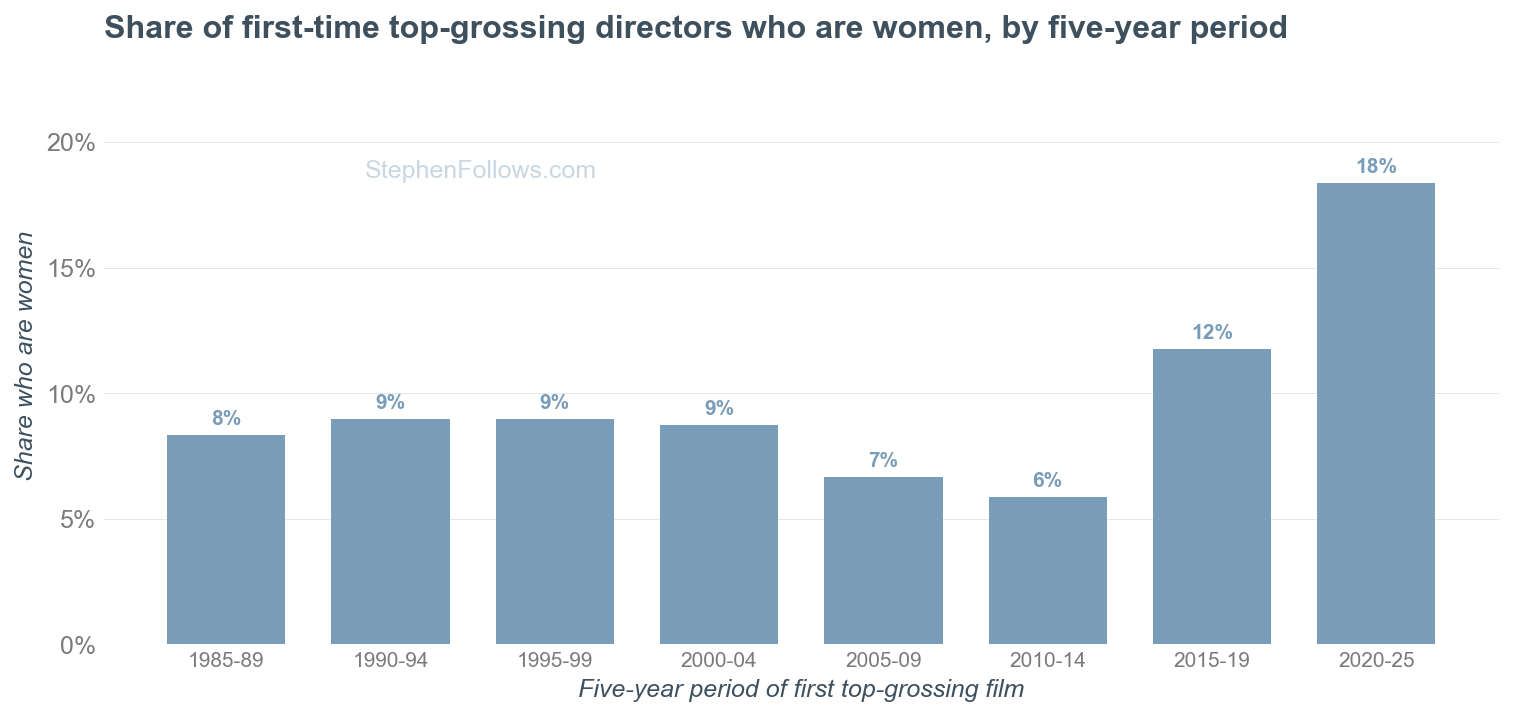
Let’s start with how many women reach the top 100 at all. The share is a long, uneven story rather than a steady climb. Women were close to one in ten of new top-grossing directors in the early 1990s, slipped back through the 2000s, and only in the 2020s reached around 18%.
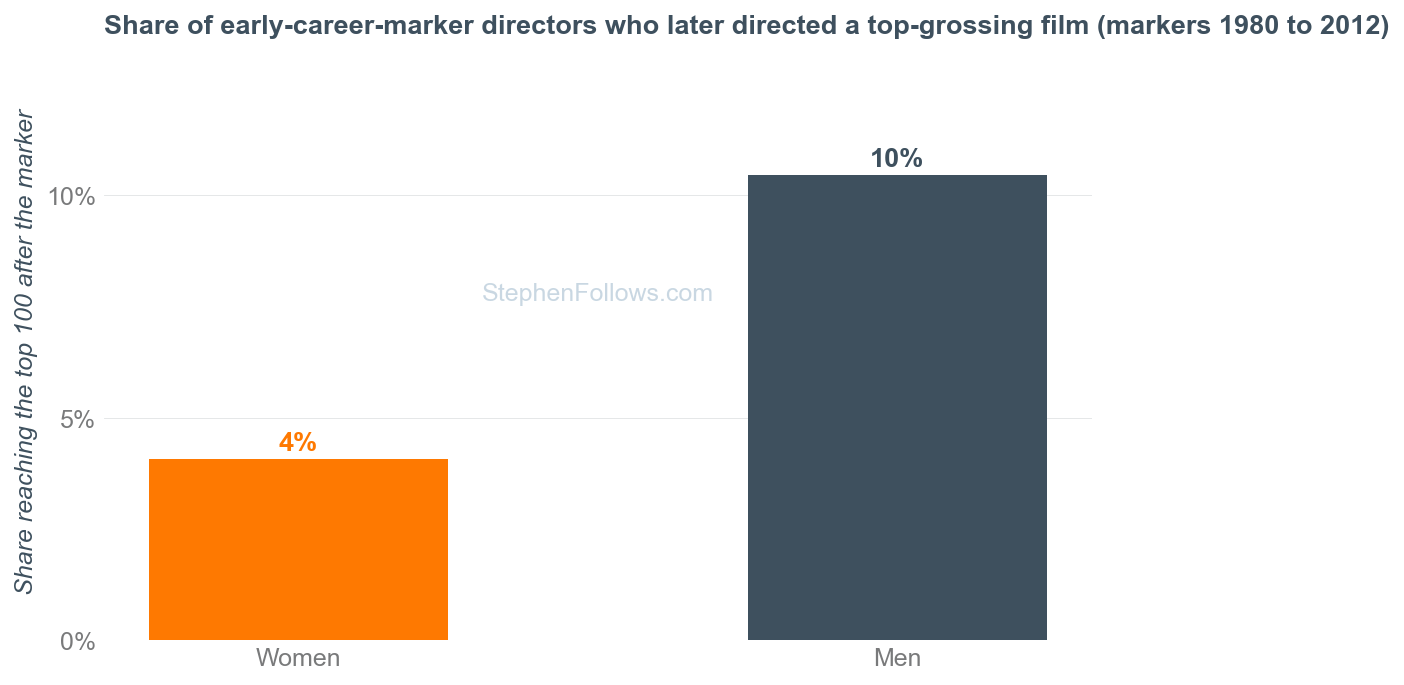
I pooled all the early-career routes, festival competitions, first-feature awards, and short-film prizes and followed only those who had attained them by 2012, so everyone has had more than a decade to convert.
One in ten male directors from that pool went on to be a top-grossing director, compared with just 4% of female directors.
On the main feeders, women and men look broadly alike. Both come overwhelmingly from writing and television. If anything, women lean into those two even more than men (85% of women had worked in television first, against 75% of men).
The biggest skew towards men was among cinematographers stepping up to directing, which was a small route in and picking from a field that has historically been massively male.
The festival discovery route is where we see a big difference in outcomes. Men out-convert women at the Sundance dramatic competition, at Cannes, at Venice, at Toronto's discovery strand, and at the Oscar short categories.
The direction is the same almost everywhere, and it holds across four decades, so it is not a matter of women having arrived too recently to have converted yet.
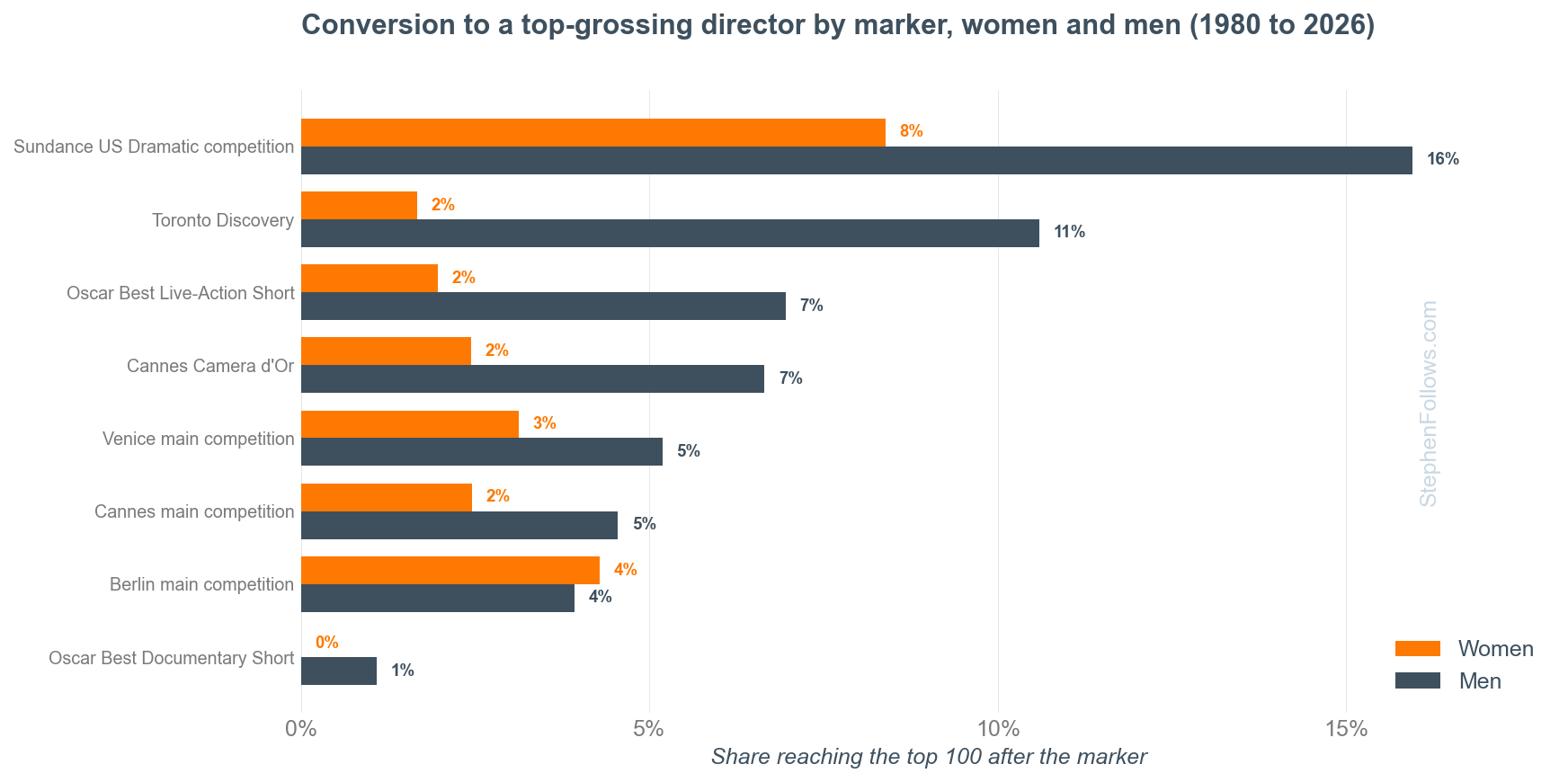
The women who do come through these routes are exactly the names you would expect - the directors who went on to make some of the most admired films of recent years. So the route does work for some women. It simply works for a far smaller share of them than of the men who start in the same place.
The other biggest difference between the genders is getting a second crack at the big director’s chair. Reaching the top 100 once is hard for everybody, and most directors never do it twice. But the rate at which they get a second turn differs.
Among directors who arrived by 2018, with plenty of time to make another film, 53% of the men went on to a second top-grossing film. For women, the figure is 40%.
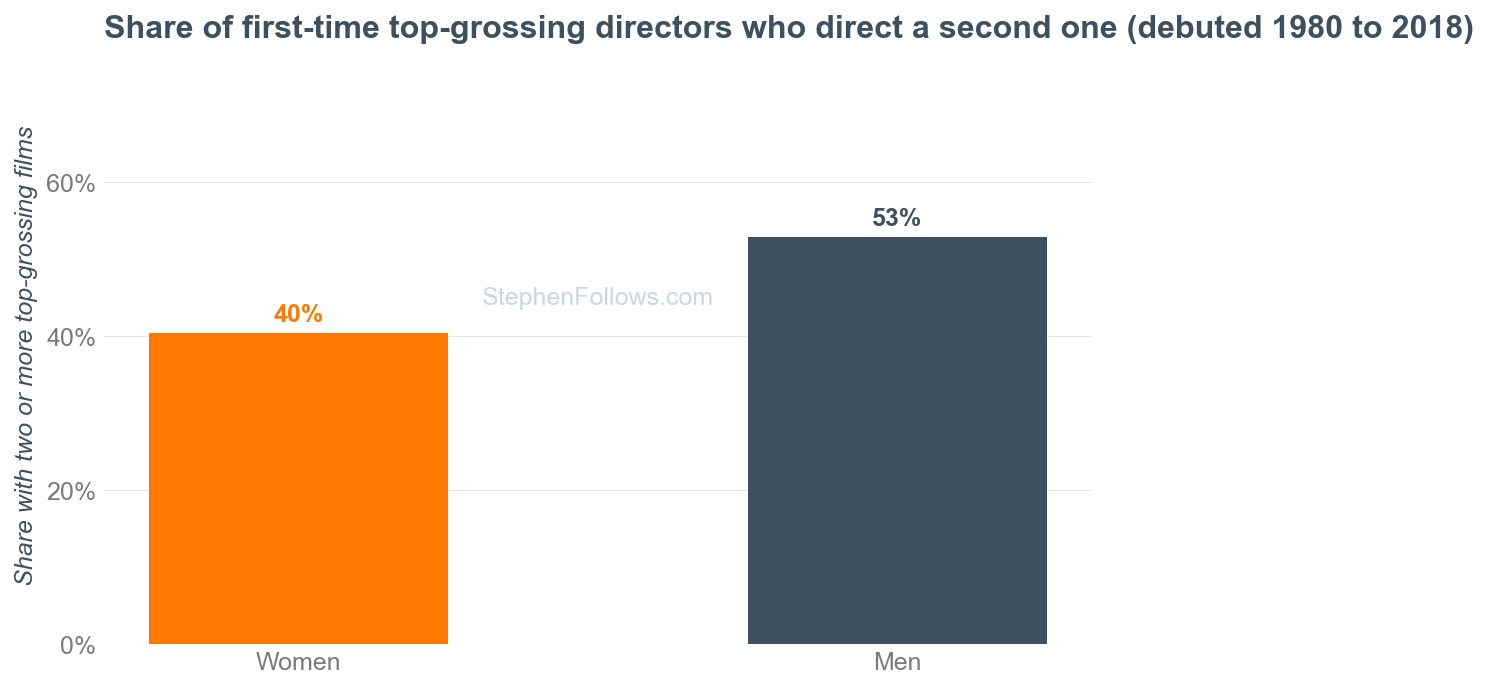
Over a whole career, men in this group average about 2.8 top-grossing films each, women just 1.9.

What does all this tell us about directing careers?
We’ve gone through a lot in this article, so I thought I’d put a handy list of things we’ve learned along the way:
Getting the job as a director on a movie that ends up in the top 100 highest-grossing movies of its year most commonly comes to men in their early forties, after years of other work.
Women and men enter the top 100 through the same main doors, those of writing and television.
A third of the seats turn over each year, while a stable group of returning names holds the rest.
The festival and award routes contribute a real but minor share, and none of them comes close to being the pipeline.
The gap between genders emerges at the discovery routes, which carry men through at more than twice the rate, and after the first film, where men are markedly more likely to get a second.
Some directors do go from being in the official selection at Sundance to becoming a top-level director, but not many. It’s one of the biggest routes within the festival discovery framing, but a poor one overall.
Notes
I’m very grateful to both the pseudonymous Hollywood Gadfly and to Dr Katherine Pieper, Program Director of the Annenberg Inclusion Initiative, both of whom generously talked this through with me over Zoom.
For today’s research, I counted a “top-grossing film” as one of the 100 highest-grossing releases at the US box office in its initial year of release. A “top-grossing director” is anyone who directed such a film, and a “first-time” top-grossing director is one reaching that group for the first time. Co-directors are each counted. My study covers first appearances from 1980 to 2025, 1,765 directors in all. This top-100 framing follows the USC Annenberg Inclusion Initiative’s annual analysis of the director’s chair, which I rebuilt in order to follow each director’s career forwards.
Box office data came from The Numbers, Box Office Mojo, and Wikipedia. Directors, prior roles, release years and dates of birth are from Wikidata, OMDb, IMDb, The Numbers, Opus and other data sources. The festival and award records, including the dramatic competitions and first-feature and short-film prizes, are from my awards database covering 1978 to 2026; for each route I took the directors of every film in it, not only the prize winners.
When I mention film in competition at Sundance in today’s piece, I am specifically referring to films in the Sundance US Dramatic Competition. Sundance has a number of selections beyond this.
A minor footnote on the Sundance figures is whether the festival film itself reaches the top 100, or if the director gets there later with a subsequent film. It is almost always the latter, with only about one in seven cracking the top 100 with the film they premiered at Sundance. That share is inflated thanks to the strange pandemic years, when the box-office bar fell low enough for small Sundance titles like Minari and Zola to slip in.
For each route, a director “converts” if they directed a top-grossing film after the route year, so the route plausibly preceded rather than followed their establishment. Measuring it at any time gives higher figures for the main competitions, because established directors keep playing them, which is why the directional measure is used and those routes are flagged. Eighteen routes were tested in all; the gender comparison for them is shown for people who reached the route by 2012, with thirteen or more years to convert, and the gap holds in that long-runway pool (women 4%, men 10%). Per-route female counts are small for some routes, so the pooled figure is the reliable one.
Prior roles come from credited work, so uncredited jobs, foreign-language work and very early-career roles can be under-recorded, and this is more true the further back you go. Recent arrivals show more prior credits of every kind than those from the 1980s, which is partly a real change and partly better record-keeping, so the prior-role shares are best read as a floor, especially for older directors, while the relative ordering, with writing and television on top, is more reliable than any single figure.
A director’s gender was applied across their whole career, using their present-day identity. This is a very minor point from a purely data perspective, which is why it is in the Notes rather than flagged in the main article. However, I know it will animate some people on either end of a topic where feelings run high.
It’s relevant here as both Wachowskis identify today as transgender women, using the pronouns she/her, but were seen as men when they co-directed their first top 100 film The Matrix in 1999.
I cannot profess to have any special insight into the best way to tackle this. It’s a deep topic that many people feel aggrieved by. I would note that the comments section of this article is hardly the right forum to debate something as big as ‘What is a woman?’ No one is going to solve anything, nor change anyone’s mind.
Whichever perspective you take, this decision accounts for just 1.9% of the directing credits for the year 1999 and 0.27% of all directing credits I studied.
I genuinely want to hear from everyone in the comments. Feel free to share your thoughts, ask me anything, challenge me, etc. Just be nice to each other. I won’t delete comments I disagree with, but I will remove nasty ones.
Further reading
If you would like to read more about the statistics behind gender in film, then you may enjoy the following: (ok, bad choice of words - you may wish to read the following):
A major new study into gender inequality in the UK film industry (2016)
Major new study into gender inequality among UK film and TV writers (2018)
Are movies dominated by a small number of old male composers? (2018)
Are women less likely to direct a second movie than men? (2019)
How well are women represented among short filmmakers? (2020)
What percentage of movies are written by women over 40? (2024)
Is Jason Blum right that there is a shortage of female horror directors? (2025)
How do women fare in gender-neutral Oscar categories? (2025)
So recognizing that Sundance Competition is not the Top Grossing Pipeline, and that writing for television is more applicable, if everything was working for all genders equally what would be the percentage of directors of top grossing films across genders ?
My god Stephen your on here. Feels like an absolute eternity ago - 15 years? Since we met in London for a coffee to talk about I think film funding. How's life?