


A few weeks ago, Digger, starring Tom Cruise and directed by Alejandro G. Iñárritu, took just $8m in the US and Canada during the opening weekend. That was Cruise’s lowest opening since Lions for Lambs twenty years ago.
By Sunday, Deadline estimated the film’s loss at around $150m. They noted that:
De Luca and Abdy, we hear, ran Digger through their analytical comps system. The combo of Cruise and Iñárritu justified a $125M production greenligiht.
Three weeks before Digger opened, De Luca told an audience at the Toronto International Film Festival what he thought of studio data, as reported by Screen:
The hedge against the unknown is embrace the unknowns; embrace what’s original, because algorithmic bullshit and predictive research and data analytics, which we all use, cannot look backwards [...] Half the time the audience doesn’t know they want it until they see it.
So which is it?
Very few people actually get to see the Studios’ greenlight models, but a decade ago Sony was hacked and many of its internal documents were leaked. Among them were 35 greenlight models, and the accompanying email chains around them,
This is a rare chance to see how things work from the inside, so I set out to understand what they reveal about Hollywood’s greenlight processes.
The main thing I learned was that they’re often wrong (only 7 of the 35 landed within 20% of the figure) and that the people using the model knew full well it wasn’t a reliable system.
Let’s start at the beginning…
What is a greenlight model?
Before a studio agrees to make a film, its finance team builds a ten-year profit-and-loss estimate covering all the money the film will earn (cinemas, home video, pay TV, free TV, etc). Sony called this lifetime estimate the “ultimate”.
The whole thing is based on how much the film will make at the theatrical box office. Ben Fritz described the process in his 2018 book The Big Picture like this:
Such projections are based on comparisons to similar movies with similar budgets released at similar times of the year, and they always include some level of subjectivity. (Is the remake of Ghostbusters most similar to other Melissa McCarthy comedies? To buddy comedies? To generic summer action films? To the first two Ghostbusters films in the 1980s?)
The comps also put a price on the people attached to a film. When Sony was creating their greenlight memo in 2014 for the movie Steve Jobs they ran the same script three ways.
With Christian Bale starring and David Fincher directing, it was worth $75m in the US.
With Leonardo DiCaprio and Danny Boyle it went up to $80m (and $120m overseas).
With Bale and Boyle it fell to $60m.
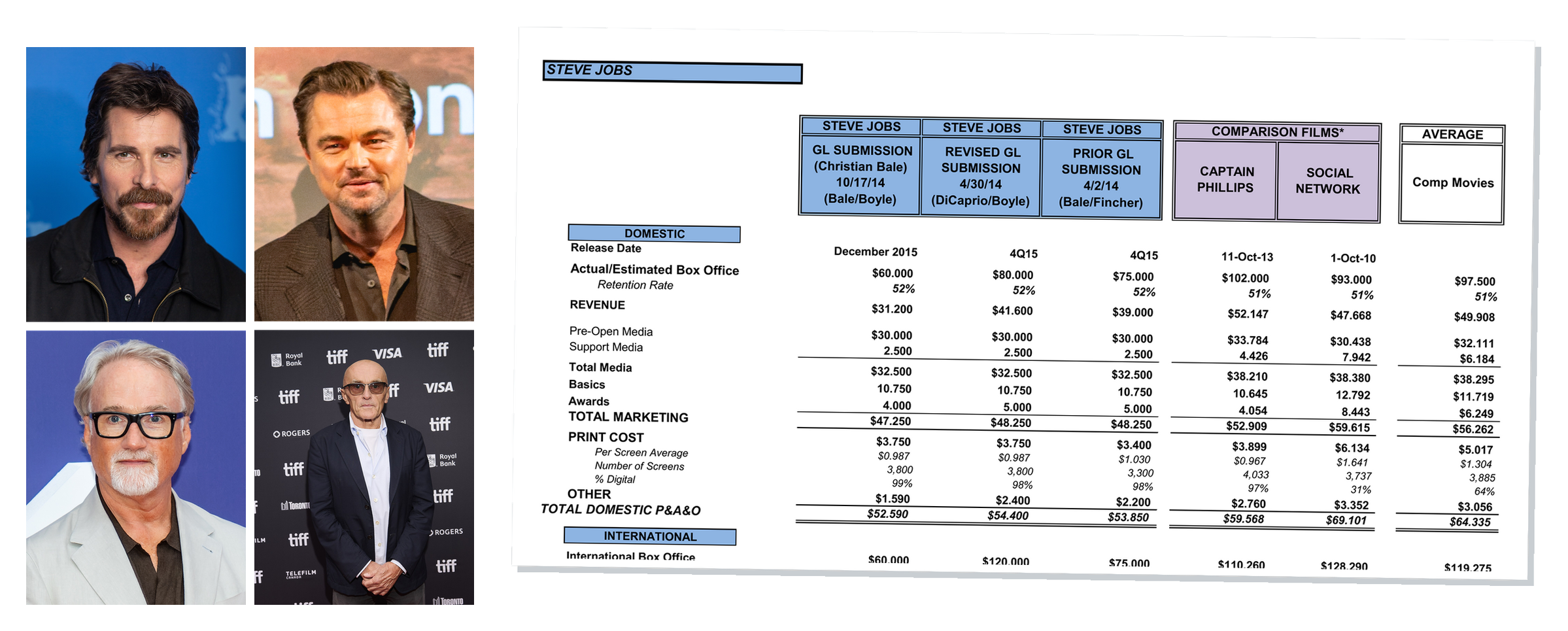
So when we think about what might have happened in the greenlighting of Digger, we can see the “Cruise plus Iñárritu equals $125m” logic at play. The world’s biggest movie star directed by one of only three directors to ever have won the Academy Award for Best Director two years in a row (Birdman in 2014, and The Revenant the year after).
With the projected income in place, the films’ profitability hurdle is calculated, which Sony called the “return threshold”. In April 2014 Andrew Gumpert, who ran business affairs at Columbia Pictures, explained to Sony’s film chair, Amy Pascal, how that year’s hurdle was set:
... 58% is the exact math. 610m slate profit target divided by 1.057.6B of budgeted production spend....
In other words, for every dollar Sony spent making films that year, it wanted $0.58 back in profit. A film whose model showed less than that failed the test on paper, no matter how much people liked the script.
How close did Sony’s greenlight figures get?
After reviewing the Sony files, I found that films came in short of what the greenlight models predicted. 24 of the 35 grossed less than their greenlight figure, and the median film took 74%. Added together, the 35 films were greenlit on $2.95bn and took $2.39bn.
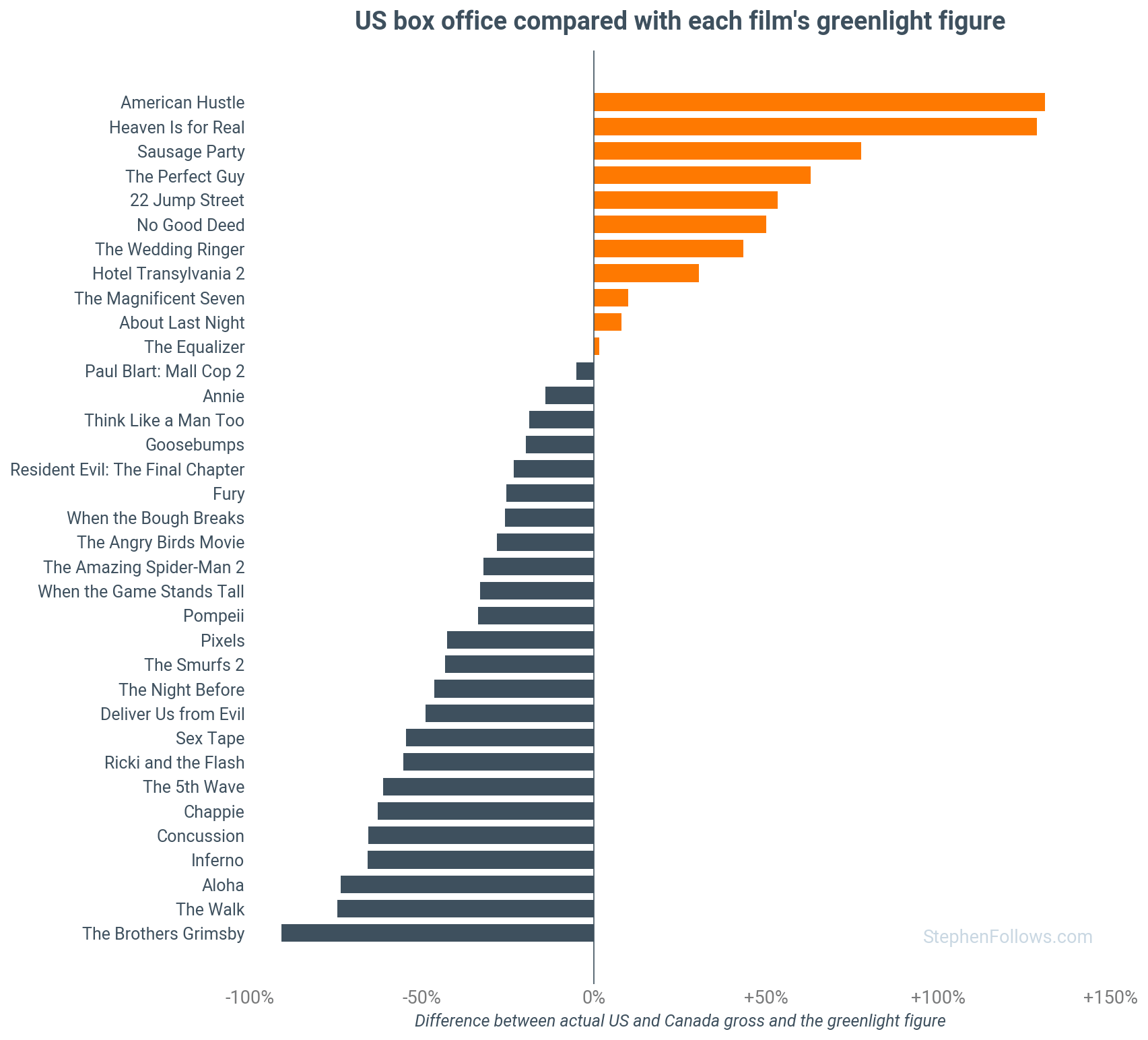
The typical miss, in either direction, was 43% of the greenlight figure. For comparison, when I looked at the opening-weekend forecasts the trade press publishes shortly before release, the typical miss was about 20%. A greenlight number is set a year or two earlier, with no trailer, no test screening and often no finished cast, so it is a much harder call.
But the bigger problem is how far they missed in both directions. Only seven landed within 20% of their figure, and only four within 10%. Nine took less than half (The Brothers Grimsby was greenlit on $75m and took $6.9m). Six beat their figure by more than 50% (American Hustle was greenlit on $65m and took $150m).

The misses also depended on size. Of the ten films greenlit on less than $50m, five fell short, which is a coin toss, but of the 25 greenlit on $50m or more, 19 fell short. The bigger the bet, the more optimistic the number.
Did the films earn what they needed to?
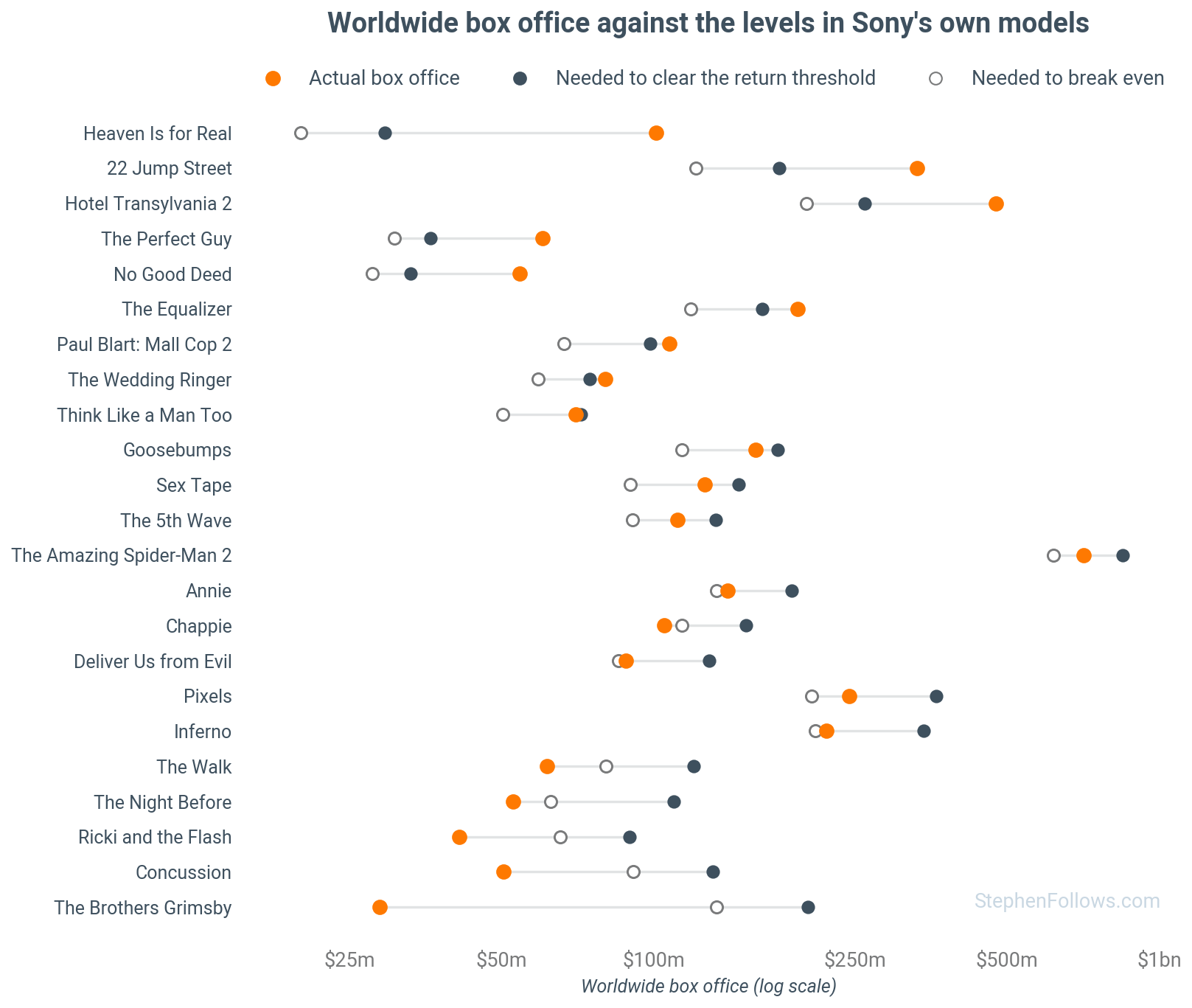
A greenlight figure can miss, and the film can still make money. So the more useful test is whether each film reached the box office total its own model said it needed to break even.
Sony calculated two levels for each film:
The worldwide gross needed to break even.
The gross needed to clear the return threshold.
Of the 25 greenlit films with these levels recorded, eight reached the box office needed to clear the threshold. Eighteen made enough to break even on Sony’s own numbers.
This means that most of these films weren’t disasters - they just didn’t do what they had been approved to do.
We also get a glimpse at the profit they expected. The Amazing Spider-Man 2 was greenlit expecting $123m of profit over its lifetime. By September 2014, with the film forecast to take $695m worldwide, the estimate had fallen to $15m. Sex Tape went from $33m to $2m, and Deliver Us from Evil from $19m to a small loss.
Sony’s finance team knew this. In November 2013 one of its executives, Stefan Litt, sent Pascal an analysis of the films from its 2009 to 2014 financial years, prepared in case investors asked about it:
It compares greenlight estimates to actual results and highlights that while box office has been higher than the GL estimate, the profit is significantly lower.
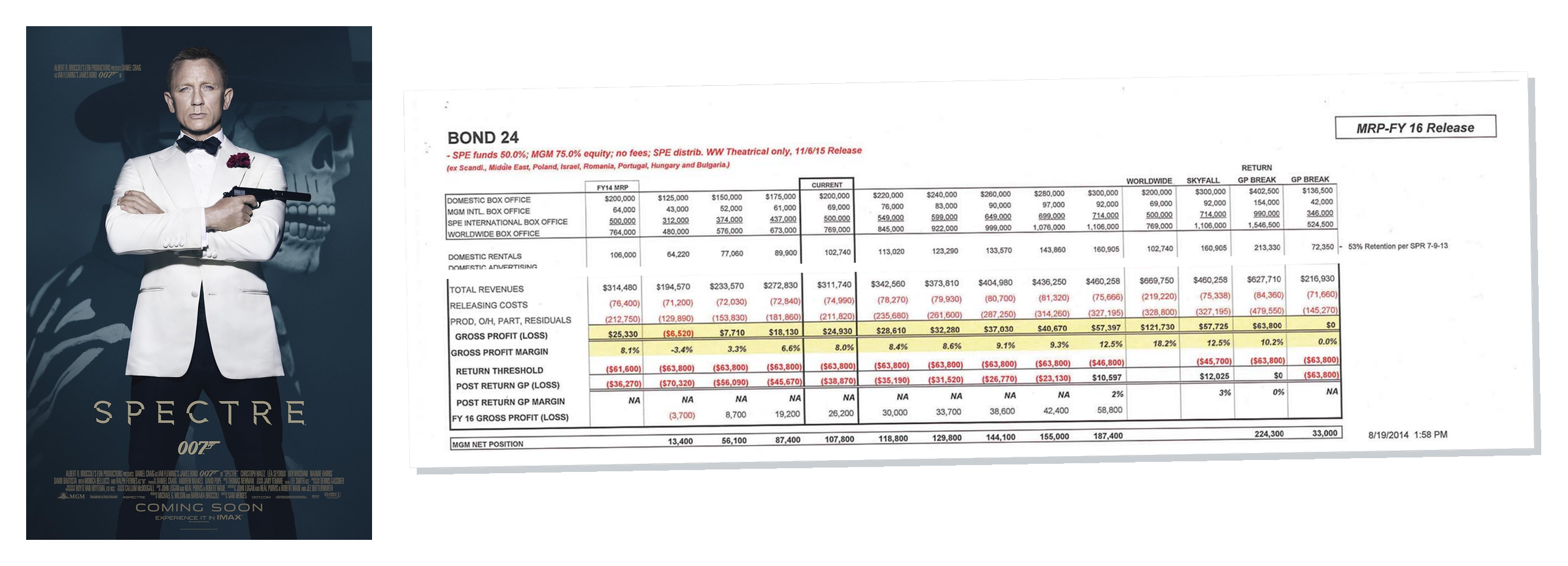
It also mentions the next James Bond film at the time, Spectre. It wasn’t far enough along for a full greenlight model at the point of the hack, but they did say that it needed to gross $1.55bn worldwide to clear the threshold (it took $879m).
Did anyone believe the numbers?
Not really!
Some of the clearest evidence comes from Amy Pascal, in an exchange with Michael De Luca, who had joined Sony as Columbia’s president of production in December 2013. In April 2014 they were going back and forth over whether to commit to a sequel to Pineapple Express, and she spelt out what a greenlight needed:
I can’t make it work as a green light if the numbers don’t pencil out I need to be making money on paper to green light which of course has [nothing] to fucking do with reality Let’s look and see what numbers we need to put in to make it work
In the email, she put “Kolgin”, which I’ve read as a typo for “nothing”.
The sequel was never made because the filmmakers held out for a $50m budget, which De Luca warned killed the model at the $45m Sony had run it at, and by mid-May he told Pascal he couldn’t land it.
The greenlight model has three “gates” a film had to clear.
The first was simply approving films that missed. Gumpert told Pascal in April 2014 that the hurdle for the rest of the year had gone up:
Started the year at 58% and it is now 63% prospectively bc we Greenlit some under roi thereby adding to the load on future use of production dollars.
The second was adjusting the inputs until the film passed. When in December 2013 Sony was bidding against Warner Bros for Get Hard, Gumpert’s note on the financial model shows how small the gap was and how it would be closed:
ROI threshold is 24m and we are 800k UNDER (we make 23.2m) at our target, BUT I know there are likely some revenue and cost tweaks that if we went through the 100% vigorous analysis of the model, we’d certainly find 820k in savings so as to be at the roi target at 100mwwbo..
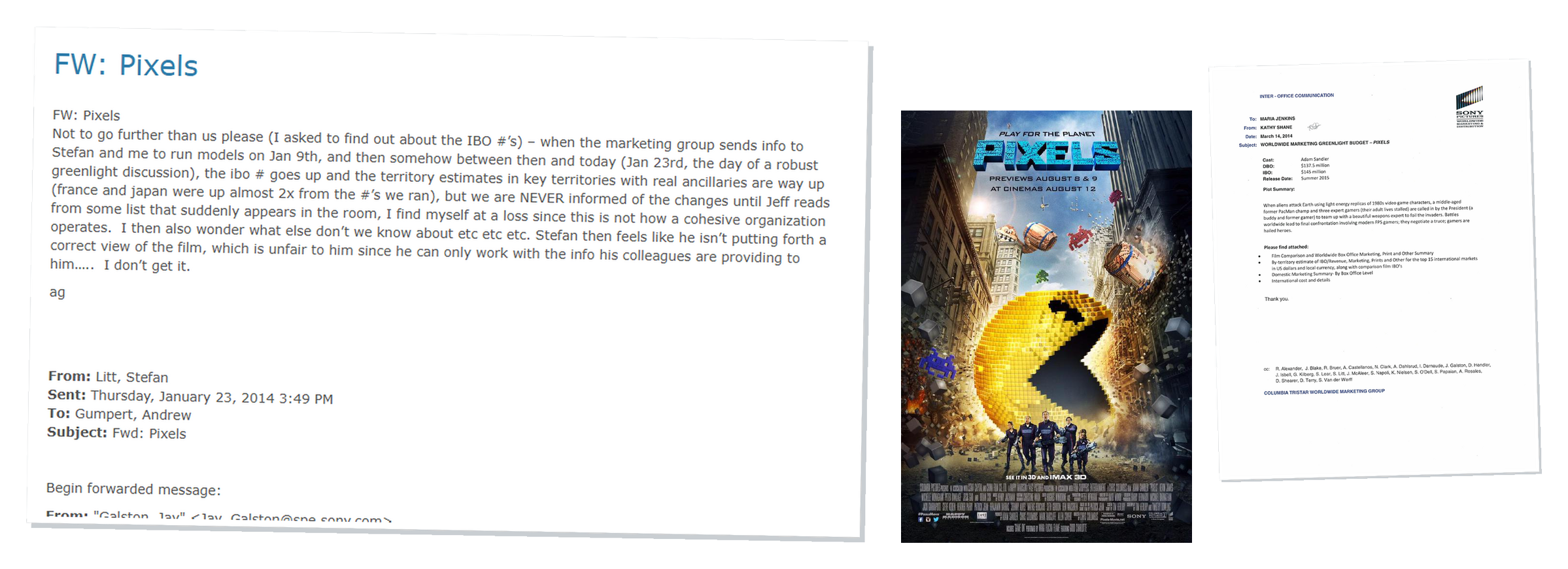
Sometimes the inputs moved without finance being told. After the greenlight meeting for Pixels in January 2014, Gumpert complained to Pascal and Columbia president Doug Belgrad that:
the ibo # goes up and the territory estimates in key territories with real ancillaries are way up (france and japan were up almost 2x from the #’s we ran), but we are NEVER informed of the changes until Jeff reads from some list that suddenly appears in the room
Sometimes nobody had the inputs at all. In September 2014, De Luca explained to Belgrad how the backend payments (i.e. the talent’s share of profits) had been filled in on a model for a Seth Rogen project set in a 1948 jazz club:
Blair actually didn’t know the backends so I plugged in the interview backend and jay made something up for Jamie in the model
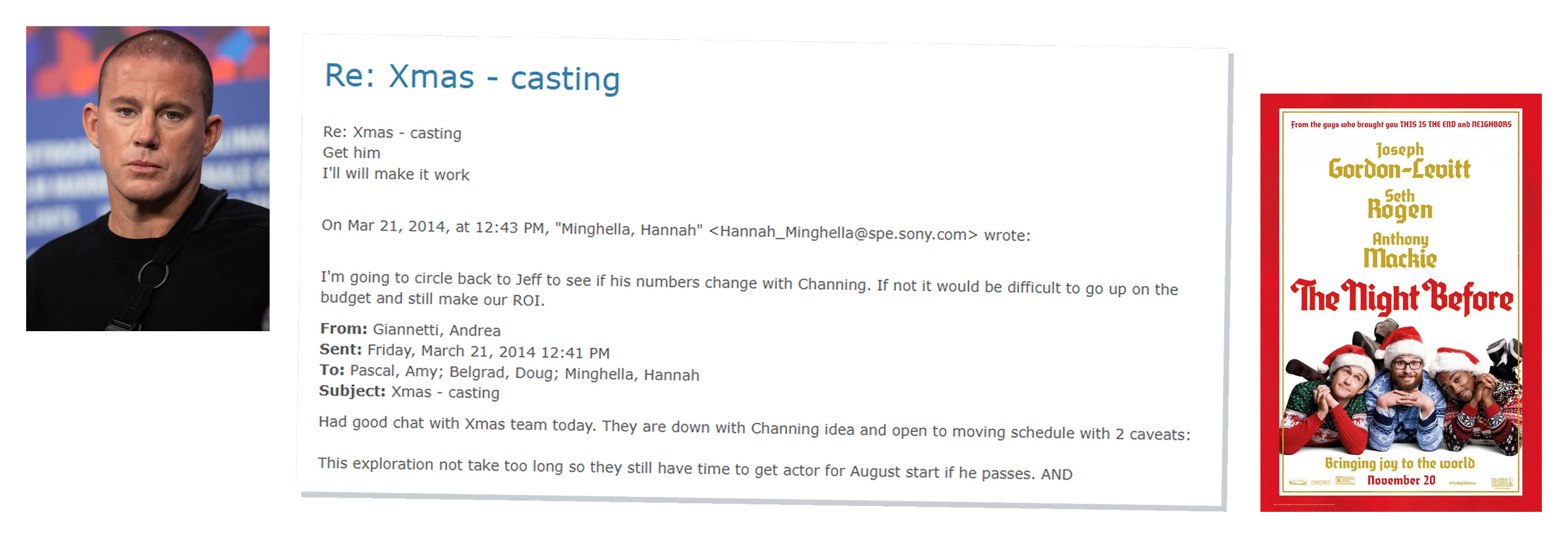
The third way was to want the film badly enough. In March 2014 Hannah Minghella, who ran Columbia’s production alongside De Luca, warned that casting Channing Tatum in the Christmas comedy that became The Night Before would cost money (Tatum didn’t end up in the film):
I’m going to circle back to Jeff to see if his numbers change with Channing. If not it would be difficult to go up on the budget and still make our ROI.
Pascal’s replied simply:
Get him I’ll will make it work
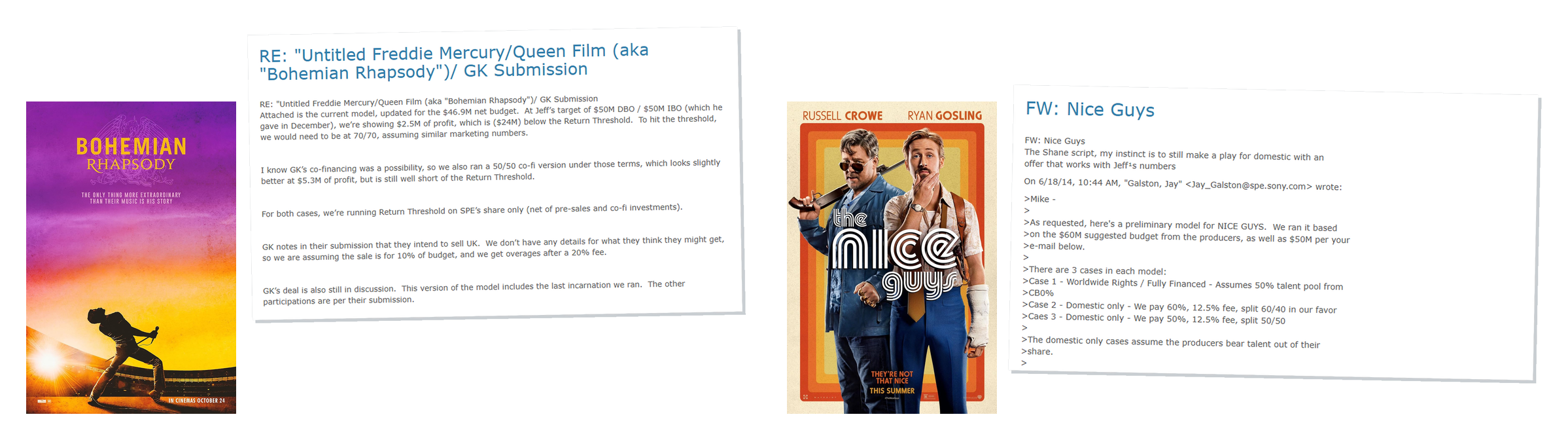
That’s not to say that Sony folks didn’t listen to their models sometimes. In March 2014, they considered the project, which eventually became Bohemian Rhapsody, at its $46.9m budget and found it $24m below the threshold, and Pascal ruled out making it at that price. The Nice Guys lost money in every scenario at the producers’ $60m budget, and Sony didn’t make it.
What about the films Sony passed on?
The leak also includes a folder of greenlight memos marked “Not Doing”. Five of those films were made elsewhere and released in cinemas, and Sony’s figures missed on them too. Two beat the number Sony had put on them, and three fell short.
“Story of Your Life” was estimated to gross $75m in the US and was eventually made as Arrival at Paramount, grossing $100.5m
Get Hard was estimated to gross $80m, and when Warner Bros made it, it grossed $90.4m.
Sony guessed $30m for Ex Machina, passed, and then A24’s version grossed $25.4m
Terminator 5 was modelled at Sony at $135m, but Terminator Genisys only grossed $90m for Paramount
Sony thought Poltergeist would gross $80m, but it eventually grossed $47.4m for Fox.

What can’t a comps model see?
A comps model can only see films that look like films already made. Which brings us back to Digger, an R-rated original satire starring one of the world’s biggest action stars, directed by the Oscar winner behind The Revenant. Variety called it a rare big-budget, star-driven R-rated original comedy.
Rare is the problem. Any comps for that package have to come from Cruise films that are nothing like it or Iñárritu films that are nothing like it, and however carefully they are weighed, the result is a confident-looking number for a kind of film the model has never seen.
Digger could also be described as:
An arthouse film with an unusual tone, an unclear plot, starring with an old man who looks vaguely familiar but ultimately isn’t someone you’d recognise.
That version is unlikely to pass any greenlight model!
But what the Sony files really reveal is that, as much as Hollywood likes to pretend it’s all hard-nosed business, powerful people make choices and then look for the numbers to back them up after the fact.
The projects were made after someone had decided to get the films made. De Luca, looking back on his Sony years, told Ben Fritz in The Big Picture:
The projections were insane.
While that’s terrible financial modelling, isn’t that what we want from the people who led huge art-based companies?
Notes
The Sony material comes from WikiLeaks’ searchable public archive of the 2014 hack of 173,132 emails and 30,287 documents. I used three parts of it:
The marketing department’s greenlight memos for films due out in Sony’s 2014 to 2017 financial years, each giving the box office figure the film was approved on and the comps behind it.
Finance “sensitivity” pages printed between August and October 2014, one per film, each with a column headed GREENLIGHT beside the latest forecast and the box office needed to break even and to clear the threshold.
1,717 internal emails from Amy Pascal’s mailboxes that discuss greenlights, ultimates, comps or the threshold.
I kept the original spelling and punctuation, and only material about greenlight decisions, budgets, forecasts and deals, and nothing personal.
For each film I used, in order of preference: the column headed GREENLIGHT on Sony finance’s sensitivity page (19 films, including Concussion, whose whole page is labelled as the greenlight case), or the latest greenlight submission in the marketing department’s greenlight memo (16 films). Both sources point in the same direction. Films sourced from the finance pages took a median of 81% of their figure and those from the memos 67%.
I left out six films with a greenlight figure.
The Interview (its release was cancelled after the hack)
Kitchen Sink (never released)
Patient Zero (released straight to video in 2018)
And three projects that changed beyond recognition before release (the 2013 Smurfs 3, which became Smurfs: The Lost Village in 2017, a third Ghostbusters that became the 2016 reboot, and the 2014 Uncharted, made eight years later).
US and Canadian grosses come from The Numbers (via OpusData), except The Equalizer, which comes from Box Office Mojo.
The break-even and threshold levels come from the sensitivity pages printed in August to October 2014. They reflect costs, marketing budgets and financing deals at that point, which later changed for some films, so treat the count of eight as a close approximation.