


Last month, Netflix announced that about 6% of its staff were losing their jobs, including its chief content officer, Bela Bajaria. Her replacement is Peter Rice, who himself was described by Deadline as having been fired from his role as Chairman of General Entertainment at Disney in 2022 (apparently two years ahead of his contracted end date)
Stories like this have given streaming executives a reputation for having short careers. The Ankler reported in 2023 that one showrunner no longer bothers to learn the names of creative executives because:
they’ll be gone in a year.
I looked at dangerous jobs a few weeks ago, but I completely overlooked ‘Streaming Exec’ as being one of the high-wire acts.
But I don’t like to go on rumours and a few headline cases - data is king. So I pulled the data to see how long senior streaming executives typically last, how their departures are explained, and whether they know what they’re signing up for.
I gathered all the relevant news stories I could find (11,802 in total) from nine trade publications (Variety, The Hollywood Reporter, Deadline, TheWrap, Screen, Realscreen, IndieWire, Puck and The Ankler) published since January 2011 to this week. This allowed me to track 1,387 senior appointments, 531 at the streamers and 856 at the traditional studios. See the Notes section at the end for the details.
How long do they last?
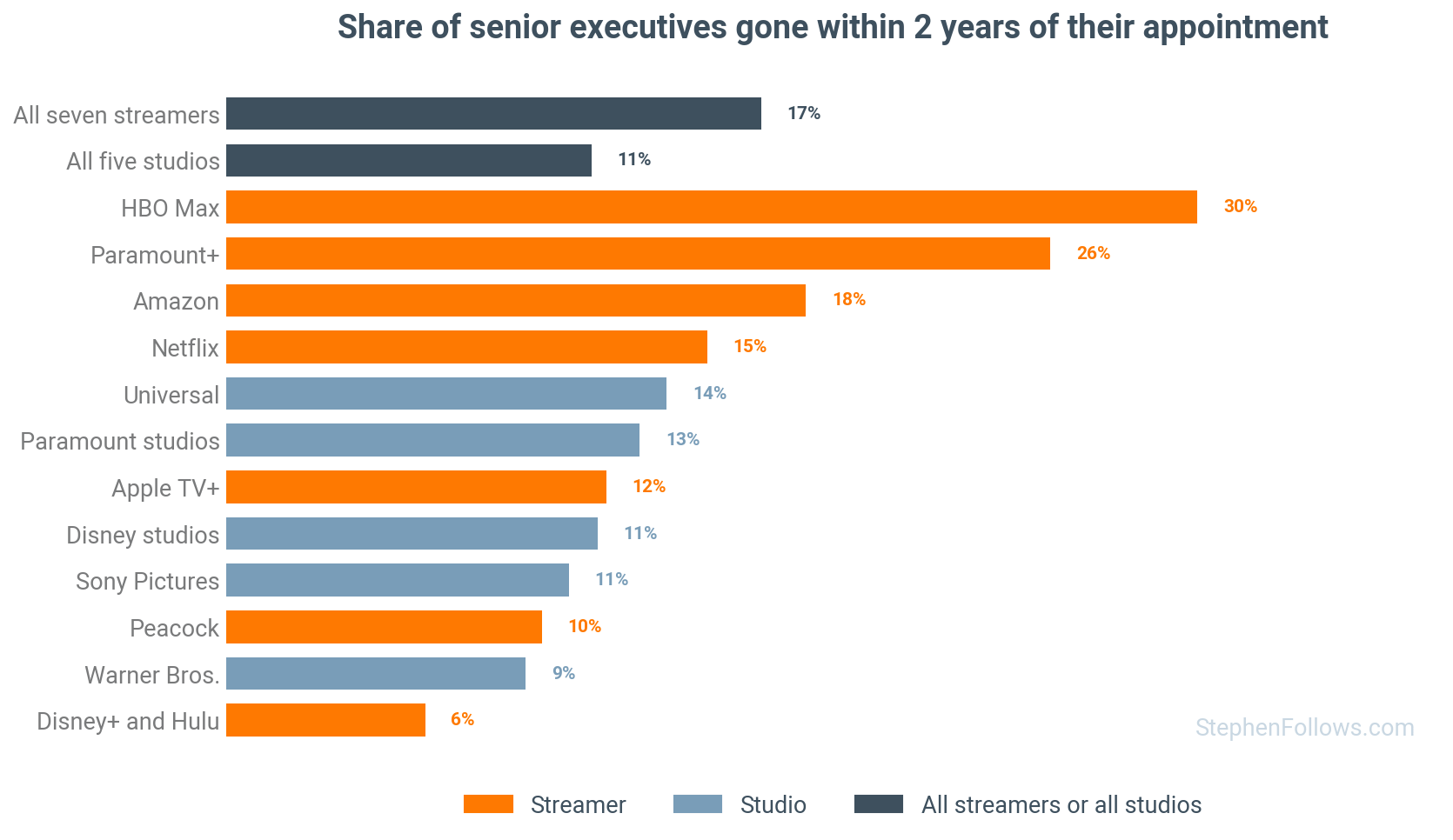
Across the seven streamers, 17% of senior appointees left within two years, compared with 11% at the studios. The gap widens with time. After three years it’s 31% against 21%, and after five years it’s 51% against 36%.
The chart below shows the share of senior executives (Vice President up) at each company who had left (for whatever reason) within two years of their appointment. Streamers are in orange, studios in blue, and the two dark bars at the top are each group as a whole.
That’s not to imply that all streamers are the same (#NotAllStreamersButAlwaysAStreamer).
The two ‘Most Merged Streamers’ are at one end. 30% of senior appointees at HBO Max were gone within two years, and half within about three years. HBO Max’s owner has changed hands three times in eight years. Paramount+ is next at 26%, and it too has been through two mergers.
Perhaps surprisingly, Netflix is the steadiest of the big streamers over the long run, with only 15% of its senior appointees gone within two years. Half were still there after six years, the longest of any streamer with enough data. (Bajaria herself fits that pattern, as ten years is a long run anywhere.) Amazon is in between, at 18%.
Traditional studios hold on to their senior staff longer. At Disney, half of their senior appointees were still in post after 13 years.
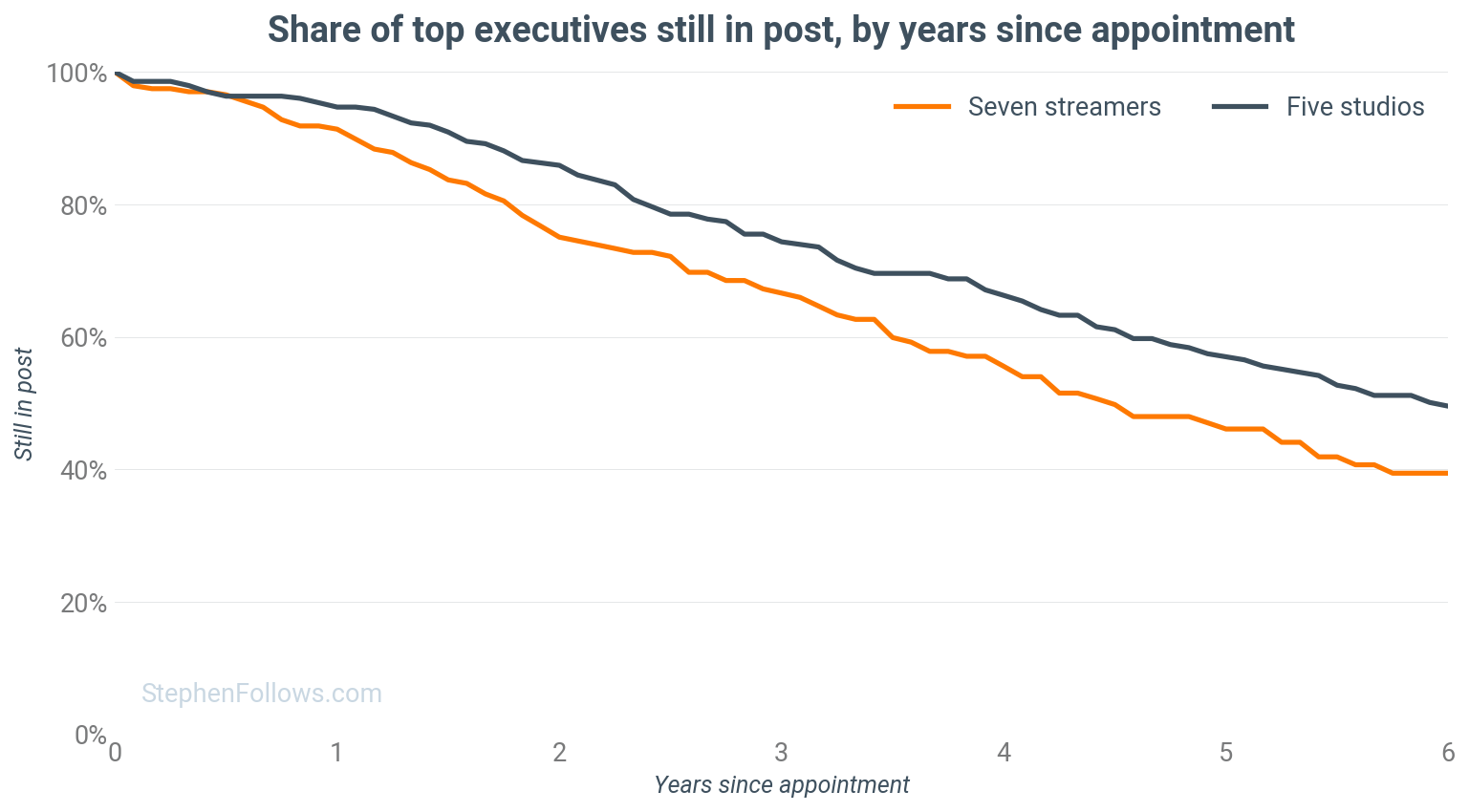
The chart below narrows it to the very top layer (chief executives, chairs, presidents and the heads of film, television, content and marketing), 247 appointments at the streamers and 362 at the studios. It shows the share still in post in each year after their appointment
The two lines track each other for the first six months, after which the streamers start to fall away. A quarter of top streaming executives left within two years, compared with 14% at the studios. Half had gone within four and a half years at the streamers, and within six at the studios.
So, yes, streaming executives do turn over faster than studio executives.
But the data suggest it is at least worth learning their first names, given that fewer than one in ten top streaming executives left within their first year.
How exits get reported
Working out why someone left is harder than working out when. Over twenty years ago, Variety’s Brian Lowry wrote in Variety:
There’s the employee who is ‘leaving to pursue a better opportunity’ that sounds like she was elbowed out, the promotion that’s really a demotion, the resignation that’s actually a firing.
So I haven’t tried to judge who jumped and who was pushed.
What I could do was track how the trade press described it at the time, logging the words used in the coverage.
If any report said the person was fired, ousted, let go, laid off, “out” or that their role was eliminated, it counts as reported as Removed.
If the exit came with a restructure, a merger or a new boss, but without those words, it counts as a Restructure.
Then come exits for another job, for the person’s own company or a producing deal, and for retirement or personal reasons.
Everything else is “No reason reported”.
Of 185 reported exits of senior streaming executives, about half came either with words of removal (22%) or as part of a restructure or a change of boss (30%). Around a quarter (26%) were reported as moves to another job, and 4% as leaving to start a company or produce. Just 2% were attributed to retirement or personal reasons, and 16% had no reason at all.
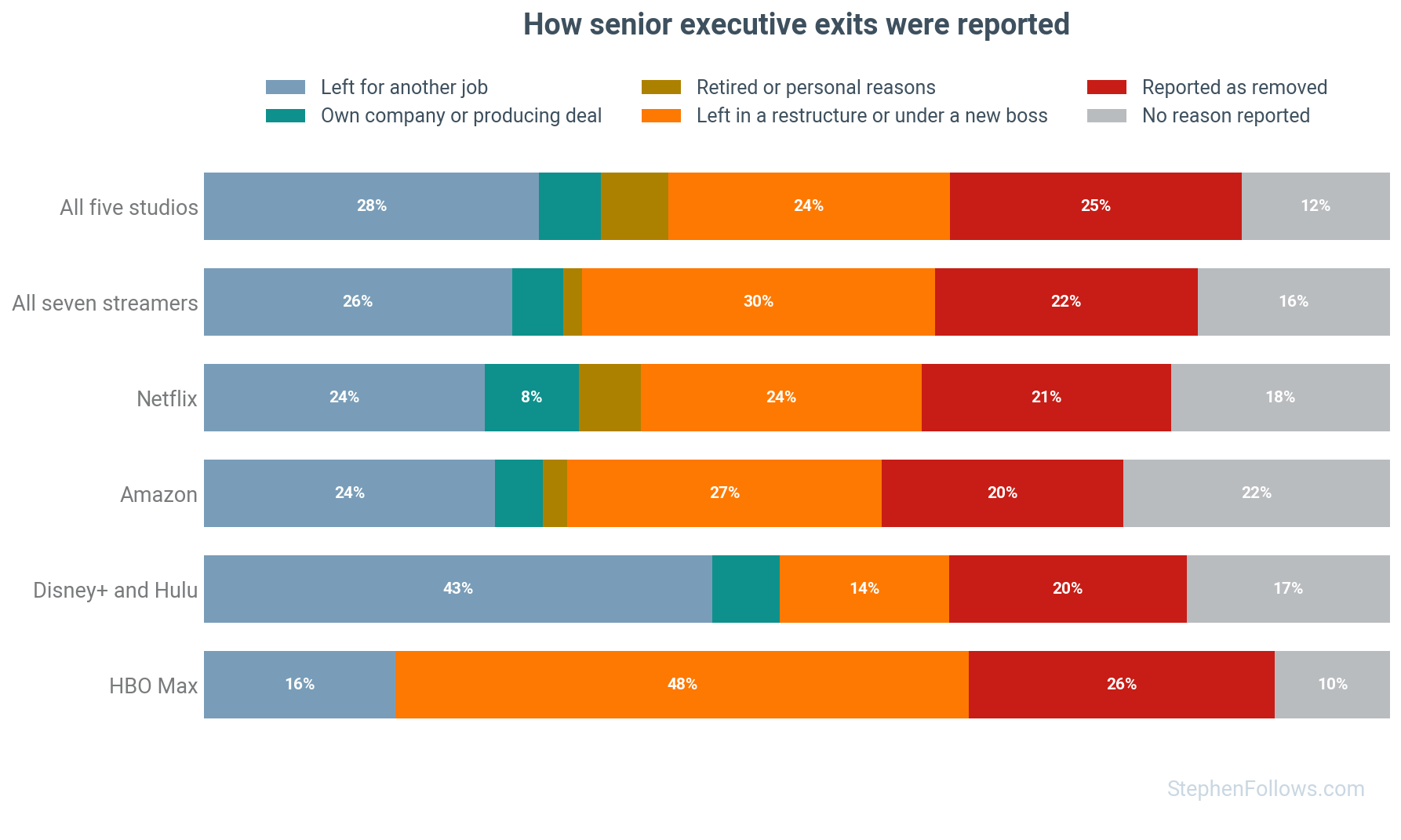
The studios look similar (25% reported as removed, 24% in a restructure, 28% for another job), with one difference that makes sense. Retirement is three times as common at the studios (6%), which have a longer-serving workforce.
A producing deal is a common soft landing. One in twelve exit stories about senior streaming executives (8%) mentions a production or first-look deal, whatever else the story says. One veteran told The Hollywood Reporter in 2016, in a piece on exit packages:
This is a town where you’re paid to go away.
Do they know going in?
I doubt anyone starting a C-Suite job at a streamer is unaware of this truth. Firstly, they will know the industry rumours I mentioned at the top. Second, Netflix co-founder Reed Hastings wrote a whole book laying out the policy.
In No Rules Rules (2020), Hastings and Erin Meyer set out how the company treats people who are doing a merely adequate job (pp. 170 to 171):
For people who value job security over winning championships, Netflix is not the right choice, and we try to be clear and non-judgmental about that.
A few pages later, Hastings explains the cushion (pp. 174 to 175):
Each time we let go of someone, we offer several months’ salary (from four months for an individual contributor to nine months for a vice president). That’s why we say: ADEQUATE PERFORMANCE GETS A GENEROUS SEVERANCE
That’s not to say that the studios are much kinder. In 2013, after three film studio chiefs lost their jobs in a year, The Hollywood Reporter asked executives who had been through it how they coped. Bill Mechanic, who ran Fox’s film studio until 2000, said:
You’re essentially hired to be fired. There is no riding off into the sunset.
Notes
Today’s research is based on 11,802 articles from Variety, The Hollywood Reporter, Deadline, TheWrap, Screen, Realscreen, IndieWire, Puck and The Ankler published since January 2011 to the start of October 2026.
Some of the hard bits were tracking the companies:
Netflix is all of Netflix.
Amazon is Amazon Studios, Prime Video and Amazon MGM Studios, with MGM counted from the day the purchase closed (17 March 2022).
Apple TV+ is Apple’s video business.
Disney+ includes Hulu throughout, plus Disney’s streaming and direct-to-consumer units, but not ABC or Disney Channel.
HBO Max includes HBO’s programming teams from Max’s launch on 27 May 2020.
Paramount+ includes CBS All Access, and Showtime from 27 June 2023.
Peacock is Peacock and NBCUniversal’s streaming unit.
The studios are the film and television studios of Disney (with the Fox units counted from 20 March 2019), Warner Bros., Universal, Sony Pictures and Paramount.
The trades write more about Netflix than about Peacock, and more about chief executives than about vice presidents, so coverage is uneven. How an exit was reported is not the same as why it happened. A neat “to pursue other opportunities” can hide a firing, and a reported ouster can be one side’s version.