


As with all the best questions I answer, this one came from Ted Hope. Ted sat on the Debut film jury at the recent Venice Film Festival and emailed to ask:
I was surprised to learn that the Venice Debut Film Prize comes with a $100K split between the director and the producer team. Makes me wonder.... who else has a cash prize and how do they all fall in the year? Can you be eligible for more than one? Do they all require premieres?
It’s a great question, and it got me digging. I started reading the rules of the biggest festivals, widened my net to all Oscar-qualifying short film festivals, and ended up hunting for film festivals that claim to offer a prize of at least $5,000. By the end, I had data on 423 festivals across 90 countries.
TL;DR - Do film festivals pay cash prizes?
Yes, many do. 49% of the festivals I tracked offer some kind of cash prize. Together, they offer an annual prize pool of $8 million ($5.7 million for features and $2.3 million for shorts).
The typical feature prize is small (the median is about $5,800), with only 14 offering $50,000 or more.
The most famous festivals are among the least generous. Cannes pays nothing at all in its official selection, Venice pays for one prize, and Sundance’s jury prizes carry no money.
Show me the money
I counted a prize only if a festival’s own published regulations or awards page says it pays money to the director, the producer, the film or a named creative.
I noted when they offered money to a distributor, prizes in kind (post-production services, equipment, residencies), or other grants tied to a future project, but they weren’t in Ted’s question, so they aren't in my main findings.
The chart below shows some of the most generous festivals. The dark blue bars are prizes that any feature can compete for, and the orange bars are ones with some kind of entry restriction, such as nationality, region, or genre.
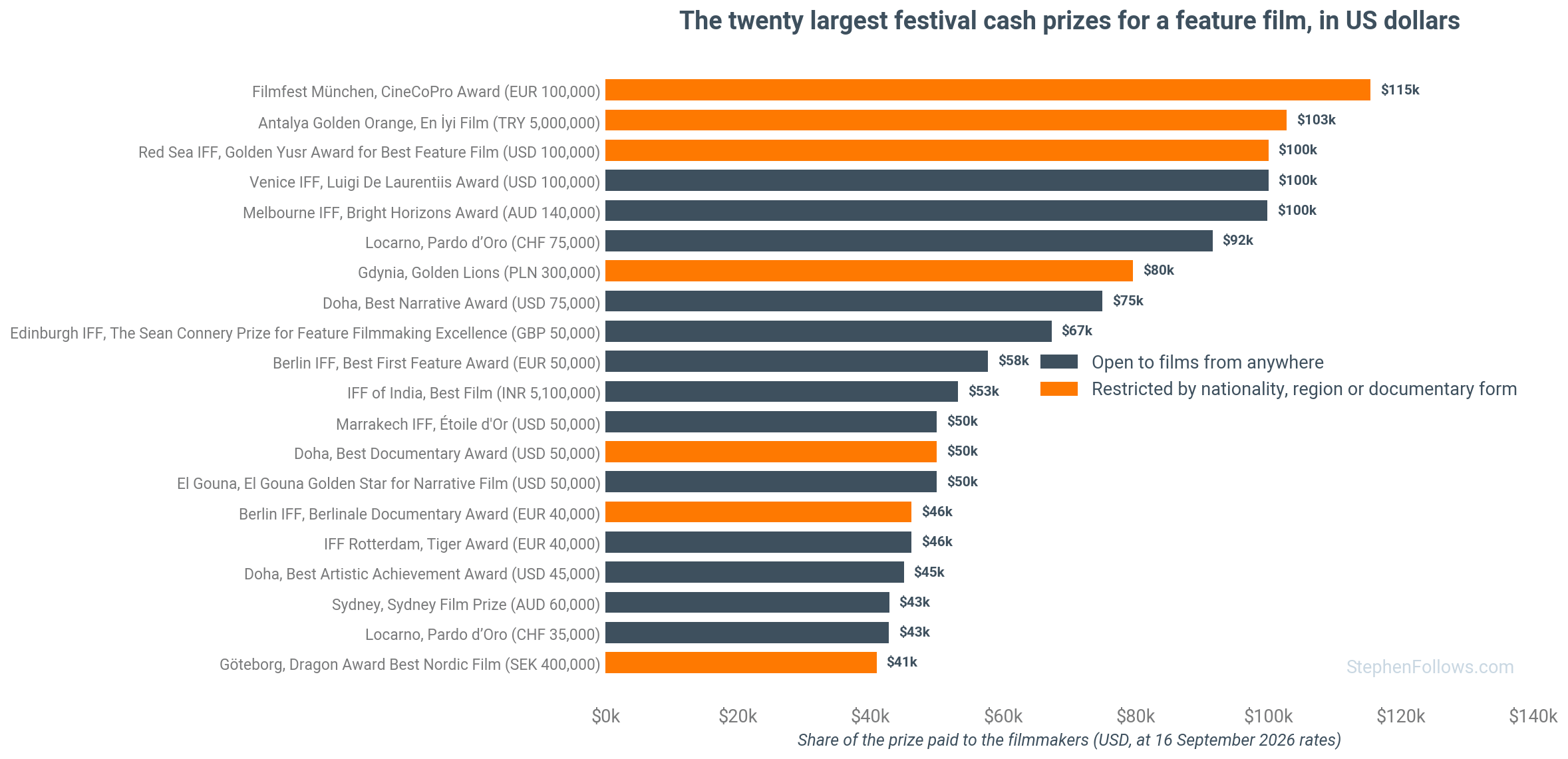
The top of the table is not where most people would guess. The single largest pot is the CineCoPro Award at Filmfest München, €100,000 paid to the German co-producer of an international co-production, funded by the Bavarian film fund.
Next is the national competition at Antalya Golden Orange, whose Best Film prize is TRY 5,000,000 (about $103,000) but open only to Turkish productions.
Then come two prizes of $100,000 each. The Golden Yusr at the Red Sea International Film Festival in Jeddah is split between director and producer, but only films by Arab, African or Asian filmmakers qualify.
And Venice’s Lion of the Future, the Luigi De Laurentiis Award for a debut film, is donated by Filmauro and ‘divided equally between the director and the producer’. That one is open to any first fiction feature in any of the festival’s competitive sections.
The Bright Horizons Award at the Melbourne International Film Festival pays AUD 140,000 (about $100,000) to the winner of a competition for first and second features, and asks only for an Australian premiere.
Locarno’s Pardo d’Oro (CHF 75,000, shared by director and producer), Gdynia’s Golden Lions (PLN 300,000, for Polish films and co-productions), the new Doha Film Festival’s Best Narrative Award ($75,000) and Edinburgh’s Sean Connery Prize (£50,000 for a feature that world premieres there) round out the top of the chart.
Do the big five festivals pay anything?
You may have spotted that some of the biggest awards (i.e. Palme d’Or, Golden Lion, Golden Bear, Sundance Grand Jury Prize, etc.) are missing. That’s because the most prestigious prizes in world cinema are shiny trophies, not actual cash.
Cannes pays nothing in its official selection. The 2026 regulations list the Palme d’Or, the Grand Prix, the Caméra d’Or and the rest with no money attached. The only cash the festival itself gives is to film school shorts in La Cinef (€15,000, 11,000 and 7,500).
There is some money at Cannes, but it comes from other people. Critics’ Week (which the festival does not run) pays €8,000 for its French Touch Prize and €4,000 for its SACD screenwriting prize, and its Gan Foundation award gives €20,000 to a French distributor. The Golden Eye documentary award, created by the festival with the French authors’ society Scam in 2015, pays €5,000 from Scam to the winner, chosen from the documentaries across all selections.
Venice pays for exactly one prize, the debut award that Ted was on the jury for. The Golden Lion, the Silver Lions, the Volpi Cups and every Orizzonti award state no money in the regulations. The independent sections have a little, such as €10,000 for the Critics’ Week grand prize.
Berlin is the most generous of the three European majors. Its own juries hand out seven cash prizes worth €130,000 a year: €50,000 for the best first feature, €40,000 for the documentary award, €20,000 for the best short, and four prizes in its Generation strand for young audiences worth €20,000 between them. The Golden and Silver Bears carry nothing.
When I looked at who owns each major festival a few weeks ago, I noted how the US festivals sit apart from the European ones because they are not publicly funded. However, in this regard, they follow the same path as Cannes and Venice: the headline award offers no direct financial reward, but pockets of cash appear around the margins.
Sundance‘s Grand Jury Prizes, directing awards and audience awards carry no money. The cash there comes from sponsors with specific interests. The Alfred P. Sloan Foundation gives $25,000 to a film about science or technology, and Amazon MGM funds two $10,000 producers’ awards. Toronto gives CAD$ 20,000 with its Platform Prize, and its famous People’s Choice Award lists no money at all on the awards page.
So if you have a finished feature and you are counting on prize money, the biggest brands are the wrong place to look. The festival that pays the most cash to feature filmmakers across all its prizes is Locarno, at about $333,000 a year.
When does the money fall?
Ted also asked when most of the money falls in the year. It seems that as the year ramps up, cash flows more heavily. The chart below combines all the 560 feature cash prizes at the 125 festivals that pay them, by the month the festival opens.
Three quarters of the year’s feature prize money is awarded between June and December.
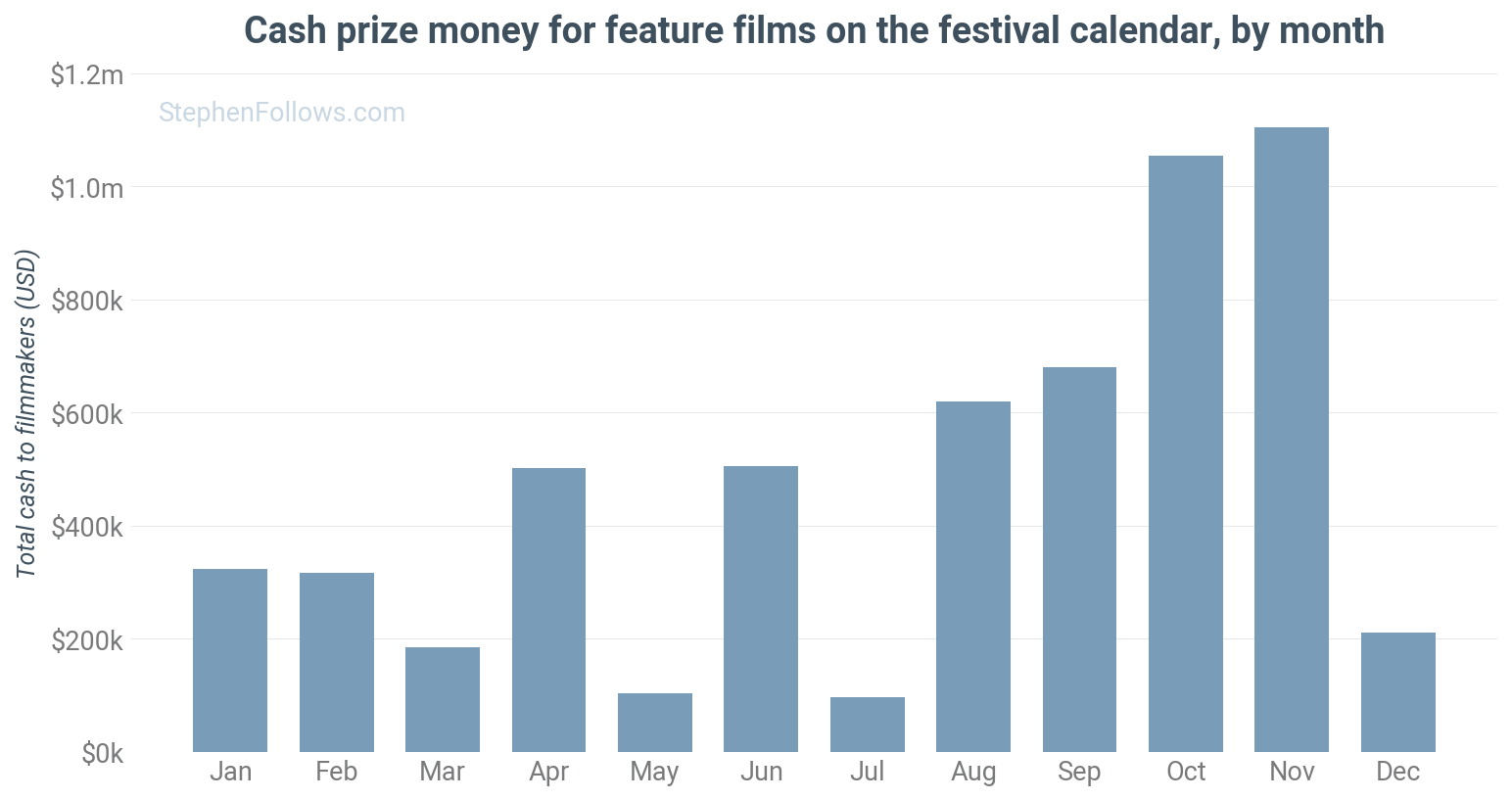
November carries about $1.1 million across 19 festivals, from Tallinn and Cairo to Goa, Doha, Turin and Marrakech. October is close behind at about $1.05 million across 23 festivals (Busan, Warsaw, Tokyo, Antalya, El Gouna, Valladolid). Those two months hold 38% of the year’s feature prize money.
Who gets the money?
I’ve actually been on a bit of this journey myself. Back in 2010, I wrote a short film that performed strongly at awards. We collected £10,000 in cash for winning the Reed Short Film Competition, and £30,000 in future funding by winning the Virgin Media Shorts Award. (We were also nominated for a BIFA and longlisted for a BAFTA, neither of which would have resulted in any money, had we won).
The £10k cash was easy to split up, but the £30,000 funding for the director’s next short was more complicated.
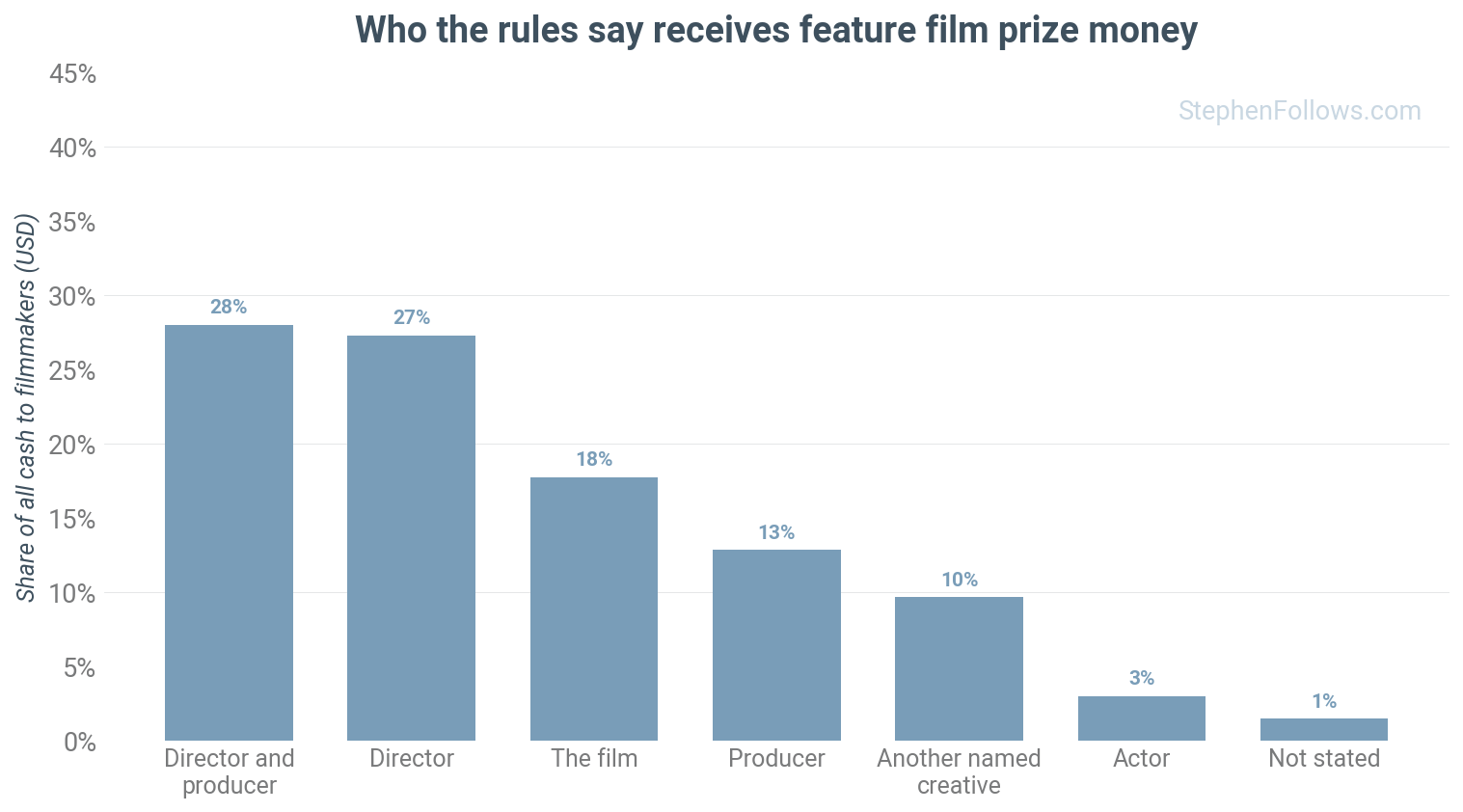
Festivals know things can get fraught, so most are extremely clear about what the money is for and who can receive it:
More than a quarter of the money is written to be split between the director and the producer, which is the model at Venice, Berlin, Locarno, Karlovy Vary, Rotterdam, Marrakech, Doha, El Gouna and Goa.
Another 27% goes to the director alone. Producers alone get 13%, mostly in Spain and Turkey, where the rules write the cheque to the production company.
18% goes ‘to the film’, which in practice means whoever the festival has on file as the entrant.
And one dollar in ten goes to a named creative who is not the director, usually an actor, a screenwriter or a cinematographer.
Then there is the money that never reaches the filmmakers at all. Thirty-four prizes at 18 festivals, worth about $540,000, are paid to a distributor, on the condition that the film is released in the festival’s country. San Sebastián is the clearest case. Its Kutxabank New Directors Award is €50,000, but half goes to the Spanish theatrical distributor, and if there is no Spanish distributor, that half ‘will remain vacant’.
Valladolid‘s Espiga de Oro is €70,000, the largest sum any festival in the study attaches to a best film prize, and every Euro of it goes to the Spanish distributor. Sitges states outright that it ‘does not award cash prizes’, then gives €20,000 to the Spanish distributor of its best film.
Do they all demand a premiere?
Actually, no.
This surprised me, as I imagined the festivals were buying exclusivity with their money. The chart below shows the premiere requirements for the 560 feature cash prizes I tracked.
Only 6% of the prizes (10% of the money) require a world premiere. This includes Venice’s debut award, Rotterdam’s Tiger competition, Toronto’s Platform section, Tallinn’s main competition, Edinburgh’s competition, and a handful of others. The orange bars count prizes, and the dark bars count money.
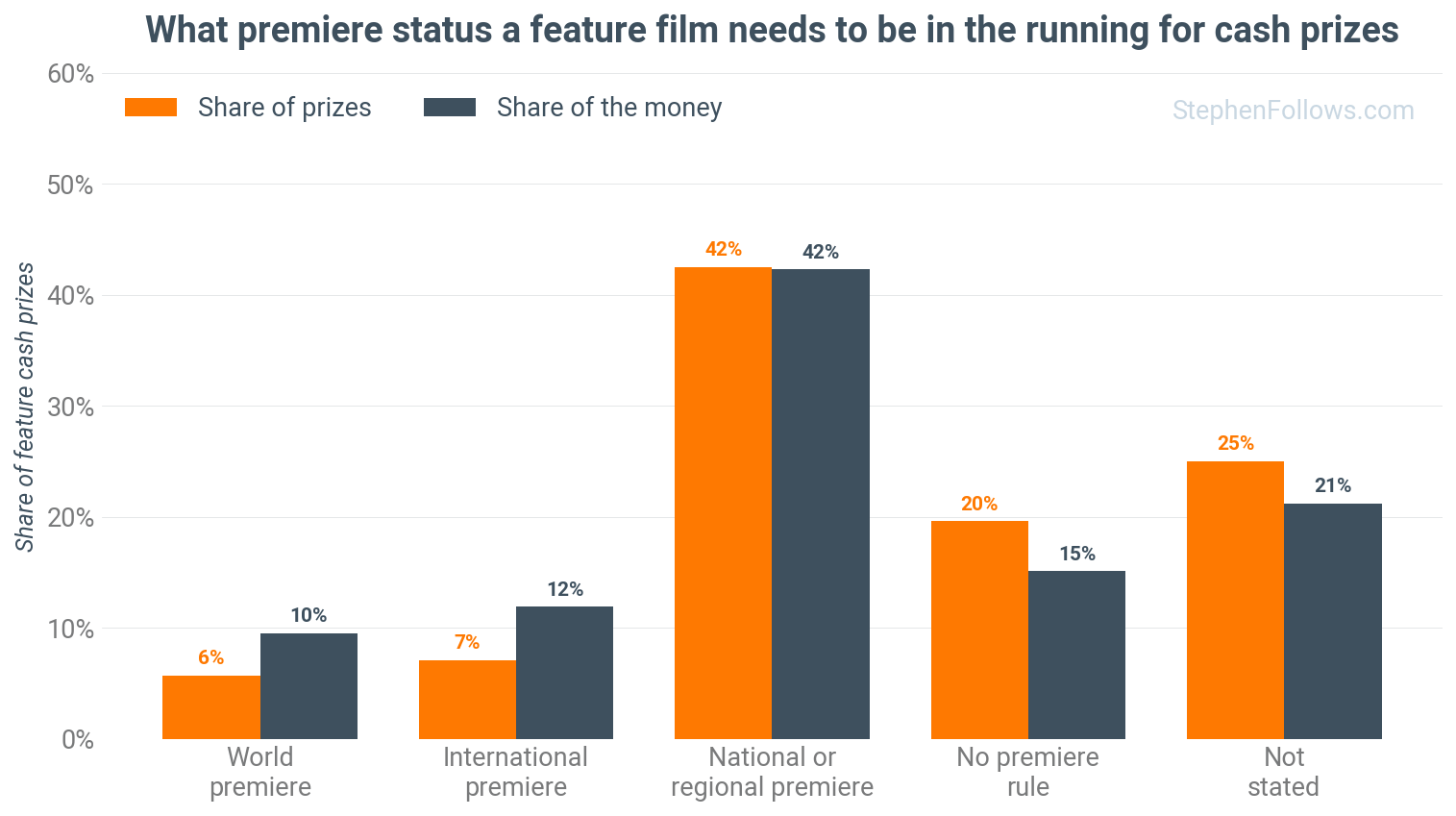
Another 7% (12% of the money) accept an international premiere, meaning a film may have already played at home. That is the rule at Berlin, Locarno, Karlovy Vary and San Sebastián’s New Directors section.
Then comes the bulk. 42% of the prizes, and the same share of the money, only require a national or regional premiere.
Tokyo asks that the film has not been released in Japan.
Cairo, Doha, Marrakech and Red Sea ask for a Middle East and North Africa premiere.
Melbourne and Sydney ask for an Australian premiere.
Gijón, Seville and Cinema Jove want the Spanish one.
Goa requires that the film has not screened in India.
How many cash awards could you win with the same film?
Films that do well at festivals tend to do well at more than one festival because, well, the film is excellent! So it stands to reason that if many festivals offer money without requiring premieres, a film could go festival to festival and scoop up money.
Let's make up an extreme case. I’ve assumed that you have just made your first fiction feature, which lasts over 60 minutes, from a country that does not host any festival in the study and is not in Asia, the Arab world, Latin America or Europe (i.e. it doesn’t qualify for those special prizes reserved for a nationality or a region).
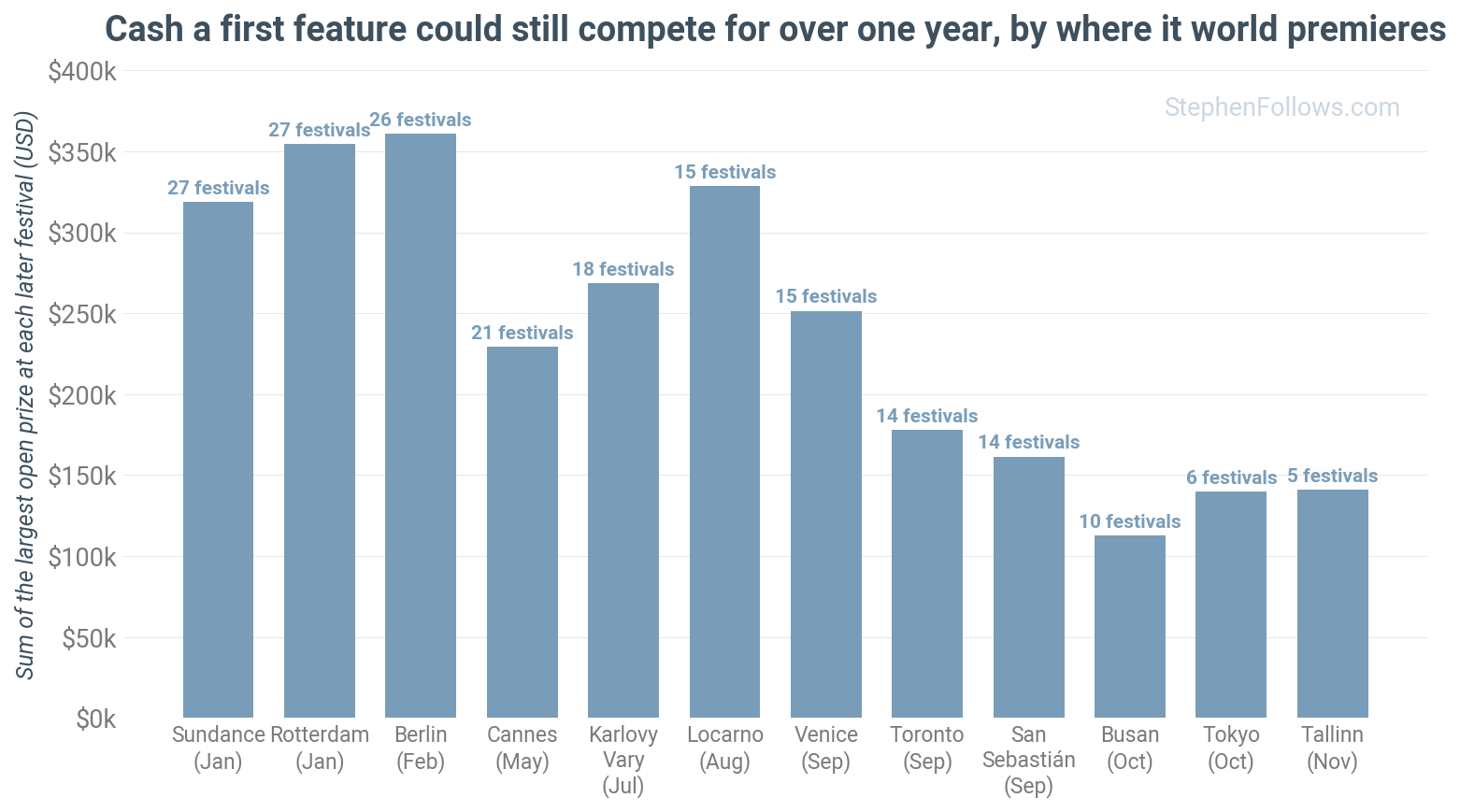
You’d world premiere at one of twelve major festivals that demand it, and then travel to every later festival in the same calendar year at which it still meets the published premiere rule for at least one cash prize. Each visit counts as a public screening in that country.
A debut that world premieres in Berlin in February is eligible for cash prizes at 26 further festivals before the year is out, with the largest pots at each adding up to about $361,000.
That counts the €50,000 debut prize in Berlin, then Sydney’s AUD 60,000, Istanbul’s €30,000 Golden Tulip, the $25,000 Andrzej Wajda award at Mastercard OFF CAMERA in Kraków, Locarno’s CHF 30,000 audience prize, Turin’s €20,000 and Tokyo’s JPY 3,000,000
Other routes you may consider include:
Start in Rotterdam or Sundance in January, and there are 27 festivals and a little less money.
Start in Venice in September, and there are 15 festivals and about $251,000 left in the year.
Start in Tokyo or Tallinn, and there are five or six.
Yeah, but does it ever actually happen?
Theory is one thing, but let's see how often films win multiple awards.
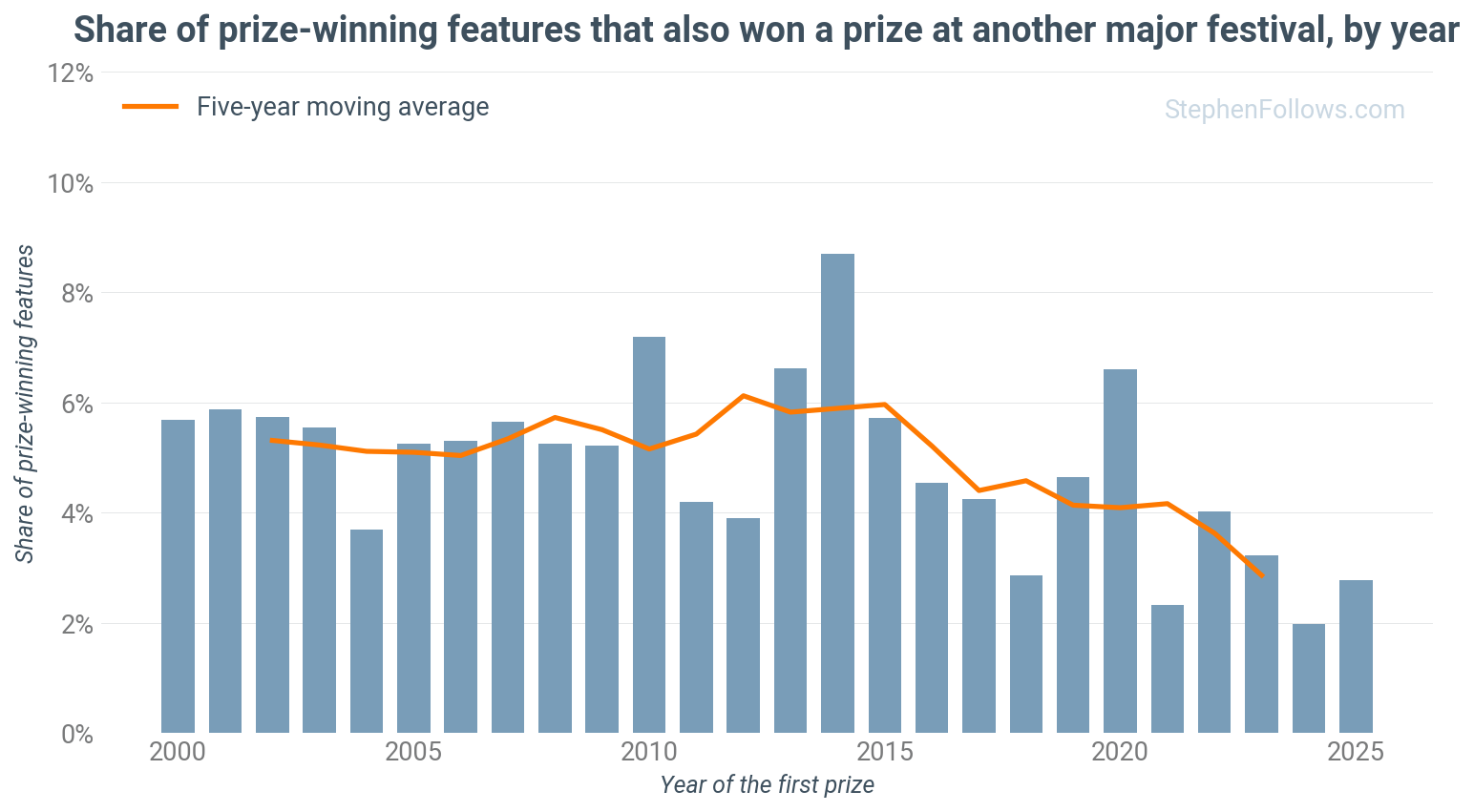
I took every feature that won a prize at Cannes, Venice, Berlin, Sundance, Toronto, SXSW, Tribeca or the BFI London Film Festival between 2000-25 and looked at whether they also won a prize at another of those eight festivals.
Just 131 of those 3,147 films (i.e 4.2%), won something at two or more of the eight festivals, and only seven won at three. The share has drifted down, from around 5% to 6% in the 2000s to 2% to 4% since 2021.
The most common pairing is Berlin and Sundance (31 films), which makes sense given the calendar. A film premieres at Sundance in January, plays Berlin’s Panorama or Generation section a few weeks later, and picks up an audience or independent jury prize there. Berlin and Tribeca (17) and Cannes and London (15) follow.
The films that managed three are a small club. Beasts of the Southern Wild took the Grand Jury Prize at Sundance, the Caméra d’Or at Cannes and the Sutherland Award in London in 2012, and All That Breathes did the same route a decade later. Of those six prizes, only one carries money, the €5,000 that comes with the Golden Eye at Cannes.
So the answer to ‘can you win at more than one’ is yes, but the answer to ‘do films win cash at more than one’ is almost never.
What about shorts?
Let’s end by quickly looking at short films.
Short film prizes are more common than feature prizes but much smaller. The 423 festivals list 805 cash prizes for shorts at 172 festivals, worth about $2.3 million in total, with a median of about $1,700. Nearly two-thirds of them pay less than $2,500, and only 35 pay $10,000 or more.
The Louisiana Film Prize pays $50,000, decided by the festival audience, to a short shot in Louisiana, and the full sum only if it was shot in Caddo or Bossier Parish. Among the international festivals, the largest are the Berlinale Shorts CUPRA Filmmaker Award at €20,000, Doha’s best short ($20,000), Edinburgh’s Thelma Schoonmaker Prize (£15,000) and Locarno’s Pardino d’Oro for the best auteur short (CHF 15,000). The dedicated short film festivals pay in the low thousands. Clermont-Ferrand’s Grand Prix is €5,000 and Oberhausen’s is €8,000.
Across all 805 prizes, 45% of the money is written to the director alone.
Notes
I built my festival study list using:
The 50 festivals accredited by FIAPF (the International Federation of Film Producers Associations).
14 festivals a working filmmaker would expect to see and that FIAPF does not list (Sundance, SXSW, Tribeca, Telluride, New York, BFI London, Rotterdam, Fantasia, IDFA, CPH:DOX, Sheffield DocFest, Red Sea, Marrakech and Doha).
123 festivals whose awards qualify a short film for the Academy Awards.
190 festivals whose FilmFreeway listing claims a cash prize of $5,000 or more.
46 festivals found by searching for large prizes reported in the trade press.
I removed 19 listings that turned out to be award schemes, funds, or contests without a festival. That left 423 festivals in 90 countries.
For each festival, I downloaded the current regulations, or the awards page where the regulations name prizes without amounts, and recorded every prize that includes money or a valued non-cash award.
For the first chart, I converted figures to US dollars at the European Central Bank’s rates around the time of writing, and where a prize is split with a distributor, I show only the filmmakers’ share.
I updated this article on 27 September 2026 to avoid some ambiguity in my phrasing. The Berlin paragraph now lists all seven cash prizes awarded by the festival’s own juries, worth €130,000 in total, whereas it previously named only three. No totals or charts have changed, as the dataset behind them already included all seven.
The few environments that allow indie filmmakers to pay rent is one of the reasons why recent (and future) filmmakers are starting to come from YouTube and other platforms that enable creators to get paid while practicing their craft. My $0.02.