


Earlier this year, the head of the Berlin Film Festival, Tricia Tuttle, was criticised by Germany’s culture commissioner, Wolfram Weimer, for standing next to filmmakers wearing keffiyehs and brandishing Palestinian flags.
“So what?” you might think, “Why would annoying a politician be any concern of a film festival?”.
Well, that’s because the festival is owned by the German Government. The company that runs the Berlin Film Festival has exactly one shareholder (the Federal Republic, holding the entire €25,000 of share capital) and its supervisory board is chaired by the federal culture minister.
Almost all film festivals sell themselves as temples of artistic independence, but they all have an eventual owner to whom they answer.
I was curious who owns these institutions, who appoints their bosses and who pays the bills, so I dug through official records for the 20 biggest festivals in the world
Five ways to own a film festival
Nine of the twenty were founded by a public body of some kind, from Mussolini’s Biennale in 1932 to Shanghai’s city government in 1993. The other eleven began as private initiatives, whether local merchants in San Sebastián, film critics in Busan or Robert De Niro in post-9/11 New York.
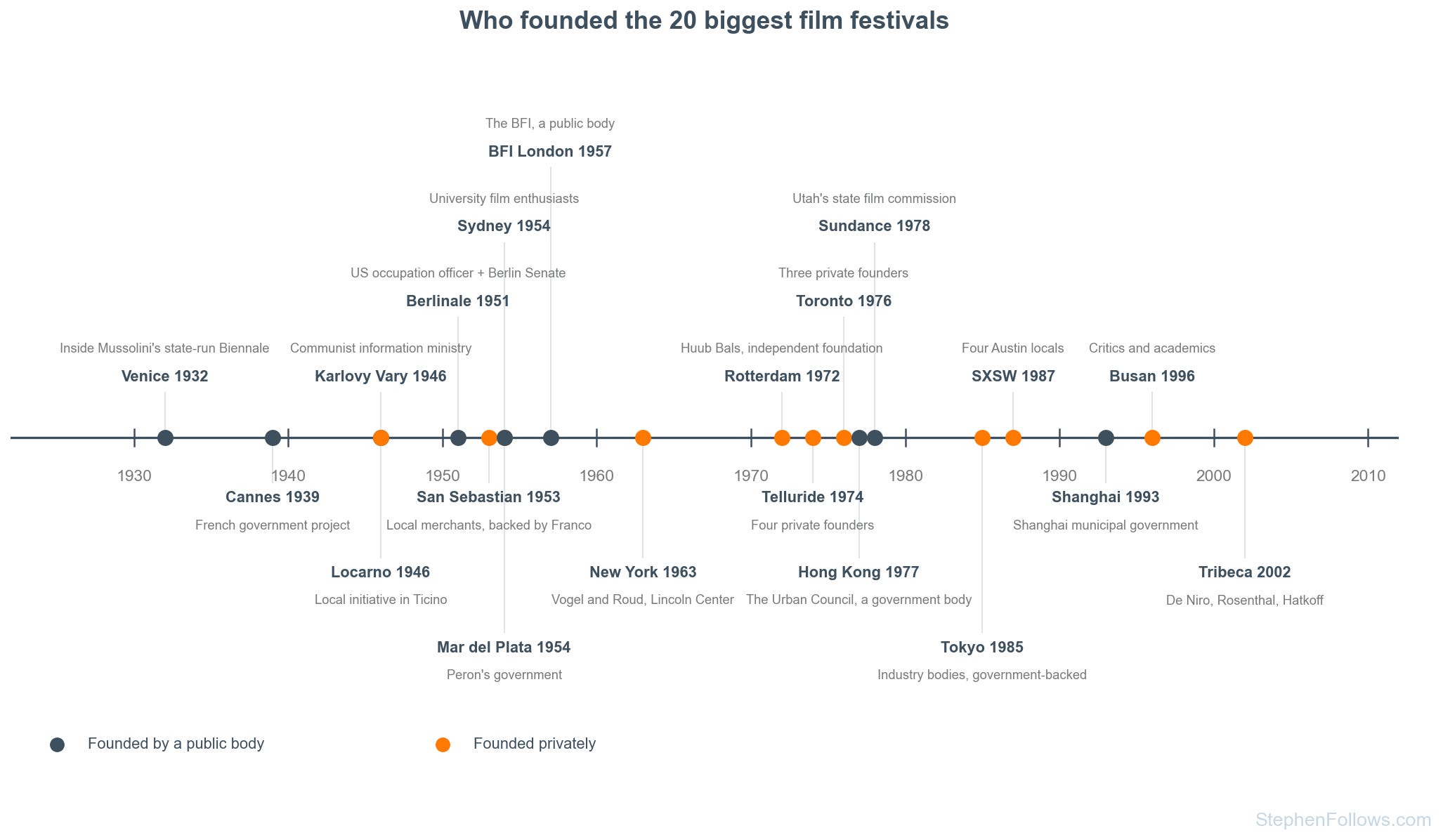
But the founding arrangement isn’t always the one in place today. Locarno and San Sebastián started privately and are now substantially public, while Sundance began as a Utah state film commission project and is now a private charity, so the story of who owns a festival is really the story of who took it over.
After looking up their current ownership structure, I found I could group the festivals into one of five groups:
Owned or run by the state
Technically private but state-controlled
Publicly funded nonprofits
Private nonprofits
Privately owned companies
Let’s look at each in turn.
1. Owned or run by the state
The purest case is the Berlinale. Its operating company (Kulturveranstaltungen des Bundes in Berlin GmbH, or KBB, a legacy of the festival’s origins as a Cold War project in occupied Berlin) is 100% federally owned. Every time the festival's leadership has changed, a single government resolution has enacted it, signed by an official at the federal culture ministry.

San Sebastián is the same idea, albeit with more shareholders. The festival is a company owned 25% each by the Spanish state’s film institute, the Basque Government, the province of Gipuzkoa and the city council. When the festival needed a new director for 2027, its first change in 16 years, the four governments had to agree.
Shanghai is run by the municipal state apparatus. Mar del Plata, Latin America’s only A-list festival, is run directly by INCAA, Argentina’s national film institute, which is why President Milei’s cuts to INCAA hit the festival directly.
And the BFI London Film Festival belongs in this group as it’s run by the British Film Institute, an arm’s-length Royal Charter charity funded by the culture ministry and the National Lottery, whose accounts are laid before Parliament.
2. Technically private but state-controlled
Cannes and Venice both present as private institutions, but under the hood the state controls both.

Cannes is run by a French association (the festival itself began life in 1939 as a government project) whose statutes require government approval to change. Its board includes twelve public-institution seats out of 28, and its vice-presidency belongs by right to the CNC, the national film agency.
Venice’s festival is run by La Biennale, legally a private foundation. That doesn’t initially sound like a state entity, but its president is appointed by ministerial decree, the mayor of Venice and the president of the Veneto region sit on the board by law, and the state auditor reviews it annually. Italian law does offer private funders a route to a Biennale board seat, but they would need to put up 20% of the endowment, and none has ever used it.
3. Publicly funded nonprofits
Busan, Toronto, Rotterdam, Locarno, Sydney, Tokyo and Hong Kong are all independent organisations on paper, but which rely on public money.

Busan is the most dependent on public money. The city of Busan paid 49.8% of the festival’s costs in 2025, with national money from the Korean Film Council adding another 4.1%, its lowest share ever. The festival’s organising committee was chaired by the city’s mayor himself until governance reforms in 2016, so for its first two decades the principal funder also chaired the board.
Toronto is a registered charity that pulls in more than any other festival on this list, some C$45.6m in 2024. Government grants were 15% of that, split three ways between Ottawa (C$3.7m), Ontario (C$1.8m) and the City of Toronto (C$1.3m). TIFF’s new market is the result of increased public funding, with Ottawa committing C$23m over three years.
Rotterdam is a Dutch foundation, and its audited accounts show 51% of income coming from public sources, chiefly a structural grant from the national culture ministry (€2.1m) and one from the city (€1.4m).
Locarno is a Swiss association funded by all three levels of Swiss government: the federal culture office, the canton of Ticino (which has just renewed its CHF 3.4m a year through 2030) and the town itself. Public money is about 38% of Locarno’s budget, and falling as sponsorship grows.
Sydney is a company limited by guarantee, funded by Screen Australia, the New South Wales government and the City of Sydney.
Tokyo is run by UNIJAPAN, a film-industry association, with backing from two ministries: the trade ministry METI and the Agency for Cultural Affairs.
Hong Kong’s festival is run by a charitable society subsidised by the government’s Cultural and Creative Industries Development Agency.
So while technically none of these seven is owned by the state, if the public money dried up it’s hard to see how they could carry on.
4. Private nonprofits
The American trio of Sundance, Telluride and New York are genuinely private charities. Their boards appoint themselves, as American nonprofit boards do, and there are no state seats, ministerial appointments or public shareholders.

Every US charity has to file an annual tax return (the Form 990), which is public, so we know more about these three than about most of the festivals above.
The Sundance Institute took in $46.4m last year, roughly two-thirds of it from donations rather than ticket sales, and the festival is only one of the things it does (the Institute also runs its year-round labs for filmmakers).
Telluride is run by a charity called the National Film Preserve, registered in Berkeley, California, several hundred miles from the festival, with a small board of insiders that includes Ken Burns and Alexander Payne.
Film at Lincoln Center, founded in 1969 as the Film Society of Lincoln Center, runs the New York Film Festival as its flagship programme rather than as a separate organisation.
These organisations pay no income tax, and their donors get deductions, so that is kinda like a state subsidy, just not “public money” in the way we typically think of it.
5. Privately owned companies
Now for the most complicated type - commercial companies.

Tribeca has been majority-owned since 2019 by James Murdoch’s Lupa Systems, with Attention Capital, Robert De Niro and Jane Rosenthal all having undisclosed stakes.
SXSW has been 51% controlled by Jay Penske’s media group since 2023. It was founder-owned for over three decades until the pandemic cancelled the 2020 edition and nearly sank the company. Penske's joint venture bought a 50% stake in 2021 to keep it afloat, then took a further 1% from a private investor in 2023. The owner of the remaining 49% has never been disclosed. The London edition, launched in 2025, isn't run by the Austin company at all but under licence by a separate British company whose controlling shareholder is a Penske Media director.
Karlovy Vary, which many assume is a state festival, is actually owned by KVIFF Group, an investment vehicle whose majority owner is Rockaway Arts, a private Czech investment group. The Czech register records KVIFF Group as sole shareholder of the festival company, though the exact stakes behind it are not publicly disclosed.
How much public money are we talking about?
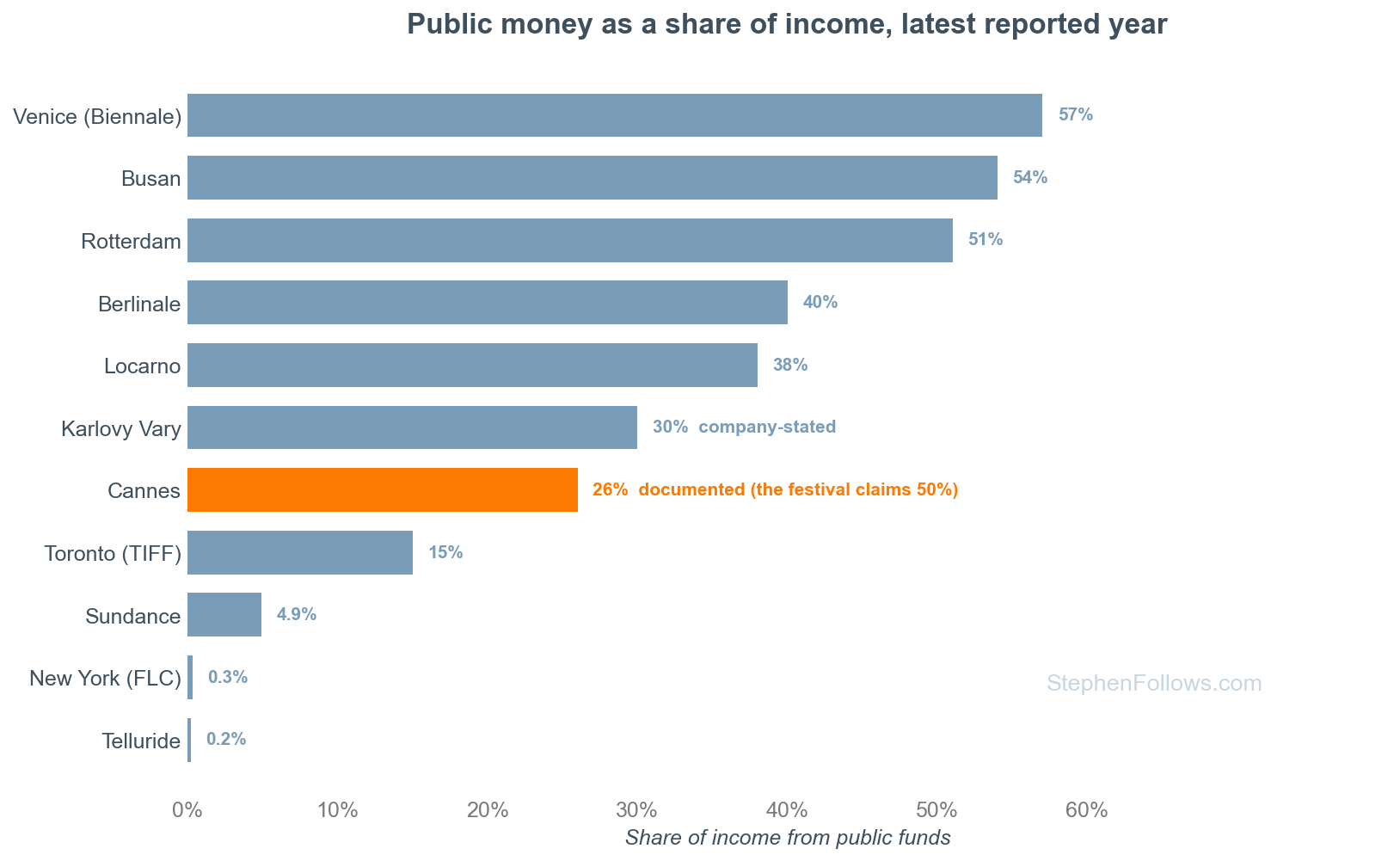
Venice opens next week and also tops my chart of reliance on public money.
La Biennale takes about €32.6M a year in public contributions, around 57% of its income, and Venice’s film festival has its own earmarked line of €13.5M a year from the culture ministry’s cinema directorate.
Other interesting tidbits I gleaned from the documents were:
The city of Busan covered 49.8% of the Busan Film Festival’s costs in 2025, with national money adding 4.1%.
Rotterdam’s annual report shows 51% public income.
The Berlinale runs on roughly 40% public money.
Locarno is 38%.
Even privately owned Karlovy Vary draws about 30% of its budget from public sources, by its own executive director’s account, including a record CZK 47M a year from the Czech culture ministry.
Toronto sits at 15% per its audited 2024 figures, though a new C$23M federal commitment to launch TIFF’s official content market will push that back up.
Sundance took $2.2M in government grants last year, about 5% of its income, per its tax filings.
Telluride and Film at Lincoln Center (which runs the New York Film Festival) have figures of $27,750 and $52,439, respectively.
Cannes is a little bit more complicated. I have emailed them to ask but as of the moment of writing, I can’t work it out. The Festival de Cannes publishes no accounts, so the €35M budget you see quoted everywhere is just what the festival told franceinfo in 2024. The festival has been claiming that half its budget is public money since at least 2009, across every stated budget figure from €20M to €35M. This could well be true but feels woolly, and I couldn’t verify it.
When I added up every public subsidy that can actually be documented: the CNC’s grant of around €2.25–2.5m (per the Cour des comptes’ audit of the CNC), the city of Cannes’s €1.9m cash grant (locked in until 2035) plus in-kind support the city itself values at about €4.1m (per the regional audit chamber’s report on the commune), €500,000 from the region and €150,000 from the département.
It comes to roughly €9m, or 26% of the budget (if it were half the stated €35m budget as claimed, then it would need to add up to €17.5m).
I’m sure I will get to the bottom of this at some point, but as for right now it’s a bit of a mystery. Ironically, the commercial market is more transparent than the parent charity! The Marché du Film is run by a company called SOGOFIF, wholly owned by the festival’s association, and its filings show €11.1M of revenue at a 16% net profit margin in its most recently published accounts (the year to September 2022).
What does that come to per festival-goer?
To put this in scale, Venice costs Italian taxpayers WAY more per festival attendee than the other festivals cost their respective constituents. The state pays about €143 for every ticket sold at the Venice film festival (94,703 of them in 2024, against the Mostra’s €13.5M earmarked state line).
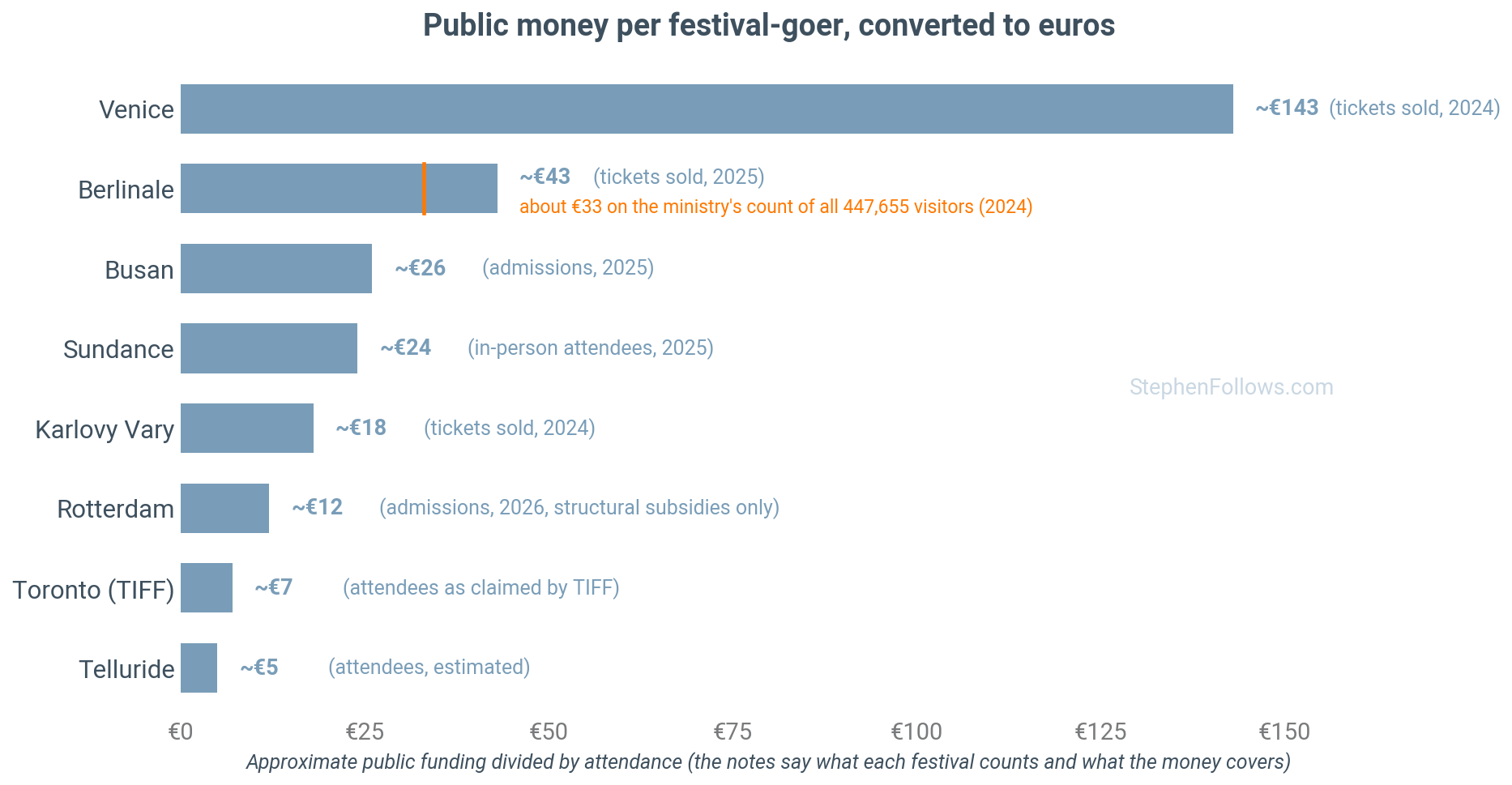
Germany pays about €43 per Berlinale ticket (340,000 sold in 2025). That federal money funds the whole Berlinale operation, including the European Film Market, not just the public screenings. And the finance ministry’s own report counts 447,655 visitors across all 1,913 Berlinale events in 2024, which would bring the figure down to about €33 a head.
At the other end, Telluride’s public subsidy works out around $6 per attendee, and Toronto’s roughly C$10 for each of its 700,000 attendees. Sundance, the supposed free-market case, actually gets about $26 of government money per in-person attendee, more than privately owned Karlovy Vary’s €18.
I should point out that the counting basis differs by festival (tickets sold, admissions, unique attendees; each bar says which, and the Notes give the detail), so treat this as a pattern rather than a like-for-like league table. Some of the funding figures also cover more than the public-facing festival, so a few bars will read higher than a strict per-cinema-goer measure would give.
How much do festival CEOs get paid?
One last set of nuggets before I finish up. While going through all these records, I picked up a lot of data points on CEO salaries.
I’ve done my best to normalise it and put it in US dollars. That said, each job is different: some only run the festival, while others also run the wider organisation or other events. Some also offer better benefits, such as generous pension provision, travel, etc.
The best paid are the heads of the three American non-profits.
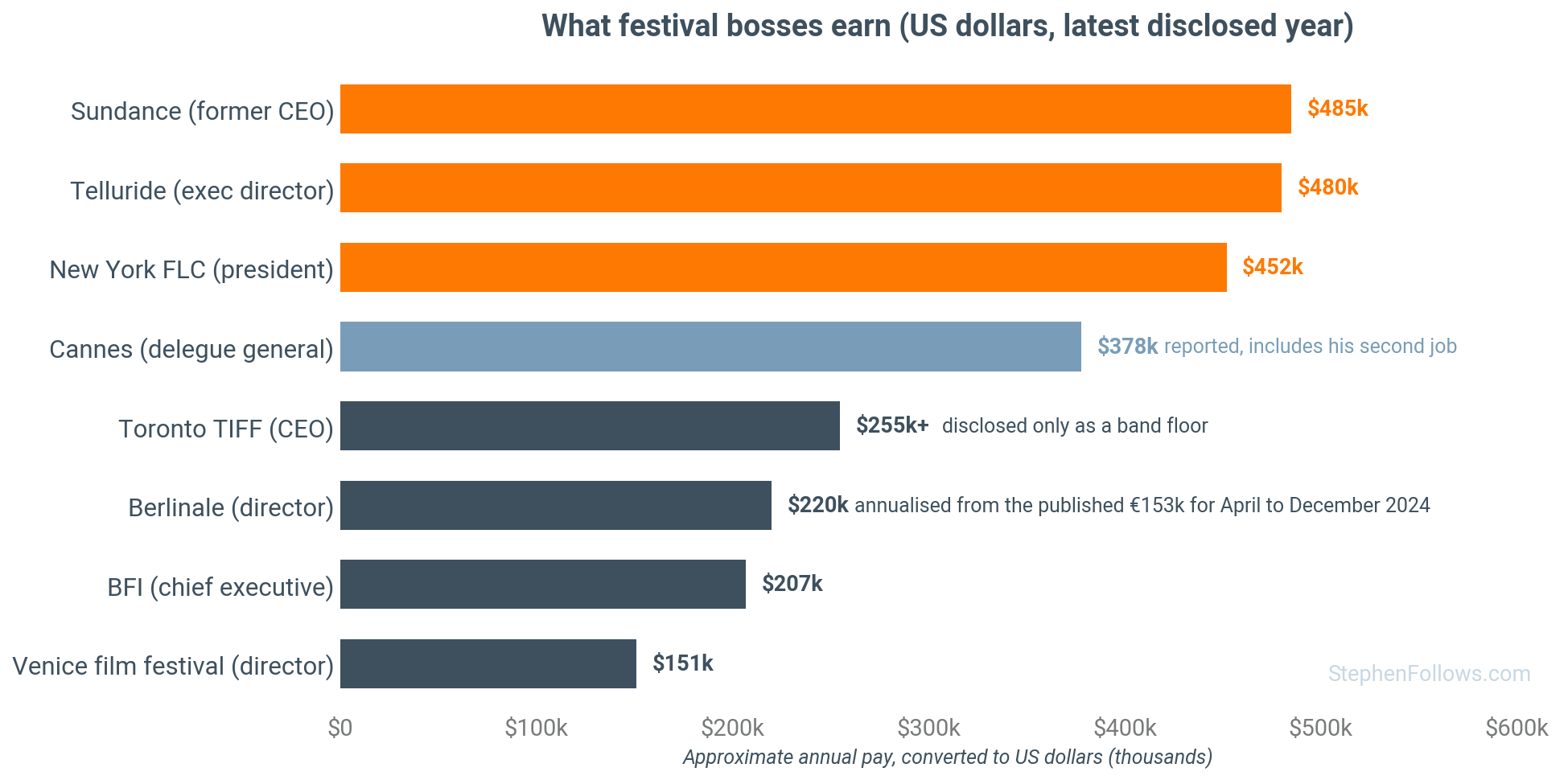
The three American charity bosses cluster at $450k to $485k. The state-festival bosses cluster at $150k to $260k. Alberto Barbera runs Venice, the world’s oldest festival, for €140,000 a year, about 30 cents on the dollar of what Telluride pays its executive director to run a festival a fraction of the size.
Tricia Tuttle’s pay was €153,000 for her first nine months in the job (April to December 2024), published individually in the German finance ministry’s annual shareholdings report. That works out at an annualised rate of about €204,000, which is my calculation rather than a published figure.
Ben Roberts runs the entire BFI (including the London Film Festival) for £163,000, per its annual report. That’s the salary - with pension benefits, his total package is £210,000 to £215,000, which is closer to how the American totals are reported.
Thierry Frémaux’s pay at Cannes has never been officially disclosed but Mediapart reported in June 2024 that it was €350,000, covering both of his jobs (Cannes and the Institut Lumière in Lyon).
It should be noted that due to the reporting requirements of US charities, we have the best figures for these three. The German and British public bodies publish their bosses' pay too.
Notes
I picked the 20 festivals based on industry weight (FIAPF A-list status, market size, press accreditation and premiere power) rather than just attendance alone. The list was Cannes, Berlinale, Venice, Toronto, Sundance, BFI London, Busan, Rotterdam, Locarno, San Sebastián, Karlovy Vary, Tokyo, Tribeca, SXSW, Telluride, New York, Hong Kong, Shanghai, Sydney and Mar del Plata. Attendance-based rankings would produce a different list.
Ownership and governance facts come from primary records wherever possible, including from the German Handelsregister and the federal Beteiligungsbericht for the Berlinale; the Czech obchodní rejstřík for Karlovy Vary; UK Companies House for SXSW London; IRS Form 990 filings (via ProPublica Nonprofit Explorer) for Sundance, Telluride and Film at Lincoln Center; TIFF’s audited FY2024 statements and CRA filings; the BFI’s 2024/25 annual report; La Biennale’s transparency pages and accounts; San Sebastián’s transparency portal; Busan’s audited 2025 settlement as reported by Nocut News and Yonhap; and the Colorado and Utah legislatures’ own bill texts.
The Cannes financial picture comes from the Cour des comptes’ audit of the CNC, the Chambre régionale des comptes’ audit of the city of Cannes, the city’s published subsidy register, and SOGOFIF’s company filings; the €35m budget and 50/50 claim are the festival’s own statements to franceinfo and Le Figaro.
Public-money percentages are not perfectly comparable. Venice’s 57% covers the whole Biennale (which also runs the art and architecture exhibitions), Busan’s 54% is the festival proper per its 2025 settlement, Rotterdam’s and Locarno’s cover the festival organisations, the Berlinale’s ~40% is the festival itself, Karlovy Vary’s ~30% is the company’s own stated share of its 2025 budget, Toronto’s 15% is the whole charity, and the US figures are the government-grants line of each charity’s operations. Cannes’s 26% is a documented floor, not a measured share as it’s the sum of every public subsidy traceable to a primary document, set against the festival’s own stated budget. The festival says the true figure is 50%.
The per-festival-goer chart divides each festival’s public funding by its attendance, but festivals count different things: tickets sold (Venice 94,703 in 2024; Berlinale 340,000 in 2025 (the German finance ministry’s report counts 447,655 visitors across all 1,913 Berlinale events in 2024, a broader measure that includes the industry side); Karlovy Vary 127,325 in 2024), admissions (Busan 175,889 cinema admissions in 2025; Rotterdam ~286,000 visits in 2026), unique in-person attendees (Sundance 85,472 in 2025, per its own attendance report; Telluride ~5,000, estimated), or a loose “attendees annually” claim (Toronto’s 700,000). Rotterdam’s figure uses structural subsidies only, so it understates. Currency conversions are approximate. Treat the chart as a pattern, not a precision ranking. The same goes for the pay chart, which mixes audited disclosures, a Canadian band floor and one press-reported figure across different years and pension treatments.
I updated this article after publication on 27 September 2026. I had presented an annualised figure for Tricia Tuttle's pay as if it were the published number. The published figure is €153,000, covering her first nine months in the job. I also tightened some ambiguous language around how I described government ownership and control, and added more detail to the per-festival-goer calculations
Wow, this is very comprehensive. Thank you. One thing that would be interesting to correlate is how much income is generated in the local economy for each of these Film Festival’s. I do believe that’s been previously stated as the strong proof point that public money has a good ROI. Love to see you pull those numbers into this report.
This is cool information! Wish I’d have thought of it!